May 2026
By: Bryan Reynolds | 29 May, 2026

This article diagnoses the SIS modernization crisis in K-12 and higher education and proposes an incremental, event-driven sidecar middleware pattern—using CDC, OneRoster, Ed-Fi, and LTI Advantage—to decouple legacy SIS platforms from LMS and AI tools, reduce SaaS concentration risk exposed by the May 2026 Canvas ransomware outage, and ensure operational continuity, scalability, and regulatory compliance.
Read MoreBy: Bryan Reynolds | 28 May, 2026

The article argues that marketing leaders must stop relying on vendor-built AI personalization and instead treat custom AI as core software: build bespoke personalization grounded in proprietary first-party data to secure differentiation, lower marginal query costs at scale, and meet evolving 2026–2027 regulatory requirements.
Read MoreBy: Bryan Reynolds | 23 May, 2026
The article analyzes how Big Tech’s projected $725 billion in AI capital expenditure for 2026—paired with massive engineering layoffs—reshapes the build-vs-buy decision for mid-market technology leaders, arguing for a portability-first, hybrid strategy that switches between self-hosted models and commodity APIs based on regulatory, latency, IP, and volume thresholds.
Read MoreBy: Bryan Reynolds | 22 May, 2026

The article analyzes the May 2026 Canvas ransomware outage to demonstrate how SaaS dependencies create concentrated operational risk and prescribes a practical program—dependency mapping, exportable state pipelines, graceful degradation patterns, vendor incident playbooks, and chaos engineering—to ensure business continuity when third-party services fail.
Read MoreBy: Bryan Reynolds | 20 May, 2026

The Reflex May 2026 benchmark shows vision-based (computer-use) AI agents consume roughly 45× more input tokens, take minutes rather than seconds, and incur higher latency, non-deterministic failures, and maintenance costs compared with API-first agents, so enterprises should prefer structured API or MCP integrations except when no programmatic alternative exists.
Read MoreBy: Bryan Reynolds | 18 May, 2026

This article decodes the Five Eyes' May 1, 2026 warning and translates it into concrete engineering controls—scoped permissions, circuit breakers, deterministic kill switches, semantic observability, and human-in-the-loop checkpoints—plus a phased rollout and procurement checklist to safely deploy agentic AI in enterprises.
Read MoreBy: Bryan Reynolds | 15 May, 2026

In May 2026 researchers found roughly 380,000 publicly accessible applications built on prompt-to-app “vibe-coding” platforms, with at least 5,000 actively leaking sensitive corporate and personal data; combined security audits show ~91.5% of sampled generated apps contain critical vulnerabilities tied to AI hallucinations and missing security context, demonstrating that custom development buys essential architectural controls, threat modeling, and secret management that dramatically reduce breach risk and financial exposure.
Read MoreBy: Bryan Reynolds | 13 May, 2026
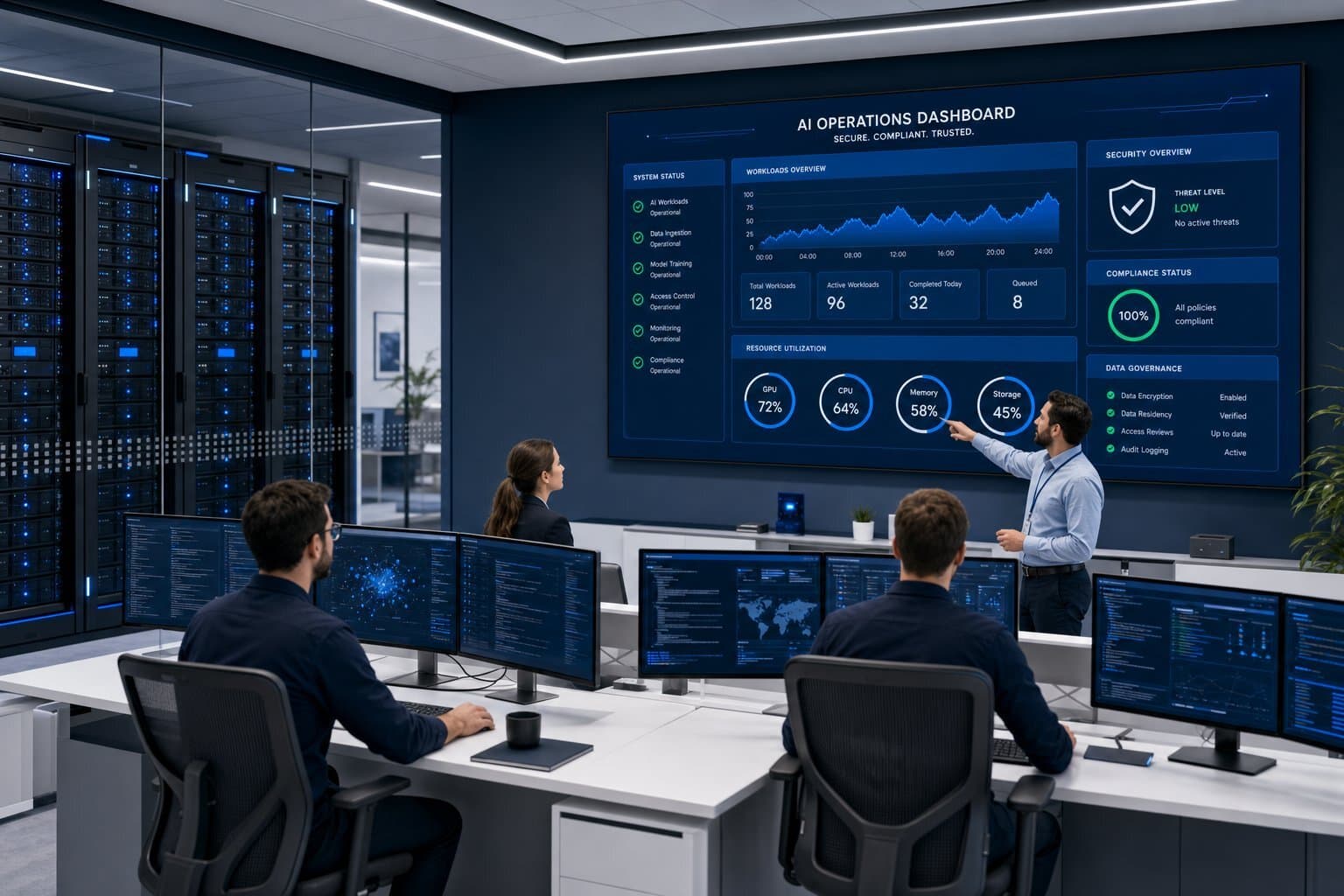
This article argues that regulated enterprises should use self-hosted AI developer agents (exemplified by Coder Agents) to keep source code and sensitive data inside the corporate perimeter, meet FedRAMP/HIPAA/PCI-DSS/EU-AI-Act obligations, and integrate agentic workflows into secure CI/CD pipelines, while also candidly accounting for the substantial GPU, MLOps, and operational costs required to run local LLM infrastructure.
Read MoreBy: Bryan Reynolds | 11 May, 2026

This report analyzes how top engineering teams deploy and secure autonomous AI agent swarms (e.g., Stripe’s “Minions”) inside GitHub Enterprise without overwhelming CI/CD, covering architecture, orchestration, security guardrails, cost/ROI, metrics, and practical next steps.
Read MoreBy: Bryan Reynolds | 08 May, 2026

The article argues that robust data governance must be treated as core infrastructure for safe, scalable AI; replacing unmanaged data lakes and raw ERPs with knowledge graphs and GraphRAG pipelines, combined with active runtime governance, prevents AI hallucinations and unlocks measurable ROI for agentic enterprise workflows.
Read MoreBy: Bryan Reynolds | 06 May, 2026

This article argues that fully autonomous AI agents are not ready to replace human architects in complex enterprise software development; instead, an architect-led approach — combining human judgment, strict data modeling, deterministic infrastructure, and governance — is required to avoid generated technical debt, secure migrations, and maximize long-term ROI.
Read MoreBy: Bryan Reynolds | 04 May, 2026

This report explains why enterprises are shifting from generic public AI assistants to privately hosted internal AI app stores of specialized agents, detailing an IDEAL five-layer architecture, the technical advantages of .NET 10 and C# 14, security models like MCP, ReBAC and Non‑Human Identities, and the financial and operational ROI that favors bespoke engineering for mission-critical workflows.
Read MoreBy: Bryan Reynolds | 01 May, 2026

This article argues that the 2026 "SaaSocalypse"—which erased roughly $1 trillion in SaaS market value—exposed the fatal flaws of per-seat pricing as AI-driven agentic automation compresses seat counts, forcing vendors toward consumption- and outcome-based billing and prompting enterprises to rebuild internal custom platforms to protect margins and data sovereignty.
Read More