Forced Migrations: Don't Let Vendors Break Your Workflows
August 04, 2026 / Bryan Reynolds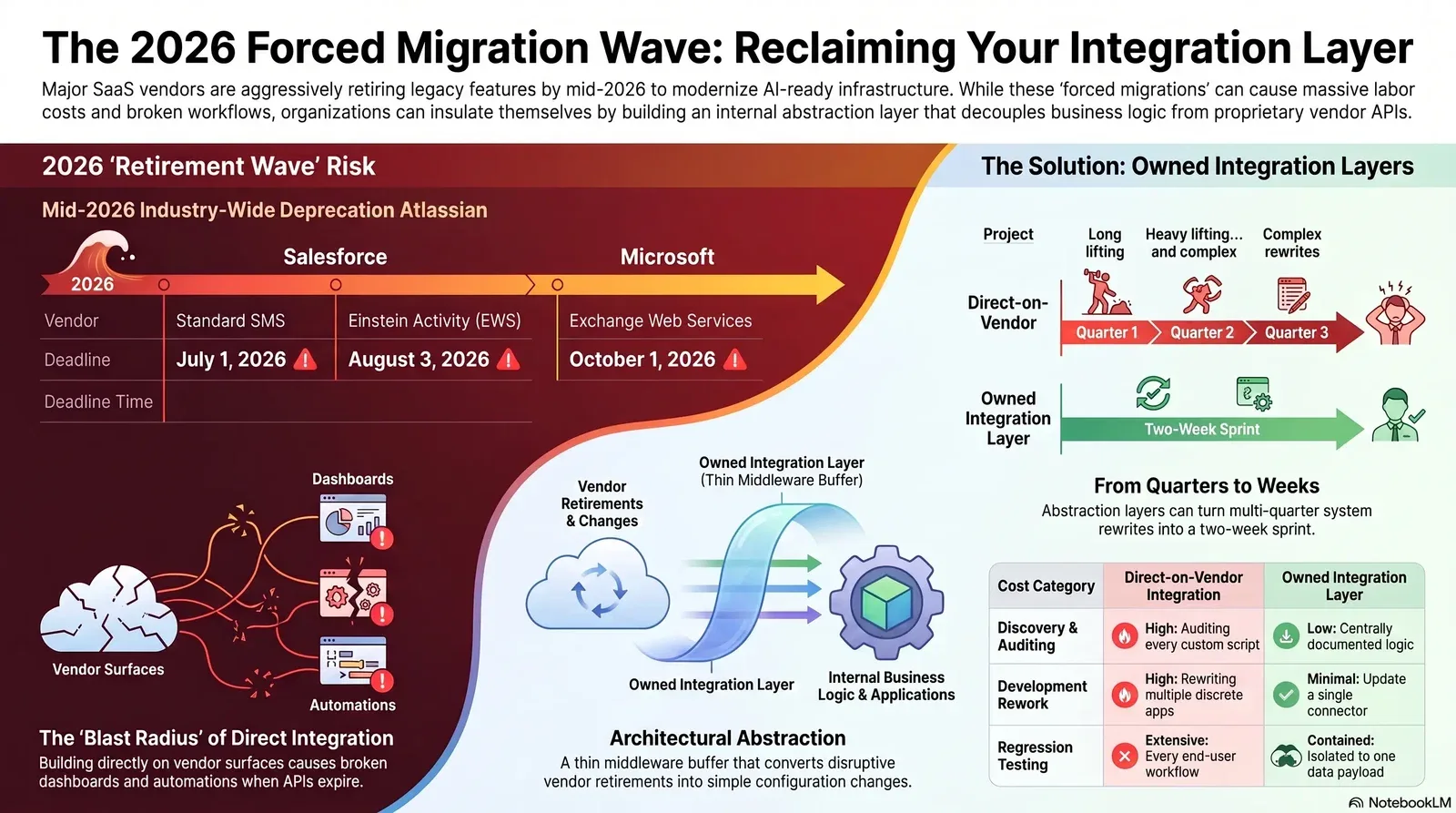
On July 1, 2026, Salesforce officially switched off its standard SMS channel, forcing organizations to adopt its new Enhanced Service Channels. By August 2026, teams relying on Einstein Activity Capture must complete a migration to Microsoft Graph that no internal stakeholder requested, simply to keep their email and calendar data flowing. Neither of these architectural changes originated on any customer's strategic roadmap, yet every affected enterprise is absorbing the labor, testing overhead, and operational risk required to execute the transition.
The standard industry advice treats a vendor feature retirement migration as an unavoidable weather event: read the release notes, stay current, and dutifully follow the provider's upgrade path. However, this reactionary posture masks a critical vulnerability. Exposure to forced migrations is fundamentally a design choice. Companies that route automations, telephony, activity capture, and messaging directly through a vendor's proprietary integration surface inherit an unknown expiration date. Organizations that establish integration layer ownership—routing these functions through a thin, internal abstraction layer—convert a disruptive vendor retirement into a contained configuration change. The architectural imperative is not to abandon the underlying enterprise platform, but to cease building load-bearing workflows directly on retirable vendor surfaces. A pragmatic way to get there is to follow a phased legacy modernization roadmap instead of relying on one-off, reactive migrations.
The Mid-2026 Feature Retirement Wave
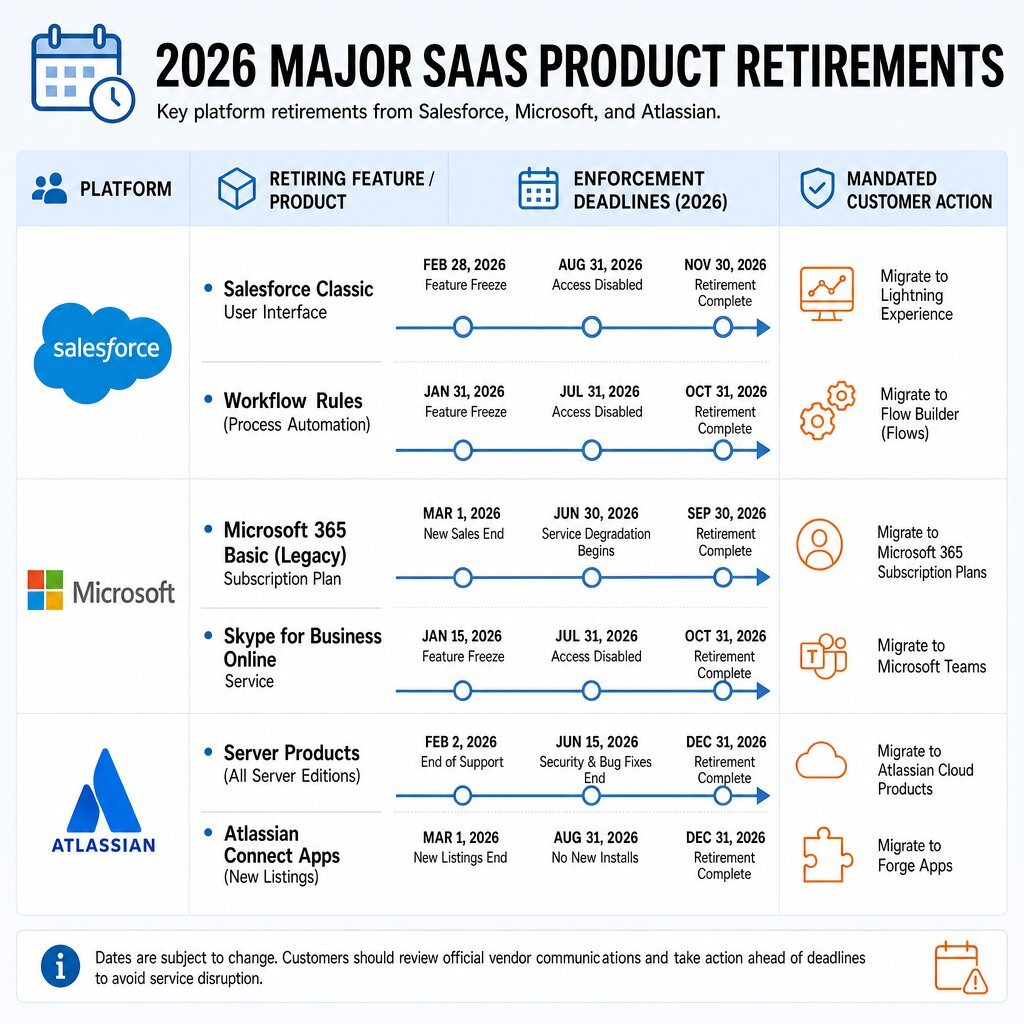
Vendor feature retirements are accelerating at an unprecedented pace. The mid-2026 wave across major Software-as-a-Service (SaaS) providers demonstrates a clear, industry-wide pattern of platforms forcefully deprecating legacy capabilities to modernize their backend infrastructure.
Salesforce and Microsoft currently present the most immediate and disruptive timelines. Microsoft has scheduled the total deprecation of Exchange Web Services (EWS) in Exchange Online, with phased disablement beginning October 1, 2026, and permanent retirement enforced by April 1, 2027. Because the Einstein Activity Capture Microsoft Graph migration is a strict prerequisite for continued synchronization, Salesforce set a compliance deadline of August 3, 2026. If organizations fail to upgrade their authentication protocols by this date, automatic data capture stops completely. Sales teams are subsequently forced into manual data entry, which immediately degrades CRM data completeness and breaks downstream pipeline visibility.
Concurrently, the Salesforce feature retirement 2026 roadmap extends deep into customer service operations. The Salesforce Open CTI framework has entered maintenance mode and will reach complete End of Life on February 28, 2028. Effective immediately, no new Agentforce Service organizations can implement Open CTI, forcing contact centers to migrate to the proprietary Salesforce Voice product on Salesforce’s terms and timeline.
Atlassian is enforcing a similarly aggressive transition for its on-premises and hosted user base. The company will block new Data Center license purchases on March 30, 2026, halt license expansions for existing customers by March 30, 2028, and execute a total End of Life on March 28, 2029. Following the 2029 deadline, all Data Center environments and associated Marketplace applications become entirely read-only, forcing a massive migration to Atlassian Cloud.
| Enterprise Platform | Retiring Feature or Product | Enforcement Deadlines | Required Customer Action |
|---|---|---|---|
| Salesforce | Standard SMS & Facebook Messenger | July 1, 2026 (SMS) / Feb 14, 2026 (Live Agent) | Migrate to Enhanced Service Channels. |
| Salesforce | Einstein Activity Capture (EWS) | August 3, 2026 (Cutover) / Oct 1, 2026 (EWS Block) | Execute Microsoft Graph API upgrade. |
| Salesforce | Open CTI Telephony Framework | Immediate (New Orgs) / Feb 28, 2028 (End of Life) | Transition telephony systems to Salesforce Voice. |
| Atlassian | Data Center & Marketplace Apps | March 30, 2026 (New Sales End) / March 2029 (EOL) | Replatform to Atlassian Cloud architecture. |
Platform Consolidation Around AI-Era Architectures
The current density of these migration events is structural, not incidental. Enterprise platforms are rapidly consolidating around AI-era architectures, making legacy integration pathways financially and technically unviable for vendors to maintain.
The Salesforce retirement of Open CTI perfectly illustrates this architectural shift. Open CTI relies on browser-based JavaScript APIs that sit outside the platform's core, real-time data model. In stark contrast, its mandated replacement, Salesforce Voice, integrates natively with Omni-Channel routing, facilitating real-time call transcription, Data Cloud ingestion, and Agentforce AI capabilities. Legacy web frameworks simply cannot feed the high-velocity, structured data streams required by modern generative AI agents, especially as enterprises push toward integrating AI into every customer touchpoint.
Similarly, the Microsoft ecosystem is deprecating EWS because the older protocol relies on an all-or-nothing service account access model that poses significant security risks. Microsoft Graph replaces it by providing a unified REST architecture with highly granular, OAuth 2.0-backed security scopes. As enterprise platforms pivot toward secure, highly integrated data models, supporting disparate, older integration pathways becomes an unacceptable burden for the vendor. Consequently, the vendor retires the feature, modernizes their stack, and transfers the massive labor cost of that modernization directly to the customer base. Without strong AI-era identity and access controls, including those required for AI compliance and enforcement, organizations face both operational and regulatory risk.
The Hidden Labor Costs of In-Place Migrations
The true cost of a forced migration extends far beyond simply flipping a configuration toggle in a settings menu. When a vendor fundamentally shifts its data model, the blast radius impacts reporting, automation, and organizational training.
During the Einstein Activity Capture upgrade, historical synchronization behaviors change at a structural level. Legacy tools like Lightning Sync wrote calendar meetings as physical, queryable Event records directly in the Salesforce database. The updated capture mechanisms store email and event data on entirely separate cloud infrastructure, merely rendering the data visually on the record timeline. This underlying architectural change instantly breaks existing dashboards, automated territory scoring models, and record-triggered automations that previously listened for the creation of new Event records.
Mid-market engineering and revenue operations teams ultimately absorb substantial labor costs during these transitions. The enterprise technical debt accumulated through years of bespoke configurations must be resolved through rigorous discovery phases, extensive workflow rewrites, regression testing, and organizational change management. When forced migrations occur, the customer pays for the architectural overhaul, regardless of whether the new functionality provides any tangible business value to their specific operational model.
| Migration Cost Category | Direct-on-Vendor Integration | Owned Integration Layer (Middleware) |
|---|---|---|
| Discovery & Auditing | High: Requires tracking down every custom script, Flow, and dashboard tied to the deprecated API. | Low: Dependencies are centrally documented within the middleware routing logic. |
| Development Rework | High: Demands rewriting multiple discrete applications and automations to match the vendor's new schema. | Minimal: Requires updating a single middleware connector; downstream logic remains entirely untouched. |
| Regression Testing | Extensive: Every end-user workflow touching the integration must be validated in a sandbox environment. | Contained: Testing is isolated to the single data payload passed between the vendor and the abstraction layer. |
Architecting the Owned Integration Layer
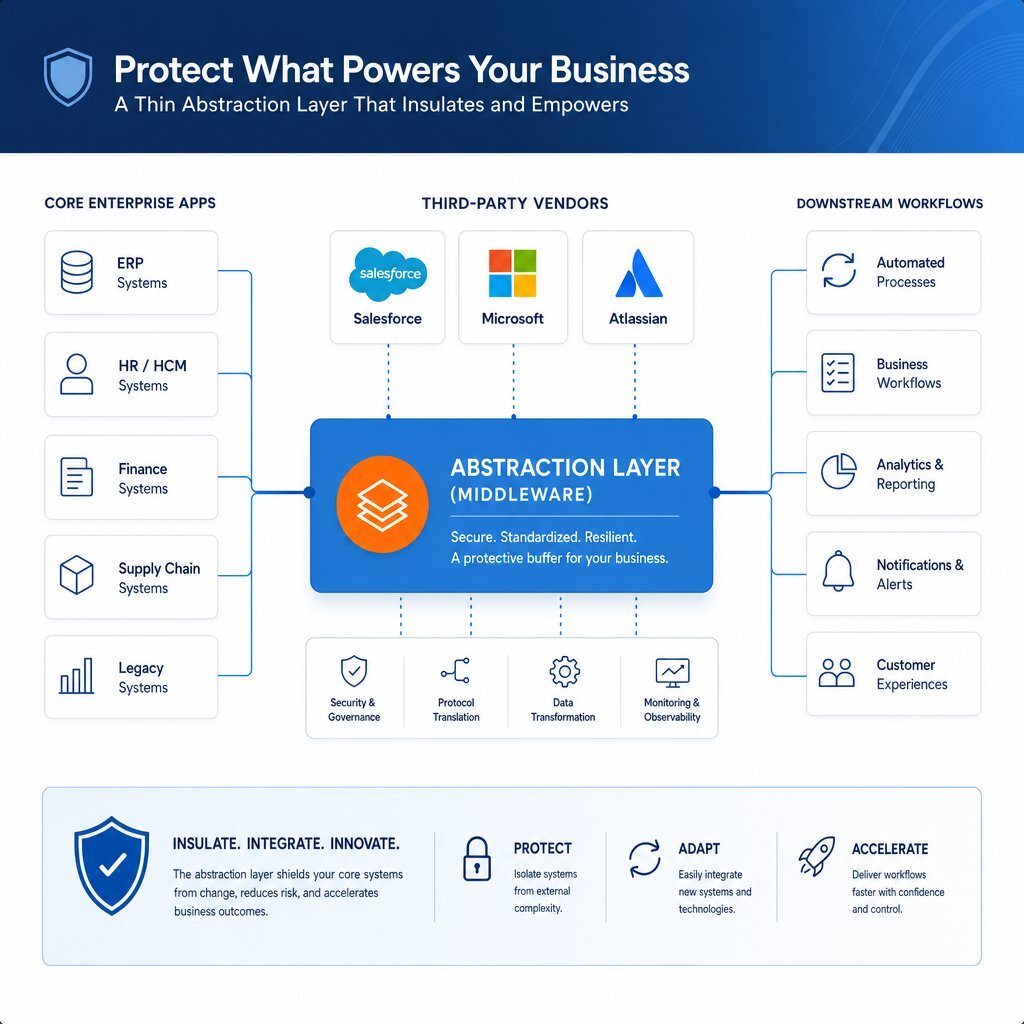
To insulate business operations from unpredictable vendor roadmaps, technology executives must adopt the principle of integration layer ownership. Instead of hardcoding critical workflows directly against a SaaS vendor's proprietary APIs, engineering teams build an owned abstraction layer utilizing middleware services, standard RESTful APIs, and event-driven contracts.
An owned integration layer functions as a highly resilient protective buffer. For example, instead of connecting a third-party telephony provider directly into the Salesforce UI via Open CTI, the telephony system communicates with an internal middleware service. The middleware then interfaces with Salesforce via standardized, generic APIs. When Salesforce inevitably deprecates Open CTI in 2028, the core telephony business logic remains entirely untouched. The engineering team only needs to update the single middleware connector to point toward the new Salesforce Voice endpoint, converting a multi-quarter rewrite into a two-week sprint.
Developing these modern architectures requires specialized engineering practices. Solutions like Baytech Consulting's Tailored Tech Advantage provide custom-crafted architectures built on resilient, highly available infrastructure. Utilizing a modern technology stack—including .NET, Docker, and Kubernetes with PostgreSQL—development teams can deploy lightweight, containerized sidecar services that handle all external SaaS communication. Through Agile methodology and rapid, iterative deployment, these middleware components are implemented transparently, allowing the organization to establish total control over its data routing without disrupting daily operations. This same sidecar pattern echoes how community hospitals modernize around legacy systems in approaches like EHR sidecars, proving the model scales across industries.
Auditing Forced-Migration Exposure
Organizations cannot protect systems they have not accurately mapped. Technology leaders must proactively audit their environment before the next vendor deprecation notice arrives. An effective integration audit targets structural dependencies to determine exact exposure levels and potential blast radiuses.
To accurately score the risk of a potential feature retirement, enterprise architects evaluate specific inventory criteria. Integrations relying on legacy authentication protocols, such as Exchange Web Services, pose an immediate critical risk due to impending global disablement. Furthermore, architects must identify custom applications or scripts that communicate directly with a SaaS platform's proprietary endpoints rather than passing through an internal API gateway.
Data model dependencies also reveal hidden exposure. Reports, dashboards, or automation flows that depend on the exact database schema maintained by the vendor—such as legacy Salesforce Event records versus external activity capture—will inevitably break during a forced migration. Finally, workflow criticality dictates the urgency of abstraction. If a vendor severs an integration pathway without warning, architects must know whether the failure merely inconveniences internal staff or completely halts revenue generation, customer support, and core operational delivery. Treat this audit as a kind of data readiness scorecard for integrations, not just for analytics and AI projects.
Assigning a risk score based on these precise variables provides a clear, quantitative inventory of workflows requiring immediate abstraction versus those that can safely tolerate a vendor's standard in-place migration path.
Accept vs. Abstract: The Break-Even Decision
The decision to build an abstraction layer versus accepting the vendor's mandated upgrade path hinges on strict break-even logic. Building and maintaining custom middleware incurs distinct hosting and operational costs. However, teams subjected to their second or third forced migration on a single enterprise platform are already paying the equivalent financial cost of an abstraction layer through constant development rework.
| Operational Profile | Exposure Level & Blast Radius | Strategic Recommendation | Financial Justification |
|---|---|---|---|
| Isolated Capabilities | Few workflows affected; low impact on core revenue generation or data integrity. | Migrate in Place | The operational cost of building and hosting middleware vastly exceeds the cost of a simple, one-off vendor configuration change. |
| Core Business Operations | Multiple critical integrations (telephony, ERP, billing) tied directly to the vendor's UI/API. | Build Abstraction Layer | Integration layer ownership prevents compounding technical debt, contains future modernization costs, and protects revenue flow. |
| End-of-Life Systems | Core application requires entirely rewritten infrastructure (e.g., Atlassian Data Center EOL). | Replatform via Sidecars | Utilizing containerized sidecars allows the organization to gradually move logic off the dying platform prior to full migration, minimizing risk. |
If a CRM instance contains a single, non-critical SMS routing rule, migrating in place to the vendor's new enhanced messaging channel is the pragmatic, cost-effective choice. Conversely, if an organization runs complex, multi-stage routing across proprietary telephony, billing, and marketing surfaces, inserting an owned middleware layer becomes an essential, mathematically sound risk-mitigation strategy. Retirement notices are valuable negotiation and decision windows; they present the optimal moment to re-evaluate whether a specific workflow belongs on the vendor's platform at all, or whether it should move into a modern architecture that avoids compounding AI-driven technical debt as systems evolve.
Contract Clauses That Limit Future Damage
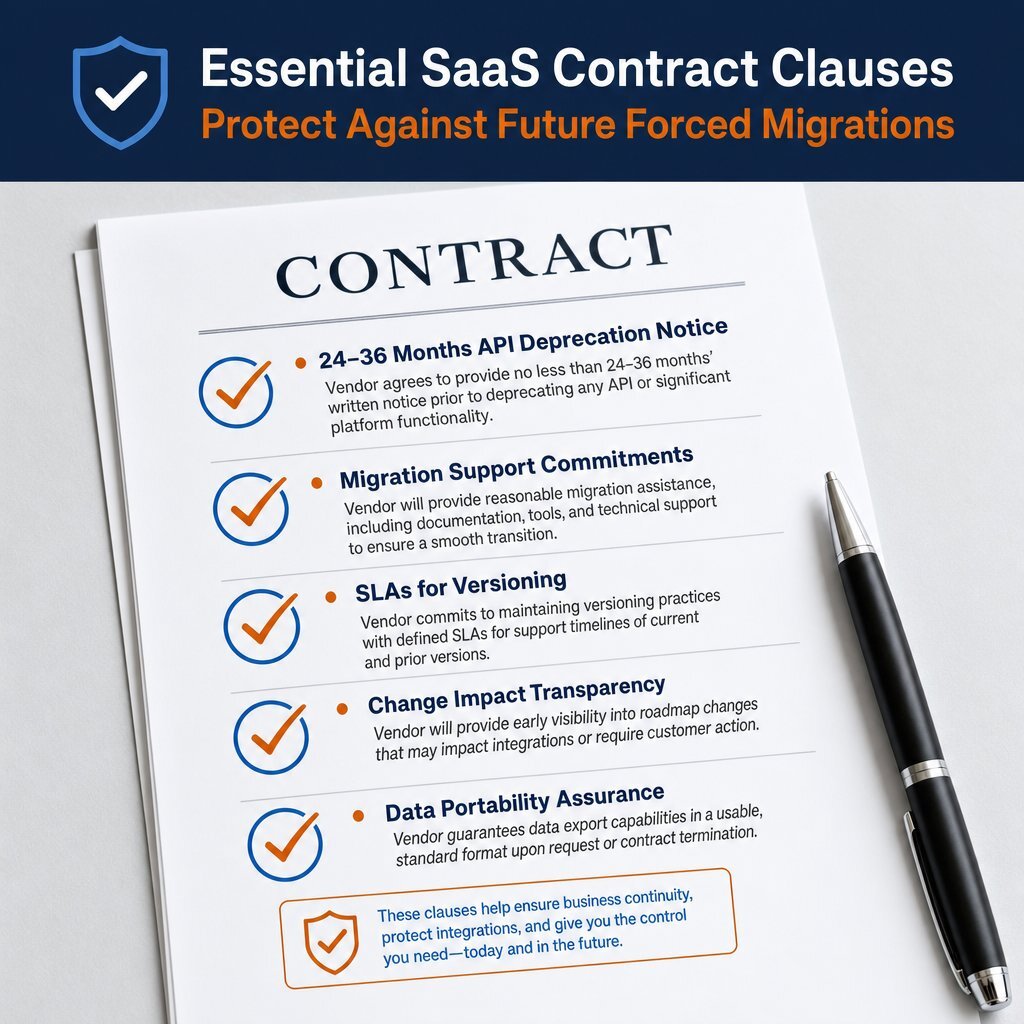
While architectural abstraction provides robust technical defense against forced migrations, intelligent procurement strategies provide necessary commercial defense. Enterprise leaders must utilize SaaS renewal negotiations to legally constrain the chaos and financial drain of feature retirements.
A standard vendor contract heavily favors the platform's ability to alter, degrade, or deprecate services at will. To establish a baseline of operational protection, Chief Technology Officers must enforce strict, customized service-level agreements regarding API versioning and deprecation notice periods. Strong commercial agreements dictate that the vendor must provide a minimum of 24 to 36 months of advanced, written notice prior to deprecating any public API or integration surface, and should align with engagement models that prevent scope creep from silently consuming your team’s time—much like the dynamics explored in scope creep contract strategies.
Furthermore, technology leaders should mandate that the vendor provides extensive migration support commitments within the master services agreement. This includes guaranteeing full parity documentation, dedicated engineering support hours, and access to parallel testing environments at no additional cost during the transition period.
Enterprise SaaS platforms continuously evolve, and the aggressive retirement of legacy features is a permanent fixture of the modern technology landscape. The mid-2026 retirement wave across Salesforce, Microsoft, and Atlassian unequivocally proves that relying entirely on a vendor's proprietary integration roadmap is a fragile, expensive strategy. By auditing system exposure, negotiating protective contract clauses, and deliberately architecting an owned integration layer, enterprises transform highly disruptive, mandatory rebuilds into routine maintenance tasks. Organizations seeking to reclaim their architectural autonomy can leverage development partners to build resilient, enterprise-grade abstraction layers that ensure critical data workflows remain firmly under internal control, regardless of what the vendor decides to retire next. When done well—with strong UX design and change management support from teams skilled in UX design—end users experience a smoother transition even as the underlying integrations are completely reworked.
Frequently Asked Questions
What happens to Einstein Activity Capture if the Microsoft Graph migration is not completed by August 2026?
If the authentication upgrade is not completed prior to the deadline, the connection between the CRM and Microsoft Office 365 will fail entirely. Einstein Activity Capture will cease syncing emails, calendar events, and contacts, forcing personnel to log all activities manually and severely compromising data accuracy. For sales organizations that already struggle with adoption, this kind of manual logging gap can quietly erode pipeline visibility and revenue in the same way weak intake processes drain law firms, as described in revenue leak and intake audits.
Supporting Resources
About Baytech
At Baytech Consulting, we specialize in guiding businesses through this process, helping you build scalable, efficient, and high-performing software that evolves with your needs. Our MVP first approach helps our clients minimize upfront costs and maximize ROI. Ready to take the next step in your software development journey? Contact us today to learn how we can help you achieve your goals with a phased development approach.
About the Author

Bryan Reynolds is an accomplished technology executive with more than 25 years of experience leading innovation in the software industry. As the CEO and founder of Baytech Consulting, he has built a reputation for delivering custom software solutions that help businesses streamline operations, enhance customer experiences, and drive growth.
Bryan’s expertise spans custom software development, cloud infrastructure, artificial intelligence, and strategic business consulting, making him a trusted advisor and thought leader across a wide range of industries.