In this article
- Beyond Lift-and-Shift: A Phased Legacy Modernization Roadmap for Mid-Market Operations
- The Dual Traps of Legacy Systems: Big-Bang Rewrites and Indefinite Deferral
- Lift-and-Shift Cloud Migration Versus Genuine Architectural Modernization
- The Incremental Toolkit: Patterns for Zero-Downtime Evolution
- Prioritizing the Modernization Backlog: Business Risk and Value Mapping
- A Phased Legacy Modernization Roadmap for Mid-Market Enterprises
- Keeping the Lights On: Strategies for Zero-Downtime Migration
- Measuring Value Per Phase: Proving Progress to Stakeholders
- Conclusion: The Pragmatic Middle Path
- Frequently Asked Questions
- Supporting Resources
- About Baytech
- About the Author
Beyond Lift-and-Shift: A Phased Legacy Modernization Roadmap for Mid-Market Operations
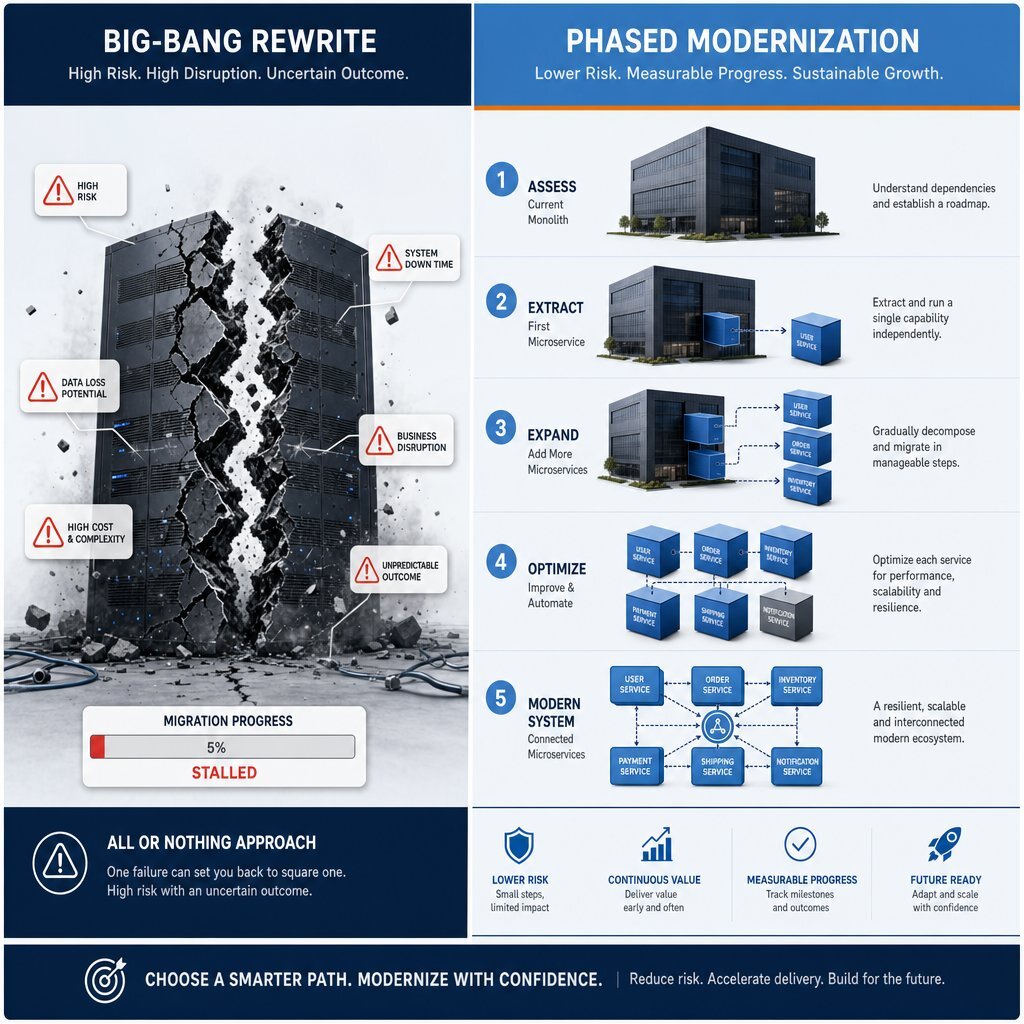
The big-bang software rewrite is the most reliable way for a mid-market enterprise to spend two years and a fortune, only to arrive exactly back where the project started. Across industries, technical leadership frequently faces a daunting realization: the core systems running the business have become too brittle to modify, too expensive to maintain, and too critical to turn off. The typical response from executive boards oscillates between two equally destructive extremes. The first is the multi-year, wholesale system rewrite—a high-risk gamble that historically collapses under its own weight. The second is indefinite deferral, where organizations choose to endure escalating technical debt until a catastrophic failure forces their hand.
There is a less heroic, far more effective path. Phased legacy modernization offers an incremental approach that systematically reduces operational risk, ensures continuous business uptime, and delivers measurable value at every step. By decomposing aging monoliths, prioritizing modernization targets based on exact business value, and replacing architecture in strategic slices, organizations can escape the legacy trap without halting their operations. For operations leaders and technology executives, this roadmap is not a theoretical exercise in cloud architecture; it is a defensive strategy designed to protect revenue streams while aggressively positioning the business for future scalability.
The Dual Traps of Legacy Systems: Big-Bang Rewrites and Indefinite Deferral
Mid-market operations leaders operate under unique, unforgiving constraints. Unlike massive enterprise giants, they lack the capital and shareholder patience to fund endless research and development cycles. Unlike early-stage startups, they possess years of critical customer data, complex integrations, and established workflows that cannot be paused for a system overhaul. Consequently, when legacy software begins to stifle business agility, the chosen modernization strategy determines whether the company accelerates its market share or stalls completely. The two most common strategies—the big-bang rewrite and doing nothing—are both guaranteed to fail.
The Anatomy of the Big-Bang Failure
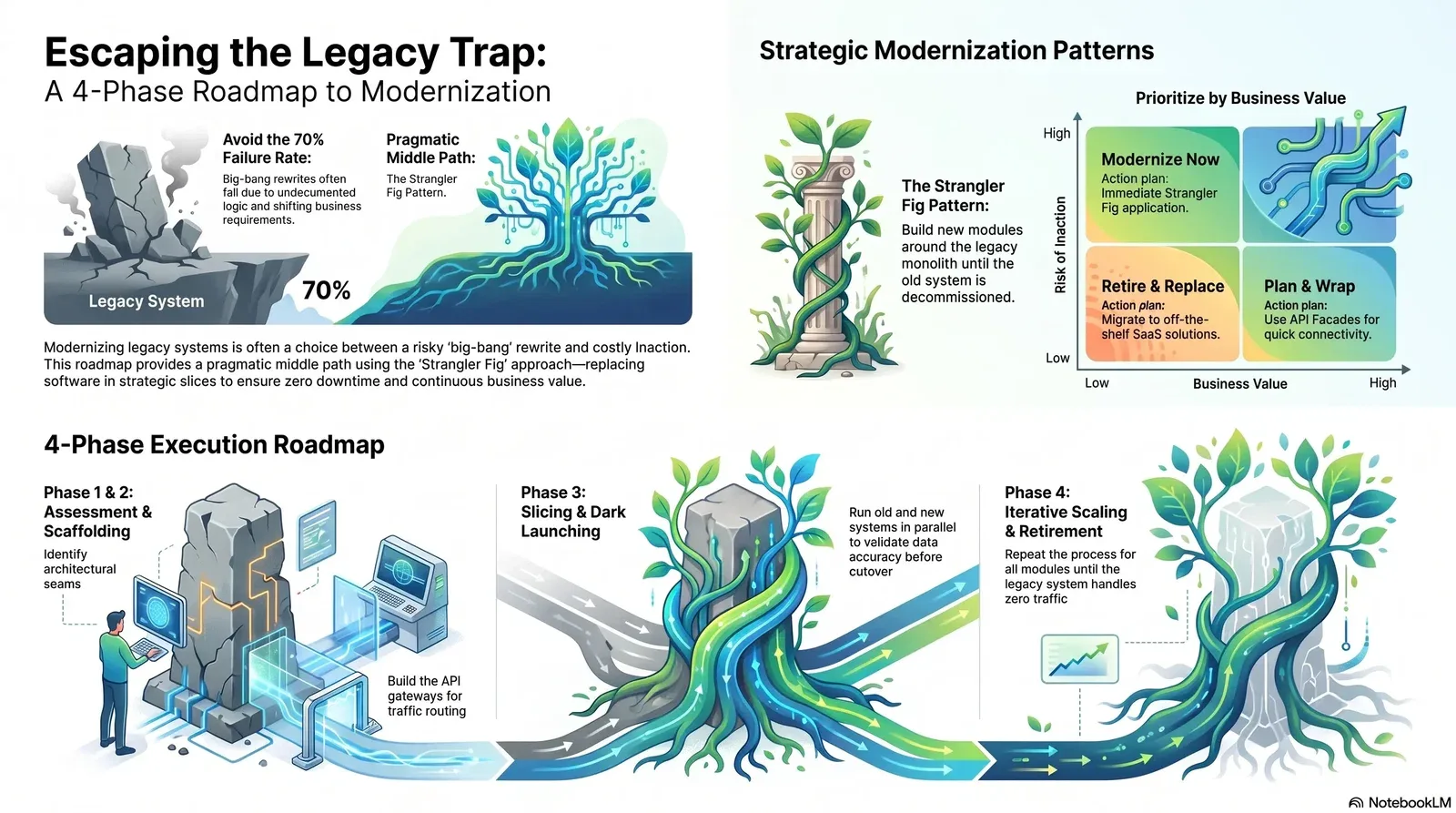
The traditional approach to modernization involves building a completely new system in parallel with the old one, culminating in a single, high-stakes "cutover" date. This methodology consistently fails. Gartner reports that over 70% of enterprise modernization programs fail or significantly exceed their budgets by 30% or more. Similarly, the Standish Group's historical CHAOS report database shows that a staggering 69% of IT projects are either challenged or fail outright.
Big-bang rewrites collapse due to structural, rather than purely technical, flaws. Legacy systems rarely possess accurate, up-to-date documentation. The original developers have usually long since departed, leaving behind a "black box" of code where modifications are dangerous and tribal knowledge is lost. Attempting to replicate decades of undocumented business logic, hard-coded rules, and edge-case patches results in severe feature parity gaps.
Furthermore, because the business environment continues to evolve during the multi-year rewrite, the new system is often obsolete by the time it finally launches. The engineering team is effectively forced to hit a moving target while blindfolded. Stakeholders grow impatient as quarters pass without any visible return on investment. The project is eventually rushed to meet an artificial deadline, resulting in a flawed cutover that disrupts operations, alienates users, and permanently damages the credibility of the IT department.
The Hidden Costs of Indefinite Deferral
Faced with the terrifying statistics of rewrite failures, many executives choose the perceived safety of the status quo. This "do-nothing drift" is equally perilous. Software gradually decays during its extended maintenance phase, transitioning from a business enabler to a strategic liability. The financial penalty for inaction is severe and compounds annually.
The average direct cost of operating and maintaining a single monolithic legacy system can reach $30 million annually, with IT teams spending up to 25 hours a week simply managing patches and fighting operational fires. In the financial sector alone, institutions that fail to modernize risk losing an estimated $57 billion by 2028 due to missed revenue opportunities and operational inefficiencies. Systems built on legacy technologies possess a below-average architecture rating that is three times higher than systems using modern tech, resulting in updates being delivered 40% slower.
Beyond direct maintenance costs, legacy systems inflict a heavy "innovation tax." Stagnant infrastructure blocks integration with modern APIs, advanced analytics, and automated workflows. The reliance on obsolete programming languages restricts the available talent pool. Modern engineering talent avoids organizations running outdated technology stacks, leading to severe recruiting challenges and a heavy reliance on expensive, specialized contractors. This creates a state of "human debt" alongside technical debt, where the organization becomes entirely dependent on a shrinking pool of legacy experts.
Additionally, the security posture of legacy systems is fundamentally compromised. Because vendor support for legacy products eventually ceases, these systems harbor unpatched vulnerabilities. They lack support for modern security frameworks like Zero Trust, expanding the attack surface and forcing organizations to rely on brittle workarounds. Maintaining these systems ultimately stifles business growth, opens critical security vulnerabilities, and exposes the organization to crippling compliance risks. The perceived stability of doing nothing is a dangerous illusion; it is merely a slow progression toward structural collapse.
Lift-and-Shift Cloud Migration Versus Genuine Architectural Modernization
The technology sector frequently conflates cloud migration with application modernization. When cloud vendors pitch rapid digital transformation, their proposed solution is often a "lift-and-shift" migration. Understanding the critical distinction between merely rehosting an application and genuinely rearchitecting it is the first step toward a durable operations strategy. Misunderstanding this difference guarantees that organizations will pay for modern cloud infrastructure while receiving none of its benefits.
Lift-and-shift, officially known as rehosting, involves moving an application from on-premises hardware to a cloud environment—such as migrating physical servers to cloud-based virtual machines—without altering the application's underlying code or architecture. The system runs exactly as it did before, just in a different physical data center.
While rehosting provides immediate relief from hardware procurement cycles and offers basic infrastructure elasticity, it fundamentally fails to solve application-level bottlenecks. If a monolithic application was originally designed to process transactions synchronously through a single, congested database, moving that monolith to the cloud will not make the application process transactions any faster. The architecture remains brittle, the technical debt remains unpaid, and the integration friction remains excessively high. The organization simply moves its problems to a more expensive hosting environment.
Genuine architectural modernization, or rearchitecting, changes the fundamental structure of the software. It involves decomposing tightly coupled monoliths into independent, modular components that communicate via standardized APIs. This enables individual modules to scale independently, fail gracefully without taking down the entire system, and receive frequent updates without massive regression testing.
| Dimension | Lift-and-Shift (Rehosting) | Architectural Modernization (Rearchitecting) |
|---|---|---|
| Codebase Modification | Minimal to none. The exact same binaries run in a new location. | High. Monolithic code is decomposed, rewritten, and modularized. |
| Execution Timeline | Rapid (weeks to months). | Gradual and continuous (months to years). |
| Scalability Gains | Limited to infrastructure scaling (adding CPU/RAM to a virtual machine). | High application-level scaling (individual microservices scale horizontally). |
| Technical Debt Reduction | None. Existing architectural flaws are ported directly to the cloud. | High. Legacy code is systematically eliminated and replaced with clean architecture. |
| Primary Business Driver | Exiting physical data centers; hardware end-of-life; basic disaster recovery. | Accelerating feature delivery; improving system resilience; enabling new digital workflows. |
Implementing true scalability requires shifting the organizational mindset away from "fixing the old" and toward continuous, architectural evolution. Modernization is not a change of hosting venue; it is a fundamental redesign of how the business operates digitally. Replatforming—a middle ground where applications are slightly modified to use managed cloud services like databases—offers slight improvements, but only true rearchitecting eliminates the constraints of the legacy monolith.
The Incremental Toolkit: Patterns for Zero-Downtime Evolution
To modernize an architecture without triggering a massive operational outage, engineering teams rely on a specific set of incremental design patterns. These patterns allow a legacy application to remain fully functional while it is systematically dismantled and replaced from the inside out. They represent the tactical execution of the phased roadmap, shifting the burden of change from the end-user to the underlying architecture.
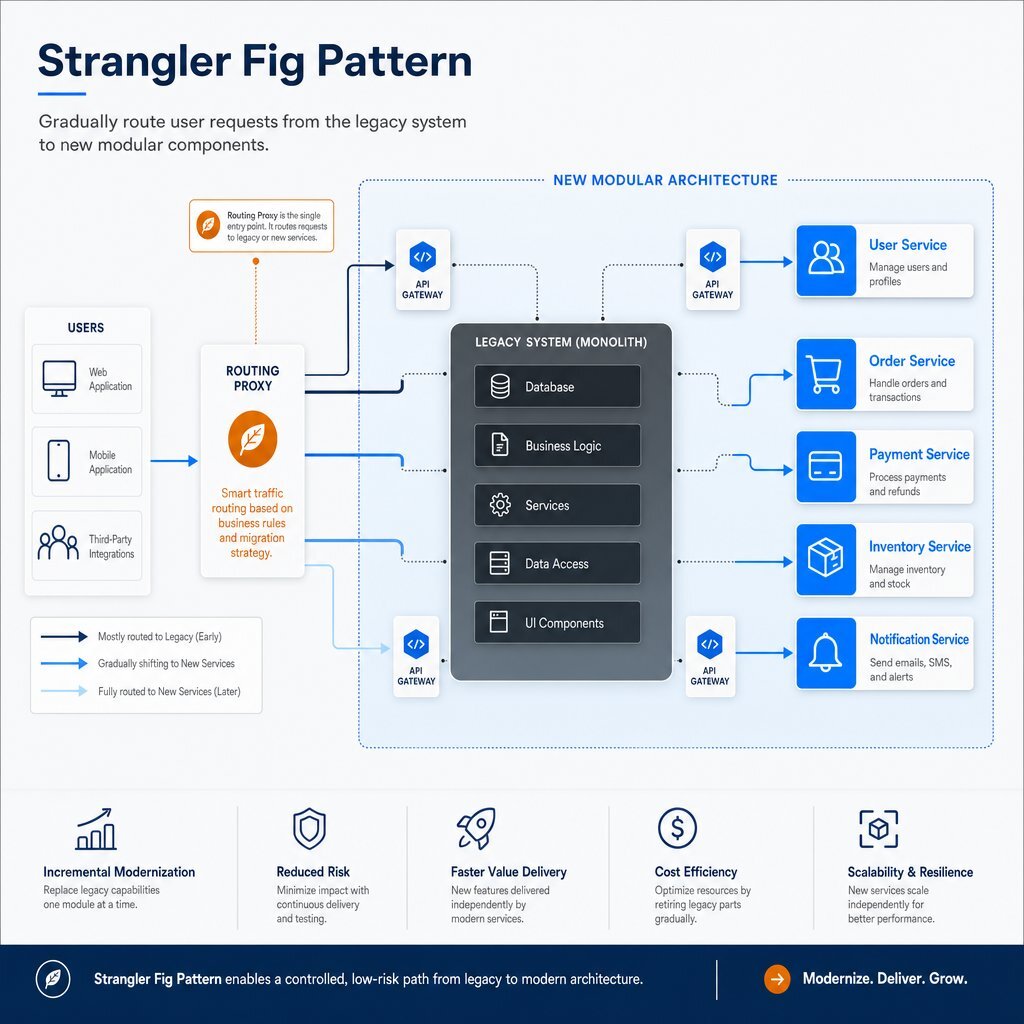
The Strangler Fig Pattern
The cornerstone of incremental modernization is the Strangler Fig pattern. Coined in 2004 by software engineer Martin Fowler, the pattern draws its name from the strangler fig vines of Australia. These vines seed in the upper branches of a host tree and gradually grow downward to take root in the soil. Over time, the vine thickens, captures sunlight, and becomes self-sustaining. Eventually, the original host tree dies and rots away, leaving only the new, robust structure of the strangler fig.
In software architecture, this pattern involves building a new system around the edges of the legacy monolith. An interception layer—often a sophisticated API gateway or routing proxy—is placed between the end-users and the legacy system. Initially, this proxy routes 100% of the traffic to the old software. As developers build new, modernized modules, the routing proxy is updated to intercept specific requests and route them to the new modules instead.
Over months or years, more functionality is migrated. The legacy system handles less and less traffic until it is completely "strangled" and safely decommissioned. Because the replacement happens in isolated, thin slices, the operational risk approaches zero. If a new module fails under load, the routing proxy simply flips the traffic back to the legacy system while the team investigates.
A practical case study involving a retail coupon system demonstrates the power of this pattern. The modernization team isolated a highly used but structurally simple API endpoint (/get_coupons) as their first slice. They built a modern RESTful API that served new consumers, while an API gateway acted as a passthrough to maintain backwards compatibility for existing legacy consumers. This allowed them to prove the value of the new architecture and gain stakeholder trust without touching the complex, high-risk transactional systems.
API Facades and Wrapper Architectures
For mid-market organizations heavily reliant on massive on-premises ERPs or mainframe infrastructure, full code extraction is not always immediately feasible. In these scenarios, the API Facade, or API Wrapping pattern, provides a crucial intermediate step to unlock business value quickly.
An API wrapper introduces a modern interface layer on top of existing, rigid infrastructure. For example, a modern frontend web application requires data in a lightweight JSON format, but the legacy backend only outputs outdated SOAP XML or flat files. Instead of rewriting the massive backend immediately, engineers build a secure API wrapper that intercepts the modern JSON requests, translates them into a format the legacy system understands, retrieves the data, and translates it back in milliseconds.
This approach preserves battle-tested business logic while enabling modern applications to interact with the old system seamlessly. It prevents the legacy system from blocking immediate business initiatives, such as launching a new mobile application or integrating a modern CRM, while the deeper architectural work continues in the background. However, engineering leaders must remain vigilant against scope creep. Wrapping a poorly designed "God API" that handles too many diverse functions can harden the bad architecture. Wrappers must enforce strict domain boundaries to ensure the legacy system is segmented properly for future replacement.
The Sidecar Pattern
Derived from distributed systems and modern cloud-native orchestration platforms like Kubernetes, the Sidecar pattern allows teams to enhance legacy applications without altering their underlying code. Just as a motorcycle sidecar is attached to a motorcycle to provide additional passenger capacity without modifying the motorcycle's engine, a software sidecar is deployed directly alongside a primary application container.
Sidecars handle peripheral, cross-cutting operational concerns such as centralized logging, security monitoring, telemetry, mutual TLS encryption, or configuration synchronization. For a legacy application that lacks modern observability, an operations team can deploy an Envoy or Fluent Bit sidecar to monitor network traffic and collect critical system metrics.
The sidecar shares the exact same lifecycle, network resources, and host disk as the main application. This instantly modernizes the system's security and observability posture, generating critical data needed to plan the rest of the modernization effort, all without requiring a single line of legacy code to be rewritten or recompiled. It is the ultimate low-risk modernization tactic.
Database Decomposition and Change Data Capture
Application code is relatively easy to extract; data is notoriously difficult. Monolithic systems typically rely on a single, massive, heavily coupled relational database. Extracting a module's codebase is useless if that newly modernized module must still query a central legacy database hampered by locking issues, outdated stored procedures, and competing read/write workloads from unmodernized systems. As organizations adopt cloud-native architectures, these shared monolithic databases become the primary bottleneck preventing independent deployment and rapid innovation.
Database decomposition is the process of breaking this monolithic data store into smaller, purpose-built databases aligned with specific service boundaries (the database-per-service pattern). To achieve this without halting the business, engineering teams leverage Change Data Capture (CDC) technologies like Debezium combined with event streaming platforms like Apache Kafka.
CDC tools monitor the transaction logs of the legacy database at a granular level. Every time a row is updated in the legacy system, the CDC tool captures that event and streams it in real-time to the new, modernized database (such as a scalable PostgreSQL instance). This ensures both databases remain perfectly synchronized during the transitional period. Read operations can be safely diverted to the new database, proving its performance, before write operations are officially cut over. This pattern eliminates the terrifying prospect of a weekend data migration window, replacing it with a continuous, verifiable synchronization process.
Prioritizing the Modernization Backlog: Business Risk and Value Mapping
A comprehensive modernization toolkit is useless without a strategic sequence of execution. Technical teams often gravitate toward modernizing the most intellectually interesting, technically flawed, or newest components first. This is a severe strategic error. Modernization must be driven entirely by measurable business value and operational risk.
Mid-market operations leaders must conduct a ruthless assessment of their legacy estate, mapping every core component onto a prioritization matrix. This matrix measures the tangible business value of modernizing a specific module against the cost and operational risk of retaining the legacy code.
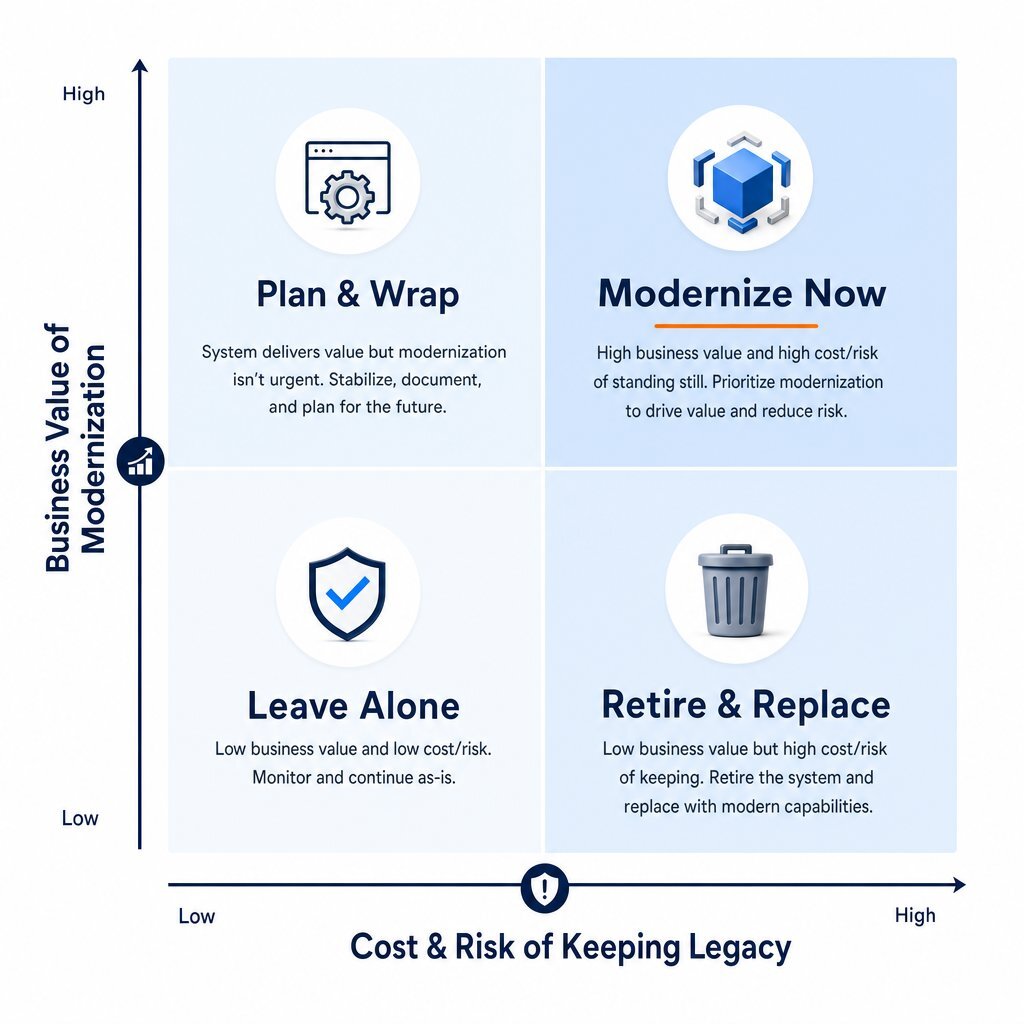
| Strategy Quadrant | Business Value of Modernization | Cost & Risk of Keeping Legacy | Action Plan & Justification |
|---|---|---|---|
| 1. Modernize Now (The Core) | High | High | Prioritize immediately. Apply the Strangler Fig pattern. These components actively block revenue generation, degrade customer experience, or pose severe security threats. They are the engines of the business. |
| 2. Plan & Wrap (The Enablers) | High | Low | Apply API Facades. The legacy system is stable and secure, but its data is urgently needed for new digital initiatives. Wrap the interfaces, connect them to modern frontends, and schedule deeper replacement for later. |
| 3. Retire & Replace (The Commodities) | Low | High | Decommission and migrate. Stop paying developers to maintain custom code for non-differentiating functions (e.g., standard HR, payroll processing, or generic CRM tools). Migrate these to off-the-shelf SaaS solutions immediately. |
| 4. Leave Alone (The Archives) | Low | Low | Isolate and monitor. These are stable, low-traffic backend systems (e.g., historical compliance archives). Moving them generates zero ROI. Leave them in place and restrict access. |
Decision Criteria for the First Slice
When selecting the very first component to modernize from the "Modernize Now" quadrant, the goal is to build momentum and prove the efficacy of the methodology to skeptical stakeholders. The ideal first target should be a "thin slice" of the application that has high visibility and clear business value, but relatively low technical complexity.
For instance, rather than attempting to untangle a complex, multi-step financial reconciliation engine that writes to a dozen tables on day one, a team might choose to modernize the customer profile retrieval API. This component is heavily used, meaning modernizing it provides immediate, visible performance benefits to the end-user. It relies on simple read operations rather than complex transactional writes, making database synchronization easier. Furthermore, it can easily be routed through a transitional API gateway.
Securing this early victory validates the phased approach, builds confidence within the engineering team, and most importantly, secures the ongoing executive funding required to tackle the significantly harder, write-heavy transactional systems later in the roadmap.
A Phased Legacy Modernization Roadmap for Mid-Market Enterprises
Translating abstract patterns and prioritization matrices into execution requires a rigorous, phased roadmap. This sequence moves an organization from an undocumented, monolithic legacy environment to a scalable, cloud-native architecture over a series of controlled increments. The focus at every phase remains on delivering value while protecting system uptime.
Phase 1: Comprehensive Baseline Assessment and Seam Identification
Modernization programs fail when they begin blindly. The initial phase must meticulously map the unknown terrain of the legacy system. Teams cannot simply look at the user interface and guess how the system works; they must analyze the underlying dependencies, network traffic patterns, and undocumented database interactions.
The primary technical objective here is to identify architectural "seams"—junction points where code, programs, or modules meet. A seam is a natural boundary where developers can insert new behavior or intercept traffic with minimal disruption to the surrounding code. Examples include external batch input files, database readers, or web service proxies.
Baytech Consulting advocates strongly for a rigorous discovery phase before any multi-million dollar software commitments are made. This phase catalogs business rules, defines non-negotiable compliance requirements, and establishes a clear functional baseline. Engineers must develop automated functional tests that treat the legacy system as a "black box," providing objective insights into its true behavior. Without this baseline, it is entirely impossible to verify if the modernized system is accurately replicating the necessary business logic.
Phase 2: Establishing Transitional Architecture and Data Governance
Before a single line of legacy code is replaced, the team must build the structural scaffolding that will allow the old and new systems to coexist seamlessly. This "transitional architecture" is temporary code and infrastructure explicitly designed to manage the migration. While this code will eventually be discarded, the reduced risk it provides justifies its development cost.
This phase involves standing up the API gateway that will handle event interception and traffic routing. It also requires establishing the data synchronization mechanisms—such as the Debezium Change Data Capture pipelines—that will securely bridge the legacy database and the modern infrastructure. Furthermore, organizations must build their automated CI/CD (Continuous Integration / Continuous Deployment) pipelines during this phase. Leveraging modern DevOps practices and container orchestration platforms like Kubernetes ensures that all future modernizations can be deployed rapidly, consistently, and safely. The foundation built here dictates the velocity of all subsequent phases.
Phase 3: Slicing, Executing, and Validating the First Increment
With the scaffolding fully operational, the engineering team extracts the first prioritized slice of functionality identified during the assessment phase. The logic is rewritten in a modern runtime, backed by a modern, decomposed data store, and deployed directly alongside the legacy system.
Crucially, traffic is not immediately cut over. The system enters a "dark launching" or "dual run" state. The API routing proxy sends a complete copy of live production traffic to both the legacy component and the newly modernized component. The system only returns the legacy response to the user, but engineers aggressively compare the outputs of both components in the background. They monitor for data discrepancies, latency spikes, and unhandled edge cases. Once the new component consistently and perfectly matches the legacy system's output under real-world production load, the routing rules are updated to make the new component the primary authority. The legacy component is bypassed for that specific workload.
Phase 4: Iterative Scaling, Team Adaptation, and Legacy Retirement
With the first slice validated and live, the modernization methodology transforms into a repeatable engine. The team moves down the prioritization matrix, systematically extracting, rewriting, and routing the next module.
As more behavior moves to the modernized architecture, the legacy footprint shrinks. Hardware resources dedicated to the legacy monolith can be scaled back, reducing operational overhead. Crucially, this phase demands significant organizational adaptation. Legacy systems become rigid because the organizational processes that built them are rigid. To prevent the new system from degrading into tomorrow's legacy software, organizations must introduce new agile development practices and reorganize their structures to align with Conway's Law, which states that software designs inevitably mimic the communication structures of the organizations that create them.
Eventually, the legacy system handles zero traffic. The organization can definitively power down the obsolete servers, terminate the exorbitant legacy licensing contracts, and carefully remove the transitional architecture. The strangler fig has completely replaced the host tree, and the business operates on a fully modernized, highly scalable platform.
Keeping the Lights On: Strategies for Zero-Downtime Migration
The core mandate for mid-market operations is continuous availability. E-commerce supply chains cannot pause for weekend maintenance windows; financial trading platforms cannot afford lost seconds; healthcare record systems must be accessible around the clock. Phased modernization achieves true zero-downtime migrations through specific, advanced deployment controls.
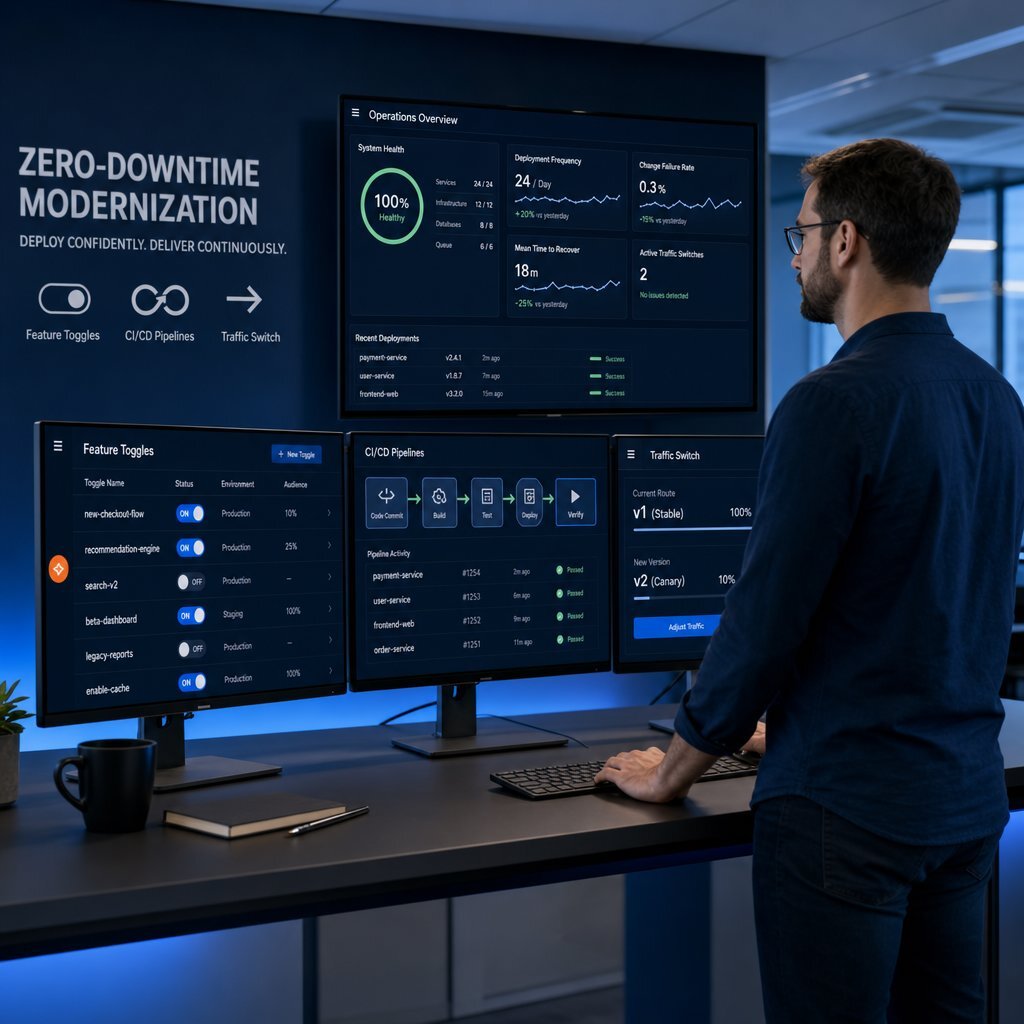
Feature toggles (or feature flags) are critical instruments in this effort. By wrapping new modernized code in a logical toggle using tools like LaunchDarkly or Azure App Configuration, operations teams can deploy code to the production environment without actually exposing it to users. Traffic routing can be controlled dynamically at runtime. If a newly modernized billing module exhibits unexpected latency under peak load, an operations manager can simply toggle the traffic back to the legacy billing module instantly. This bypasses the need for a chaotic database rollback or an emergency code deployment, reducing outage recovery time from hours to seconds.
Furthermore, these tools allow organizations to separate the technical act of deployment from the business act of release. Deployment is moving code to a server; release is allowing users to interact with it. Technical teams can deploy constantly, allowing business stakeholders to release the modernized features only when the operations staff is fully trained and ready to support them.
This separation directly addresses the human elements of technology adoption. Change management is critical on the people side of system migrations, where emotional engagement and human factors dictate adoption success. By controlling the release cadence, leadership ensures that system migrations never outpace user comprehension, preventing the operational friction that typically derails major software rollouts.
Measuring Value Per Phase: Proving Progress to Stakeholders
A multi-phase modernization roadmap requires sustained financial backing and executive patience. If the business must wait three years to see a return on investment, the project will inevitably fall victim to budget cuts, leadership changes, or shifting corporate priorities. The incremental model solves this vulnerability by delivering measurable, verifiable ROI at the conclusion of every single phase.
To maintain buy-in from the CFO and other strategic leaders, the modernization team must track and communicate metrics that resonate beyond the engineering department. An effective weighted decision matrix removes emotion and reveals the true financial and operational impact of the software changes.
- Cost Reduction Metrics: Track the immediate drop in legacy licensing costs, virtual machine footprint, or mainframe MIPS (Million Instructions Per Second) consumption as specific, high-cost workloads are offloaded to efficient cloud-native microservices.
- Velocity Metrics: Demonstrate how the decoupling of architecture allows teams to ship features faster. A minor interface change that once required a six-week regression testing cycle on the monolith can now be deployed in an afternoon on the isolated microservice. This metric proves to the Head of Sales that the IT department is accelerating time-to-market.
- Performance and Resilience Metrics: Highlight the reduction in latency, database deadlocks, and transaction timeouts. Show exactly how the database decomposition eliminated a specific bottleneck that previously caused the ERP to crash during end-of-month financial reconciliation.
The most compelling argument for the CFO is the inherent financial safety of the incremental model. Because the Strangler Fig approach requires smaller, targeted investments rather than massive upfront capital expenditure, financial risk is tightly contained. If market conditions shift drastically and the modernization program must be paused after only three modules are replaced, the organization still retains the permanent, operational value of those three modernized modules. This stands in stark contrast to a paused big-bang rewrite, which yields absolutely nothing but uncompiled code and lost capital. The phased approach guarantees a return on the investment made to date, regardless of future project disruptions.
Conclusion: The Pragmatic Middle Path
Legacy software modernization is not merely an IT infrastructure project; it is a fundamental defense of the company's future operational viability and market competitiveness. Mid-market operations cannot afford the catastrophic failure rates and budget overruns of big-bang rewrites, nor can they survive the escalating technical debt, talent drain, and crippling security vulnerabilities of indefinite deferral.
The pragmatic middle path is incremental, continuous evolution. By utilizing proven patterns like the Strangler Fig, deploying API facades for immediate connectivity, maintaining zero downtime with feature toggles, and meticulously managing database decomposition, organizations can rewrite their core systems in flight. A phased roadmap demands absolute engineering discipline—requiring precise baseline assessments, rigorous prioritization based on business value, and the construction of robust transitional architectures—but the reward is a durable, scalable system delivered with zero operational downtime. The system evolves seamlessly, matching the pace of the business without ever disrupting it.
The technology exists to break the legacy cycle permanently. Success now depends entirely on execution. Firms seeking to navigate this complex landscape require partners who combine elite engineering prowess with deep operational pragmatism. Baytech Consulting specializes in providing this exact balance, utilizing Tailored Tech Advantage and Rapid Agile Deployment to architect phased modernization roadmaps that protect the core business today while aggressively building the scalable infrastructure required for tomorrow. For organizations weighing how much to build themselves versus rely on vendors, a self-hosting vs. SaaS deployment matrix can further sharpen those decisions.
Frequently Asked Questions
What happens to a modernization project if business priorities suddenly change mid-way?
Because a phased modernization roadmap replaces the system in isolated slices, pausing the initiative does not result in lost work. The modules that have already been modernized and routed into production continue to run independently and deliver ongoing business value, while the remaining legacy components safely maintain the rest of the operational load until the modernization initiative resumes.

Supporting Resources
- Legacy software modernization: a guide to unlocking scalability
- The hidden costs of legacy software: why your enterprise system may be holding you back
How to choose a software partner in 2026
About Baytech
At Baytech Consulting, we specialize in guiding businesses through this process, helping you build scalable, efficient, and high-performing software that evolves with your needs. Our MVP first approach helps our clients minimize upfront costs and maximize ROI. Ready to take the next step in your software development journey? Contact us today to learn how we can help you achieve your goals with a phased development approach.
About the Author

Bryan Reynolds is an accomplished technology executive with more than 25 years of experience leading innovation in the software industry. As the CEO and founder of Baytech Consulting, he has built a reputation for delivering custom software solutions that help businesses streamline operations, enhance customer experiences, and drive growth.
Bryan’s expertise spans custom software development, cloud infrastructure, artificial intelligence, and strategic business consulting, making him a trusted advisor and thought leader across a wide range of industries.