
Unlocking Success: How to Choose a Software Partner in 2026
January 03, 2026 / Bryan ReynoldsIn the high-stakes arena of modern enterprise, software has ceased to be a mere support function; it is the central nervous system of business strategy, the primary driver of competitive differentiation, and, increasingly, the arbiter of survival. For C-level executives—whether a visionary Chief Technology Officer (CTO) mapping a digital future, a strategic Chief Financial Officer (CFO) guarding the bottom line, or a growth-focused Head of Sales—the selection of a software development partner is not a procurement task; it is an investment decision with existential implications. The digital graveyard is littered with the carcasses of "transformational" projects that failed not due to a lack of vision, but due to a catastrophic failure of execution and partnership.
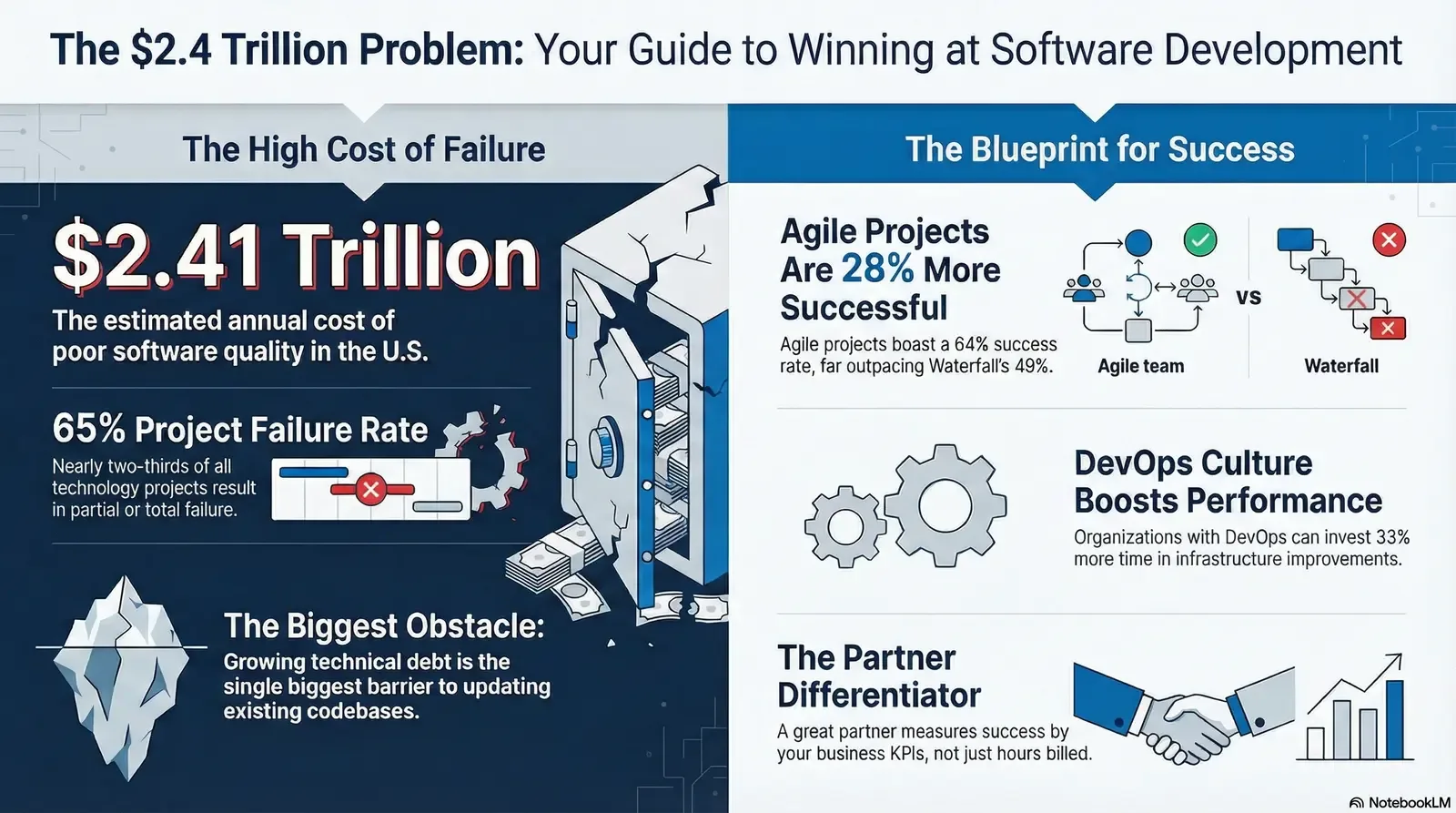
Recent industry analysis provides a sobering backdrop to this decision: the cost of poor software quality in the United States alone has ballooned to trillions of dollars annually—estimated at $2.41 trillion in recent reports—driven by accumulating technical debt, cybersecurity failures, and project overruns. Conversely, the right partner acts as a force multiplier, accelerating time-to-market, ensuring enterprise-grade security, and delivering assets that appreciate in value rather than depreciating into legacy burdens.
This comprehensive research report dissects the anatomy of a high-performing software development partner. It moves beyond the superficial checklist of "good communication" and "technical skills" to explore the structural, financial, and cultural mechanics that define success in 2025. We will explore the nuances of Agile maturity, the financial imperatives of technical debt management, the strategic importance of DevOps transparency, and the critical distinctions between a transactional "vendor" and a strategic "partner." Through the lens of Baytech Consulting’s operational philosophy—centered on Tailored Tech Advantage and Rapid Agile Deployment —we will illustrate how these abstract concepts translate into tangible business victories.
I. The Strategic Alignment: Beyond the Code
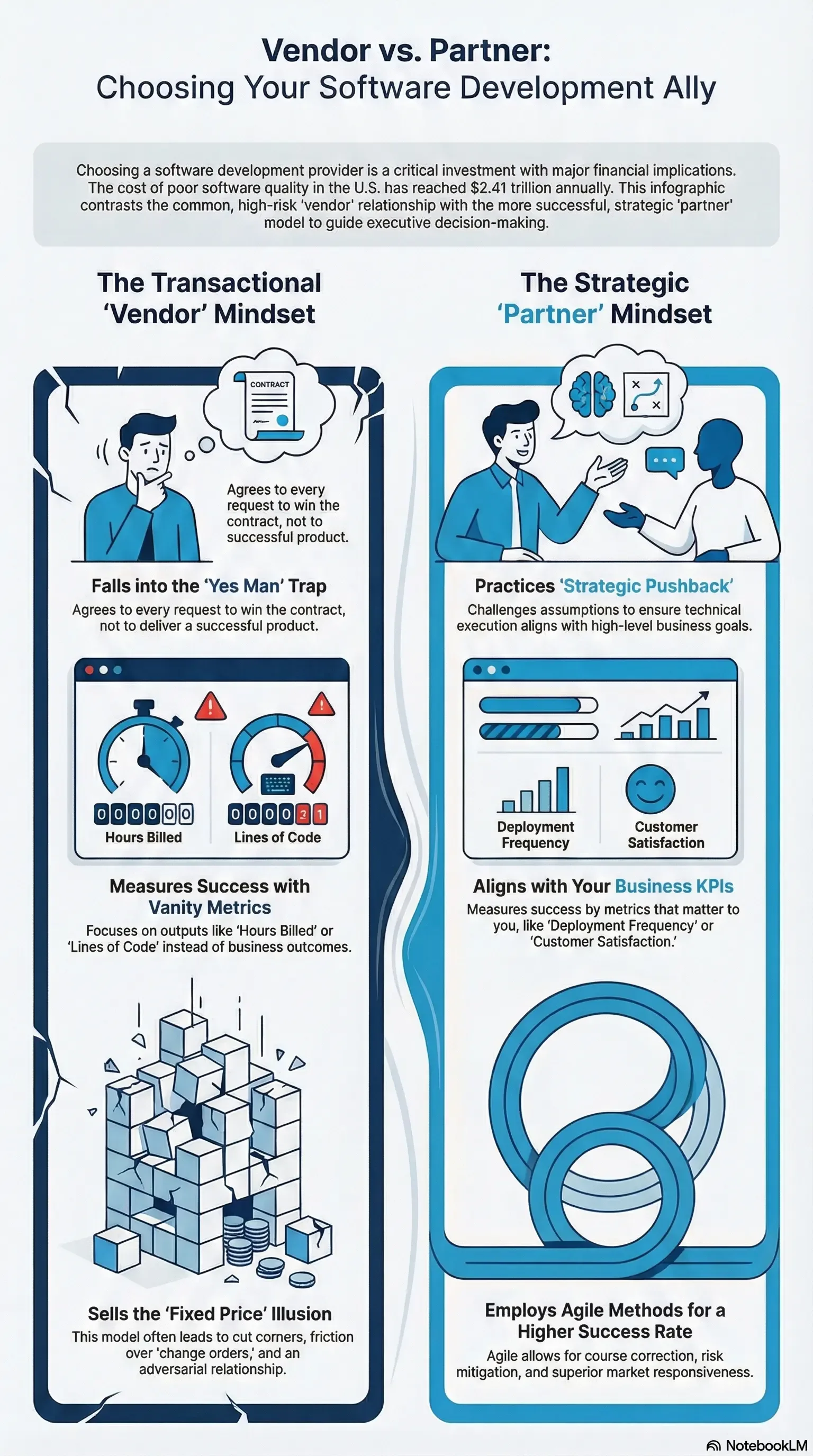
The defining characteristic of a great software development partner is the ability to transcend the role of an "order taker." In the traditional vendor model, a client hands over a specification, and the vendor returns code. This transactional relationship is fraught with peril because it assumes the client has perfect foresight and the vendor has zero strategic input. In the modern partner ecosystem, this dynamic is inverted. The partner must possess the intellectual honesty and strategic acumen to challenge assumptions, refine the vision, and align technical execution with business outcomes.
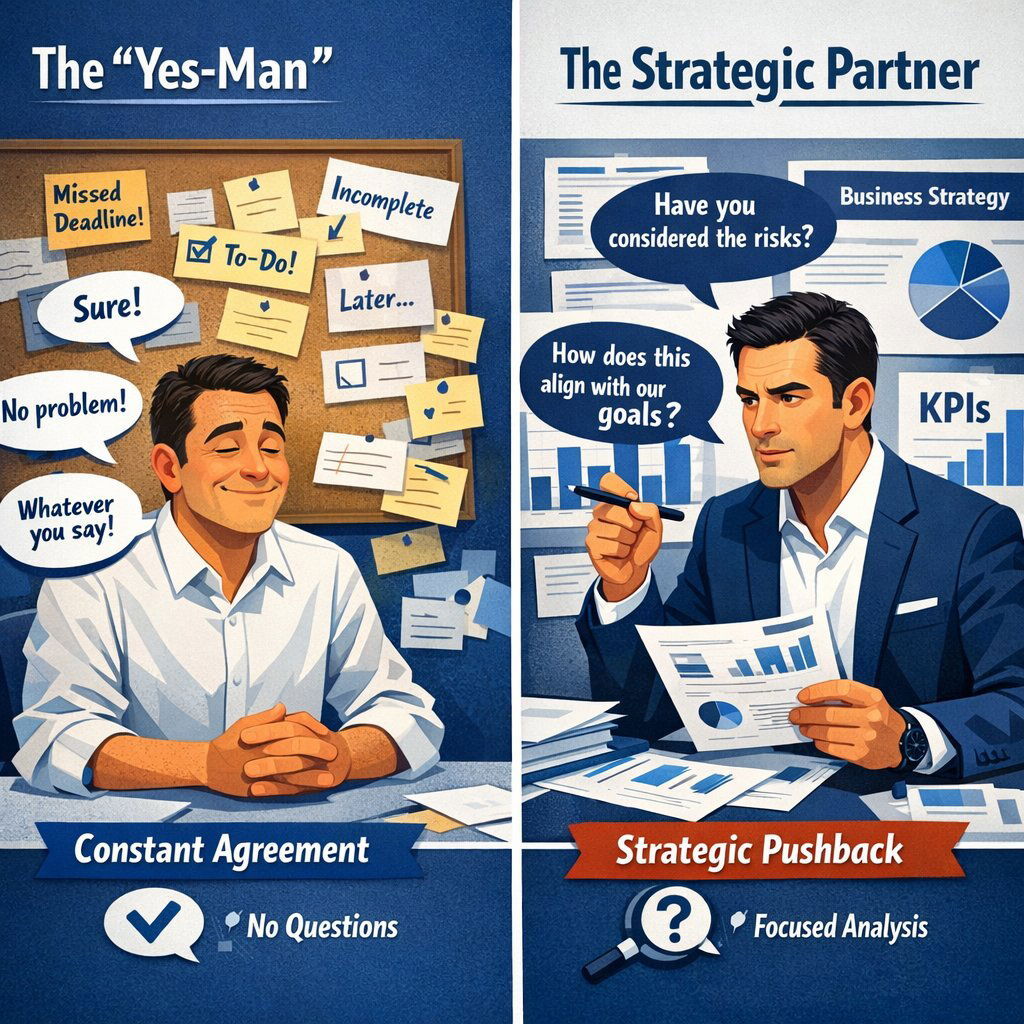
The "Yes Man" Trap vs. Strategic Pushback
A common pitfall in vendor selection is prioritizing compliance over competence. A partner who agrees to every deadline, every feature request, and every budget constraint without scrutiny is often setting the stage for failure. The "Yes Man" vendor optimizes for winning the contract, not for delivering the product. They are incentivized to minimize friction during the sales process, often at the expense of reality.
Great partners, by contrast, exhibit "Strategic Pushback." They ask the uncomfortable questions that define the "Discovery Phase":
- "Why are we building this feature now? How does it serve the MVP (Minimum Viable Product)?"
- "This timeline risks quality; can we de-scope to hit the date safely?"
- "The proposed architecture will limit scalability in 18 months; should we invest more now to save later?"
This alignment requires a deep understanding of the client's industry. A logistics company needs a partner who understands supply chain latency, not just database latency. 3 A fintech firm needs a partner who understands regulatory compliance (SOC2, PCI-DSS) as deeply as they understand encryption algorithms. 4 When a partner understands the business domain, they can make micro-decisions in the code that support the macro-goals of the company.
The Metrics of Alignment: What Are We Optimizing For?
How do we measure this intangible alignment? It manifests in the metrics a partner prioritizes. In a transactional relationship, the vendor cares about output metrics: Lines of Code (LOC), Hours Billed, and Tickets Closed. These are vanity metrics that tell us nothing about business value.
A great partner aligns their success with the client's business KPIs and operational metrics, such as:
- Cycle Time: The time it takes for a validated idea to reach the customer.
- Deployment Frequency: How often value is shipped to production.
- Change Failure Rate: The percentage of deployments that cause a failure in production.
- Customer Satisfaction (CSAT): How well the software solves the user's problem. 5
If the goal is user acquisition, the development strategy should prioritize features that drive onboarding, even if it means delaying backend optimization. If the goal is stability for a mission-critical financial system, the strategy must prioritize testing coverage and automated rollback capabilities over feature velocity. This is the essence of Tailored Tech Advantage—aligning the technology stack and process to the specific business context of the client.
Case in Point: The Cost of Misalignment
Consider the "Digital Graveyard" of failed projects. Statistics show that nearly 66% of technology projects end in partial or total failure. 7 Often, this is due to a misalignment of expectations. The client expects a Ferrari; the vendor builds a tank. Both are engineering marvels, but only one fits the race track. A great partner spends the "Discovery Phase" not just mapping database schemas, but mapping the "Definition of Success." They ensure that when the inevitable trade-offs between Time, Cost, and Scope arise, the decisions made align with the strategic intent of the executive team.
Research from the Boston Consulting Group (BCG) supports this, indicating that fully staffed teams with cross-disciplinary capabilities (including product managers with wide-ranging skills) see a 76% increase in project performance. 8 This underscores the necessity of a partner who brings more than just coders to the table—they must bring product strategists who can align the technical build with the market reality.
II. Technical Excellence: The Engine of Innovation
While strategic alignment sets the course, technical excellence determines the speed and safety of the journey. In 2025, technical competence is not just about knowing a programming language; it is about mastering the ecosystem of delivery. This includes the infrastructure, the pipeline, the quality assurance, and the architecture.
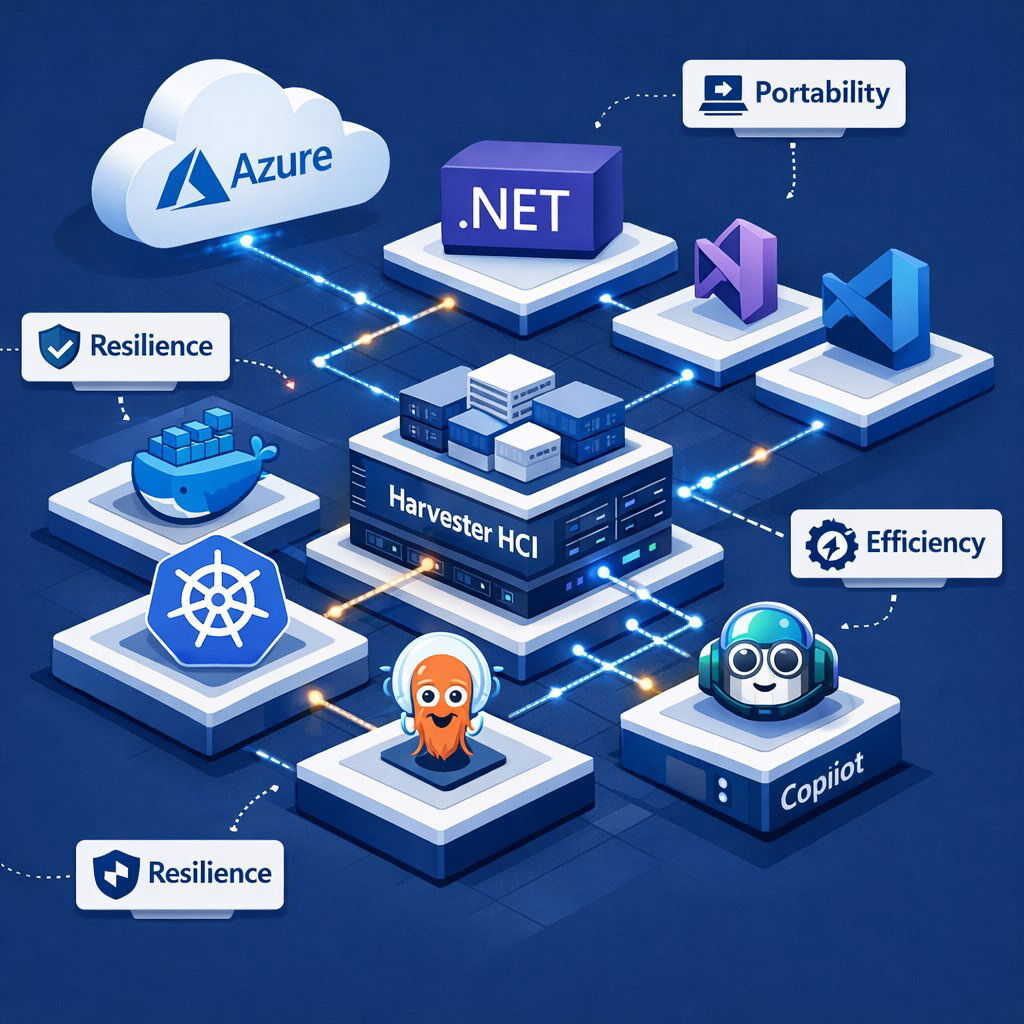
The Modern Tech Stack: A Litmus Test for Competence
A great partner stays on the bleeding edge of stability—adopting new technologies that have crossed the chasm from "experimental" to "enterprise-ready." The choice of a tech stack is a major indicator of a partner's maturity. For a deeper analysis on how advanced AI tooling and architectures are redefining enterprise success, explore the insights in Harnessing Generative AI for Enterprise Success in 2025.
1. The Power of.NET and Microsoft Ecosystems
For B2B enterprises, the Microsoft stack (Azure,.NET, SQL Server) remains a gold standard for maintainability and support. A partner deeply entrenched in this ecosystem—using tools like Visual Studio 2022 and Azure DevOps—brings a level of integration and productivity that disjointed open-source stacks often struggle to match. The cohesion between the IDE (Integrated Development Environment), the cloud platform (Azure), and the pipeline (Azure DevOps) reduces friction, allowing developers to focus on logic rather than plumbing. 9
However, modern.NET is not the monolithic beast of the past. It is cross-platform, high-performance, and cloud-native. Partners utilizing VS 2022 and VS Code are leveraging AI-assisted development (via GitHub Copilot) and robust debugging tools that significantly reduce the "mean time to resolution" for bugs.
2. Containerization and Orchestration: The Strategic Value of Kubernetes
The mention of "Kubernetes" should be music to a CFO's ears, despite its technical complexity. Why? Because Kubernetes represents portability and efficiency for scalable, modern applications.
- Portability: Applications containerized in Docker and managed by Kubernetes can run anywhere—Azure, AWS, on-premise servers, or hybrid environments. This prevents vendor lock-in, a critical strategic advantage. If Azure raises prices, a containerized application can be migrated to another provider with minimal friction.
- Efficiency: Kubernetes allows for "bin-packing," squeezing the maximum utility out of every dollar spent on server infrastructure. It also enables auto-scaling, meaning the business pays for computing power only when customers are actually using the system. 10
- Resilience: Kubernetes provides "self-healing" capabilities. If a container crashes, Kubernetes detects it and restarts it automatically, often before a user even notices. This contributes directly to uptime SLAs (Service Level Agreements). 10
Table 1: Strategic Implications of Technology Choices
| Technology | Legacy Approach | Modern Partner Approach (e.g., Baytech) | Strategic Benefit for Executives |
|---|---|---|---|
| Hosting | Dedicated Physical Servers or VMs | Harvester HCI / Rancher / Kubernetes | Lower TCO: Reduces licensing fees (VMware tax) and hardware footprint. Agility: Faster provisioning. |
| Deployment | Manual File Transfers (FTP) | Azure DevOps / Argo CD | Risk Reduction: Automated, repeatable deployments eliminate human error. Speed: Features reach market in minutes, not days. |
| Database | Monolithic SQL Server | Postgres / SQL Server (Containerized) | Scalability: Handles data growth without exponential cost increases. |
| Development | Notepad++ / Basic Editors | VS Code / VS 2022 | Productivity: Advanced tooling and AI integration speed up development cycles. |
3. Harvester HCI: The Open Source Advantage
A unique differentiator for forward-thinking partners like Baytech Consulting is the adoption of Harvester HCI (Hyperconverged Infrastructure). For decades, enterprises have paid a "VMware tax"—hefty licensing fees for virtualization software. Harvester is an open-source alternative built on Kubernetes.
- For the CFO: Harvester eliminates the licensing costs associated with traditional virtualization stack (like vSphere/SAN), significantly lowering the Total Cost of Ownership (TCO). 13
- For the CTO: It unifies the management of Virtual Machines (VMs) and Containers. This is crucial for businesses transitioning from legacy applications (VM-based) to modern microservices (Container-based). It allows them to run side-by-side on the same infrastructure, managed by Rancher. 15
DevOps: The Factory Floor of Software
If the software is the product, DevOps is the assembly line. A partner without a mature DevOps culture is akin to a car manufacturer assembling vehicles by hand.
- CI/CD (Continuous Integration/Continuous Deployment): Great partners automate the path from "developer's laptop" to "production server." This reduces the "it works on my machine" phenomenon and ensures that deployments are boring, predictable events rather than high-stress nightmares.
- GitOps with Argo CD: Modern partners utilize "GitOps," where the entire infrastructure is defined in code. Tools like Argo CD constantly monitor the live environment and ensure it matches the "source of truth" in the code repository. If a server drift occurs, Argo CD corrects it automatically. 17
- DORA Metrics: Elite partners measure themselves against DORA (DevOps Research and Assessment) metrics: Deployment Frequency, Lead Time for Changes, Time to Restore Service, and Change Failure Rate. These are the "vital signs" of a high-performing engineering organization. 18
Insight: Ask a potential partner to show you their deployment pipeline. If they can't demonstrate an automated sequence of Build → Test → Deploy, they are likely relying on manual processes that are prone to human error and consume valuable developer time.
III. Methodologies that Matter: The Agile Advantage
The debate between Waterfall and Agile is largely settled in the realm of custom software development, yet many firms still practice "Water-Scrum-Fall"—a disguise of Agile terms over rigid, waterfall processes. True Agile is a statistical imperative for success in 2025. If you'd like practical insights on using Agile to maximize outcomes, including startup scenarios, see our resource on finding the best startup consultant.
The Data on Agile vs. Waterfall
Research consistently shows that Agile projects have a significantly higher success rate (64%) compared to Waterfall projects (49%). 19 Furthermore, Agile projects are 28% more successful than their non-Agile counterparts. 20 The Standish Group's CHAOS Report, a benchmark in the industry, reinforces that small, iterative projects succeed far more often than large, monolithic ones.
Why does this gap exist?
- Feedback Loops: Waterfall relies on a "Big Bang" delivery at the end. If the requirements were slightly off at the start (which they always are due to the "Knowledge Deficit"), the result is a catastrophe. Agile delivers working software every 2-3 weeks, allowing for course correction.
- Risk Mitigation: In Agile, the riskiest assumptions are tested first. If a project is going to fail, Agile ensures it fails fast and cheap, rather than slow and expensive.
- Market Responsiveness: In 2025, market conditions change monthly. A 12-month Waterfall plan is obsolete by month 4. Agile allows the product roadmap to evolve with the market. 21
The "Baytech" Flavor: Rapid Agile Deployment
A great partner adapts Agile to the enterprise context. It’s not just about "moving fast and breaking things." It’s about "moving fast and fixing things." Baytech Consulting’s approach, Rapid Agile Deployment, emphasizes specific practices that drive velocity without sacrificing quality:
- The Daily Stand-up: Not a status report, but a synchronization event to unblock engineers. It keeps the momentum high. 21
- The Retrospective: A critical mechanism for continuous improvement. If a partner doesn't do retrospectives, they aren't learning. They are repeating the same mistakes sprint after sprint.
- The Demo: Every sprint should end with a demo of working software. This is the ultimate transparency. Executives shouldn't read status reports; they should see the product evolve. This tangible progress builds trust and allows stakeholders to provide feedback on the actual product, not an abstract document.
Insight: A partner who insists on a 200-page specification document before writing a line of code is selling you a false sense of security. They are selling you a plan that will change the moment reality hits. A partner who insists on a backlog of user stories and a 2-week sprint cadence is selling you adaptability.
The Hybrid Model: Handling Regulatory Constraints
Some industries (Finance, Healthcare) require a hybrid approach due to regulatory requirements for documentation and scope definition. A sophisticated partner knows how to wrap Agile execution inside a governance framework that satisfies auditors. They use tools like Azure DevOps to automatically link code changes to requirements (Work Items), creating an automated audit trail that satisfies compliance without slowing down development. 19
IV. The Financial Equation: Pricing Models and TCO
For the CFO, the pricing model is often the primary filter. However, the cheapest hourly rate often leads to the most expensive total cost of ownership (TCO). Understanding the incentives behind pricing models is crucial for alignment. If you want to identify the optimum strategy for your software product, dive into our comprehensive guide on software product development services designed for business success.
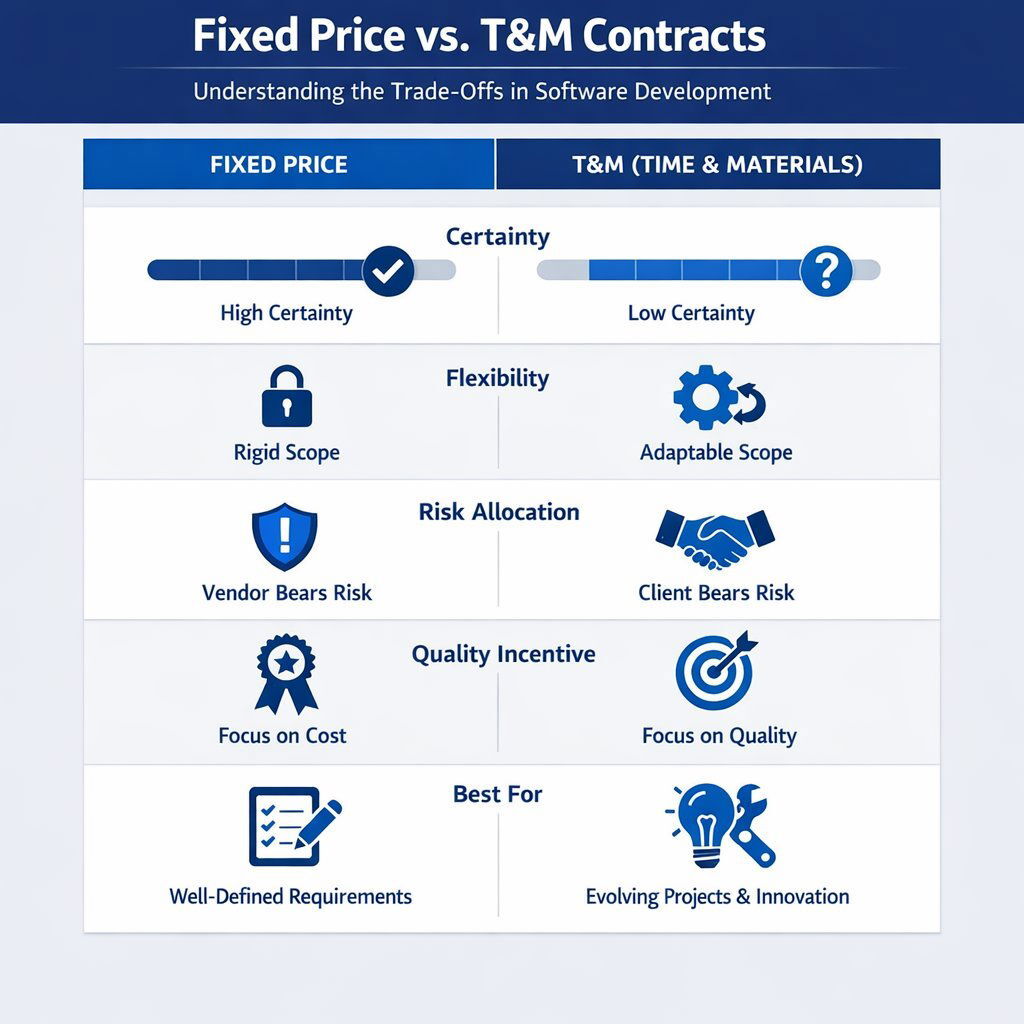
Fixed Price vs. Time & Materials (T&M): An Economic Analysis

| Feature | Fixed Price | Time & Materials (T&M) |
|---|---|---|
| Certainty | High (Budget is capped) | Low (Budget is estimated) |
| Flexibility | Low (Scope is frozen) | High (Scope evolves) |
| Risk Allocation | Vendor assumes risk (and charges a premium) | Client assumes risk (but pays for actuals) |
| Quality Incentive | Low (Vendor incentivized to cut corners to protect margin) | High (Vendor incentivized to deliver value to keep the contract) |
| Start Time | Slow (Requires months of spec writing) | Fast (Starts immediately with broad goals) |
| Best For | Small, well-defined projects (MVPs) | Complex, evolving enterprise platforms |
23
The "Fixed Price" Illusion
Many executives gravitate toward Fixed Price contracts for the illusion of budgetary control. However, software development is inherently discovery-based. When you fix the price and scope, you lock yourself into a "knowledge deficit." You are making decisions when you know the least about the project.
- The Change Order Cycle: In a fixed-price model, every new idea or discovery requires a "Change Order." This introduces friction, negotiation, and delays. The relationship becomes adversarial: the client wants "what was implied," and the vendor delivers "what was written."
- The Buffer: Vendors are rational actors. If they bid on a fixed-price project, they will add a 20-30% "risk buffer" to the cost to cover the unknowns. You are paying for risk management, whether the risk materializes or not. If the project goes smoothly, the vendor keeps the buffer as profit. If it goes poorly, they cut corners to save their margin. 23
Why T&M Wins for Innovation
For strategic partners, the Time & Materials model (often with a "Not to Exceed" cap or "Budgetary Guidance") is superior. It aligns incentives. The partner works to deliver maximum value per hour. If a feature turns out to be complex but low-value, a T&M partner can suggest cutting it to save budget. A Fixed Price partner must build it because it's in the contract, wasting resources on low-value code. 24
The CFO's Compromise: A "Capped T&M" model. "We will work on a T&M basis, but we will not exceed $50k per month without written authorization." This provides the flexibility of Agile with the budgetary guardrails of Fixed Price.
V. Risk Management: Quality, Security, and IP
A software partner is a custodian of your intellectual property and a gatekeeper of your security. In an era where a single breach can end a company, this responsibility is paramount. If you want to understand how today's AI-driven development environments are changing the risk landscape, see our analysis of AI and next-gen code security for actionable advice.
Quality Assurance (QA) as a Culture
Quality is not a phase at the end of the project; it is a continuous activity. The "Cost of Quality" curve is exponential: fixing a bug during the design phase costs pennies; fixing it in production costs thousands (in developer time, reputation, and lost revenue). 26
- Test Automation: A great partner writes automated tests (Unit, Integration, End-to-End) alongside the code. This ensures that a new feature doesn't break an old one (Regression Testing).
- The "Broken Window" Theory: Bad code attracts more bad code. A partner committed to quality enforces coding standards and conducts peer code reviews on every pull request.
- Dedicated QA: While developers should test their code, a great partner provides dedicated QA engineers who think like users, not like programmers. They try to break the system so your customers don't have to. 27
Security and Compliance: DevSecOps
In 2025, security cannot be bolted on; it must be baked in. The development partner must practice DevSecOps—integrating security into the development pipeline.
- Static Application Security Testing (SAST): Scanning code for vulnerabilities (SQL injection, XSS) automatically upon every commit.
- Dependency Scanning: Modern software is built on open-source libraries. A partner must use tools to ensure that these libraries (NuGet, NPM) are patched and secure from vulnerabilities like the famous Log4j exploit. 28
- Compliance Fluency: If you are in healthcare (HIPAA) or finance (SOC2, PCI-DSS), your partner must demonstrate fluency in these standards. They should understand how to handle PII (Personally Identifiable Information) and encryption at rest and in transit. 27
Intellectual Property (IP) Rights: Who Owns the Code?
This is the most critical legal question.
- Work for Hire: The standard should be "Work for Hire." Once you pay the invoice, you own the code, the design, and the data.
- The Trap: Some agencies retain ownership of the "core libraries" or "framework," granting you only a license. This creates vendor lock-in. If you want to switch partners, you might lose the foundation of your software.
- Source Code Access: A great partner provides you with access to the source code repository (GitHub, Azure DevOps) from Day 1. You should never be "held hostage" by a vendor who refuses to release the code. Transparency is the antidote to lock-in. 30
Insight: Check the contract for the "Pre-existing IP" clause. It is acceptable for a partner to retain rights to their pre-built utility libraries, provided you get a perpetual, royalty-free, irrevocable license to use them. This allows them to reuse generic code (like a logging framework) while you own the unique business logic.
VI. The "Soft" Skills: Communication and Transparency
Data indicates that 59% of employees have missed messages due to communication issues, and 24% of businesses have had poor customer experiences due to the same. 32 In software development, communication failure is the leading cause of project failure—more than technical incompetence.
The Rhythm of Communication
A great partner establishes a "Rhythm of Business" that keeps stakeholders informed without overwhelming them:
- Daily: Stand-ups (15 mins).
- Weekly: Status Reports (Budget burn, Risks, Accomplishments).
- Bi-Weekly: Sprint Demos (Show and Tell).
- Quarterly: Strategic Business Reviews (Roadmap alignment).
Transparency Tools
Transparency shouldn't be a meeting; it should be a dashboard.
- Jira / Azure Boards: The client should have full read-access to the backlog. You should be able to see exactly who is working on what.
- Time Tracking: Detailed logs of hours spent. "4 hours - Fixing login bug" is better than "4 hours - Development."
- The "Bad News" Test: A great partner delivers bad news early. "We are going to miss the deadline because the API integration is more complex than documented." A bad partner hides this until the day before the launch. Proactive communication allows executives to manage expectations and adjust strategy. 33
Cultural Fit
Cultural fit is not about "having a beer together." It's about shared values.
- Ownership: Do the developers say "Your user base" or "Our user base"?
- Curiosity: Do they ask "How" or "Why"?
- Empathy: Do they understand the stress of the Head of Sales who needs this feature to close a deal?
VII. Global Strategy: Onshore, Nearshore, or Offshore?
The geography of your partner determines the logistics of collaboration and the quality of the interaction. Learn how different staffing strategies shape today’s SaaS authentication, security, and global project outcomes by reviewing our coverage of SaaS authentication strategies.
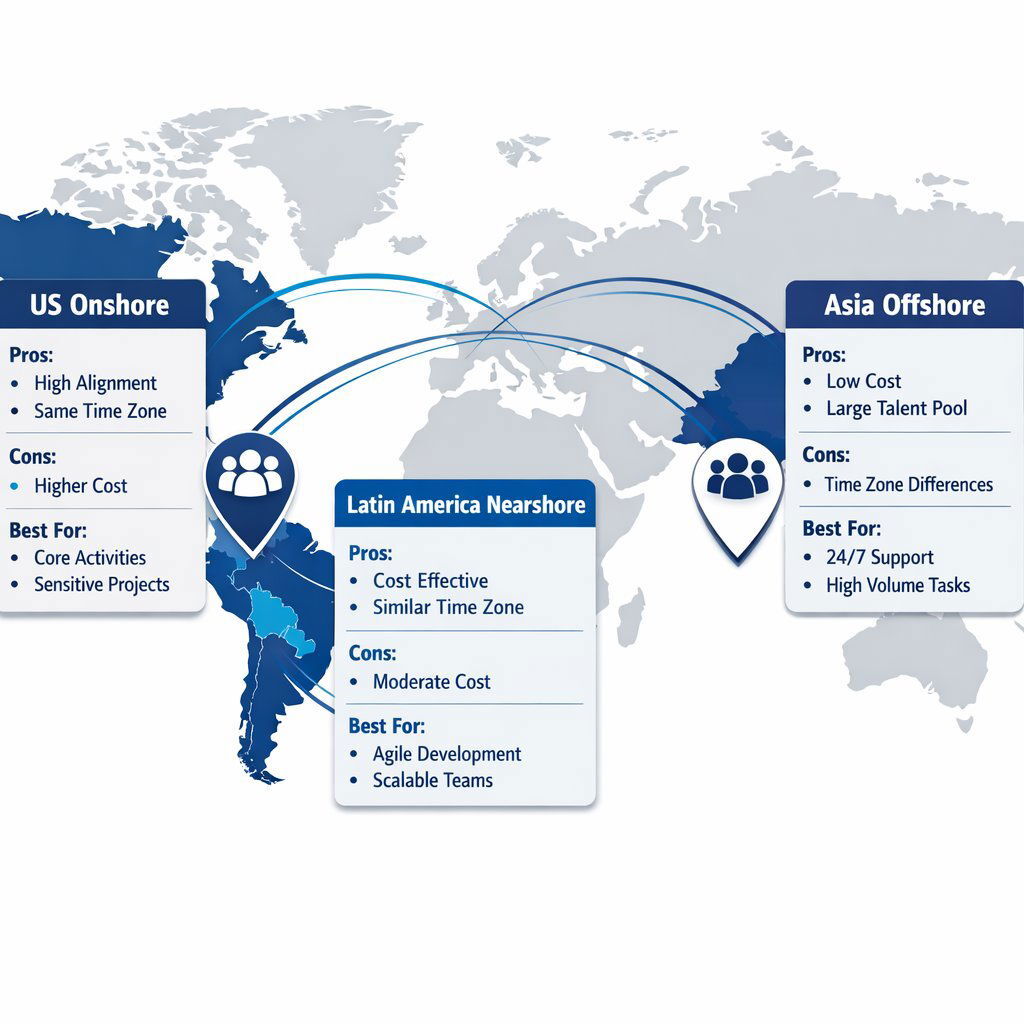
The Onshore Advantage (US-Based)
- Pros: Same time zone, native language fluency, cultural alignment, legal recourse in US courts, higher quality standards. 34
- Cons: Higher hourly rate.
- Best For: Core IP development, complex logic, projects requiring high interaction, regulated industries.
The Offshore Reality
- Pros: Low hourly rate.
- Cons: Time zone dissonance (12-hour lag), communication friction, cultural nuance gaps, reduced legal protection, high turnover. 35
- The "Hidden Cost": You often need to hire a "Bridge Manager" internally to manage the offshore team, negating some cost savings.
The Hybrid Model (The Baytech Sweet Spot)
Many high-performing firms use a Hybrid model. High-level architecture, project management, and lead engineering happen Onshore (US). Execution of well-defined tasks happens Nearshore or with highly vetted senior offshore talent. This balances cost with quality.
Insight: Time zone alignment is often more critical than language alignment. A Nearshore team in Latin America (CST/EST time zones) allows for real-time collaboration, which is essential for Agile. An offshore team in Asia requires asynchronous communication, which slows down the "Ask-Answer" cycle from minutes to 24 hours. 37
VIII. Vetting the Partner: The Executive Checklist
When interviewing potential partners, move beyond the standard RFP (Request for Proposal). Use these targeted questions to reveal their true operational maturity.
The "Litmus Test" Questions
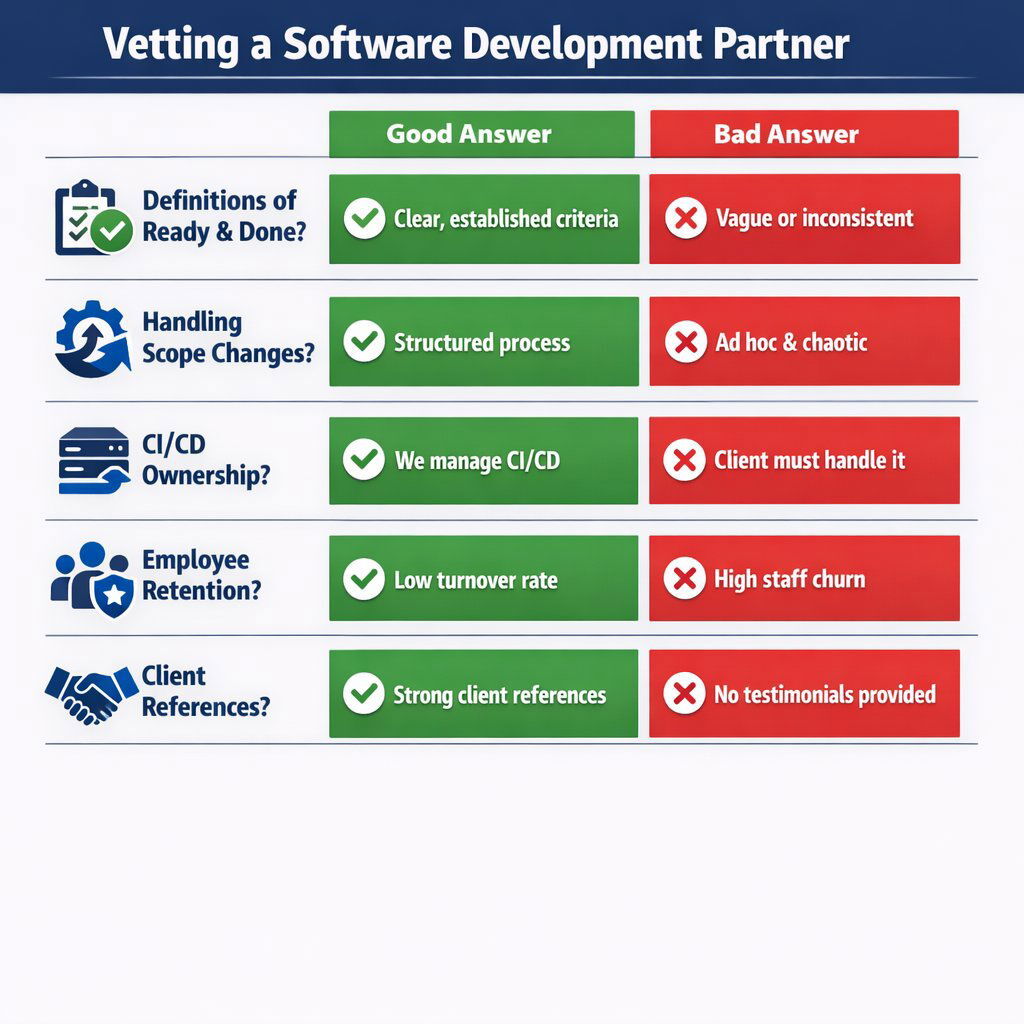
- "Show me your definitions of 'Ready' and 'Done'."
- Good Answer: A detailed checklist. "Ready" means we have design, acceptance criteria, and data. "Done" means coded, tested, passed QA, and deployed to staging. 33
- Bad Answer: "When the developer says it's finished."
- "How do you handle a change in scope mid-sprint?"
- Good Answer: "We trade it. If you want to add Feature X, we must remove Feature Y of equal size to protect the sprint goal, or we push it to the next sprint."
- Bad Answer: "We'll just squeeze it in" (This leads to burnout and bugs).
- "Can I speak to a client who fired you?" (Or at least a client where things went wrong).
- Good Answer: An honest post-mortem of a difficult project and how they resolved it.
- Bad Answer: "All our clients are 100% happy." (This is statistically impossible).
- "Who owns the CI/CD pipeline?"
- Good Answer: "We build it, but you own the credentials and the repo. We can hand it over tomorrow."
- Bad Answer: "We host it on our internal servers."
- "What is your employee retention rate?"
- High turnover at the partner agency means knowledge leaks from your project every few months. 39
IX. Conclusion: The Partnership Imperative
Choosing a software development partner is choosing a co-pilot for your digital transformation. The "Great" partner is not necessarily the one with the lowest rate, nor the one with the flashiest sales deck.
A great partner is defined by Reliability, Transparency, and Alignment.
- They write code that is clean, testable, and owned by you.
- They use processes (Agile, DevOps) that reduce risk and increase visibility.
- They care about your business outcomes as much as their own margins.
In 2025, software is too critical to be treated as a commodity. It requires a relationship built on trust, verified by data, and sustained by mutual success. Whether you are building the next disruptive SaaS platform or optimizing a legacy enterprise system, the right partner is the difference between a line item on a balance sheet and a competitive advantage in the market.
For Baytech Consulting, this means:
- Tailored Tech Advantage: Using the right tool (Harvester, Kubernetes,.NET) for the specific job.
- Rapid Agile Deployment: Delivering value fast, with transparency and quality.
Actionable Next Steps
- Audit Your Internal Readiness: Do you have a Product Owner? Do you have a clear vision?
- Define Your Non-Negotiables: Is it Time Zone? IP Ownership? Tech Stack (.NET/Azure)?
- Start Small: Engage a partner for a "Discovery Phase" or a small "Proof of Concept" (POC) before signing a multi-million dollar contract. Test the marriage before the wedding.
Frequently Asked Questions
Q: Should I choose a partner based on their industry experience or their technical skills?
A: Ideally, both. However, technical skills are transferable, while industry nuance is learned. A partner with elite technical skills and a strong "Discovery" process can learn your industry. A partner with industry experience but poor technical habits will build you a "knowledgeable" but unmaintainable system. Look for "Smart Generalists" or specialized firms that have proven they can learn complex domains quickly. To see how people factors shape these outcomes, check the article The People Side of System Migrations: Strategies for 2025.
Q: How do I know if a development partner is financially stable?
A: Ask for their years in business and team size stability. Companies that have weathered economic downturns (like 2008 or 2020) demonstrate resilience. You can also ask for a D&B (Dun & Bradstreet) report or references from long-term clients (3+ years) to gauge stability.3
Q: What is the biggest red flag in a software development proposal?
A: A precise estimate without a detailed discovery. If a vendor gives you a fixed price quote for a complex system after one phone call, they are either lying to get the deal (and will jack up the price later) or they are incompetent. Honest partners provide "Ranges" or "Estimates" and insist on a Discovery phase to firm up the numbers.39
Supporting Resources
- https://www.it-cisq.org/the-cost-of-poor-quality-software-in-the-us-a-2022-report/
- https://project.co/project-management-statistics/)
- https://spacelift.io/blog/devops-statistics
About Baytech
At Baytech Consulting, we specialize in guiding businesses through this process, helping you build scalable, efficient, and high-performing software that evolves with your needs. Our MVP first approach helps our clients minimize upfront costs and maximize ROI. Ready to take the next step in your software development journey? Contact us today to learn how we can help you achieve your goals with a phased development approach.
About the Author

Bryan Reynolds is an accomplished technology executive with more than 25 years of experience leading innovation in the software industry. As the CEO and founder of Baytech Consulting, he has built a reputation for delivering custom software solutions that help businesses streamline operations, enhance customer experiences, and drive growth.
Bryan’s expertise spans custom software development, cloud infrastructure, artificial intelligence, and strategic business consulting, making him a trusted advisor and thought leader across a wide range of industries.