
In this article
- Why Software Projects Still Fail in 2026 — and the Engineering Discipline That Prevents It
- The Number That Will Not Move: Software Project Failure Rates Over Time
- What the Data Blames — and What It Does Not
- Doomed Before Code: The Set-Up-Phase Problem
- Scope Creep, Structurally: Why It Happens and How to Contain It
- The Prevention Disciplines: Discovery, Estimation, Feedback, and Honesty
- Early-Warning Signs: Spotting Failure Before It Lands
- Conclusion
- About Baytech
- About the Author
Why Software Projects Still Fail in 2026 — and the Engineering Discipline That Prevents It
Technology is almost never the reason software projects fail. In the year 2026, enterprise organizations operate with an unprecedented array of advanced engineering tools. Engineering teams utilize AI-assisted coding agents, highly automated continuous integration pipelines, and infinitely scalable cloud infrastructures hosted on robust platforms. The modern technology stack—encompassing tools from Kubernetes and Docker to specialized microservices—has largely solved the pure computational challenges of application development. Despite these profound technological advancements, the success rates of custom software initiatives look alarmingly similar to the rates recorded more than two decades ago. The failure rate barely moves, and the data has stated the exact same thing for twenty years: the primary killers of technology initiatives are unclear requirements and scope creep.
The enterprise software industry continuously cycles through new programming languages, modern frameworks, and advanced architectures under the false assumption that a new tool will finally solve the delivery problem. This is a fundamental misdiagnosis of the issue. When a high-profile, multi-million-dollar software build misses its launch date by six months and consumes double its allocated budget, the immediate reflex of executive leadership is to blame the technology. The underlying database was deemed insufficiently scalable, the chosen frontend framework was accused of lacking maturity, or the legacy systems proved too complex to integrate. However, empirical evidence completely contradicts this narrative. The statistics dictate that projects are doomed by human factors, weak processes, and poor planning long before the first line of code is committed to a repository.
Failure-rate content in the enterprise technology space is frequently reduced to marketing fodder for project management software vendors, or it is presented as simple statistical roundups that list grim numbers without offering a structural engineering fix. This comprehensive analysis takes the exact opposite approach. By synthesizing decades of documented failure data from primary institutional sources—including the Standish Group, McKinsey & Company, and the Project Management Institute (PMI)—this report translates theoretical project risk into a concrete, executable engineering-and-process prevention plan.
The core thesis of this analysis is definitive: software project failure is largely a preventable condition. Prevention does not live in the codebase; it lives in the earliest phases of a project, during setup and discovery. Success requires a commitment to rigorous discovery, disciplined scope control, realistic progressive estimation, tight feedback loops, and unflinching honesty in status reporting. This report provides executives—from Visionary Chief Technology Officers (CTOs) to Strategic Chief Financial Officers (CFOs)—with the blueprint to de-risk custom software builds and secure a return on investment.
The Number That Will Not Move: Software Project Failure Rates Over Time
To understand the scale of the software delivery crisis, one must examine the definitive longitudinal studies on project outcomes. The data reveals a systemic crisis in how organizations plan, fund, and execute technology builds. The financial hemorrhage associated with these failures is not a symptom of bad luck or unforeseen technical hurdles; it is the predictable outcome of fundamentally flawed processes.
Analyzing the Standish CHAOS Data Baseline
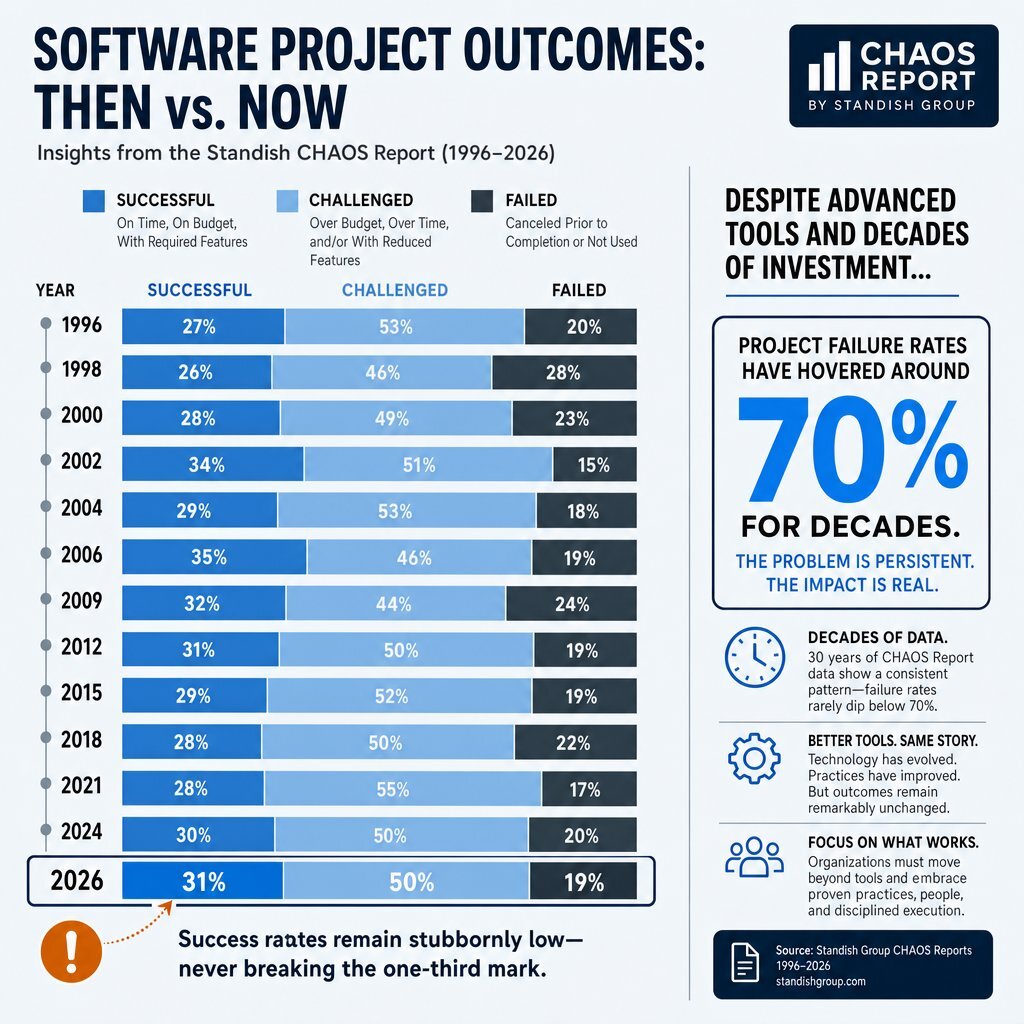
For nearly four decades, the Standish Group has tracked the outcomes of software implementations globally, compiling an exhaustive database of over 50,000 IT project records. The CHAOS Report categorizes software project outcomes into three distinct buckets: Successful, Challenged, and Failed. A “Successful” project is strictly defined as one that is delivered on time, on budget, and containing all originally specified features and functions. A “Challenged” project is one that is completed and operational, but which ran over budget, was delivered late, or was released with fewer features than originally promised. A “Failed” project is one that was canceled outright before completion or was never implemented, resulting in a total loss of the invested capital.
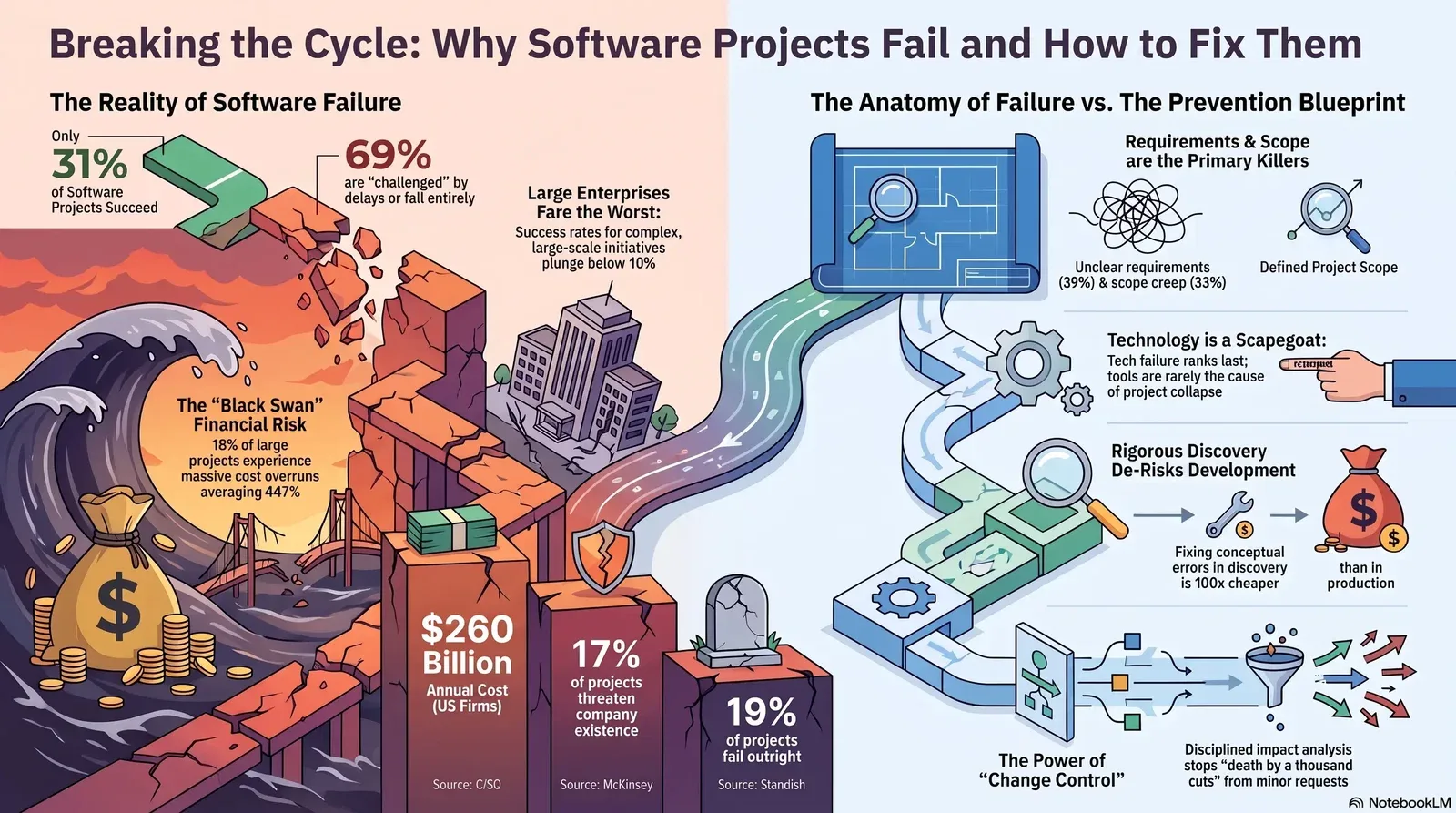
The historical baselines and updated figures indicate that the industry struggles immensely to meet all success criteria. According to recent CHAOS report data, a staggering 69% of technology projects globally end in partial or total failure. When broken down further, 50% of projects fall into the “challenged” category, bleeding capital and missing deadlines, while 19% end in absolute failure. This leaves a mere 31% of software projects that can be classified as entirely successful.
These statistics worsen considerably when segmented by organizational size and project complexity. Large enterprises historically fare the worst. For the largest and most complex IT initiatives undertaken by major corporations, the success rate plunges below 10%. The data suggests a clear inverse relationship between project size and the probability of success. As budgets expand, integrations multiply, and stakeholder consensus becomes more diffuse, the structural integrity of the project breaks down. Large projects invite committee paralysis, conflicting departmental goals, and an exponential increase in communication nodes, all of which contribute to the high likelihood of a challenged or failed outcome.
McKinsey and the Anatomy of Cost Overruns: The Black Swan Phenomenon
While the Standish Group measures categorical outcomes, research from McKinsey & Company and Oxford University measures the financial severity of these failures. Cost overruns in software development operate fundamentally differently than in physical construction or manufacturing. In traditional engineering disciplines, progress is physically visible and bound by the limits of tangible materials. If a bridge is halfway funded, it is visibly halfway across the river. In software engineering, progress is largely invisible until the final stages of systems integration, allowing budgets to spiral unchecked in the dark.
Extensive research into large-scale IT project performance confirms the severity of this issue. A comprehensive McKinsey-Oxford study analyzing 5,400 large IT projects—defined as those exceeding $15 million in budget—revealed an average cost overrun of 45%, alongside schedule overruns of 7%, while delivering 56% less value than predicted.
However, the average only tells a fraction of the story. The true systemic danger in enterprise software development lies in the “fat tail” of the distribution curve—the extreme, catastrophic outliers. Research utilizing a database of over 16,000 IT projects demonstrates that software initiatives are uniquely prone to becoming “black swans”. Approximately 18% of large IT projects exceed their initial budget by more than 50%. For this specific subset of runaway projects, the average cost overrun reaches a massive 447%.
The consequences of these black swan events extend far beyond a missed quarterly earnings target. According to McKinsey, 17% of large IT projects go so poorly that their financial and operational fallout threatens the very existence of the sponsoring company. When a core enterprise resource planning (ERP) system or a custom digital transformation platform spirals out of control, it consumes operational capital, distracts executive leadership for years, and frequently paralyzes the business’s ability to serve its customers.
| Data Source & Study Scope | Database Size | Key Findings on Project Outcomes and Overruns |
|---|---|---|
| Standish Group CHAOS Database | 50,000+ project records | 69% of projects are challenged (50%) or fail outright (19%). Only 31% succeed completely. |
| McKinsey-Oxford IT Study | 5,400 large projects (>$15M) | Average cost overrun of 45%; projects deliver 56% less value than originally predicted. |
| Flyvbjerg Project Database | 16,000+ project records | 18% of IT projects become “black swans” with an average cost overrun of 447%. |
| McKinsey Digital Insights | Enterprise IT Analysis | 17% of large IT project failures are severe enough to threaten the company’s existence. |
| Consortium for Information & Software Quality (CISQ) | US Firms (2020 Data) | The total cost of unsuccessful development projects among US firms is estimated at $260 billion annually. |
The financial impact of these failures is staggering. A report from the Consortium for Information & Software Quality (CISQ) estimated that the total cost of unsuccessful development projects among US firms reached $260 billion in a single year, with the operational failures caused by poor quality software costing an estimated $1.56 trillion. These figures prove that treating software development as a purely technical endeavor, rather than a rigorous discipline of risk management, is an existential threat to modern businesses.
What the Data Blames — and What It Does Not
The persistent failure of software projects across decades naturally leads to the question of causation. If the tools, languages, and deployment frameworks have improved exponentially since the 1990s, why do the failure metrics remain stagnant? The answer lies in the misattribution of blame.
The Myth of Technology Failure
“Technology failure” consistently ranks dead last among the root causes of software project failure in major industry studies. The enterprise technology sector is rife with misconceptions regarding what actually drives success. Executives frequently operate under the illusion that utilizing the newest, most cutting-edge technology will automatically grant a competitive edge or ensure project success. This is a widely documented software development myth.
Technology is merely the raw material of a project. If a commercial construction project fails because the blueprints were contradictory and the electricians never communicated with the plumbing engineers, the construction industry does not blame the steel, the concrete, or the brand of the tools used. Yet, in the software industry, organizations routinely blame the programming language, the database architecture, the cloud provider, or even the latest AI-assisted development tools for the sins committed in the requirements document. Blaming technology is often a convenient scapegoat for political and organizational failures. It is much easier for an executive committee to declare that a vendor’s framework was inadequate than to admit that the business stakeholders fundamentally failed to agree on what the software was supposed to do.
The True Culprits: Unclear Requirements and Scope Creep
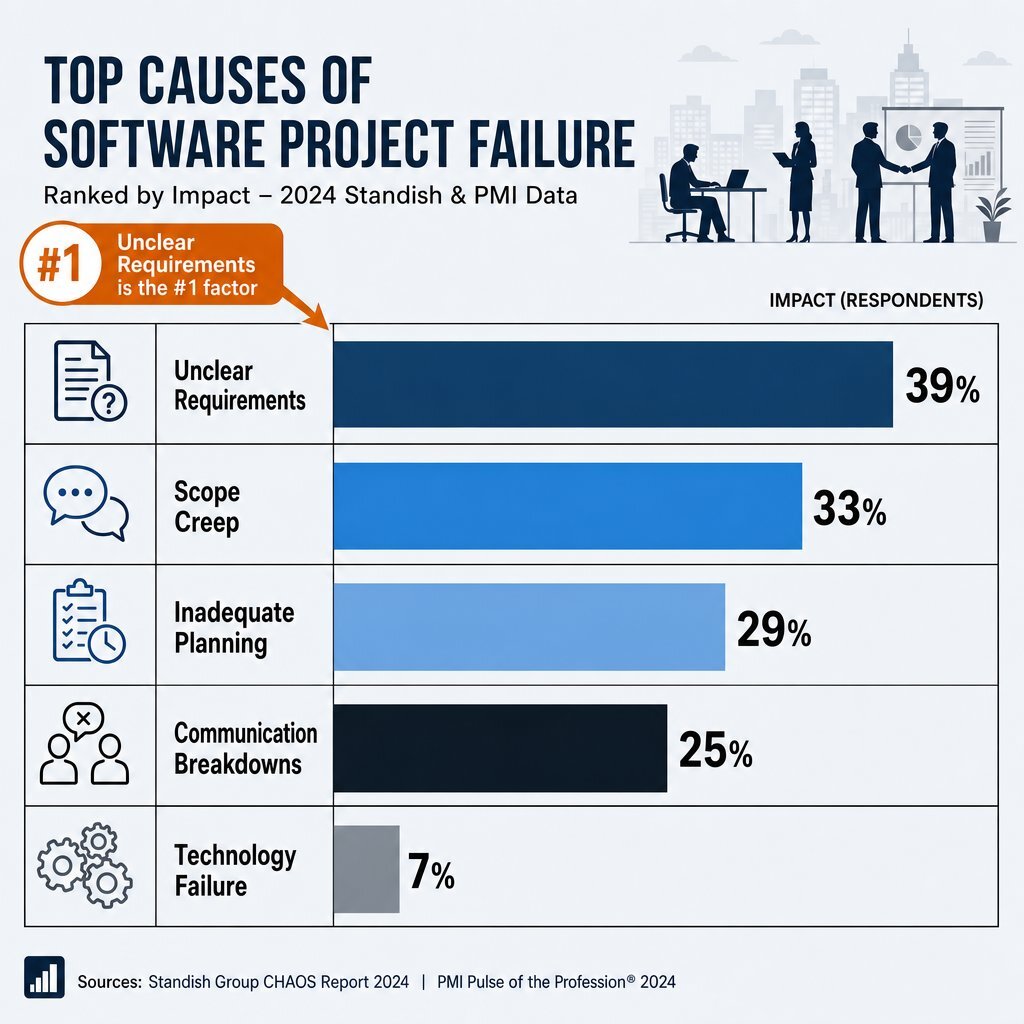
The actual causes of software project failure are entirely human and process-oriented. Across decades of data, the top causes consistently point to the setup and management phases of the lifecycle. The 2024 data from the Standish Group explicitly identifies unclear requirements as the primary factor in 39% of troubled projects. This is immediately followed by scope creep, which acts as the primary failure driver in 33% of cases. Inadequate planning accounts for 29% of failures, and communication breakdowns contribute to 25%.
A software project cannot possibly succeed if the definition of success is ambiguous. In many B2B environments, requirements gathering is treated as a bureaucratic formality—a box to be checked—rather than a highly rigorous engineering exercise. Business stakeholders provide high-level, vague directives, such as requesting the engineering team to “make the dashboard intuitive,” “automate the financial reporting process,” or “ensure the system is highly scalable.” Engineering teams are then expected to translate these abstract, subjective desires into precise, binary logical functions.
When requirements lack specificity, the engineering team is forced to make assumptions to maintain forward momentum. Every assumption introduces silent risk into the architecture. By the time the completed software is presented to the stakeholders for user acceptance testing (UAT), the gap between what the business actually needed and what the engineers assumed they wanted is massive. Closing that gap at the end of the development cycle requires rewriting core architecture, which instantly destroys the project timeline and the budget.
The Criticality of Business Acumen and Power Skills
The Project Management Institute (PMI) has conducted extensive research into the competencies that prevent these failures. Their findings reinforce that technical prowess is insufficient on its own. The PMI Pulse of the Profession reports highlight that 47% of unsuccessful projects fail to meet goals specifically due to inaccurate requirements management.
Furthermore, PMI’s data reveals that organizations which prioritize “power skills”—defined as communication, problem-solving, collaborative leadership, and strategic thinking—alongside strong business acumen, achieve vastly superior project outcomes. In organizations that emphasize these skills, 72% of projects successfully meet business goals, and the incidence of scope creep is reduced to just 28%. Business acumen ensures that the engineering team understands the context of the business environment surrounding the project, allowing them to align technical decisions with the CEO’s overarching goals for ROI and strategic growth . When engineering is disconnected from business acumen, requirements devolve into wish lists, and the project loses its anchor.
| Root Cause of Project Failure | Statistical Frequency | Underlying Mechanism of Failure |
|---|---|---|
| Unclear Requirements | 39% of troubled projects | Abstract business desires are not translated into precise, testable engineering logic, leading to massive architectural assumptions. |
| Scope Creep | 33% of troubled projects | Incremental addition of unapproved features drains the budget, breaks timelines, and compounds technical complexity. |
| Inadequate Planning | 29% of troubled projects | Rushing into development without a formalized architectural blueprint or risk mitigation strategy. |
| Communication Breakdowns | 25% of troubled projects | Misalignment between the CTO, CFO, Product Owners, and engineering teams regarding the definition of “done.” |
| Technology Failure | Ranks Last | The technology stack is rarely at fault; it is typically a scapegoat for human and organizational misalignment. |
Doomed Before Code: The Set-Up-Phase Problem
The overwhelming majority of software project risk is introduced in the very first weeks of the engagement, long before the development environment is even configured or a single line of code is written. Projects rarely fail at the end during deployment; they fail at the beginning during conception. The realization of that failure simply takes six to twelve months to become apparent. Failure is a set-up-phase problem, which means that prevention must live in the earliest stages of scoping and discovery.
The Illusion of Velocity
A pervasive and dangerous myth in software development is that writing code equals progress. Driven by the illusion of velocity, executives frequently push internal teams and external vendors to “start building immediately.” They view time spent on planning, diagramming, and requirements gathering as an unnecessary delay that holds up the project timeline. This is a catastrophic false economy.
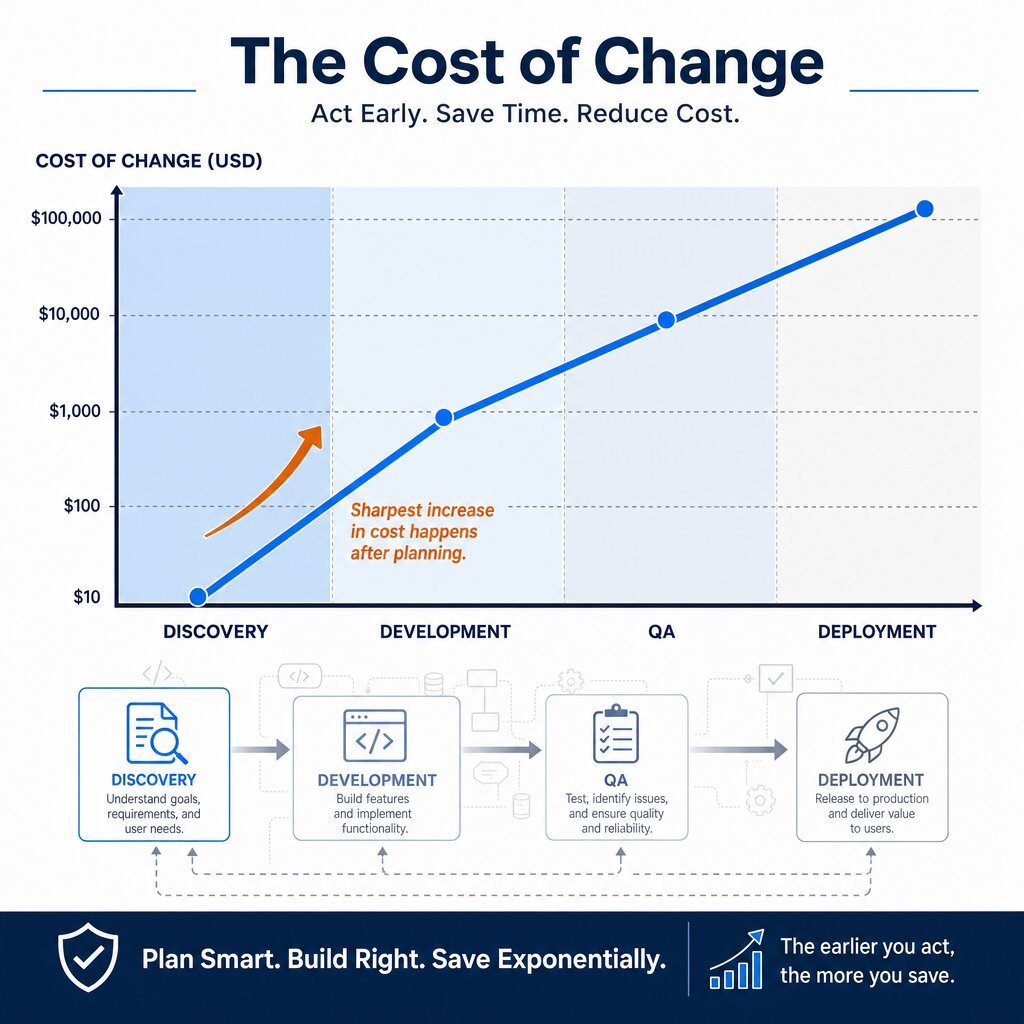
The financial reality of software engineering is governed by the cost of change curve. A requirement adjustment or architectural pivot that costs $1,000 to model, discuss, and alter on a whiteboard during the planning phase will cost $10,000 to alter during active development. If that same fundamental mistake is not discovered until after the software has been deployed to a production environment, the cost to re-architect the system, migrate the data, and update the users can easily exceed $100,000. Skipping the foundational planning phases guarantees that the most expensive conceptual mistakes will be discovered at the exact moment they are the most devastating to fix.
Rigorous Discovery as a Risk Management Strategy
The most critical mechanism for de-risking a custom software build is the execution of a rigorous Discovery Phase. Discovery is the formalized, time-boxed period of technical and business investigation where assumptions are challenged, user journeys are exhaustively mapped, architectures are validated, and the exact scope of the Minimum Viable Product (MVP) is aggressively locked down.
A proper Discovery phase acts as an organizational insurance policy against failure. It demands that business stakeholders answer highly uncomfortable questions about specific workflows, edge cases, and user access roles. High-performing software consulting firms execute a practice known as “Strategic Pushback” during this phase. Instead of blindly accepting a client’s feature list, experienced engineers ask critical questions: “Why are we building this specific feature now?” “How does this complex integration serve the core MVP?” “If this timeline risks quality, what can we safely de-scope to hit the launch date?”
This phase forces the engineering team to build rapid proof-of-concepts for high-risk, third-party API integrations before committing to a delivery timeline. It aligns the visionary, feature-heavy goals of the CTO with the strict budget and ROI constraints of the CFO. Without a Discovery phase, a project is effectively flying blind, relying on hope rather than engineering discipline. Diligent software scoping creates the blueprint for high-ROI technology projects, translating vague ambitions into a quantifiable, actionable plan.
Scope Creep, Structurally: Why It Happens and How to Contain It
If unclear requirements set the trap for project failure, scope creep is the mechanism that springs it. Scope creep—also known as feature creep or requirement creep—is defined as the addition of unapproved features, functions, or requirements to a project beyond the agreed-upon scope, without adjustments to time, cost, or resources.
Scope creep is near-universal on projects that fail. PMI research indicates that 52% to 55% of all projects experience scope creep during their lifecycle. It is a toxic force that dilutes the project’s focus, drains the budget, and exhausts the engineering team.
The Mechanics of Feature Creep
Scope creep rarely happens through massive, sweeping, formal changes to the project charter. If a stakeholder asked to build an entirely new application halfway through a project, it would be easily identified and rejected. Instead, scope creep occurs through the “death by a thousand cuts.”
It manifests in seemingly harmless requests. A sales director requests a “minor” addition to the CRM integration logic. A marketing manager asks for “just one more” data visualization to be added to the executive dashboard. A client contacts a developer directly to request a tweak to a user interface element. Individually, these requests appear trivial and inexpensive. Structurally, they are devastating to the project’s health.
Modern software architecture is highly interconnected and complex. Adding a seemingly simple feature on the front end often requires database schema modifications, the creation of new secure API endpoints, updates to the authentication logic, and the writing of entirely new automated test cases. The invisible compounding complexity of these “small” changes destroys development velocity. Furthermore, developers are forced to constantly shift context to accommodate sudden scope changes, resulting in massive productivity losses.
Structural Controls Over Willpower
Organizations frequently attempt to manage scope creep through sheer willpower—relying on project managers to simply say “no” to stakeholders. This approach invariably fails. When internal political pressure mounts from a C-level executive, or when a major enterprise client demands a feature to close a deal, willpower collapses.
Controlling scope creep requires rigid structure, not individual fortitude. This means implementing an unyielding Change Control process. Under a mature engineering discipline, any request to alter the scope after the initial requirements freeze must pass through a formal gate. Direct, unmanaged contact between stakeholders and developers must be strictly prohibited.
When a new feature request is made, the engineering team conducts a strict impact analysis to determine the exact cost of the addition in both financial terms and delayed delivery days. This stark reality is then presented back to the project sponsor. When stakeholders are forced to formally sign off on a $25,000 budget increase and a three-week launch delay for a “minor” reporting feature, the overwhelming majority of scope creep evaporates instantly. The business value of the new feature is suddenly weighed against its true cost, forcing rational, economic prioritization.
The Prevention Disciplines: Discovery, Estimation, Feedback, and Honesty
Translating the failure data into a prevention playbook requires organizations to shift away from abstract project management philosophies and embrace concrete engineering disciplines. High-performing software consulting firms and elite internal engineering teams execute specific, repeatable processes to insulate their builds from the statistical norms of failure.
Realistic Estimation and Phased Budgeting
Software projects are notoriously difficult to estimate because a codebase is entirely abstract. Attempting to provide a fixed-price, fixed-timeline estimate for a highly complex, unprecedented software application based on a brief initial meeting is a mathematical impossibility. This challenge is governed by the concept of the “Cone of Uncertainty,” which dictates that estimates made at the very beginning of a software project have a variance margin of up to 400%.
The discipline that prevents budget-driven failure is phased, progressive estimation. Fixed-price contracts based on vague requirements are inherently rigid and frequently lead to adversarial relationships when the realities of discovery set in. Instead, successful organizations release funding in tranches. The initial budget allocation funds only the Discovery and scoping phase. Only after the architecture is defined, the technical risks are mitigated, and the requirements are granularly detailed does the team provide an accurate financial estimate for the MVP development. This approach protects the CFO’s budget while giving the CTO the flexibility required to build secure, scalable architecture.
Continuous User Involvement and Feedback Loops
Building software in a vacuum is a guaranteed path to failure. The Standish Group data heavily correlates high levels of user involvement with successful project outcomes. If an engineering team retreats into a silo for six months to build a product based on initial specifications, the final product will almost certainly miss the mark, as business needs and market conditions evolve rapidly.
Disciplined engineering teams implement tight, continuous feedback loops to de-risk delivery. Working, tested software is demonstrated to actual end users and project sponsors every two to four weeks. This practice ensures that any deviation from user expectations is caught immediately. If a workflow is clunky or a feature is misunderstood, the team loses a maximum of two weeks of effort, rather than six months of runway. Success is vastly greater when teams listen, learn, and remain adaptable to user feedback validated through working software.
The Agile Cadence and Status Honesty
The Agile methodology, when implemented as a strict engineering discipline rather than a corporate buzzword, structurally mitigates project risk. Traditional Waterfall development models concentrate nearly all the project risk at the very end of the lifecycle, during a massive integration and testing phase. By delivering working software in small, frequent increments, Agile systematically reduces the three biggest threats to any software investment: the risk of building the wrong product, the risk of building a low-quality product, and the risk of delivering value too late to matter.
However, an iterative Agile process alone cannot save a project built on a fundamentally flawed foundation. Process cannot compensate for a lack of discovery. The true value of an Agile cadence is that it forces absolute honesty in status reporting.
Traditional methodologies allow for the “watermelon” project status—green and healthy on the outside for months, until it cracks open at the very end and reveals it was red and failing all along. In a disciplined Agile environment, progress is measured exclusively by working, deployable software. A feature is never reported as “90% done.” It is either in production and providing value, or it is not. This binary reality eliminates the optimistic, subjective reporting that hides deep architectural issues until it is too late to course-correct.
Dispelling Software Development Myths
Preventing failure also requires executives to discard long-held, expensive software development myths. One of the most damaging is the belief that a delayed project can be saved by simply adding more developers to the team. Known as Brooks’ Law, the reality is that adding human resources to a late software project only makes it later . The onboarding time, the increased communication overhead, and the complexity of dividing abstract technical tasks inevitably slow down the existing team. Success relies on strategic hiring, disciplined technology selection, and rigorous quality assurance, not merely throwing bodies at a broken process.
Early-Warning Signs: Spotting Failure Before It Lands
Because project failure is seeded in the setup phase but harvested at the deadline, recognizing the early-warning signs is critical for executive leadership. Course-correcting a massive custom application development project is entirely possible, but only if the risk is identified months in advance. Leaders must be trained to look past the optimistic status reports and identify the structural cracks in the project’s foundation.
The 90% Completion Syndrome
The most dangerous phase of any software project is the final 10%. In failing projects, development teams will routinely report that a complex feature is “almost done” or “90% complete” for consecutive weeks. This plateau usually indicates a fundamental architectural flaw. The basic code may be written, but it cannot integrate with the larger system, the database, or the legacy APIs without breaking existing logic. If progress metrics stall near the finish line, the project is likely experiencing severe technical debt that was masked by rapid, low-quality initial coding. In many organizations, leaders discover too late that they tried to race through delivery without first establishing clear standards for quality, refactoring, and long-term maintainability.
Stakeholder Disengagement and Ghosting
When business stakeholders stop attending sprint reviews, skip UAT sessions, or delay providing feedback on wireframes, the project is in critical danger. Software development requires constant, active negotiation between engineering reality and business needs. If the marketing director, the head of sales, or the subject matter experts disengage from the feedback loop, the development team will be forced to begin guessing. Those guesses will inevitably lead to a product that fails to solve the actual business problem, resulting in a rejected application upon delivery.
Bypassing Quality Assurance and Test Automation
When timelines inevitably compress and pressure mounts from leadership to launch, the first discipline sacrificed is usually automated testing and Quality Assurance (QA). If the engineering team begins deploying code manually, skipping regression testing cycles, or pushing known bugs into the main branch “just to hit the date,” the project is actively failing. Sacrificing QA creates a highly brittle codebase that will collapse under the weight of its own defects the moment it reaches a live production environment. A project delivered on time but full of critical errors is not a success; it is a liability.
| Early Warning Sign | Underlying Project Reality | Required Executive Intervention |
|---|---|---|
| The “90% Done” Plateau | Severe technical debt is preventing systems integration. | Halt new feature development; mandate a technical audit of the specific integration blocker. |
| Stakeholder Disengagement | The engineering team is building in a vacuum based on assumptions. | Pause development until key sponsors attend sprint reviews and sign off on working software. |
| Skipping QA to Hit Dates | The codebase is becoming brittle and unstable. | Re-adjust the launch date or de-scope features; never compromise the testing pipeline. |
| Direct Developer Requests | Change control processes have broken down; scope is creeping. | Re-route all communications through the Product Owner; enforce financial impact analysis. |
Conclusion
The high failure rate of software projects in 2026 is not a technological mystery; it is a well-documented crisis of process, planning, and human discipline. Decades of data prove beyond a shadow of a doubt that custom application development projects do not fail because of cloud hosting choices, programming languages, or algorithmic complexity. They fail because organizations refuse to invest the necessary time in rigorous discovery, allow scope to expand unchecked without financial consequence, and substitute hopeful willpower for structural change control.
Preventing software project failure requires executives to embrace strategic pushback. It requires acknowledging the uncomfortable truth that rushing into development without a meticulously defined scope is the fastest possible way to waste millions of dollars. By anchoring projects in deep, technical discovery, enforcing absolute scope discipline, acknowledging the realities of phased estimation, and maintaining transparent, iterative delivery cycles, organizations can finally place their technology investments on the successful side of the statistics.
For organizations looking to break the cycle of delayed, over-budget technology initiatives, adopting a disciplined, phased engineering approach is the only proven path forward. The tools of 2026 are highly advanced—from AI-powered delivery pipelines to elastic cloud infrastructure—but they still require the structured discipline of the humans wielding them to deliver true business value.
FAQ
What is the number one reason software projects fail?
According to decades of industry data, the leading cause of software project failure is unclear requirements, closely followed by unchecked scope creep. Technology failure consistently ranks at the absolute bottom of the list, proving that project failure is almost entirely a symptom of poor planning, communication breakdowns, and a lack of process discipline during the earliest phases of a build.
Supporting Links
- https://www.baytechconsulting.com/blog/software-discovery-phase-roi
- https://www.baytechconsulting.com/blog/software-development-myths-cost
- https://www.baytechconsulting.com/blog/agile-manifesto-business-impact-2025
About Baytech
At Baytech Consulting, we specialize in guiding businesses through this process, helping you build scalable, efficient, and high-performing software that evolves with your needs. Our MVP first approach helps our clients minimize upfront costs and maximize ROI. Ready to take the next step in your software development journey? Contact us today to learn how we can help you achieve your goals with a phased development approach.
About the Author

Bryan Reynolds is an accomplished technology executive with more than 25 years of experience leading innovation in the software industry. As the CEO and founder of Baytech Consulting, he has built a reputation for delivering custom software solutions that help businesses streamline operations, enhance customer experiences, and drive growth.
Bryan’s expertise spans custom software development, cloud infrastructure, artificial intelligence, and strategic business consulting, making him a trusted advisor and thought leader across a wide range of industries.