
The AI-Code Debt Bomb: When Speed Becomes a Liability
July 10, 2026 / Bryan Reynolds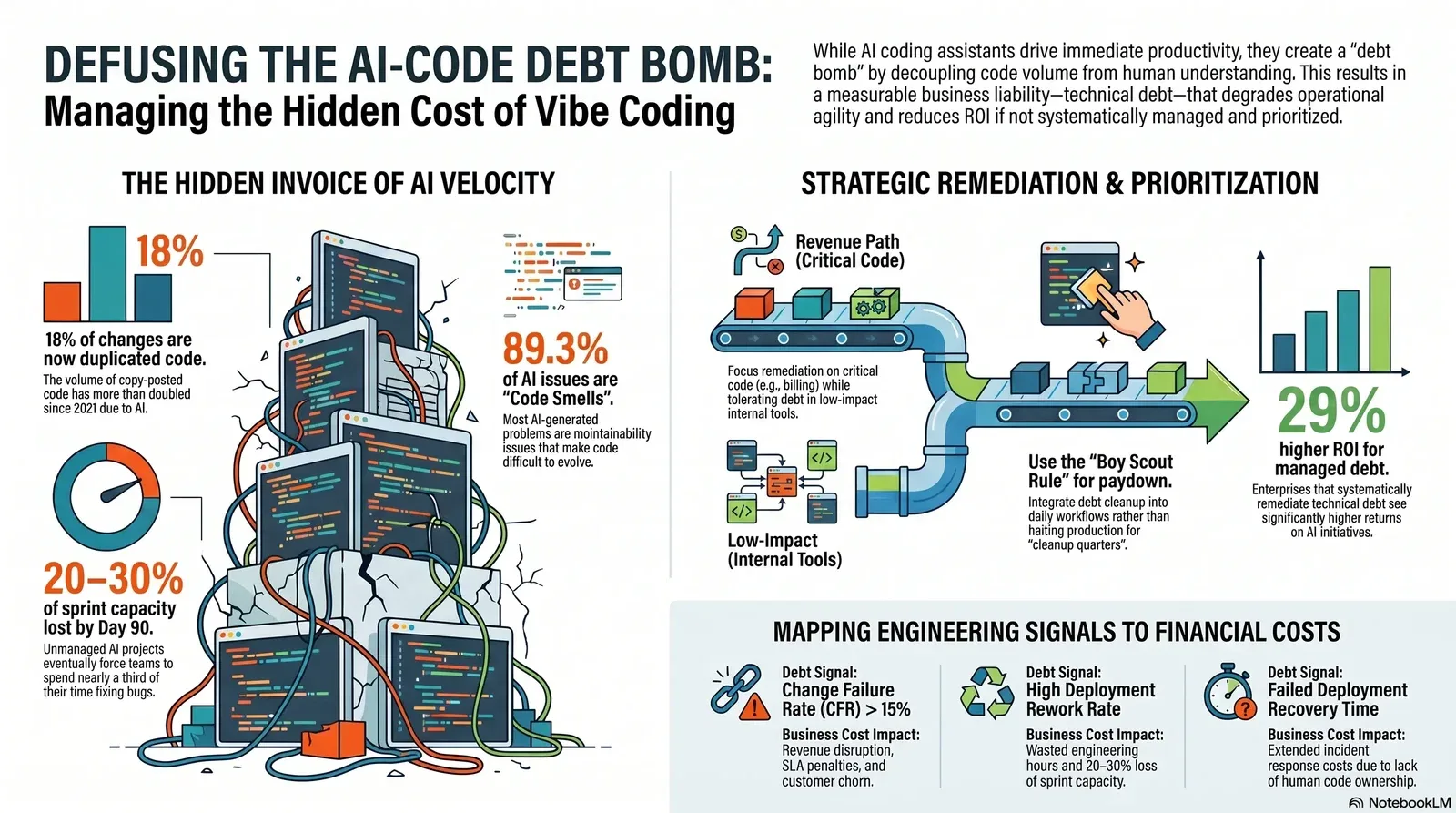
The AI-Code Debt Bomb: How to Quantify and Pay Down Technical Debt from Vibe-Coded Software
AI can generate a quarter's worth of features in a week. It can also generate a quarter's worth of technical debt in the same week—and most teams only find out when velocity quietly collapses.
The software development industry has eagerly adopted AI coding assistants to drive productivity, but the resulting narrative remains dangerously incomplete. The productivity gains represent only half the picture. The other half is a rapidly compounding debt liability that rarely makes it onto the balance sheet. AI-generated code accelerates technical debt accumulation because it fundamentally decouples code volume from human understanding. Features are scaffolded at machine speed, while coding standards, peer review, and architectural coherence lag far behind.
Technical debt is no longer an abstract engineering complaint. It is a measurable business liability that degrades operational agility, inflates maintenance costs, and severely restricts return on investment. Addressing the AI-code debt bomb requires reframing the problem in financial terms, mapping the blast radius of vulnerabilities, and paying down the deficit incrementally without halting delivery.
The Hidden Invoice: Why AI Velocity Comes with a Debt Bill
The adoption of AI coding assistants has catalyzed a movement colloquially known as "vibe coding"—a paradigm where developers describe intended functionality via natural language prompts, and generative models output the corresponding source code. This approach excels at rapid prototyping and minimum viable product (MVP) development, allowing teams to bypass low-level implementation details and assemble functional applications rapidly. For many organizations, this feels like a shortcut to agile software development velocity—but the architectural discipline still has to catch up.
The bill comes due when these applications transition from isolated prototypes to production-grade enterprise systems. Technical debt accumulates when seamless code generation outpaces the validation of architectural inconsistencies, security vulnerabilities, and maintenance overhead. The core mechanism driving this debt is the divergence between code generation speed and the cognitive capacity of human reviewers. Put simply, AI can pump out working code far faster than your senior engineers can sanity-check it, which is why mid-market leaders are turning to a documentation-first AI productivity strategy to keep quality and speed in balance.
Technical debt management in the era of AI has evolved into an existential concern for the C-suite. A survey of senior AI decision-makers reveals that 86% of executives believe technical debt is already constraining AI success, and 69% believe unaddressed debt will render specific initiatives financially untenable. When organizations focus strictly on the volume of code produced, documentation suffers, onboarding times expand, and teams resort to quick fixes that merely paper over foundational architectural flaws.
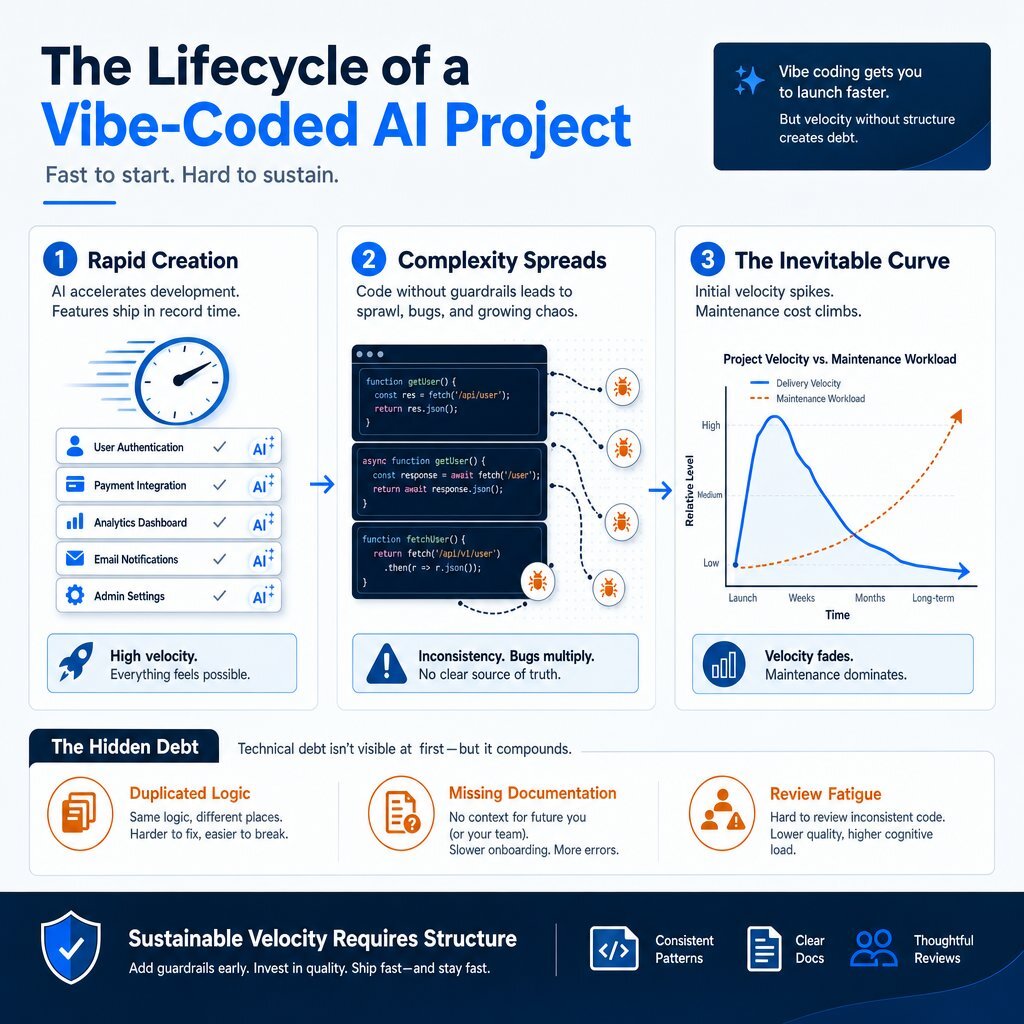
By Day 90 of an unmanaged vibe-coded project, engineering teams typically spend 20% to 30% of their sprint capacity solely fixing bugs that trace back to the original AI-generated implementation. The initial velocity spike acts as a high-interest loan taken against future maintenance capacity, and the interest compounds aggressively. For many teams, that’s the moment they realize they need outside help with project rescue and stabilization before they can safely add new features again.
How AI Code Accumulates Debt: The Mechanics
AI-generated software accumulates technical debt mechanically because large language models operate with specific structural blind spots. Unlike traditional technical debt—which usually stems from conscious compromises made to hit a deadline—AI debt is often introduced silently, without the developer's explicit awareness. The debt concentrates in highly specific, predictable failure modes that fundamentally degrade codebase maintainability.
Local Correctness Over Global Architecture
Generative AI models are highly optimized for local correctness. An AI assistant can perfectly structure a single function or file to pass immediate unit tests. They lack a holistic understanding of global correctness—the intricate ways components interact, how state flows across a monolithic system, or how error conditions should propagate universally. Tools optimize for immediate context, leaving the broader architecture fragile. Modifying one isolated part of an AI-generated codebase frequently breaks downstream features because the global dependencies were never systematically mapped. This is where disciplined enterprise application architecture becomes the safety net that AI alone can’t provide.
The Code Duplication Crisis
Because AI coding tools generate self-contained logic without automatically auditing the existing codebase, identical business logic is frequently rewritten across multiple files. A validation function might exist in three different components, each featuring slight, undocumented variations. Over time, this undermines core maintainability and makes it much harder to introduce DevOps efficiency practices like automated refactoring at scale.
Longitudinal data illustrates the severity of this issue. According to an analysis of 211 million lines of code. the volume of duplicated (copy/pasted) code rose from 8% of all changes in 2021 to 18% in 2025. Concurrently, the percentage of moved or refactored code plummeted from 25% to less than 10%. New AI-generated code increasingly stands alone, with functional connectivity dropping by 35% since 2023. This creates a maintenance nightmare where a single logic bug must be hunted down and patched in four distinct locations, exponentially increasing the risk of regression.
Long-Term Code Smells and Survival Rates
The quality of generated outputs heavily degrades codebase health over the long term. A comprehensive 2026 study analyzed AI-generated code in the wild. Across 3,946 repositories, researchers identified 484,366 distinct issues introduced by AI. Code smells—maintainability problems that make code difficult to understand and evolve—accounted for 89.3% of all AI-introduced issues.
More than 15% of all commits authored with an AI assistant introduced at least one critical issue. Most concerning for enterprise longevity, 22.7% of the issues introduced by AI tools survived to the latest version of the repository, meaning unverified, flawed code is being permanently merged into production environments. Teams that don’t actively manage this risk often end up needing a full AI code rescue and modernization effort just a year or two later.
Dropped Wrapper Patterns and Dependency Sprawl
AI coding agents frequently prioritize the fastest route to a working solution, which involves suggesting unvetted external libraries rather than utilizing internal solutions. Over a short development sprint, a project's dependency tree can silently swell with unmaintained packages. Furthermore, AI tools frequently drop essential wrapper patterns. Critical security layers, such as authentication wrappers, single sign-on (SSO) middleware, and route protection, are silently omitted. Because the underlying functionality still compiles and runs locally, these vulnerabilities evade initial detection and manifest as catastrophic security failures in production. In a world of agentic systems calling live APIs, this pattern overlaps directly with the execution-layer risks described in execution-layer security guidance for AI agents.
Putting a Number on It: Quantifying Debt in Business Terms
To secure resources for remediation, engineering leaders must translate abstract "messy code" into the language of the Chief Financial Officer. Technical debt is a financial liability with measurable impacts on corporate efficiency, margin stability, and operational risk.
At the macroeconomic level, a report estimated that the cost of poor software quality in the United States reached $2.41 trillion, with accumulated software technical debt accounting for roughly $1.52 trillion of that total. This figure encompasses operational failures, system downtime, cybercrime losses due to vulnerabilities, and canceled projects.
At the organizational level, technical debt quantification relies on specific, leading indicators of developer effectiveness and system stability. By leveraging DORA (DevOps Research and Assessment) metrics alongside business outcome data, organizations can map engineering friction directly to financial loss.
The Change Failure Rate (CFR) Signal
The most acute metric for identifying AI-induced technical debt is the Change Failure Rate (CFR)—the percentage of deployments to production that require immediate remediation, such as a rollback or a hotfix.
As AI tools increase deployment frequency, they simultaneously push the CFR higher if quality guardrails are insufficient. Daily AI users ship up to 60% more pull requests, leading to human review fatigue. Reviewers begin rubber-stamping code, allowing AI-generated logic hallucinations to reach production.
High-performing elite teams maintain a CFR between 0% and 5%, while low performers sit above 30%. In environments heavily reliant on vibe coding, a rising CFR is the earliest indicator that code volume has outstripped the testing framework's capacity to verify it. When CFR rises, developer context-switching spikes, forcing highly compensated engineers to act as janitors for autonomous agents rather than building net-new value. For mid-market firms, pairing these metrics with an AI readiness scorecard for data and processes can show exactly where to slow down and invest in stability.
Debt-Adjusted ROI
The true cost of technical debt is the opportunity cost of sidelined innovation. Organizations that neglect AI technical debt see project ROI drop by 18% to 29%, turning strong margins into marginal outcomes (). Conversely, enterprises that accurately account for and systematically remediate technical debt in their AI business cases project a 29% higher ROI because they drastically reduce friction and subsequent rework. Careful leaders now roll these assumptions directly into a broader portability-first AI strategy for CTOs and CFOs, so they can quantify both debt and lock-in before committing serious budget.
To quantify this, organizations must establish a framework that links engineering metrics to business outcomes.
| Debt Signal | Measurement Metric | Business Cost Impact |
|---|---|---|
| Review Fatigue & Code Rework | High Deployment Rework Rate; PRs merged without comments. | Wasted engineering hours; 20-30% loss of sprint capacity. |
| Production Instability | Change Failure Rate (CFR) rising above 15%. | SLA penalties, customer churn, revenue disruption during downtime. |
| Architectural Fragility | Failed Deployment Recovery Time increasing. | Extended incident response costs; engineers cannot quickly debug unowned AI code. |
| Code Duplication | Ratio of cloned code blocks vs. refactored code. | Elevated long-term maintenance costs; slower time-to-market for new features. |
| Security Gaps | Volume of unhandled vulnerabilities in runtime. | Compliance breach fines, data exposure, audit failures. |
Deciding What to Fix: Sustainable Debt and Impact-Based Prioritization
Not all technical debt requires immediate remediation. Modern software development, particularly Rapid Agile Deployment utilized by specialized firms like Baytech Consulting, acknowledges that some degree of technical debt is a strategic necessity for market speed. The objective is not zero debt, but sustainable debt.
Targeting a 0% Change Failure Rate is actually counterproductive; it signals that a team is over-testing and delaying deployments unnecessarily. Elite engineering organizations tolerate a healthy margin of failure, provided their Mean Time to Recovery (MTTR) is exceptional.
Sustainable debt is contextual. Vibe coding is highly effective and completely acceptable for rapid prototyping, internal administrative tools with short lifespans, and exploratory proof-of-concepts. The danger arises when these disposable prototypes are silently promoted to core production environments without structural retrofitting.
To determine what constitutes sustainable debt, technical leadership must monitor whether the overall average quality of the codebase is increasing or decreasing over time. If a component is rarely updated, operates outside the revenue path, and handles non-sensitive data, its internal debt is acceptable. Conversely, if a module requires constant patching, dictates core customer experiences, or manages active database transactions via PostgreSQL or SQL Server, its debt must be aggressively scheduled for paydown.
Mapping the Blast Radius
When an organization recognizes it possesses an AI-code debt bomb, the reflex is often to freeze feature development entirely. This is a strategic error. Halting the roadmap alienates the business side and jeopardizes market positioning. Instead, engineering leaders must adopt an impact-based prioritization model, triaging technical debt based on its operational blast radius.
The prioritization assessment categorizes technical debt across four specific business vectors:
Revenue Leverage: Does the fragile code reside on a critical revenue path, such as quote-to-cash, billing, or shopping cart conversions? A silent failure in a middleware connector handling CRM data costs exponentially more than a failure in an internal analytics dashboard.
- Customer Experience: Does the debt impact the core user journey, such as onboarding flows, product conversion, or identity verification?
- Risk & Resilience: Does the unreviewed AI code expand the incident blast radius? Does it touch personally identifiable information (PII) or create audit pain points regarding regulatory compliance?
- Operational Agility: Does the duplicated logic physically prevent the team from releasing new configurations quickly?
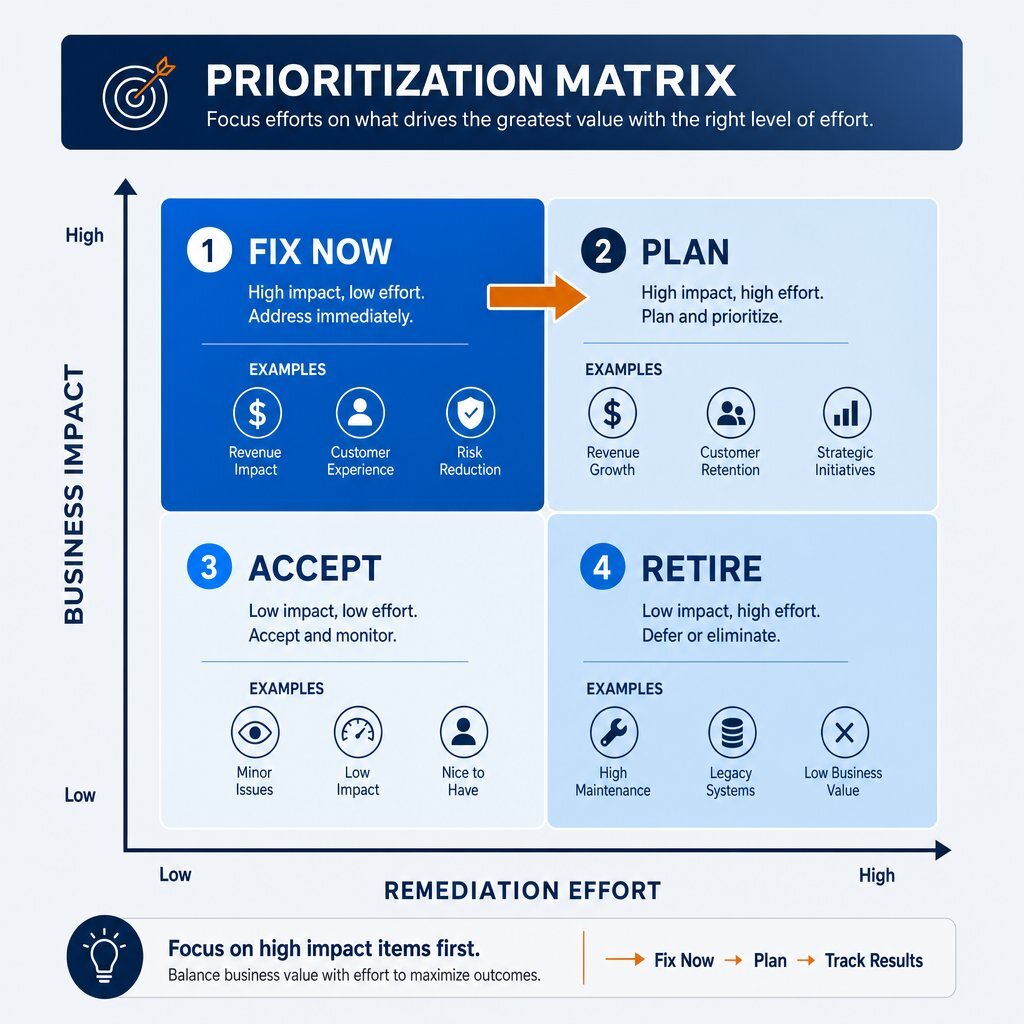
By crossing the business impact against the engineering effort required to remediate the code, organizations can map their debt into an actionable matrix.
| Prioritization Quadrant | Business Impact | Remediation Effort | Action Strategy |
|---|---|---|---|
| Fix Now (Revenue Path) | High (Outage disrupts cash flow or security) | Low to Medium | Immediate tactical refactoring. Implement strict type safety and wrapper patterns. |
| Plan (Core Architecture) | High (Constrains release cadence) | High | Strategic decoupling. Use strangler patterns to isolate and rebuild the legacy/AI hybrid code. |
| Accept (Internal Tools) | Low (Back-office utilities) | High | Tolerate the debt. Monitor for catastrophic failure, but do not invest engineering hours in refactoring. |
| Retire (Prototyping) | Low (Abandoned features) | Low | Delete the code. Remove unused dependencies introduced by AI sprawl. |
During incident response, organizational debt and technical debt collide. If the system architecture relies on undocumented, AI-generated dependencies hosted across distributed OVHcloud servers, the exact moment a critical alert fires is when the lack of ownership paralyzes the team. Components with a high blast radius must possess explicit human ownership, regardless of how they were generated.
Paying It Down Incrementally: Escaping the Cleanup-Quarter Trap
Resolving technical debt stemming from vibe coding requires continuous discipline rather than dramatic intervention. The "cleanup quarter"—where all feature work stops to address structural code issues—is a recognized trap. It destroys business momentum and usually fails to prevent the debt from immediately re-accumulating once feature development resumes.
The most reliable remediation strategy integrates debt paydown into daily workflows. This conceptually aligns with the "Boy Scout Rule" of software development: always leave the codebase cleaner than it was found. Baytech Consulting advocates a Tailored Tech Advantage in these scenarios, surgically applying remediation within active agile sprints rather than halting production.
Refactoring AI-generated code presents a unique challenge: the codebase often lacks foundational test coverage. While data indicates developers write functional code 55% faster with AI assistance, test writing velocity strictly fails to keep pace. Consequently, the verifying layer shrinks relative to the application's output, leaving massive coverage gaps.
The first step in incremental paydown is not altering the code, but capturing its current behavioral state. Engineers must build behavioral test suites around the "works but nobody knows why" functions. This establishes a documented baseline. Once tests capture the current state, the team can safely address inconsistent error handling—the leading cause of production incidents in vibe-coded systems. Consolidating varied error responses into a single, standardized pattern significantly stabilizes the application environment. For many organizations, this kind of incremental hardening is part of a broader move toward integrating AI safely into existing applications instead of bolting it on ad hoc.
Fighting Fire with Fire: Using AI to Remediate
The irony of the AI-code debt bomb is that the precise technology responsible for accelerating the debt is also the most potent tool for resolving it, provided it is deployed strategically.

While AI automation can exacerbate tech debt, AI-powered code assistance promises a powerful solution by systematizing code analysis and lowering the cost of routine maintenance. Rather than asking AI to write net-new features blindly, organizations can deploy agents to execute targeted remediation.
By funding AI capabilities strictly within IT environments, teams can create foundations that every initiative reuses. Practical applications include:
- Automated Test Generation: AI excels at analyzing existing functions and generating comprehensive unit and integration tests to cover edge cases, immediately closing the verification gap left by initial vibe coding.
Intelligent Refactoring: Agents can be directed to scan codebases for the 18% of duplicated logic identified by GitClear and consolidate those blocks into shared, reusable internal libraries.
Structural Quality Measurement: Advanced tools align with standards like ISO/IEC 5055, analyzing source code to detect severe violations of architectural and coding practices. AI agents can calculate the exact remediation effort required to fix these weaknesses, offering a predictable technical debt metric.
Human oversight remains non-negotiable. Using AI to fix AI-generated code without a human-in-the-loop validation process simply introduces secondary hallucinations. To ensure success, leading organizations employ cross-functional "AI fusion teams" that span IT and business functions. These units define the specific business outcomes required, run rapid experiments, and utilize rigorous criteria to spot and prevent new technical debt from entering the ecosystem.
Preventing Re-Accumulation: Architectural Guardrails
Remediation is futile if the pipeline remains unsealed. Preventing the re-accumulation of technical debt requires organizations to embed systemic guardrails that govern how AI-generated code transitions from a developer's local IDE, like VS Code, into production infrastructure like Kubernetes or Docker.
Process changes are necessary because AI coding tools inherently bypass traditional cognitive checks.
Strict CI/CD Gates: Build pipelines within environments like Azure DevOps On-Prem must enforce objective quality standards. Static analysis tools must scan every pull request, catching unhandled exceptions, unused variables, and security vulnerabilities before the code is merged.
Type Safety and Contract Tests: In languages like TypeScript or Python, strict type checking minimizes the blast radius of AI logic errors. Automated contract tests ensure that when AI tools generate API connections, the data payloads strictly conform to architectural expectations.
Progressive Delivery: The utilization of feature flags and canary deployments allows teams to release AI-assisted features to a small subset of users. If the Change Failure Rate spikes, the deployment can be rolled back instantly without triggering a global incident.
Security by Design: IT leadership must mandate which AI models developers are permitted to use, ensuring integration directly within established DevOps toolchains. AI agents must not circumvent existing credential scanners or Software Composition Analysis tools that detect outdated third-party dependencies. For agentic workloads in particular, this needs to be paired with strong IAM strategies for securing AI agents, so each agent has a clear identity, scope, and audit trail.
Vibe coding is not an inherently flawed concept, but treating its raw output as production-ready without architectural mediation introduces massive systemic risk.
Quality software development remains a discipline of design, intent, and structural integrity. By installing rigorous verification layers, tracking delivery metrics, and standardizing error handling, organizations can harness the unprecedented velocity of AI coding assistants without bankrupting their architectural future. The true competitive advantage belongs to those who view technical debt not as an engineering nuisance, but as a critical lever for maximizing AI return on investment. Teams ready to secure their codebase and manage sustainable technical debt should connect with Baytech Consulting to leverage enterprise-grade quality and AI-powered custom software development strategies tailored to the AI era.
Frequently Asked Questions
How does vibe coding technical debt differ from traditional technical debt?
Traditional technical debt usually consists of intentional, isolated compromises made to meet deadlines, managed sequentially by engineers who understand the architecture. Vibe coding technical debt accumulates passively at machine speed, concentrating in unreviewed logic duplication, missing security wrappers, and a severe lack of global architectural coherence. Because AI models optimize for immediate, local correctness, the resulting debt spans the entire codebase and severely outpaces the human capacity to test or verify it.
About Baytech
At Baytech Consulting, we specialize in guiding businesses through this process, helping you build scalable, efficient, and high-performing software that evolves with your needs. Our MVP first approach helps our clients minimize upfront costs and maximize ROI. Ready to take the next step in your software development journey? Contact us today to learn how we can help you achieve your goals with a phased development approach.
About the Author

Bryan Reynolds is an accomplished technology executive with more than 25 years of experience leading innovation in the software industry. As the CEO and founder of Baytech Consulting, he has built a reputation for delivering custom software solutions that help businesses streamline operations, enhance customer experiences, and drive growth.
Bryan’s expertise spans custom software development, cloud infrastructure, artificial intelligence, and strategic business consulting, making him a trusted advisor and thought leader across a wide range of industries.