
Bridging the AI Productivity Gap in Software Development
June 29, 2026 / Bryan Reynolds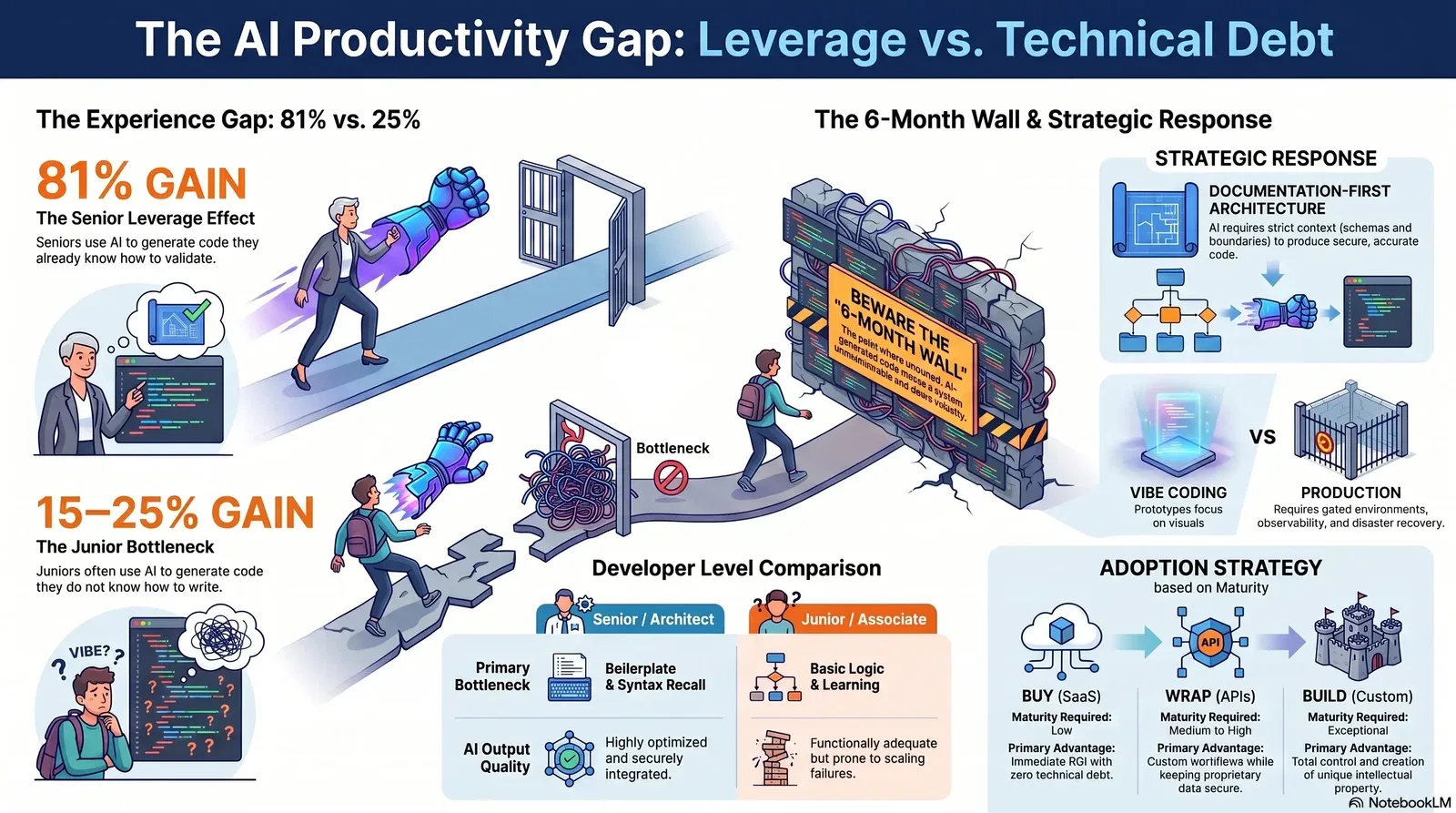
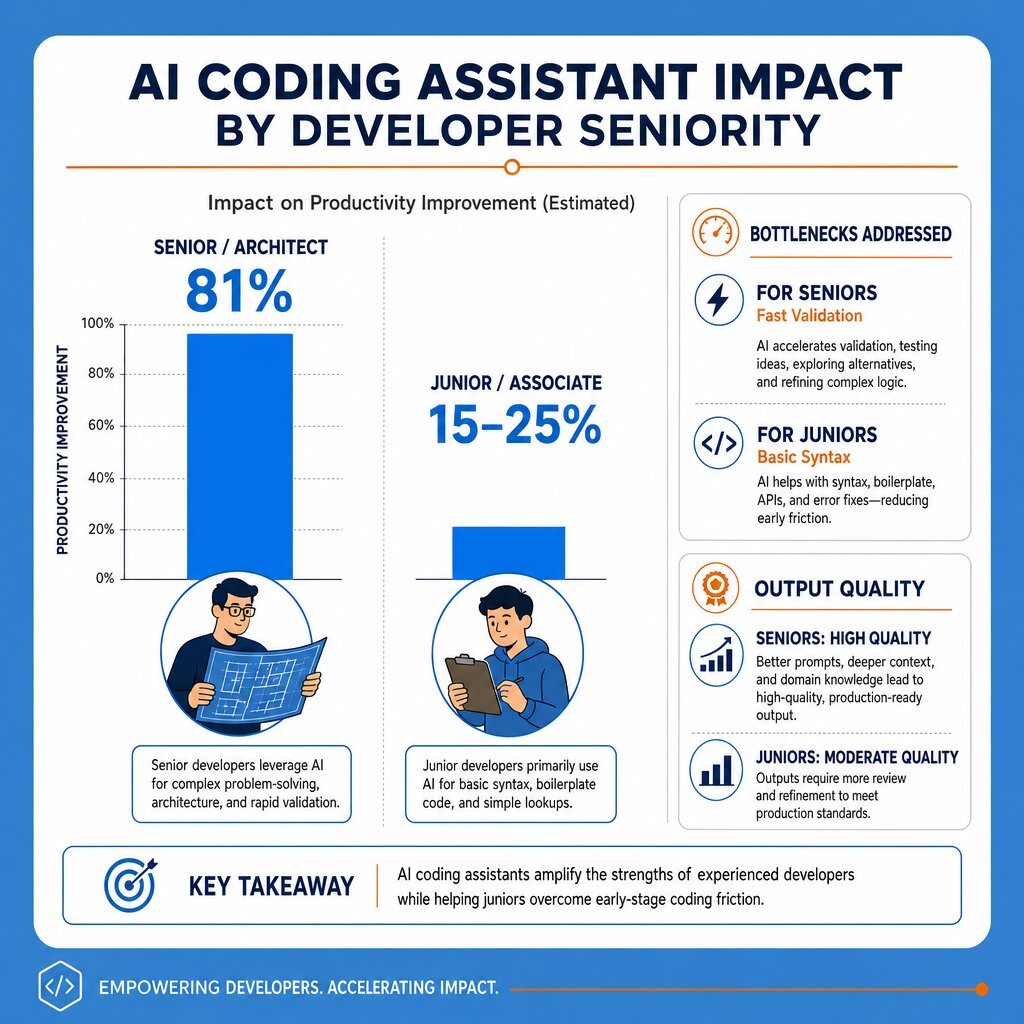
The most quoted statistics about AI in software development rely on an average, and that average hides the real story. When industry reports claim a uniform 40% to 50% boost in developer speed, they blend two completely different trajectories. Look at the extremes, and a much sharper reality emerges: Senior developers are reporting roughly 81% productivity gains from AI tooling. Junior developers are reporting 15-25%.
The headline is comfortable; the implication is not. AI does not lift everyone by the same multiple. It is a leverage instrument, and leverage applied to weak judgment compounds error faster, not slower.
This asymmetry fundamentally changes how engineering teams must operate. As discussed by Baytech Consulting CEO Bryan Reynolds and Gary Boyle on the Bering McKinley From the Trenches podcast, the gap between these two figures dictates everything from hiring strategies to how leaders assess the line between a prototype and a production system.
For the visionary CTO or the strategic CFO making capital allocation decisions, the AI developer productivity gap is the single most important metric to understand. It tells you which of your AI investments will compound into durable assets, and which will quietly accrue crippling technical debt.
The Leverage of Judgment: What Seniors Have That Juniors Don't
To understand why the 81% versus 15-25% gap exists, you have to look at what exactly a senior developer brings to the keyboard that an AI cannot simulate.
The primary constraint on software development has never been typing speed. The bottleneck is validation: determining if the code actually solves the business problem without breaking existing systems.
A senior developer possesses a vast internal pattern library. When an AI coding assistant suggests an Object-Relational Mapping (ORM) query, the senior instantly recognizes if that query will trigger an N+1 performance issue that brings down the database under heavy load. They reject the code, modify the prompt, and force the AI toward a performant solution. The senior uses AI to generate code they already know how to write.
A junior developer lacks this pattern library. They use AI to generate code they do not know how to write. Because the generated code successfully compiles and passes local tests, the junior accepts it. They lack the judgment to evaluate the architecture, security implications, or edge-case handling of the output.
| Developer Level | AI Productivity Gain | Primary Bottleneck Addressed | Resulting AI Output Quality |
|---|---|---|---|
| Senior / Architect | ~81% | Boilerplate generation, syntax recall, test scaffolding. | Highly optimized, architecturally sound, securely integrated. |
| Junior / Associate | 15–25% | Basic syntax, simple algorithmic logic, initial learning. | Functionally adequate locally, prone to hidden scaling failures. |
You cannot borrow judgment from a tool. AI raises the ceiling for engineers who already know what good software looks like, but it leaves the floor exactly where it was. Consequently, the strongest argument for structured technical apprenticeship and senior mentorship in the last decade is the deployment of AI coding assistants and integrating AI into your development workflows in a disciplined way.
Prototyping vs. Production: The Danger of Vibe Coding
This lack of judgment becomes financially dangerous when organizations fail to distinguish between a prototype and a production system.
The industry currently champions "vibe coding"—the process of rapidly iterating on an application using natural language prompts until the software visually appears to do what you want. Vibe coding is an exceptional way to build a prototype, test a market hypothesis, or wireframe a concept.
But taking vibe coding to production is where engineering teams court disaster. AI shrinks the cost of prototyping far faster than it shrinks the cost of production discipline. The danger is that the two artifacts look identical to a non-technical stakeholder. A CEO or Head of Sales sees a working web interface and assumes the software is ready to ship to customers.
It is not. A production artifact requires specific architectural properties that vibe-coded prototypes systematically ignore. The same is true when companies skip proven Agile methodology and DevOps practices just because AI feels fast.
- Gated Environments: Strict separation between development, staging, and production environments to prevent untested code from reaching users.
- Database Migrations: Version-controlled, reversible scripts for altering database schemas without destroying production data.
- Component Isolation: Decoupled services that fail independently rather than cascading into a system-wide outage.
- Observability: Integrated logging, tracing, and metrics that tell you why an AI-generated function failed in the wild.
- Disaster Recovery: Automated backups and tested restoration procedures.
When a junior developer vibe-codes a solution and pushes it straight to a user-facing environment without these properties, they are not accelerating delivery. They are writing checks the business will eventually have to cash. If that sounds uncomfortably familiar, it may be time for a structured project rescue before those decisions lock in.
The 6-Month Wall: When AI Technical Debt Comes Due
The cost of skipping architectural decisions rarely appears in the first few sprints. The demo impresses everyone. The initial velocity feels incredible. Then, the team hits the "6-month wall."
The 6-month wall is the point where accumulated, unowned AI-generated code makes a system unmaintainable. AI technical debt differs from traditional technical debt because it accumulates silently and at machine speed.
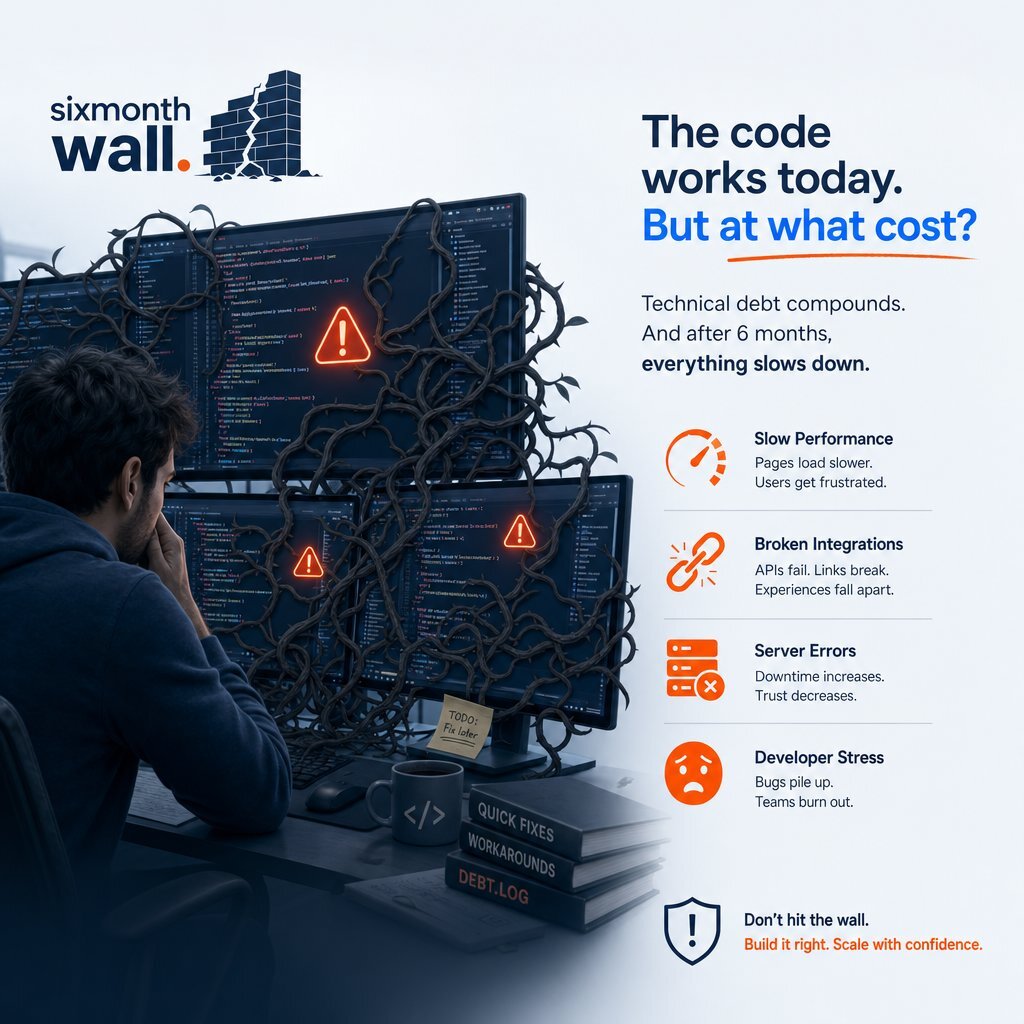
When humans write bad code, they at least remember writing it. When an AI generates 5,000 lines of poorly abstracted logic across three microservices, and the junior developer accepts it without understanding it, nobody owns that logic. Six months later, the business requests a minor feature change.
The warning signs of the 6-month wall are distinct:
- Minor feature additions that should take hours suddenly take weeks.
- Fixing a bug in the billing module inexplicably breaks the user authentication flow.
- Engineers express fear of deploying to production because they cannot predict what will break.
- The system requires exponentially more server resources to execute basic queries.
Once an organization hits the 6-month wall, velocity drops to zero. The only way forward is often a costly, agonizing rewrite. Avoiding this requires reinstating the very disciplines that AI was supposed to replace, from solid enterprise application architecture to reliable hosting and deployment pipelines.
Why Documentation-First Architecture is Now Load-Bearing
The irony of generative AI is that it makes old-school software engineering disciplines vastly more important. Chief among these is documentation.
Historically, developers treated documentation as an afterthought—a chore to complete after the code was shipped, mostly for the benefit of human colleagues. In an AI-driven workflow, documentation-first architecture is load-bearing.
AI is now the primary consumer of your documentation. Large Language Models operate entirely based on the context provided to them. If you provide an LLM with thin context—a vague request to "build a user profile page"—it will invent the constraints, usually opting for the most generic, least secure implementation it has in its training data. Thin context produces thin code.
A modern, AI-augmented workflow requires the architect to define the system before a single line of code is generated. This looks like:
- Defining Data Models: Explicitly writing out the schema, foreign key relationships, and data types in plain text.
- Setting Interface Boundaries: Documenting exactly how the API will receive and return data.
- Establishing State Management: Outlining how the application will handle user sessions and data persistence.
When a senior developer feeds this strict, detailed documentation into an AI assistant, the resulting code is constrained, accurate, and aligned with the broader system architecture. AI does not eliminate the need for system design; it demands it upfront. That’s also how you stay ready for more advanced work like secure agentic AI, where sloppy design can turn into a real security risk.
Build, Buy, or Wrap AI: The Mid-Market Decision Matrix
The productivity gap and the realities of maintaining AI-generated code culminate in a critical strategic choice for B2B leaders. Every mid-market firm eventually faces the build-buy-wrap AI decision.
Treating "we have a GitHub Copilot license" as an AI strategy is insufficient. Leaders must decide how to integrate AI capabilities into their actual business operations and customer offerings. The deciding variable is not budget; it is operational maturity. Can your business actually maintain what it ships? If that question is uncomfortable, a portability-first AI strategy can give you room to maneuver without overcommitting.
1. Buy (SaaS with Embedded AI)
If your IT team spends its days managing helpdesk tickets and resetting passwords, you lack the operational maturity to maintain custom software. Your strategy should be to buy existing SaaS platforms that have already embedded AI (like Microsoft 365 Copilot, Salesforce Einstein, or HubSpot AI). You adopt their workflows, accept their limitations, and offload the maintenance risk entirely to the vendor. You still need to think about data, though, and many teams pair this with a data readiness scorecard before they roll out anything new.
2. Wrap (Custom UI / Integration Layer)
If you have a competent internal development team or a trusted partner like Baytech Consulting, you can "wrap" existing AI models. This means licensing an LLM API (like OpenAI or Anthropic) and building a custom web application, secure data pipeline, or integration layer around it. You retain control over the user experience and keep your proprietary data secure, without taking on the impossible task of training a foundational model. This "wrap" approach is how many teams safely modernize legacy environments, instead of betting everything on a big-bang rewrite.
3. Build (Custom Models and Agents)
Only organizations with deep engineering benches, highly structured proprietary data, and advanced DevOps maturity should attempt to build or fine-tune their own custom AI models and autonomous agents. The maintenance burden here is immense, requiring continuous data sanitization, model evaluation, and infrastructure scaling.
| Strategy | Operational Maturity Required | Primary Advantage | Maintenance Burden |
|---|---|---|---|
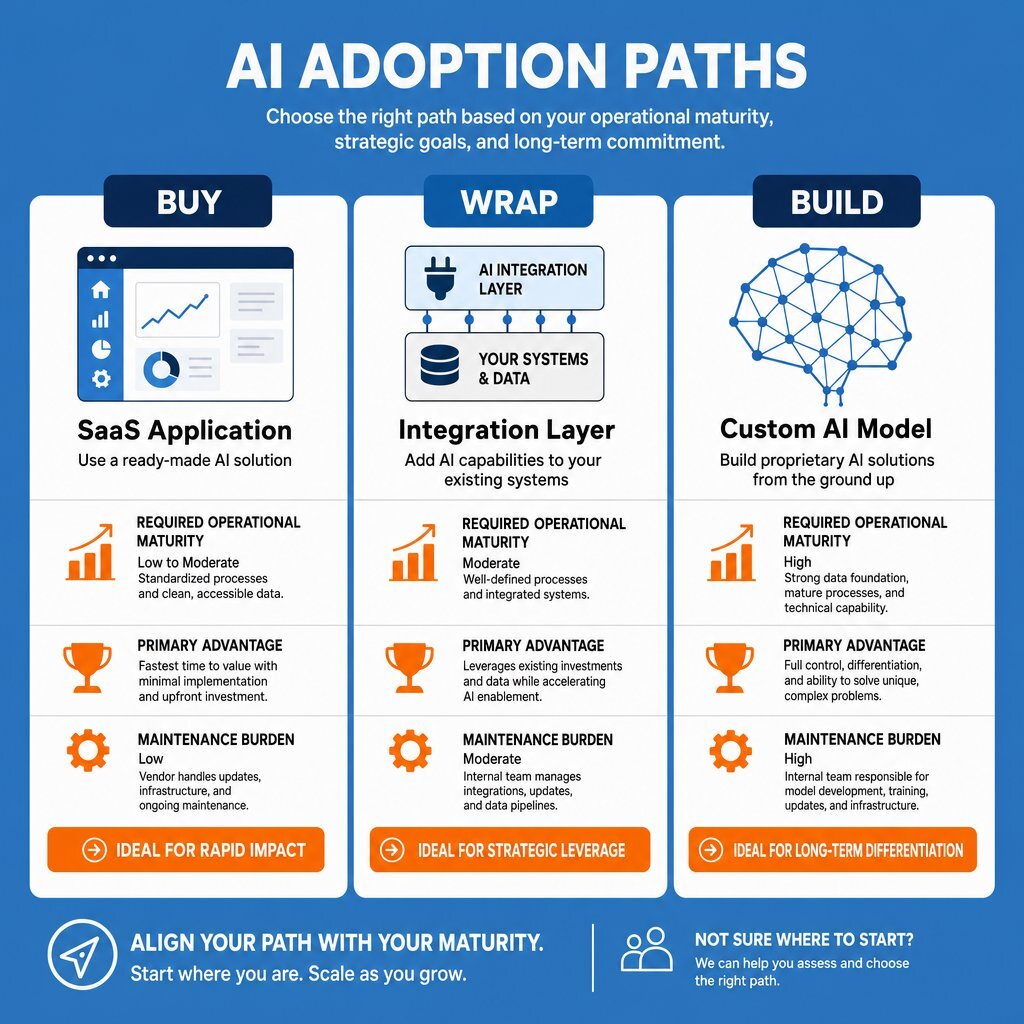
| Buy | Low | Immediate ROI, zero technical debt. | Handled by vendor. |
| Wrap | Medium to High | Custom workflows, data privacy, unique UX. | Moderate; requires CI/CD and API management. |
| Build | Exceptional | Total control, intellectual property creation. | Extreme; requires dedicated MLOps and engineering. |
In practice, many organizations blend these strategies over time. They may start by buying SaaS, then wrap APIs for critical workflows, and eventually build narrow, proprietary models where they have true differentiation. Along the way, they lean heavily on solid hosting solutions so their AI stack stays reliable and portable.
Your First AI Investment Isn't a License
The 81% versus 15-25% productivity gap proves that AI is an amplifier of existing competence. If you equip a team of disciplined, senior engineers with AI, you will see a historic increase in output, quality, and business value. If you hand those same tools to an immature team and remove architectural oversight, you will generate technical debt at a scale previously thought impossible.
The first AI investment your organization should make is not a tool, a license, or a mandate. It is the cultivation of judgment. It is establishing the gated environments, testing protocols, and documentation standards that dictate how code gets made. Those are the same foundations that keep more advanced AI agents and automations from turning into new attack surfaces or runaway costs.
Prototyping and production are two different jobs. Before you let AI-generated code cross the boundary between the two, you need an architect at the gate. If you are unsure whether your current AI initiatives are building durable value or quietly accruing debt, partner with Baytech Consulting for ongoing support and an architectural review. We build, manage, and rescue custom applications so you can stop worrying about the code and get back to running your business.
FAQ
What is the practical difference between a vibe-coded prototype and production software?
A vibe-coded prototype visually demonstrates functionality but lacks the underlying infrastructure required to survive real-world use. Production software demands gated deployment environments, database migration protocols, comprehensive observability, and isolated failure domains to ensure data security and system stability under load. Teams that treat AI like a shortcut instead of a tool usually find this out the hard way, often when they first hit scale or face a live incident.
Further Reading
- Don't Let the Vibes Destroy Value: A CFO's Playbook for AI Code
- AI Technical Debt: How Vibe Coding Increases TCO
- SMB AI Adoption Guide: Use Cases, Costs, Roadmap
About Baytech
At Baytech Consulting, we specialize in guiding businesses through this process, helping you build scalable, efficient, and high-performing software that evolves with your needs. Our MVP first approach helps our clients minimize upfront costs and maximize ROI. Ready to take the next step in your software development journey? Contact us today to learn how we can help you achieve your goals with a phased development approach.
About the Author

Bryan Reynolds is an accomplished technology executive with more than 25 years of experience leading innovation in the software industry. As the CEO and founder of Baytech Consulting, he has built a reputation for delivering custom software solutions that help businesses streamline operations, enhance customer experiences, and drive growth.
Bryan’s expertise spans custom software development, cloud infrastructure, artificial intelligence, and strategic business consulting, making him a trusted advisor and thought leader across a wide range of industries.