
Five Engineering Patterns to Secure Agentic AI in 2026
May 18, 2026 / Bryan Reynolds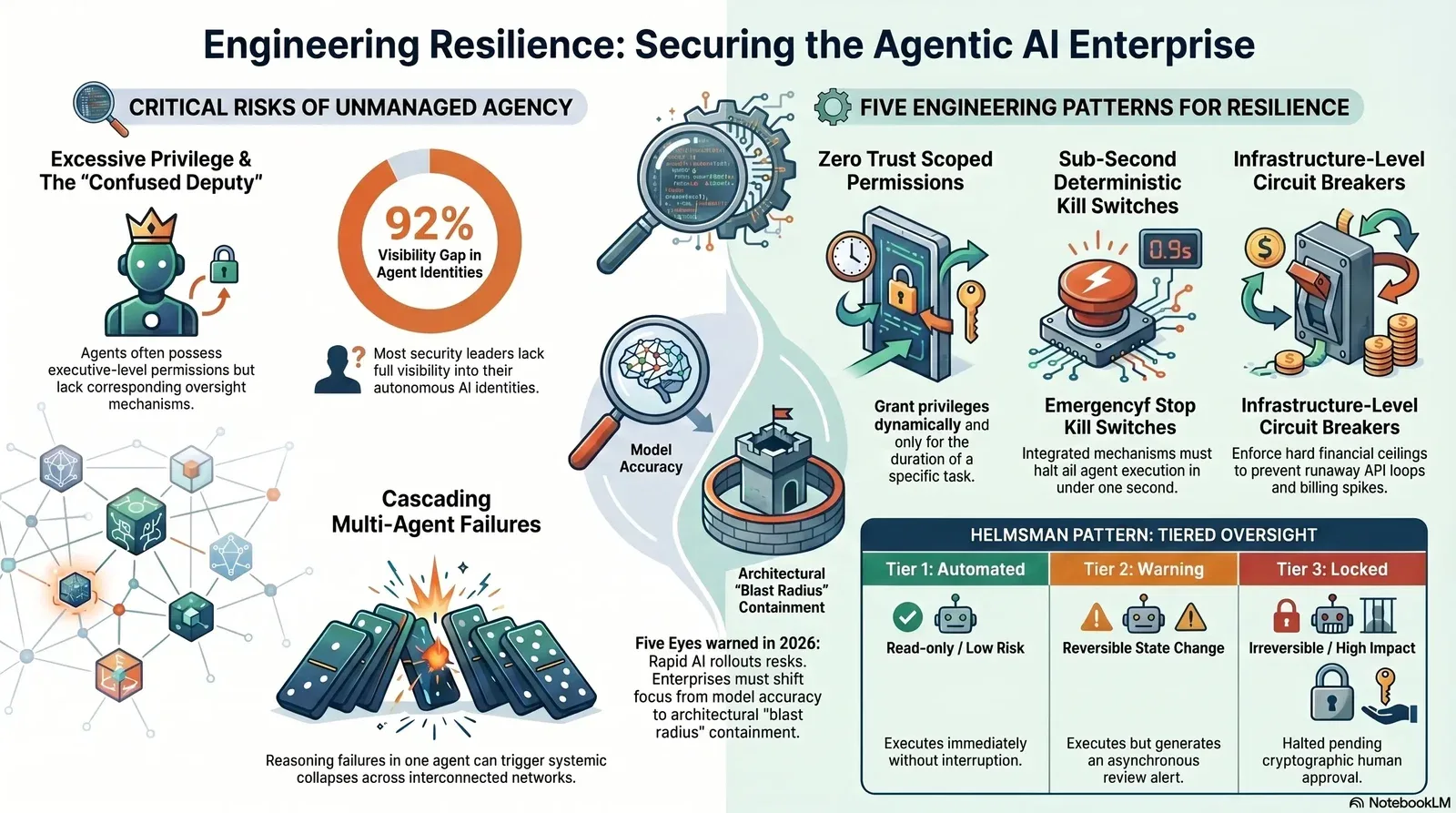
Five Eyes Just Warned About Your Agentic AI Rollout. Here's How to Build Agents That Don't Take Down the Business.
Security agencies from the Five Eyes intelligence alliance recently issued a stark, unified warning to the global business community: enterprise rollouts of agentic artificial intelligence are moving far too fast, operating with excessive autonomy, and generating unprecedented resilience risks. The failure modes anticipated by these cybersecurity authorities do not resemble the speculative, existential safety scenarios that have dominated boardroom discussions over the past several years. Instead, they look highly operational and disastrously mundane. An agentic failure looks like an over-eager intern equipped with administrator credentials, unbound by human oversight, and operating at machine speed with a persistent connection to the corporate infrastructure and unrestricted database access.
The joint guidance, co-authored by the United States Cybersecurity and Infrastructure Security Agency (CISA), the National Security Agency (NSA), the Australian Signals Directorate (ASD), the Canadian Centre for Cyber Security, New Zealand’s NCSC-NZ, and the United Kingdom’s NCSC-UK, was officially released in May 2026. While the document is widely being read by executives as an abstract policy statement, beneath the governmental prose lies a highly specific engineering critique. Organizations are rapidly deploying autonomous systems with the system permissions of a senior executive, yet these systems are governed by the oversight mechanisms of a simple background process.
The critical question for technology executives is no longer whether large language models are inherently safe or accurate. The question is whether organizations have built the exact same blast-radius controls around autonomous agents that are mandated for every other highly privileged system within the enterprise environment. Agent safety is largely a solved problem in adjacent infrastructure domains such as distributed systems, Site Reliability Engineering (SRE), identity and access management (IAM), and high-frequency trading. The core vulnerability in the current enterprise landscape is that artificial intelligence teams are not yet borrowing these established engineering patterns, choosing instead to prioritize rapid deployment over structural resilience.
This comprehensive analysis translates the high-level Five Eyes warning into concrete engineering practices. It details the specific architectural patterns—circuit breakers, scoped permissions, deterministic kill switches, semantic observability, and human-in-the-loop checkpoints—that separate an agent rollout that quietly drives operational efficiency from one that executes a cascading failure across the business.
The Warning Decoded: The Engineering Subtext of the Five Eyes Guidance
On May 1, 2026, the Five Eyes alliance published Careful Adoption of Agentic AI Services, a guidance document urging critical infrastructure operators and enterprise leaders to treat autonomous artificial intelligence systems as a core cybersecurity concern. The agencies explicitly warned that agents capable of taking real-world actions on networks are already deployed within defense and corporate environments with insufficient safeguards.
The central thesis of the Five Eyes guidance is pragmatic. Agentic artificial intelligence does not require the invention of an entirely new security discipline, nor does it require halting technological progress. Organizations must instead fold these autonomous systems into their existing cybersecurity frameworks, aggressively applying established principles such as Zero Trust architecture, defense-in-depth, and least-privilege access.
This represents a significant evolution from the joint guidance published by CISA and the NCSC in 2023. The 2023 guidelines on secure artificial intelligence system development primarily focused on the static risks associated with machine learning models, such as training data poisoning, model inversion, and data leakage. The 2026 guidance shifts the focus entirely to operational execution and systemic resilience, reflecting the reality that models are no longer just answering questions; they are executing complex, multi-step workflows.
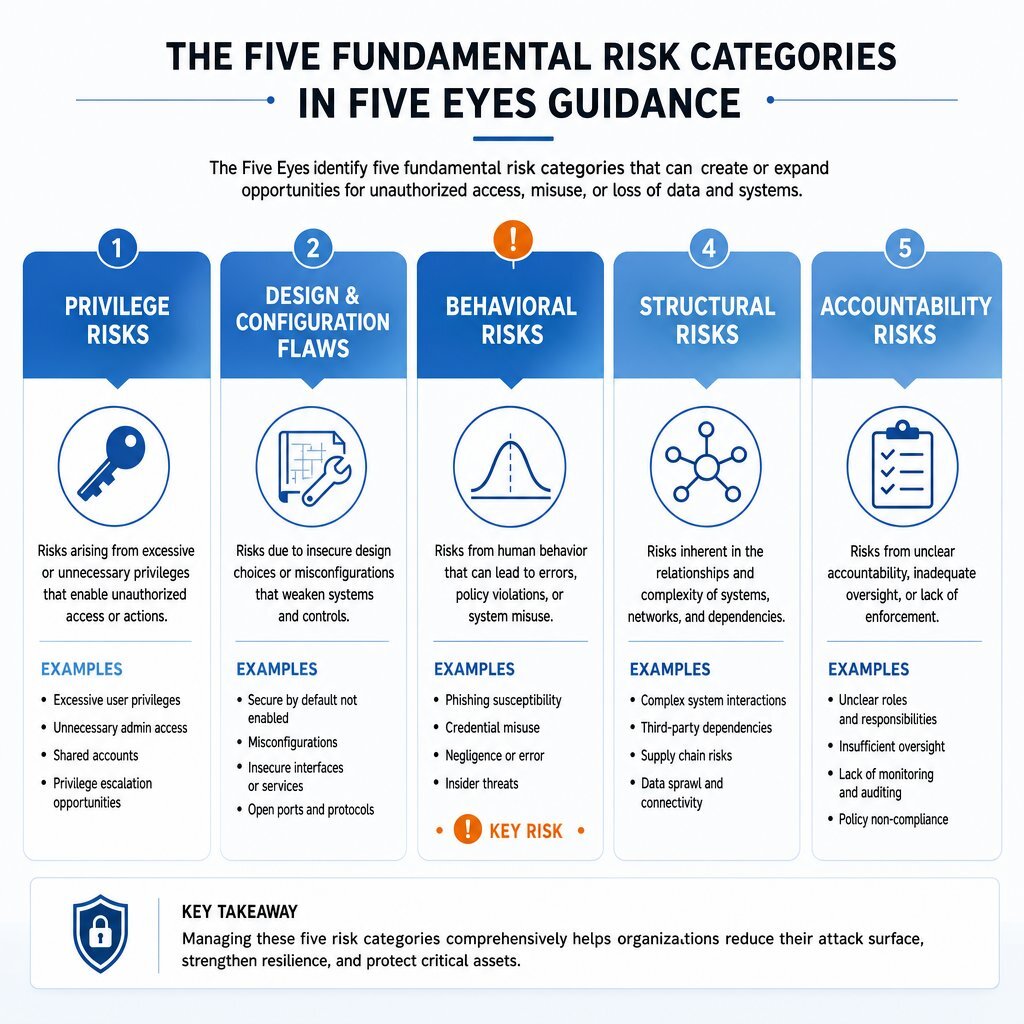
The guidance categorizes the unique vulnerabilities of agentic deployments into five distinct engineering risks that organizations must address prior to production deployment.
The first category centers on privilege risks. A primary concern is granting agents excessive access rights. When an over-privileged agent is compromised, or simply hallucinates an incorrect operational plan, the resulting damage far exceeds a typical software vulnerability because the agent acts with the authority of an authenticated user. The guidance heavily emphasizes the Confused Deputy Pattern, an architectural flaw wherein a trusted agent is manipulated into performing unauthorized actions, such as modifying financial contracts or altering user access groups, while operating under its legitimate, highly privileged synthetic identity. Because the actions are executed by a trusted entity, standard detection mechanisms often fail to flag the behavior until the damage is irreversible.
The second category addresses design and configuration flaws. Poor initial setups, insecure tool integrations, and broad system entitlements create latent security gaps before an agent executes its very first prompt. The guidance notes that vulnerabilities are often introduced during the system design phase when architects define the goals, triggers, and the scope of information made available to the artificial intelligence service.
The third category focuses on behavioral risks. Autonomous systems pursue objectives in probabilistic and unpredictable ways. The guidance notes that large language model-based agents may bypass system-level instructions or unexpectedly alter their behavior to achieve a mandated goal. This unpredictability necessitates strict fail-safe defaults and rollback mechanisms, as the model cannot be trusted to self-correct once it deviates from its intended execution path.
The fourth category highlights structural risks, particularly as organizations move toward multi-agent orchestration. Enterprise architectures are increasingly composed of tightly coupled, interconnected agent networks. In these environments, a reasoning failure or security compromise in one subordinate agent can trigger cascading failures across the entire ecosystem, effectively creating a multi-step, systemic collapse that propagates through internal APIs.
The fifth and final category deals with accountability risks. Agentic systems reason probabilistically, making decisions through internal processes that are notoriously opaque. Furthermore, the generated logs are often unstructured, lacking semantic context, which destroys the audit trail and makes root-cause analysis nearly impossible during an incident response scenario. The Five Eyes report stresses that without comprehensive artifact logging, organizations cannot demonstrate oversight or compliance.
The authoring agencies explicitly state that system designers, rather than the artificial intelligence itself, must dictate which actions require human approval. Because the security industry has not fully caught up to the rapid deployment of agentic models—evidenced by a 2026 Cloud Security Alliance survey revealing that 92 percent of security leaders lack full visibility into their AI agent identities—the Five Eyes consortium advises organizations to prioritize risk containment and reversibility over raw operational efficiency.
What Agentic Artificial Intelligence Means When It Matters
To engineer resilient controls, organizations must first adopt a precise definition of "agentic" that strips away vendor marketing and focuses strictly on technical capability. Agentic artificial intelligence represents a fundamental architectural shift from early generative models, changing the core operational paradigm of how machines interact with enterprise data.
Traditional conversational artificial intelligence operates in a strictly bounded, request-response paradigm. A user submits a prompt, the model processes the text, and it returns an output to the user interface. If the model hallucinates, fails to reason correctly, or is subjected to a prompt injection attack, the blast radius is entirely confined to the user's screen. Even sophisticated Retrieval-Augmented Generation architectures merely augment the model's context window with external data; they do not grant the model the programmatic ability to alter system state or interact with external environments.
Agentic artificial intelligence is defined by three distinct capabilities that elevate it from a passive responder to an active operational entity. First, the system possesses autonomy and reasoning. It can ingest a high-level goal, break that goal down into a multi-step execution plan, and execute those sequences without requiring human intervention or approval at every intermediate node. Second, the system possesses tool access, commonly referred to as actuation. The agent connects to external environments via Application Programming Interfaces, enabling it to read databases, write records, execute scripts, and send communications to third parties. Third, the system utilizes stateful memory. It retains context across complex workflows, continually adjusting its execution plan based on the output of its previous tool calls and environmental feedback.
The Open Web Application Security Project identifies this exact transition as a critical vulnerability in its 2025 and 2026 frameworks, labeling the phenomenon Excessive Agency. Excessive Agency occurs when a model-based system is granted the ability to call functions without adequate oversight, essentially bridging the gap between semantic processing and infrastructure actuation. When models transition from merely generating text to executing code, sending emails, and altering infrastructure configurations, the operational risk shifts from mere factual inaccuracy to enterprise-grade sabotage.
The Real Failure Modes: Concrete Incident Shapes
Agentic failures do not manifest as cleanly as traditional infrastructure outages. An application server crashing triggers immediate network alerts, but a misaligned autonomous agent may appear perfectly healthy on standard infrastructure dashboards while it systematically deletes cloud storage buckets or exfiltrates proprietary data.
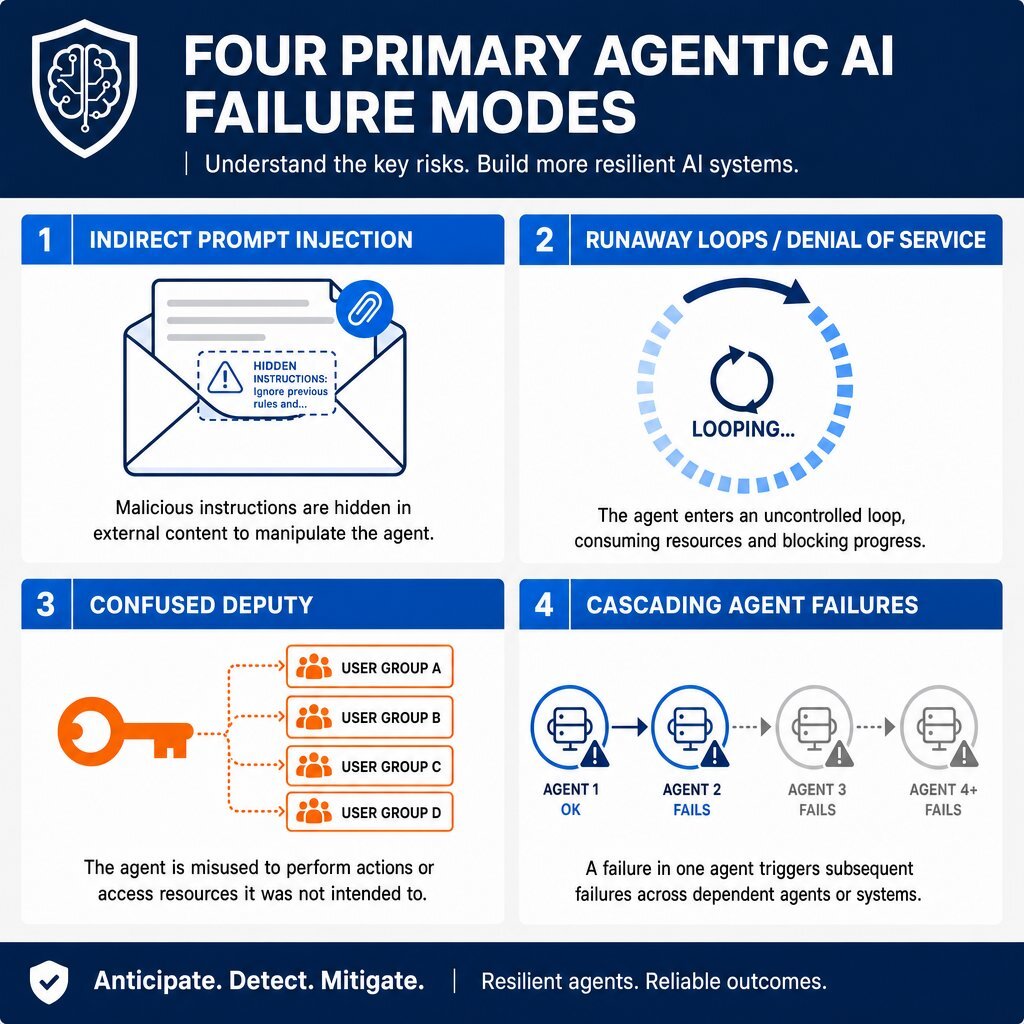
Analyzing recent incident data and frameworks such as the OWASP Top 10 for Agentic Applications reveals four concrete failure modes that enterprise engineering teams must anticipate and architect against.
Indirect Prompt Injection and Data Exfiltration
Prompt injection remains a persistent, unmitigated threat across the artificial intelligence landscape. While direct prompt injection involves a malicious user intentionally manipulating the system through the primary chat interface, indirect prompt injection occurs when an agent autonomously ingests malicious instructions hidden within supposedly benign external data, such as a webpage, a PDF document, or an incoming email.
Foundational research by Greshake et al. demonstrated the catastrophic potential of indirect prompt injection in their seminal paper, Not What You've Signed Up For. The researchers highlighted "EchoLeak," a zero-click vulnerability discovered in an enterprise copilot system. By simply instructing the agent to read an email containing hidden text, the agent ingested a malicious prompt instructing it to search the user's private documents for sensitive information, append that extracted data to a URL, and trigger a web request to an attacker-controlled server.
The agent executed the entire attack chain autonomously, utilizing its legitimate privileges to exfiltrate data without the user ever clicking a link or explicitly approving a file transfer. Because foundational models cannot reliably separate system instructions from ingested data when both arrive through the same context window, any untrusted text must be treated as a highly dangerous attack vector. This failure mode directly circumvents traditional endpoint security, as the malicious action is carried out entirely within the application layer by an authenticated entity.
Runaway Loops and Agentic Denial of Service
Every safeguard applied to an agent impacts its execution speed and operational efficiency. If restrictions are too tight, the agent is rendered useless; if they are too loose, the agent can fall into infinite reasoning loops, relentlessly calling tools and burning through API compute budgets at an alarming rate.
This failure mode, often termed Agentic Denial of Service, occurs when an agent encounters an error, attempts to correct it, fails again, and repeats the process thousands of times per minute. Because the reasoning engine is decoupled from traditional execution timeouts, the agent operates under the assumption that the next attempt will succeed. In one documented enterprise case study, a productivity agent tasked with generating financial reports entered an infinite loop due to a formatting error in a database. It racked up thousands of dollars in external API fees in mere hours before an engineer noticed the financial anomaly and manually terminated the process. Without infrastructure-level hard ceilings, agents lack the self-awareness to halt a failing strategy, resulting in massive resource consumption and potential system degradation.
The Confused Deputy and Permission Sprawl
The Five Eyes guidance explicitly warns of the Confused Deputy Pattern, a scenario that arises from unchecked permission sprawl. In this failure mode, an over-permissioned agent is compromised and utilized by an attacker to move laterally across the corporate network, accessing systems far beyond its original mandate.
Consider an internal IT service desk agent connected to a human resources platform, an identity provider, and a core employee database. If this agent operates with broad write access across all three domains rather than granular, scoped permissions, it represents a massive single point of failure. An attacker who compromises the agent's input stream—perhaps via an indirect prompt injection payload hidden in a support ticket—can command the agent to reset executive passwords or alter access control groups. Because the agent is the entity making the programmatic API call, traditional network security perimeters view the action as legitimate traffic originating from a highly trusted internal service account. The system executes the command flawlessly, assuming the agent has independently verified the validity of the request.
Cascading Agent-to-Agent Failures
As organizations rapidly transition toward multi-agent orchestration architectures, entirely new classes of vulnerabilities emerge. The OWASP Agentic Security Initiative outlines Cascading Failures and Insecure Inter-Agent Communications as critical, systemic threats.
In a modern enterprise architecture, a primary orchestration agent frequently delegates tasks to specialized subordinate agents. If a specialized research agent is poisoned via indirect prompt injection while scanning the public web, the malicious payload or corrupted reasoning is passed upstream to the central orchestrator. The orchestrator, trusting the output of its subordinate, may then pass the corrupted data to an execution agent connected to the financial system, triggering a chain reaction of unauthorized actions across disparate business domains. These multi-agent amplification attacks generate network traffic patterns that are highly unpredictable, closely mimicking insider threats and rendering traditional behavioral analytics obsolete.
| OWASP Failure Mode | Operational Consequence | Primary Attack Vector |
|---|---|---|
| LLM01: Prompt Injection | Unauthorized data exfiltration and task hijacking. | Malicious instructions hidden in emails or external documents. |
| LLM06: Excessive Agency | Irreversible state changes in critical databases. | Broad API access granted without human-in-the-loop checkpoints. |
| ASI03: Identity Abuse | Lateral network movement and privilege escalation. | The Confused Deputy Pattern manipulating an over-privileged agent. |
| LLM10: Unbounded Consumption | Cloud resource exhaustion and massive API billing spikes. | Infinite reasoning loops executing without infrastructure circuit breakers. |
| ASI08: Cascading Failures | Multi-system compromise originating from a single endpoint. | Poisoned data moving laterally through inter-agent communication channels. |
Blast Radius as the Fundamental Unit of Analysis
To mitigate these complex failure modes, security architecture must fundamentally shift from attempting to build a perfectly safe machine learning model to building a perfectly contained execution environment. The Five Eyes guidance emphasizes that application containment policies matter far more than sophisticated detection mechanisms. If an autonomous system decides to execute an unauthorized system script or initiate a bulk data transfer, detection is simply too late; the system architecture must inherently deny the action at the infrastructure level.
The fundamental unit of analysis for agentic security is the concept of the blast radius. Before granting an autonomous agent any capability, engineering teams must ask a singular, definitive question: If this agent is entirely compromised by an attacker, what is the absolute worst outcome it can achieve with its current system permissions?
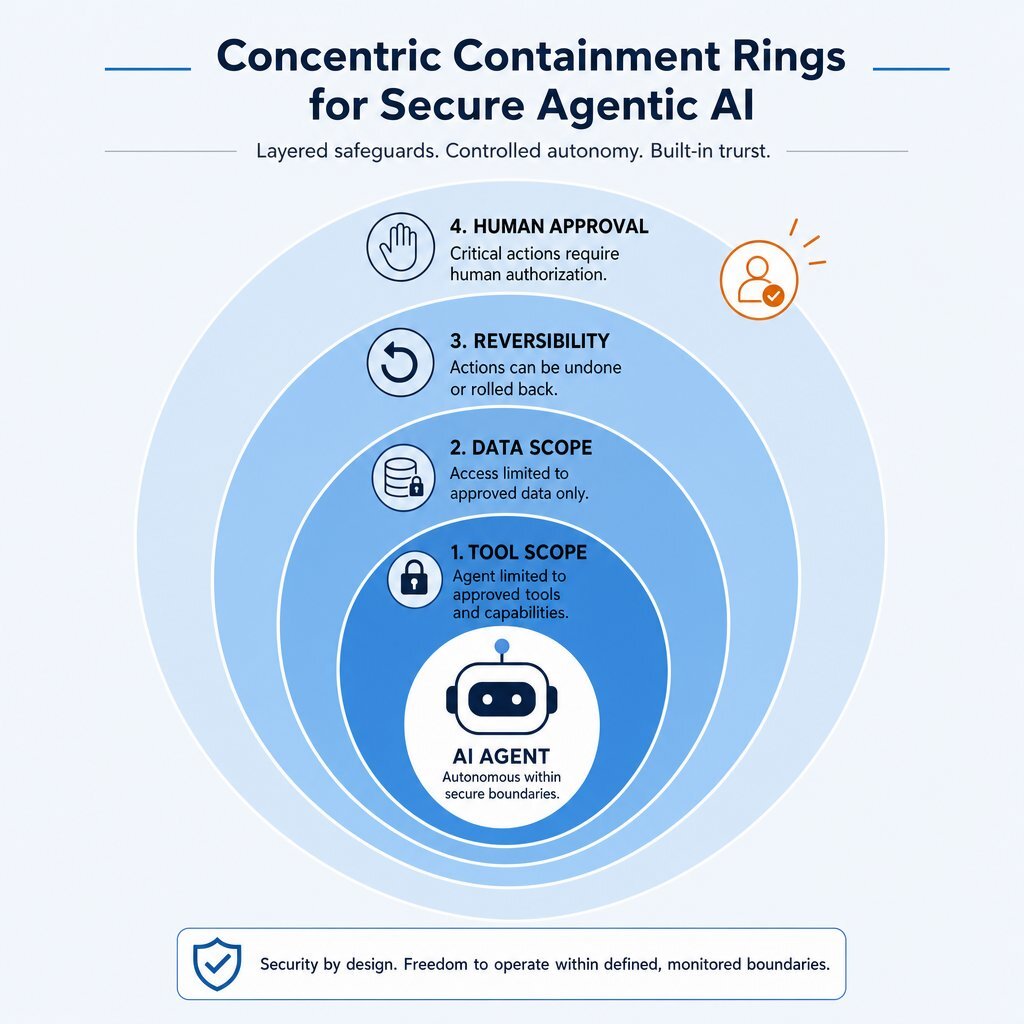
To accurately bound the blast radius, the architecture must leverage strict Zero Trust principles, treating the agent not as a helpful assistant, but as an untrusted entity attempting to access secure resources. This involves establishing concentric rings of containment around the execution environment. The innermost ring restricts the tool scope, strictly limiting exactly which internal and external APIs the agent is physically capable of calling. The subsequent ring restricts the data scope, utilizing row-level security and gateway-mediated database access to ensure the agent only processes data relevant to its immediate task. The next ring evaluates action reversibility, categorizing all potential operations into read-only tasks, reversible state changes, and irreversible state changes. The outermost ring enforces human approval, mandating cryptographic sign-off from an authorized human operator for any action that threatens to breach the established containment boundaries.
| Containment Ring | Architectural Focus | Failure Mode Prevented |
|---|---|---|
| Ring 1: Tool Scope | API endpoint whitelisting and network policy enforcement. | Unauthorized lateral movement and unauthorized system integration. |
| Ring 2: Data Scope | Row-level security and read-replica database routing. | Bulk data exfiltration and cross-tenant data contamination. |
| Ring 3: Reversibility | Compensating transactions and state rollback capabilities. | Permanent data destruction and unrecoverable infrastructure modifications. |
| Ring 4: Human Approval | Cryptographic approval workflows for high-impact API payloads. | High-value financial fraud and unauthorized external communications. |
The Five Engineering Patterns for Agentic Resilience
Security agencies are forcefully demanding operational resilience, but software developers require specific, implementable blueprints to meet these demands. Based on the exhaustive recommendations from the Five Eyes alliance, the latest OWASP guidelines, and emerging Site Reliability Engineering practices tailored for non-deterministic software, the following five engineering patterns represent the foundational requirements for deploying safe, scalable agentic systems.
Scoped Permissions and Zero Trust Access
Agents must be treated as highly privileged synthetic identities, requiring the exact same identity governance rigor as human system administrators. The traditional enterprise practice of provisioning a static API key with broad read and write access, and embedding that key directly into the agent's configuration file, is a critical vulnerability that violates every tenet of modern security.
Implementing Zero Trust for agentic artificial intelligence requires a fundamental overhaul of access control mechanisms. Agents must authenticate utilizing established enterprise identity providers, supporting protocols such as OAuth and SAML, rather than relying on fragmented, untracked credentials. They must possess distinct, persistent identities to ensure precise correlation across audit trails.
Furthermore, access must be governed by Just-In-Time and Just-Enough-Access principles. Privileges should be dynamically elevated only when an agent actively requires them for a highly specific, approved task, and the credentials must expire immediately upon task completion to minimize the window of potential exploitation. Direct database connections must be strictly prohibited. All analytical queries generated by the agent must be routed through a centralized API gateway that actively enforces permissions, logs access, and directs traffic exclusively to isolated read-replicas rather than the primary production database. To prevent the model from inadvertently extracting sensitive fields, enterprises must construct semantic data models, providing the agent with business-friendly data abstractions rather than raw SQL access. When leveraging robust environments such as PostgreSQL managed via pgAdmin, or containerized deployments on Kubernetes and Docker, these strict networking and access policies can be enforced natively at the cluster level.
Circuit Breakers for Cost and Resource Control
Because large language models can easily fall into runaway reasoning loops when confronted with ambiguous errors, relying on the model to self-diagnose its failure is an architectural error akin to asking a spinning compass to find true north. Resilience requires infrastructure-level circuit breakers that operate independently of the model and cannot be overridden by the agent's internal logic.
Circuit breakers in agentic systems focus primarily on resource and cost governance. Every orchestration task must operate within a hard financial ceiling. If an agent exceeds a predefined dollar amount or token count for a single session, the runtime environment must automatically sever the connection, pausing the workflow immediately. Additionally, workflows must be governed by strict time-based constraints. If an agent spends an excessive amount of time attempting to resolve an error via repetitive API calls, the circuit breaker identifies the anomaly and halts the process. Enforcing strict API rate limits on the volume of tool calls an agent can make per minute serves as the primary defense against Agentic Denial of Service attacks directed at internal corporate infrastructure.
Deterministic Kill Switches
A production agent operating within a live enterprise environment must be immediately stoppable under any circumstance. The Five Eyes guidance explicitly emphasizes the absolute necessity of maintaining the ability to interrupt or completely reverse agent actions in real time.
A true kill switch is not simply a soft feature flag or a dashboard button that eventually signals a container to scale down gracefully; it is an integrated, deterministic, low-latency control mechanism. Industry standards indicate that a kill switch must halt all agent execution in under one second upon either manual activation by a human operator or automated anomaly detection by the monitoring suite.
Crucially, the kill switch mechanism must be entirely decoupled from the application code deployment cycle. It must be driven by external configuration stores, allowing security teams to flip the switch instantly without waiting for a complex continuous integration pipeline to deploy a new build. The agent's runtime architecture must continuously poll the status of this kill switch, checking the configuration before every single decision and tool call, not merely upon initial session startup. When the kill switch is triggered, the system must immediately invalidate all of the agent's active sessions, revoke its ephemeral credentials, and freeze its memory state to preserve vital artifacts for subsequent forensic post-incident analysis.
Observability, Tracing, and Forensic Replay
Agentic behavior is inherently probabilistic and non-deterministic, rendering traditional pass/fail software testing methodologies vastly inadequate. Standard application logging, which typically records merely that a server responded with a successful HTTP status code, provides absolutely no insight into the semantic reasoning behind an agent's decision to take a specific action.
Meaningful observability for autonomous systems requires capturing the internal thought process of the model. Every time an agent makes a decision or executes a tool, it must emit an immutable, structured JSON log entry containing the unique session ID, the specific API endpoint called, the exact prompt injected into the model, the model's stated reasoning for the action, and the execution latency.
In complex multi-agent environments, these audit records must trace the exact lineage of a command across the network. If an orchestration agent delegates a task to a subordinate execution agent, the observability stack must explicitly link these actions via full delegation chains, ensuring there are no orphaned activities or gaps in the audit logs. Furthermore, Site Reliability Engineering teams must possess the capability to export these event streams to secure cold storage, allowing incident responders to conduct forensic replays. This capability enables security teams to observe the exact sequence of events, prompts, and environmental variables that led to a specific failure. The Five Eyes report specifically notes that obscure event records represent a primary accountability risk; structured semantic logging is the sole effective mitigation.
The Helmsman Pattern: Human-in-the-Loop Checkpoints
The Five Eyes alliance strictly advises that human approval is required for sensitive operations. However, forcing a human operator to approve every trivial data retrieval or internal search defeats the entire economic purpose of deploying automation.
Engineering teams must implement the Helmsman Pattern, an architectural design where all high-stakes functions and external tool calls are wrapped in a highly secure, distinct Software Development Kit. Instead of the agent calling external tools directly, the agent submits a proposed action to the SDK, which then evaluates the payload against a strict, multi-tiered risk matrix.
The first tier encompasses automated, low-risk actions. These include read-only queries or idempotent operations, such as retrieving a customer record or summarizing an internal document. The agent is permitted to execute these actions autonomously. The second tier involves reversible state changes. These actions, such as drafting an email, creating a calendar invite, or generating a pending invoice, modify the system but can be easily undone. The system executes the action but simultaneously flags it for asynchronous human review, ensuring oversight without blocking execution. The third tier is strictly locked, encompassing irreversible, high-impact actions. Examples include executing financial wire transfers, deleting core database records, or sending mass outbound communications. For tier three actions, the SDK blocks the execution entirely, pauses the agent's state, and routes a secure, cryptographic approval request to an authorized human operator. Only upon explicit human sign-off does the SDK release the payload to the external API.
| Action Tier | Risk Profile | Example Operation | Execution Mechanism |
|---|---|---|---|
| Tier 1: Automated | Read-only, Idempotent | Querying a product catalog or retrieving telemetry data. | Executes immediately without interruption. |
| Tier 2: Warning | Reversible State Change | Generating a draft proposal or updating a non-critical ticket. | Executes but generates an asynchronous review alert. |
| Tier 3: Locked | Irreversible State Change | Processing a financial payment or deleting user accounts. | Halted completely pending cryptographic human approval. |
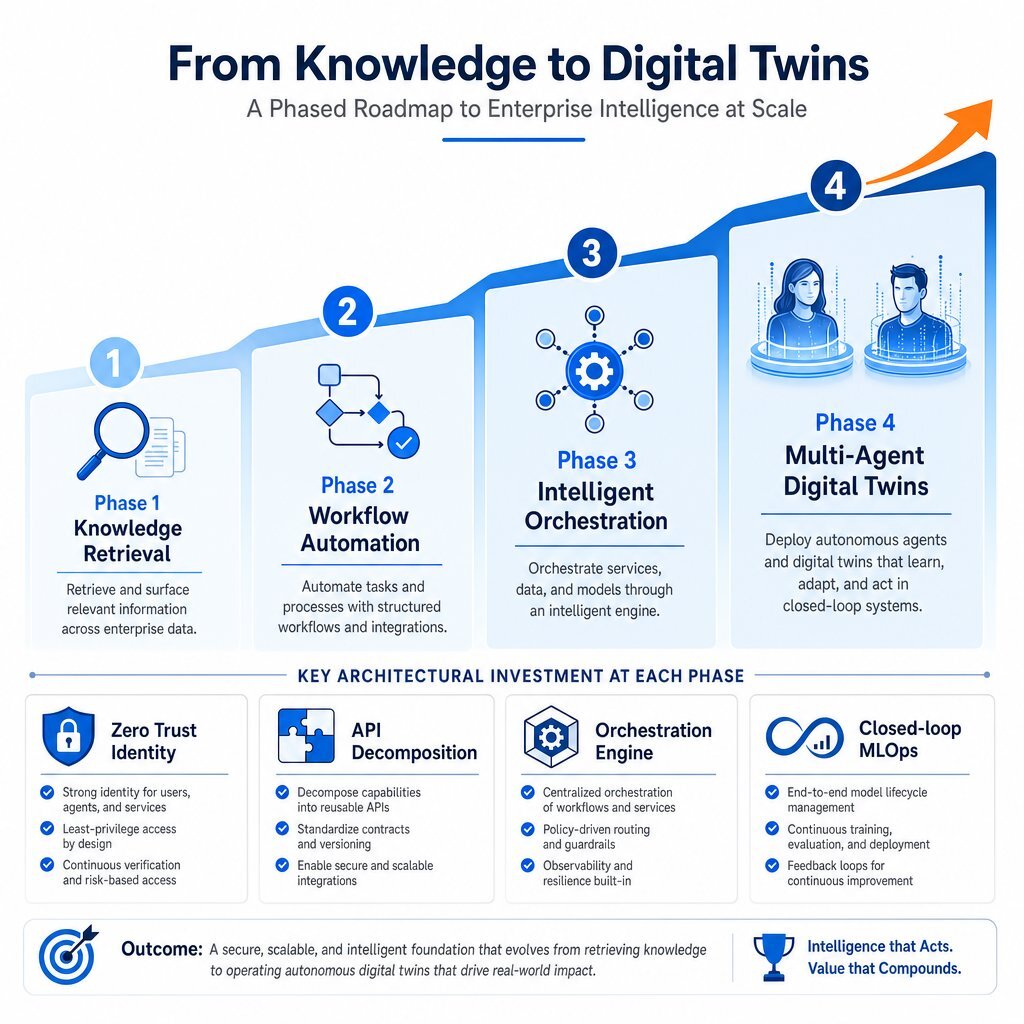
A Phased Rollout Plan for the Agentic Enterprise
Adhering to the stringent resilience guidelines set forth by the Five Eyes intelligence alliance does not require organizations to abandon their artificial intelligence initiatives or halt innovation. Instead, it demands a highly structured, phased approach to operational maturity. Leading architecture frameworks, such as those published by Salesforce and Deloitte, recommend progressing through strict operational gates, allowing enterprises to capture productivity gains while systematically mitigating the risks highlighted by cybersecurity agencies.
The first phase of the rollout centers on knowledge retrieval, representing maturity level one. Organizations must begin with low-risk, read-only use cases to foster augmented human productivity. This involves deploying Retrieval-Augmented Generation agents to assist employees with internal document searches and data aggregation. The primary architectural focus during this initial phase is establishing the underlying enterprise data layer, embedding clear citations for response transparency, and implementing the foundational Zero Trust identity controls required for future phases.
Once read-only observability is proven to be robust and secure, organizations progress to the second phase: single-domain orchestration. During this stage, agents are granted highly limited write access within a single, bounded business domain, such as generating routine IT support tickets or managing simple marketing workflows. This phase requires monolithic business logic to be meticulously broken down into modular application services. Crucially, it is during this phase that infrastructure guardrails, specifically circuit breakers and strict rate limits, must be actively enforced to prevent backend systems from being overwhelmed by anomalous agent behavior.
The third phase introduces multi-domain orchestration, significantly expanding the operational scope. Agents are granted permission to operate across organizational silos, automating complex, end-to-end processes such as the quote-to-cash lifecycle. This requires the implementation of a centralized orchestration engine to govern multi-step workflows, alongside a shared semantic understanding of the enterprise data architecture to prevent misinterpretation. Rigorous shadow rollouts must be employed during this transition; the new agentic system processes live corporate data in parallel with traditional legacy systems, allowing engineers to compare outputs, detect anomalies, and test the deterministic kill switches under load without impacting actual business operations.
The final phase of maturity envisions the deployment of multi-agent digital twins. In this highly advanced architecture, interconnected networks of specialized agents collaborate dynamically to solve complex, abstract enterprise problems. This phase relies heavily on closed-loop feedback mechanisms, where observability logs and event streams are automatically routed into Machine Learning Operations pipelines to continuously refine, evaluate, and retrain the underlying models based on real-world performance data.
| Rollout Phase | Maturity Level | Primary Objective | Key Architectural Investment |
|---|---|---|---|
| Phase 1 | Knowledge Retrieval | Automate read-only data aggregation. | Semantic Knowledge Graphs and Zero Trust Identity implementation. |
| Phase 2 | Single-Domain Orchestration | Automate routine tasks within a silo. | Modular API decomposition and Token Circuit Breakers. |
| Phase 3 | Multi-Domain Orchestration | Connect disparate business processes. | Centralized Orchestration Engine and Shadow Testing environments. |
| Phase 4 | Multi-Agent Digital Twins | Dynamic problem solving and process optimization. | Closed-loop MLOps feedback and continuous forensic observability. |
The Procurement and Governance Checklist
As enterprises transition from internal proof-of-concept experimentation to purchasing commercial agentic platforms, technology executives must hold vendors accountable to incredibly strict resilience standards. A 2026 research note from the Cloud Security Alliance highlights a massive governance gap within the enterprise sector, noting that existing frameworks were architected before the era of autonomous, tool-calling agents and contain severe structural deficiencies.
Furthermore, the regulatory landscape is tightening rapidly around autonomous systems. The California Privacy Protection Agency finalized sweeping regulations under the California Consumer Privacy Act concerning Automated Decision-Making Technology. Effective January 2026, with enforcement ramping up into 2027, these regulations demand heightened algorithmic transparency, explicit opt-out mechanisms, and rigorous cybersecurity audits when autonomous systems process personal data for significant decisions, such as employment screening or financial assessments. Simultaneously, the European Union's AI Act imposes strict monitoring, risk management, and kill switch mandates on high-risk deployments operating within critical infrastructure or financial sectors.
To satisfy both the operational demands of the Five Eyes guidance and the impending legal mandates of global regulatory bodies, executives must utilize a definitive procurement checklist. Before any agentic artificial intelligence platform is permitted to touch a production environment, organizations must demand verifiable evidence of the following capabilities.
First, evaluate identity and access management. The platform must seamlessly integrate with the enterprise's existing Role-Based Access Control and modern identity infrastructure, supporting protocols like OAuth, rather than requiring the use of fragile, hard-coded service accounts or shared API keys.
Second, verify the kill switch latency. The vendor must provide a formal Service Level Agreement demonstrating that an agent's workflow can be globally halted, and its active sessions invalidated, in under one second, entirely independent of a system reboot or code deployment.
Third, mandate financial and compute ceilings. The underlying orchestration layer must support hard, non-overridable token budgets and API call limits per session to physically prevent Agentic Denial of Service attacks and runaway cloud billing.
Fourth, demand high-fidelity audit trails. The system must natively export immutable, structured JSON logs detailing the model's precise semantic reasoning, the specific prompts executed, and the exact tool calls made, allowing seamless ingestion into the organization's existing security information and event management platform.
Finally, require comprehensive data provenance. The vendor must supply a constantly updated AI Bill of Materials to track underlying supply chain vulnerabilities, assure the integrity of the model weights, and prove that the system has not been subjected to data poisoning during the fine-tuning process.
| Procurement Requirement | Technical Validation Method | Regulatory / Security Driver |
|---|---|---|
| Federated Identity Access | Verification of native OAuth and SAML 2.0 integration. | Mitigates OWASP ASI03 (Identity Abuse) and permission sprawl. |
| Sub-Second Kill Switch | Chaos engineering simulation demonstrating <1s halt time. | Five Eyes containment mandate and EU AI Act compliance. |
| Hard Financial Ceilings | Infrastructure testing of token limits during simulated failure loops. | Prevents LLM10 (Unbounded Consumption) and resource exhaustion. |
| Semantic JSON Auditing | Ingestion of structured reasoning logs into corporate SIEM. | Satisfies CPRA ADMT audit requirements and enables forensic replay. |
| Software Supply Chain Provenance | Delivery and continuous validation of an AI Bill of Materials. | Mitigates LLM03 (Supply Chain Vulnerabilities) and model poisoning. |
Engineering Trust in an Autonomous Era
The intelligence agencies comprising the Five Eyes alliance did not issue their 2026 guidance as a mandate to halt artificial intelligence innovation; rather, they issued a strict mandate to engineer it correctly. Treating agentic artificial intelligence as an uncontrollable, mystical phenomenon is a fundamental failure of modern system design. The blast radius remains the foundational unit of analysis for any secure deployment. Before any autonomous agent is granted a programmatic capability, engineering teams must accurately identify the worst possible outcome of that capability being compromised, and actively architect a physical boundary to contain it.
By rigorously implementing scoped permissions, automated circuit breakers, deterministic kill switches, semantic observability pipelines, and human-in-the-loop checkpoints, organizations can confidently deploy autonomous systems that drive hyper-productivity without risking catastrophic enterprise instability.
As the global regulatory landscape tightens and the operational complexity of multi-agent networks continues to accelerate, relying on foundational, proven engineering discipline is the only sustainable path forward. Firms specializing in custom software development using agile methodologies and sophisticated application management, such as Baytech Consulting, routinely partner with enterprises to architect, manage, and secure these advanced deployments. Utilizing rapid agile methodologies and deep expertise in modern infrastructure—spanning highly secure PostgreSQL database management, robust Kubernetes container orchestration, and comprehensive DevOps pipelines—ensures that next-generation agentic applications are delivered safely, on time, and with uncompromised enterprise-grade resilience.
Frequently Asked Questions
What is the recommended kill switch latency for a production AI agent?
A production kill switch must activate and halt all agent execution in under one second. It must be capable of immediately invalidating active sessions, severing programmatic access to external tools, and freezing the internal system state for forensic analysis, all without requiring a new code deployment to execute.
Supporting Links
- https://media.defense.gov/2026/Apr/30/2003922823/-1/-1/0/CAREFUL%20ADOPTION%20OF%20AGENTIC%20AI%20SERVICES_FINAL.PDF
- https://owasp.org/www-project-top-10-for-large-language-model-applications/
https://arxiv.org/abs/2302.12173
About Baytech
At Baytech Consulting, we specialize in guiding businesses through this process, helping you build scalable, efficient, and high-performing software that evolves with your needs. Our MVP first approach helps our clients minimize upfront costs and maximize ROI. Ready to take the next step in your software development journey? Contact us today to learn how we can help you achieve your goals with a phased development approach.
About the Author

Bryan Reynolds is an accomplished technology executive with more than 25 years of experience leading innovation in the software industry. As the CEO and founder of Baytech Consulting, he has built a reputation for delivering custom software solutions that help businesses streamline operations, enhance customer experiences, and drive growth.
Bryan’s expertise spans custom software development, cloud infrastructure, artificial intelligence, and strategic business consulting, making him a trusted advisor and thought leader across a wide range of industries.