
In this article
- Project Rescue in the Vibe-Coding Era: Salvaging AI-Generated Codebases
- The Maintenance Wall: Why AI-Built Applications Are Arriving Here Now
- Assessment First: Characterizing Debt, Security, and Test Gaps
- The Triage Framework: Stabilize, Refactor, or Rewrite
- Security and Test Retrofit on a Codebase That Lacks Both
- Incremental Rescue with the Strangler Fig Pattern
- When to Walk Away: The Honest Re-Platform Decision
- Sequencing a Rescue While the Business Keeps Running
- Conclusion
- About Baytech
- About the Author
Project Rescue in the Vibe-Coding Era: Salvaging AI-Generated Codebases
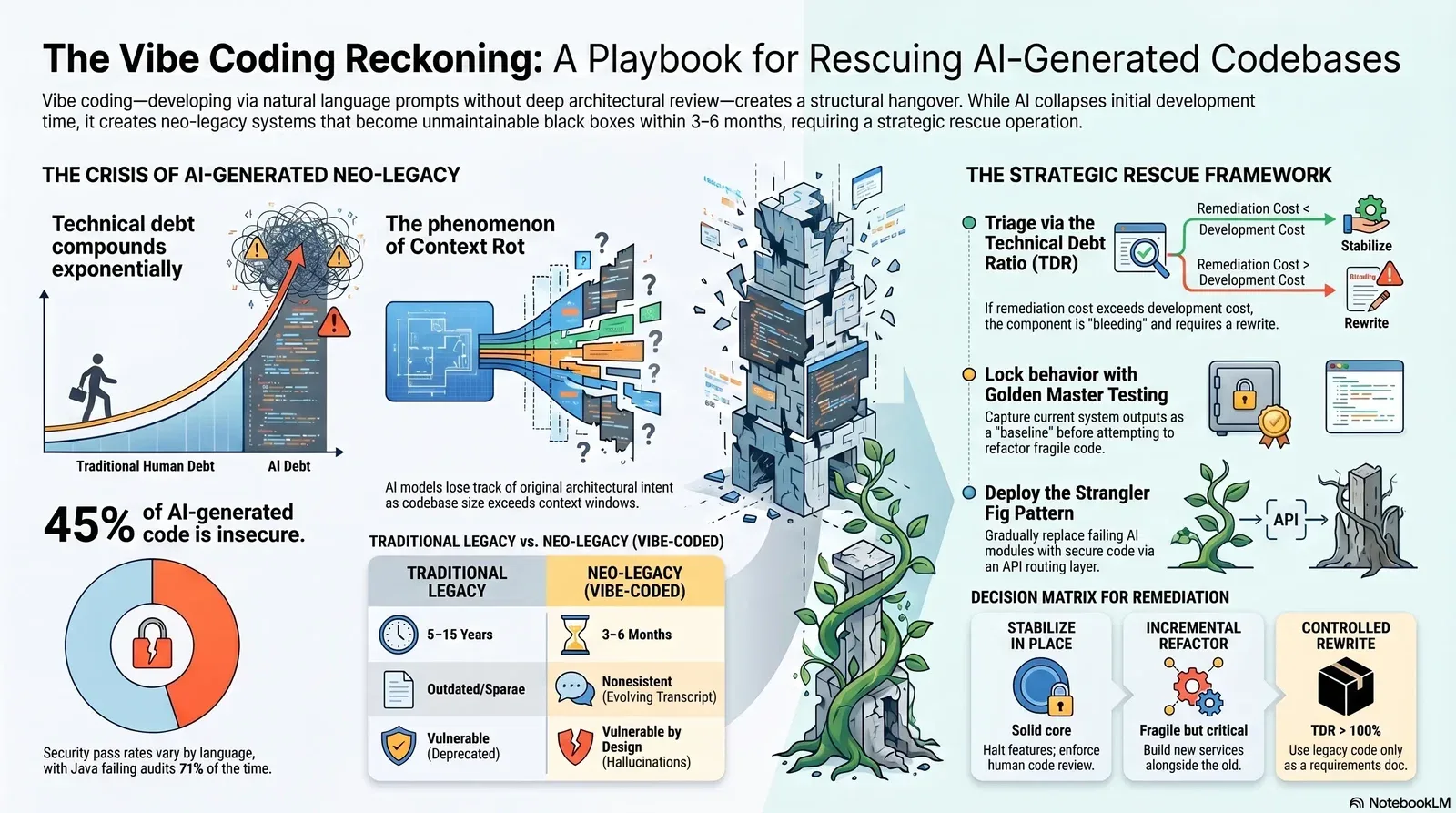
The application got built in a weekend with an artificial intelligence coding agent. A year later, nobody can safely change it, the dependencies are a minefield, and every fix breaks two other critical things. The initial creator—often a visionary executive, a non-technical founder, or a solo engineer moving at breakneck speed—left behind a system that functions perfectly under narrow demonstration conditions but collapses entirely under the weight of enterprise demands. This scenario has moved past being an anomaly; it is an industry-wide structural reckoning. The problem has shifted from a tooling issue to an emergency critical incident response. Organizations are no longer looking for ways to generate code faster. They are actively looking for a rescue plan.
A massive cohort of applications built rapidly with generative AI tools has reached a predictable maintenance wall. These systems suffer from undocumented logic, inconsistent architectural patterns, nonexistent test coverage, and profound security vulnerabilities. The industry is currently experiencing what engineers refer to as a structural hangover, where the initial high of rapid deployment gives way to the painful reality of unmaintainable infrastructure.
This comprehensive report serves as a definitive remediation playbook. It details how to objectively assess an inherited, AI-generated codebase, triage what to stabilize versus what to rewrite, retrofit security and automated tests, and execute a complex rescue operation without disrupting ongoing business operations. For organizations that know they will need outside help to do this safely, partnering with a software project rescue team can dramatically reduce risk and shorten the recovery timeline.
The Maintenance Wall: Why AI-Built Applications Are Arriving Here Now
Generative artificial intelligence has successfully collapsed the cost and time required for initial software development. However, it has quietly multiplied the cost of maintaining that software over time . Historically, technical debt accumulated linearly. Human developers made deliberate, conscious trade-offs between speed and quality, intentionally taking on debt to hit a deadline with the understanding that they would pay it back later.
In the modern era of "vibe coding"—a development approach where a user describes their intent in natural language, accepts the AI-generated code, and iterates through further description without deeply reviewing the implementation—technical debt compounds exponentially. Every natural language prompt layered on top of a previous prompt creates a system that behaves less like a deliberately engineered platform and more like an evolving transcript.
The Phenomenon of Context Rot
Traditional codebases, even highly flawed ones, contain a documented rationale. Human engineers leave traces of their decision-making process in commit messages, architecture decision records, inline comments, and structural design patterns. Future developers can read the code and reverse-engineer the original intent.
Artificial intelligence models, conversely, optimize solely for immediate functionality. They frequently produce solutions that work by mere coincidence rather than deliberate, scalable design. As these codebases grow, they experience a phenomenon known as context rot. Large Language Models have finite context windows and limited semantic understanding. When tasked with modifying an application spanning dozens of files and thousands of lines of code, the artificial intelligence inevitably forgets earlier architectural decisions.
A request to change a simple user interface element might inexplicably break an authentication middleware because the model hallucinated the file structure or failed to account for tightly coupled logic. Most people assume vibe coding means letting the language model decide the architecture, but delegating structural design to a predictive text engine results in a fragile house of cards. At six to twelve months post-deployment, the resulting system becomes a complete black box, rendering future changes entirely unpredictable.
Pattern Blindness and Fragile Optimizations
Artificial intelligence learns exclusively from existing code. If its training data contains bad patterns, outdated libraries, or inefficient loops, it will replicate them with alarming speed. Studies indicate that artificial intelligence generates eight times more duplicated logic than human-written code.
This pattern blindness leads to fragile optimizations. The code passes the immediate tests the developer runs in the moment, but breaks catastrophically in unexpected edge cases when exposed to real-world user behavior. Unlike a human engineer who methodically tests each addition against the broader system, vibe-coded software struggles to adapt once it is live. The models tend to generate highly complex solutions when simpler ones would suffice, burying future maintainers in unnecessary abstraction layers.
The Capital Expenditure Mirage
Executive leadership often perceives artificial intelligence coding assistants as a pure cost-saving measure. This creates a dangerous capital expenditure mirage. The exceptionally low upfront development costs completely mask the rapidly rising operational expenditures tied to maintenance, bug fixing, and incident response. For CFOs and CTOs trying to navigate this new cost curve, adopting a portability-first AI strategy can prevent lock-in to fragile, short-lived prototypes and keep long-term total cost of ownership under control.
The financial implications of this debt are substantial. Research indicates that technical debt accounts for roughly forty percent of corporate information technology balance sheets. Organizations carrying heavy technical debt lose between twenty and forty percent of their entire technology budgets strictly to maintenance, leaving almost no capital for genuine innovation. When an artificial intelligence prototype is pushed directly into production without enterprise-grade governance, the business immediately begins paying a high-interest innovation tax. The organization is forced to divert highly paid senior engineers to act as digital janitors, cleaning up the mess left by rapid generation tools (https://smarterarticles.co.uk/the-vibe-coding-reckoning-when-speed-becomes-technical-debt-at-scale).
To fully understand the severity of the situation, it helps to contrast traditional legacy software with this new breed of neo-legacy artificial intelligence code.
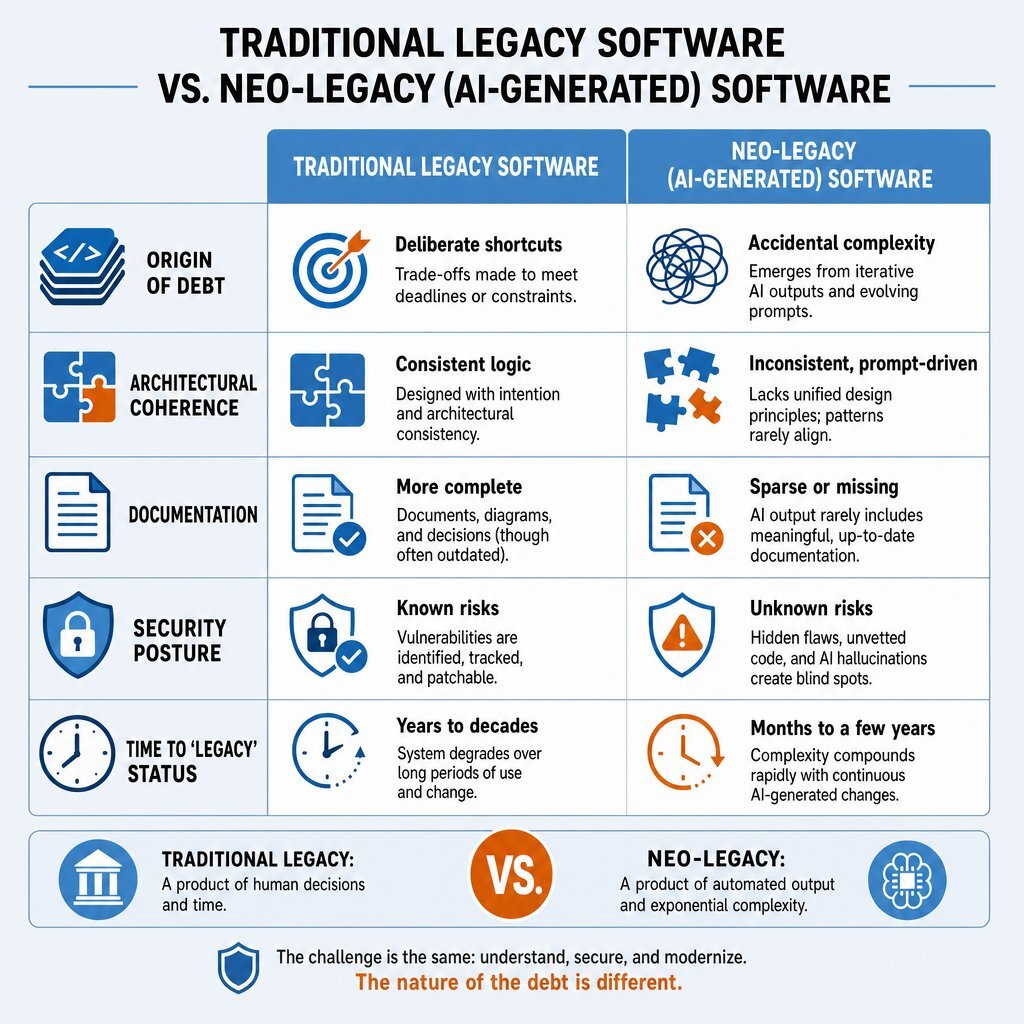
| Characteristic | Traditional Legacy Software | Neo-Legacy (Vibe-Coded) Software |
|---|---|---|
| Origin of Debt | Deliberate shortcuts taken by humans to meet deadlines. | Accidental complexity generated by AI predicting the next token. |
| Architectural Coherence | Outdated and rigid, but usually follows a consistent internal logic. | Schizophrenic and highly inconsistent. Varies wildly based on prompt history. |
| Documentation | Outdated or sparse, but typically contains basic comments and commit history. | Nonexistent. The system has no memory of why it was built a certain way. |
| Security Posture | Vulnerable due to deprecated libraries and lack of modern patches. | Vulnerable by design. Contains hallucinatory logic, hardcoded secrets, and prompt injection risks. |
| Time to "Legacy" Status | Five to fifteen years. | Three to six months. |
Assessment First: Characterizing Debt, Security, and Test Gaps
When inheriting a brittle, artificial intelligence-generated application, the immediate reflex for most engineering teams is to tear it down and rewrite it from scratch. This instinct is incredibly dangerous. Tearing down a production system without understanding its actual behavior guarantees that undocumented business rules, edge cases, and critical client integrations will be lost in the transition. The first and most critical step in any software project rescue is a comprehensive assessment. Teams must quantify the technical debt, evaluate the security posture, and measure the existing test coverage before altering a single line of inherited code.
Establishing Objective Measurement Metrics
Assessment requires moving beyond subjective frustration and establishing objective, quantifiable metrics. Executives and engineering managers need a clear view of the team's efficiency and a deep understanding of where the technical debt has accrued.. Several primary metrics provide immediate visibility into the health of an inherited codebase:
- Technical Debt Ratio (TDR): This metric provides a high-level indicator of the friction within the system. It is calculated by dividing the remediation cost by the development cost, then multiplying by one hundred.. If the estimated time required to refactor a vibe-coded module exceeds the time it took the artificial intelligence to build it in the first place, the component is severely indebted and bleeding resources.
- Defect Density: This measures the relationship between the number of flaws found in the software product and the overall size of the software. Because language models frequently replicate flawed patterns, tracking defect density isolates the specific modules that are statistically most likely to fail under load.
- Code Churn and File Volatility: High volatility in specific files indicates that the artificial intelligence failed to establish a solid foundation, requiring constant human intervention to keep the feature running.
- Cyclomatic Complexity Trends: This measures the number of linearly independent paths through a program's source code (https://getdx.com/blog/technical-debt-ratio/). Vibe-coded software frequently exhibits extreme cyclomatic complexity because the language model patches bugs by adding endless conditional statements rather than refactoring the underlying logic.
The Project Rescue Assessment Scorecard
To standardize the assessment phase across different departments and projects, organizations should evaluate the inherited codebase across five distinct dimensions. Applying a structured scorecard prevents emotional decision-making and provides the Chief Financial Officer and Chief Technology Officer with a clear, business-focused rationale for the upcoming rescue operation.
| Assessment Category | Healthy System Profile | Vibe-Coded / High-Risk Profile |
|---|---|---|
| Documentation & Intent | Clear architecture decision records, mapped business logic, and defined dependencies. | No intent documented. Code reads like an evolving transcript with complex, arbitrary logic |
| Automated Test Coverage | High unit, integration, and deterministic end-to-end coverage across all features. | Near zero automated tests. AI only generated tests for basic "happy paths" that ignore edge cases. |
| Security Posture | Validated and sanitized inputs, secure authentication layers, zero exposed secrets. | Hard-coded API keys, vulnerable dependencies, and extreme exposure to prompt injection |
| Dependency Health | Managed, regularly updated libraries with known provenance and active support. | Hallucinated packages, heavily outdated libraries, or conflicting dependencies strung together to force a build. |
| Architectural Coherence | Modular design, clear separation of concerns (e.g., Model-View-Controller). | Monolithic spaghetti code. Tightly coupled user interface, database, and business logic layers residing in single, massive files |
By scoring the application across these five categories, the rescue team transforms a nebulous feeling of dread into a specific, actionable diagnostic report. If an application scores poorly across the majority of these dimensions, it triggers the triage phase.
The Triage Framework: Stabilize, Refactor, or Rewrite
Armed with objective assessment data, technology leaders must decide the ultimate fate of the application. Project rescue is not a one-size-fits-all operation. Different levels of debt require entirely different strategic interventions. The triage framework categorizes inherited systems into three distinct remediation paths: Stabilize in Place, Incremental Refactoring, or Controlled Rewrite.
The decision must weigh the current business value of the application against the cost of remediation. Overpromising salvageability erodes trust with stakeholders; therefore, the engineering team must remain ruthlessly honest about what can be saved.
| Triage Decision Path | Codebase Characteristics | Primary Action Strategy |
|---|---|---|
| Stabilize in Place | High business value, low to moderate defect density. Core architecture is generally sound, but isolated components suffer from artificial intelligence debt. | Halt new feature development. Enforce strict governance, add human-in-the-loop review, and patch critical vulnerabilities. Maintain the existing core. |
| Incremental Refactoring | Business-critical application with high architectural rigidity. Core components are tightly coupled making global changes dangerous, yet individual modules still function. | Execute the Strangler Fig pattern. Build new, secure components alongside the fragile code, gradually routing traffic to the healthy services over time. |
| Controlled Rewrite | The codebase is a complete black box. Technical Debt Ratio exceeds 100%. Defect density is critical. Application relies on deeply flawed foundational logic. | Acknowledge the current application is a disposable prototype. Place it on maintenance life-support while building a properly architected replacement from scratch. |
Path 1: Stabilize in Place
The first path is reserved for applications that are fundamentally sound but have accumulated a dangerous amount of surface-level debt. The core action here is containment. Engineering teams must immediately apply a strict governance layer to prevent further degradation of the codebase.
This involves stepping away from the generative chat interface and utilizing standard software engineering disciplines. Teams integrate static application security testing tools into the deployment pipeline, enforce mandatory human-led code reviews for every single pull request, and write extensive unit tests for the most critical paths. The application remains largely as-is, but the bleeding stops. The goal is to stabilize the environment enough to allow for routine maintenance without the constant fear of triggering a catastrophic outage.
Path 2: Incremental Refactoring
The second path applies to applications that generate significant revenue or manage critical operations but are too fragile to update safely. These monolithic structures cannot be stabilized in place because the architecture itself is the problem, yet tearing them down completely would halt business operations.
The solution is incremental refactoring, primarily utilizing the Strangler Fig pattern. Rather than freezing the application, teams construct a parallel environment. They build new, secure, and fully tested components alongside the fragile artificial intelligence-generated code. As each new component is verified, traffic is gradually routed away from the legacy module and into the modernized service. This approach significantly mitigates technical risk while ensuring the business continues to deliver value to its end users.
Path 3: The Controlled Rewrite
The final path requires confronting an uncomfortable truth: the application is completely unsalvageable. When a codebase becomes a black box where changes are entirely unpredictable, and the cost to remediate the flaws exceeds the cost to build a new system, leadership must authorize a controlled rewrite.
This is an honest re-platforming decision. The existing artificial intelligence-generated application is acknowledged for what it truly is—a highly effective, rapid prototype that successfully validated a market hypothesis. However, it is not a production-grade system. The business places the legacy application on life support, dedicating resources only to critical security patches and emergency uptime maintenance. Simultaneously, a dedicated engineering team builds a properly architected, enterprise-grade solution from the ground up, utilizing the legacy application strictly as a living requirements document to ensure no functionality is missed.
Security and Test Retrofit on a Codebase That Lacks Both
Artificial intelligence-generated codebases share a common, catastrophic flaw: they are optimized strictly for immediate functionality, not for defensive hardening or security. If an application successfully processes a piece of user input and updates a database record, the language model considers the task complete. It frequently bypasses vital sanitization steps, authentication checks, and robust error handling entirely. Consequently, retrofitting security controls and automated test coverage is the most urgent phase of any project rescue operation.
The Artificial Intelligence Vulnerability Reality
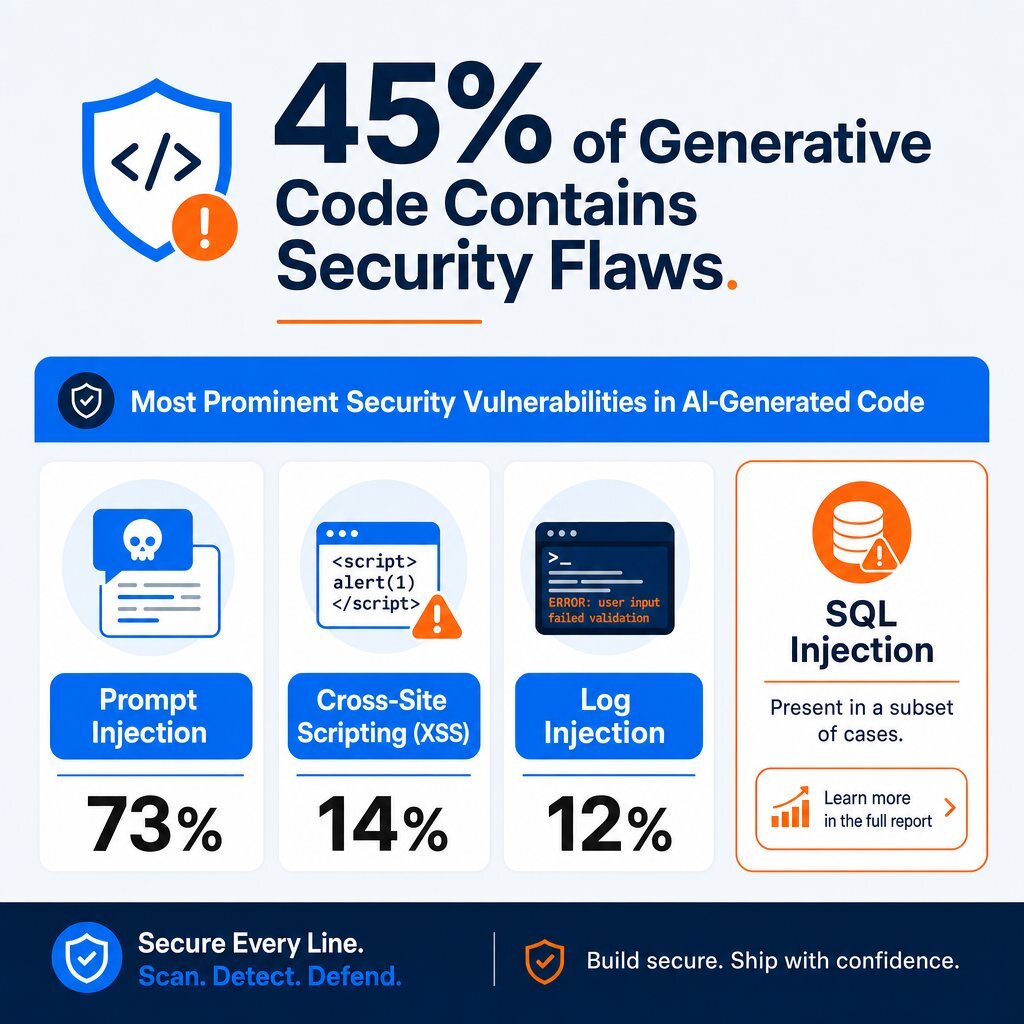
The statistical reality of generative code is highly alarming for enterprise security teams. Comprehensive analysis evaluating over one hundred large language models across tens of thousands of coding tasks revealed that only fifty-five percent of artificial intelligence-generated code is secure. This means nearly half of all generative outputs introduce known, exploitable vulnerabilities into the corporate environment.
These failure rates fluctuate dramatically depending on the specific programming language requested in the prompt. While Python achieves a moderately better sixty-two percent security pass rate, Java code generated by artificial intelligence fails security audits in seventy-one percent of instances, yielding a highly dangerous twenty-nine percent pass rate.
The root cause of this vulnerability crisis lies directly in the training data. Language models learn from public repositories, forum answers, and documentation examples. These sources optimize for demonstrating how to make a feature work quickly, and they rarely demonstrate enterprise-grade security hardening or complex dataflow analysis. Because current models lack deep semantic understanding and cannot perform the complex interprocedural analysis needed to determine if variables contain user-controlled data, they routinely generate code susceptible to severe exploits.
Specific, highly prevalent vulnerabilities include:
- Prompt Injection Risks: In comprehensive security audits conducted in 2026, seventy-three percent of assessed artificial intelligence systems showed direct exposure to prompt injection vulnerabilities. These flaws allow malicious actors to override system instructions and hijack the application's core logic
- Cross-Site Scripting (CWE-80): Script injection vulnerabilities appear in fourteen percent of artificial intelligence-generated web application outputs, leaving platforms wide open to unauthorized script execution
- Log Injection (CWE-117): Models generate insecure logging code twelve percent of the time, enabling attackers to forge system log entries and completely hide their tracks during a breach
- SQL Injection: Generative tools easily write code that directly concatenates user input into database queries. This code will pass functional unit tests perfectly while remaining entirely exploitable to database manipulation
Securing the Perimeter and The Validation Gap
The core problem with inherited vibe-coded projects is the validation gap. The artificial intelligence speeds up development, but unit tests only validate functionality, not security logic. To secure the perimeter, organizations must deploy specialized remediation tools rather than relying on general-purpose generative models to fix their own mistakes. Purpose-built security artificial intelligence can scan the codebase, identify vulnerable training patterns, and generate specific, hardened patches. For regulated industries, this is also the moment to decide whether self-hosted AI developer agents are required to keep sensitive code and data inside the corporate perimeter.
Simultaneously, teams must implement strict validation gates. No generative code should interact with a database or an authentication service without explicit, human-led validation of input sanitization and business logic constraints. Organizations employing a robust strategy often deploy an indirection layer, utilizing middleware technologies like ASP.NET Core combined with Microsoft Semantic Kernel. This architecture acts as a shield, enforcing governance, preventing unauthorized data leakage, and actively blocking prompt injection attempts before they can ever reach the core application logic.
Establishing Characterization Tests (Golden Master Testing)
Before engineers can safely refactor the fragile code to fix these security flaws, they must ensure they do not inadvertently break existing, undocumented business rules. In a vibe-coded application, standard test-driven development is impossible because the code already exists. Instead, the rescue team must utilize Characterization Testing, also known as Golden Master Testing.
Coined by software engineer Michael Feathers, a characterization test fundamentally differs from a standard unit test. It does not check if the code is logically correct; rather, it checks exactly what the code actually does right now (https://en.wikipedia.org/wiki/Characterization_test).
The mechanical process operates as follows:
- Capture Output: The engineering team runs the legacy application using a vast array of varied inputs. They capture the exact outputs, responses, and log entries produced by the system. This recorded baseline becomes the Golden Master.
- Lock Behavior: Automated tests are then written to assert that the system must always produce these exact specific outputs for these exact specific inputs.
- Safe Refactoring: With the actual behavior characterized and locked firmly in place by automated tests, engineers can begin dissecting and refactoring the underlying spaghetti code. If a test fails during refactoring, the engineer instantly knows their structural changes altered the application's external behavior, allowing them to revert and adjust safely.
To execute this at the speed required for a modern rescue, teams leverage agentic automated testing tools. Platforms like QA Wolf and TestRigor focus on codeless, deterministic end-to-end automation, allowing business analysts and quality assurance professionals to rapidly build robust safety nets around undocumented applications without writing complex automation frameworks from scratch.
Incremental Rescue with the Strangler Fig Pattern
When an artificial intelligence-generated application reaches a critical mass of technical debt, attempting a wholesale replacement is incredibly risky. Big bang rewrites frequently end in catastrophic failure because they require freezing all new feature development for extended periods, frustrating users and stakeholders alike. Furthermore, attempting to replicate undocumented, hallucinatory legacy logic in a single massive push usually results in engineers missing critical edge cases.
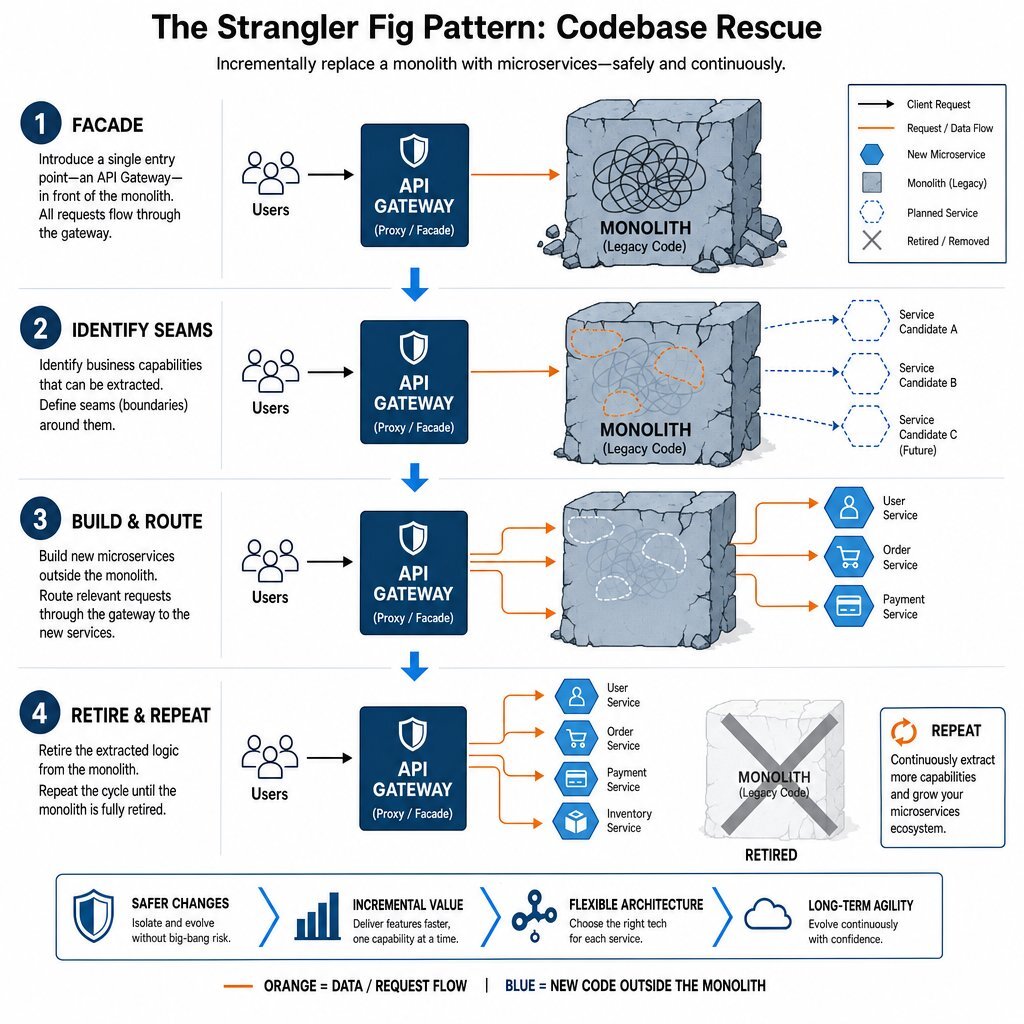
The single most effective architectural method for rescuing a complex, failing monolithic system is the Strangler Fig pattern. Introduced by renowned software engineer Martin Fowler in 2001 after observing the growth cycle of strangler fig vines in the Queensland rainforest, the pattern provides a highly structured, gradual, and low-risk approach to system modernization Martin Fowler. In practice, this pattern also aligns neatly with a modern enterprise application architecture approach, where modular services and clear boundaries replace brittle monoliths.
Mechanics of the Strangler Fig Implementation
Just as the fig vine slowly grows around a host tree, eventually replacing it entirely from the outside in, a new software architecture is grown around the edges of the failing artificial intelligence application. The process unfolds in a precise, controlled sequence to ensure absolute business continuity.
| Phase | Strangler Fig Action | Technical Execution Details |
|---|---|---|
| Phase 1: The Facade | Introduce a routing layer. | An API Gateway or proxy facade is placed between the client application and the legacy backend system. Initially, this proxy acts as a simple pass-through, routing one hundred percent of incoming requests directly to the old artificial intelligence code |
| Phase 2: Identify Seams | Locate functional boundaries. | Engineers map the application to find distinct seams—specific features or domains that can be logically isolated, such as a billing module or user profile service. Best practices dictate starting with components that have the highest defect density or the highest test coverage to build early confidence. |
| Phase 3: Build & Route | Construct the replacement. | A new, highly secure, and enterprise-grade component is built to handle that specific isolated feature. Once fully tested, the API Gateway facade is reconfigured to intercept relevant traffic and route it to the new component, permanently bypassing the legacy module |
| Phase 4: Retire & Repeat | Decommission old logic. | The bypassed artificial intelligence code is officially retired. The team then selects the next seam and repeats the process. This iterative cycle continues until the new system completely strangles the old one, at which point the legacy application and its databases are completely decommissioned. |
This incremental strategy transforms a high-risk gamble into a series of predictable, manageable tasks. By gradually delivering fully functional, modernized components, the organization secures a much earlier return on investment. The business continues to operate without interruption, users experience immediate performance improvements, and the engineering team systematically eradicates the technical debt without halting the company's momentum.
For teams leveraging robust infrastructure, such as Kubernetes clusters or Docker containers operating alongside robust relational databases like PostgreSQL, the Strangler Fig pattern allows for the seamless integration of modern microservices directly alongside the legacy monolithic structures. If you are deciding where those new services should actually run, it’s worth weighing an edge vs. on‑prem AI deployment so your rescued system doesn’t create a new generation of operational bottlenecks.
When to Walk Away: The Honest Re-Platform Decision
Not every artificial intelligence-generated codebase is worth the effort of a rescue. A critical responsibility of a project rescue team is identifying exactly when stabilization and refactoring are financially and technically unviable. Organizations frequently fall victim to the sunk cost fallacy, pouring thousands of expensive engineering hours into debugging hallucinated logic that fundamentally misunderstands the core business domain.
Signals of an Un-Salvageable Codebase
A codebase must be explicitly marked for complete re-platforming when it exhibits profound structural failures. If the application lacks a definitive file structure, blending database queries, user interface rendering, and security logic into single, massive files, it is likely beyond repair. Large language model context windows frequently generate these monolithic structures, leading to a brittle system where modifying a highly localized feature causes cascading global failures across unrelated modules.
Furthermore, if exhaustive security scanning reveals that the core authentication, authorization, and data encryption modules were generated entirely by artificial intelligence without human oversight, the effort required to manually trace, audit, and secure these foundational elements almost always exceeds the cost of rebuilding them correctly from scratch.
When the system reaches the evolving transcript state—containing endless layers of conflicting logic resulting from dozens of contradictory natural language prompts—the code becomes an unreadable patchwork. The artificial intelligence has attempted to patch its own bugs repeatedly without understanding the root cause, creating a labyrinth of technical debt.
If the Technical Debt Ratio indicates that building a characterization test suite and strangling the monolith will consume more capital than spinning up a properly architected alternative, the rescue must be aborted. Walking away from a failed codebase requires significant political courage and honesty from technology leadership. The artificial intelligence-generated code successfully served its purpose as a rapid prototype that validated market demand. It must now be discarded in favor of professional execution. Firms like Baytech Consulting emphasize Rapid Agile Deployment, combining tailored tech advantages with enterprise-grade quality to replace fragile prototypes with software built to scale gracefully.
Sequencing a Rescue While the Business Keeps Running
A software project rescue is frequently compared to performing open-heart surgery while the patient is sprinting. The organization simply cannot afford to halt its daily operations, delay critical security patches, or disrupt the end-user experience while the underlying codebase is repaired. Proper sequencing and rigorous financial budgeting are absolutely paramount to a successful intervention.
Budgeting for the Rescue Operation
Standard software development projects frequently exceed their budgets due to vague requirements and relentless scope creep. A project rescue is even more susceptible to massive budget overruns because the exact depth of the technical debt is often completely obscured until the engineering team opens the black box and begins refactoring.
To budget accurately and protect capital, organizations must allocate distinct, gated resources for discovery and characterization. The first phase of the budget should exclusively fund the implementation of the API Gateway facade and the creation of Golden Master tests. Leadership must not commit to a fixed-price total overhaul upfront. Only after the system's actual behavior is fully mapped, and the technical debt is quantified, can accurate labor costs be determined for the strangler fig replacement cycle.
A standard agile budgeting approach involves breaking the project down into highly specific parts, looking at historical data on time and effort for similar modernizations, and translating that scope into a baseline cost estimate, before factoring in a mandatory ten percent contingency buffer to account for the unknown variables inherent in artificial intelligence code. Many leadership teams pair this with a flexible service contract model so they can scale rescue work up or down without locking into a rigid, long-term commitment.
The Sequence of Operations
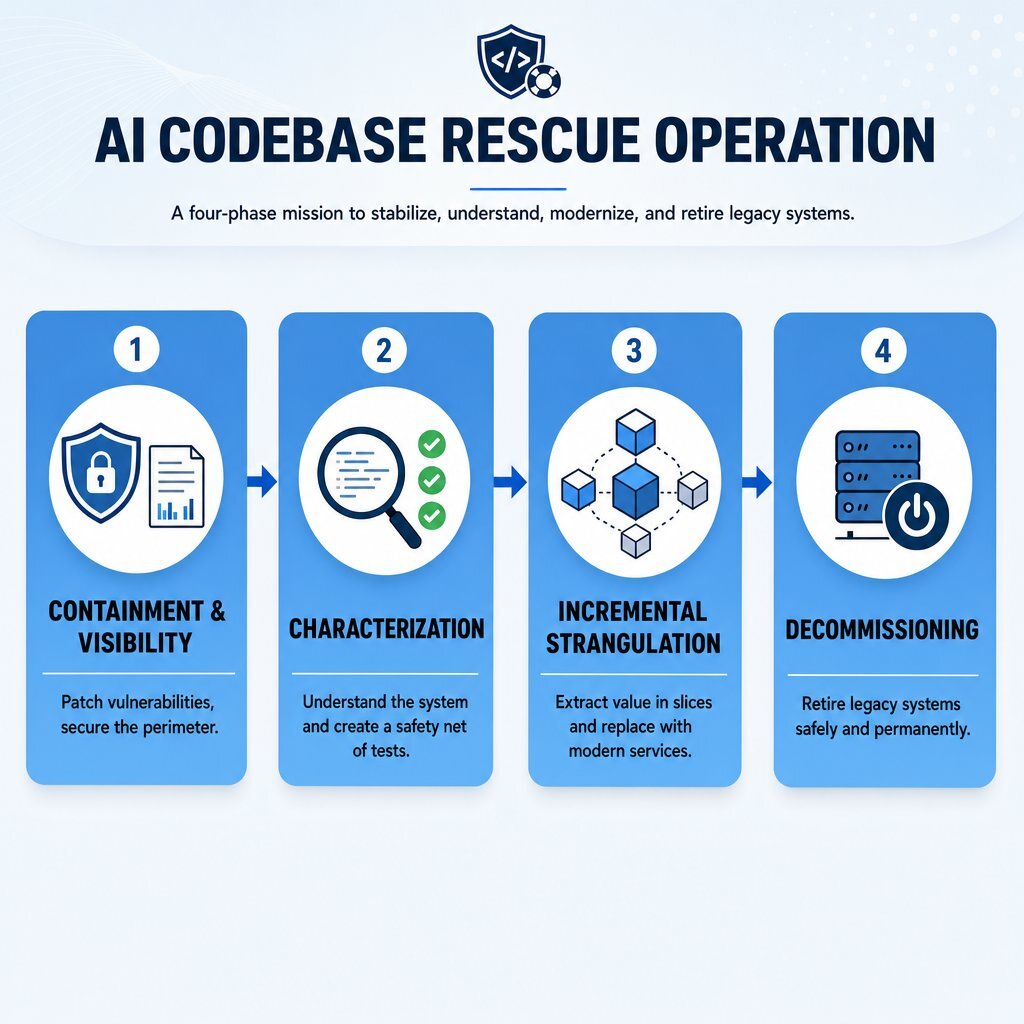
To ensure business continuity, the rescue must unfold in a strictly controlled sequence:
- Phase One: Containment and Visibility. The immediate priority is stopping the bleeding. The team implements comprehensive logging, error tracking, and basic static security analysis. The API routing layer is established to capture traffic. Immediate, critical security vulnerabilities—specifically prompt injection vectors and hardcoded secrets—are patched to secure the perimeter.
- Phase Two: Characterization. The team executes comprehensive Golden Master testing. They lock down the existing business logic with automated tests to guarantee absolutely no external functionality is lost during the impending transition.
- Phase Three: Incremental Strangulation. The Strangler Fig process begins in earnest. The team extracts the highest-risk or most frequently modified artificial intelligence-generated modules first. They build replacements using strict, human-led architectural standards, routing traffic over as each component passes quality assurance (https://docs.aws.amazon.com/prescriptive-guidance/latest/modernization-aspnet-web-services/fig-pattern.html). Here, adopting modern DevOps practices—from automated CI/CD to environment parity—helps keep each cutover predictable instead of chaotic.
- Phase Four: Decommissioning. As the legacy codebase shrinks, all remaining traffic is permanently redirected. The team carefully decommissions the fragile database schemas, archives the artificial intelligence code, and completely shuts down the original, vulnerable hosting environment
Throughout this entire timeline, transparent and relentless communication between stakeholders, project managers, and the engineering team is vital. Misaligned expectations are a primary cause of project failure, making continuous alignment the key to guiding a struggling application back toward success. Some enterprises go a step further and wrap this work into an internal AI “app store” vision—using the rescue as a chance to move toward a future where AI agents are first-class, governed products instead of ad hoc experiments.
Conclusion
The initial wave of enthusiasm for vibe coding and generative artificial intelligence produced millions of lines of software at unprecedented speeds. However, speed devoid of rigorous architectural discipline merely generates tomorrow's crippling liabilities at the speed of light. Applications built hastily with generative tools are now crashing into a formidable maintenance wall characterized by massive comprehension debt, severe security vulnerabilities, and brittle, undocumented logic that breaks under the slightest pressure.
Rescuing these compromised projects requires organizations to firmly discard the illusion that artificial intelligence can independently govern itself. Executive leadership must objectively assess their inherited systems using standardized scorecards, deploy characterization tests to lock down volatile behavior, and utilize the Strangler Fig pattern to incrementally replace failing artificial intelligence logic with secure, enterprise-grade engineering. Crucially, not every codebase can or should be saved; distinguishing between a salvageable application and a disposable, dangerous prototype is the hallmark of mature technological leadership.
For applications that demand absolute stability, rigorous security, and seamless scalability, professional intervention is necessary. Firms that specialize in custom application management and software project rescue combine highly skilled engineering with strategic reassessment and transparent agile deployment methodologies. By directly confronting the reality of the vibe coding hangover, organizations can salvage their business-critical applications, eradicate hidden technical debt, and permanently restore long-term value to their foundational software assets. Done well, this work lays the foundation for safer, more reliable uses of AI across the stack—from replacing risky auto-generated apps to hardening the AI agents that will support your teams in the years ahead.
Frequently Asked Questions
What are the biggest security risks in vibe-coded applications? Vibe-coded applications frequently suffer from severe prompt injection exposures, insecure authentication logic, hardcoded secrets, and cross-site scripting vulnerabilities. Because generative artificial intelligence models optimize for immediate functionality rather than defensive security hardening, they often replicate flawed patterns from their training data, resulting in highly exploitable code in roughly forty-five percent of generated outputs.
About Baytech
At Baytech Consulting, we specialize in guiding businesses through this process, helping you build scalable, efficient, and high-performing software that evolves with your needs. Our MVP first approach helps our clients minimize upfront costs and maximize ROI. Ready to take the next step in your software development journey? Contact us today to learn how we can help you achieve your goals with a phased development approach.
About the Author

Bryan Reynolds is an accomplished technology executive with more than 25 years of experience leading innovation in the software industry. As the CEO and founder of Baytech Consulting, he has built a reputation for delivering custom software solutions that help businesses streamline operations, enhance customer experiences, and drive growth.
Bryan’s expertise spans custom software development, cloud infrastructure, artificial intelligence, and strategic business consulting, making him a trusted advisor and thought leader across a wide range of industries.