
SaaS Pricing Shift: How to Negotiate AI-Driven Renewals
June 15, 2026 / Bryan Reynolds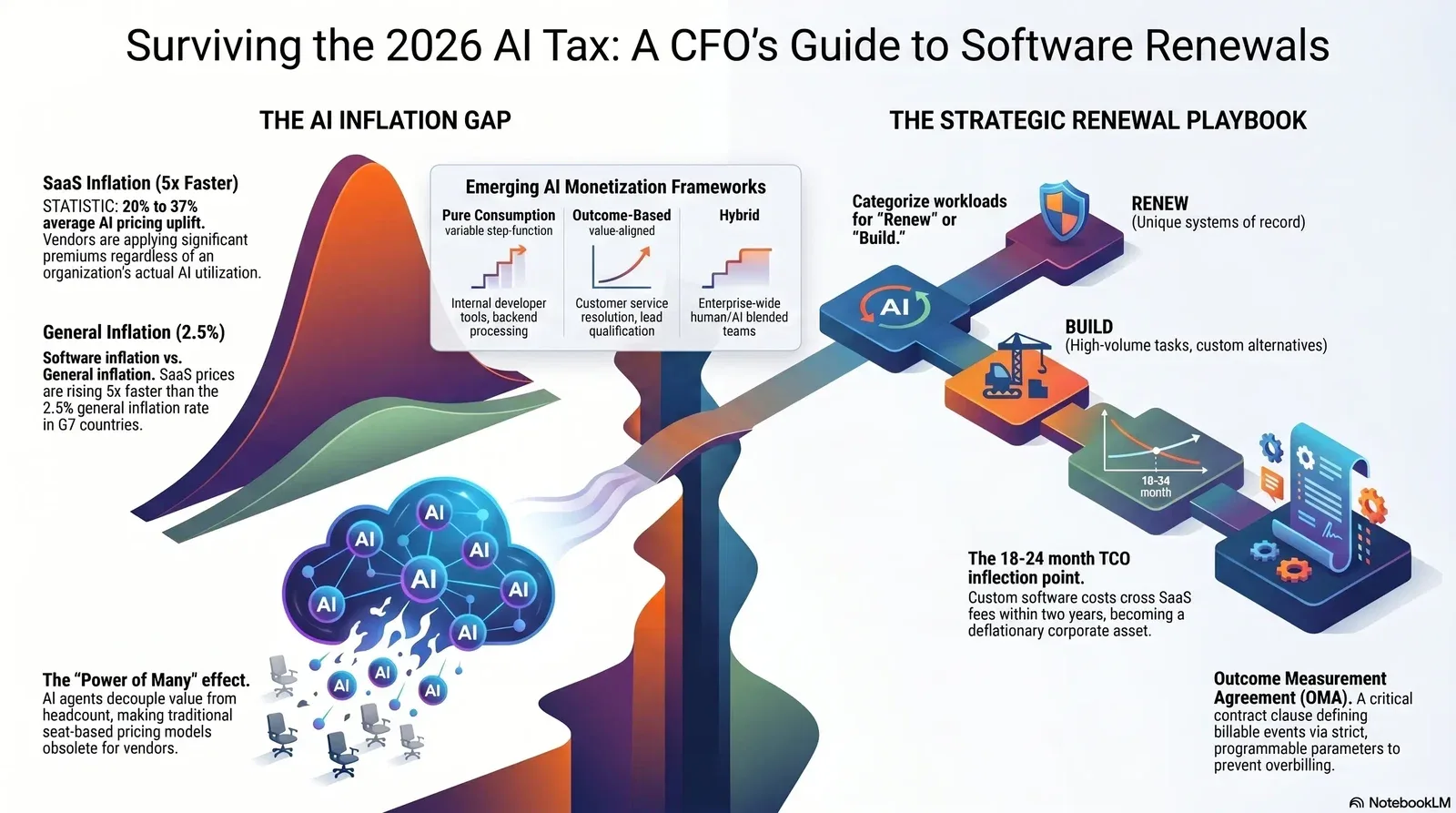
The CFO's 2026 AI Renewal Playbook: Surviving the AI Tax at Contract Time
The line item on the 2026 software renewal quote that was not present in previous years—an artificial intelligence pricing uplift ranging from 20 to 37 percent—is not a rounding error. It represents the leading edge of a structural repricing event across the enterprise software sector. The software-as-a-service industry is currently undergoing a fundamental transformation, abandoning predictable, seat-based subscription models in favor of dynamic, usage- and outcome-based frameworks driven by the integration of autonomous agentic capabilities. For financial leaders, procurement teams, and chief technology officers evaluating these rapidly approaching renewals, the introductory trial-month expenditure is rarely a reliable indicator of the ultimate financial burden when projected over a thirty-six-month operational scale.
Finance leaders must treat AI-era software renewals as complex portfolio management decisions rather than routine administrative approvals. The evaluation process now demands rigorous modeling of cost curve shapes, assessing whether expenses will scale linearly, sub-linearly, or via unpredictable step-functions at projected enterprise transaction volumes. It requires the implementation of robust contractual safeguards, particularly the negotiation of Outcome Measurement Agreements, prior to document execution. Furthermore, it necessitates evaluating the total cost of ownership against bespoke, custom-built alternatives, utilizing the genuine threat of internal application development as a strategic lever rather than a mere negotiating bluff.
This comprehensive research report provides a robust, data-driven framework for finance and technology executives to evaluate AI pricing uplifts, decode shifting SaaS monetization strategies, implement protective contract mechanisms, and determine the optimal inflection point for replacing external vendor dependencies with custom software solutions.
The Macroeconomic Context of the 2026 Software Renewal Environment
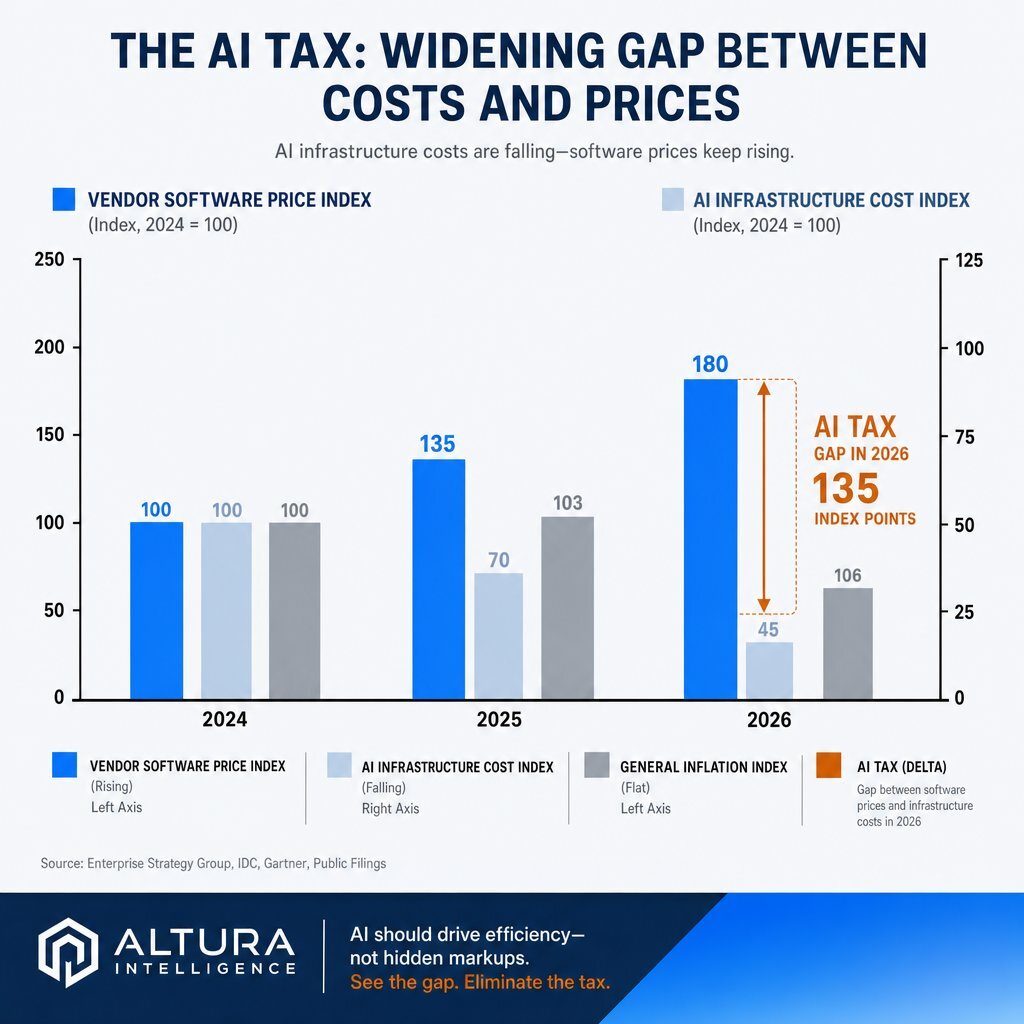
The enterprise technology sector in 2026 is defined by a striking operational contradiction: the underlying infrastructure costs of artificial intelligence computational models have plummeted, yet the end-user price of the enterprise software embedding these technologies has surged dramatically. Enterprise budgets are currently absorbing what industry analysts categorize as a software inflation tax. Software vendors are raising subscription and licensing prices at an annualized rate of 12.2 percent, a figure that scales nearly five times faster than the 2.5 percent general economic inflation rate observed across G7 countries.
Consequently, organizations find themselves paying 12 percent more for software year-over-year while deriving only 2.5 percent of that increase from broader macroeconomic inflationary pressures. The remaining 9.5 percent represents pure vendor margin expansion extracted directly from enterprise technology budgets. The financial burden of this expansion is substantial and compounding. Per-employee SaaS costs climbed to $9,100 annually in 2025, representing a 15 percent increase from the $7,900 benchmark recorded in 2023. Currently, a typical organization allocates one out of every eight budget dollars to software-as-a-service platforms, with a staggering 70 percent of corporate IT budgets consumed merely by keeping existing systems operational rather than funding new capability expansion or strategic digital transformation initiatives.
The Discrepancy Between Compute Costs and Vendor Pricing
This aggressive vendor price expansion sits in direct opposition to the actual underlying costs of AI computational models. Over a two-year period leading into 2026, fundamental AI model costs have decreased by 93 percent. The cost to process data through the ChatGPT API, for example, dropped precipitously from 0.03 per 1,000 tokens in 2024 to 0.002 in 2026, while leading foundational model developers including OpenAI, Anthropic, and Google drastically reduced API pricing for their top-tier generative models. Infrastructure hardware has mirrored this severe deflationary trend, with high-performance GPU compute hours, such as those for H100 processors, falling significantly on the open market.
Despite AI infrastructure costs declining by 40 to 70 percent for the software vendors themselves, these enterprise providers are resolutely refusing to pass the underlying savings to the consumer. Instead, vendors are aggressively extracting value through an AI tax, defined as a 20 to 37 percent premium attached to contract renewals. This premium is frequently bundled indiscriminately into the core software package, regardless of whether the enterprise customer actively requests, requires, or utilizes the newly integrated artificial intelligence capabilities.
This value extraction materializes through several distinct, highly orchestrated vendor go-to-market strategies that mirror the broader “SaaSocalypse” shift in software pricing and valuation models. The most common tactic is the forced SKU migration. In this scenario, vendors systematically retire legacy pricing tiers, forcing enterprise buyers into premium packages that mandate the adoption of AI tools. ServiceNow's generative AI add-on, branded as Now Assist, provides a clear example of this dynamic. The capability is sold via the Pro Plus SKU, which mandates a 50 to 60 percent uplift on the customer's base tier pricing. For an ITSM Enterprise customer previously paying a base cost of 160 to 200 per fulfiller on a monthly basis, the forced migration pushes the financial outlay to between 240 and 320 per fulfiller, completely transforming the platform's total cost of ownership.
Alternatively, major ecosystem providers leverage mandatory feature bundling, integrating AI models directly into core productivity suites without providing an opt-out mechanism for cost-conscious buyers. Microsoft initiated aggressive price increases ranging from 9 to 33 percent across its commercial M365 plans starting in July 2026, effectively forcing its entire user base to subsidize its AI investments. When direct price increases are met with severe pushback, vendors engage in shrinkflation. Industry data indicates that approximately 60 percent of software vendors actively mask price increases by reducing the value of existing tiers without lowering the associated cost. An analysis of late 2025 procurement data revealed that 28 percent of renewals involved downgraded technical support, tightened service-level agreements, or reduced feature sets for the same historical base price.
The Existential Threat to Seat-Based Monetization
To effectively combat these aggressive pricing maneuvers, finance leaders must understand the underlying catalyst driving vendor behavior. The software industry is responding to an existential threat to its traditional valuation and revenue forecasting models. For over two decades, SaaS valuations relied entirely on predictable, seat-based recurring revenue. The fundamental assumption of the industry was that revenue scaled in direct, linear proportion to human headcount.
The rapid proliferation of autonomous AI agents completely shatters this economic paradigm. In a modernized, agent-driven ecosystem, a single human operator can orchestrate dozens of automated processes simultaneously. This fundamentally decouples the technological value delivered to an organization from the number of human seats billed by the vendor. This dynamic, categorized by Deloitte analysts as the "Power of Many" effect, allows organizations to drastically reduce their required user licenses while maintaining or even increasing total operational output.
The financial implications of permanently declining seat counts are severe for software vendors and their investors. Financial analysis models indicate that a 30 percent decline in seat licenses across a customer base, even if partially offset by a 10 percent per-seat price increase, results in a net 23 percent contraction in vendor revenue. In a more aggressive scenario where autonomous agents trigger a 50 percent seat decline, paired with a 15 percent price increase, the vendor suffers a staggering 42.5 percent revenue contraction. Facing the prospect of collapsed discounted cash flows and heavy "uncertainty taxes" applied by public market investors, software vendors are rushing to shift their monetization models toward usage and outcomes before their seat-based revenues evaporate.
Industry forecasts confirm the sheer velocity of this transition. Gartner predicts that by the year 2030, at least 40 percent of all enterprise SaaS spending will transition to usage-, agent-, or outcome-based models, while traditional seat-based revenue share will decline sharply from 21 percent to just 15 percent of total market capitalization. The transition window is currently peaking, meaning that renewals negotiated in 2026 will set the financial baseline for the next half-decade of enterprise technology architecture.
A Field Guide to AI Pricing Models and Cost Curves at Scale
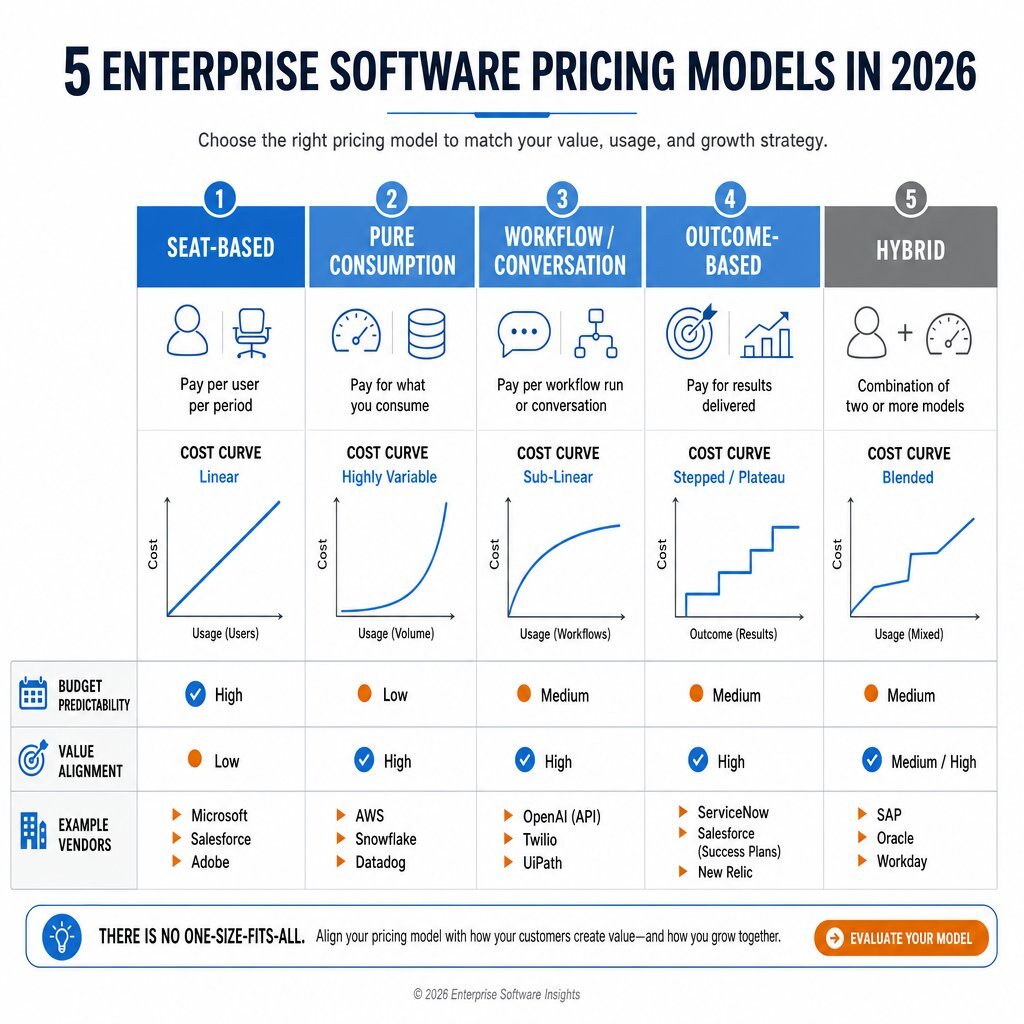
As the traditional per-seat licensing model erodes, vendors are introducing highly complex, multi-variable monetization structures to capture the value generated by artificial intelligence. Survey data reveals that more than 75 percent of AI providers report deep uncertainty regarding how to price agentic solutions effectively, leading to broad, chaotic market experimentation. For the enterprise CFO, accurately forecasting departmental expenditure requires deeply understanding these emerging pricing architectures and the unique cost curves they generate at scale.
The fundamental rule of AI-era software economics is that AI marginal costs are not equivalent to traditional SaaS marginal costs. In the legacy SaaS model, adding an additional user to a multi-tenant cloud application incurred virtually zero marginal cost for the vendor, allowing for gross margins between 80 and 90 percent. Conversely, every single AI query consumes measurable computing resources, memory allocation, and complex orchestration load. Consequently, AI-native platforms and augmented SaaS tools frequently operate on heavily compressed 50 to 60 percent gross margins. Vendors are fundamentally unwilling to absorb this variable cost, choosing instead to pass the cost-to-serve metric directly to the enterprise buyer through novel pricing frameworks.
Primary AI Monetization Frameworks in 2026
The enterprise market has broadly consolidated around four distinct pricing mechanisms. Each framework aligns with specific technological capabilities and bears unique cost curve implications for the buyer.
The first mechanism is the pure consumption-based model, which relies on granular billing of tokens or API calls. Under this usage-based billing structure, the enterprise is charged strictly based on metered system utilization, calculating variables such as computing time, generative tokens consumed, or the active duration of an autonomous agent. The cost curve shape for this model is a highly variable step-function that scales directly and aggressively with system utilization. Budget predictability is exceptionally low, as volatile usage environments can lead to severe, unforeseen budget spikes. Salesforce Agentforce utilizes a variation of this model through its "Flex Credits" option, charging $500 per 100,000 credits for custom actions, which requires enterprise teams to maintain granular tracking and strict governance through digital wallet dashboards to prevent cost overruns. Finance and technology teams that want to avoid these token “bill shocks” should understand why browser-style, token-hungry AI agents can be 45× more expensive than efficient API-based designs.
The second prevalent framework is the workflow or conversation-based model, which charges buyers per discrete task initiated. This model abstracts raw computational metrics into understandable workflow units, charging the customer every time a predefined action is initiated or a conversation occurs, regardless of the ultimate business outcome or success of that interaction. The cost curve shape here scales linearly based on transaction volume. Predictability is moderate, as human or agent transaction volumes are generally easier for finance teams to forecast than raw computational tokens. Salesforce Agentforce provides a "Conversations" pricing tier that perfectly exemplifies this approach, charging a flat $2.00 per external customer-facing conversation, placing the financial risk of a prolonged or complex customer interaction squarely on the vendor, while placing the risk of high-volume, low-value interactions on the buyer.
The third framework is the outcome-based model, designed to perfectly align vendor revenue with tangible value capture. Outcome pricing represents the theoretical maximum alignment between buyer value and software cost, as the enterprise pays a fee only when the AI agent successfully delivers a verified, tangible business result. The cost curve shape is theoretically sub-linear to linear, as software costs strictly track with realized business value. Predictability is moderate; while the gross spend remains highly variable based on volume, finance teams can tolerate the variance because every dollar spent is contractually tied to a successful business operation. Intercom's customer service AI agent, Fin, pioneered a strict outcome-based model, charging the enterprise $0.99 per successfully resolved customer ticket. In this ecosystem, resolving a ticket is defined by specific behavioral parameters, such as the human customer confirming resolution or the distinct absence of a follow-up inquiry after the agent provides an answer.
The fourth and most rapidly adopted framework is the hybrid pricing model, which combines a base subscription with dynamic usage tiers. Hybrid pricing structures pair a baseline subscription—which covers the vendor's fixed operational costs, secures a revenue floor, and provides baseline platform access—with a variable usage or outcome-based overage component. The cost curve creates a stepped plateau, offering high predictability up to the baseline threshold, followed by moderate predictability as usage scales into the overage tiers. According to data from Bessemer Venture Partners, hybrid models are rapidly becoming the absolute industry standard, soaring to approximately 41 percent adoption across top-tier vendors. This model dominates because it strikes a negotiated compromise: it insulates vendors from total failure risk while protecting enterprise buyers from paying full market price for incomplete or hallucinated automated tasks. Companies such as EvenUp and Leena AI leverage this model effectively to balance predictable recurring revenue with scalable upside.
| Pricing Model | Cost Curve Shape | Budget Predictability | Value Alignment | Best-Fit Enterprise Workload | Example Vendors |
|---|---|---|---|---|---|
| Traditional Seat-Based | Linear (Step-function by headcount) | Very High | Very Low (High shelfware risk) | Core systems of record requiring mandatory human-in-the-loop oversight. | Legacy CRM, ERP baselines |
| Pure Consumption (Tokens) | Highly Variable (Unpredictable Spikes) | Low | Low (Costs accrue even if output fails) | Internal developer tools, backend data processing, API endpoints. | OpenAI API, Anthropic |
| Workflow / Conversation | Linear (Scales strictly by volume) | Moderate | Moderate (Value depends entirely on workflow quality) | High-volume external routing, pre-sales inquiries, initial support triage. | Salesforce Agentforce (Conversations) |
| Outcome-Based | Value-Aligned (Sub-linear to value) | Moderate (Spend is offset by direct ROI) | Very High | Customer service resolution, automated billing reconciliation, lead qualification. | Intercom (Fin), EvenUp, Graph AI |
| Hybrid (Base + Overage) | Stepped Plateau | High (Assuming proper consumption caps are negotiated) | High | Enterprise-wide deployments blending human teams with augmented AI agents. | ServiceNow (Pro Plus), Microsoft |
Projecting the 36-Month Cost Horizon
The fundamental error procurement teams commit when evaluating 2026 software contracts lies in optimizing exclusively for the initial 12-month expenditure. The cheapest pricing model at the trial phase is frequently the most punitive and expensive at a 36-month operational scale, necessitating a longer-term analytical lens.
Consider a mid-sized enterprise deploying an AI customer service agent to handle 5,000 interactions monthly. Under a strict outcome-based model charging $0.99 per resolution, and assuming an optimistic 80 percent resolution rate, the immediate cost appears highly efficient at roughly $3,960 per month. The CFO views this as a clear victory, as it is significantly cheaper than hiring a team of human agents to manage the same volume. However, as the organization scales its internal knowledge base, refines its product documentation, and the AI becomes exponentially more proficient over the next two years, the underlying mathematics shift violently.
If the company grows and the agent handles 25,000 resolutions monthly by year three, the software cost scales in absolute lockstep, soaring to $24,750 monthly. The enterprise is effectively penalized financially for improving its own internal data architecture and business processes, because increased operational efficiency directly triggers proportionally increased outcome fees paid to the vendor.
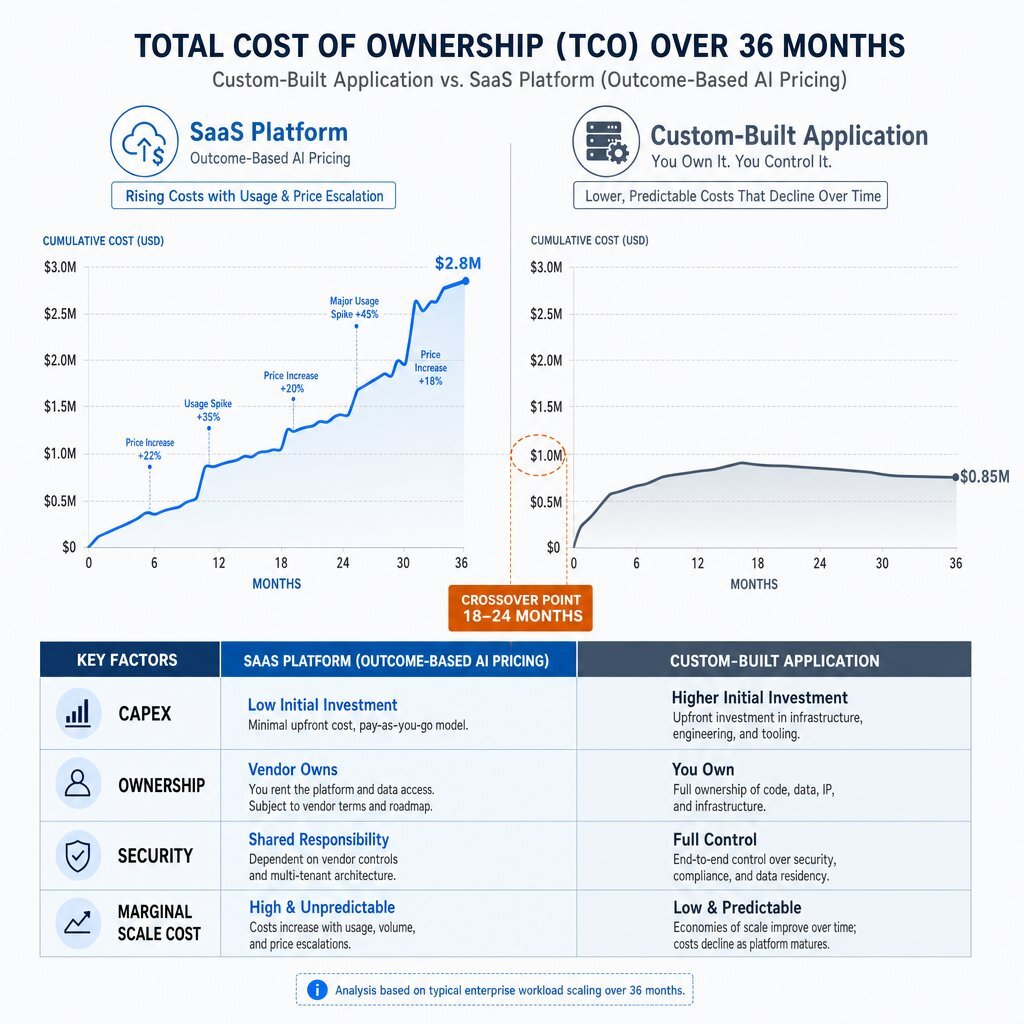
Conversely, a custom-built internal solution or a flat-rate infrastructure model incurs significant upfront capital expenditure during the initial 12 months for architecture, deployment, and testing. Yet, by month 36, the marginal software cost of resolving the 25,000th ticket approaches zero, limited only by fractions of a cent in raw cloud computing overhead. Financial modeling must therefore rigorously contrast the diverging, volume-dependent cost curves of SaaS monetization models against the stabilized, predictable maintenance costs of internal infrastructure over a multi-year horizon.
The Renewal Decision Framework: Renew, Renegotiate, or Replace
Faced with mandatory 20 to 37 percent pricing uplifts across the software portfolio, finance and procurement teams must abandon broad, company-wide mandates. A universal directive to either accept all AI pricing or reject all AI pricing is strategically flawed. The evaluation process must be conducted on a workload-by-workload basis, analyzing the specific utility, stability, and volume of the underlying business function.
The evaluation process involves parsing subtle vendor signals and categorizing discrete enterprise workloads into three strategic buckets: Renew and Absorb, Renegotiate to Consumption, or Replace and Build.
Identifying Vendor Extraction Signals
Before engaging in workload categorization, procurement teams should actively monitor enterprise vendors for behavioral signals that indicate an impending margin extraction maneuver. Identifying these signals early provides the enterprise with the crucial lead time required to develop viable alternatives.
The most glaring signal is the issuance of a SKU retirement notice. A notification that a legacy, non-AI pricing tier is being deprecated is a direct trigger for a forced migration to an AI-inclusive, high-margin package. This communication should instantly initiate a formal market evaluation and a pause on all auto-renewal processes. Another pervasive tactic is the introduction of "no extra charge" pilot features. Vendors frequently introduce beta generative AI functionalities into core tools at no additional cost for a preliminary term. The strategic objective is to establish deep operational dependency among end-users, paving the way for a punitive, mandatory price uplift at the subsequent contract renewal once the enterprise is structurally reliant on the tool. Finally, procurement must be deeply suspicious of aggressive early renewal incentives. Vendors offering steep, time-limited discounts for early contract signatures are typically attempting to secure long-term legal lock-in before superior, lower-cost market alternatives or internal enterprise builds fully mature.
Workload Categorization Strategy
If the software functions as a foundational system of record—such as enterprise resource planning software, core financial ledgers, or heavily integrated human capital management systems—and the vendor possesses unreplicable industry integrations, absorbing the AI uplift may be mathematically sound. This falls into the Renew and Absorb category. The switching costs and operational disruption associated with ripping out a core system of record often negate the savings of avoiding the AI tax. However, the renewal must be gated by strict, non-negotiable price protection clauses capping future expansion.
For workloads characterized by high volatility, seasonal spikes, or unpredictable utilization patterns—such as e-commerce marketing generation, seasonal retail customer support, or ad-hoc data analysis—rigid seat-based or outcome-based models are highly inefficient. Organizations should place these tools in the Renegotiate to Consumption bucket. Procurement must invoke a transition-to-usage clause, shifting the contract to a metered consumption model equipped with predefined, unbreakable hard ceilings to prevent runaway costs during peak seasons.
The most critical category is Replace or Build, reserved for high-volume, stable, and increasingly commoditized functions. When an AI agent is utilized for highly repetitive, standardized processes—such as basic Tier 1 IT support triage, internal password resets, straightforward data extraction, or basic lead qualification—the logic for paying a continuous, compounding SaaS premium collapses. In these high-volume scenarios, the marginal cost of a vendor's outcome-based fee will vastly exceed the amortized capital cost of a bespoke, API-driven internal application. This specific threshold—high volume coupled with high stability—acts as the inflection point where building custom software transitions from a luxury technology initiative to a strict fiscal imperative, especially when paired with a portability-first AI strategy that lets you move between self-hosted models and third-party APIs.
Contract Terms That Actually Protect the Buyer

If the portfolio analysis dictates that maintaining the vendor relationship is the optimal path, the contract negotiation phase becomes the enterprise's primary defense against the AI tax. Analyzing real-world procurement data reveals that aggressive, data-backed pushback is highly effective, contradicting the narrative that vendors hold all the power.
According to anonymized procurement data from the negotiation platform Tropic, initial AI pricing uplifts proposed by software vendors average between 20 and 37 percent. Structured, disciplined negotiation reduces these initial vendor asks by approximately 55 percent in relative terms. Nevertheless, it is crucial to note that final negotiated pricing still typically lands 12 percent above pre-AI historical baselines, representing a permanent structural increase in technology operating expenses.
Securing favorable economics requires transcending standard percentage discount discussions. Procurement leaders must demand specific, contractual risk-allocation clauses. As Stanford Law's analysis of AI vendor contracts demonstrates, software providers are aggressively allocating legal, operational, and financial risk to the buyer while hoarding the upside. Empirical legal analysis shows that 92 percent of AI vendors claim broad rights to utilize customer data for their own model training, only 17 percent commit to full regulatory compliance regarding AI outputs, and a mere 33 percent provide standard indemnification against third-party intellectual property claims.
To survive the complex 2026 contracting environment, CFOs and procurement leaders must demand the inclusion of several critical terms.
The Outcome Measurement Agreement
When engaging with outcome-based pricing models, the vendor possesses an inherent, severe conflict of interest: they unilaterally define and measure what constitutes a billable outcome. Buyers must categorically refuse to sign outcome-based contracts without attaching a detailed Outcome Measurement Agreement to the master services contract.
This agreement must explicitly define the specific outcome parameters, eliminating all vague vendor terminology such as "resolved inquiry" or "assisted interaction." Instead, it should utilize strict, programmable definitions. For example, the agreement should mandate a standard such as the 72-hour inactivity rule, which dictates that an interaction is only legally classified and billed as a resolution if the end-user remains entirely inactive for 72 hours following the AI agent's final response. Furthermore, the methodology must define exactly how outcomes are tracked within the software's architecture, preventing the vendor from unilaterally altering the counting algorithm mid-term to artificially inflate invoice volumes. Crucially, the enterprise must retain comprehensive, recurring rights to audit the vendor's resolution metrics against internal application logs, ensuring billing integrity.
Cap Structures and Elevated Liability
Financial leaders must implement strict consumption caps with hard ceilings. For any hybrid or usage-based pricing component, the contract must establish a maximum monthly spend threshold. Once this financial limit is reached, the service must systematically throttle usage or pause agentic action rather than automatically authorizing surprise overage charges. Uncapped hybrid billing agreements present an unacceptable financial risk to the enterprise and must be treated as a non-negotiable rejection criterion by the legal team.
Given the unpredictable nature of autonomous AI agents—which have the capacity to hallucinate, expose internal data, or execute flawed workflows at machine speed—historical liability limits must be drastically expanded. Standard SaaS contracts traditionally include general caps covering minor service outages, often limited to a few months of subscription fees. Buyers should push aggressively for the inclusion of "Super Caps." These caps are often sized at three to five times the total annual contract value and are specifically designated for catastrophic events, data breaches, or security incidents directly triggered by autonomous agent behavior. Many of the same engineering realities behind these clauses are explored in depth in guidance on five engineering patterns to securely deploy agentic AI in 2026.
Price Protection and SKU Locks
To defend against future margin extraction, the contract must contain a strict price protection clause restricting annual subscription rate increases to a fixed ceiling, typically negotiated between 3 and 5 percent, and strictly indexed to the Consumer Price Index to account for genuine macroeconomic inflation. Procurement must demand the complete eradication of "market rate" terminology, ensuring that any language granting the vendor the right to adjust pricing based on undefined, vendor-determined market rates is excised from the agreement.
Finally, buyers must secure SKU-level price locks. To combat the pervasive threat of forced SKU migrations, the contract must guarantee that the specific feature set and pricing of the enterprise's current tier will remain available and fully supported by the vendor for the entire duration of the multi-year agreement. This legally prevents the vendor from forcefully retiring a legacy product to mandate a mid-term upgrade to an AI-inclusive, premium tier.
The Build vs. Buy Paradigm Shift: Custom Software TCO in the AI Era
Historically, the debate between purchasing commercial off-the-shelf software and building custom applications leaned heavily and consistently toward buying. Custom development was viewed by corporate boards as inherently capital-intensive, painfully slow to deploy, and fraught with long-term operational maintenance burdens. However, the foundational economics of software creation have fundamentally inverted by the year 2026.
The widespread availability of AI-assisted coding environments, modular microservices architectures, and robust open-source orchestration frameworks has drastically accelerated internal development lifecycles while plummeting initial capital requirements. Simultaneously, the compounding AI tax applied to SaaS renewals has vastly increased the total cost of ownership for third-party platforms. This macroeconomic shift dictates that building bespoke software is no longer a vanity project for technology companies; for specific, high-volume enterprise applications, engaging custom software development services is the most fiscally responsible strategy available to the CFO.
The Hidden Penalty: Analyzing the Integration Tax
When evaluating SaaS renewals against custom builds, traditional financial models routinely fail to account for the "integration tax". Standard SaaS applications rarely, if ever, exist in a vacuum. They mandate a complex, fragile web of point-to-point connections, brittle middleware scripts, and continuous manual data reconciliation across disparate customer relationship management platforms, enterprise resource planning systems, and financial ledgers.
As the corporate SaaS portfolio sprawls, the engineering overhead required to maintain these vendor integrations scales exponentially. Updates pushed autonomously by one vendor frequently break the API logic of another connected system, leading to cascading system downtime, data corruption, and the requirement for emergency engineering intervention. The true total cost of ownership of a repriced SaaS tool must therefore accurately include not only the vendor's subscription fee and the new AI uplift but also the continuous, highly expensive labor cost of the integration tax. Custom-built microservices, designed natively to communicate directly with the enterprise's existing data lakes and core architecture, eliminate this integration friction entirely, resulting in vastly lower long-term maintenance costs.
Worked Example: 36-Month Custom Software TCO Calculation
To clearly illustrate this financial inflection point, consider an enterprise evaluating a business intelligence and embedded analytics platform utilized for a high-volume, multi-tenant external customer portal. The incumbent SaaS vendor has mandated a shift to a new AI-infused tier, escalating costs substantially over a three-year projection.
The alternative is a custom-built, hybrid microservices architecture—a methodology frequently engineered by specialized consultancies. Development firms, such as Baytech Consulting, utilize a tailored tech advantage approach, leveraging high-performance, open-source technology stacks including PostgreSQL, robust Kubernetes orchestration, and optimized Docker environments to construct bespoke applications. These custom applications execute core business functionalities seamlessly without subjecting the enterprise to recurring, compounding vendor taxation.
The following data models a comparative 36-month TCO analysis, directly contrasting a repriced premium SaaS platform operating on an outcome-based model against a custom-built internal solution developed by an external engineering firm:
| TCO Dimension (36-Month Scale) | Repriced SaaS (Outcome/Hybrid Model) | Custom Build (In-House or Consultancy) |
|---|---|---|
| Initial Capital Expenditure | 30,000 – 60,000 (Integration / Setup) | 180,000 – 310,000 (Development) |
| Year 1 Total Cost | $120,000 (Licensing + Usage Fees) | 181,000 – 310,000 (Capital Outlay + Minor Ops) |
| Year 2 Total Cost | $150,000 (Factoring 25% Usage Growth) | 95,000 – 160,000 (Maintenance + Iteration) |
| Year 3 Total Cost | $187,500 (Factoring 25% Usage Growth) | 95,000 – 160,000 (Maintenance + Iteration) |
| Total 36-Month Financial Outlay | $487,500 | 371,000 – 630,000 |
| Marginal Cost of Scale | High (Cost scales tightly and punitively with volume) | Near Zero (Fixed infrastructure overhead limits cost) |
| Intellectual Property | Owned entirely by the vendor; proprietary lock-in. | 100% owned by the enterprise, increasing corporate valuation. |
| Data Isolation & Security | Vendor dependent, utilizing shared multi-tenant architecture. | Native configuration; absolute control over data sovereignty. |
Financial analysis of this model reveals that while the initial capital requirement for a custom build is significantly higher, the total cost of ownership curves inevitably cross between month 18 and month 24. By the third year of operation, the custom build transitions into a highly efficient, deflationary corporate asset. As transaction volumes increase, the SaaS model continues to extract punitive, compounding fees. Conversely, the custom build simply requires marginal increases in raw cloud computing power—a resource that is currently dropping in price across major infrastructure providers.
Strategic Deployment: The Hybrid Custom Architecture Model
The most effective modern architectural strategy is rarely a binary, absolute choice between building everything from scratch or buying everything off the shelf. The optimal technical path for 2026 is the hybrid microservices model.
In this architectural framework, the enterprise purchases flexible, highly commoditized platform infrastructure with strong, open API capabilities. This includes standard payment gateways, underlying database hosting through providers like OVHcloud, or foundational infrastructure from Microsoft Azure. Simultaneously, the organization engages custom software development services to build the specific, high-value AI logic and proprietary business-rule engines that sit atop that purchased infrastructure.
By cordoning off the proprietary intellectual property—such as unique pricing algorithms, specialized AI agent routing logic, or proprietary data models—into an internally owned microservice, the enterprise retains total control over its core competitive advantage. This custom microservice interacts with the commodity SaaS layers via clean, secure API calls. This drastically reduces the total SaaS footprint required by the organization and completely nullifies the vendor's ability to force an AI tax upon the company's most critical, volume-heavy operations. For many organizations, this looks like standing up a secure, internal AI “app store” or agent platform, as described in detail in analysis of why enterprises are building private AI app stores instead of relying on public tools.
This methodology requires robust internal engineering capabilities or deep partnership with enterprise-grade development firms that prioritize rapid agile deployment and transparent technical communication. By focusing specialized engineering talent strictly on differentiated, revenue-generating code rather than commoditized infrastructure, the organization maximizes its technological return on investment.
Weaponizing the Custom Build Option in Vendor Negotiations
The mathematical viability of a custom software build serves a secondary, equally vital operational purpose for the finance department: it fundamentally alters the balance of power during contract renewals. When an enterprise procurement team enters a negotiation solely armed with competitor SaaS quotes, the incumbent vendor retains the ultimate leverage of high switching costs. The vendor operates with the knowledge that migrating from one massive enterprise CRM to another is a logistical nightmare fraught with data loss risks, rendering the threat of departure largely hollow.
However, a meticulously modeled custom-build alternative operates as an asymmetric negotiating weapon. Presenting a SaaS vendor with a comprehensive TCO breakdown detailing exactly how the organization plans to internalize a specific workload neutralizes the vendor's primary leverage.
Executing the Leverage Strategy at the Negotiating Table
To render the threat of a custom build completely credible in the eyes of an incumbent vendor, the finance team must collaborate closely with engineering and IT operations to generate an irrefutable internal business case long before the renewal date approaches. The procurement leader must bring structured, undeniable data to the renewal table.
First, the enterprise must present precise workload volumetric data. This includes rigorous tracking of API calls, daily transaction counts, and generated outcomes over the previous twelve months. Presenting this data proves to the vendor that the enterprise comprehensively understands its own usage metrics and cannot be manipulated by opaque, vendor-generated pricing projections.
Second, the finance team must present raw compute benchmarks. This involves a direct cost analysis comparing the vendor's proposed outcome fee against the raw wholesale cost of the underlying AI token consumption. By highlighting the vast discrepancy between an AI agent charging $0.99 per resolution versus the fraction of a cent it costs to execute that same query via direct foundational API access, the enterprise strips away the illusion of the vendor's underlying costs.
Third, the presentation of formal third-party development quotes is highly effective. Providing a documented statement of work or detailed project estimates from established custom software development services proves that the capital expenditure required to build the replacement microservice has been fully quantified, vetted by engineering, and is ready for executive execution.
Finally, the procurement leader must reveal the amortized ROI projections. Sharing a 36-month Net Present Value calculation that directly contrasts the vendor's proposed multi-year contract against the capital amortization of the custom build demonstrates that the CFO is making decisions based on long-term corporate valuation rather than short-term budget preservation. In some cases, this business case will also surface situations where auto-generated “no-code” tools are simply too risky, making it safer to lean on expert teams who understand the security risks of auto-generated apps and why deliberate architecture matters.
When an enterprise account executive is confronted with a mathematically sound, operationally viable plan to replace a segment of their platform with a bespoke internal tool, the typical vendor playbook fails completely. The focus of the negotiation immediately shifts away from defending minor percentage discounts and pivots toward preventing the complete loss of a flagship enterprise account.
This high-pressure environment is precisely where the most aggressive procurement victories are won. Vendors faced with credible custom-build threats are statistically far more likely to grant sweeping contractual concessions. These concessions frequently include unconditional SKU price locks, permanent waivers on mandatory AI feature adoption, and the institution of hard consumption ceilings on usage-based metrics. The strategic objective for the CFO is not necessarily to execute the custom build in every single instance, but to utilize its undeniable economic reality to enforce strict financial discipline upon the vendor's pricing architecture.
Navigating the Path Forward
The 2026 software market dictates that financial complacency carries an unprecedented premium. The 20 to 37 percent AI tax attached to standard enterprise renewals represents a massive, unwarranted transfer of capital from enterprise buyers to software vendors, effectively masking the underlying reality that actual AI computational costs are rapidly approaching zero.
Finance and technology leaders can no longer afford to view SaaS renewals as an automated administrative function delegated to junior procurement officers. It is a rigorous, high-stakes portfolio management exercise that demands deep analytical scrutiny, cross-departmental collaboration between finance and engineering, and a willingness to walk away from predatory vendor relationships.
Organizations must immediately audit their software portfolios, identifying every upcoming renewal over the next twelve to eighteen months, categorizing each platform based on workload stability and core competency alignment. Auto-renewals must be halted, and negotiations must commence six to nine months prior to expiration to maximize the runway for market evaluation. Contractual discipline is paramount; Outcome Measurement Agreements and hard consumption ceilings must be secured before any document execution. Crucially, for every mission-critical, high-volume application facing a substantial price hike, organizations must conduct a formal build-versus-buy analysis, partnering with proven custom software development services to establish a credible baseline that caps vendor leverage. For regulated industries in particular, this often means evaluating whether to keep sensitive workloads on-prem or at the edge; resources like the 2026 guide to balancing cost and performance between edge and on‑prem AI deployments can help frame those decisions.
Enterprises that systematically adapt to this rigorous framework will secure sustainable, scalable technological infrastructure that drives long-term valuation. Those that merely accept the revised, AI-inflated terms of the modern software era will find their operational budgets systematically dismantled by the very efficiency tools they sought to deploy. Consultancies specializing in bespoke architecture, such as Baytech Consulting, remain uniquely positioned to assist enterprises in modeling these complex transitions, architecting tailored solutions that reclaim both fiscal predictability and operational sovereignty. For many executive teams, partnering with a firm that brings AI fluency and disciplined delivery—like the specialists described on Baytech’s AI powered custom software services page—is the most direct route to regaining control over AI-era software spend.
Frequently Asked Questions
What is the average AI tax increase for enterprise software in 2026? The AI tax typically manifests as a 20 to 37 percent pricing uplift applied directly to enterprise software contract renewals. This substantial increase is routinely enforced through forced SKU migrations, mandatory feature bundling, or the introduction of new usage-based tokens, applied regardless of whether the enterprise actively requests or utilizes the newly integrated artificial intelligence capabilities.
About Baytech
At Baytech Consulting, we specialize in guiding businesses through this process, helping you build scalable, efficient, and high-performing software that evolves with your needs. Our MVP first approach helps our clients minimize upfront costs and maximize ROI. Ready to take the next step in your software development journey? Contact us today to learn how we can help you achieve your goals with a phased development approach.
About the Author

Bryan Reynolds is an accomplished technology executive with more than 25 years of experience leading innovation in the software industry. As the CEO and founder of Baytech Consulting, he has built a reputation for delivering custom software solutions that help businesses streamline operations, enhance customer experiences, and drive growth.
Bryan’s expertise spans custom software development, cloud infrastructure, artificial intelligence, and strategic business consulting, making him a trusted advisor and thought leader across a wide range of industries.