
The SaaSocalypse: How AI Is Reshaping Software Markets in 2026
May 01, 2026 / Bryan Reynolds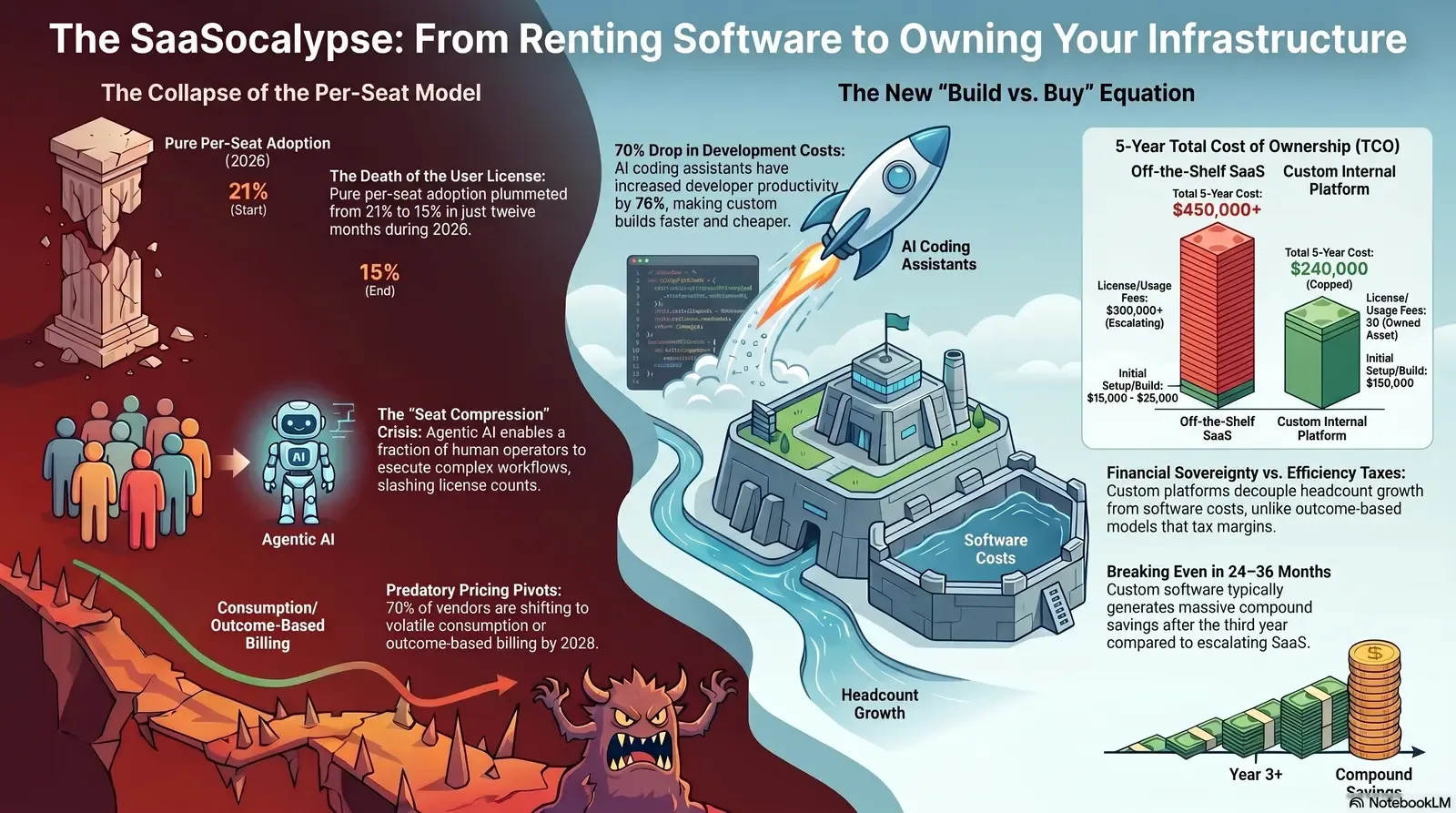
The "SaaSocalypse" of 2026: Why Per-Seat Pricing is Dead
The enterprise software market underwent a structural reckoning in the first quarter of 2026. Between late January and early February, over $1 trillion in market capitalization evaporated from the software-as-a-service (SaaS) sector. Financial analysts swiftly dubbed the event the "SaaSocalypse"—a massive valuation reset driven by a sudden, industry-wide realization: the traditional per-seat licensing model is fundamentally broken.
For two decades, software revenue was inextricably tethered to human headcount. If a company hired more employees, it bought more software licenses. Today, as autonomous artificial intelligence agents successfully execute complex, multi-step workflows, organizations require a fraction of the human operators they once did. The immediate result is "seat compression," an environment where enterprises drastically slash software license counts while simultaneously increasing actual software utilization through intelligent automation.
As traditional SaaS vendors scramble to replace lost per-user revenue by forcing customers into volatile consumption-based or outcome-based pricing models, corporate technology buyers face an unprecedented budget crisis. The transition away from predictable, flat-rate subscriptions to dynamic billing—where every API call, AI token, and automated resolution incurs a fee—has transformed enterprise software from a fixed operating expense into an unpredictable financial liability. In response, a massive inversion in the "build versus buy" equation is underway.
Organizations are realizing that renting generic software is no longer a sustainable strategy for maintaining operating margins. The central issue for enterprise leaders is no longer whether per-seat pricing is dead, but rather how to stop the bleeding caused by predatory consumption metrics. The data indicates that the most viable defense is a return to custom software development, leveraging modern, open-source infrastructure to build internal platforms that scale infinitely without penalizing headcount growth or automation efficiency.
The Macroeconomic Collapse of the Seat Model
To understand the current crisis, one must examine the economic foundation of the SaaS industry between 2005 and 2025. The per-seat pricing model worked perfectly because it aligned vendor incentives with customer growth. A predictable, recurring revenue stream allowed vendors to command massive valuation multiples on Wall Street, while corporate procurement teams appreciated the simplicity of forecasting budgets based on hiring plans. Software was, in essence, a tax on human capital.
The Phenomenon of Seat Compression
The deployment of agentic AI disrupted this equilibrium permanently. Agentic AI refers to systems capable of autonomous reasoning, task orchestration, and execution without continuous human oversight. When an enterprise deploys an AI agent capable of resolving 50% of tier-one customer support tickets or autonomously processing routine legal contracts, the human workforce required to manage those tasks shrinks drastically.
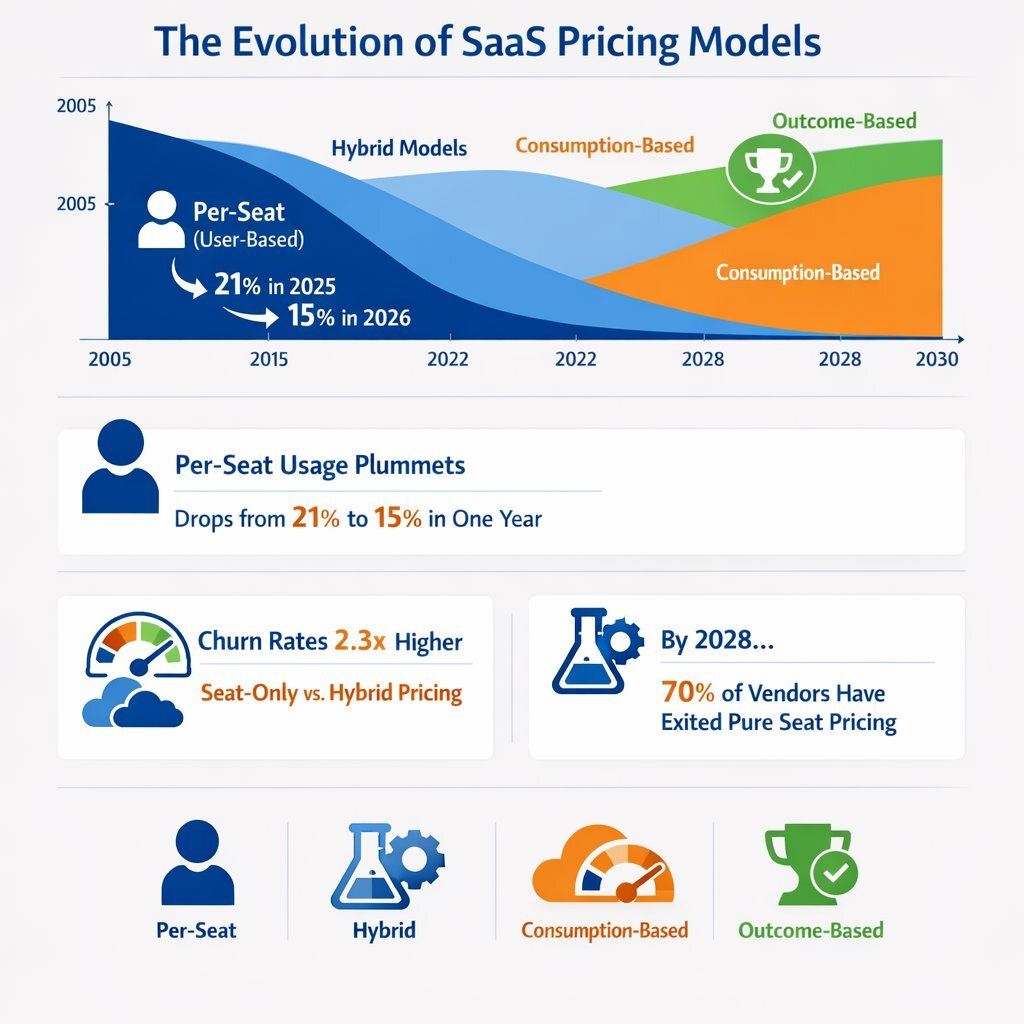
If ten AI agents can perform the work of one hundred sales development representatives (SDRs), the enterprise no longer requires one hundred customer relationship management (CRM) licenses; it requires ten. The software itself remains mission-critical, but the vendor's revenue collapses by 90%. Market data indicates a notable decline in pure per-seat pricing, falling below 20% in 2026. Specifically, pure per-seat adoption plummeted from 21% to 15% in just twelve months.
Meanwhile, hybrid and consumption models are aggressively taking over, with per-seat revenue projected to represent a minority fraction of total enterprise software spend by 2030. Leading SaaS providers experienced churn rates 2.3 times higher on seat-only models compared to hybrid structures.
The Great Unbundling of Software Value
The core utility for most B2B software is undergoing a great unbundling. Historically, software provided a user interface (UI) for a human to interact with a database. Today, AI agents bypass the UI entirely, interacting directly with the underlying data via APIs. When the human interface becomes obsolete, the justification for a premium per-user license disappears. Software platforms are being reduced to mere "data plumbing," fundamentally commoditizing the application layer.
When the human is removed from the loop, the seat disappears, the license fee collapses, and the venture capital moats that funded the sector are drained in real-time. This is prompting a radical revaluation where software companies are no longer judged by their "Users under Management," but rather by their data processing capabilities and "Megawatts under Management." For enterprises trying to modernize without ripping out legacy systems, approaches like the AI Sidecar Pattern show how to add powerful AI capabilities without getting locked into per-seat UI pricing at all.
The Vendor Pivot: Consumption and Outcome-Based Pricing
Faced with declining seat counts, major software vendors are aggressively refactoring their monetization strategies. The goal is to capture the value of the efficiency their platforms provide, shifting the financial burden back to the enterprise buyer. By 2028, industry research forecasts that 70% of software vendors will have transitioned away from pure seat-based models toward new value metrics.
The Rise of Consumption-Based Pricing
Consumption-based (or usage-based) pricing charges customers based on the volume of service utilized. Instead of paying a flat subscription fee, organizations are billed for API calls, compute minutes, data processed, or AI tokens consumed.
Generative AI workloads do not scale linearly by user; they scale by model complexity and computational intensity. A single "power user" orchestrating multiple AI agents can generate one hundred times the compute costs of a standard human user. Vendors, facing massive cloud infrastructure and GPU inference costs, are passing these variable expenses directly to the buyer. Without deliberate cost controls—like model routing, prompt compression, and semantic caching, as described in The Token Tax: Stop Paying More Than You Should for LLMs—those bills can quickly spiral out of control.
While consumption pricing is marketed as highly transparent—allowing customers to pay only for what is utilized—it introduces severe budget volatility. A seemingly minor operational change, such as a marketing team launching a new automated campaign or a support team adjusting an agent's prompt instructions, can trigger an exponential surge in token consumption, resulting in devastating end-of-month invoice surprises.
The Shift to Outcome-Based Models
The most aggressive evolution in 2026 is the transition to outcome-based pricing. Under this model, vendors charge based on a verified business result.
For example, AI-driven customer service platforms have begun charging a flat fee (e.g., $0.99 to $2.00) per successfully resolved customer ticket, rather than charging for the agent's software license. Cybersecurity and fraud-prevention tools charge a percentage of the fraudulent transactions prevented. Salesforce's Agentforce platform notably shifted to charging $2 per automated conversation.
Outcome-based pricing forces the vendor to share operational risk, but it also creates a scenario where the enterprise is effectively outsourcing its core operational margins. If a software vendor captures a flat fee or a percentage of every closed deal, every resolved ticket, or every processed document, the enterprise's software expenses scale infinitely alongside its revenue. The software ceases to be a tool and becomes a permanent tax on the company's growth.
The Hybrid Squeeze
Because pure outcome-based models require complex attribution and pure consumption models cause customer churn due to unpredictability, the dominant transition state in 2026 is the hybrid model.
Vendors charge a baseline platform access fee (to guarantee recurring revenue) and layer aggressive consumption meters on top of it. This allows vendors to secure downside protection while participating entirely in the customer's upside.
| Pricing Model | Billing Mechanism | Vendor Benefit | Enterprise Risk |
|---|---|---|---|
| Per-Seat (Legacy) | Flat fee per human user | Predictable recurring revenue | Paying for unused "shelfware" |
| Consumption-Based | Pay per token, API call, or compute hour | Protects vendor from high AI inference costs | High budget volatility; penalizes heavy usage |
| Outcome-Based | Pay per resolved ticket, lead, or transaction | Uncapped revenue potential scaling with client success | Software becomes a permanent tax on operational margins |
| Hybrid | Base access fee + metered overages | Guaranteed floor with unlimited upside | Double financial burden; complex invoice auditing |
The Enterprise Financial Crisis: Volatility and the "Efficiency Tax"
For Chief Financial Officers (CFOs) and Chief Information Officers (CIOs), the SaaSocalypse has triggered an operational crisis. Historically, SaaS sprawl was viewed as a procurement issue—departments buying too many redundant applications. In 2026, the primary driver of rising software costs is not portfolio expansion, but pricing mechanics.

Budgetary Unpredictability and Escalation
SaaS portfolios have remained virtually flat in terms of application counts, yet overall spending has risen by an average of 8% annually. The average enterprise now spends roughly $55.7 million annually on SaaS, with large enterprises spending upwards of $245 million.
The volatility introduced by token-based billing and AI consumption add-ons means that modest changes in daily workflows can blow up quarterly financial forecasts. Furthermore, a staggering 79% of IT leaders report encountering unexpected price increases during contract renewals, as vendors systematically dismantle legacy fixed-rate tiers. Many are now pairing financial oversight with technical safeguards—such as AI firewalls that not only protect data, but also throttle runaway prompts before they trigger massive, unplanned token usage.
In highly regulated environments or companies managing massive data throughput, this unpredictability acts as an "efficiency tax." As the organization becomes more adept at leveraging AI to replace human labor, the software vendor extracts an ever-increasing toll on the business's fundamental unit economics.
Emerging Performance Telemetry: NACC and CT
To combat this opacity, finance and engineering teams have developed new telemetry metrics to evaluate software utility. The most prominent in 2026 is Net Agentic Contribution per Case (NACC).
NACC calculates the gross financial value of an AI-driven decision or action, subtracting the direct operating costs—including model tokens, orchestration API overhead, human-in-the-loop review cycles, and remediation costs for AI hallucinations.
Similarly, Cognitive Throughput (CT) measures the volume of complex, multi-step tasks a system can complete autonomously without human intervention. By analyzing NACC and CT, CFOs are discovering a grim reality: the margins generated by increased productivity are being entirely consumed by the skyrocketing consumption fees charged by the SaaS vendors powering those agents. The enterprise takes the risk of implementing the automation, but the SaaS vendor extracts the financial reward.
Sector-by-Sector Vulnerability Analysis
The pain of shifting software economics is not distributed equally. Industries characterized by high transaction volumes, complex regulatory environments, heavy data processing, and rapid scaling are experiencing the most severe margin compression under the new pricing paradigms. The analysis below highlights the precise vulnerabilities across key B2B sectors.
Advertising Technology (AdTech) and Marketing
AdTech relies on processing billions of real-time bidding events, impressions, and customer data platform (CDP) updates daily. As marketing SaaS platforms transition to pricing based on contacts managed or campaigns executed autonomously, the costs become prohibitive. If an agency's automated lead generation tool charges $2 per qualified lead, the Customer Acquisition Cost (CAC) floor is artificially elevated, destroying the agency's profitability in an already tight-margin environment. The blended CAC for B2B SaaS alone has soared to 1,200 for developer tools and 650 for MarTech.
Furthermore, multi-touch attribution models require constant API polling; paying a consumption fee for every attribution calculation turns a marketing necessity into a financial liability.
Gaming and Digital Entertainment
The gaming industry requires highly specialized infrastructure, particularly for multiplayer matching engines, real-time leaderboards, and player analytics. Relying on off-the-shelf backend-as-a-service (BaaS) tools subjects game studios to predatory API rate limits and egress fees. When a game achieves viral success, a consumption-based SaaS backend can instantly bankrupt the studio through infrastructure scaling costs. The unpredictable nature of concurrent player counts means that fixed-cost, owned infrastructure is the only viable path to protecting the margins of a hit title.
Healthcare and Medical Operations
In the healthcare sector, organizations are deploying AI to manage the revenue cycle, process claims, and handle patient scheduling. Generic SaaS platforms charge exorbitant consumption fees for processing millions of health records. Furthermore, healthcare requires strict HIPAA compliance and absolute data sovereignty. When paying per-outcome (e.g., per claim processed), hospitals find that the software tax wipes out the operational savings gained from replacing administrative headcount.
For a claims specialist, an AI workflow that saves 25% of time per claim should yield massive organizational savings, but not if the SaaS vendor captures that delta in resolution fees. Healthcare organizations that want to keep those gains often start with a careful data readiness audit so their internal AI platforms can run safely on their own governed datasets rather than through expensive third-party tools.
Financial Services, Real Estate, and Mortgage
Financial institutions and real estate brokerages handle high-stakes document intelligence—extracting data from thousands of pages of loan agreements, titles, and zoning filings.
Under a token-based SaaS pricing model, processing a single commercial real estate transaction can consume thousands of dollars in AI compute credits. The financial services sector is realizing that relying on third-party SaaS for core data processing constitutes a massive leakage of proprietary value. Algorithms that determine underwriting risk or detect fraud must be owned internally; otherwise, the firm is merely renting its core competency.
Education (LMS) and Telecom
Learning Management Systems (LMS) in the education sector face massive, seasonal fluctuations in user volume. Seat-based models traditionally penalized educational institutions for maintaining accounts for alumni or part-time students. However, transitioning to consumption-based models is equally perilous when video streaming, assignment uploads, and AI-assisted grading trigger immense data processing spikes during final exams. Telecom providers face similar scale issues; processing call detail records (CDRs) and network telemetry via third-party SaaS platforms introduces latency and uncontrollable billing variables.
Software and High-Tech Startups
For fast-growing tech startups, relying on a sprawling stack of third-party SaaS applications creates technical debt and brittle integrations. Startups that build their core offerings around external APIs often find their margins completely eroded as their user base scales, forcing them to raise prices prematurely and sacrifice market share. The "SaaS Sprawl" problem—where the average enterprise juggles over 100 different applications—creates a governance nightmare of redundant costs and security gaps.
Founders are discovering that investors now expect a thoughtful AI and data strategy from day one. As outlined in Why Generic AI Startups Are Dead: Playbook for Moats, durable value comes from owning your workflows and data, not from gluing together an expensive stack of third-party SaaS tools.
The Renaissance of Custom Internal Platforms
For the past fifteen years, the prevailing wisdom in enterprise IT was "buy when you can, build when you must." Custom software was viewed as expensive, slow to deploy, and fraught with maintenance debt. SaaS was the pragmatic choice. In 2026, the mathematics of the "build versus buy" equation have completely inverted.
The Plummeting Cost of Custom Development
The same artificial intelligence that is destroying the per-seat SaaS model has revolutionized software engineering. The widespread adoption of AI coding assistants, generative application platforms, and automated testing suites has dramatically lowered the cost and time required to build custom enterprise software.
An internal platform that would have cost $500,000 and taken nine months to build in 2022 can now be architected and deployed for $100,000 in a matter of weeks. Developer productivity has increased by upwards of 76% in just one year, and feature build times have dropped by 70%.
This completely erases the primary historical advantage of SaaS: speed to market. When the cost of building custom software drops by 70%, while the cost of renting SaaS increases by 14.2% annually through hidden consumption fees, "buying" is no longer the fiscally responsible default. Teams that want to measure and sustain those productivity gains typically adopt modern engineering metrics frameworks, such as those described in The Future of Developer Productivity: Metrics That Matter, to ensure their new internal platforms actually ship faster and better over time.
The Value of Specialized Development Partners
To execute this transition successfully, organizations frequently partner with specialized development firms. Entities such as Baytech Consulting specialize in custom software development and application management, delivering a Tailored Tech Advantage. By crafting solutions with cutting-edge technologies and employing Rapid Agile Deployment methodologies, these partnerships ensure that custom platforms are timely, adaptive, and fully transparent.
The utilization of highly skilled engineers guarantees enterprise-grade quality and on-time delivery, replacing the rigid limitations of generic SaaS with software that perfectly matches the organization's unique operational IP. If you need ongoing help rather than a one-off build, an embedded dedicated team model can give you the flexibility of SaaS with the control of in-house engineering.
Total Cost of Ownership (TCO) Reversal
Enterprise leaders must analyze the Total Cost of Ownership across a five-year horizon. SaaS costs compound quietly through user expansion, premium feature paywalls, and mandatory integrations. Custom software requires a higher initial capital expenditure (CapEx), but transitions into a highly predictable, low-cost operational expense (OpEx) for maintenance and hosting.
When an enterprise builds a custom internal platform, it owns the intellectual property and the underlying codebase. There are no per-seat licenses. Scaling from 100 to 1,000 employees incurs only marginal increases in cloud hosting costs, completely decoupling headcount growth from software expenditure.
Furthermore, custom software eliminates the hidden "integration tax." The average enterprise utilizes over 100 SaaS applications, requiring fragile, expensive middleware to keep data synchronized. A unified custom platform centralizes the data architecture, providing a single source of truth that generic SaaS tools cannot match.
The Five-Year TCO Breakdown
The financial disparity becomes stark when modeling costs over five years for a mid-market enterprise.
| Cost Category (5-Year Horizon) | Off-the-Shelf Enterprise SaaS | Custom Internal Platform |
|---|---|---|
| Initial Setup / Development | 15,000 to 25,000 (Implementation) | $150,000 (Full lifecycle build) |
| License / Consumption Fees | $300,000+ (Scales with usage/seats) | $0 (Unlimited users and outputs) |
| Integrations & Middleware | $60,000 (API connectors, rate limits) | $15,000 (Built natively) |
| Maintenance & Hosting | $30,000 (Vendor premium support) | $75,000 (Managed cloud hosting) |
| Price Hikes / Feature Gates | $45,000 (Historical 10-15% annual bump) | $0 (Owned asset) |
| Total 5-Year Estimated Cost | $450,000+ (Escalating forever) | $240,000 (Predictable & Capped) |
Data modeling indicates that custom software typically reaches its break-even point against enterprise SaaS between months 24 and 36, after which it generates massive compound savings.
Modern Enterprise Architecture: Owning the Foundation
Deciding to build a custom platform is only the first step; the architecture upon which it is deployed determines its ultimate profitability. Swapping expensive SaaS applications for expensive, proprietary cloud infrastructure merely shifts the financial burden from the application layer to the infrastructure layer. To truly protect operating margins, organizations must leverage open-source, cloud-native technologies that eliminate vendor lock-in entirely.
Escaping the Virtualization Trap with Harvester HCI
A critical component of this strategy involves modernizing the underlying hyperconverged infrastructure (HCI). Following massive price hikes and licensing changes by legacy virtualization providers, enterprises discovered that their on-premise and private cloud environments had become financially toxic.
To counter this, visionary engineering teams are migrating to Harvester HCI, a 100% open-source, cloud-native hyperconverged infrastructure solution built on Kubernetes.
Harvester integrates storage, compute, and networking into a single platform without the exorbitant licensing fees associated with proprietary hypervisors. By utilizing KubeVirt, Harvester allows IT operators to manage traditional virtual machines (VMs) alongside modern containerized workloads within the same ecosystem. When this stack is paired with a thoughtful enterprise application architecture, you get a foundation that is both cost-efficient and ready for the next decade of AI-driven workloads.
Deploying the Open-Source Tech Stack
When Harvester is paired with Rancher (an enterprise Kubernetes management platform), organizations gain a single pane of glass to deploy and manage their custom applications anywhere—from bare-metal on-premise servers to hybrid cloud environments.
This architecture completely decouples the software from the hardware.
The most resilient custom platforms are built upon a carefully curated tech stack. The software development lifecycle is orchestrated using Azure DevOps On-Prem, ensuring complete control over continuous integration and deployment (CI/CD) pipelines without exposing source code to public multi-tenant environments. Engineers write and debug sophisticated logic utilizing VS Code/VS 2022.
For robust, relational data storage that guarantees sovereignty, Postgres & pgAdmin or SQL Server are deployed, completely avoiding the opaque consumption fees of cloud-native database-as-a-service offerings.
These containerized applications, managed via Docker and Kubernetes, are securely hosted on OVHCloud servers, offering predictable bandwidth and compute pricing. Network perimeters and inter-service communications are fiercely protected by pfSense firewalls.
Finally, while the core business logic remains proprietary, the platform seamlessly integrates with ubiquitous productivity suites like Microsoft 365/Teams/OneDrive and Google Drive, ensuring that end-users experience no disruption in their day-to-day document workflows. The enterprise effectively builds its own private cloud, achieving the agility of SaaS with the financial control of an owned asset.
The True Return on Investment (ROI)
The return on investment for abandoning predatory SaaS models extends far beyond simple spreadsheet calculations; it fundamentally alters the enterprise's valuation and operational agility. Industry surveys from 2026 indicate that 35% of mid-market and enterprise organizations have already replaced at least one major SaaS tool with a custom-built internal solution, and nearly 78% plan to increase internal builds over the next year.
Financial Sovereignty and Margin Protection
The primary ROI mechanism is the immediate cessation of margin leakage. When a company's core operational software is an owned asset, revenue growth drops directly to the bottom line. If a logistics company builds a custom routing and tracking platform, doubling their delivery volume does not double their software costs.
In contrast, under a consumption-based SaaS model, the software vendor essentially claims a permanent dividend on the logistics company's success. By capping software expenses, the enterprise dramatically improves its EBITDA (Earnings Before Interest, Taxes, Depreciation, and Amortization), directly increasing the company's valuation multiple.
Data Ownership and AI Readiness
In the age of generative AI, proprietary data is an organization's most valuable asset. Relying on fragmented SaaS platforms traps critical business intelligence in siloed, third-party databases. Custom internal platforms allow organizations to consolidate their data into owned architectures.
This unified data fabric is the prerequisite for deploying secure, internal AI agents that actually understand the business's unique context. A defensible AI strategy cannot be built on top of rented data plumbing. When an organization owns its data layer, it can train private models without fearing data exfiltration or paying a vendor for the privilege of accessing its own insights. Many enterprises begin by rolling out targeted, high-ROI use cases—like AI automation that replaces busywork—and then expand into deeper agentic systems as their internal platforms mature.
Competitive Differentiation
Generic software enforces generic processes. When an enterprise uses the same off-the-shelf SaaS CRM, ERP, and project management tools as its competitors, it is forced into the exact same operational workflows.
Custom software allows an organization to digitally codify its unique operational IP. If a business has a highly specialized, highly efficient method for processing healthcare claims or managing real estate portfolios, embedding that logic into a proprietary platform creates an insurmountable competitive moat. The software bends to the business, rather than forcing the business to bend to the software.
To keep that advantage over time, you also need disciplined delivery. Blending modern Agile methodology with DevOps and AI-assisted development makes it easier to ship constant improvements to your internal tools without reintroducing the same bloat and rigidity that plagued legacy SaaS.
Conclusion
The "SaaSocalypse" of 2026 was not the end of software; it was the end of an economic illusion. The per-seat licensing model was an artifact of an era where human labor was the primary engine of digital productivity. As AI agents assume the execution of complex tasks, software vendors have resorted to hybrid and outcome-based pricing models that effectively tax enterprise efficiency and destroy predictable budgeting.
Renting critical digital infrastructure is no longer a viable strategy for organizations aiming to protect their operating margins. The dramatic reduction in custom development costs, combined with the power of open-source, cloud-native architectures like Kubernetes, Rancher, and Harvester HCI, has permanently flipped the "build versus buy" equation.
By building custom internal platforms, enterprises reclaim their financial sovereignty, secure their proprietary data, and establish a digital foundation that scales infinitely without penalty. The organizations that thrive in the next decade will not be those with the largest SaaS budgets, but those who recognized the macroeconomic shift early and transitioned from renting generic tools to owning their technological destiny.
Frequently Asked Questions
- Why are major software vendors abandoning the per-user licensing model? Vendors are abandoning per-seat pricing because AI agents are automating tasks previously done by humans, leading to severe "seat compression" where enterprises require far fewer licenses to accomplish the same volume of work. To survive this massive drop in traditional recurring revenue, vendors are rapidly shifting to consumption-based metrics (charging per API call, compute minute, or token) and outcome-based models (charging per successfully resolved task) in an attempt to capture the monetary value of the automation they provide.
- How does building a custom internal platform protect operating margins? Custom platforms shift software from a recurring, endlessly escalating operational expense (OpEx) into an owned corporate asset. This transition eliminates predatory per-user license fees, arbitrary feature paywalls, and unpredictable consumption overages. As a company scales its headcount or transaction volume, a custom platform accommodates that growth with only marginal increases in basic cloud hosting and infrastructure maintenance, ensuring that gross revenue growth drops directly to the bottom line rather than enriching a third-party SaaS vendor.
- What is the true ROI of migrating away from bloated SaaS subscriptions? The true financial ROI is typically realized between 24 and 36 months post-deployment, as the flat cost of maintaining custom software crosses the aggressively compounding curve of SaaS subscription renewals. Beyond direct spreadsheet savings (which often cut five-year software TCO in half), the strategic ROI includes the complete elimination of expensive integration middleware, absolute ownership and sovereignty over proprietary data for future AI training, and the distinct competitive advantage of executing highly specialized business workflows without being constrained by generic SaaS limitations.
Further Reading
- https://www.amdocs.com/sites/default/files/2021-07/evaluating-the-ROI-of-cloud-migration-whitepaper.pdf
- https://www.getmonetizely.com/blogs/the-2026-guide-to-saas-ai-and-agentic-pricing-models
https://www.suse.com/c/ending-high-virtualization-costs-why-2026-is-the-right-time-to-switch/
About Baytech
At Baytech Consulting, we specialize in guiding businesses through this process, helping you build scalable, efficient, and high-performing software that evolves with your needs. Our MVP first approach helps our clients minimize upfront costs and maximize ROI. Ready to take the next step in your software development journey? Contact us today to learn how we can help you achieve your goals with a phased development approach.
About the Author

Bryan Reynolds is an accomplished technology executive with more than 25 years of experience leading innovation in the software industry. As the CEO and founder of Baytech Consulting, he has built a reputation for delivering custom software solutions that help businesses streamline operations, enhance customer experiences, and drive growth.
Bryan’s expertise spans custom software development, cloud infrastructure, artificial intelligence, and strategic business consulting, making him a trusted advisor and thought leader across a wide range of industries.