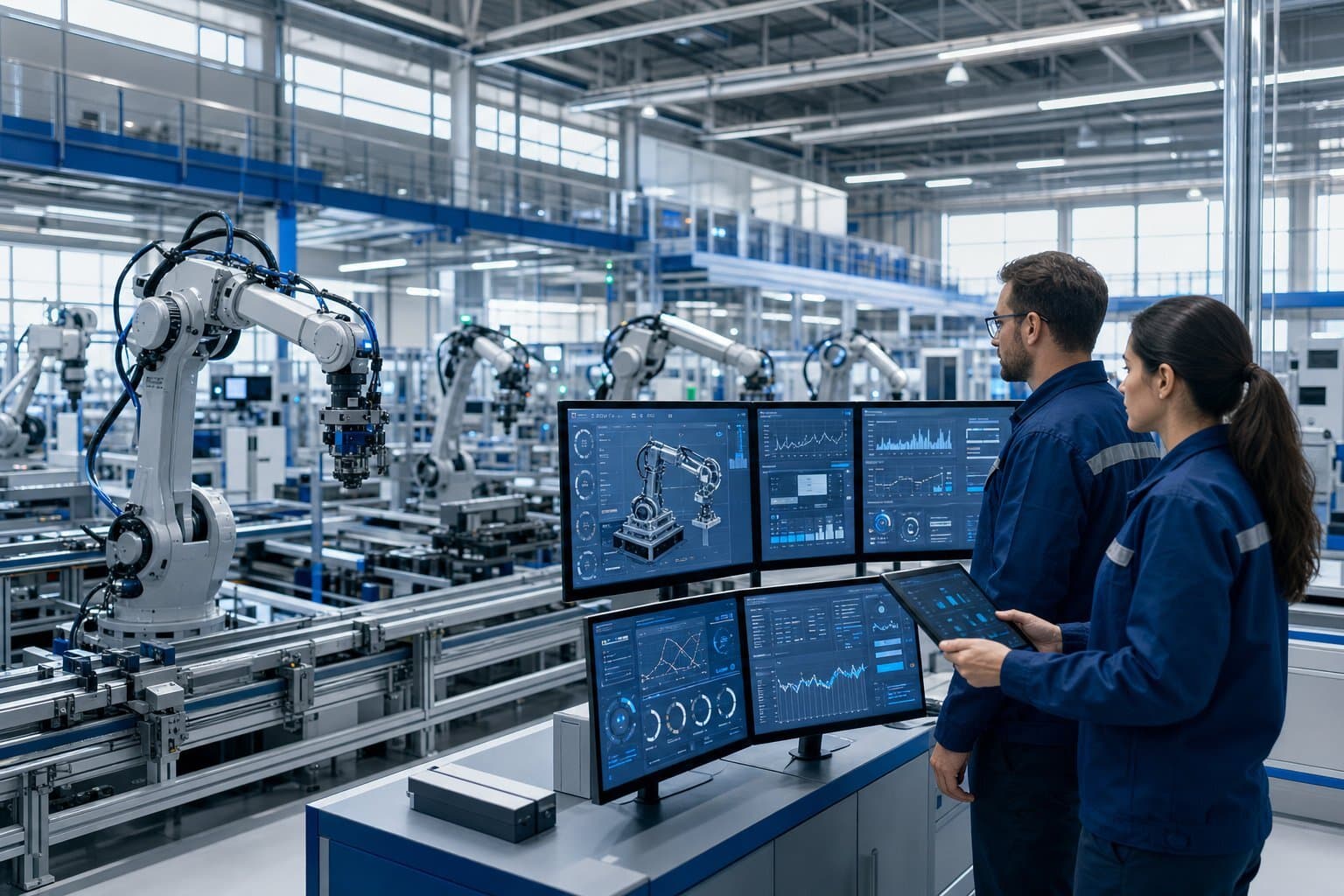
Top 10 Manufacturing Software Development Companies in the US for 2026
July 09, 2026 / Bryan ReynoldsNearly 2 million manufacturing jobs are projected to go unfilled by 2033, and most manufacturers know they can’t hire their way out of it. In Deloitte’s 2025 survey of 600 manufacturing leaders, 80% said they plan to put at least 20% of their improvement budgets into smart manufacturing. The gap between the shop floor you have and the automated one you need is being closed by software.
This article profiles 10 manufacturing software development companies with verified Clutch profiles, real project data, and documented manufacturing experience, so you can build a shortlist without wading through vendor marketing. It also breaks down realistic costs, the development process, and the questions you should ask before you sign anything.
Key Takeaways
Nearly 2 million manufacturing jobs are projected to go unfilled by 2033, and that shortfall (not vague “digital transformation” goals) is the real force behind 2026 software budgets.
Team sizes on this list range from 50-249-person boutiques to a 5,000‑engineer public company, so there’s a fit whether you run one plant or a multi-site enterprise.
Every company profiled has an active Clutch profile with verified client reviews and ratings from the high 4s to a perfect 5.0.
Among the best manufacturing software development companies for different needs: Baytech Consulting for mid-market manufacturers that want a fixed-cost, onshore-only team with direct architect access; Trigent Software for multi-decade production-line experience; Grid Dynamics for Fortune 1000-scale AI and robotics programs; Simform for AI/ML-driven predictive maintenance platforms; and OpenXcell for smaller, scoped automation pilots.
Realistic project costs for manufacturing software run from about $25,000 for a scoped pilot to well over $1 million for a multi-site MES or ERP integration.
Why Manufacturers Buy Custom Software Instead of Off-the-Shelf ERP/MES
Off-the-shelf ERP and MES platforms are built to be generic. They ship with a fixed data model, a standard workflow, and a vendor roadmap that must serve thousands of other customers simultaneously. This works well until a manufacturer's production line, compliance requirements, or legacy equipment don't match the software's assumptions, which, in practice, is most of the time.
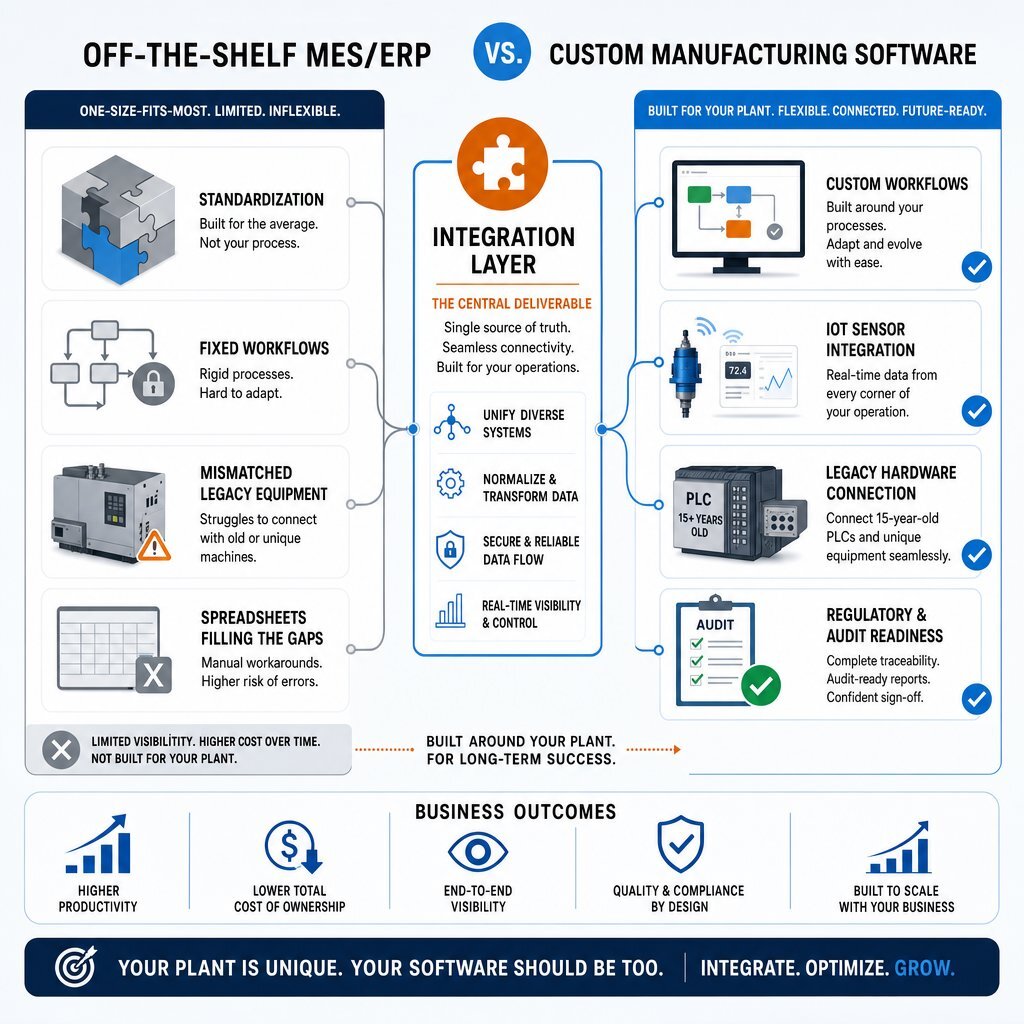
Custom manufacturing software starts on the plant floor. A team can model the specific sequence of a facility's production line, the exact fields an inspector needs to sign off on a batch, or the specific way a 15-year-old PLC needs to communicate with a modern dashboard. Of course, custom builds cost more upfront and take longer to reach a first release than clicking "activate" on a SaaS module. Nonetheless, manufacturers increasingly accept this tradeoff because forcing physical operations to conform to generic software creates workarounds, spreadsheets, and shadow processes that erode the very efficiency the software was bought to deliver.
There's also an integration reality that off-the-shelf platforms handle poorly: connecting IoT sensors, older SCADA systems, warehouse hardware, and modern cloud dashboards into one coherent picture. Custom development treats that integration layer as the primary deliverable.
Categories where manufacturers now choose custom over off-the-shelf
Manufacturing Execution Systems (MES), tailored to a specific production sequence.
Predictive maintenance platforms that ingest sensor data unique to a facility's equipment mix.
Compliance and audit tooling built around specific regulatory frameworks (FDA, ISO, DO-178C, GDP serialization).
Legacy modernization that keeps a working plant-floor system online while replacing it in phases.
Supply chain and logistics platforms that reflect a manufacturer's supplier network, not a reference architecture.
The Driver: A 2-Million-Worker Shortfall Force Automation Investment
Deloitte and The Manufacturing Institute project a shortfall of more than 2 million manufacturing workers over the next decade, driven by an aging skilled workforce retiring faster than pipelines can replace it. At the same time, U.S. factory employment was 12.69 million in December, its lowest level since March 2022, even as reshoring and foreign investment rise. Manufacturers are being asked to produce more with a shrinking workforce that’s harder to backfill.
Automation and robotics have moved from a cost-cutting tactic to a necessity. The International Federation of Robotics reports that roughly 542,000 industrial robots were installed globally in 2024, more than double the number installed a decade earlier. Deloitte's 2025 survey found that 80% of manufacturing executives plan to invest at least 20% of their improvement budgets in smart manufacturing initiatives this year, spanning automation hardware, sensors, data analytics, and cloud infrastructure.
This isn’t about installing robots. Fortune Business Insights projects the global manufacturing IoT market will reach $673.95 billion by 2032, reflecting the software layer that makes automation useful: platforms that turn sensor data into schedules, maintenance alerts, and real-time visibility on the floor. The stakes of getting such an approach wrong keep rising: manufacturing was the most targeted sector for cyberattacks in 2025, as every new sensor and IoT endpoint expands the attack surface a plant has to defend.
For software buying decisions, this means a partner’s ability to build automation-ready systems, integrate with existing sensors and equipment, and secure a growing web of connected devices now matters as much as their hourly rate.
What a Manufacturing Software Development Company Needs to Get Right
Not every custom software firm that lists “manufacturing” as a vertical actually understands it. Here’s what separates a good partner from one learning on your dime:
Plant-floor and OT experience. A team that has only built customer-facing SaaS will underestimate the work involved in talking to machines, sensors, and legacy control systems that were never designed to expose an API.
A track record with regulated or safety-critical workflows. Manufacturing spans consumer goods, aerospace, and pharma. A partner should point to work in your compliance environment, such as ISO 9001, FDA-regulated medical devices, and DOT-related safety.
Integration depth. The hardest part is getting it to talk reliably to 10-year-old PLCs, warehouse systems, and ERPs that were never meant to integrate.
A security posture built for OT. Given how often manufacturers were targeted in 2025, a partner should provide specific practices for securing industrial control systems and IoT endpoints.
Transparent pricing. “Quick integrations” that turn into six-figure overruns are common. Clear scope and pricing up front are a signal of a mature delivery process.
Onshore or near-shore availability for plant visits. Some work requires being on the floor to observe a workflow or test hardware. A fully offshore, remote-only team can become a constraint.
The List of the Best Manufacturing Software Development Companies in the US for 2026
The companies below were selected based on verified Clutch ratings, documented manufacturing case studies, and industry recognition. Each profile explains what the firm actually does, points to a real client outcome when available, and closes with the type of manufacturer it best suits.
Company | HQ | Founded | Team Size | Clutch rating | Manufacturing focus |
Baytech Consulting | Irvine, CA | 2007 | 11-50 engineers | 5.0 | Plant operations, compliance workflows, IoT/AI integration |
Devox Software | Miami, FL | 2018 | 100+ engineers | 5.0 | Legacy modernization, AI-accelerated manufacturing platforms |
Simform | Orlando, FL | 2010 | 250–999 | 4.8 | Manufacturing is the core vertical; the AI/ML platform works |
Fingent | New York, NY | 2003 | 450+ | 4.9 | SAP S/4HANA plant migrations, enterprise manufacturing systems |
Hidden Brains | Irvine, CA | 2003 | 250–999 | 4.8 | Manufacturing named vertical: Caterpillar, Honeywell clients |
Trigent Software | Southborough, MA | 1995 | ~2,000 | 4.8 | 16+ year Navistar (truck manufacturer) relationship |
Kellton | Reston, VA | 2009 | 1,800–2,000+ | 4.7 | Semiconductor, battery/inverter electronics manufacturing |
Grid Dynamics | San Ramon, CA | 2006 | ~5,000 | 4.8 | Dedicated manufacturing/IoT/robotics practice |
OpenXcell | Las Vegas, NV | 2009 | 500+ | 4.8 | AI/IoT generalist with growing manufacturing work |
Space-O Technologies | Mesa, AZ | 2010 | 200+ | 4.8 | Enterprise app portfolio; scale/cost alternative |
1. Baytech Consulting
Baytech Consulting is one of the manufacturing software development companies in the USA, built on an onshore-only delivery model: every engineer on a project is a salaried, full-time employee, not an outsourced contractor rotated in and out mid-project. Founded in 2007 and based in Irvine, California, the firm holds a 5.0 rating on Clutch and won a Clutch Fall 2024 Global Award for Software Development, Web Development, and App Modernization.
The firm's manufacturing practice focuses on digitizing plant operations, logistics, and compliance workflows. Documented client results include 100% paperless workflows, 99.9% audit readiness, 70% faster task completion, and 4x greater operational transparency after replacing manual, paper-based processes. On the AI side, Baytech embeds machine learning into production forecasting, quality control, and real-time compliance monitoring from the architecture stage onward, rather than as an add-on.
Every engagement starts with a fixed cost and timeline agreed before development begins, delivered in one-to-four-week sprints using Agile, Scrum, or Kanban. Clients work directly with the engineers building the system rather than through account managers.
Best fit: Manufacturers who want a fixed-cost, onshore-only engineering team and direct access to senior architects, rather than a large offshore bench.
If disconnected systems or manual sign-offs are still slowing down your floor, that's worth a conversation before the next budget cycle locks in.
2. Devox Software
Legacy modernization and AI acceleration are where Devox Software concentrates its manufacturing work, alongside logistics and automotive engagements that share similar integration challenges. Its proprietary AI Solution Accelerator is the centerpiece of the offering: one documented client credited the tool with speeding up a complex manufacturing modernization project, specifically praising the firm's ability to embed with an internal team and provide architectural guidance rather than simply supplying extra developers. A 50,000+ minimum and 50–99/hr rate band rule out small pilots; this is a firm built for mid-to-large transformation work.
Best fit: Manufacturers running a legacy modernization or transformation effort who want an AI-accelerated delivery model and are prepared for a multi-month engagement.
3. Simform
Manufacturing sits alongside healthcare, financial services, and logistics as a named vertical in Simform's product and platform engineering practice. What distinguishes the firm's delivery model is co-engineering: rather than disappearing to build in isolation and handing off a finished product, Simform's team works embedded alongside a client's internal staff for the length of the project, a structure clients review and credit for surfacing complex operational requirements before development starts.
The firm's 2025 Clutch ranking as the #1 AI company among nearly 15,000 platform listings carries real weight for manufacturers specifically shopping for predictive maintenance or production-forecasting capability, since both depend on the same ML infrastructure that the ranking recognizes.
Best fit: Manufacturers who want a mid-sized partner with strong AI/ML credentials for predictive maintenance or production-forecasting platforms, and who value a co-engineering delivery model.
4. Fingent
Two decades of delivery history and a four-country team footprint give Fingent a natural fit for manufacturers running operations across multiple locations or borders. That's the shape of its most relevant documented project: an SAP S/4HANA migration for a client's manufacturing plants, standardizing processes across international business units while still accommodating local regulatory variation from one country to the next.
Beyond the ERP work, the firm's ISO 27001:2022 certification (current as of its latest audit cycle) provides manufacturers with a documented information security baseline to reference in their own compliance reviews, rather than a verbal assurance.
Best fit: Manufacturers running multi-site or international operations who need ERP/SAP integration to work alongside custom development, with a documented security certification already in place.
5. Hidden Brains
CMMI Level 3 and ISO 27001 certifications set Hidden Brains apart in terms of process maturity. This discipline shows up directly in client feedback: one reviewer specifically pointed to a 90-page project scope document produced before any development began, capturing requirements in enough detail to head off the scope creep that derails so many manufacturing builds elsewhere.
Manufacturing is one of more than 30 industries the firm serves, with a client roster that includes Caterpillar and Honeywell International. This is the evidence that it can operate at enterprise scale when a project calls for it, while its $25,000+ minimum and broad project range keep it accessible for smaller work too.
Best fit: Manufacturers who want a large, process-mature vendor with enterprise manufacturing client references and a wide range of achievable project sizes.
6. Trigent Software
A 16-year relationship with Navistar, a major US truck manufacturer, anchors Trigent's manufacturing credentials; the firm built and continues to evolve a mass-customization ordering engine that manages billions of feature-combination possibilities and confirms build compatibility before an order ever reaches the production line.
Elsewhere, a semiconductor-adjacent client saw 44 analytics dashboards migrated from Tableau to Power BI with a documented low defect rate, and a natural health products manufacturer credited the firm's work with a 150% jump in daily order throughput and a 30-40% cut in order processing time. ISO 9001 and ISO 27001 certified, and with roughly 2,000 employees, Trigent names manufacturing as a genuine core vertical rather than a line on an industry-served list.
Best fit: Manufacturers with complex, long-horizon operational software needs who value a partner with a genuine multi-decade track record in the vertical.
7. Kellton
Both discrete and process manufacturing show up in Kellton's project history. A semiconductor company's website and intranet modernization drew specific client praise for timely delivery and disciplined use of standard security patches. This is a relevant detail for manufacturers in IP-sensitive or regulated segments, where basic vendor security hygiene matters as much as feature delivery. Separately, a battery and inverter electronics manufacturer built a solar solutions platform to integrate directly with the client's channel partners and distributors, enabling them to generate custom estimates without routing every request back through the manufacturer's internal team. With 1,800-2,000+ professionals, the firm has the bench depth to run multiple workstreams simultaneously on a single engagement.
Best fit: Mid-market manufacturers, particularly in semiconductor or electronics manufacturing, seeking a large-team partner with experience in channel- and distributor-facing systems.
8. Grid Dynamics
Scale is the defining trait here: at roughly 5,000 technical professionals and public-market status, Grid Dynamics operates the largest, most enterprise-oriented practice on this list. Its dedicated manufacturing offering spans IoT and predictive maintenance, real-time production analytics, and, through its GAIN (Grid Dynamics AI Native) platform, intelligent robotics and computer vision for industrial operations.
One global manufacturing client saw a projected $250 million revenue opportunity and a three-year ROI increase from an AI-powered IoT analytics platform the firm built, a figure consistent with its Fortune 1000 client base. Worth noting directly: as a publicly traded company, Grid Dynamics files financial disclosures and operates under public-market governance.
Best fit: Large or multi-plant manufacturing enterprises with Fortune 1000-scale budgets who want AI-native robotics, computer vision, or IoT analytics capability from a publicly accountable vendor.
9. OpenXcell
Cost, not vertical depth, is OpenXcell's argument for a spot on this list. Its $10,000+ minimum and sub-$25/hr average rate are the lowest of any firm profiled here, making it a realistic option for proof-of-concept work (e.g., an IoT sensor dashboard pilot, a scoped automation script, a single-workflow digitization project) rather than a full production-line MES buildout.
Best fit: Smaller manufacturers or single-facility operations testing a scoped pilot before committing budget to a larger platform build.
10. Space-O Technologies
Volume is the case for Space-O Technologies, as manufacturing is one industry among many in a portfolio that leans more toward broader enterprise and consumer app work than toward deep plant-floor experience.
What it does have is a scale of delivery: 1,200+ clients and 300+ completed solutions, and its 75 Clutch reviews are the highest review volume in the group. For a manufacturer weighing general engineering discipline and proven delivery capacity over manufacturing-specific domain depth, that track record is a legitimate factor, even without the vertical case studies the more specialized firms on this list can point to.
Best fit: Manufacturers prioritizing broad software engineering capability and a large delivery track record over deep, manufacturing-specific domain expertise.
Why Manufacturing Software Projects Fail
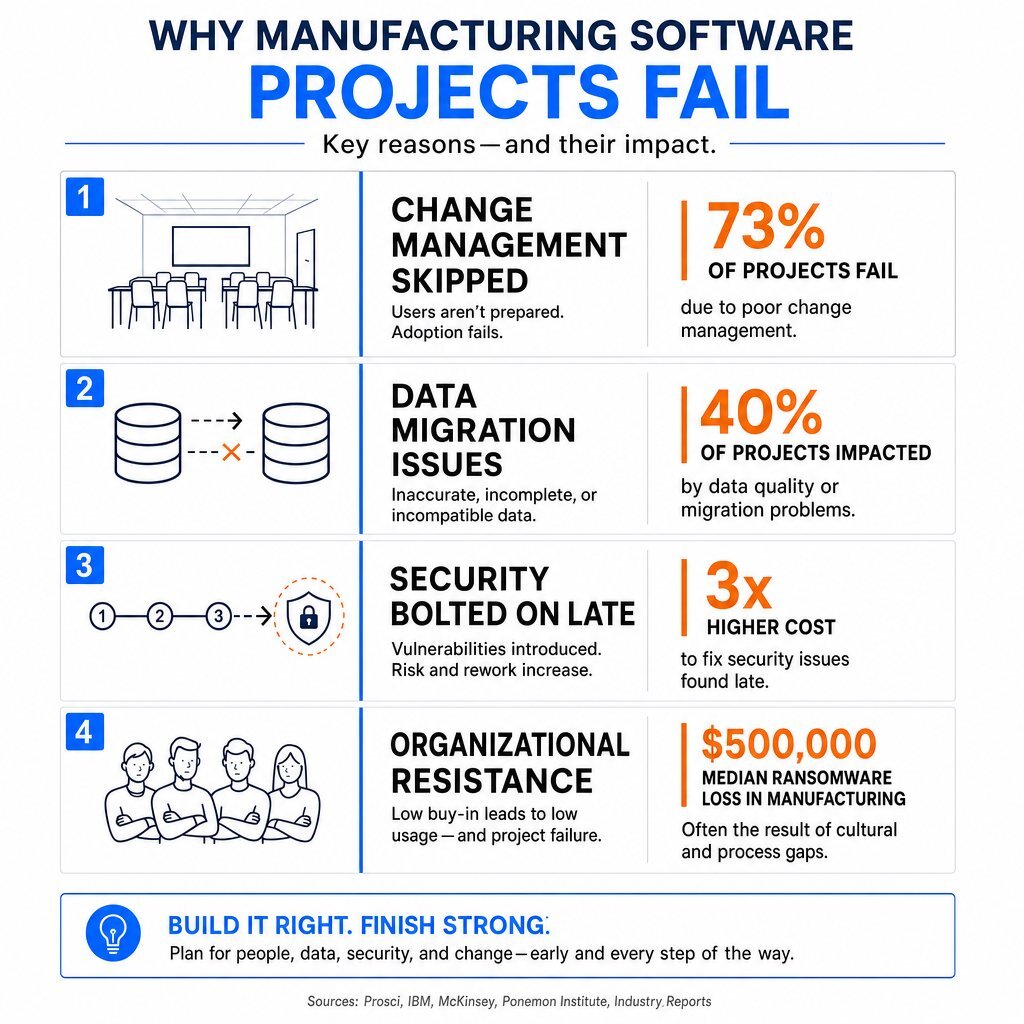
Panorama Consulting’s ERP Report found that discrete manufacturing ERP implementations fail to meet their objectives 73% of the time, with average cost overruns of 215%. Also, Gartner projects that 70% of all ERP implementations will miss their goals over the next 3 years, with manufacturing’s complexity likely pushing its rate even higher.
The reasons for these are following:
Change management gets skipped
In 95% of failed ERP projects, companies spent less than 10% of the total budget on training and change management. Manufacturers still treat this as a line item to trim when budgets tighten, even though it’s the factor that determines whether the system is used on the floor.
Data migration blows the timeline
Across more than 2,400 documented ERP implementations, inadequate change management, poor data migration, and inexperienced implementation teams account for more than 75% of failures. All three are preventable with manufacturing-specific expertise, which is why generalist IT vendors struggle here more than vertical specialists.
Security gets bolted on after launch
The median ransomware payment for manufacturers now sits around $500,000, and roughly 80% of European manufacturers still run OT systems with known, unpatched vulnerabilities. It’s far cheaper to close that gap at the design stage than to retrofit security after an incident, yet security is still scoped as a late checklist.
Organizational resistance
About 76% of manufacturers say digital transformation is hard mainly because of legacy machinery, integration costs, and workforce resistance (not because the technology itself doesn’t work). A software partner can help with the first two. The third requires leadership to remain engaged throughout the rollout.
What Building Manufacturing Software Looks Like
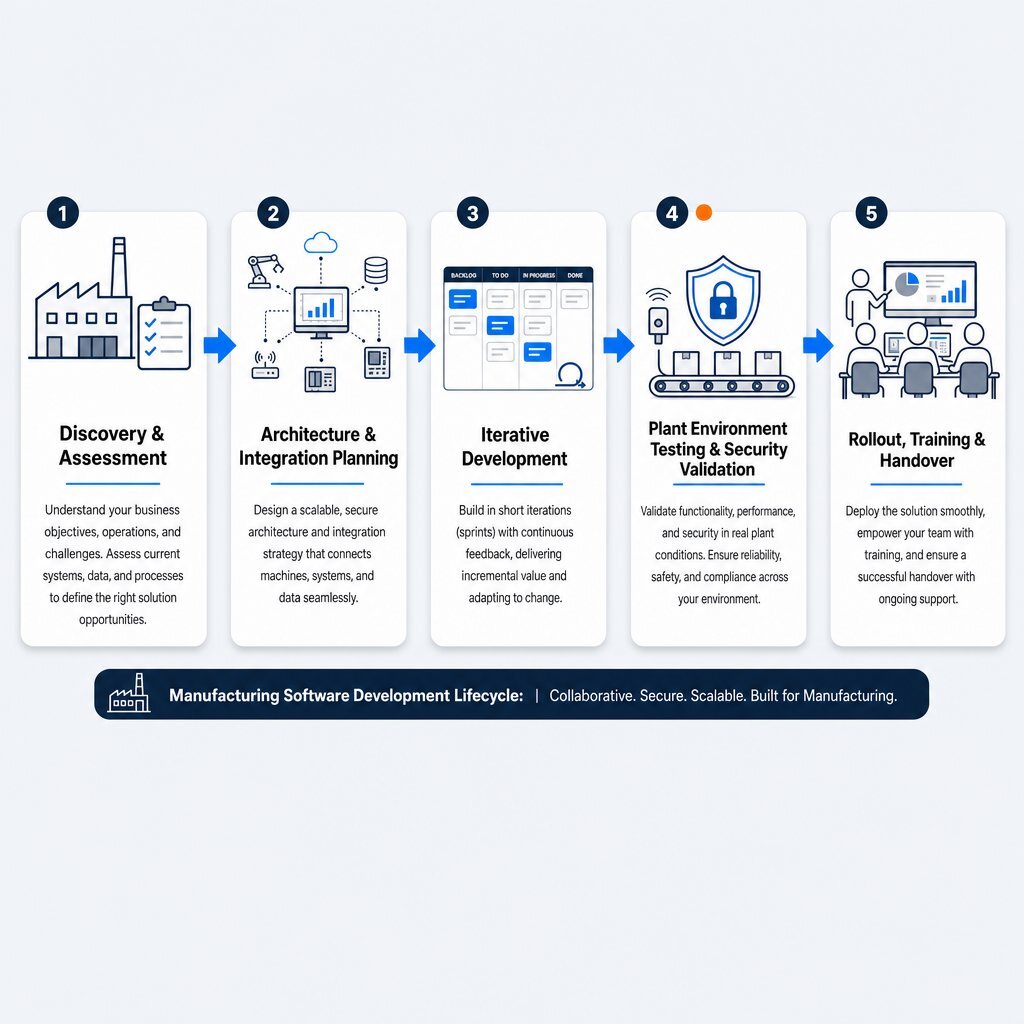
Discovery and plant-floor assessment. Since data migration and integration drive most documented failures, this is where the real risk gets managed: audit existing equipment, data, and compliance requirements before anyone writes code.
Architecture and integration planning. Map every legacy PLC, SCADA system, and ERP connection up front, because it’s the single largest source of scope creep on manufacturing builds.
Iterative development in sprints. One‑ to four‑week sprints keep a working version visible early, the same phased approach that underlies the 85% success rate firms see with experienced implementation partners in a category where 73% of projects fail.
Testing against real plant conditions and security exposure. Validate against live‑like production data and real OT attack surface. In 2025, organizations with full OT visibility contained ransomware in about 5 days, compared to the 42‑day industry average.
Rollout, training, and handover. Because most failed implementations under‑invested in training, a phased rollout, structured training, and documented handover largely determine whether the previous 4 stages hold up in production.
Baytech Consulting's Approach to Manufacturing Software Development
Every engineer on a Baytech project is a salaried, onshore employee, not part of a rotating offshore bench. Each project runs in one‑ to four‑week sprints with cost and timeline agreed before development starts, rather than being billed hourly as scope drifts.
Manufacturing clients report 100% paperless workflows, 99.9% audit-readiness, 70% faster task completion, and 4x greater operational transparency after moving away from manual, paper-based processes. Founded in 2007 and headquartered in Irvine, California, Baytech holds a 5.0 Clutch rating and received a Clutch Fall 2024 Global Award for Software Development, Web Development, and App Modernization.
If your plant is running on paper approvals or disconnected systems, scope your project on a free initial call with a fixed cost and timeline before any commitment.
Conclusion
The manufacturers who come out ahead in 2026 will be the ones who choose a software partner that understands plant-floor operations and legacy integration. The fastest way to see if a vendor is a fit is to talk specifics, not compare marketing pages.
Book a free scoping call with Baytech Consulting to get a fixed cost and timeline for your manufacturing software project before you commit.
Frequently Asked Questions About Manufacturing Software Development Companies
Who owns the intellectual property (IP) when I hire an agency?
With off‑the‑shelf SaaS, you’re renting access to someone else’s platform. With the right development partner, you should own what gets built.
Reputable manufacturing software development companies use a Master Services Agreement (MSA) that transfers full IP ownership to you once you’ve made the final payment. It covers the source code, data models, and any proprietary algorithms.
Owning the IP matters because it prevents lock‑in. You can bring maintenance in‑house later or switch agencies without losing control of the system that runs your plant.
Is custom manufacturing software cheaper long-term than a SaaS ERP or MES?
Custom software costs more upfront because you’re paying for the hours to design and build your own architecture. SaaS ERP or MES looks cheaper at the start, but you keep paying per user, per device, or per facility for as long as you run it.
When you compare proposals over a 3‑ to 5‑year window, many manufacturers find that custom builds reach a lower total cost of ownership. You avoid rising seat licenses for hundreds of operators and don’t have to pay for features you never use.
How do agencies prevent production downtime during integration?
The better firms avoid “big‑bang” cutovers. Instead, they use parallel deployment.
They set up the new system alongside your legacy SCADA, ERP, or paper process. It ingests live data and runs in shadow mode, but it doesn’t yet control equipment. Once the new outputs match the old system and pass QA, the team cuts over in phases, usually during scheduled maintenance windows.
Done well, this approach keeps lines running while the new system takes over, instead of risking an unplanned shutdown.
What internal staff should I assign to a custom software project?
You can’t just sign a contract and wait for a finished system. Even the best manufacturing software development companies need input from your side.
At a minimum, you should assign:
A Product Owner with authority (often an Operations Director or Plant Manager) to make final workflow decisions.
Shop‑floor operators early in the design phase, so the interface works for people in PPE, on noisy lines, and on mounted tablets.
An IT lead to handle secure network access, VPNs, user accounts, and internal approvals.
Without these roles, projects stall on unanswered questions or deliver screens that don’t match how work happens on the floor.
How does securing operational technology (OT) differ from standard IT software security?
IT security focuses on protecting data and preventing attackers from gaining access to business systems. OT security has to protect people and keep equipment running safely.
On the plant floor, availability and safety matter as much as confidentiality. Top‑tier manufacturing software partners design around this. They follow frameworks such as the Purdue Model to segment the plant network from the corporate network and the public internet.
This means PLCs, IIoT sensors, and robots sit on tightly controlled layers, with limited and monitored paths to anything outside the plant. If ransomware hits the front office, the goal is to keep production control systems isolated and online. Such architecture has to be designed in from the start; it’s hard and expensive to bolt on later.
About Baytech
At Baytech Consulting, we specialize in guiding businesses through this process, helping you build scalable, efficient, and high-performing software that evolves with your needs. Our MVP first approach helps our clients minimize upfront costs and maximize ROI. Ready to take the next step in your software development journey? Contact us today to learn how we can help you achieve your goals with a phased development approach.
About the Author

Bryan Reynolds is an accomplished technology executive with more than 25 years of experience leading innovation in the software industry. As the CEO and founder of Baytech Consulting, he has built a reputation for delivering custom software solutions that help businesses streamline operations, enhance customer experiences, and drive growth.
Bryan’s expertise spans custom software development, cloud infrastructure, artificial intelligence, and strategic business consulting, making him a trusted advisor and thought leader across a wide range of industries.