
Stop Blaming Teams: Scope Creep Is a Contract Problem
July 08, 2026 / Bryan Reynolds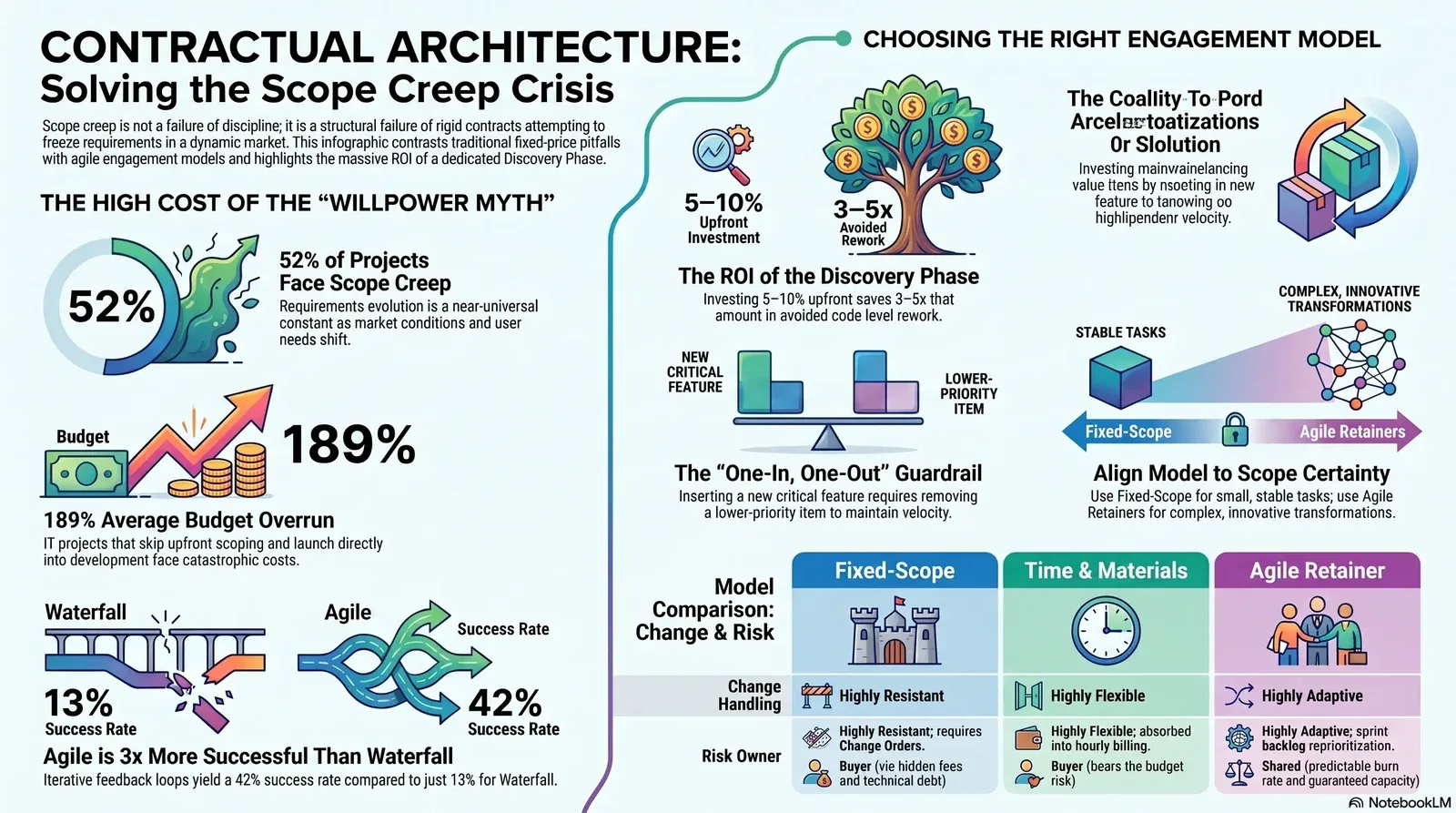
Scope Creep Is a Contract Problem, Not a Discipline Problem: Fixed-Scope vs. Agile Retainer
Scope creep is not what happens when a team lacks discipline. It is what happens when the commercial contract governing a project pretends that the initial requirements were permanently frozen, despite the reality that they never were.
The software industry has spent decades attempting to solve project management failures through behavioral prescriptions. The standard advice dictates that project managers must define the scope more tightly, stakeholders must learn to say no, and engineering teams must aggressively hold the line against any deviation from the original specifications. This prescriptive advice completely ignores the structural reality of commercial software development. Requirements evolve on nearly every real-world project because market conditions shift, user feedback invalidates early assumptions, and technical complexities are uncovered only after code is written.
Treating the natural evolution of a software product as a behavioral failing to be disciplined away guarantees adversarial relationships between buyers and vendors. Instead, scope creep must be recognized for what it fundamentally is: a contract and engagement model decision. The way a custom software development engagement is structured dictates exactly who absorbs the impact of change and how painful that absorption will be.
By reframing scope creep away from project management willpower and toward contractual architecture, executive leadership can stop fighting change and start managing it. The decision between a fixed-scope agreement, a time-and-materials (T&M) contract, or an agile retainer ultimately determines whether the discovery of a new business requirement triggers a strategic pivot or a catastrophic contractual dispute.
The Willpower Myth: Why Holding the Line Fails
The prevailing narrative in software procurement is that a perfectly executed project is one where the final, delivered codebase matches the initial requirements document verbatim. Any deviation from that original document is labeled "scope creep," a term heavily loaded with negative connotations of mismanagement and financial waste.
The data reveals that this narrative is fundamentally disconnected from the reality of engineering. According to a global analysis by the Project Management Institute, 52% of all completed projects experience scope creep or uncontrolled changes to the original parameters. This figure has steadily risen as organizational agility becomes a competitive necessity, stakeholder expectations increase, and technology delivery cycles compress. When more than half of all professional software initiatives require post-kickoff scope alterations, treating change as a rare anomaly is a systemic failure of project governance.
If requirements evolution is a near-universal constant, attempting to control it solely through willpower is a mathematical impossibility. A Chief Technology Officer (CTO) cannot discipline a market into remaining static while an application is being built. When an enterprise software team discovers that a planned feature will not deliver the anticipated return on investment (ROI), abandoning that feature in favor of a newly identified user need is not a failure of project management discipline. It is the definition of strategic agility.
The friction arises when the commercial contract lacks the elasticity to accommodate this strategic agility. A contract that assumes total, unyielding certainty at day zero treats every subsequent discovery as a breach of the original agreement. The engagement model, therefore, dictates whether new information is leveraged as a competitive advantage or weaponized as a costly dispute.
Change As the Default: Structural Realities of Software Delivery
To understand why traditional, rigid contracts consistently fail modern software projects, it is necessary to examine the historical shift in how technology is both built and procured.
Historically, enterprise software development relied almost entirely on the Waterfall methodology, a sequential design process heavily dependent on exhaustive upfront planning and fixed parameters. In this paradigm, business analysts locked all requirements before architectural design began, design was finalized before implementation commenced, and quality assurance testing occurred only at the very end of the lifecycle. The data compiled over decades exposes the profound flaw in this approach. According to the Agile vs. Waterfall success rate analysis, traditional Waterfall projects demonstrate a mere 13% success rate, with an astonishing 59% of projects failing completely.
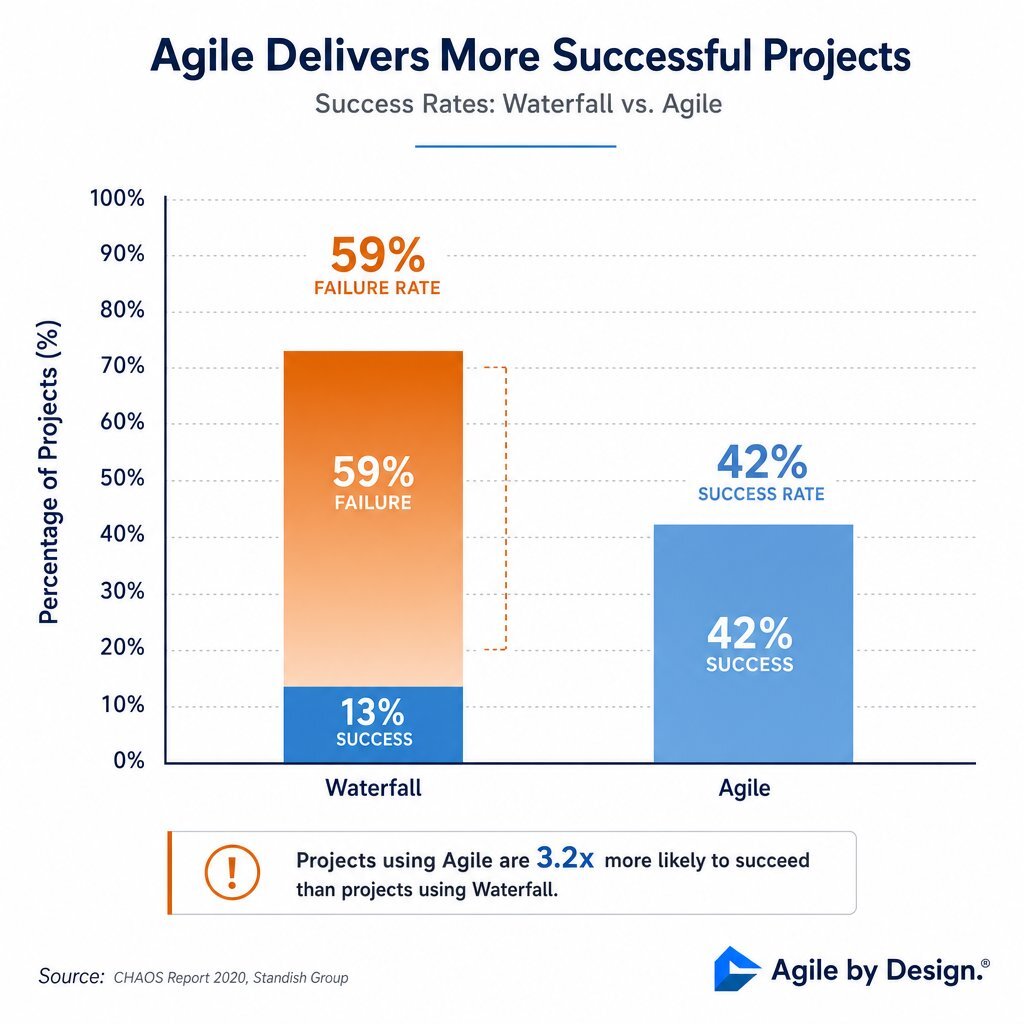
By contrast, Agile software development methodologies—which actively anticipate and incorporate change through iterative feedback loops and continuous deployment—demonstrate a 42% success rate, making them three times more likely to succeed than their Waterfall counterparts. Agile frameworks acknowledge that the client's understanding of the product is at its absolute lowest point on the first day of the project. As the project progresses and functional software is placed into the hands of users, knowledge increases, and requirements must naturally adapt.
This methodological shift from Waterfall to Agile requires an identical shift in commercial engagement models. The enterprise software market has already recognized this necessity in the Software-as-a-Service (SaaS) sector. The industry is currently undergoing a massive migration away from rigid, seat-based licensing toward flexible, consumption-based pricing models. By 2025, an estimated 85% of software companies had adopted usage-based structures. Enterprise buyers demand consumption-based pricing because they want to pay for the actual value they extract from a system, rather than paying for a rigid, predetermined capacity they may never utilize.
Custom software development procurement must follow this exact logic. Organizations that attempt to purchase custom software using rigid, fixed-price contracts are buying a theoretical feature list. Organizations that utilize agile retainers or time-and-materials contracts are buying execution capacity and strategic alignment, ensuring that their budget is always deployed against the most valuable business outcomes, even when those outcomes change mid-flight.
The Evolution of Software Engagement Models
There are three primary commercial models utilized in the modern custom application development market: the Fixed-Scope (or Fixed-Price) model, the Time-and-Materials (T&M) model, and the Agile Retainer (or Dedicated Team) model. Each model handles the inevitability of scope change differently, and each assigns the financial and operational risk of that change to a different party.
Evaluating these models requires moving beyond basic hourly rate comparisons. Executive leadership must understand how each framework governs team behavior, prioritizes feature delivery, and manages the friction of altering technical direction.
Fixed-Scope: The Illusion of Certainty
The Fixed-Scope or Fixed-Price (FP) contract is traditionally favored by procurement departments, legal teams, and Chief Financial Officers (CFOs) because it offers the illusion of ultimate budget predictability. In this model, the software vendor agrees to deliver a highly specific, exhaustively documented set of features for a predetermined sum, by a predetermined date.
The foundational premise of a fixed-scope contract is that the project requirements are flawlessly understood by the buyer, perfectly translated into technical specifications by the vendor, and completely immune to external market shifts. Because the vendor assumes the financial risk of any cost overruns, they must protect their profit margins by strictly, often ruthlessly, defending the boundaries of the original scope of work.
When the inevitable change occurs—such as a marketing director requesting a dynamic data visualization dashboard instead of the originally scoped static PDF report—the fixed-scope model treats the request as a hostile event. The vendor must halt ongoing development, estimate the cost of the newly requested dashboard, draft a formal Change Order, negotiate the pricing, and submit it for executive approval. This process creates massive administrative overhead and injects immediate, toxic friction into the client-vendor relationship. The vendor is financially incentivized to say "no" to protect their margin, while the buyer feels nickel-and-dimed for making necessary, logical adjustments to the product.
Fixed-scope contracts inherently shift the risk of change directly to the buyer via these change orders. While the initial sticker price appears safe and certain, the Total Cost of Ownership (TCO) frequently balloons as the project collides with reality. Furthermore, the model is exceptionally punishing when the scope is unstable. If a vendor is locked into a fixed budget and timeline but encounters unforeseen technical debt, the only remaining variable they can compress is quality. Developers are forced to cut corners on code architecture, skip comprehensive quality assurance (QA) testing, and ignore perfective maintenance to meet arbitrary, fixed deadlines. The buyer ultimately pays for this technical debt years later through system instability and degraded performance.
Time-and-Materials (T&M): Pricing Flexibility
The Time-and-Materials (T&M) model operates on a fundamentally different psychological and financial premise: the explicit acknowledgment of uncertainty. In a T&M engagement, the buyer pays for the actual hours worked by the development team and the materials (such as third-party software licenses, API consumption, or cloud infrastructure) consumed, regardless of the final feature count.
This model removes the friction of change orders entirely. Because the vendor is compensated for their time, they are financially indifferent to whether that time is spent building the originally planned static report or the newly requested visualization dashboard. The development team can pivot instantaneously based on user feedback, shifting business priorities, or newly discovered technical constraints. T&M prices flexibility, allowing for a significantly faster project start because it does not require months of exhaustive upfront specification before a single line of code can be written.
However, the primary drawback of the T&M model is the lack of strict budget predictability. For financial stakeholders, an uncapped T&M contract can feel like a blank check. Without rigorous project governance, active client involvement, and high levels of mutual trust, T&M projects can suffer from subtle budget inflation as developers gold-plate features, pursue unnecessary technical tangents, or operate with a lack of urgency. The security in a T&M contract is not found in a static upfront document signed months in advance; it is found in a dynamic, ongoing governance process that responds to real-world conditions with full financial transparency.
Agile Retainers: Strategic Value Alignment
The Agile Retainer, frequently referred to as the Dedicated Team model, represents the maturation of the T&M concept applied specifically to enterprise agile frameworks. Instead of paying for a loose, fluctuating collection of hourly billing, the organization secures a dedicated, cross-functional engineering squad—typically comprising UX designers, frontend and backend developers, QA engineers, and a dedicated product manager—for a fixed monthly capacity.
The Agile Retainer perfectly aligns the financial predictability of a fixed-price model with the ultimate flexibility of a T&M engagement. The CFO benefits from a constant, known monthly burn rate, while the CTO and product owners retain total control over what the team actually builds. The buyer owns the team's velocity and capacity, while the agile product backlog dictates the exact deliverables for each two-week sprint.
If a new regulatory compliance requirement emerges mid-project, the product owner simply moves that requirement to the top of the backlog, intentionally displacing a lower-priority feature. No change orders are required, no contract renegotiations occur, and the monthly budget remains identical. Firms that specialize in custom application development and rapid agile development, utilize this dedicated team approach to foster deep strategic partnerships. The agile retainer team becomes intimately familiar with the client's business logic, legacy tech stack, and user base, operating as a seamless extension of the internal organization. This model allows the buyer's most expensive and talented in-house engineers to focus on core, revenue-generating innovations, while the dedicated team handles context features, platform expansion, and ongoing perfective maintenance.
Who Absorbs the Risk? A Comparative Analysis
To successfully navigate software engagement models, executives must analyze who mathematically and operationally absorbs the risk of change. Choosing the wrong model based solely on the desire for upfront certainty often leads to adversarial vendor relationships, blown budgets, and degraded software quality.
| Engagement Metric | Fixed-Scope (Fixed-Price) | Time-and-Materials (T&M) | Agile Retainer (Dedicated Team) |
|---|---|---|---|
| Cost Certainty | High initial certainty; highly variable final cost due to change orders and disputes. | Low upfront certainty; costs scale directly with the exact hours consumed. | High monthly predictability; total project cost depends on the duration of the engagement. |
| Change Handling | Highly resistant. Requires formal change orders, timeline renegotiation, and administrative delays. | Highly flexible. Changes are absorbed seamlessly into ongoing hourly billing without administrative friction. | Highly adaptive. Changes simply reprioritize the agile sprint backlog; the team pivots instantly. |
| Risk Owner | Vendor owns delivery risk; Buyer owns market/change risk (via expensive change order fees). | Buyer owns budget risk; Vendor bears no financial risk for shifting goals or inefficiencies. | Shared. Buyer controls backlog priority; Vendor guarantees engineering capacity and sprint velocity. |
| Quality Incentive | Vendor is financially incentivized to minimize effort to maximize margin, severely risking technical debt. | Vendor is incentivized to work thoroughly, risking over-engineering or slower delivery cycles. | Team is incentivized by long-term partnership renewal and continuous deployment success. |
| Buyer Involvement | Heavy upfront involvement during scoping; minimal during execution; heavy during legal/scope disputes. | Continuous, active involvement required to monitor hours, direct tasks, and approve timesheets. | Strategic involvement required for backlog grooming, sprint planning, and user acceptance. |
| Best-Fit Scenario | Highly predictable, small-scale projects with absolutely stable requirements and zero need for innovation. | Open-ended research, legacy system rescues, or highly exploratory technical development. | Long-term enterprise initiatives, complex SaaS platforms, and major digital transformations. |
Offshore Economics and the Contract Risk Multiplier
The risk dynamics of engagement models amplify exponentially when geographic arbitrage is introduced. For instance, pursuing a Fixed-Scope contract with an offshore vendor to secure the lowest possible upfront sticker price is a common tactic that routinely results in a catastrophic Total Cost of Ownership (TCO).
When evaluating offshore software engineering, decision-makers often focus on the low direct hourly rate without considering the hidden costs of communication delays, requirements translation overhead, cultural misalignment, and risk premiums. According to research on offshore software development by the 7 hidden costs of offshore software development, teams spread across five or more time zones experience an average 20% delivery delay due to asynchronous feedback. Furthermore, quality assurance rework—fixing code that technically meets the written specifications but fails to meet actual user expectations—is the primary hidden cost in offshore engagements, consuming an average of 18% of total offshore hours.
| Region (Mid-Level Engineer) | Direct Hourly Rate | Typical Hidden-Cost Uplift* | Effective Hourly Cost (TCO) |
|---|---|---|---|
| India | 20 - 25 | 40 - 60% (communication lag & massive re-work) | 28 - 40 |
| Eastern Europe | 35 - 50 | 25 - 45% (project management & compliance overhead) | 44 - 73 |
| Latin America | 35 - 80 | 15 - 35% (travel & legal risk factors) | 40 - 108 |
| North America (US) | 120 - 200 | 5 - 15% (standard local project management) | 126 - 230 |
*Data synthesized from offshore consulting benchmarks and total cost of ownership analysis.
In a rigid fixed-price structure, these offshore communication failures immediately trigger defensive behavior. As the offshore vendor burns through their fixed budget due to misaligned requirements and rework, they will inevitably race the clock to preserve profitability. This results in unreadable source code, hardcoded workarounds, and malfunctioning cloud architectures. A T&M or Agile Retainer model provides significantly more transparency and immediate course correction when managing distributed teams, ensuring that communication failures are caught in week two rather than month six.
The Parallels Between Custom Software and SaaS Consumption Pricing
The enterprise software market's rejection of fixed-scope custom development mirrors its rejection of traditional, seat-based SaaS licensing. The SaaS industry has reached a fundamental turning point where enterprise customers demand pricing that reflects real value and actual usage, rather than paying for theoretical access.
This transition to consumption-based pricing (also known as usage-based or pay-as-you-go pricing) shares the exact psychological underpinnings of the Agile Retainer model. Traditional seat-based pricing assumes predictable, static usage across an organization, much like a fixed-scope contract assumes predictable, static requirements. In reality, organizations overbought SaaS licenses to cover fluctuating team structures, resulting in massive software waste. According to Flexera, hybrid and consumption-based pricing models have grown exponentially because AI-driven workloads and dynamic business needs have created nonlinear consumption patterns that fixed seats simply cannot capture.
By shifting to an Agile Retainer, an enterprise buyer applies consumption-based logic to human capital. Rather than prepaying for a monolithic, fixed-scope block of software that may contain dozens of unused features, the buyer pays for the ongoing consumption of engineering velocity. They direct that velocity exactly where it generates the highest immediate value. Both consumption-based SaaS and agile software retainers eliminate waste, align costs with outcomes, and transform the vendor relationship from a static transaction into a collaborative partnership.
Choosing by Certainty: Matching the Model to the Scope
The decision to utilize a fixed-price contract, a T&M agreement, or an agile retainer should never be driven by vendor preference, organizational habit, or boilerplate procurement templates. The decision must follow a single, objective metric: how well the scope is actually understood at the exact moment the contract is signed.
High Certainty Environments (The Domain of Fixed-Scope)
A fixed-scope contract is genuinely the right choice when the "known unknowns" are reduced to near zero. This model is appropriate for highly commoditized system integrations, exact duplications of existing software tailored for a new internal department, or heavily constrained, small-scale regulatory compliance updates. If the project requires absolutely no net-new innovation, no iterative user testing, and relies on a completely standardized technology stack, a fixed-price model safely caps financial exposure without threatening product quality.
Moderate to Low Certainty Environments (The Domain of Agile Retainers & T&M)
Conversely, fixed-scope contracts backfire spectacularly when applied to modern digital transformations, the integration of generative AI agents, or the development of novel customer-facing platforms. Custom software development is inherently an exercise in continuous discovery. Unforeseen technical challenges will inevitably emerge when attempting to integrate legacy, on-premises infrastructure with modern, cloud-native microservices. End-user behaviors will dictate workflow modifications that no executive or business analyst could have accurately predicted during the initial requirements gathering phase.
In these fluid environments, utilizing an Agile Retainer or a tightly governed T&M model delivers vastly superior outcomes despite the apparent lack of upfront cost certainty. By paying for reliable capacity and execution velocity rather than a rigid, brittle feature list, the CTO ensures that the engineering team is always deployed against the most critical problems. If a severe security vulnerability is discovered, or if a direct competitor launches a highly disruptive feature, the agile retainer allows the business to pivot its engineering resources instantly. The cost of pivoting under an agile retainer is simply the opportunity cost of delaying lower-priority backlog items. The cost of pivoting under a fixed-price contract involves budget-breaking change orders, prolonged legal reviews, and total project paralysis.
The Discovery Phase Lever: Reducing Uncertainty and TCO
If an organization strongly prefers the financial mechanics of a fixed-scope contract but faces a software initiative with inherent complexity and uncertainty, there is a powerful mechanism available to artificially increase certainty before signing the master development agreement: The Discovery Phase.
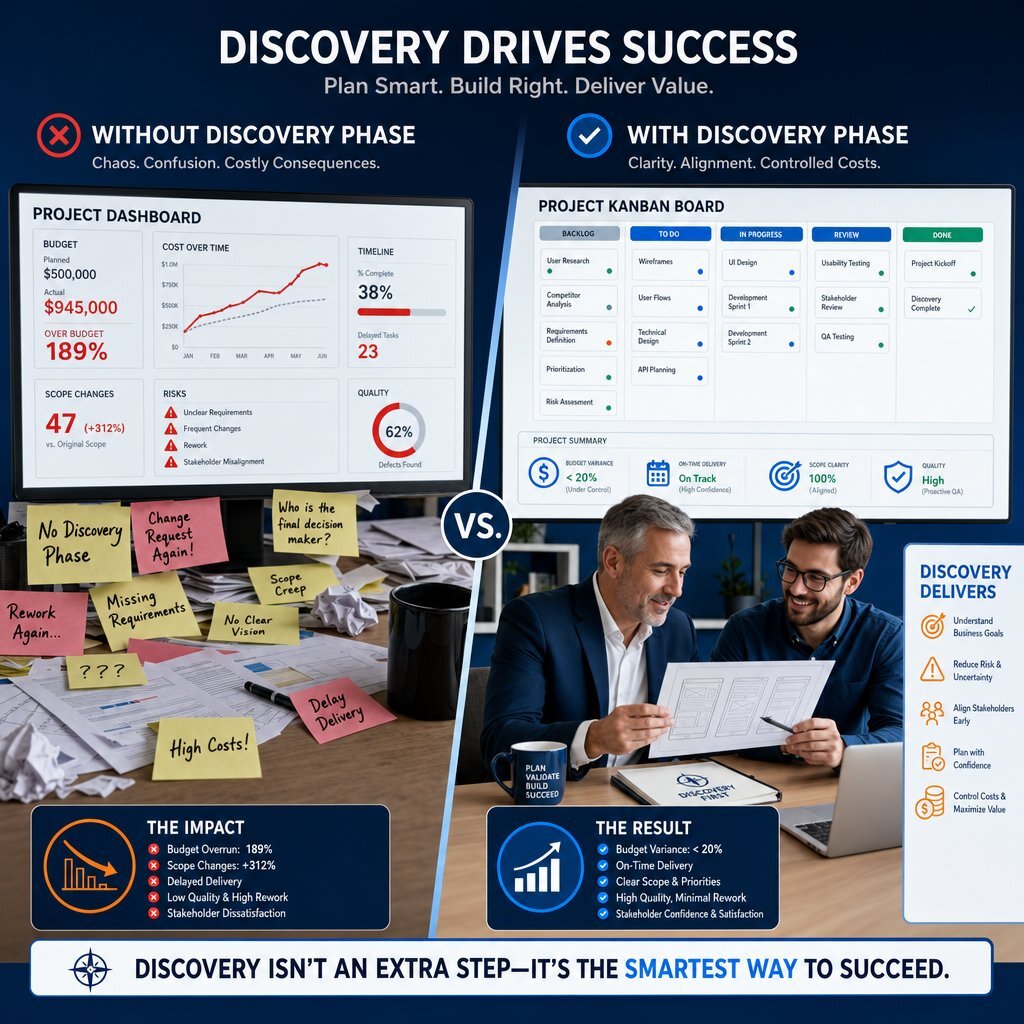
The most profound and expensive failure point in custom software development occurs when organizations rush headlong into execution without adequate preparation. According to long-term industry data compiled by the Standish Group CHAOS Report analysis, IT projects that skip upfront scoping and launch directly into development exceed their budgets by a staggering average of 189%. Furthermore, analysis indicates that 50% of all software project failures can be traced directly back to requirements-related rework—meaning the team built the wrong product because they failed to validate the scope.
A rigorous software Discovery Phase acts as the ultimate risk-mitigation lever. It is a distinct, relatively low-cost, paid engagement—typically lasting two to four weeks—where cross-functional teams define exactly what needs to be built, validate technical feasibility, and map the user architecture before a single line of expensive production code is written.
The Financial ROI of Discovery
Investing in a formal discovery phase requires a mindset shift for many executives who mistakenly view non-coding analysis activities as unnecessary overhead. However, the financial return on investment for discovery is highly quantifiable and immediate. A standard discovery phase generally costs between 5% and 10% of the total estimated project budget. Yet, it typically saves three to five times that amount in avoided code rework, caught requirements, and aligned stakeholder expectations.
| Project Metric | Execution Without a Discovery Phase | Execution With a Discovery Phase |
|---|---|---|
| Budget Accuracy | Estimates are typically off by 200-300% | Final costs fall within 15% of the estimate |
| Average Project Cost Overrun | 189% (Standish Group benchmark) | Under 20% |
| Requirements-Related Rework | Responsible for 50% of all project failures | Caught and resolved early during the scoping phase |
| Time to First Usable Feedback | 3-6 months (Post-development testing) | 2-4 weeks (Clickable prototype stage) |
| Cost of Discovering a Scope Misalignment | 50,000 - 200,000 (Expensive code-level rework) | 5,000 - 15,000 (Low-cost design and wireframe adjustments) |
During a robust discovery phase, business analysts and system architects conduct detailed stakeholder interviews, evaluate competitor research, develop high-fidelity clickable wireframes, and comprehensively assess the target technology stack. This deep technical assessment routinely identifies hidden architectural landmines, such as legacy APIs that cannot support modern data loads, or strict regulatory compliance hurdles (such as HIPAA or SOC 2) that require fundamentally different database encryption structures.
Crucially, ruthlessly prioritizing features during the discovery phase allows organizations to identify and eliminate software bloat. Industry data suggests that up to 64% of built software features are rarely or never used by actual end-users. If an original project feature list contains 20 items, and the discovery phase validates that only 12 are genuinely necessary to launch a successful Minimum Viable Product (MVP), the organization has instantly saved 40% of its development budget. Those deferred features are placed onto the product roadmap, to be built only if post-launch user data proves they are actually required.
Once the discovery phase is fully complete, the level of project certainty shifts dramatically from low to high. Armed with validated architecture diagrams, clickable prototypes, and a comprehensive project risk register, an organization can safely execute a Fixed-Scope contract for the MVP, or transition confidently into an Agile Retainer knowing exactly what the initial sprints must accomplish. Discovery is not a luxury or a delay tactic; it is the most cost-effective investment an organization can make to govern scope creep and reduce Total Cost of Ownership.
Guardrails for Any Engagement Model
Regardless of whether an organization ultimately selects a fixed-price contract, an open-ended time-and-materials structure, or an adaptive agile retainer, the natural forces of scope creep will inevitably test the boundaries of the engagement. No commercial model is entirely immune to human nature, shifting market demands, or technical surprises.
To prevent any software engagement from spiraling into massive budget overruns or adversarial legal standoffs, specific contractual, financial, and operational guardrails must be firmly established and rigorously enforced.
1. The Change-Order Friction Process (For Fixed-Scope)
In a fixed-scope project, the change-order process must be intentionally designed to force strategic deliberation without grinding active development to a complete halt. A healthy, functional change-order process requires that any proposed deviation from the discovery-phase blueprint be formally documented with a tri-fold impact assessment. Before any executive approves a change, they must be presented with:
- The Financial Impact: What is the exact, hard-dollar cost of designing, building, and testing the new feature?
- The Timeline Impact: How many days or weeks will this change add to the project's critical path and final delivery date?
- The Architectural Impact: Does this late-stage addition compromise existing security protocols, scalability metrics, or system performance?
By forcing business stakeholders to view the timeline delays and architectural consequences alongside the financial cost, executives often realize that a "minor UI tweak" is not worth delaying the entire product launch by three weeks. This guardrail ensures that only changes with a massive, proven ROI are approved, while nice-to-have features are systematically deferred to phase two.
2. Backlog Governance and the "One-In, One-Out" Rule (For Agile Retainers)
Agile retainers thrive on ultimate flexibility, but flexibility without strict governance rapidly devolves into endless development cycles and bloated software. The primary operational guardrail for an agile retainer is rigorous backlog governance, enforced by an empowered, decisive Product Owner.
When a new business requirement surfaces, it cannot simply be added to the bottom of an ever-expanding wish list. It must be accurately sized (estimated in story points by the engineering team) and ranked against existing priorities. The most effective metric for controlling scope in this model is the strict enforcement of the "One-In, One-Out" rule during active sprints. If a new capability is deemed highly critical and inserted into the upcoming two-week sprint, a feature of equal complexity must be removed from that sprint and pushed back into the backlog.
This mechanism forces a zero-sum prioritization game. Stakeholders are completely free to change their minds and alter the scope, but they must continuously decide what the business is willing to sacrifice to accommodate that immediate change. This single, elegant mechanism transforms scope creep from an external vendor-management issue into an internal business-strategy discussion.
3. Adjustment Budgets and Contingency Planning (For All Models)
Budgeting for custom application development must acknowledge the statistical reality of the software engineering industry. Because projects inherently involve deep technical discovery and unforeseen hurdles, CFOs and project sponsors must establish dedicated adjustment budgets—often referred to as contingency funds.
Financial best practices dictate allocating a minimum of 15% to 20% of the total project cost specifically for unforeseen scope evolution and necessary technical pivots. Crucially, this adjustment budget should not be heavily advertised to the development team, as Parkinson’s Law dictates that work will inherently expand to fill the available budget. Instead, the contingency fund is held securely at the executive level to seamlessly fund high-value discoveries or navigate technical roadblocks without requiring emergency board approvals or halting project momentum.
In T&M models, this financial guardrail takes the form of strict "Not-To-Exceed" (NTE) thresholds. The contract remains highly flexible, but automated financial alerts trigger mandatory executive review when 50%, 75%, and 90% of the approved budget is consumed, ensuring that budget unpredictability is caught and managed long before it becomes a crisis.
4. Continuous Deployment and Transparent Tooling
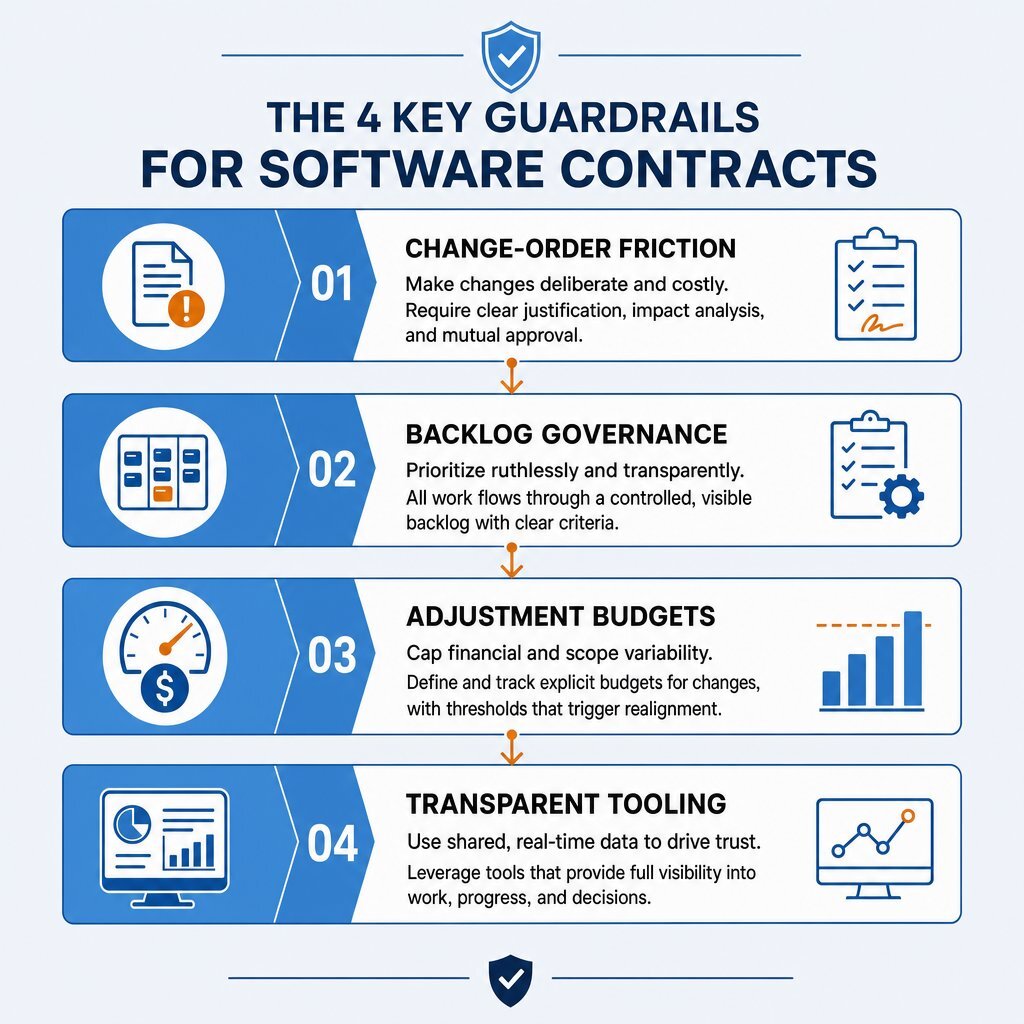
Trust is the foundational currency that enables flexible engagement models to function effectively. In T&M and Agile Retainer agreements, the buyer must have verifiable, daily proof that the vendor is operating efficiently and delivering quality code. This vital guardrail is entirely technical. Organizations must mandate the use of centralized, fully transparent tools—such as Azure DevOps On-Prem, Jira, or GitLab—where every single billed hour can be directly traced to a specific pull request, an automated test result, and a deployed software feature.
By implementing robust Continuous Integration and Continuous Deployment (CI/CD) pipelines, organizations ensure that code is integrated, tested, and deployed daily. This entirely prevents the dangerous "90% done" syndrome, where an offshore vendor claims a massive feature is complete, only for the buyer to discover during final User Acceptance Testing (UAT) that it fundamentally fails to meet core business requirements. Transparent DevSecOps tooling forces architectural issues to the surface immediately, allowing scope, timeline, and engineering resources to be adjusted in real-time.
Realigning Contracts with Commercial Reality
Scope creep is not an indicator of a weak project manager, nor is it proof of an undisciplined software engineering team. It is the natural, inevitable byproduct of a static commercial contract attempting to contain a dynamic, rapidly evolving business reality. As industry data consistently proves, software requirements will always change as a project transitions from abstract planning to tangible reality.
The ultimate solution to scope creep lies in structural alignment. Fixed-scope contracts attempt to purchase absolute certainty, but in doing so, they shift the severe risks and costs of change directly onto the buyer through adversarial change orders, delayed timelines, and severely compromised code quality. Time-and-materials and agile retainers, by contrast, explicitly acknowledge the reality of evolving requirements. By pricing flexibility, reliable capacity, and continuous deployment rather than rigid feature sets, these models absorb change gracefully, ensuring that elite engineering talent is always deployed against the highest-value business priorities.
For visionary technology leaders and strategic financial officers, the executive mandate is clear: align the engagement model to the project's actual level of upfront certainty. Utilize a robust Discovery Phase to define the knowns, eliminate wasted features, and drastically reduce the risk of the 189% cost overruns that plague the industry. And when building complex, innovative enterprise software where the final destination is highly likely to evolve, abandon the dangerous illusion of the fixed-price contract in favor of the strategic, adaptable partnership offered by an agile retainer. By fixing the contract structure, organizations permanently solve the discipline problem. For leaders planning long-term AI-heavy platforms, it is also worth exploring how AI-driven productivity gaps in software development and mid-market data readiness directly affect which contract model will actually deliver usable, maintainable systems over time.
FAQ
How does an Agile Retainer prevent a project from going over budget indefinitely?
An Agile Retainer prevents runaway costs by fixing the monthly financial burn rate while utilizing rigorous backlog governance, such as the "One-In, One-Out" rule, to strictly manage deliverables. While the total timeline may flex to accommodate new features, the monthly financial exposure is capped and entirely predictable, allowing the business to pause or terminate the engagement the moment the software achieves its intended return on investment.
Many mid-market organizations also couple agile retainers with a portability-first AI and infrastructure strategy, so they can shift workloads and renegotiate vendor relationships without rewriting their entire platform when priorities change.
Supporting Links
- https://www.baytechconsulting.com/blog/7-hidden-costs-of-offshore-software-development
- https://www.baytechconsulting.com/blog/consumption-based-pricing-enterprise-shift
- https://www.baytechconsulting.com/blog/time-and-materials-vs-fixed-price-2025
About Baytech
At Baytech Consulting, we specialize in guiding businesses through this process, helping you build scalable, efficient, and high-performing software that evolves with your needs. Our MVP first approach helps our clients minimize upfront costs and maximize ROI. Ready to take the next step in your software development journey? Contact us today to learn how we can help you achieve your goals with a phased development approach.
About the Author

Bryan Reynolds is an accomplished technology executive with more than 25 years of experience leading innovation in the software industry. As the CEO and founder of Baytech Consulting, he has built a reputation for delivering custom software solutions that help businesses streamline operations, enhance customer experiences, and drive growth.
Bryan’s expertise spans custom software development, cloud infrastructure, artificial intelligence, and strategic business consulting, making him a trusted advisor and thought leader across a wide range of industries.