
Beyond the Scribe: Reclaiming Clinicians' Evenings
August 05, 2026 / Bryan Reynolds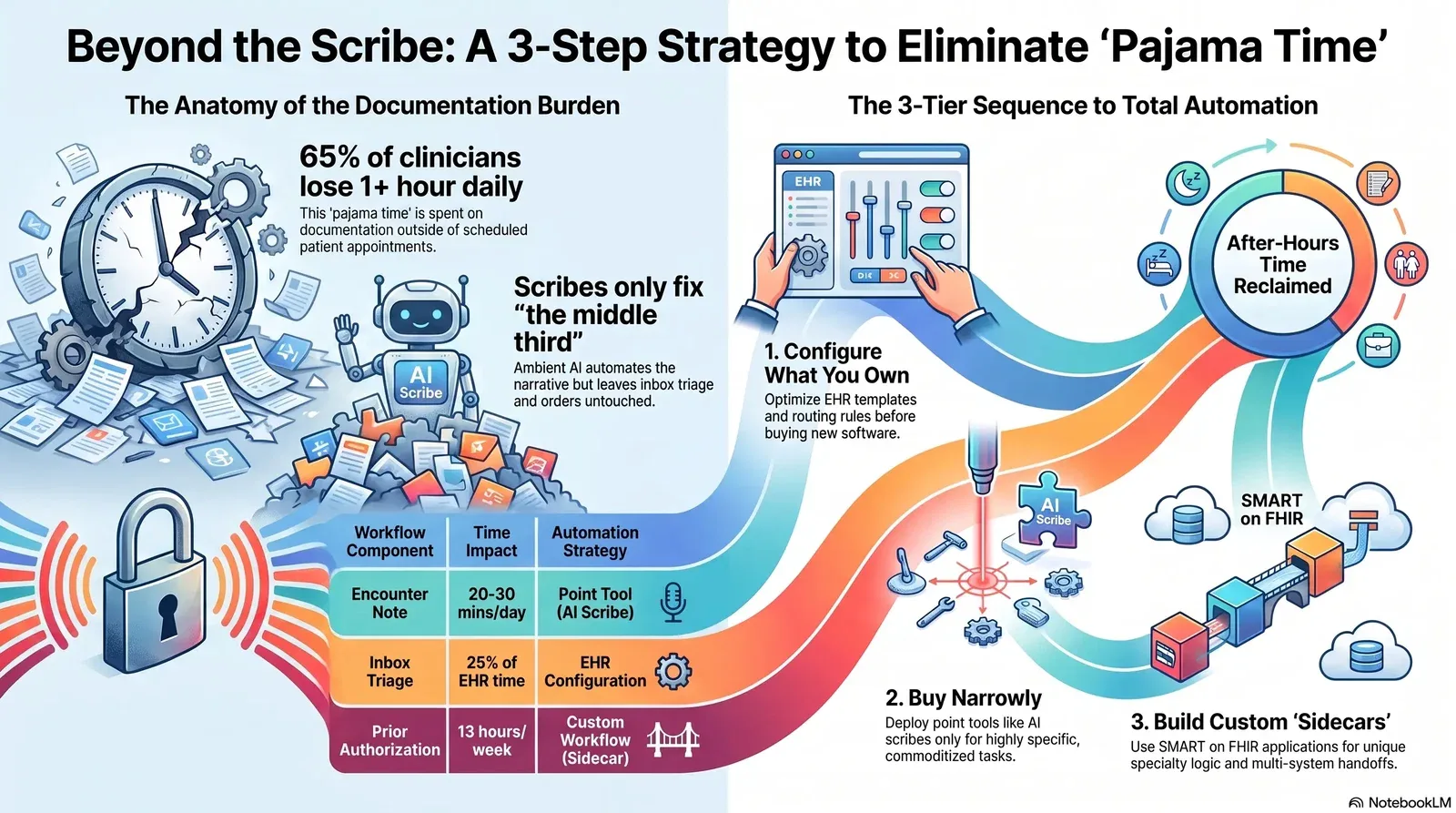
Your clinicians did not get into medicine to spend their evenings typing. Two-thirds of them lose an hour or more every day to documentation outside scheduled appointments, and the artificial intelligence (AI) scribe you just bought only fixed the middle third of the problem.
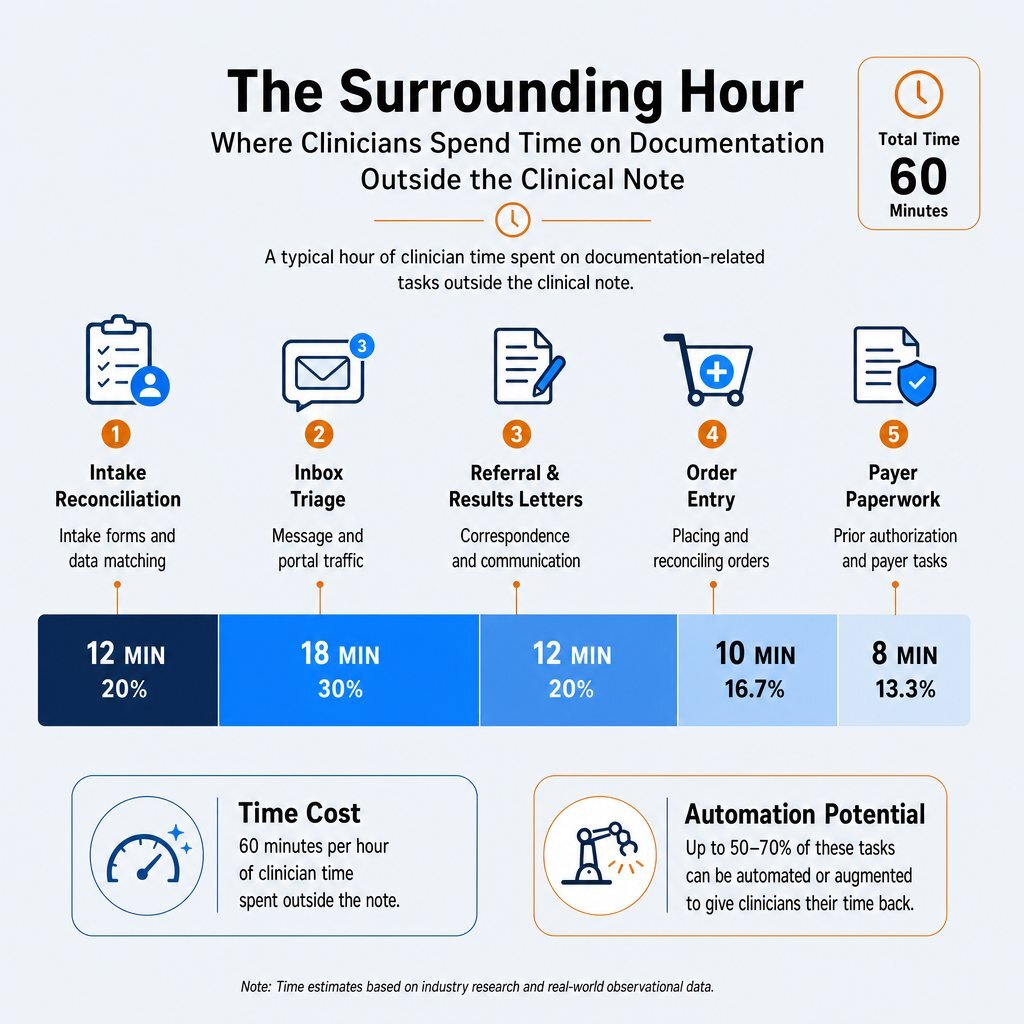
The healthcare market has collapsed the complex operational challenge of the "documentation burden" into a single directive: buy a scribe. This assumption is fundamentally flawed. While ambient listening technology is a necessary intervention, it is not sufficient on its own. The hour your clinicians spend working after hours is consumed by intake reconciliation, inbox triage, referral and results letters, order follow-up, and payer paperwork. These workflow steps surround the clinical note, and they do not disappear just because the note writes itself.
Practices that actually recover clinician time treat documentation as an end-to-end pipeline. They prioritize clinical workflow automation to handle the handoffs that currently sit in queues. Implementing this requires a vendor-neutral sequencing strategy: configuring the electronic health record (EHR) first, buying point tools to close measured gaps, and building custom workflow software fitted exactly to how a specific practice routes work.
The clinician documentation burden is bigger than the note
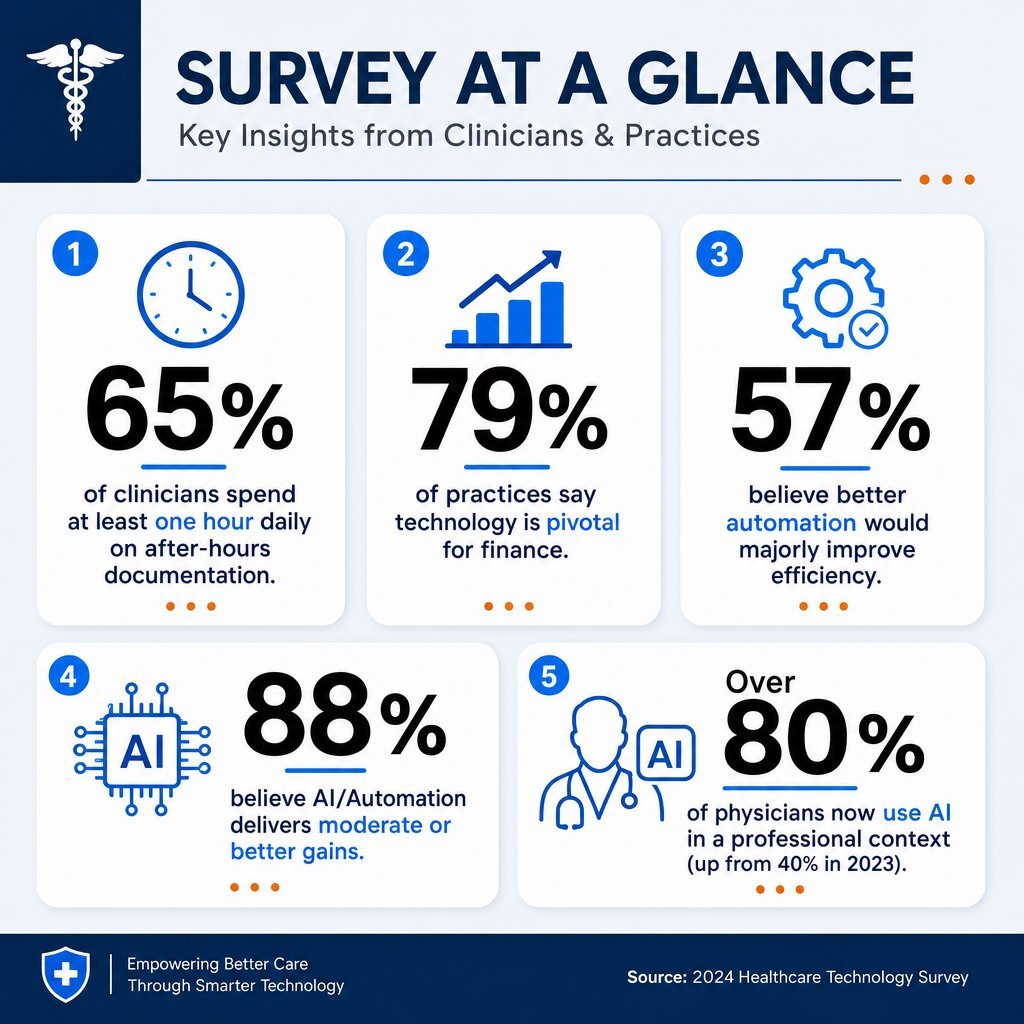
Independent practices are betting heavily on technology to maintain their operational sovereignty, but they are aiming at the wrong target. A May 2026 national survey by Veradigm of 360 independent practice leaders highlights a stark operational reality: 65% of clinicians spend at least one hour per day on documentation outside of scheduled appointments, and 26% spend two or more hours.
Practice leaders already believe in the fix. According to the Veradigm data, 79% of respondents state that technology is pivotal to long-term financial stability, and 57% say better automation would provide a significant or major improvement to practice efficiency. An overwhelming 88% believe AI and automation could deliver at least moderate efficiency gains. Physicians themselves are ready for this shift. The AMA 2026 Physician AI Survey indicates that over 80% of physicians now use AI in a professional context, double the share from 2023. To turn that interest into real outcomes, practices need disciplined execution around rigorous discovery and implementation planning instead of one-off tool purchases.
The gap is no longer technology adoption; the gap is knowing which workflow steps to automate in what order. This external documentation time—colloquially termed "pajama time"—consists of highly fragmented, cognitive-switching tasks. Studies analyzing EHR event log data indicate that for every hour physicians provide direct clinical face time to patients, nearly two additional hours are spent on EHR and desk work. A substantial portion of this involves manual routing, data reconciliation, and navigating disjointed systems that were designed for billing compliance rather than clinical efficiency.
What the AI scribe fixed—and the workflow it left untouched
The ambient AI scribe represents a critical leap forward, but published evaluations show it leaves adjacent administrative tasks completely untouched. Ambient solutions successfully decrease physician burnout, improve same-day chart closure rates, and enable clinicians to repurpose typing time for direct patient education.
However, KLAS Research findings reveal the strict limitations of ambient speech documentation. Satisfaction rises as clinicians adopt initial AI tools, but it plateaus quickly if they are handed too many disconnected applications or half-finished workflows. More importantly, early adopters report that while they no longer type during the patient encounter, their overall workload has not decreased proportionately.
Clinicians still have to manually enter orders, format referral instructions, click through disjointed templates, and correct AI hallucinations before signing the chart. The ambient scribe automates the transcription of the clinical narrative. It does not automate the clinical operations that result from that narrative. If a physician dictates a complex care plan, the scribe creates a beautifully formatted paragraph. It does not queue the lab orders, draft the prior authorization request, or route the referral to the appropriate specialist. Without the right guardrails, it can even introduce new defects and rework, similar to how poorly governed AI coding creates a growing AI-generated technical debt burden in software teams.
Anatomy of the surrounding hour
When the AI scribe finishes drafting the encounter note, the surrounding administrative hour begins. This hour is consumed by a series of adjacent workflows where information sits in queues, requiring the clinician to act as a manual router.
The highest-yield targets outside the note are areas where work demands synthesis across multiple systems. The most acute administrative chokepoint is payer prior authorization. The 2026 American Medical Association (AMA) physician survey reveals that physicians complete an average of 39 prior authorizations per week, consuming approximately 13 hours of physician and staff time. Furthermore, 94% of physicians report that prior authorization contributes to burnout, and 79% report that patients abandon treatment due to authorization challenges.
Beyond payer paperwork, inbox and message triage dominates the time spent in the EHR outside scheduled clinic hours. Log-based analyses show that reviewing and responding to patient portal messages, pharmacy refill requests, and staff queries frequently accounts for nearly a quarter of total daily EHR time. Order entry and referral correspondence consume the remainder, requiring clinicians to synthesize historical context and manually push data into external modules.
| Workflow Component | Time Cost / Impact | Automation Potential | Optimal Fix Strategy |
|---|---|---|---|
| Encounter Note | 20–30 mins per day (manual typing). | High | Point Tool (Ambient AI scribe). |
| Inbox Triage | ~25% of total EHR time. | Medium | EHR Configuration (Routing rules, templates). |
| Prior Authorization | 13 hours weekly per physician. | High | Custom Workflow Automation (APIs, Sidecars). |
| Order Entry | 10–15 mins per day of manual clicking. | Low to Medium | EHR Configuration (Standardized order sets). |
| Referral Letters | Highly variable; context synthesis. | High | Custom Workflow Automation. |
Fix in sequence: Configure, buy, build
Practices that successfully close the time-leakage gap avoid buying disjointed software subscriptions that create new integration headaches. Instead, they treat automation as a sequenced pipeline. The optimal sequence for medical practice automation software is strict: configure the systems you own first, add point tools only where they close a measured gap, and reserve custom workflow automation for routing logic unique to your practice. This mirrors broader legacy-modernization guidance for mid-market firms, where a phased roadmap beats risky big-bang overhauls every time; the same thinking applies here, as explored in our phased legacy modernization roadmap.
1. Configure what you own
The mandatory first step is exhausting the native capabilities of the existing EHR. A massive percentage of documentation bloat stems from poorly configured systems. Before purchasing external software, technical teams must optimize internal EHR templates, standardize order sets, and refine patient-portal intake questionnaires so that structured data flows directly into the chart. Routing rules must be tightened so that prescription renewals bypass the physician and land directly in the clinical pharmacist's or registered nurse's queue. If you do not fix the underlying routing rules, adding AI will simply process bad workflows faster.
Taking this configuration-first approach also aligns well with iterative, Agile methodology practices: make small, measurable changes inside tools you already own, get feedback from clinicians, and adjust quickly before you commit to larger investments.
2. Buy narrowly
Once the EHR is fully optimized, independent practices should deploy commercial point tools to solve highly specific, commoditized problems. The ambient AI scribe belongs in this tier. Point tools only earn their subscription when they operate silently in the background or integrate natively. If a point tool requires the clinician to open a separate browser tab, manage a secondary login, or monitor a new standalone inbox, it has failed the automation test. Every new interface is a context switch that increases cognitive load and degrades efficiency.
When evaluating these tools, focus on how they plug into your existing stack and how they will be supported over time. A tightly scoped AI scribe or portal module, backed by strong service contracts, can offload real work without creating brittle new dependencies or surprise maintenance burdens.
3. Build where your routing logic is unique
When a mid-size practice or Managed Service Organization (MSO) hits the ceiling of off-the-shelf software, custom workflow automation becomes the most financially viable path. Markers that dictate a custom build include specialty-specific routing logic, multi-system handoffs across distinct clinics, and unique staffing models that commercial vendors do not support.
This is typically achieved using an EHR sidecar architecture powered by SMART on FHIR (Substitutable Medical Applications, Reusable Technologies on Fast Healthcare Interoperability Resources). A sidecar application operates alongside the existing EHR to deliver targeted automation without attempting to replace the EHR as the authoritative system of record. The sidecar handles complex workflows—such as aggregating clinical evidence for prior authorization or automating referral loops—and explicitly synchronizes the required data back to the EHR.
Executing this level of interoperability requires enterprise-grade engineering. Baytech Consulting specializes in this tier of Custom Application Development. By utilizing Rapid Agile Deployment methodologies, Baytech engineers tailored sidecar applications that snap securely into existing EHR frameworks. Utilizing technologies like Azure DevOps On-Prem, PostgreSQL, and robust API gateways, this approach ensures practices capture the precise operational logic required to automate their unique handoffs while maintaining strict compliance and system performance. Many community hospitals use a similar sidecar pattern to modernize older EHRs without ripping and replacing their core, as outlined in our guide on being priced out of Epic and using sidecars to stay competitive.
| Intervention Tier | Trigger Criteria | Examples | Risk of Failure |
|---|---|---|---|
| Configure (EHR) | Misrouted messages, repetitive clicking, unstructured intake. | Order sets, portal forms, inbox delegation rules. | Low. Requires only internal operational discipline. |
| Buy (Point Tool) | High volume of commoditized work (e.g., dictation). | Ambient AI scribes, standard patient engagement apps. | Medium. Point tools can easily become disconnected data silos. |
| Build (Custom) | Unique specialty logic, multi-EHR environments, advanced PA needs. | SMART on FHIR sidecars, custom referral engines. | High, unless executed by an experienced engineering partner. |
Measuring recovered time
Automation initiatives frequently fail because baseline metrics were never established. The same visibility gap that hides revenue leakage—only 24% of practices report high visibility into where they lose revenue—hides time leakage too. To determine if an automation sequence is actually reducing the clinician documentation burden, practice administrators must measure recovered time directly.
Key performance indicators for workflow automation include:
- After-Hours EHR Time: Tracked via system audit logs, this measures the exact minutes spent active in the EHR outside of scheduled shift hours. This is the empirical measurement of "pajama time."
- Chart-Closure Lag: The average number of days (or hours) elapsed between the end of a patient encounter and the final signature on the clinical note.
- Inbox Turnaround Time: The duration from when a patient or staff message enters the queue to when it is resolved and archived.
Without establishing these baselines over a 30-day period prior to implementation, organizations will rely on anecdotal evidence rather than data-driven validation to assess the return on investment. The same discipline that helps mid-market firms decide whether to build, buy, or wrap AI systems—outlined in our guide to bridging the AI productivity gap in software development—applies here: start with measurable goals, then invest.
A 90-day plan for a mid-size practice
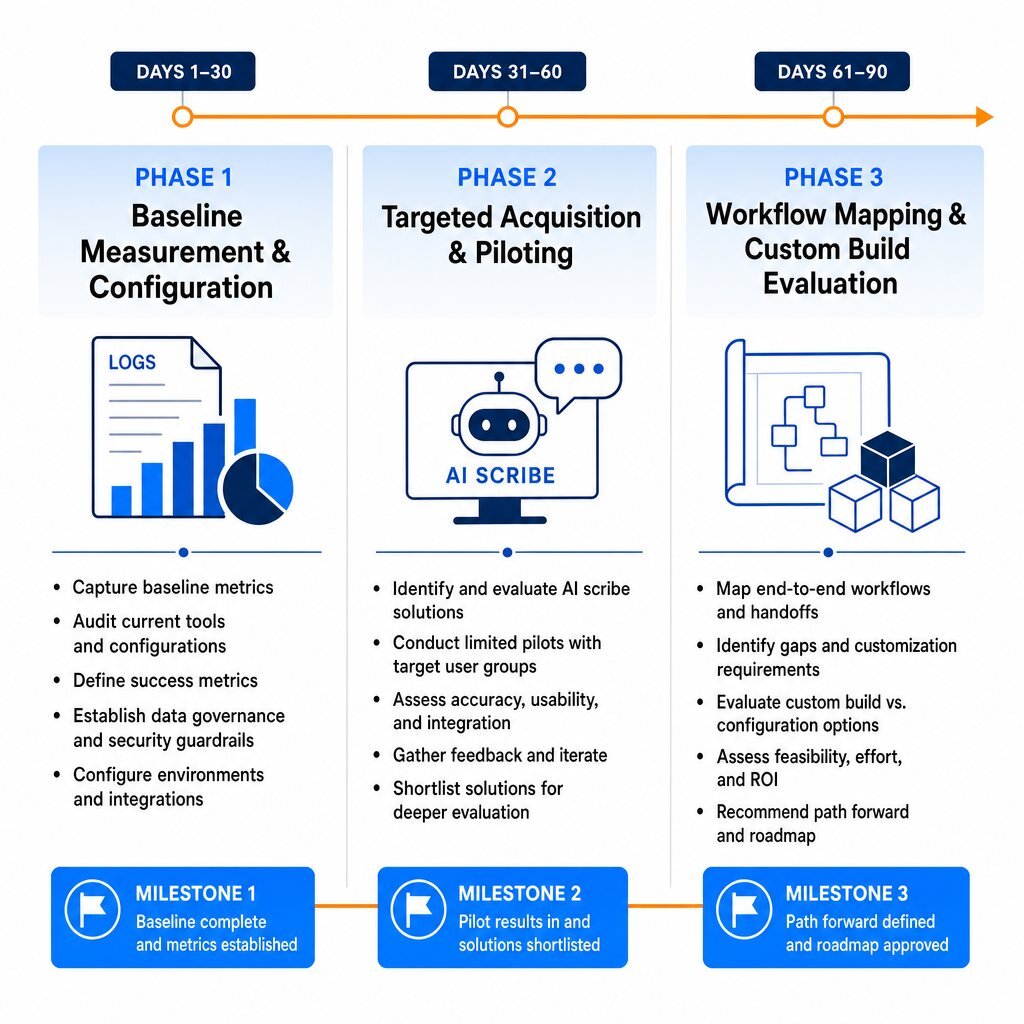
Translating this sequencing strategy into reality requires a disciplined, time-bound execution plan. For a mid-size independent practice, a realistic 90-day pipeline looks like this:
- Days 1–30: Baseline Measurement and Configuration. Extract the preceding 30 days of EHR event log data to establish baseline metrics for after-hours charting, chart-closure lag, and inbox turnaround. Simultaneously, audit the EHR to identify and repair broken routing rules, outdated order sets, and inefficient documentation templates.
- Days 31–60: Targeted Acquisition and Piloting. Introduce the highest-leverage point tool—typically an ambient AI scribe—to a strictly defined pilot group of clinicians. Ensure the tool integrates seamlessly with the existing EHR architecture. Measure the pilot group's metrics against the established baselines at the end of the 30-day window to validate time recovery.
- Days 61–90: Workflow Mapping and Custom Build Evaluation. Analyze the remaining workflow bottlenecks. If inbox triage and payer paperwork are still causing significant delays, map the precise logic of these handoffs. Engage engineering partners to evaluate the architecture of a SMART on FHIR sidecar application, defining the scope for a custom build that will automate the practice's unique operational friction points.
The clinician documentation burden will not be solved by a single software purchase. Buying an AI scribe to fix an hour of after-hours documentation is highly effective for the 20 minutes spent writing the note, but it leaves the remaining 40 minutes of inbox triage, order entry, and payer paperwork completely unresolved. Independent practices that wish to remain independent must transcend the scribe. By adopting a disciplined approach to clinical workflow automation, organizations can permanently eliminate the unbilled hours draining their clinical workforce. Partnering with a firm like Baytech Consulting provides the tailored tech advantage needed to architect and deploy these custom integrations safely and effectively, especially when paired with ongoing support for continuous optimization rather than one-time launches.
Frequently Asked Questions
When does custom workflow automation make sense for a practice or MSO?
Custom workflow automation is required when a practice hits the functional ceiling of off-the-shelf software, typically indicated by unique, specialty-specific routing logic, complex multi-system handoffs, or a proprietary staffing model. Instead of forcing staff to adapt to rigid commercial software, a custom SMART on FHIR sidecar application molds the technology to the exact operational patterns of the practice, automating workflows while maintaining the EHR as the authoritative system of record. When scoping that kind of project, it helps to lean on a proven enterprise application architecture approach so integrations, data models, and security controls are designed to scale from the start.
- Scribe Shield: How CTOs Can Vet HIPAA AI Scribes in 2026
- Priced Out of Epic? How Sidecars Save Community Hospitals
- Virtual Care ROI: Measuring the True Financial Impact
- Stop Losing Cases: Plug Your Law Firm's Revenue Leak
- The Quiet Share Shift: Why Your Customers Want Self-Service
Are You Really AI-Ready? The Mid-Market Data Scorecard
About Baytech
At Baytech Consulting, we specialize in guiding businesses through this process, helping you build scalable, efficient, and high-performing software that evolves with your needs. Our MVP first approach helps our clients minimize upfront costs and maximize ROI. Ready to take the next step in your software development journey? Contact us today to learn how we can help you achieve your goals with a phased development approach.
About the Author
Bryan Reynolds is an accomplished technology executive with more than 25 years of experience leading innovation in the software industry. As the CEO and founder of Baytech Consulting, he has built a reputation for delivering custom software solutions that help businesses streamline operations, enhance customer experiences, and drive growth.
Bryan’s expertise spans custom software development, cloud infrastructure, artificial intelligence, and strategic business consulting, making him a trusted advisor and thought leader across a wide range of industries.