
Why Estimating Software Fails and What Executives Should Do
August 07, 2026 / Bryan Reynolds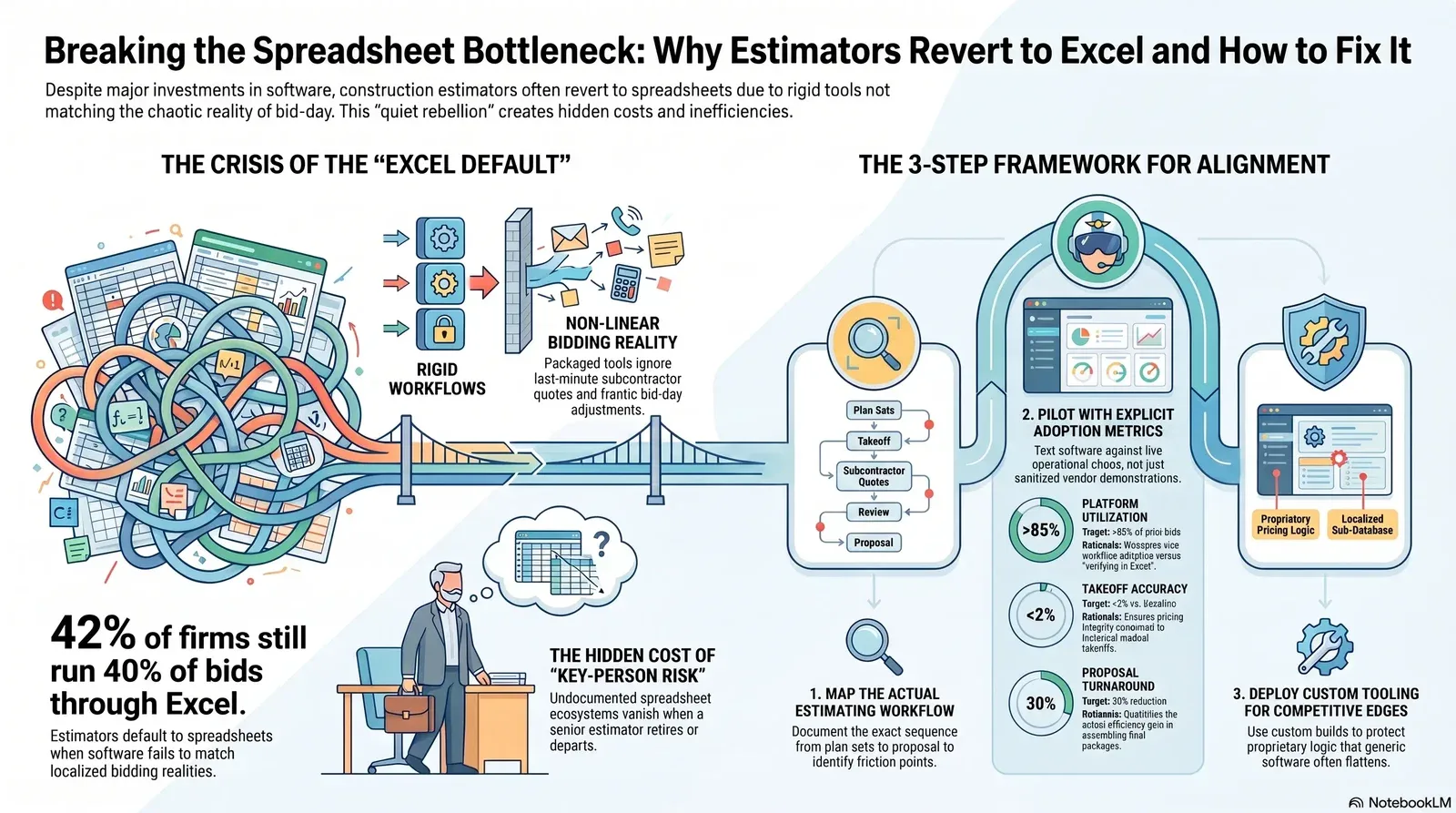
Many construction firms invest five-figure sums into commercial estimating software only to watch their pre-construction teams quietly revert to legacy methods. Two years after implementation, 42% of construction firms report their estimators still run at least 40% of bids through Microsoft Excel. This widespread abandonment is rarely a failure of the software's codebase; it is a profound mismatch between the platform's rigid architecture and the chaotic reality of how construction bids are actually assembled.
Software vendors routinely diagnose this spreadsheet regression as a training deficit, prescribing additional onboarding sessions or stricter administrative mandates. This narrative is flawed. Estimators default to spreadsheets because spreadsheets bend to accommodate highly specialized cost structures, proprietary assembly logic, and last-minute bid-day chaos. Packaged tools, by contrast, force the estimator to bend to a generic workflow designed by developers far removed from the pressures of commercial bidding.
The stakes for resolving this friction are immediate. According to the ServiceTitan 2026 Commercial Specialty Contractor Industry Report, cost estimating (24%) and bid management (22%) represent the two pre-construction functions delivering the earliest measurable returns from artificial intelligence and automation. Every bid that dies in a spreadsheet bottleneck represents lost pipeline capacity, trapping contractors in outdated workflows while competitors successfully scale.
Why Construction Estimating Software Adoption Fails
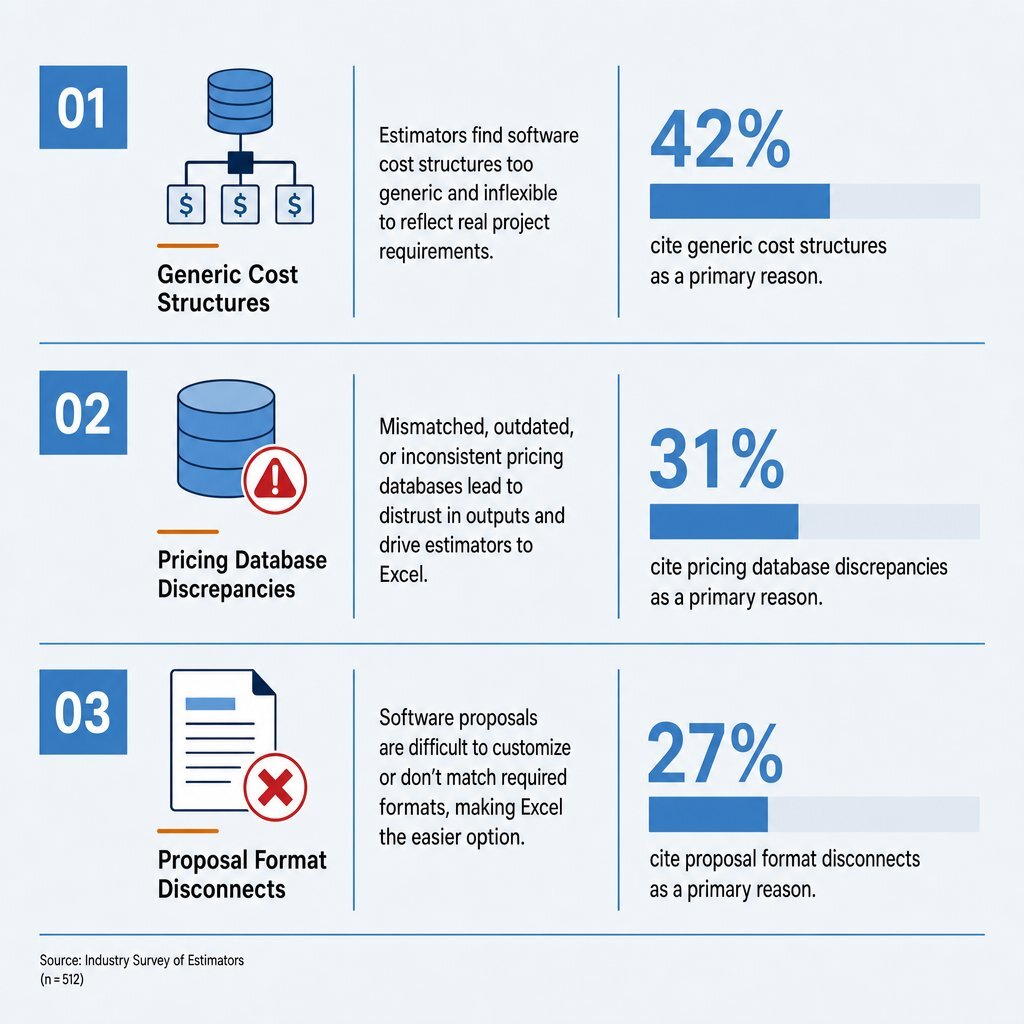
The 42% spreadsheet default rate points to a structural failure in how construction technology is evaluated and deployed. When pre-construction teams abandon a platform, the root causes consistently trace back to rigidities built into off-the-shelf software rather than user error. An FMI Corporation survey isolated three primary drivers for this abandonment:
- Generic Cost Structures: The software's underlying data model does not map to the localized bidding realities or specialized trade scopes of the contracting firm.
- Pricing Database Discrepancies: Integrated pricing databases fail to accurately reflect local market costs or historical project data, forcing estimators to perform continuous manual overrides that defeat the purpose of automation.
- Proposal Format Disconnects: The platform generates a generic proposal output that strips away established branding and formatting, violating client expectations.
Packaged software inherently assumes a linear, orderly progression: perform a takeoff, apply pricing, add markup, generate a proposal, and submit. Real-world bidding is entirely non-linear. The actual workflow involves waiting on delayed subcontractor quotes, discovering a drawing-spec contradiction, receiving an addendum that alters the scope hours before submission, and applying a last-minute global adjustment based on a phone call.
The goal for construction executives is not merely acquiring software, but securing workforce alignment. A 2026 survey of contractors at the Trimble Dimensions conference revealed that 38% of respondents consider "getting employees to buy in and excel with technology" their top priority for the year. Forcing estimators into rigid workflows actively works against this buy-in, prompting the quiet rebellion of the Excel default.
Why Estimators Still Use Excel
Pre-construction professionals are highly rational actors tasked with protecting project margins. Their loyalty to the spreadsheet is not driven by a stubborn refusal to modernize; it functions as a tactical defense mechanism against software that slows them down.
Spreadsheets handle non-linear bidding realities effortlessly. If a mechanical subcontractor submits a revised quote minutes before a deadline, an estimator using a spreadsheet can dynamically adjust a single cell, instantly cascading that change through the entire assembly logic and final margin calculation. Generic estimating software frequently locks up under these conditions, requiring the user to navigate through multiple nested menus to adjust an underlying assembly just to change a bottom-line number.
Furthermore, estimating logic often serves as a primary competitive differentiator. Experienced estimators build proprietary formulas to account for abnormal soil environments, limited working space, premium crew schedules, and highly localized labor productivity rates. A 2024 study by FMI Corporation reported that nearly 62% of construction companies attribute project losses directly to poor cost estimation, indicating that granular accuracy is paramount. Packaged tools frequently flatten these granular adjustments into generic variables. Estimators revert to spreadsheets because they remain the only tools malleable enough to encode the actual, unvarnished reality of how the firm builds.
The integration of specialized cost databases further complicates adoption. While industry-standard databases like RSMeans offer baseline transparency, experienced contractors heavily modify these figures with manual adjustments based on proprietary supplier relationships or premium materials not listed in standard specifications. If a newly purchased estimating platform fails to allow seamless integration of these nuanced, historical adjustments, the platform becomes an obstacle rather than an asset.
The Business Cost of the Spreadsheet Default
While the estimator's reliance on spreadsheets is a rational response to rigid software, the business cost to the firm is severe. The construction sector is currently navigating a period of acute margin pressure and labor scarcity. The Associated Builders and Contractors (ABC) reports that the U.S. construction industry requires 349,000 net new workers in 2026 simply to maintain equilibrium with project demand, creating an environment where seasoned estimators are exceedingly difficult to hire. Simultaneously, 71% of commercial specialty contractors reported raising wages heading into 2026, a sharp increase from 55% the previous year.
With labor and overhead costs surging, scaling revenue requires maximizing the leverage of existing pre-construction teams. Relying on disconnected spreadsheets actively undermines this leverage in several measurable ways:
- Lost Bid Capacity: Manual data entry and repetitive assembly creation limit the volume of bids an estimator can process. Firms trapped in spreadsheets sacrifice top-line revenue simply because they lack the bandwidth to pursue available opportunities.
- Key-Person Risk: Complex bidding workbooks inevitably evolve into massive, undocumented ecosystems understood by only one senior estimator. If that individual departs or retires—a statistical probability given that the average U.S. construction worker is 42.5 years old—the firm's institutional bidding capability vanishes overnight.
- Version Control and Scope Gaps: Spreadsheets lack rigorous audit trails. Distributing document revisions manually via email frequently results in subcontractors bidding off obsolete drawing sets, introducing catastrophic scope gaps. Disconnected workflows and tools cost the construction industry billions annually, with pre-construction teams losing hours every week to rework.
- Silent Errors: Unmeasured error rates in manual spreadsheets lead to outsized financial risks. A single broken macro, a hard-coded override forgotten in a hidden row, or a misaligned cell reference can eliminate a project's entire profit margin.
- Data Silos: Bid data trapped in a localized file cannot flow seamlessly into project management (PM) or enterprise resource planning (ERP) systems. The ServiceTitan report notes that only 20% of contractors operate on a single, unified technology platform. This fragmentation forces manual re-keying, which introduces further error and severs the critical feedback loop between what was estimated and what a project actually cost to build.
Recognizing these liabilities, top-tier contractors are rapidly evolving. The Engineering News-Record (ENR) Top 400 General Contractors have tripled their adoption of artificial intelligence in pre-construction workflows over an eighteen-month span, proving that market leaders are aggressively targeting these bottlenecks to secure early project advantages. Many are also rethinking their broader digital stack, investing in DevOps efficiency and modern deployment practices so estimating tools can evolve without disrupting live projects.
Fix Step One: Map the Estimating Workflow
The remedy for software abandonment begins long before engaging a vendor or requesting a demonstration. Construction firms frequently purchase software based on an RFP feature checklist, assuming the tool will dictate an improved process. This approach guarantees failure. The most critical step is mapping the firm's actual estimating workflow and using that map as the sole evaluation rubric.
Documenting the current state requires tracking a bid from inception to submission. Analysts must map the exact sequence: receiving the plan set, opening the PDF, starting the takeoff, building the spreadsheet, looking up pricing, formatting the proposal, and submitting the final package. This kind of disciplined analysis mirrors the rigorous discovery phase checklists used in successful software projects and brings the same clarity to pre-construction.
A rigorous workflow map captures the friction points that feature checklists miss. It identifies precisely which steps carry the highest time-cost and which introduce the most manual errors. Furthermore, it surfaces unstated integration requirements. If the estimating workflow requires passing budget codes directly into a specific project management system, and the prospective software cannot automate that exact handoff, the tool will inevitably force a return to manual data entry.
Skipping this discovery phase is the primary driver of post-launch rework and outright software rejection. Executing a comprehensive UX-led discovery phase provides a cost-effective guardrail against investing in a platform that estimators will ultimately refuse to use. In practice, that means applying the same UX-led discipline outlined in The Costly Truth About Skipping UX-Led Discovery in Software and adapting it to your estimating process before you ever sign a software contract.
Fix Step Two: Pilot with Explicit Adoption Metrics
Once the workflow is mapped, the procurement process must shift from a controlled sales demonstration to a live operational pilot. Vendor demonstrations occur in highly sanitized environments; they do not test how software responds to an incomplete architectural drawing, a delayed addendum, or a chaotic bid day.
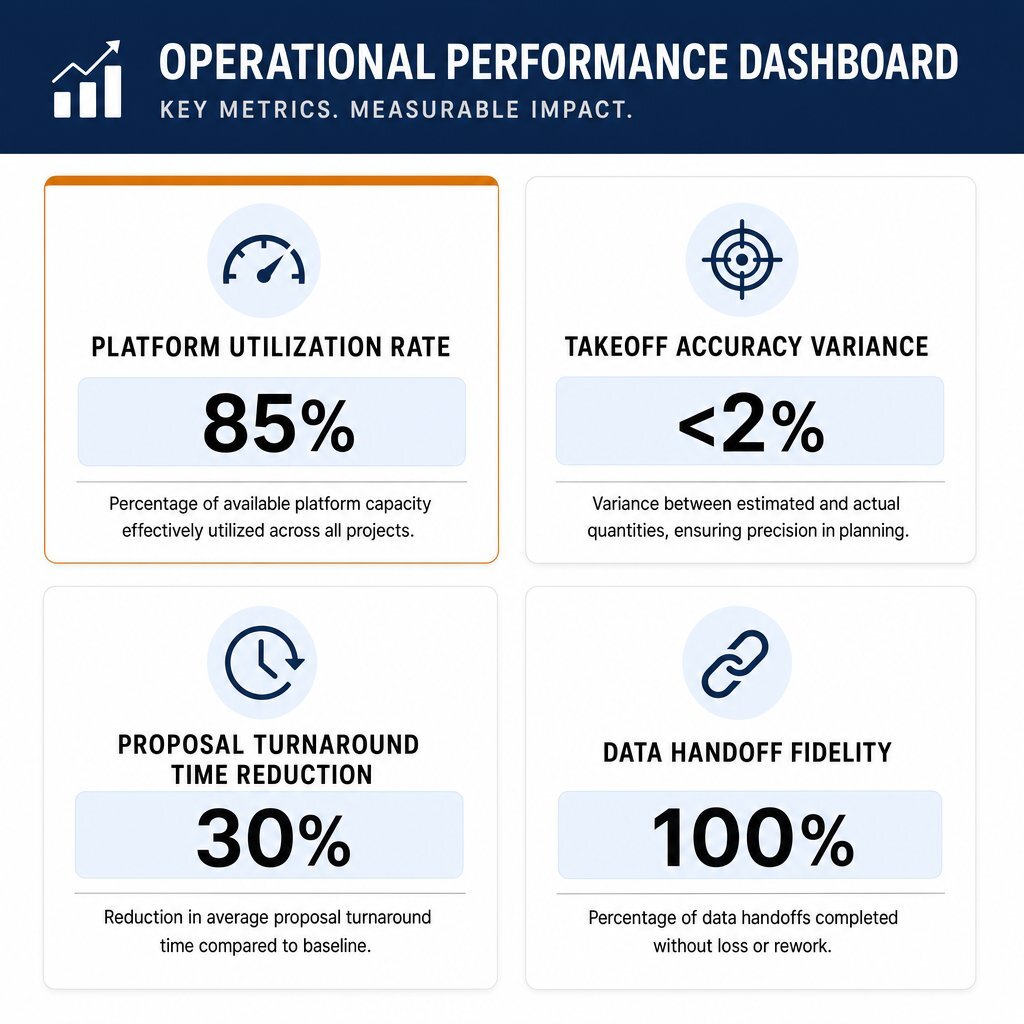
Contractors must negotiate a 60-day pilot program tied to concrete adoption and performance metrics. Defining success before signing prevents post-implementation disputes and ensures the software vendor is fully aligned with the firm's operational outcomes. A successful pilot agreement explicitly states the thresholds the software must meet to warrant a full, paid deployment across the pre-construction team.
| Metric Category | Target Threshold | Strategic Rationale |
|---|---|---|
| Platform Utilization Rate | > 85% of pilot bids | Measures true workflow adoption. If estimators run test bids in the software but verify the math in Excel, the tool has failed. |
| Takeoff Accuracy Variance | < 2% vs. baseline | Evaluates the reliability of the software's measurement algorithms against manual historical takeoffs to ensure pricing integrity. |
| Proposal Turnaround Time | 30% reduction | Quantifies the efficiency gain. The software must demonstrably reduce the hours spent assembling the final submission package. |
| Data Handoff Fidelity | 100% automated transfer | Tests system integration. Approved estimates must flow into the project management system with zero manual re-keying. |
During the pilot, it is imperative to test the platform's pricing database against the actual scope and final cost of at least three recently completed projects. The variance between the database's output and the firm's historical reality will instantly reveal how much manual override work the platform demands. If the discrepancy is massive, the software functions merely as an expensive calculator requiring constant correction, practically guaranteeing that estimators will abandon it.
These same pilot metrics also help expose deeper contract and governance issues. When thresholds, contingencies, and change-control rules are clearly defined, you avoid the scope creep and blame games that plague many technology rollouts. Treat your estimating platform agreements like any other major project and apply the principles from Stop Blaming Teams: Scope Creep Is a Contract Problem so incentives stay aligned from day one.
Fix Step Three: Know When to Build Custom Tooling
For many mid-market contractors, configuring an off-the-shelf platform will suffice. If the firm's bidding strategy relies on standard scopes, generic pricing databases, and straightforward markups, commercial SaaS platforms offer a reasonable path away from spreadsheets.
However, a distinct threshold exists where commercial software ceases to be an accelerator and becomes an operational constraint. When a firm's core estimating logic serves as a closely guarded competitive asset—when the specific way it assesses risk, accounts for crew productivity, and structures its sub-tier assemblies is exactly what wins bids—forcing that logic into a generic software container destroys the firm's edge.
In these scenarios, developing custom construction bidding software transitions from a technological luxury to a strategic necessity. Custom tooling encodes the firm's actual method instead of forcing conformity to a generic approximation.
A realistic custom or hybrid estimating build does not require reinventing every component from scratch. Modern software architecture supports modular development. A firm might retain a best-in-class off-the-shelf takeoff tool but commission a custom bidding engine that ingests the takeoff data via API. This bespoke engine can house the firm's proprietary historical cost databases, execute its unique assembly logic, apply dynamic localized risk factors, and automatically generate highly branded, client-ready proposals. When done well, this kind of architecture mirrors the phased legacy modernization roadmaps mid-market enterprises use to escape rigid, outdated systems without risky big-bang rewrites.
The markers indicating a construction firm is ready for a custom build include:
- Hitting SaaS Ceilings: The pre-construction team spends more time building administrative workarounds to bypass software limitations than they do actually estimating project costs.
- Complex Data Integration Requirements: The firm requires real-time, bi-directional data flow between estimating, a legacy ERP, and a niche CRM, which off-the-shelf connectors cannot support without extensive middleware.
- Proprietary Intellectual Property: The firm's historical cost benchmarking, predictive modeling, and sub-tier leveling algorithms provide a decisive market advantage that executive leadership wants to digitize, scale, and protect.
Custom software development delivers workflows that actually fit. The application adapts to the estimator's processes, eliminating the unused modules, rigid approval chains, and generic assumptions that drive teams back to spreadsheets. While the upfront capital expenditure is higher than renting a SaaS seat, the return on investment compounds rapidly. Custom software reaches cost parity with mid-tier SaaS spending within two to three years, as process inefficiencies are eliminated at scale and the firm gains a proprietary asset no vendor can reprice or retire.
When estimators refuse to abandon their spreadsheets, they are communicating a fundamental truth about the firm's operations. They are signaling that the rigid systems they have been handed actively conflict with the fluid, high-stakes realities of construction bidding. The solution is not remedial training on a flawed tool. By thoroughly mapping the true pre-construction workflow, establishing ruthless pilot metrics, and strategically deploying custom engineering where proprietary logic demands it, executives can finally break the spreadsheet bottleneck.
That shift often starts by partnering with a team that understands both software and field realities. Custom software consulting firms like Baytech Consulting specialize in bridging this exact gap, engineering scalable applications that encode a business's unique competitive advantage rather than erasing it. From UX design and discovery to UX design services and long-term ongoing support, the right partner helps you treat estimating software as a strategic asset, not just another tool. Fixing the estimating process secures the pipeline, maximizes labor leverage, and ultimately protects the firm's profit margins in an increasingly competitive market.
FAQ
What defines a successful software pilot for a pre-construction team? A successful pilot is defined by measurable adoption metrics rather than subjective user feedback or feature checklists. True success requires that at least 85% of bids flow entirely through the new platform without estimators reverting to spreadsheets. Additionally, takeoff accuracy must meet historical baselines, and data must transfer automatically to project management systems without any manual re-keying. If you also track quote turnaround like a custom CPQ sales velocity program—measuring cycle time from bid invite to proposal—you get a clearer picture of how much speed and capacity your new process really delivers.
Supporting Links
- The Costly Truth About Skipping UX-Led Discovery in Software
- Custom Construction Bidding Software: Your Edge in Complex Estimates
Stop Blaming Teams: Scope Creep Is a Contract Problem
About Baytech
At Baytech Consulting, we specialize in guiding businesses through this process, helping you build scalable, efficient, and high-performing software that evolves with your needs. Our MVP first approach helps our clients minimize upfront costs and maximize ROI. Ready to take the next step in your software development journey? Contact us today to learn how we can help you achieve your goals with a phased development approach.
About the Author

Bryan Reynolds is an accomplished technology executive with more than 25 years of experience leading innovation in the software industry. As the CEO and founder of Baytech Consulting, he has built a reputation for delivering custom software solutions that help businesses streamline operations, enhance customer experiences, and drive growth.
Bryan’s expertise spans custom software development, cloud infrastructure, artificial intelligence, and strategic business consulting, making him a trusted advisor and thought leader across a wide range of industries.