
The Costly Truth About Skipping UX-Led Discovery in Software
July 03, 2026 / Bryan Reynolds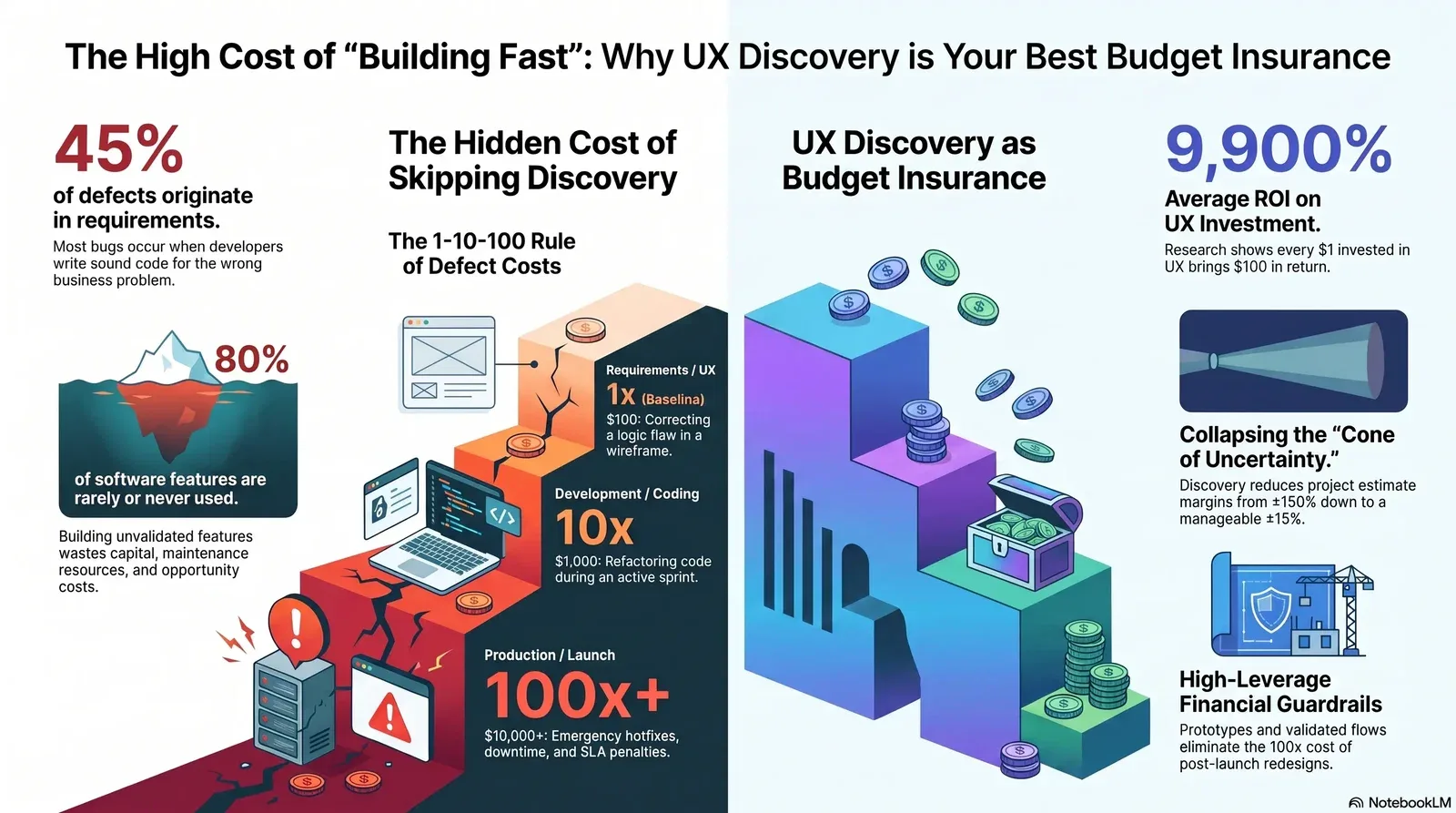
The Real Cost of a Bad Discovery Phase: A UX-Led Approach to Killing Rework Before It Starts
The cheapest bug to fix is the one you catch in a wireframe. The most expensive is the one you find after launch—and the two are often the exact same misunderstanding, caught months apart.
When technology executives and finance leaders face aggressive delivery deadlines, the pressure to "start building" immediately often overrides the need for upfront planning. In these high-stakes scenarios, the software discovery phase gets slashed. It looks like non-essential overhead that delays the real work of writing code.
Skipping discovery does not save money. It defers the cost, multiplying it exponentially as post-launch rework. A UX-led discovery phase acts as the highest-leverage cost-control activity in custom application development. By forcing teams to validate workflows and prioritize features before engineering begins, discovery prevents the exact errors—wrong requirements, misaligned user flows, and unused features—that compound into catastrophic budget overruns.
The Wireframe-vs-Production Cost Curve
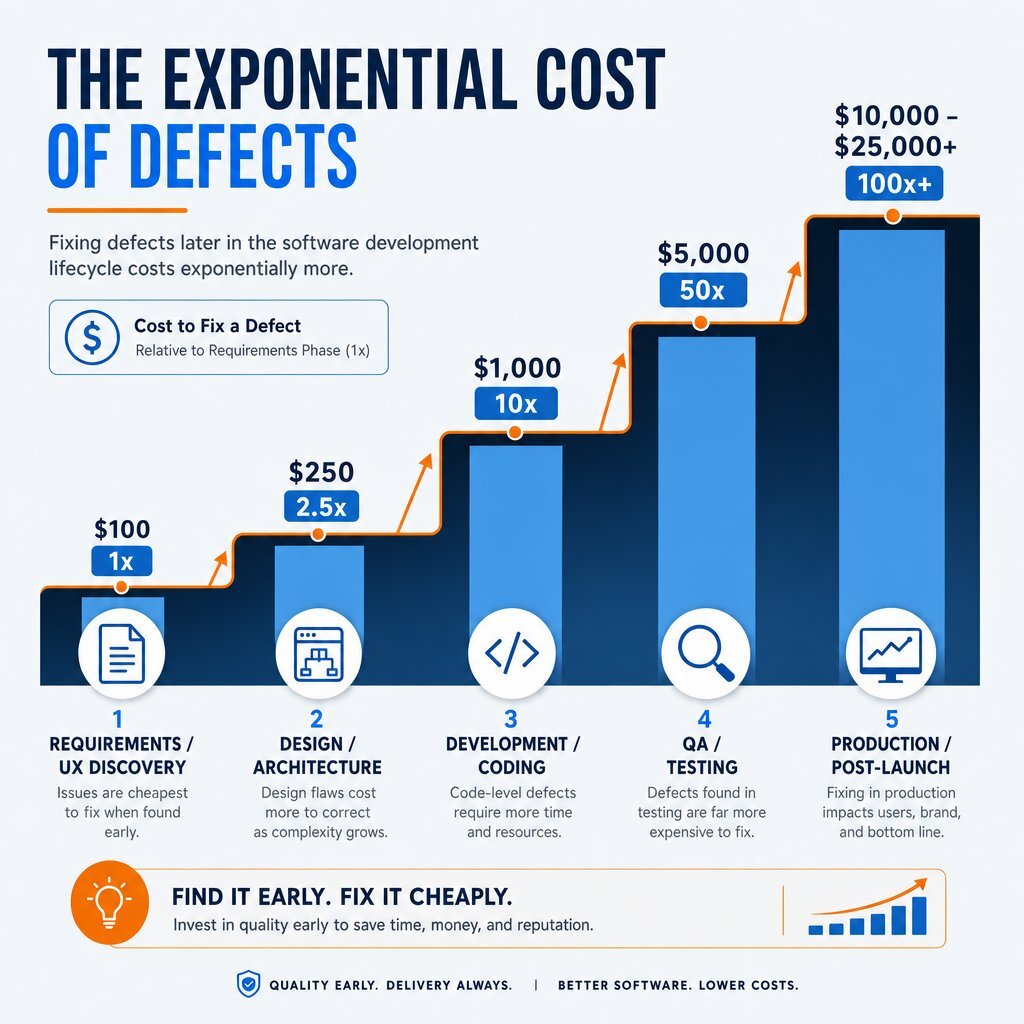
Timing dominates defect cost. The capital required to alter software does not scale linearly; it scales exponentially depending on when the change occurs in the software development lifecycle (SDLC). An engineering team correcting a missing step in a Figma mockup spends a fraction of the time and money required to reverse-engineer and patch a live database handling that same workflow.
This principle rests on decades of software economics research. Dr. Barry Boehm documented the original cost-of-change curve in 1981. The resulting 1-10-100 rule dictates that fixing a defect gets drastically more expensive as it moves downstream.
| SDLC Phase | Relative Cost Multiplier | Estimated Cost per Defect | Financial Impact Context |
|---|---|---|---|
| Requirements / UX Discovery | 1x (Baseline) | $100 | Correcting a logical flaw in a user story or wireframe. |
| Design / Architecture | 2.5x | $250 | Updating a high-fidelity prototype or system architecture diagram. |
| Development / Coding | 10x | $1,000 | Refactoring code during active sprint work. |
| QA / Testing | 50x | $5,000 | Re-allocating developer context, patching, and re-running test suites. |
| Production / Post-Launch | 100x+ | 10,000 - 25,000+ | Emergency hotfixes, downtime, incident response, and SLA penalties. |
Catching a defect in production costs up to 100 times more than catching it during the requirements phase. A foundational 2002 study by the National Institute of Standards and Technology (NIST) estimated that inadequate testing and discovery infrastructure costs the U.S. economy $59.5 billion annually. More than a third of that financial drain is entirely preventable through earlier validation. When business units cut a UX discovery phase to save time, they actively opt into the most expensive tier of the defect cost curve.
Where Rework Really Comes From
Engineering teams lose an average of 33% of their total capacity to rework. To effectively reduce this waste, leadership must understand where rework originates. The immediate instinct is to blame poor coding practices or inadequate Quality Assurance (QA). The data proves otherwise.
Industry benchmarking by software economics researcher Capers Jones reveals that approximately 45% of all software defects are "requirements-origin" defects. These errors occur when developers write functionally sound code that solves the wrong problem. Because these misalignments are introduced before development begins, they easily survive unit testing and QA—which only verify that the code matches the flawed specification. The end-user is usually the first to discover the mistake.
This disconnect drives massive capital waste in the form of unused features. A large-scale product analytics study by Pendo analyzed anonymized usage data across 600 companies and found that 80% of features in the average software product are rarely or never used. The average feature adoption rate sits at a dismal 6.4%.
When teams build features that users ignore, the business pays three times over: the initial cost of development, the ongoing maintenance tax of supporting that code, and the opportunity cost of misallocated capital. Most rework traces back to unvalidated workflows and misunderstood users, making UX and requirements discovery the definitive prevention mechanism. For mid-market leaders, pairing that discovery work with a structured data readiness scorecard also prevents teams from building on top of low-quality or incomplete data that will undermine the product later.
What UX-Led Discovery Actually Produces
A software discovery phase is not a theoretical brainstorming exercise. It is a structured, artifact-driven process designed to translate ambiguous business goals into validated technical specifications.
When UX design leads the discovery process, the focus shifts from simply asking stakeholders what they want to observing how end-users actually behave. This practical approach yields concrete deliverables that serve as financial guardrails for the rest of the project.
| Discovery Artifact | What It Is | Downstream Cost Prevented |
|---|---|---|
| Validated User Flows | Visual maps detailing the exact steps a user takes to achieve a specific goal. | Prevents architectural rewrites caused by missing steps or circular logic discovered mid-development. |
| Interactive Prototypes | Clickable, high-fidelity mockups simulating the final product without functional code. | Eliminates the 100x cost of releasing a feature that fails usability standards and requires a post-launch redesign. |
| Prioritized Backlog | A rigorously scoped list of requirements, separating the Minimum Viable Product (MVP) from future enhancements. | Curbs scope creep and prevents budget exhaustion on low-value, rarely-used features. |
| Risk Register | A documented log of technical, compliance, and organizational risks alongside mitigation strategies. | Advances planning to avoid late-stage integration failures or security compliance violations that can halt a launch entirely. |
These artifacts ensure that every subsequent dollar spent on engineering is directed toward a validated, usable, and technically feasible solution. They also make it much easier to plug into a disciplined Agile methodology, where iterations are still anchored to clear user journeys instead of shifting opinions.
Discovery as Budget Insurance
For strategic CFOs and project sponsors, the highest value of discovery is budget predictability. Estimating the cost and timeline of a software project based solely on a high-level vision is statistically perilous due to the "Cone of Uncertainty".
Popularized by software researcher Steve McConnell, the Cone of Uncertainty illustrates how project estimates at the initial concept phase carry a massive margin of error—often off by 50% to 200%. At this stage, variables regarding third-party API integrations, legacy database constraints, and precise user workflows remain entirely unknown.
Organizations that demand binding fixed-bid contracts or rigid internal budgets before conducting a discovery phase force engineering teams to pad their estimates heavily to absorb unknown risks. A structured requirements discovery phase systematically collapses this uncertainty. By mapping user flows and defining edge cases before coding starts, the margin of error for project estimates drops to a manageable 10% to 20%.
Consider the financial difference between estimating a vague requirement versus a discovered requirement:
| Requirement State | Example Specification | Cost Predictability |
|---|---|---|
| Pre-Discovery (Vague) | "The system needs a dashboard for logistics managers to track shipments." | Very Low. Developers guess what data matters. Changes inevitably happen post-launch. Estimate margin: ±150%. |
| Post-Discovery (Validated) | "Dashboard displaying active shipments via the FedEx API, filtering out delivered items, with a one-click export to CSV for daily reporting." | High. The exact API, filtering logic, and user intent are defined. Developers build exactly what is scoped. Estimate margin: ±15%. |
The UX-led discovery phase acts as an insurance policy, tightening estimates and making the final budget deeply defensible to the board. When you combine that with a portability-first AI strategy, you also avoid committing to platforms or vendors that could blow up your cost structure halfway through the project.
Symptoms of Skipped Discovery
When projects skip or underfund upfront discovery, the consequences rarely show up during the first few coding sprints. The symptoms remain hidden until integration, user acceptance testing (UAT), or post-launch deployment. Organizations can identify a skipped discovery phase by looking for these specific post-launch tells:
- High Requirement Churn: Requirement churn measures the percentage of project specifications that change, are added, or are deleted during active development. A high churn rate indicates that the original requirements were largely guesswork. When developers must constantly pause to accommodate new workflows, sprint velocity plummets.
- The Rework Loop: Engineering teams find themselves trapped in a cycle of rebuilding the same feature multiple times because it continually fails to meet user expectations in UAT or production.
- Low Time-to-First-Value (TTFV): If end-users require extensive onboarding, training manuals, and customer support interventions to complete basic tasks, the UX was not validated. The software may function technically, but it fails operationally.
- Elevated Defect Escape Rates: When requirements are vague, QA engineers do not know exactly what to test against. This ambiguity allows critical workflow bugs to bypass pre-release detection and directly impact customers. In complex environments, adding disciplined B2B software testing practices on top of good discovery sharply reduces these escaped defects.
Measuring Discovery ROI
A common objection to funding a robust discovery phase is the perceived difficulty of measuring its return on investment. Discovery is highly measurable if organizations track the correct engineering and adoption metrics.
Foundational research from Forrester indicates that, on average, every dollar invested in UX brings $100 in return—yielding an ROI of 9,900%. While this macro-statistic is compelling, B2B executives can prove the value internally by tracking three specific metrics:
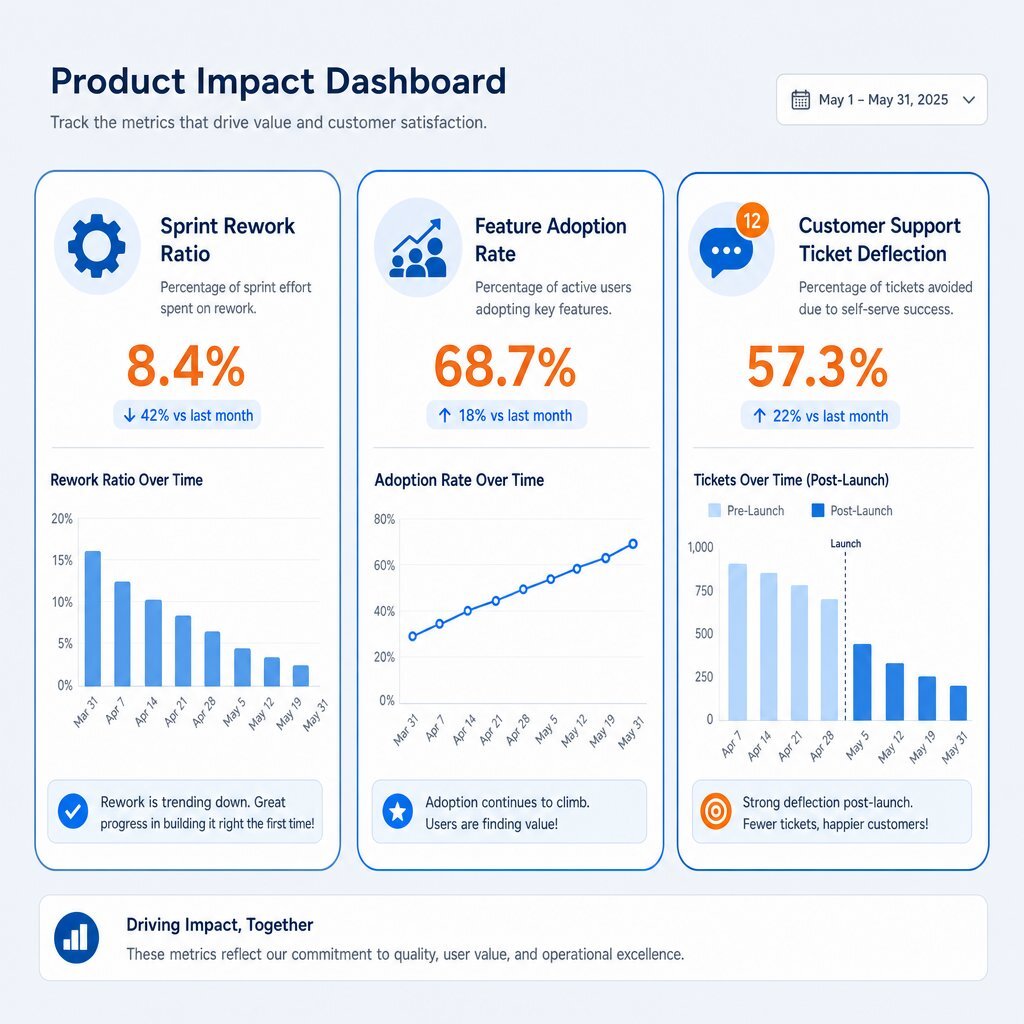
- Sprint Rework Ratio (SRR): Using Jira JQL queries, teams can track the percentage of sprint story points dedicated to rework, regressions, and spec-correction rather than new feature work. High-performing teams keep this ratio below 10%, while average teams routinely burn 20% to 40% of their sprints fixing preventable errors.
- Feature Adoption Rate: Product teams must utilize product analytics to track what percentage of users actively engage with new features. Pushing adoption from the industry average of 6.4% to 20% or higher directly correlates to revenue retention and UX success.
- Customer Support Ticket Deflection: Proper UX discovery eliminates user friction. Tracking a drop in "how-to" support tickets post-launch offers a clear, hard-dollar cost saving attributed directly to UX design.
When these metrics improve over multiple releases, it is strong evidence that your discovery phase is working. Pairing this with a disciplined UX design practice makes those gains repeatable instead of one-off wins tied to individual designers.
Right-Sizing Discovery to the Project
Recognizing the value of discovery does not mean falling into analysis paralysis. The goal is not to document every line of code upfront in a rigid Waterfall methodology. Modern discovery focuses on right-sizing the effort proportionally to the project's scope, complexity, and risk profile.
Industry benchmarks suggest allocating approximately 10% to 15% of the total project budget and timeline to the discovery phase. For a massive enterprise legacy modernization, this might entail a six-week engagement involving deep stakeholder interviews, competitive analysis, and extensive prototype testing. For a focused internal operational tool, a highly structured, one-week design sprint may suffice.
The determining factor for scoping discovery relies entirely on the risk of getting it wrong. If a feature is easily reversible and low-risk, teams can adopt a lean approach. If the software is a mission-critical B2B platform—where a failed deployment risks severe operational downtime, client churn, or compliance violations—deep UX discovery is absolutely mandatory. In some cases, that may also mean planning ahead for project rescue or phased modernization if you inherit half-built or AI-generated systems that skipped proper discovery the first time.
Killing rework requires addressing defects at their source. The empirical reality is that skipping discovery guarantees misaligned requirements, unused features, and compounding rework costs that emerge when they are most expensive to fix. Investing in a UX-led discovery phase provides organizations with validated blueprints, accurate budget estimates, and the assurance that engineering hours are spent building features that users actually want.
Baytech Consulting specializes in custom application development built on rigorous discovery and scoping protocols. Combining a Tailored Tech Advantage with Rapid Agile Deployment, our teams ensure that every project is anchored in validated user needs. Whether deploying modern cloud infrastructure or managing secure deployments via Azure DevOps On-Prem and Kubernetes, Baytech partners with B2B leaders to minimize upfront costs, mitigate technical risk, and maximize long-term software ROI. For organizations looking to infuse automation into their products, we also design discovery phases that explicitly account for integrating AI so that agentic workflows and data flows are validated before you commit to full-scale build-out.
Frequently Asked Questions
What is the primary difference between a discovery phase and agile sprint planning?
Sprint planning is a tactical exercise that determines how an engineering team will execute a predefined set of tasks over the next two weeks. The software discovery phase is a strategic investigation that determines what the product must be, validating user workflows and business requirements before the agile backlog is ever created. Treat discovery as a short, intensive project in its own right, then use those findings to guide your sprints and, when needed, to plan modern code rescue and legacy overhaul work instead of piling new features on unstable foundations.
Supporting Links
- https://www.baytechconsulting.com/blog/why-the-discovery-phase-saves-your-software-project-and-budget
- https://www.baytechconsulting.com/blog/mastering-software-scoping-essential-steps-for-successful-projects
https://www.baytechconsulting.com/blog/b2b-software-testing-how-to-avoid-over-or-under-testing-and-maximize-roi
About Baytech
At Baytech Consulting, we specialize in guiding businesses through this process, helping you build scalable, efficient, and high-performing software that evolves with your needs. Our MVP first approach helps our clients minimize upfront costs and maximize ROI. Ready to take the next step in your software development journey? Contact us today to learn how we can help you achieve your goals with a phased development approach.
About the Author

Bryan Reynolds is an accomplished technology executive with more than 25 years of experience leading innovation in the software industry. As the CEO and founder of Baytech Consulting, he has built a reputation for delivering custom software solutions that help businesses streamline operations, enhance customer experiences, and drive growth.
Bryan’s expertise spans custom software development, cloud infrastructure, artificial intelligence, and strategic business consulting, making him a trusted advisor and thought leader across a wide range of industries.