In this article
- The Revenue Geometry of Quote Turnaround Time
- Unpacking Configure Price Quote Software for Revenue Leaders
- Where Packaged CPQ Platforms Excel—and What They Cost
- The Complexity Profile That Breaks Packaged Configurators
- Custom CPQ Software Development: Architecture, Cost, and Timeline
- The CPQ Build vs Buy Scorecard
- The Payback Math: Speed, Margin, and Seat License Avoidance
- Common Failure Modes of Quoting Software for Manufacturers
- Conclusion and Next Steps
- About Baytech
- About the Author
In complex B2B sales, the first credible quote frames the deal. Across industrial, distribution, and engineered-product categories, the standard for "first" is increasingly measured in minutes and hours, yet the average B2B vendor still requires days to assemble a comprehensive proposal. This performance gap is rarely a personnel failure. It is a severe systems problem.
For revenue leaders and technology executives, quote turnaround time represents a massive, often invisible lever for revenue growth. Configure price quote software that is AI-powered is frequently marketed as a universal remedy for this delay. However, organizations with highly engineered products, multi-source cost rollups, dynamic capacity constraints, or heavy Enterprise Resource Planning (ERP) dependencies routinely spend hundreds of thousands of dollars on packaged platforms, only to find their sales teams still relying on shadow spreadsheets. The standard configurator simply cannot model their operational reality.
Quote complexity, rather than company size, must dictate the architecture of a revenue engine. For a significant cohort of mid-market manufacturers, distributors, and B2B service firms, investing in custom CPQ software development provides a scalable, margin-protecting asset that structurally outpaces any off-the-shelf alternative.
The Revenue Geometry of Quote Turnaround Time
Speed dictates B2B win rates. Buyers evaluating multiple suppliers do not wait passively for all quotes to arrive; they form strong vendor preferences within four hours of issuing a request. The vendor that delivers an accurate proposal within this critical window occupies the buyer's attention and frames the subsequent negotiations.
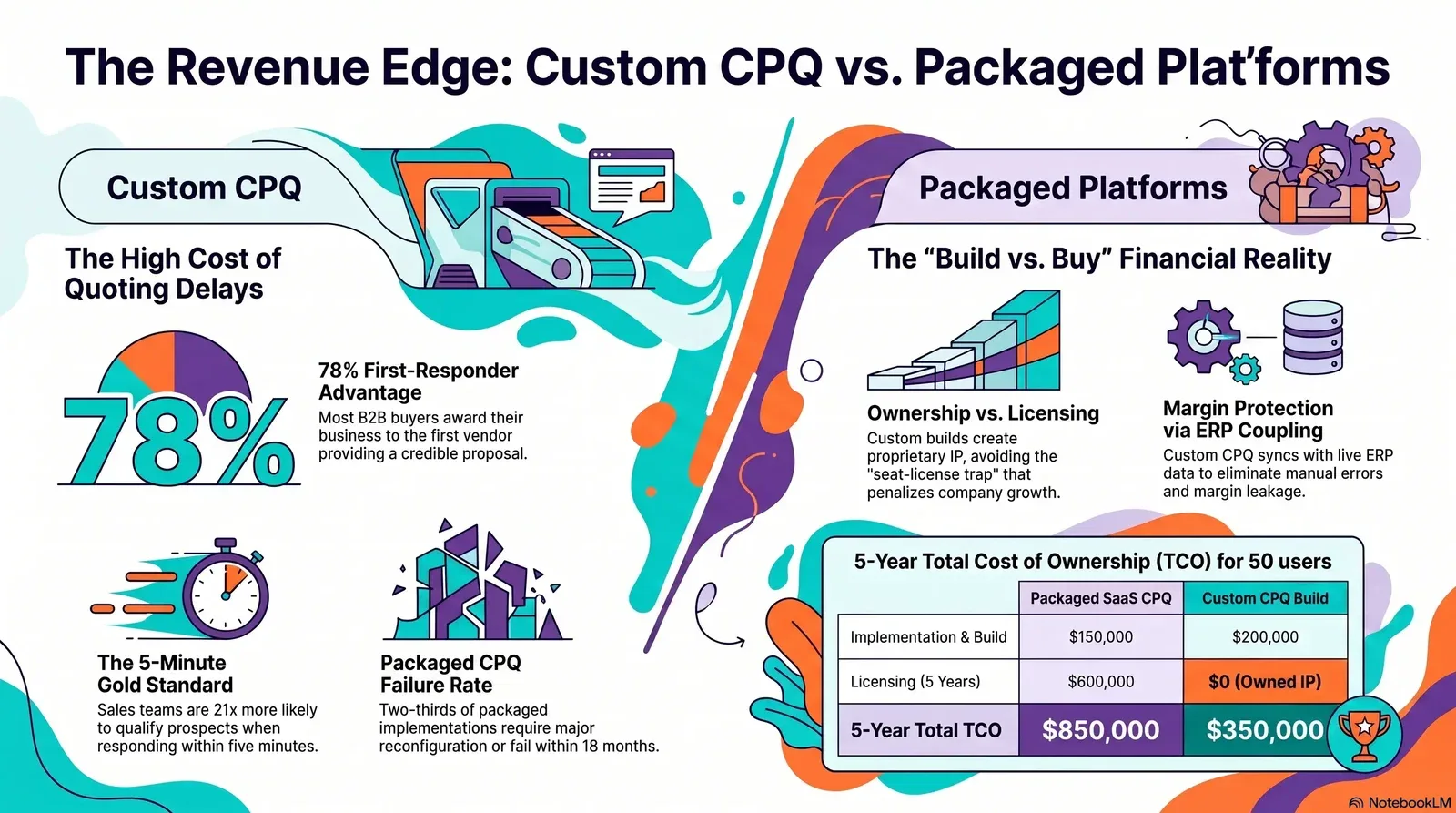
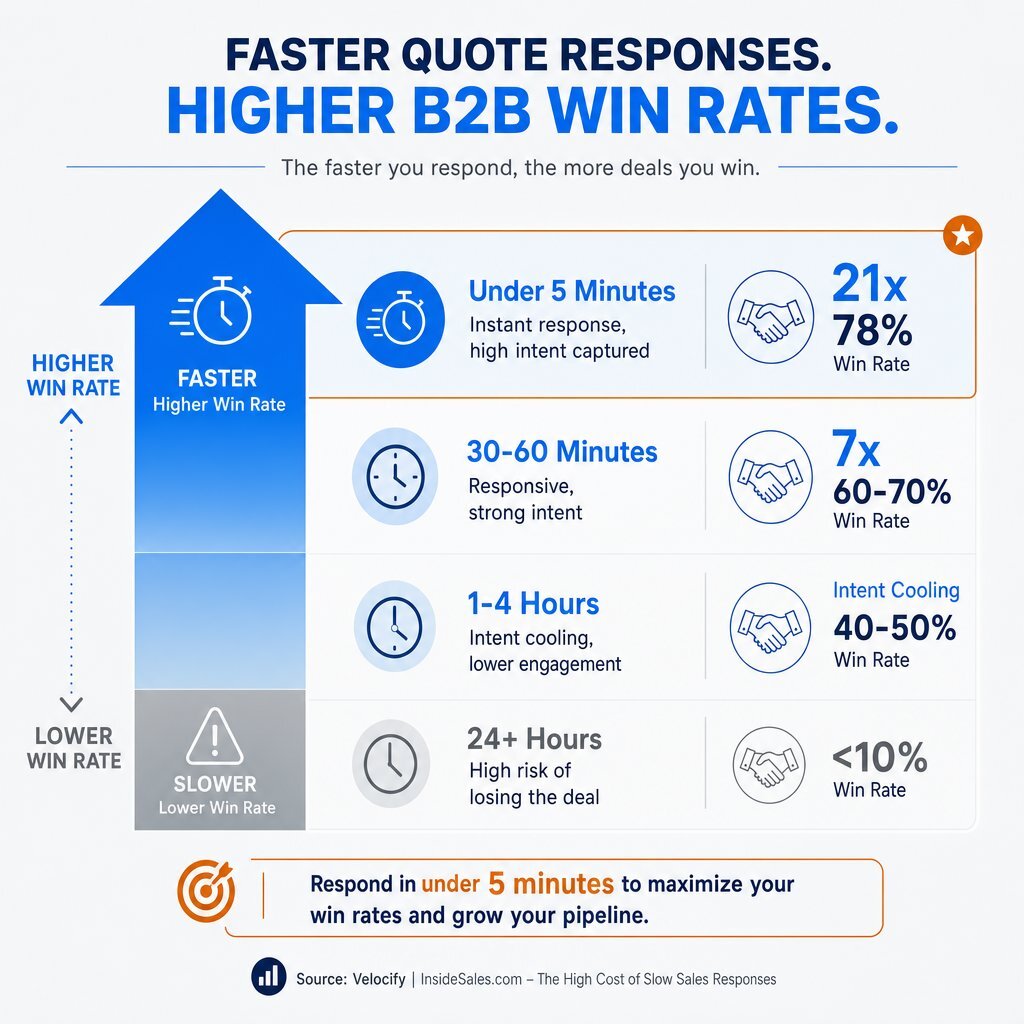
The commercial impact of response time is highly asymmetric. Sales organizations that respond to a lead within five minutes are 21 times more likely to qualify that prospect compared to those that wait 30 minutes. When response times stretch beyond a day, the probability of closing the deal approaches zero. Ultimately, 78% of B2B buyers award their business to the first vendor to respond with a credible proposal.
| Response Time | Qualification Multiplier vs. Baseline | Estimated B2B Win Rate Impact |
|---|---|---|
| Under 5 minutes | 21x greater than 30-minute response | 78%+ (First-responder advantage) |
| 30 to 60 minutes | 7x greater than 2-hour response | 60% – 70% |
| 1 to 4 hours | Intent cooling, competitive entry | 40% – 50% |
| 24+ hours | 60x lower than 1-hour response | Under 10% |
Despite these metrics, the average B2B manufacturer takes between 24 and 72 hours to respond to a quote request. Operations leadership frequently normalizes a low baseline win rate as a symptom of "market conditions" or uncompetitive pricing. In reality, buyers who receive a quote 72 hours late rarely inform the vendor that they lost on speed; they simply state they chose another supplier. Compressing response time from 48 hours to two hours directly captures this lost pipeline, generating material revenue growth without requiring additional marketing spend or headcount.
Unpacking Configure Price Quote Software for Revenue Leaders
At its core, a CPQ system automates the transition from a buyer's request to a legally binding, accurately priced proposal. Stripped of vendor marketing jargon, the category exists to perform four foundational functions:
| CPQ Core Function | Operational Definition |
|---|---|
| Configuration Rules | Enforces product compatibility logic. Prevents sales representatives from configuring a combination of features that the factory cannot physically build or deliver. |
| Pricing Engine | Applies dynamic pricing algorithms, including volume breaks, regional price books, tariff adjustments, and contract-specific discounting. |
| Approval Workflows | Routes quotes that exceed specific discount thresholds, involve non-standard terms, or require custom engineering to finance or legal teams for review. |
| Document Generation | Dynamically populates branded, legally compliant PDF proposals or digital contracts containing the correct terms and conditions for the deal type. |
A properly architected CPQ eliminates the administrative drag of manual data entry, prevents margin leakage from rogue discounting, and bridges the operational gap between customer demand and factory fulfillment.
Where Packaged CPQ Platforms Excel—and What They Cost
Packaged CPQ platforms, such as Salesforce CPQ (Revenue Cloud), Conga, and Tacton, are powerful tools when applied to the right operational profile. These platforms excel in environments characterized by standardized product catalogs, predictable tiered pricing, and rules-based options that do not require live engineering judgment.
This capability commands a premium price. The financial commitment involves heavy per-user licensing fees, steep implementation consulting costs, and ongoing administrative maintenance.
| Cost Component | Mid-Market Estimate (50-200 Users) | Enterprise Estimate (200+ Users) |
|---|---|---|
| Software Licensing | 150 – 250 per user, per month | Volume discounts apply, but multi-cloud requirements raise base cost |
| Implementation Services | 95,000 – 175,000 (10 to 14 weeks) | 325,000 – 500,000+ (6 to 9 months) |
| Ongoing Maintenance | 10% – 20% of initial implementation annually | Requires dedicated FTEs or expensive managed service retainers |
Salesforce CPQ dominates the CRM-native space, but forces organizations to pay for the base Sales Cloud seat plus the CPQ seat for anyone touching a quote. Conga serves heavy Salesforce-embedded enterprises with substantial Contract Lifecycle Management (CLM) needs, but requires a similar six-figure investment. Tacton provides excellent native CAD integrations for discrete manufacturing, but demands extensive domain configuration to function effectively.
The Complexity Profile That Breaks Packaged Configurators
The primary indicator that a packaged CPQ deployment is failing is the persistence of the shadow spreadsheet. Sales engineers inevitably revert to Excel to configure products and calculate margins, only logging into the official CPQ system to generate the final PDF [ Incepta Solutions ].
This friction occurs because packaged CPQ platforms are fundamentally CRM-centric. They are designed to manage customer data, not supply chain physics. Specific complexity profiles routinely break these tools:
Engineered-to-Order (ETO) Products: When products require multi-level Bills of Materials (BOMs) that change based on raw material availability, standard rules engines cannot easily model the physical and manufacturing constraints.
Dynamic Capacity and Cost Rollups: If pricing depends on real-time factory floor capacity, fluctuating commodity costs, or multi-source freight rates, a CRM-anchored CPQ fails because it relies on stale, batched data transfers rather than live operational ground truth.
Heavy ERP Coupling: Quoting software for manufacturers must communicate seamlessly with inventory and production scheduling. Packaged tools require brittle, expensive middleware to sync this data, leading to a disconnected architecture where sales promises do not align with operational capacity.
These structural mismatches cause staggering failure rates. Only 32% of CPQ implementations are considered fully successful by the teams that deployed them, and 67% of Salesforce CPQ deployments require major reconfiguration within 18 months because the system cannot handle real-world business workflows.
Custom CPQ Software Development: Architecture, Cost, and Timeline
When off-the-shelf software falls short, custom CPQ software development provides a superior path. A custom CPQ is an integration asset built around an organization's unique operational reality, rather than forcing the business to adapt to a vendor's generalized data model.
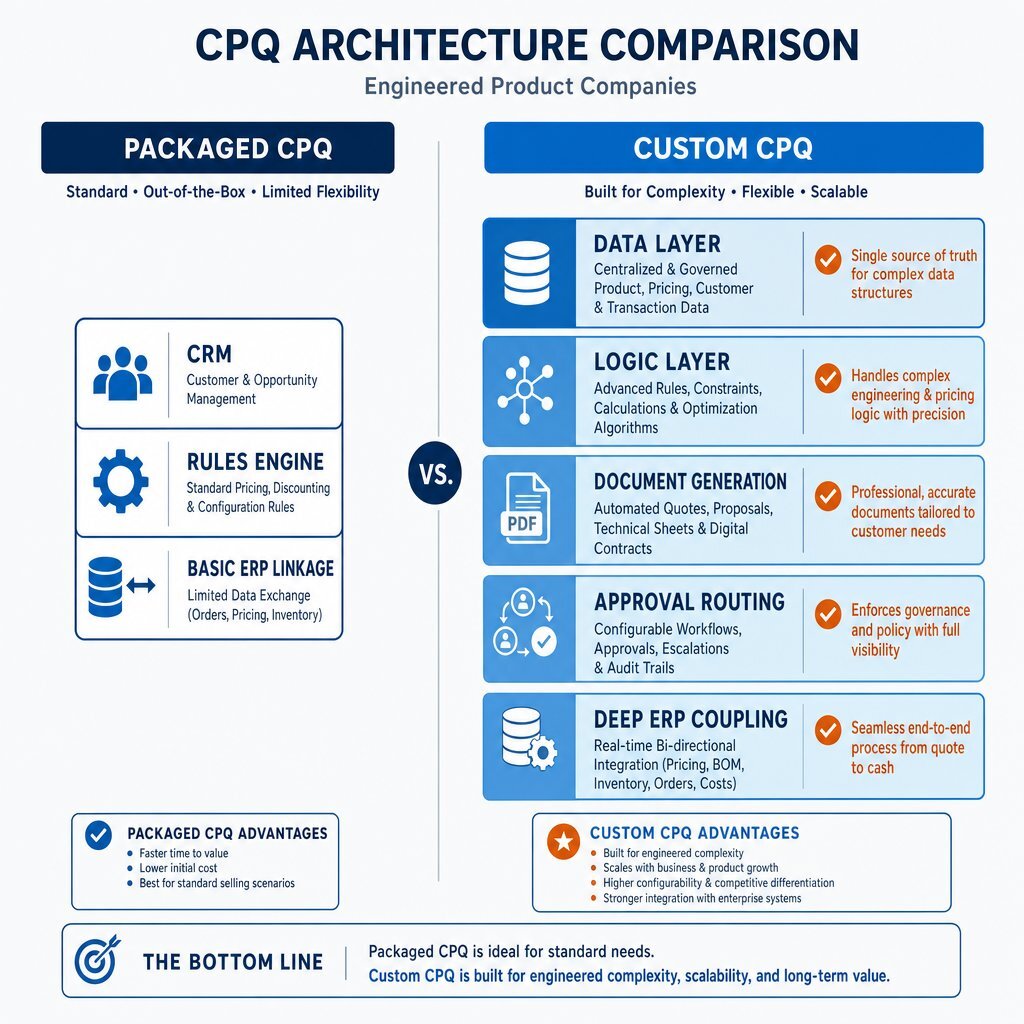
A modern custom CPQ is typically constructed utilizing a highly scalable, five-layer architectural stack:
- Data Layer: Rather than relying on restrictive CRM standard objects, catalog and inventory data are housed in high-performance relational databases (e.g., PostgreSQL or SQL Server). This is where support for all major database systems becomes a real advantage.
- Logic Layer: Custom logic engines, programmed in frameworks like .NET or React, execute bespoke engineer-to-order calculations, multi-level BOMs, and dynamic cost-plus pricing algorithms that out-of-the-box rules engines reject.
- Document Generation: The system utilizes APIs to connect with enterprise document engines (such as DocuSign Gen, PandaDoc, or internal serverless templating functions) to compile precise, legally compliant quotes.
- Approval Routing: Lightweight, event-driven orchestration patterns route approvals to specific executives based on granular margin thresholds.
- Deep ERP Coupling: Custom CPQ applications establish direct, API-led integration to ERP systems like NetSuite or SAP. This ensures every quote is based on real-time supply chain ground truth, preventing the sale of out-of-stock or unmanufacturable configurations.
Developing a custom CPQ is a capital expenditure, but it establishes a proprietary asset. Depending on the complexity of the backend infrastructure, a custom build typically ranges from $50,000 for highly focused mid-market quoting tools to $300,000+ for enterprise-grade applications mirroring global ERP workflows.
Firms specializing in complex software architecture, such as Baytech Consulting, deploy a Tailored Tech Advantage. By utilizing Rapid Agile Deployment practices, core quoting functionalities are released in iterative milestones (often culminating in an MVP within 3 to 5 months). This avoids the prolonged "big bang" rollouts that plague packaged software implementations, ensuring the resulting software aligns strictly with the company's proprietary pricing methodologies while sidestepping the integration traps of low-code/no-code platforms.
The CPQ Build vs Buy Scorecard
Evaluating whether a CPQ build vs buy strategy is appropriate requires analyzing specific organizational constraints. Executive leadership should apply the following decision matrix to determine the optimal investment path:
| Decision Factor | Favor Packaged CPQ (Buy) | Favor Custom CPQ (Build) |
|---|---|---|
| Product Complexity | Standardized SKUs, simple bundles, strictly rule-based feature selection. | Engineer-to-order, complex physical manufacturing constraints, multi-level BOMs. |
| Pricing Volatility | Static list prices, simple volume tiers, standardized periodic discounting. | High-frequency commodity cost shifts, capacity-driven pricing, multi-source freight rollups. |
| Integration Depth | CRM is the primary system of record; loose, batched ERP integration suffices. | ERP is the primary system of record; real-time inventory and factory capacity checks are mandatory. |
| User Seat Economics | Small sales team (under 20 quoters); per-user SaaS fees are negligible. | Large or expanding team (50+ quoters); perpetual per-user fees severely penalize organizational growth. |
| Strategic Advantage | Quoting is an administrative necessity; speed alone is the differentiator. | Quoting logic, unique cost structures, and proprietary algorithms are core competitive moats. |
The Payback Math: Speed, Margin, and Seat License Avoidance
The financial justification for a custom CPQ relies on three distinct payback vectors: pipeline recovery, margin protection, and aggressive software license avoidance.
1. Pipeline Recovery Through Quote-Cycle Reduction: If a company generates 500 inbound quote requests per month and manual processes result in a 24-hour response time yielding a 12% conversion rate, the pipeline leak is severe. Compressing that response time to under 15 minutes through automated logic can conservatively double the qualification rate based on empirical response-time decay models. Capturing deals previously lost to faster competitors drives immediate top-line growth.
2. Margin Protection:
Manual quoting in spreadsheets routinely leads to pricing errors, outdated component costing, and unapproved discount stacking. By coupling the quoting engine directly to live ERP cost data, custom CPQ eliminates these errors. Protecting even a 2% margin leakage on $20 million in annual quoted revenue recovers $400,000 directly to the bottom line in the first year alone.
3. Total Cost of Ownership (TCO) and Seat License Avoidance: Packaged CPQ platforms penalize scale. A 50-person sales team utilizing a packaged tool at $200 per user per month will incur $120,000 in annual licensing fees, completely independent of the initial six-figure implementation cost.
| Cost Category (50 Users, 5 Years) | Packaged SaaS CPQ | Custom CPQ Build |
|---|---|---|
| Initial Implementation / Build | $150,000 | $200,000 |
| Software Licensing (5 Years) | 600,000 (120k/year) | $0 (Owned IP) |
| Ongoing Maintenance (5 Years) | $100,000 | $150,000 |
| 5-Year Total Cost of Ownership | $850,000 | $350,000 |
Over a five-year horizon, the custom build is highly accretive. The organization owns the intellectual property outright, escaping the vendor lock-in that characterizes the commercial software market.
Common Failure Modes of Quoting Software for Manufacturers
When technology projects fail to deliver promised ROI, the software itself is rarely the culprit. Approximately 68% of CPQ projects underdeliver due to predictable, avoidable operational missteps.
The primary failure mode is attempting to automate broken processes over dirty data. If a product catalog is plagued with duplicate SKUs and undocumented pricing exceptions, migrating it to a new CPQ system merely digitizes chaos. A comprehensive data audit must precede any development work, ideally as part of a structured discovery phase checklist for engineering teams.
Scope creep presents a secondary, yet equally fatal, risk. Projects swell as stakeholders demand edge-case pricing rules and unnecessary integrations before the core quoting engine is stable, driving timelines 40% to 60% over schedule. Preventing this requires strict scope discipline and a phased rollout strategy. Ship a working core Minimum Viable Product (MVP) first, prove the value, and layer complexity in subsequent releases. A contract model that manages scope creep up front also keeps CPQ initiatives on budget and on schedule.
Conclusion and Next Steps
The B2B quoting landscape is uncompromising: the vendor that quotes first frames the deal, and the vendor that quotes accurately protects the margin. Packaged CPQ software offers a viable path for companies with standardized catalogs, but it structurally fails mid-market and enterprise organizations whose competitive advantage lies in complex, engineered, or highly integrated product offerings.
For these organizations, custom CPQ software development is not an IT expense; it is a defensive revenue strategy. By architecting a solution that maps exactly to proprietary pricing logic and integrates seamlessly with deep ERP data, companies slash quote turnaround times from days to minutes while avoiding the escalating seat-license trap of commercial vendors.
To determine the exact financial impact a custom CPQ could have on your operations, audit your existing systems. Map the time lost to manual data entry, calculate the margin leaked through spreadsheet errors, and evaluate the 5-year TCO of your current software licenses. Firms like Baytech Consulting possess the enterprise-grade engineering depth to translate those operational bottlenecks into highly scalable, proprietary technology assets that outpace the competition, using the same project rescue discipline they apply to complex legacy systems.
FAQ: Why do so many packaged CPQ implementations fail?
Approximately 67% of packaged CPQ rollouts fail or require major reconfiguration within 18 months of launch. These failures rarely stem from software bugs; they occur because organizations attempt to force complex, ERP-dependent manufacturing logic into rigid, CRM-centric packages. Combined with scope creep and uncleaned legacy data, these structural mismatches result in sales teams abandoning the tool and reverting to manual spreadsheets. A UX-led user experience design approach can also reduce the risk of abandonment by making the quoting workflow intuitive for busy sales teams.
Supporting Links
- From Reactive Bidding to Predictive Estimating: The Construction Estimating Software Advantage
- The CFO's Guide to Calculating the ROI of Custom Software Development (2025)
- Decoding the Software Proposal: An Executive's Guide to Vendor Evaluation (2026)
- The Costly Truth About Skipping UX-Led Discovery in Software
- The AI-Code Debt Bomb: When Speed Becomes a Liability
Modern AI Code Rescue: Strategies for Legacy System Overhaul
About Baytech
At Baytech Consulting, we specialize in guiding businesses through this process, helping you build scalable, efficient, and high-performing software that evolves with your needs. Our MVP first approach helps our clients minimize upfront costs and maximize ROI. Ready to take the next step in your software development journey? Contact us today to learn how we can help you achieve your goals with a phased development approach.
About the Author

Bryan Reynolds is an accomplished technology executive with more than 25 years of experience leading innovation in the software industry. As the CEO and founder of Baytech Consulting, he has built a reputation for delivering custom software solutions that help businesses streamline operations, enhance customer experiences, and drive growth.
Bryan’s expertise spans custom software development, cloud infrastructure, artificial intelligence, and strategic business consulting, making him a trusted advisor and thought leader across a wide range of industries.