In this article
- The 2026 EHR Squeeze and the False Binary
- What Migrations Really Cost (And What They Do Not Solve)
- The Sidecar Alternative: Surrounding the Legacy Core
- The Decision Framework: What to Sidecar vs. What Stays in the EHR
- The Financial Reality: A 5-Year Total Cost of Ownership Comparison
- Getting Started: The First 90 Days of a Sidecar Strategy
- The Future of the Independent Provider
- About Baytech
- About the Author
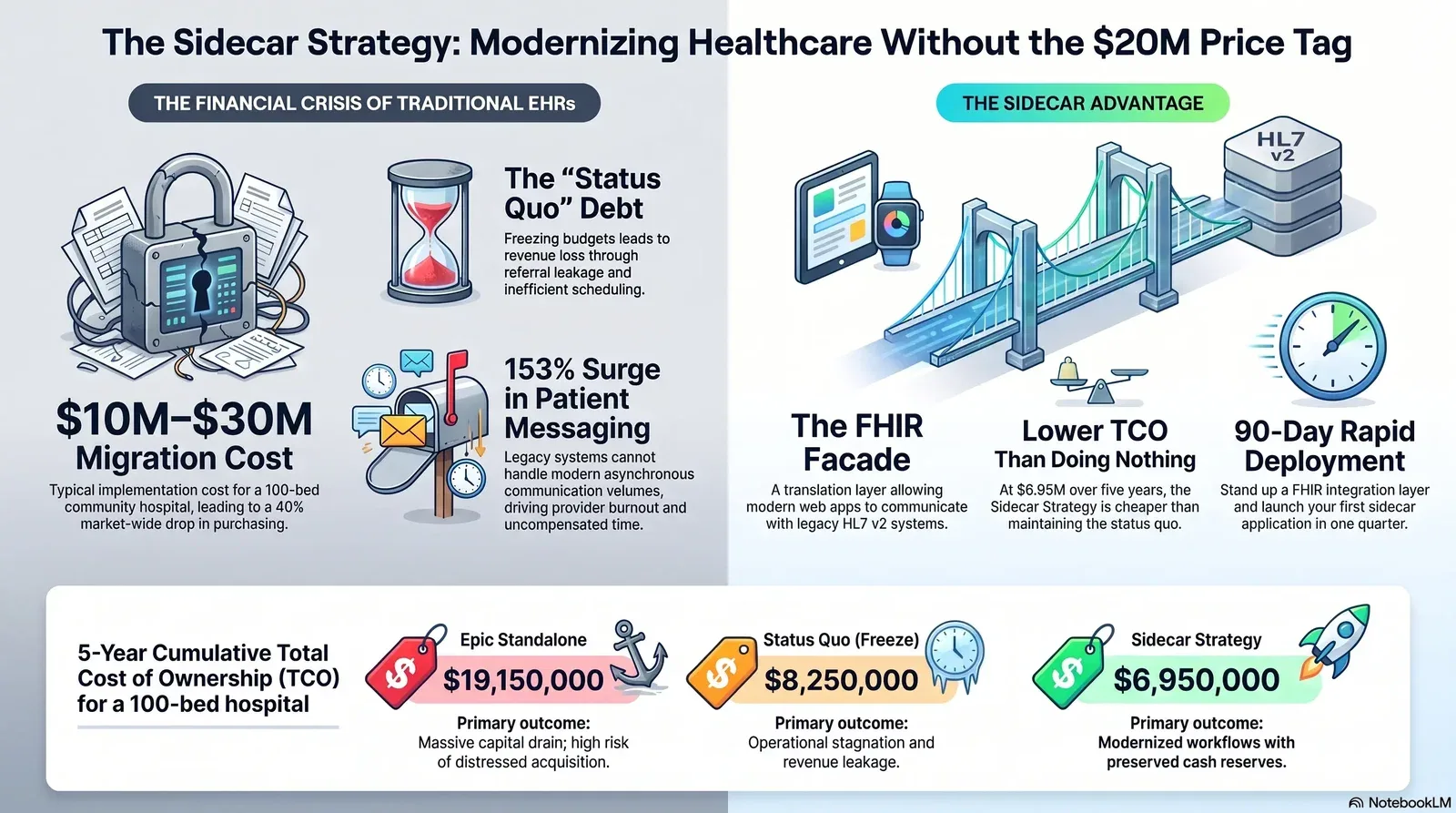
The prevailing wisdom in hospital IT has become a relentless drumbeat: switch to Epic or fall behind. For an independent community hospital, a regional multi-specialty practice, or an ambitious physician group, a full electronic health record (EHR) migration can consume years of capital budget. The 2026 market data reflects this financial exhaustion. Purchasing activity for acute care EHRs plummeted in 2025, with a 40% drop in impacted hospitals compared to 2024 and a 50% drop compared to 2023, according to a recent KLAS Research report.
Faced with eight-figure implementation quotes, organizations that cannot afford a massive migration are simply freezing their IT budgets instead. Freezing is a choice, and it is the worst one. Status quo operations bleed revenue through referral leakage, inefficient scheduling, uncompensated provider time, and administrative bloat.
The EHR conversation is framed as a binary choice—migrate or stagnate—because the vendors and consultancies profiting from migrations frame it that way. For resource-constrained providers, the highest-ROI move is usually not replacing the system of record but surrounding it. Scheduling, referral management, patient communication, and reporting can be built as modern sidecar applications that integrate directly with the existing legacy EHR.
This strategy delivers the operational benefits of a migration at a fraction of the cost and risk. By deploying a sidecar architecture, independent practices and community hospitals can modernize their workflows, preserve their cash reserves, and defend their independence against distressed acquisition.
The 2026 EHR Squeeze and the False Binary
The healthcare sector entered 2026 facing severe financial headwinds. Rising bad debt, uncompensated charity care, and supply costs have consistently challenged hospitals' financial performance, according to Kaufman Hall. For independent community hospitals, the pressure is existential. Labor expenses increased 5% year-over-year in early 2026, while increased claim denials from Medicare Advantage plans have choked cash inflows precisely when costs continue to rise. A recent analysis indicates that 756 rural U.S. hospitals are currently at risk of closure due to these compounding financial problems.
Against this backdrop, the pressure to adopt a modern EHR feels impossible to satisfy. The KLAS US Acute Care EHR Market Share report outlines a bifurcated reality. Large systems are in a holding pattern, pausing major IT projects to evaluate AI and re-examine their AI-driven SaaS pricing and renewal strategies, while Epic continues to consolidate its grip on the smaller systems and standalone hospitals that actually have capital to spend. Epic now controls 43.7% of the U.S. acute care EHR market, gaining 77 multispecialty hospitals in 2025 alone. Oracle Health, a primary alternative, has seen three consecutive years of declining market share and low customer satisfaction scores. Meanwhile, smaller vendors like TruBridge maintain a narrow foothold among budget-constrained critical access facilities, and MEDITECH retains its base by migrating 84% of its legacy customers to its Expanse platform.
The market tells independent providers they must fund a massive migration to survive. When they inevitably fail to secure the capital, their boards begin looking for a larger health system to acquire them. But the "migrate or sell" narrative ignores a critical reality: the operational pain crippling independent hospitals usually lives in the workflows around the EHR, not in the medical record itself.
What Migrations Really Cost (And What They Do Not Solve)
Replacing a legacy EHR is an enterprise trauma. The software license is only the down payment on a much larger financial commitment.
For a typical 100-bed community hospital, a standalone Epic implementation costs between 10 million and 30 million. Software licensing and installation run 2 million to 10 million, while data migration, staff training, and infrastructure add millions more. Mid-sized ambulatory practices face five-year total costs of ownership reaching 1.5 million to 3.7 million.
Many independent providers attempt to bypass these upfront capital requirements by joining a larger health system's Epic instance via the Community Connect program. While this reduces the initial outlay to between $500,000 and $2 million, it exacts a heavy strategic price. Affiliates surrender operational autonomy and data governance to the hub health system. If the acquiring hub decides to change its workflow, clinical protocols, or revenue cycle rules, the independent practice must adapt immediately or face systemic disruption. In effect, this turns what should be a technology decision into a long-term service contract and governance trade that is hard to unwind.
Furthermore, simply installing a new EHR does not automatically solve the crushing administrative burdens driving clinical burnout. A landmark June 2026 study published in the Journal of the American Medical Association (JAMA) by NYU Langone researchers revealed that patient portal messages have increased by 153% since 2020, reaching 5.4 messages per patient annually. Drawing on the Epic Cosmos dataset of over 140 million patient records, researchers logged 1.34 billion messages sent by patients over a five-year period.
Crucially, digital communication layered on top of, rather than replaced, physical visits, which actually grew by 17% during the same period. Digital tools have shifted healthcare delivery into a continuous, timeless care cycle that exhausts providers. No legacy EHR interface—no matter how newly installed—is equipped to handle this volume of asynchronous communication without driving physicians to spend uncompensated after-hours time in their inbox. Solving this requires intelligent workflow automation, thoughtful UX design tuned to clinician realities, and modern consumer tooling, not just a different database.
The Sidecar Alternative: Surrounding the Legacy Core
If the system of record functions adequately as a secure, compliant repository for clinical documentation, you do not need to replace it. You need to extract its data and put it to work in modern applications.
This is the sidecar pattern. You build lightweight, modern applications—"sidecars"—that handle specific business workflows, and you connect them to the legacy EHR via an integration layer. This extends Baytech Consulting's established minimize risk with sidecars thesis and SIS-LMS sidecar architecture into healthcare. The pattern fits perfectly in the medical sector because the central system of record is heavily regulated, incredibly sticky, and prohibitively expensive to move.
By wrapping the legacy system, you dodge the hidden costs of legacy software migrations while capturing immediate operational ROI.
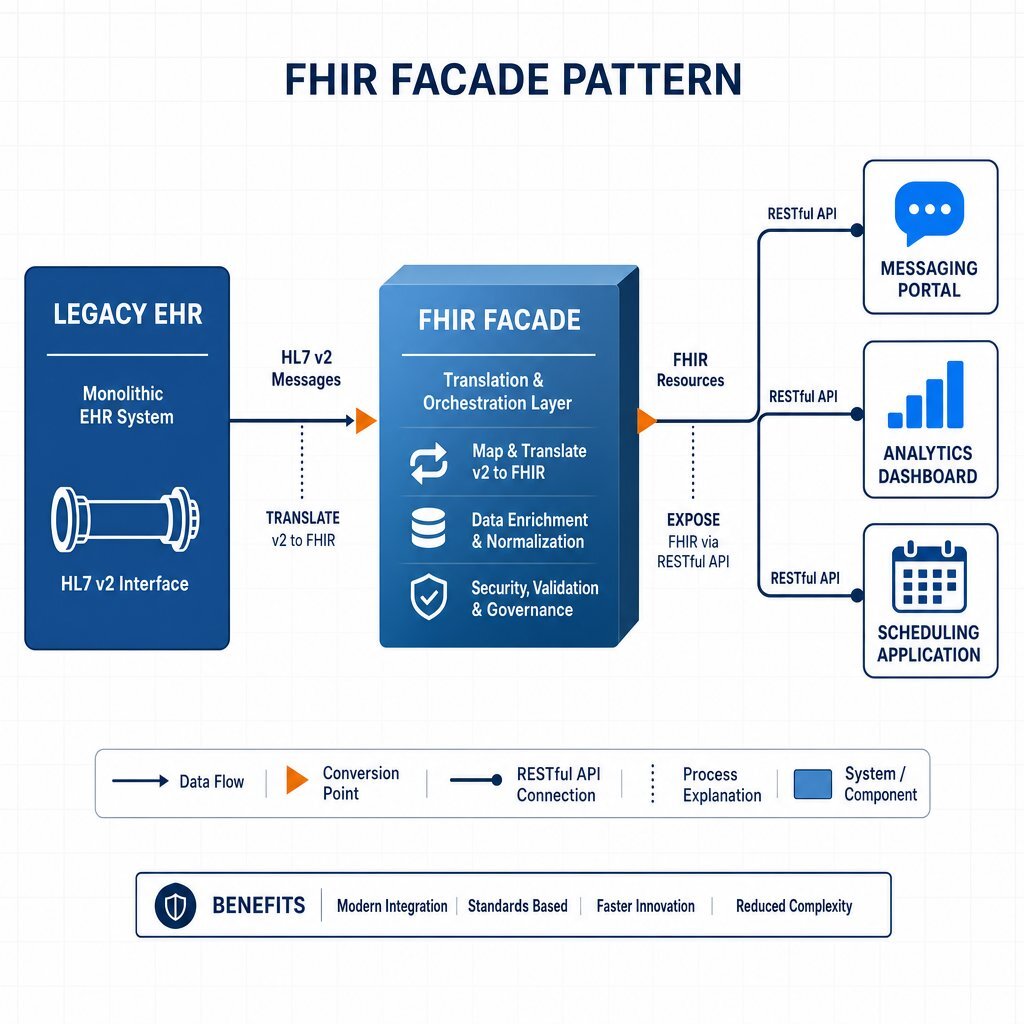
Bridging the Eras: HL7 v2 and FHIR R4 Integration
A successful sidecar strategy relies on bridging the gap between old and new interoperability standards. Your legacy EHR likely communicates via HL7 v2. Designed in the late 1980s, HL7 v2 is a pipe-delimited messaging protocol that pushes data point-to-point over internal hospital networks. It handles core clinical events flawlessly. When a patient is admitted, the system generates an ADT (Admit, Discharge, Transfer) message. When a lab finishes a test, an ORU (Observation Result) message is sent. This protocol is incredibly robust, but it was built before the web existed. It cannot support modern, on-demand API queries from mobile applications or web portals.
Modern sidecar applications require HL7 FHIR (Fast Healthcare Interoperability Resources), specifically Release 4 (R4). FHIR uses RESTful APIs, JSON, and web-standard OAuth 2.0 to represent health records as modular, easily searchable resources (e.g., Patient, Encounter, Observation).
To connect the two without modifying the legacy EHR, engineers deploy a FHIR Facade or a Replicated FHIR Repository.
A FHIR Facade acts as an architectural translation layer. When a modern patient portal (the sidecar) requests a patient's lab results, it sends a standard FHIR REST call (GET /Observation?patient=123). The FHIR Facade intercepts this call, translates it into a legacy database query or reads it from an HL7 v2 message store, formats the response back into a standard FHIR JSON resource, and delivers it to the app. The legacy EHR never knows it is talking to a modern web application, and the sidecar application never has to parse a pipe-delimited HL7 v2 message. Data remains securely in the original source system.
For workflows requiring high-volume analytics or complex chained searches, a Replicated FHIR Repository extracts data from the legacy system via HL7 v2 feeds and stores a normalized copy in a modern database, completely decoupling the analytical query load from the fragile legacy production server. This pattern also prepares organizations for future AI and analytics initiatives by improving data readiness long before any full replacement is on the table.
The Decision Framework: What to Sidecar vs. What Stays in the EHR
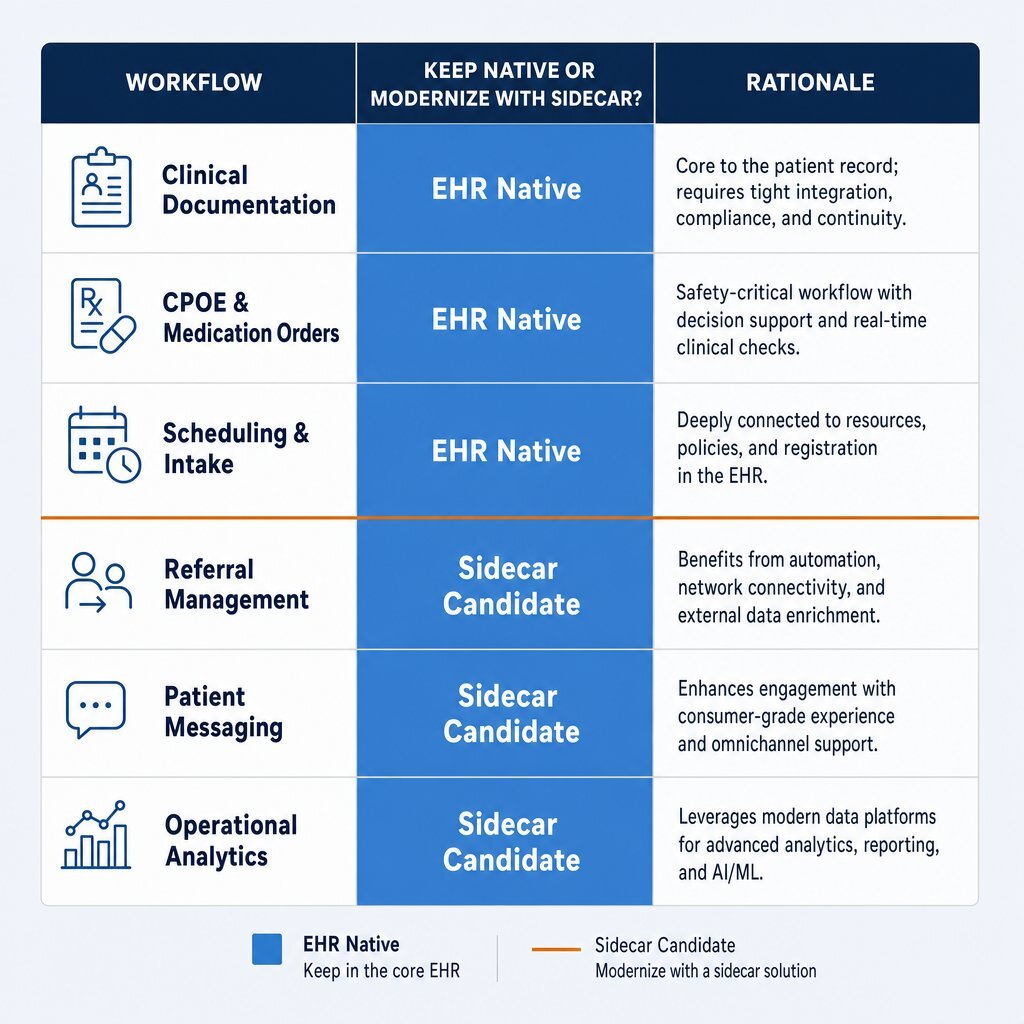
Not every function belongs in a custom sidecar. A successful technology strategy requires discipline regarding what the EHR does well versus where it creates operational friction. Use the following framework to allocate software development resources effectively.
| Workflow / Function | Target System | Rationale |
|---|---|---|
| Clinical Documentation | EHR Native | Core to HIPAA regulatory compliance, medical billing, and legal liability. Leave physician notes and official charting in the system of record. |
| CPOE & Medication Orders | EHR Native | Computerized Provider Order Entry (CPOE) and pharmacy integrations are deeply embedded in HL7 v2 workflows (ORM/OML messages). Rebuilding these carries massive clinical safety risk. |
| Patient Scheduling & Intake | Sidecar Candidate | Legacy EHR scheduling interfaces are notoriously rigid. A sidecar app can offer self-serve digital booking via FHIR APIs, significantly reducing administrative phone calls and frontend workload. |
| Referral Management | Sidecar Candidate | Each referring provider represents roughly $1.7 million in potential annual revenue to a health system. A sidecar dashboard tracking inbound referrals prevents costly network leakage and prioritizes high-value cases. |
| Patient Messaging & Portal | Sidecar Candidate | To handle the 153% spike in asynchronous patient messaging, a sidecar can implement Natural Language Processing (NLP) to intercept and route administrative requests to staff while escalating only true clinical questions to providers, following the same mobile-first patterns used in modern B2B applications. |
| Operational Analytics | Sidecar Candidate | Legacy EHR reporting often requires custom SQL scripts. A replicated FHIR repository can feed modern BI tools for real-time dashboarding on patient flow, capacity, and revenue cycle health. |
The Financial Reality: A 5-Year Total Cost of Ownership Comparison
Hospital executives evaluate technology decisions on a five-year horizon. When modeling the total cost of ownership (TCO) for a typical 100-bed independent community hospital, the financial imperative of the sidecar strategy becomes impossible to ignore.
The following model compares three distinct paths: a standalone Epic migration, freezing investment (Status Quo), and deploying a custom Sidecar Strategy.
| Year | Epic Standalone | Status Quo (Freeze) | Sidecar Strategy |
|---|---|---|---|
| Year 1 | $15,590,000 | $1,650,000 | $2,750,000 |
| Year 2 | $890,000 | $1,650,000 | $1,050,000 |
| Year 3 | $890,000 | $1,650,000 | $1,050,000 |
| Year 4 | $890,000 | $1,650,000 | $1,050,000 |
| Year 5 | $890,000 | $1,650,000 | $1,050,000 |
| 5-Year Cumulative TCO | $19,150,000 | $8,250,000 | $6,950,000 |
Data source: Modeled financial analysis based on industry benchmark aggregates for mid-market acute care facilities.
Analyzing the ROI
The Epic Standalone Path ($19.15M): The Year 1 capital outlay is staggering. It includes software licensing (2M-10M), data migration (1M-5M), external consulting, infrastructure, and a massive loss of clinical productivity during the go-live phase. While maintenance costs stabilize in subsequent years, the initial cash drain often forces independent hospitals to issue debt, deplete days-cash-on-hand reserves, or seek an immediate strategic buyer.
The Status Quo Path ($8.25M): Doing nothing is quietly expensive. While direct IT licensing costs remain flat, the hospital hemorrhages cash operationally. Unmitigated referral leakage, inefficient billing backlogs, and lost patient volume due to poor digital scheduling experiences compound year over year. The 29-day billing delays typical of manual, paper-based legacy workflows cripple cash flow and force difficult staffing decisions.
The Sidecar Strategy ($6.95M): Year 1 includes the capital cost of deploying the FHIR Facade integration layer and engineering the initial custom sidecar applications ($2.75M). However, by Year 2, the modernized workflows plug the referral leakage and streamline administrative tasks. The five-year TCO is actually lower than doing nothing, while delivering the vast majority of the operational value of a full EHR replacement. It actively improves the bottom line by recapturing lost revenue. Similar to a well-run project rescue, the sidecar path focuses on stabilizing what you already have, then layering in targeted improvements.
Getting Started: The First 90 Days of a Sidecar Strategy
Modernizing around your legacy EHR does not require a multi-year consulting engagement. Employing Baytech Consulting's Rapid Agile Deployment methodology, an engineering team can stand up a FHIR integration layer and the first sidecar application in a single quarter. This approach borrows from disciplined Agile methodology so stakeholders see value early and often instead of waiting years for a "big bang" go-live.
Here is the blueprint for the first 90 days:
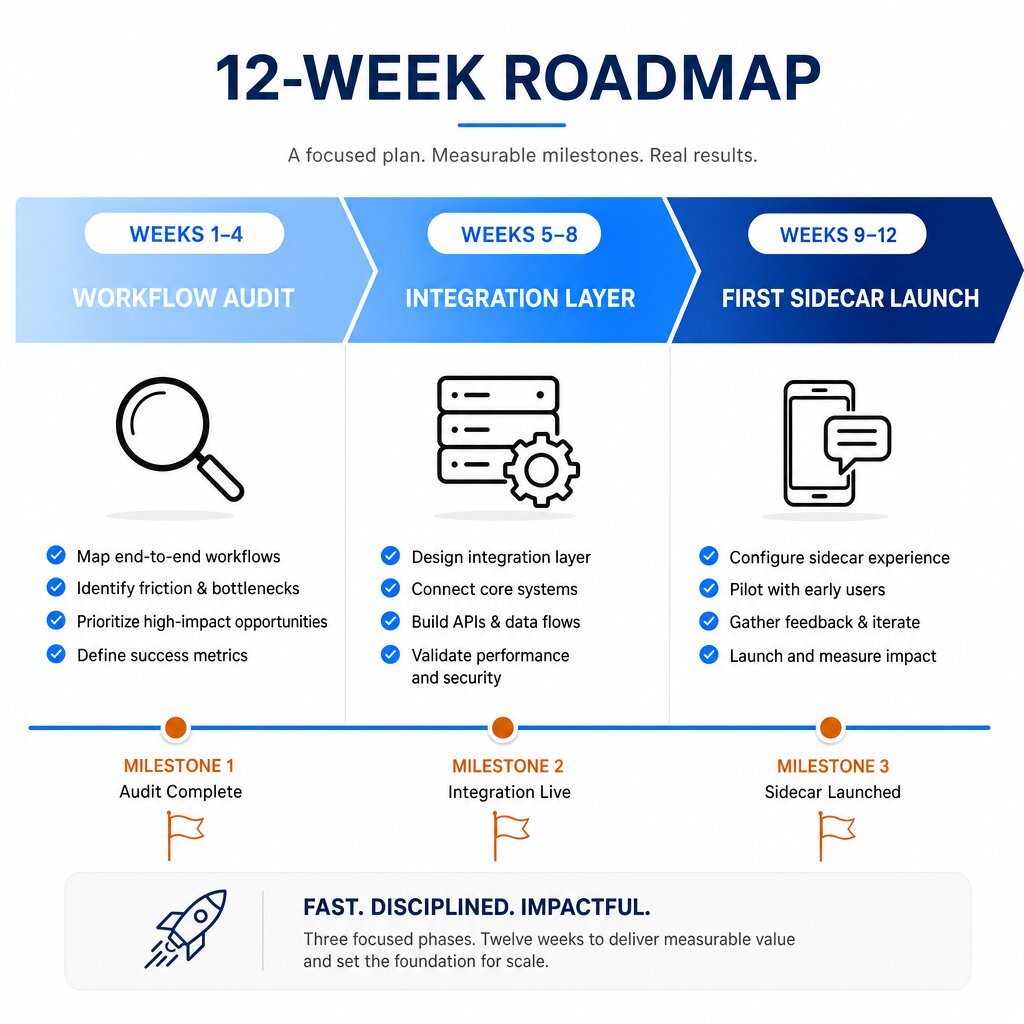
Phase 1: Workflow Audit and Legacy Assessment (Weeks 1-4)
Begin by defining the exact source of operational friction. Avoid the temptation to map every single FHIR resource at once—a common mistake that stalls integration projects indefinitely. Select one discrete workflow, such as patient intake or referral tracking. Concurrently, audit your existing legacy EHR to catalog its HL7 v2 feeds, database schemas, and proprietary APIs. Define an identity crosswalk to ensure patient medical record numbers (MRNs) translate accurately across the legacy and modern systems. This discovery phase should be as rigorous as any engineering discovery checklist you would run for a net-new system.
Phase 2: Architecture and Integration Layer (Weeks 5-8)
Establish the technical foundation. Deploy a FHIR Facade to sit between the legacy EHR and the external environment. This phase involves setting up request interception, building the data mapping logic to translate HL7 v2 PID segments into FHIR Patient resources, and establishing HIPAA-compliant audit logging. For organizations requiring deep technical control and enterprise scale, deploying this infrastructure via Kubernetes and PostgreSQL ensures high performance and scalable data management. Implement OAuth 2.0 authorization via the SMART on FHIR framework immediately to secure the API, and align it with modern DevOps and deployment practices so changes can be rolled out safely.
Phase 3: First Sidecar Application Launch (Weeks 9-12)
Develop and deploy the first targeted sidecar application. If uncompensated patient communication is the primary bottleneck, launch a digital messaging portal connected to the FHIR Facade that filters messages before they reach the physician's inbox. Because the frontend application interacts purely with standard FHIR REST APIs, development moves rapidly. Conduct user acceptance testing with a pilot group of clinicians, refine the user interface based on direct feedback, and deploy into production. Over time, this same pattern can extend to mobile experiences using proven frontend and mobile frameworks, giving patients and staff a consistent experience across devices.
The Future of the Independent Provider
Community hospitals and independent practices do not have to accept the false binary of a financially ruinous EHR migration or operational stagnation. Independence is heavily tied to capital allocation. Providers that modernize their technology affordably are vastly better positioned to avoid distressed acquisitions, protect their balance sheets, and maintain their clinical autonomy.
By treating the legacy EHR strictly as a system of record and building modern, agile sidecar applications around it, organizations capture the benefits of modern technology without the systemic risk of a rip-and-replace migration.
Baytech Consulting provides the engineering precision required to execute this strategy. Combining enterprise-grade quality with a Tailored Tech Advantage, we build the integration layers and custom sidecar applications that let healthcare providers stop fighting their software and return to patient care. Our partnership approach focuses on long-term outcomes, not just one-off launches.
FAQ
Can a FHIR Facade connect to an EHR that only speaks older HL7 v2 protocols?
Yes. A FHIR Facade operates precisely by intercepting modern FHIR REST API requests (like a web app querying a patient record) and translating them into the older protocols your legacy system understands. It executes this by querying your existing HL7 v2 message store or performing direct SQL database reads, and then returning the data to the web app in standard FHIR JSON format, requiring zero changes to your core EHR.
Supporting Links
- US Acute Care EHR Market Share 2026: Market Uncertainty Significantly Cuts Buying Decisions
- Patient portal messages doubled since 2020, study finds
FHIR Facade: Complete Architecture Guide for Modernizing Legacy Healthcare Systems
About Baytech
At Baytech Consulting, we specialize in guiding businesses through this process, helping you build scalable, efficient, and high-performing software that evolves with your needs. Our MVP first approach helps our clients minimize upfront costs and maximize ROI. Ready to take the next step in your software development journey? Contact us today to learn how we can help you achieve your goals with a phased development approach.
About the Author
Bryan Reynolds is an accomplished technology executive with more than 25 years of experience leading innovation in the software industry. As the CEO and founder of Baytech Consulting, he has built a reputation for delivering custom software solutions that help businesses streamline operations, enhance customer experiences, and drive growth.
Bryan’s expertise spans custom software development, cloud infrastructure, artificial intelligence, and strategic business consulting, making him a trusted advisor and thought leader across a wide range of industries.