
In this article
- What Happens When the Platform Changes the Rules
- Why the Lag Exists
- Mandated Rebuilds Change the Exposure
- Which Apps Are Actually at Risk
- Insulation as a Middle Path
- React Native vs Native App Development: The Current Cost Comparison, Honestly
- What a Migration Really Involves
- The Case for Staying
- Putting Framework Risk on a Review Cadence
- About Baytech
- About the Author
When the platform vendor changes the rules, a native team ships a fix on their own schedule. A cross-platform team files an issue and waits.
The cross-platform debate traditionally centers on cost and performance. For most business applications, those arguments have been conclusively settled in favor of the frameworks. Cross-platform environments deliver high-fidelity user experiences while substantially reducing development overhead. However, this consensus frequently overlooks a structural dimension that becomes critical during technological shifts: schedule dependency during operating system (OS) transitions.
Selecting a cross-platform framework inherently adopts a risk position regarding release schedules. A framework sits between the development team and the underlying platform. When a platform vendor mandates a transition that forces every application to rebuild against a new Software Development Kit (SDK), the framework's release schedule dictates the engineering team's release schedule. This analysis examines the mechanical realities of framework lag, identifies which applications carry the highest exposure, and provides a framework for evaluating whether to stay, insulate, or migrate.
What Happens When the Platform Changes the Rules
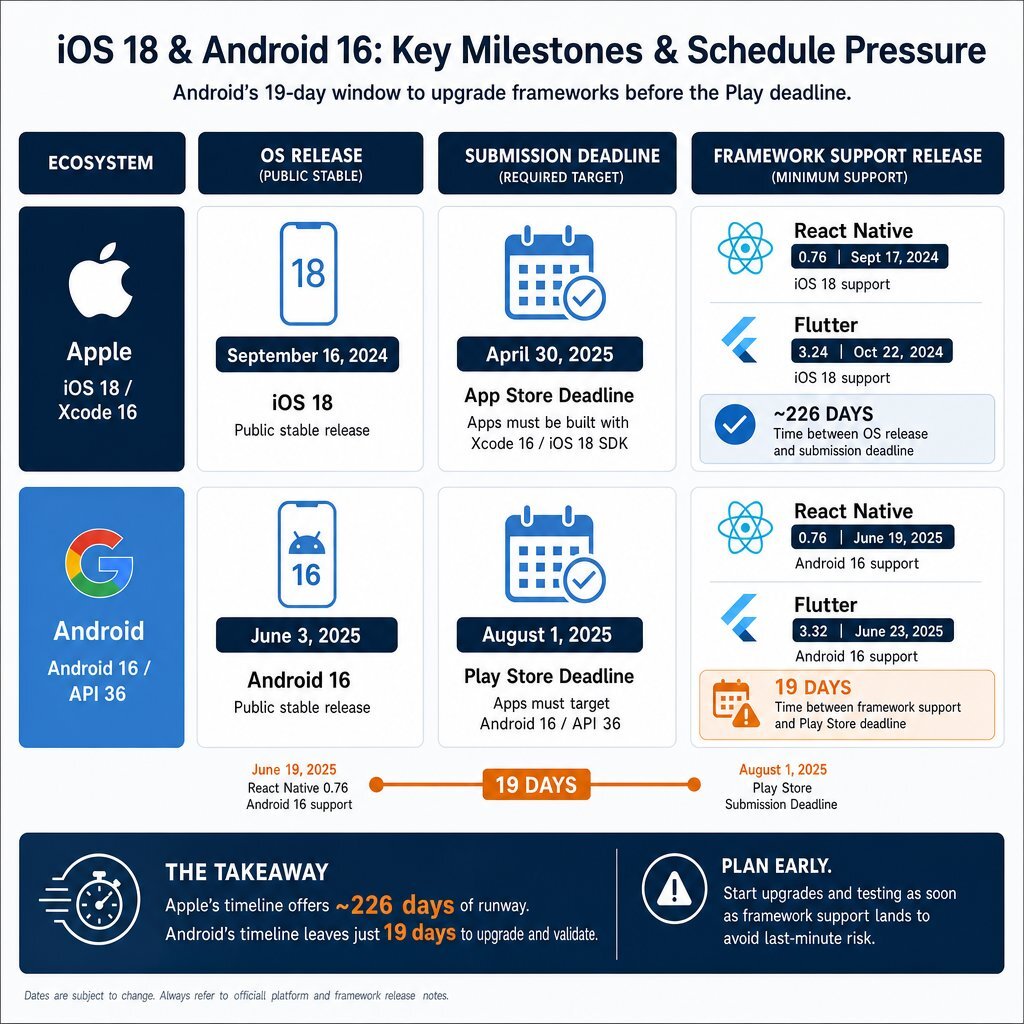
Platform vendors continuously evolve their ecosystems, balancing new capabilities against security and performance standards. These evolutions frequently manifest as SDK floors—strict submission requirements dictating the minimum API level an application must target to be accepted into an app store.
A platform transition changes the rules of engagement. When an SDK floor takes effect, it removes the option of simply abstaining from the update. For instance, Apple mandated that all App Store submissions use the iOS 18 SDK and Xcode 16 beginning April 24, 2025. Similarly, Google Play requires all new applications and updates to target Android 16 (API level 36) by August 31, 2026.
When a native development team encounters an SDK floor, engineers control the adaptation process. They update the project configuration, resolve compiler warnings, and integrate the new platform APIs directly. Conversely, a team building on a cross-platform framework cannot adopt the new SDK until the framework maintainers release a compatible version. That dependency is manageable if you already work in short, iterative cycles, but it can become painful if you skip a structured agile methodology and try to cram a year’s worth of upgrades into a single scramble before the deadline.
Why the Lag Exists
Framework lag behind OS releases is structural, not a failure of any particular open-source project. Mechanically, the framework must absorb the platform change before an application team can consume it.
Cross-platform frameworks rely on complex rendering engines, bridged APIs, and deep native integrations. When an OS introduces an architectural mandate, framework maintainers must rewrite underlying C++, Java, or Objective-C code. For example, Android 16 mandates edge-to-edge display rendering, removing previous opt-out mechanisms. To support this, React Native maintainers had to deprecate legacy components like SafeAreaView and introduce new internal properties to handle system insets properly.
UI-heavy OS updates demand even deeper integration. When Apple introduced the translucent, physics-based "Liquid Glass" design language in iOS 26, frameworks had to map custom rendering pipelines to native system behaviors. Flutter, which bypasses native OEM widgets to draw pixels directly using its Impeller engine, required significant engine-level updates to replicate these OS-level visual physics. React Native, which wraps native components, required updates to its view managers to ensure material properties rendered correctly without breaking existing layouts.
This creates a cascading dependency chain: third-party plugin maintainers must wait for the core framework to update before they can update their own libraries, leaving the application team waiting at the very bottom of the waterfall. If your mobile stack already struggles with DevOps and release automation, this extra lag compounds the pain, which is why many teams pair cross-platform work with stronger DevOps efficiency practices to shorten the time from framework update to shipping builds.
Mandated Rebuilds Change the Exposure
The cross-platform framework risk remains dormant when platform updates merely offer optional capabilities. If a business does not require the latest OS feature, the team can safely ignore the update until the framework ecosystem stabilizes.
The exposure becomes acute when a platform forces an SDK floor. If a critical bug emerges in production or a high-priority business feature must launch, the engineering team cannot push an update unless the application targets the newly mandated SDK. The following timeline illustrates the observed lag and the compressed scheduling windows created during recent major transitions:
| Platform Milestone | OS Release / Deadline | Framework Support Milestone | Window for App Teams |
|---|---|---|---|
| Apple iOS 18 / Xcode 16 | OS Released: Sept 2024 Submission Deadline: April 24, 2025 | Flutter 3.24 supported iOS 18 early (Aug 2024). Expo SDK 51 required manual upgrades. | Moderate: Months to adapt, though React Native dependency chains caused friction. |
| Google Android 16 (API 36) | OS Released: June 2025 Submission Deadline: Aug 31, 2026 | React Native 0.81 (with API 36 support) released Aug 12, 2026. | Severe: 19 Days from official framework release to store deadline. |
As demonstrated by the Android 16 transition, React Native teams had exactly 19 days from the stable release of version 0.81 to complete a major architectural upgrade, refactor edge-to-edge layouts, test, and submit before losing access to the Google Play Store. While Google offers extension requests through November 1, 2026, relying on administrative grace periods is a precarious technical strategy. The framework's release schedule dictated the operational agility of thousands of businesses.
Which Apps Are Actually at Risk
Not every cross-platform application carries the same level of transition exposure. The architecture of the application directly determines the severity of the risk. Applications utilizing standard components experience vastly different transition cycles than those entangled with deep native hardware APIs.
The following exposure assessment matrix categorizes an application's risk profile:
| Risk Level | Application Characteristics | Transition Experience |
|---|---|---|
| Low Risk | Pure UI applications. Relies strictly on core framework components. Minimal device hardware interaction. | Seamless. Upgrading the framework version generally resolves SDK floor requirements with minor layout adjustments. |
| Medium Risk | Utilizes standard hardware APIs (camera, geolocation). Relies on popular, actively maintained third-party libraries. | Moderate friction. Teams must wait for open-source maintainers to update specific plugins before completing the migration. |
| High Risk | Heavy use of custom native modules. Bridged legacy C++ or Objective-C libraries. Deep integration with OS-specific UI paradigms. | High friction. Requires dedicated native engineering effort to manually rebuild custom bridges against the new OS APIs. |
A standard Flutter enterprise app or React Native B2B platform typically falls into the low-to-medium risk categories, as primary functionality revolves around data synchronization and business logic rather than cutting-edge hardware features. For these products, the cross-platform tradeoff remains highly favorable.
However, teams that heavily customized their applications with native code to bypass past performance limitations are uniquely vulnerable. For example, React Native version 0.82 entirely removes the Legacy Architecture, forcing all applications onto the New Architecture (Fabric and TurboModules). Applications with extensive custom native bridges built on the legacy architecture face a massive, mandatory rewrite to survive this transition. If you’re in this camp, it’s worth stepping back and building a broader phased legacy modernization roadmap so you treat this rewrite as part of a coherent modernization effort, not a one-off fire drill.
Insulation as a Middle Path
For organizations identifying their application in the medium-to-high risk categories, completely abandoning the framework is not the only recourse. Insulation offers a highly effective middle path.
Insulating a cross-platform application involves explicitly isolating platform-dependent surfaces behind internal abstraction layers. Drawing on the principles of clean architecture, an engineering team wraps every third-party native plugin or bridged API in an internal interface. The core business logic interacts exclusively with the internal interface, completely unaware of the underlying cross-platform plugin. This is the same pattern used in many robust enterprise application architectures, just applied to the mobile and framework layer.
Architecture of an Insulated Cross-Platform App
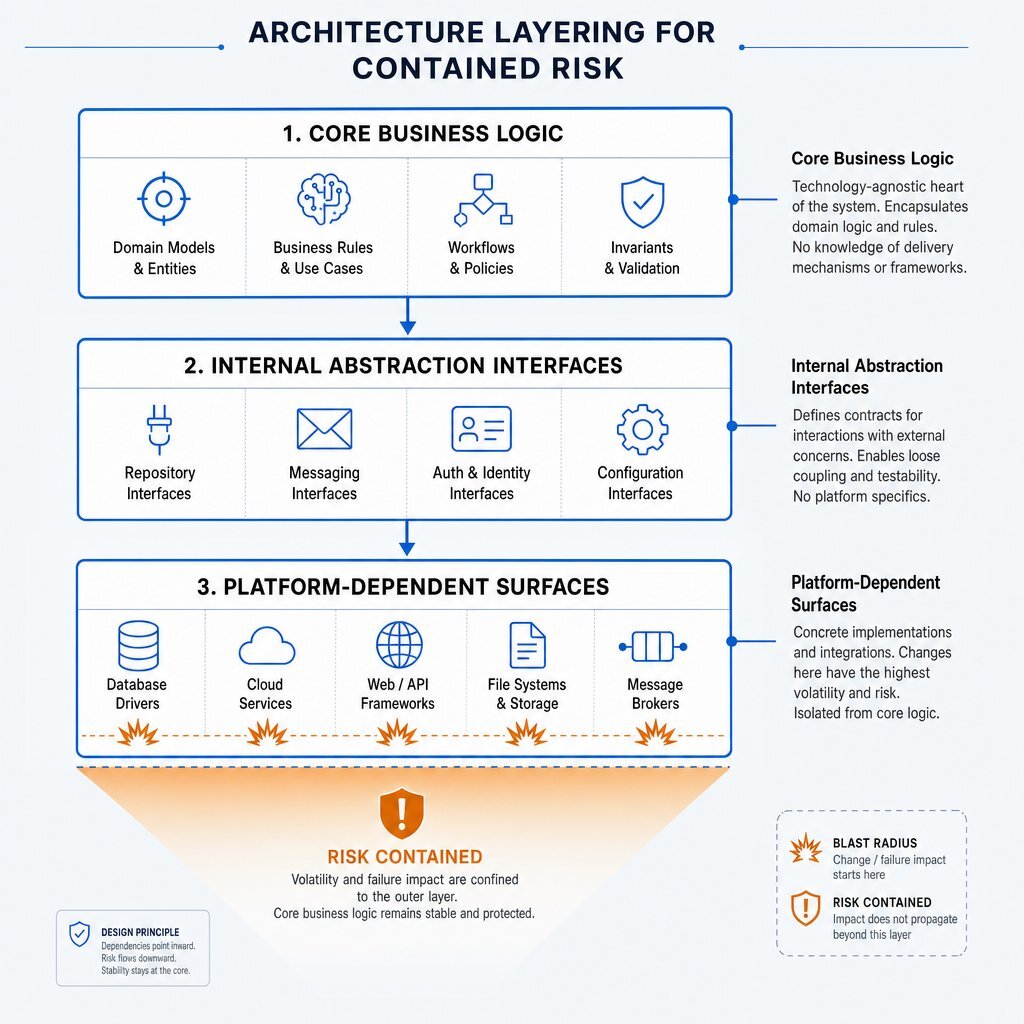
- Layer 1: Core Business Logic (Framework Agnostic)
- State management, data transformation, and business rules.
- Layer 2: Internal Abstraction Interfaces
- Strictly defined contracts (e.g.,
ILocationService,ICameraProvider).
- Strictly defined contracts (e.g.,
- Layer 3: Platform-Dependent Surfaces (The "Blast Radius")
- Third-party framework plugins (e.g.,
react-native-camera,flutter_location). - Custom bridged native modules.
- Third-party framework plugins (e.g.,
When an OS transition breaks a specific third-party dependency, the blast radius is contained entirely within Layer 3. The engineering team only needs to rewrite the adapter layer—potentially swapping in a different open-source library or writing a minimal native implementation—without altering the core application logic.
Building an insulated architecture requires a higher initial investment in software design, increasing upfront development costs by an estimated 15%. However, it drastically reduces the schedule risk during critical transitions by allowing teams to surgically repair broken native dependencies rather than waiting for external maintainers. That upfront design work pairs well with a stronger UX design and discovery process, because you’re clarifying user flows and integration points before you lock in technical seams.
React Native vs Native App Development: The Current Cost Comparison, Honestly
When evaluating risk mitigation strategies, engineering leaders must contextualize schedule dependency against the baseline costs of development. The comparison between React Native vs native app development remains heavily skewed toward cross-platform frameworks for initial builds, but the total cost of ownership shifts over the application's lifecycle.
Industry data indicates that React Native projects typically cost 30% to 40% less to build initially compared to developing separate, fully native iOS and Android applications. A single codebase and a unified team drive these savings, accelerating time-to-market.
However, ongoing maintenance alters the equation. Annual maintenance for a mobile application typically consumes 15% to 20% of the original development cost. During a volatile platform transition year, the cost of updating a heavily bridged cross-platform app can temporarily exceed the cost of updating two native apps, primarily due to the complex debugging required when framework internals clash with new OS APIs. For many mid-market firms, this lands in the same bucket as other “hidden” software costs—similar to the way modernization projects often blow past sticker price unless you plan for them, as outlined in this deeper look at modernization cost overruns.
| Strategic Option | Initial Cost vs Baseline | Timeline Impact | Risk Profile | What It Does Not Solve |
|---|---|---|---|---|
| Stay (Cross-Platform) | Baseline (Lowest) | High velocity for feature delivery. | High schedule risk during OS transitions. | The fundamental dependency on open-source framework maintainer schedules. |
| Insulate (Abstracted) | +15% overhead | Slower initial setup; fast feature delivery later. | Moderate. Blast radius is contained. | The need to eventually upgrade the core framework itself for OS compliance. |
| Migrate (Native) | +40% to +60% | Slowest. Requires two parallel development tracks. | Low. Direct control over SDK updates. | The increased financial burden of staffing and maintaining two separate codebases. |
For a deeper analysis of budgeting across these models, engineering leaders should review comprehensive app cost and maintenance guidance. You can also zoom out and look at how engagement models and contracts affect overruns and scope creep; for example, this breakdown of why scope creep is really a contract problem pairs well with the cost matrix in this section.
What a Migration Really Involves
If an application's risk profile consistently exceeds an organization's tolerance for schedule dependency, executing a migration away from the framework becomes necessary. Moving to native code is an operational shift requiring rigorous planning and sustained resourcing.
Migrations generally follow one of two established paths: brownfield or greenfield.
A brownfield migration incrementally replaces the cross-platform framework from the inside out. The existing application remains in production while the engineering team transitions specific screens and flows to native code. This approach minimizes product continuity risk but maximizes technical complexity, as the team must maintain two distinct architectures and carefully manage state and navigation boundaries across the native-to-framework bridge.
A greenfield migration involves building a completely new native application alongside the existing cross-platform product. The team aims for feature parity and executes a cutover to the new native codebase in a single update release. This provides a clean technical foundation but carries significant delivery risk, as the team essentially halts new feature development on the legacy application during the rebuild.
A successful migration strategy demands concrete checkpoints, automated parity testing, and clear fallback criteria. While moving to native resolves platform transition lag, it doubles the ongoing engineering burden. Organizations must confirm they possess the internal capacity to sustain dual native teams post-migration. If your current project already shows signs of slipping budgets, missed milestones, or architectural dead-ends, it can also be wise to treat the migration as a broader project rescue effort instead of just a code rewrite.
The Case for Staying
Highlighting the schedule risk of platform transitions does not equate to a recommendation to abandon cross-platform development. For the vast majority of mid-market B2B applications, staying put remains the correct strategic decision.
The ecosystem surrounding these frameworks is remarkably resilient. React Native and Flutter possess massive community backing and corporate sponsorship. Historically, the maintainers of these projects have successfully closed the gap on major OS releases. The introduction of the New Architecture in React Native and Impeller in Flutter demonstrates massive ongoing investments in closing the performance delta with native code.
If an application focuses on standard workflows, data entry, or content delivery, the shared-code advantage clearly wins. The cost efficiency of deploying a single engineering squad to cover both iOS and Android far outweighs the inconvenience of navigating a compressed 19-day upgrade window once a year. The key is acknowledging that the window will eventually occur and planning sprint capacity accordingly. Even when applications aim to integrate cutting-edge visual treatments such as Liquid Glass, specialized community libraries often bridge the gap rapidly, proving the ecosystem's vitality.
Cross-platform also remains a strong lever when you want a consistent experience across phones, tablets, and other touchpoints. If you’re rethinking how your users work on the go, it’s worth pairing this framework discussion with a broader mobile-first B2B app playbook so you’re not just worrying about SDKs, but also about the workflows that drive adoption and revenue.
Putting Framework Risk on a Review Cadence
The primary failure mode for organizations using cross-platform technology is treating the framework choice as a settled debate locked in at project inception. Frameworks are critical, deeply integrated third-party dependencies. Like any other piece of enterprise infrastructure, they require active, systematic risk management.
Engineering organizations must place framework risk on a defined annual review cadence. This process requires a named owner—typically a Staff Engineer or Mobile Architect—responsible for monitoring the upstream repositories of the chosen framework. The review must explicitly evaluate the application's current exposure matrix, audit the health and maintenance status of third-party plugins, and forecast the impact of upcoming OS betas, such as Apple's WWDC announcements or Google I/O developer previews.
Organizations adopting this cadence often leverage partners providing a tailored tech advantage—such as Baytech Consulting—to execute rapid agile deployments when framework updates demand immediate attention. By acknowledging the structural reality of schedule dependency, insulating vulnerable code paths, and reviewing architecture systematically, engineering teams can maintain the immense economic advantages of shared code without being paralyzed when platform vendors change the rules. Putting this kind of discipline around your mobile stack goes hand in hand with a stronger discovery phase checklist, so you’re continuously re-validating requirements instead of being surprised by each new OS release.
FAQ
Can a React Native or Flutter app be gradually migrated to native code?
Yes. A gradual, or brownfield, migration involves replacing specific screens or business logic flows with native code while the existing framework continues to host the application. This approach reduces the risk of a massive single cutover but temporarily increases technical complexity, as the engineering team must bridge navigation and state management between the native and cross-platform environments during the transition.
Supporting Links
- Android API Level 36 Migration Guide: Complete Flutter App Update for Android 16
- Designing custom UI with Liquid Glass on iOS 26
Migration to React Native in 2026 starts with a delivery question
About Baytech
At Baytech Consulting, we specialize in guiding businesses through this process, helping you build scalable, efficient, and high-performing software that evolves with your needs. Our MVP first approach helps our clients minimize upfront costs and maximize ROI. Ready to take the next step in your software development journey? Contact us today to learn how we can help you achieve your goals with a phased development approach.
About the Author

Bryan Reynolds is an accomplished technology executive with more than 25 years of experience leading innovation in the software industry. As the CEO and founder of Baytech Consulting, he has built a reputation for delivering custom software solutions that help businesses streamline operations, enhance customer experiences, and drive growth.
Bryan’s expertise spans custom software development, cloud infrastructure, artificial intelligence, and strategic business consulting, making him a trusted advisor and thought leader across a wide range of industries.