
In this article
- The Rollout That Didn't Move the Number
- Why Adoption Is the Symptom, Not the Cause
- The Fields That Actually Matter
- Tool Category by Tool Category: What Breaks and Why
- Stage-Definition Drift, the Quiet Forecast Killer
- Running the Audit
- Enrichment vs. Deduplication vs. Identity Resolution
- Making Remediation a Process, Not a Project
- Salvaging a Rollout Already in Flight
- Conclusion
- Supporting Links
- About Baytech
- About the Author
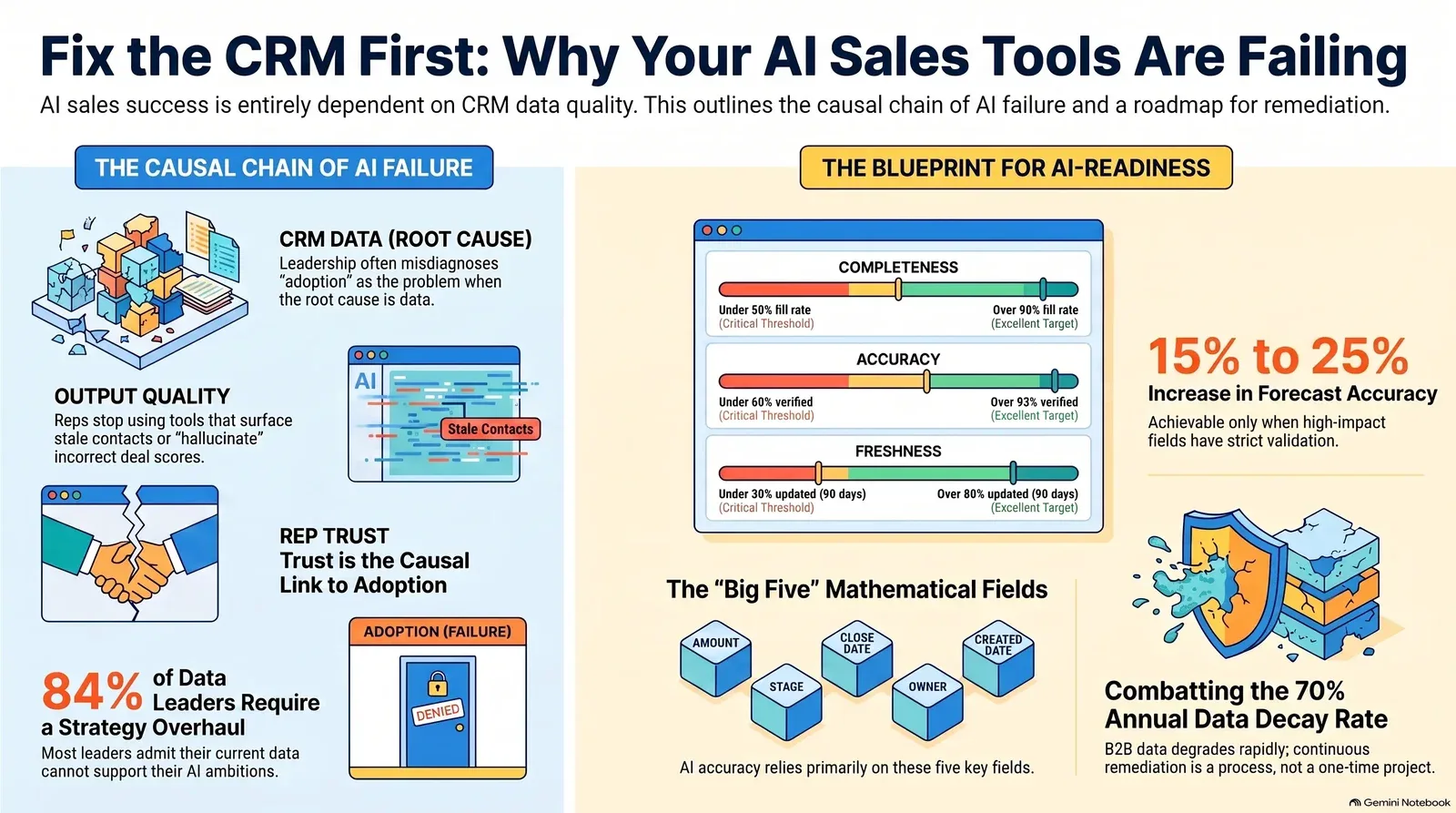
Scoring trained on bad data produces confident, incorrect scores. That is worse than having no scoring at all, because the bad prioritization now has a quantitative stamp of approval next to it, and nobody argues with it.
A sales organization buys conversation intelligence, lead scoring, and forecasting software. They run a competent implementation, train the team, and six months later the forecast is no more accurate than it was before the purchase. The common cause is upstream: every one of those tools reads from the CRM, and the CRM's records are stale, incomplete, or inconsistently defined.
To make CRM data quality and AI sales initiatives actually work together, executives need to stop treating data hygiene as an abstract concept. AI models function entirely on pattern recognition and probability. When a revenue team deploys an advanced tool, that application inherits every existing defect within the database. This article identifies which data problems degrade specific AI capabilities, how to diagnose them before buying new software, and what a realistic remediation program looks like for a mid-market revenue team.
The Rollout That Didn't Move the Number
Revenue teams are investing heavily in intelligent applications, with 87% of sales organizations currently utilizing some form of AI for tasks like forecasting, lead scoring, and automated prospecting. Sellers using these tools expect major productivity gains, yet the foundational data powering these platforms is often profoundly flawed.
Research indicates that 84% of data and analytics leaders admit their data strategies require a complete overhaul before their AI ambitions can actually succeed. If an AI agent attempts to draft a personalized email based on a contact record that has not been updated in three years, the output will be irrelevant, embarrassing, or both. Fragmented, inaccurate data breaks the models, leading 86% of IT leaders to agree that AI outputs are only as reliable as their data inputs.
Why Adoption Is the Symptom, Not the Cause
The standard explanation for a disappointing AI sales rollout is user adoption. Leadership assumes representatives simply refused to use the new platform, and frontline managers failed to enforce compliance.
Adoption matters, but it is frequently a downstream symptom of a broken system. Sales professionals stop trusting a tool that surfaces stale contacts, hallucinates account histories, and mis-scores deals they actively work. Once trust evaporates, adoption drops to zero.
The actual causal chain of a failed implementation looks like this:
CRM Data Quality → Output Quality → Rep Trust → Tool Adoption → Revenue Results (Common misdiagnosis targets Tool Adoption; actual failure point is CRM Data Quality)
Security, compliance, and data quality remain the most frequently cited barriers to broader AI adoption, consistently ranking above budget constraints or platform selection. Fixing the causal chain requires starting at the root and, for many mid-market companies, following a phased legacy modernization roadmap that stabilizes core systems before layering on AI.
The Fields That Actually Matter
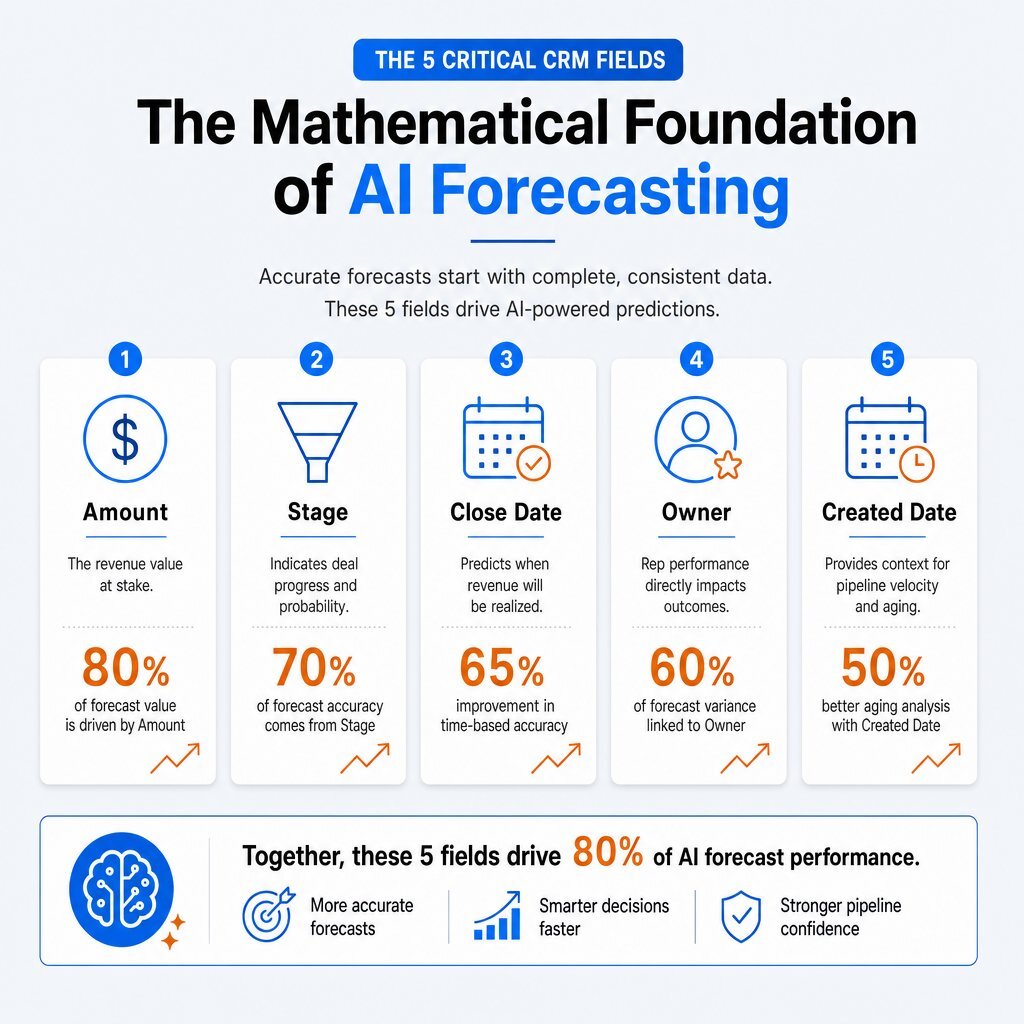
"Improve your CRM data quality" is useless advice because it lacks operational focus. Remediation requires targeting the exact data points that power predictive models. A tiny fraction of CRM fields drives a disproportionate share of forecast error.
Specifically, five fields dictate the mathematical foundation of any revenue projection: Amount, Stage, Close Date, Owner, and Created Date. These fields determine period assignment, probability, and cycle length. Everything else in the opportunity record is a distant secondary concern.
When these fields are enforced as gating requirements at the correct pipeline stages, AI-assisted forecasting can improve prediction accuracy by 15% to 25% over manual methods. However, the relative importance of these fields changes with deal size. In high-velocity SMB sales, Created Date and Stage velocity are the strongest predictors of a win. In complex enterprise sales with nine-month cycles, Close Date movement (deal slippage) and multi-threading engagement signals heavily outweigh initial velocity.
Tool Category by Tool Category: What Breaks and Why
Different AI tool categories fail on entirely different data problems. A general data cleanup will not save a specialized AI tool; remediation must be targeted directly at the dependencies of the specific technology you purchased. Treat this the same way you would treat an early discovery phase in a software project: map what each tool actually needs before you start fixing data.
| AI Tool Category | The CRM Dependency | Specific Defect That Breaks It | Required Remediation |
|---|---|---|---|
| Predictive Lead Scoring | Historical conversion data | Inconsistent outcome labeling (e.g., all lost deals marked "Timing") | Enforce strict validation rules and specific picklists for closed-won/loss reasons. |
| AI-Assisted Forecasting | Close dates and pipeline stages | Stage-definition drift and stale, historically missed close dates | Standardize stage entry criteria and automate date validation requirements. |
| Generative AI Outreach | Firmographics and job titles | Contact decay, outdated titles, and incomplete prospect histories | Implement continuous waterfall enrichment and routine accuracy verification. |
| Agentic Lead Routing | Territory mapping and ownership | Duplicate accounts, fragmented hierarchies, and inconsistent formats | Execute identity resolution and build Golden Records across the architecture. |
Stage-Definition Drift, the Quiet Forecast Killer
Stage-definition drift occurs when the informal criteria for a pipeline stage change over time without corresponding documentation or strict CRM enforcement. This silent corruption destroys forecasting models and invalidates outcome labeling.
Imagine an AI tool analyzing three years of historical closed-won and closed-lost data. The model assumes that "Stage 3 (Proposal)" carried the exact same entry criteria in 2023 as it does in 2026.
- 2023 Definition: Stage 3 requires a confirmed budget and a signed NDA.
- 2025 Definition: A new sales director loosens the rules to inflate pipeline visibility. Stage 3 now only requires a verbal request for a quote.
- 2026 AI Rollout: The AI trains on this blended data, identifying false correlations because the underlying meaning of the stage shifted.
Outcome labeling requires strict consistency. If reps log lost deals as "Timing Not Right" simply because it is the first option in a dropdown menu, the machine learning algorithm learns the wrong signals entirely.
Running the Audit
Diagnosis is highly cost-effective and should precede any AI software purchase. A baseline completeness-and-consistency audit across top-impact fields takes days, not months. Industry standard audits evaluate databases across seven weighted dimensions.
| Audit Dimension | Definition | Critical Threshold (Score 1) | Excellent Target (Score 5) |
|---|---|---|---|
| Completeness | Percentage of required fields actually populated, excluding placeholders like "N/A". | Under 50% fill rate | Over 90% fill rate |
| Accuracy | Percentage of fields matching current reality, verified against external signals. | Under 60% verified correct | Over 93% verified correct |
| Freshness | Rate of recent updates; tracking the age distribution of record modifications. | Under 30% updated in 90 days | Over 80% updated in 90 days |
| Consistency | Uniformity of standardized formats (e.g., job titles, geographic locations). | Over 40% format variations | Under 5% format variations |
| Uniqueness | Percentage of truly distinct records, identifying the duplicate rate. | Over 25% duplicates | Under 3% duplicates |
| Validity | Structural conformity and deliverability (e.g., active email verification). | Under 80% valid emails | Over 97% valid emails |
| Enrichment | Percentage of records augmented with third-party firmographic and contact data. | Under 20% enriched | Over 80% enriched |
Most enterprise B2B CRMs score between 45 and 60 out of 100 on their first audit, indicating that data quality is actively limiting sales effectiveness before AI is even introduced. This kind of hidden drag on performance is similar to the “software gap” manufacturers experience when key workflows still run on spreadsheets instead of purpose-built tools, as described in Closing the Software Gap in Reshored Manufacturing.
Enrichment vs. Deduplication vs. Identity Resolution
Revenue operations teams frequently confuse distinct data remediation processes, purchasing the wrong software to fix the wrong problem.
Enrichment involves appending third-party data—such as annual revenue, technographics, or verified direct-dial phone numbers—to existing, sparse CRM records. It solves the problem of incomplete data but does nothing to fix conflicting records.
Normalization standardizes structural formats across the database, ensuring that "USA," "United States," and "US" resolve to a single, readable value. Without normalization, territory routing and market segmentation fail.
Deduplication merges exact or highly probable matches, such as two contacts with the exact same email address.
Identity resolution is vastly more complex. It uses probabilistic matching, deterministic matching, and behavioral signals to determine which fragmented records across entirely different systems (e.g., CRM, billing, and marketing automation) refer to the same real-world entity. Successful identity resolution enables the creation of a definitive "Golden Record"—a single, authoritative profile assembled from every source. CRMs operating without Golden Records suffer from duplicate rates averaging 10% to 30%, which costs sales representatives hours of wasted effort weekly. When these data problems bleed across applications, they show up as scope, timeline, and budget issues in implementation—very similar to how modernization costs quietly climb when hidden technical debt is ignored.
Making Remediation a Process, Not a Project
Contact decay is a continuous, compounding reality. Treating data quality as a one-time cleanup project guarantees long-term failure.
B2B contact data decays at an annual rate of 22.5% to 70.3%, driven by promotions, lateral moves, company acquisitions, and domain migrations. Email addresses degrade exceptionally fast, decaying at roughly 3.6% every single month. Within twelve months, a pristine database reverts to a state of unreliability. Stale data carries an immense financial penalty; poor data quality costs U.S. businesses $3.1 trillion annually, with individual organizations losing an average of $12.9 million due to wasted outreach, damaged sender reputations, and missed pipeline.
Ongoing remediation requires strict ownership. Revenue Operations (RevOps) must own the data architecture, while frontline managers must own compliance. Off-the-shelf data tools are sufficient for simple email validation and basic enrichment, but they frequently fail in complex, multi-system enterprise environments where AI-generated changes can also create new forms of technical debt if you are not careful.
When your business logic spans a CRM, an ERP, proprietary internal databases, and a marketing automation platform, a custom integration or middleware layer becomes mandatory. Firms like Baytech Consulting specialize in building custom middleware and database integrations (utilizing robust technologies like PostgreSQL and SQL Server) that keep disparate systems strictly synchronized. Custom development provides the scalability and security required for advanced AI integrations, ensuring that intelligent systems pull from a verified, conflict-resolved dataset without vendor constraints. In practice, this often means pairing an integration strategy with the right DevOps practices so data flows stay reliable as your systems evolve.
Salvaging a Rollout Already in Flight
When a revenue leader inherits an AI rollout that is already failing to produce accurate forecasts or usable lead scores, immediate triage is required. Leadership must halt any model retraining based on current inputs to stop the AI from learning bad habits.
Remediation must be sequenced according to an impact-to-effort matrix. The highest-impact, easiest-to-fix issue is email validity. Running the active database through a validation service removes hard bounces, instantly protecting domain reputation and improving outbound AI agent performance. The second immediate step is strict deduplication based on exact email and domain matches, which consolidates fragmented activity histories.
Once baseline validity and uniqueness are restored, administrators must enforce mandatory field-level validation rules at the point of entry for all new records. AI models should only be reactivated once the CRM maintains a minimum accuracy threshold of 84% on its highest-impact forecasting fields. At that point, treat the AI rollout more like a carefully governed service engagement than a one-time purchase: define expectations, success metrics, and change control so the tool does not quietly drift off course again.
Conclusion
The failure of AI sales tools is rarely a failure of artificial intelligence; it is a failure of the data infrastructure supporting it. Buying advanced lead scoring or forecasting software before fixing the underlying CRM data guarantees that you will generate confident, highly polished inaccuracies. To achieve the 15% to 25% forecast improvements promised by modern AI, revenue leaders must audit their top-impact fields, eliminate stage-definition drift, and implement continuous identity resolution to combat data decay.
For organizations struggling with fragmented architectures and siloed data streams, partnering with engineering experts is the most efficient path forward. Engaging an enterprise software development firm like Baytech Consulting ensures that data pipelines, custom middleware, and CRM integrations are rigorously engineered to support high-performance AI deployment. The same disciplined, UX-led design mindset that makes customer-facing apps easy to use should also guide how your sales team experiences CRM and AI tools.
FAQ: Why isn't our AI sales tool working?
AI sales tools function strictly on pattern recognition, meaning they inherit and amplify every existing defect within your CRM. If historical pipeline stages were loosely defined, close dates were manually delayed, or contact records have decayed, the AI will generate confident but entirely incorrect outputs. The root cause is corrupted, fragmented, or stale input data that requires immediate remediation before the models can accurately predict future revenue. In many cases, you will see better long-term results by pairing AI with a thoughtful AI-powered development strategy instead of treating it as a quick plug-in fix.
Supporting Links
- Data Decay in B2B: Your CRM Loses 70% Accuracy Every Year
- How to Audit CRM Data Quality
The State of Data and Analytics Report
About Baytech
At Baytech Consulting, we specialize in guiding businesses through this process, helping you build scalable, efficient, and high-performing software that evolves with your needs. Our MVP first approach helps our clients minimize upfront costs and maximize ROI. Ready to take the next step in your software development journey? Contact us today to learn how we can help you achieve your goals with a phased development approach.
About the Author

Bryan Reynolds is an accomplished technology executive with more than 25 years of experience leading innovation in the software industry. As the CEO and founder of Baytech Consulting, he has built a reputation for delivering custom software solutions that help businesses streamline operations, enhance customer experiences, and drive growth.
Bryan’s expertise spans custom software development, cloud infrastructure, artificial intelligence, and strategic business consulting, making him a trusted advisor and thought leader across a wide range of industries.