In this article
- The $1.7 Trillion Wave and Its Quiet Bottleneck
- How Spreadsheet Operations Fail at Scale
- The Packaged vs. Custom Software Decision
- Avoiding Integration Failures in the Architecture Phase
- The Phased Roadmap for Custom Software
- Why This Matters to Your Valuation: The Private Equity Angle
- Your 90-Day Software Gap Assessment Checklist
- Conclusion
- About Baytech
- About the Author
American manufacturers have announced more than $1.7 trillion in domestic investment since 2025, and a striking number of the plants receiving that money still track production in Microsoft Excel. The machines are new. The software running them is not.
Reshoring coverage obsesses over site selection, tax incentives, and labor shortages. The operational software stack—production tracking, scheduling, quality, and inventory—is what determines whether a new or expanded plant actually hits its production targets. Mid-market manufacturers standing up domestic capacity quickly discover that generic off-the-shelf Enterprise Resource Planning (ERP) and Manufacturing Execution Systems (MES) struggle to model the high-mix, variable processes typical of reshored operations. Conversely, attempting to run a modern shop floor on spreadsheets inevitably results in scheduling bottlenecks, missing traceability, and data silos that make subsequent automation impossible.
For manufacturers scaling domestic operations, achieving production goals requires bridging this software gap. Doing so means navigating the build-versus-buy decision honestly, understanding the true five-year total cost of ownership, and matching custom manufacturing software development to the actual physical ramp-up timeline of the plant.
The $1.7 Trillion Wave and Its Quiet Bottleneck
The headline numbers paint a picture of an unprecedented industrial renaissance. According to the IndustrialSage US Manufacturing Investment Tracker, private-sector commitments have surpassed $1.765 trillion since January 2025, spread across 162 companies and concentrated heavily in semiconductors, automotive, and advanced technology. Concurrently, the Reshoring Initiative reported that reshoring and foreign direct investment brought 244,000 announced manufacturing jobs back to the United States in 2024 alone.
Announcements do not equal operating capacity. An honest look at the macroeconomic data reveals a highly uneven reality.
Analysis from IoT Analytics in their May 2026 Industrial Macro Pulse report shows that overall US manufacturing construction spending actually peaked in mid-2024 and has since declined by roughly 21%. Excluding the heavily subsidized electronics and semiconductor sectors—which themselves saw a 44% drop in construction spending from their peak—non-electronics manufacturing construction grew by a modest 5.6% nominally. Adjusted for inflation, real growth in construction spending was only 2.3%.
Simultaneously, the labor market is aggressively constrained. U.S. manufacturing payroll employment actually slipped by roughly 82,000 workers between early 2025 and 2026, despite the massive capital pledges, highlighting a severe shortage of skilled operators, controls engineers, and process designers.
This macroeconomic friction fundamentally alters the technology mandate for mid-market manufacturers. If capital is tightening, construction timelines are extending, and skilled talent is scarce, owner-operators cannot afford the risk of a monolithic, multi-million-dollar packaged MES implementation failing to launch. Nor can they rely on manual labor to brute-force a spreadsheet-driven production schedule. Manufacturers require capital-efficient, highly adaptive software that augments a shrinking workforce, often using AI-powered automation to do more with the team they already have.
How Spreadsheet Operations Fail at Scale
Spreadsheets are exceptional calculation tools but terrible production systems. They lack a fundamental understanding of manufacturing constraints. When a plant runs production scheduling, inventory, and quality on spreadsheets past roughly 50 employees or a second shift, the operation degrades in predictable, costly ways.
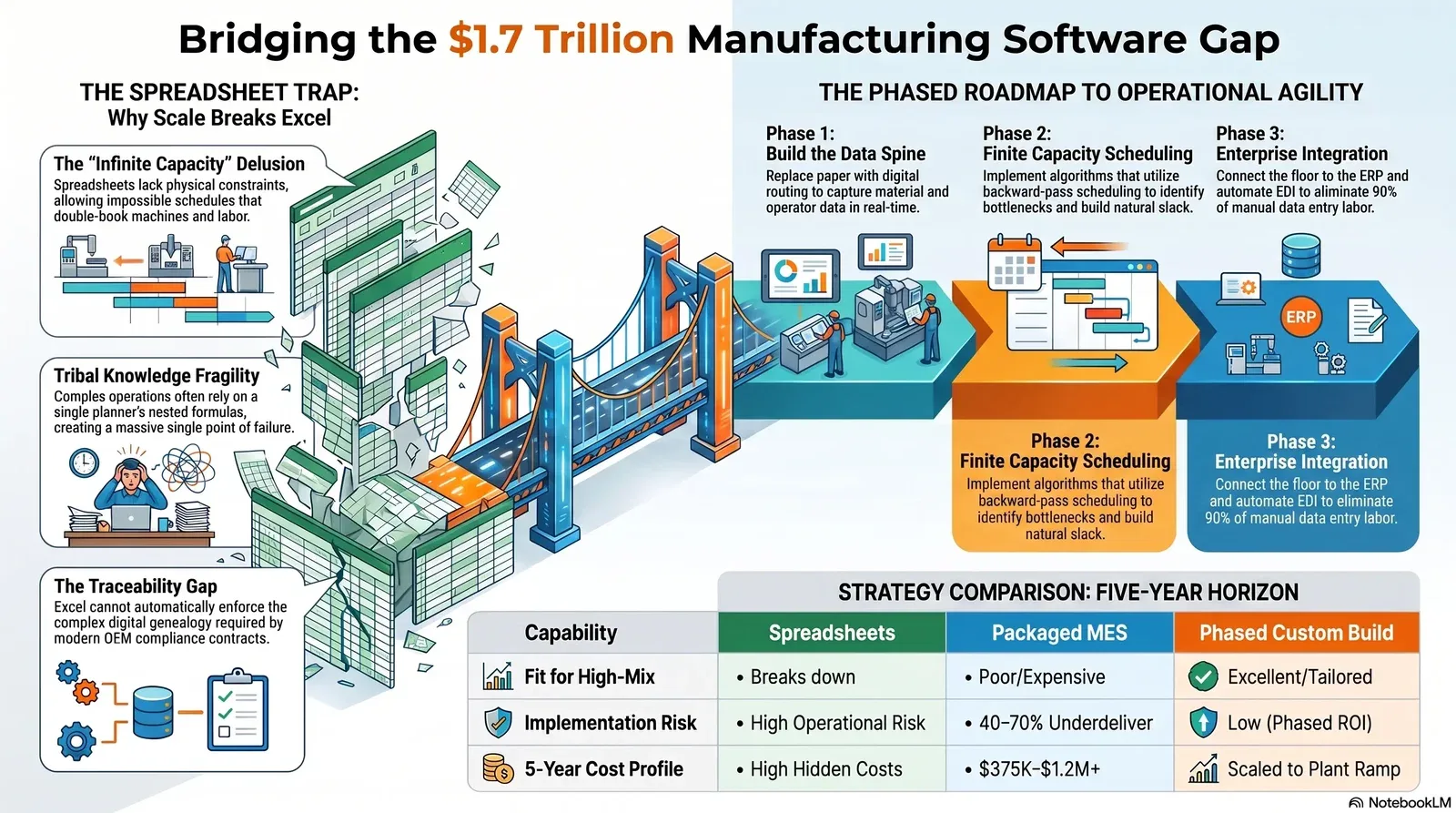
The most immediate failure mode is the infinite capacity assumption. A spreadsheet will happily allow a planner to assign 400 hours of work to a CNC mill that only has 160 available hours in a month. Spreadsheets accept labor assignments without checking operator availability and schedule simultaneous jobs on the same machine.
Other structural failures quickly follow:
The Fragility of Tribal Knowledge: Complex scheduling spreadsheets are typically built by a single experienced planner who understands every nested formula, color code, and manual workaround. This concentration of knowledge represents a critical business risk. If that planner leaves the company or takes a vacation, the schedule becomes an unmanageable black box. The operational system should hold the business logic, not a single individual. A modern agile development methodology helps you gradually move that logic into reliable software instead of one overworked expert’s head.
Cascading Schedule Errors: Planners using Excel intuitively default to forward scheduling—starting a job now and working forward to see when it lands. Forward scheduling provides zero buffer. A single one-day material delay cascades into every subsequent operation, turning a minor issue into a major shipping miss. Furthermore, a single manual data entry error, such as typing 100,000 units instead of 10,000, artificially blocks raw materials and machine time across the entire facility.
Zero Traceability: Modern OEM contracts frequently require complete digital genealogy. If a field failure occurs, the manufacturer must trace backward from the serial number to identify the exact production conditions, material lots, and operators. Excel cannot automatically enforce or track these complex relational data structures across thousands of parts.
The Shop Floor Disconnect: A planner builds a schedule in the office; the operators ignore it on the floor. Without real-time equipment data—such as a machine running slow on Fridays or tooling that requires extra attention—the spreadsheet schedule is obsolete the moment the shift begins.
When the schedule does not reflect reality, lead times extend, inventory balloons to cover the uncertainty, and the factory defaults to reactive firefighting. Clean operational data is the prerequisite for every automation and analytics investment that follows; you must build the data spine first.
The Packaged vs. Custom Software Decision
Recognizing that spreadsheets are unsustainable, manufacturers typically evaluate packaged ERP or MES platforms. Packaged software fits perfectly in high-volume, standardized environments where the company is willing to adapt its internal processes to match the software's hardcoded workflows.
Reshored mid-market operations rarely look like this. They tend to involve high-mix production, custom fabrication, complex multi-site logistics, or hybrid processes that combine discrete assembly with continuous processing. Generic MES platforms model these hybrid operations poorly.
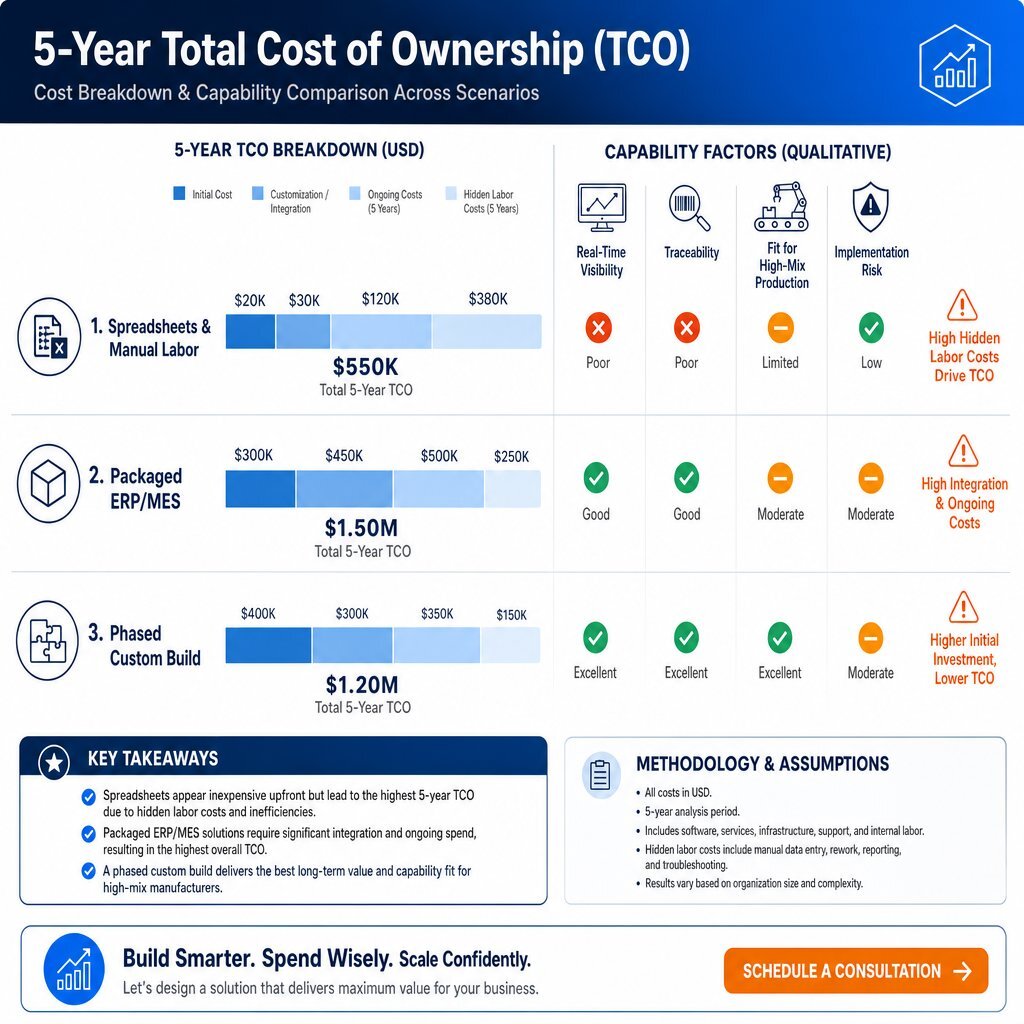
When a manufacturer attempts to force a packaged MES to fit a highly custom process, the total cost of ownership (TCO) rapidly balloons. Industry data shows that while initial software licensing for an MES might cost $50,000 to $300,000, professional implementation services, custom integration development, and ongoing per-seat licenses push the five-year TCO to 200–300% of the initial software cost.
For high-mix manufacturers, a custom-built software architecture delivers faster time-to-value without the recurring licensing bloat or forced process changes. That’s especially true when you treat this effort as a structured discovery and planning exercise instead of a one-shot gamble, using a rigorous discovery phase checklist to define scope, risks, and must-have capabilities up front.
Five-Year Total Cost and Capability Comparison
| Capability | Spreadsheets & Manual Labor | Packaged ERP / MES Suite | Phased Custom Software Build |
|---|---|---|---|
| Real-Time Visibility | None. Data is retroactive and siloed. | High, assuming successful integration. | High. Built iteratively around actual floor workflows. |
| Fit for High-Mix Production | Breaks down under complexity. | Poor. Requires expensive customization and workarounds. | Excellent. Architected specifically for the plant's unique constraints. |
| Traceability & Genealogy | Manual, error-prone, untrustable. | Excellent out-of-the-box for standard discrete manufacturing. | Fully tailored to exact OEM compliance requirements. |
| Implementation Risk | High operational risk (single point of failure). | High financial risk. 40–70% of MES projects underdeliver. | Low. Phased deployment proves ROI at each gate. |
| Five-Year Cost Profile | High hidden costs in labor, scrap, and lost capacity. | High initial Capex (375K–1.2M) plus ongoing maintenance/seat licenses. | Gradual Capex mapped to plant ramp-up; zero per-seat licensing. |
Avoiding Integration Failures in the Architecture Phase
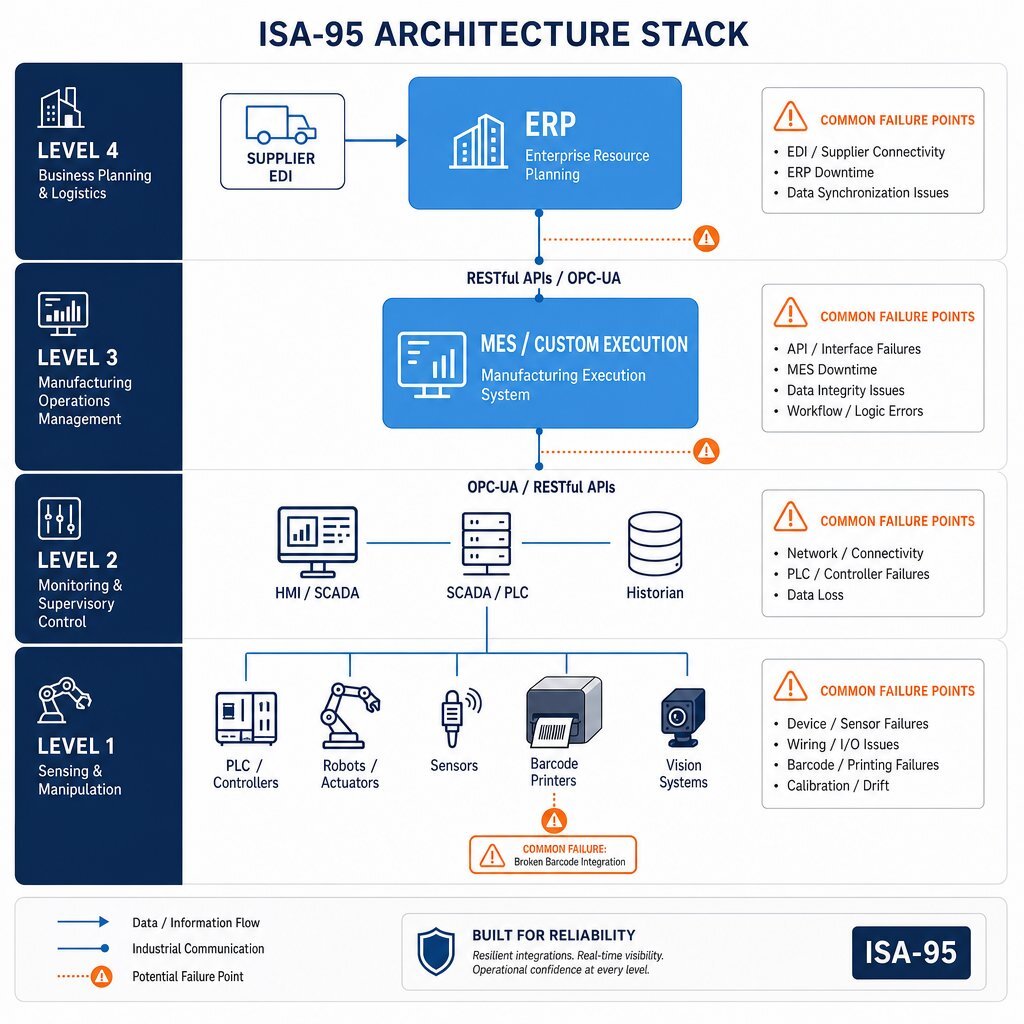
The friction point for any production system is where it touches other systems. Integration failures most often stall new plants, leaving expensive machinery waiting on data.
The most common point of failure is the ERP-to-floor connection. When planners attempt to push raw ERP schedules directly to the floor without translating them through an execution layer, operators receive unworkable instructions. A second major failure point is Electronic Data Interchange (EDI). Retaining manual steps between supplier EDI systems and internal production platforms creates inconsistent data quality; automating this transmission removes the need for manual order entry, which can eliminate up to 90% of data entry labor.
Labeling and barcode integration also routinely break down. When an ERP system retrieves order details but fails to sync with barcode scanners on the production line, operators print incorrect labels, completely destroying inventory traceability.
These failures are avoided in the architecture phase by strictly decoupling the systems. Utilizing an ISA-95 stack approach, architects separate business logistics (ERP at Level 4) from manufacturing operations (MES at Level 3). Modern custom software uses RESTful APIs and OPC-UA protocols to establish secure, event-driven communication between the cloud and the factory floor. By establishing clear master data sources of truth and relying on robust relational databases like PostgreSQL or SQL Server, data flows seamlessly from supplier EDI, through the scheduling engine, and directly to the barcode printer. Teams that follow solid DevOps practices and automation here ship changes faster and keep integrations stable under real-world load.
The Phased Roadmap for Custom Software
The primary reason legacy software modernization fails is the "big bang" deployment model. Attempting to deploy production tracking, automated scheduling, quality management, and ERP integration simultaneously overwhelms the plant floor.
A phased custom build aligns technology investments with a 12-to-24-month plant ramp-up, proving value at every stage and reducing the risk of runaway scope creep in your contracts.
Phase 1: Production Tracking and Genealogy (Months 1–6)
The goal is to build the operational data spine. Manufacturers replace paper travelers with digital routing, ensuring every part gets a digital birth record capturing raw materials, machine assignments, and operator handling. At this stage, focus heavily on cleansing master data—equipment hierarchies, bills of materials, and work centers. A UX-led design approach here also makes data capture simple enough that operators will actually use the system.
Estimated Cost Range: 50,000 – 150,000.
Phase 2: Finite Capacity Scheduling (Months 6–12)
The goal is to eliminate the spreadsheet and the tribal knowledge dependency. Developers implement a scheduling algorithm that understands physical constraints. Instead of forward scheduling, the custom module utilizes a backward pass—starting from the due date and working backward to find the latest possible start time, building natural slack into the schedule and immediately flagging capacity bottlenecks.
Estimated Cost Range: 150,000 – 300,000.
Phase 3: Quality and Integrations (Months 12–18)
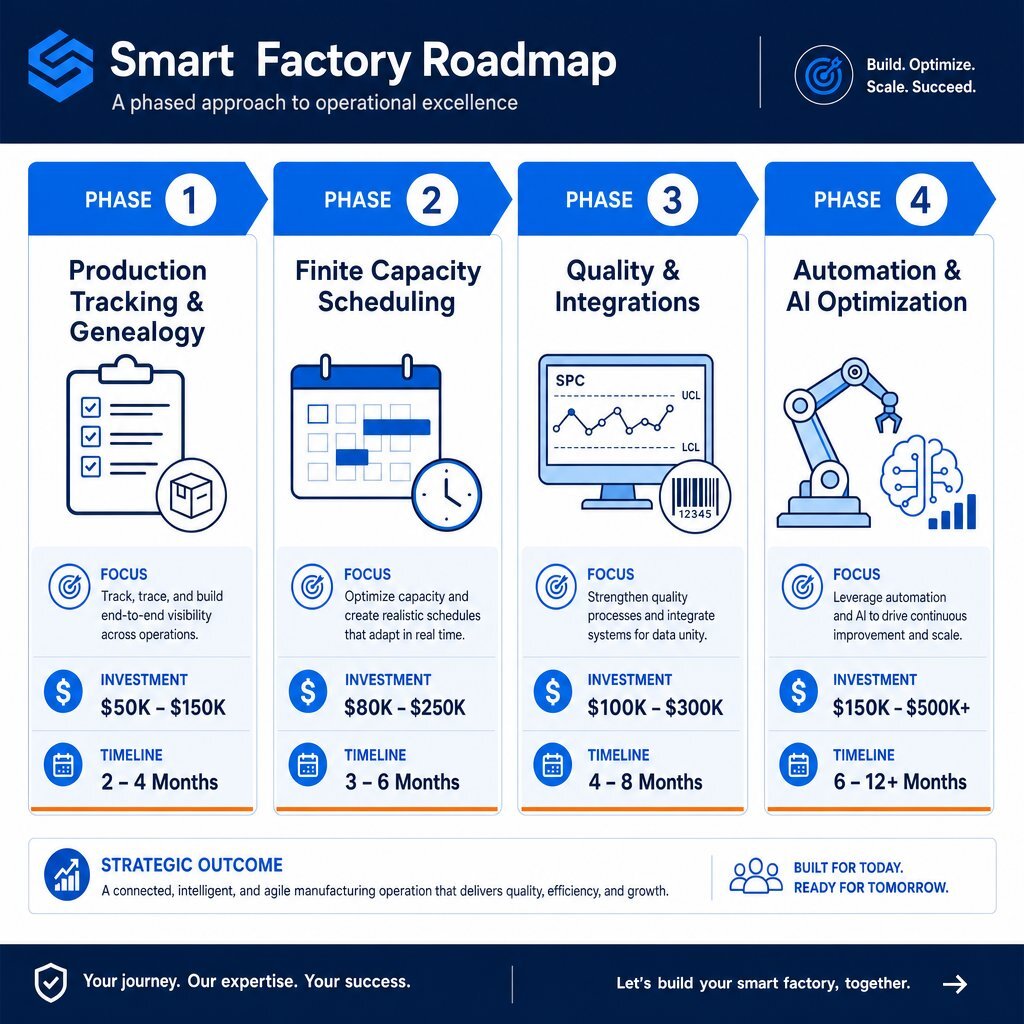
The goal is to connect the floor to the enterprise. The system moves beyond pass/fail inspection to statistical process control (SPC) data collection, alerting operators to process drift before defects occur. Simultaneously, developers execute critical integrations: ERP-to-floor data syncs, automated barcode label printing, and EDI with key suppliers.
Estimated Cost Range: 100,000 – 250,000.
Phase 4: Automation and Optimization (Months 18–24+)
The goal is to leverage the clean data spine for advanced capabilities. According to Deloitte's 2026 Manufacturing Industry Outlook, 80% of manufacturing executives plan to invest 20% or more of their improvement budgets in smart manufacturing initiatives, with agentic AI poised to elevate operations by autonomously detecting and mitigating supply chain risk. With a custom data architecture in place, the plant can seamlessly integrate machine-level sensors, or deploy agentic AI dispatch-style systems to manage exceptions and dynamic scheduling.
Estimated Cost Range: Varies based on automation hardware scale.
Why This Matters to Your Valuation: The Private Equity Angle
For owner-operators of mid-market manufacturing firms, this software gap is not just an operational headache—it is a strict valuation ceiling.
Private equity enters 2026 flush with dry powder, shifting away from growth-at-any-cost strategies toward disciplined operational value creation. According to BDO's 2026 Manufacturing Industry Predictions, PE firms are explicitly accelerating investments in mid-market players that exhibit "incomplete technology integration".
Acquirers actively seek companies with solid customer bases and capable machinery but disconnected data systems. They know that by ripping out spreadsheets and standardizing the software layer, they can immediately drive efficiencies, increase EBITDA, and capture the value the current owner is leaving on the table. That often includes a focused project rescue effort to fix or replace half-finished MES and ERP integrations.
Furthermore, BDO emphasizes that operational agility will shift from a competitive advantage to a survival requirement in 2026. Manufacturers must be able to pivot production schedules dynamically in response to supply availability while minimizing the impact on throughput and working capital. A shop floor tethered to a brittle Excel sheet cannot pivot; it can only break.
If you plan to scale, acquire, or eventually exit, modernizing your operational software stack ensures you capture that valuation premium yourself, rather than discounting it to a financial sponsor.
Your 90-Day Software Gap Assessment Checklist
Before committing capital to a new software initiative, manufacturing executives must accurately map their current vulnerabilities. Use this checklist over the next 90 days to assess your software gap:
| Assessment Area | Critical Evaluation Question | Red Flag Indicator |
|---|---|---|
| Single Points of Failure | Can your production schedule be reliably managed and executed if your primary planner is absent for two weeks? | Only one person understands the scheduling formulas. |
| Traceability Compliance | Review the compliance contracts from your top three OEM customers. Can your system generate a complete product genealogy report in under four hours? | Genealogy requires manually pulling physical paper records. |
| Integration Friction | How many times is data manually re-entered between your ERP, shop floor whiteboards, and quality systems per shift? | Operators spend more than 10% of their shift doing data entry. |
| Process Complexity | Map your workflows. Are your processes highly standardized or high-mix/hybrid? | Standardized processes fit packaged MES; high-mix processes break them. |
| The Cost of Spreadsheets | Audit last quarter's operational data. What were the costs of expedited shipping, excess raw material buffer, and machine downtime caused by scheduling errors? | Expedited freight costs consistently exceed the logistics budget. |
Conclusion
The latest wave of American manufacturing investment will not be won simply by pouring concrete and plugging in modern machinery. It will be won by the organizations that successfully bridge the software gap. Attempting to manage a modern, high-mix facility on spreadsheets ensures operational fragility. Conversely, betting the factory on a monolithic packaged MES implementation risks severe budget overruns and timeline failures.
The most resilient path forward is a phased, custom software build that matches technology deployment to the physical reality of the plant. By establishing a clean data spine for production tracking, layering on finite capacity scheduling, and integrating seamlessly with existing enterprise systems, manufacturers achieve the operational agility required to thrive.
Baytech Consulting specializes in custom software development and application management for complex B2B environments. Through our Tailored Tech Advantage and Rapid Agile Deployment methodologies, we architect systems using enterprise-grade infrastructure—utilizing PostgreSQL, SQL Server, Docker, and Kubernetes—ensuring your software scales exactly as fast as your production line. If your current stack already includes AI-generated components or rushed integrations, a structured modern code rescue can stabilize things before you scale further.
Stop managing your factory's future in a spreadsheet. Build the software that builds your business, and make sure your data is truly AI-ready for the next wave of manufacturing automation.
FAQ
What is the hidden cost of integrating an off-the-shelf MES with a legacy ERP? The initial licensing fee for an off-the-shelf MES is rarely the final cost. Integration development—connecting ERP data, machine interfaces, and custom workflows—routinely pushes the total cost of ownership to 200–300% of the initial software price, often delaying time-to-value by over a year. A phased custom build mitigates this by strictly scoping and deploying integrations iteratively, following the same kind of disciplined approach used in AI-powered productivity improvements so you can move fast without piling up technical debt.
Supporting Links
- US Manufacturing Reshoring Boom: What the Data Says
- 2026 Manufacturing Industry Predictions
The 11 Critical EDI ERP Integration Mistakes That Cost Companies Millions
About Baytech
At Baytech Consulting, we specialize in guiding businesses through this process, helping you build scalable, efficient, and high-performing software that evolves with your needs. Our MVP first approach helps our clients minimize upfront costs and maximize ROI. Ready to take the next step in your software development journey? Contact us today to learn how we can help you achieve your goals with a phased development approach.
About the Author

Bryan Reynolds is an accomplished technology executive with more than 25 years of experience leading innovation in the software industry. As the CEO and founder of Baytech Consulting, he has built a reputation for delivering custom software solutions that help businesses streamline operations, enhance customer experiences, and drive growth.
Bryan’s expertise spans custom software development, cloud infrastructure, artificial intelligence, and strategic business consulting, making him a trusted advisor and thought leader across a wide range of industries.