
The Quiet Share Shift: Why Your Customers Want Self-Service
July 29, 2026 / Bryan Reynolds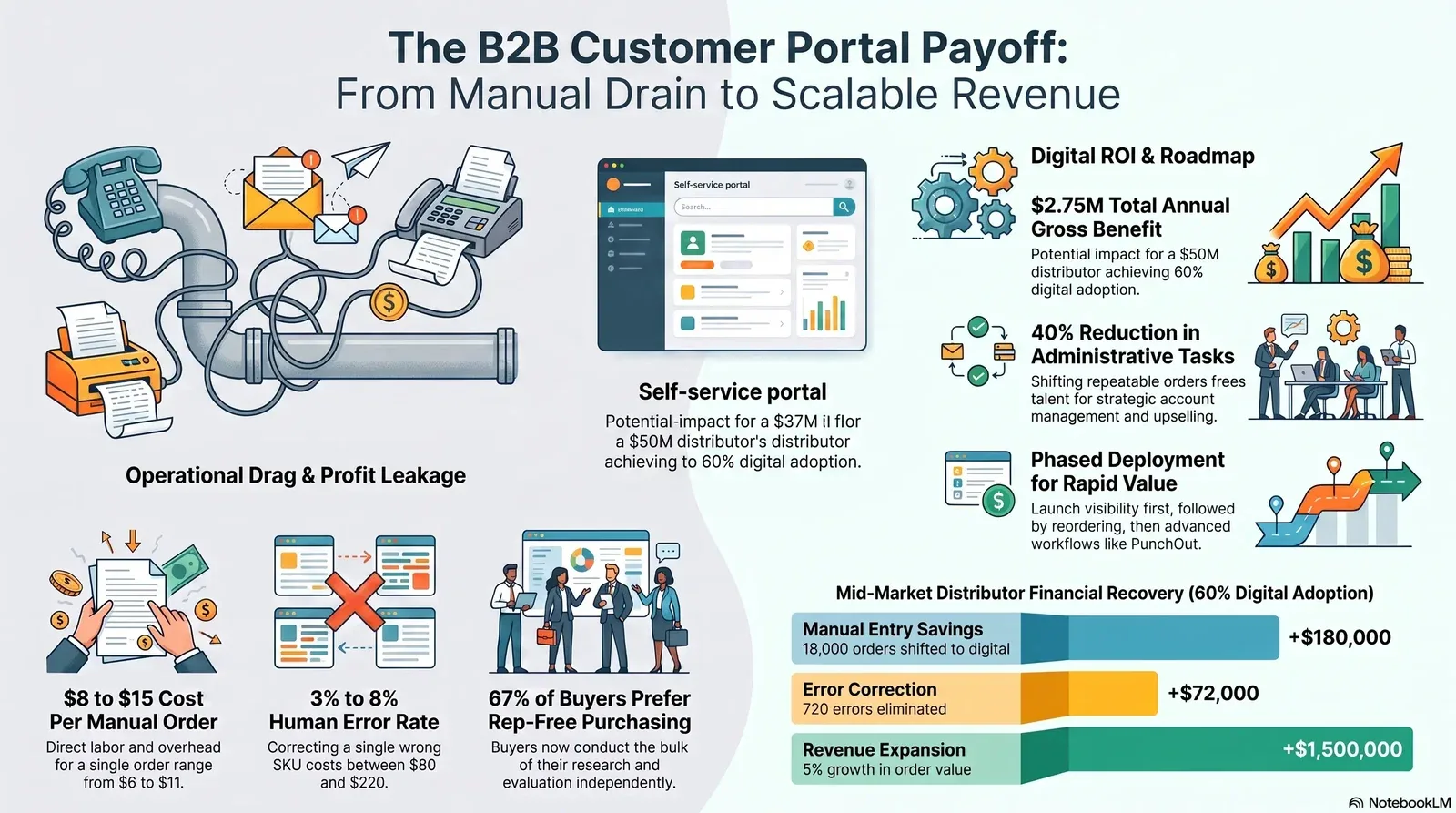
Your best customer's newest purchasing manager has never ordered by phone in their life. When your competitor gives them a digital login and you give them a voicemail box, the share shift does not announce itself—it just shows up in next quarter's revenue numbers.
Business-to-business buying behavior has shifted decisively toward digital self-service. Enterprise buyers expect the frictionless ordering experience they receive as consumers: they want to search the catalog, see their exact contract pricing, check live availability, and place orders without ever calling a sales representative. For distributors and manufacturers still taking orders by phone, email, and fax, investing in B2B customer portal development is both a defensive necessity to prevent account churn and an offensive margin play that stops representatives from keying in data and redirects them toward genuine selling.
This report makes the financial return on investment (ROI) case for a self-service ordering portal, compares packaged B2B ecommerce platforms against custom portal development, and outlines a phased architectural roadmap anchored in enterprise resource planning (ERP) integration.
The Quiet Share Shift: Why Buyers Demand Self-Service Ordering
The baseline for competing in B2B markets has moved. Omnichannel engagement is no longer a competitive differentiator; buyers simply assume it exists. The traditional sales model, where a representative controls the flow of product pricing and availability, is actively bypassed by the modern purchasing committee.
B2B buyers overwhelmingly prefer rep-free purchasing. Recent market data shows 67% of B2B buyers favor a completely rep-free digital experience, conducting the bulk of their research independently. Buyers currently spend a mere 17% of their total purchasing journey interacting directly with potential suppliers. The vast majority of the buying process is consumed by internal alignment, independent evaluation, and digital research. If a supplier fails to offer a digital self-service portal during this decisive window, that supplier remains invisible.
Digital tools and self-directed research have also accelerated the buying cycle. The average B2B purchase cycle compressed from 11.3 months in 2024 to 10.1 months in 2025. Buyers move faster because artificial intelligence and digital portals allow them to gather data and reach consensus without waiting for sales callbacks. Consequently, 95% of the time, the winning vendor was already on the buyer's "Day One" shortlist. Aligning your portal roadmap with a rigorous discovery phase keeps you on that shortlist.
When buyers do engage, their tolerance for friction is nonexistent. Inconsistent information across channels is now the leading driver of supplier switching. A staggering 52% of B2B buyers state they will abandon a supplier if the digital portal, marketing materials, and sales representatives provide contradictory information regarding price or lead times. A portal must act as an unmediated window into your operational truth, backed by disciplined DevOps and integration practices.
The True Cost of Manual Order Entry
To justify the capital expenditure of a digital portal, executives must first quantify the financial drain of their existing manual processes. Manual entry destroys margins through hidden labor costs, error correction, and misallocated talent.
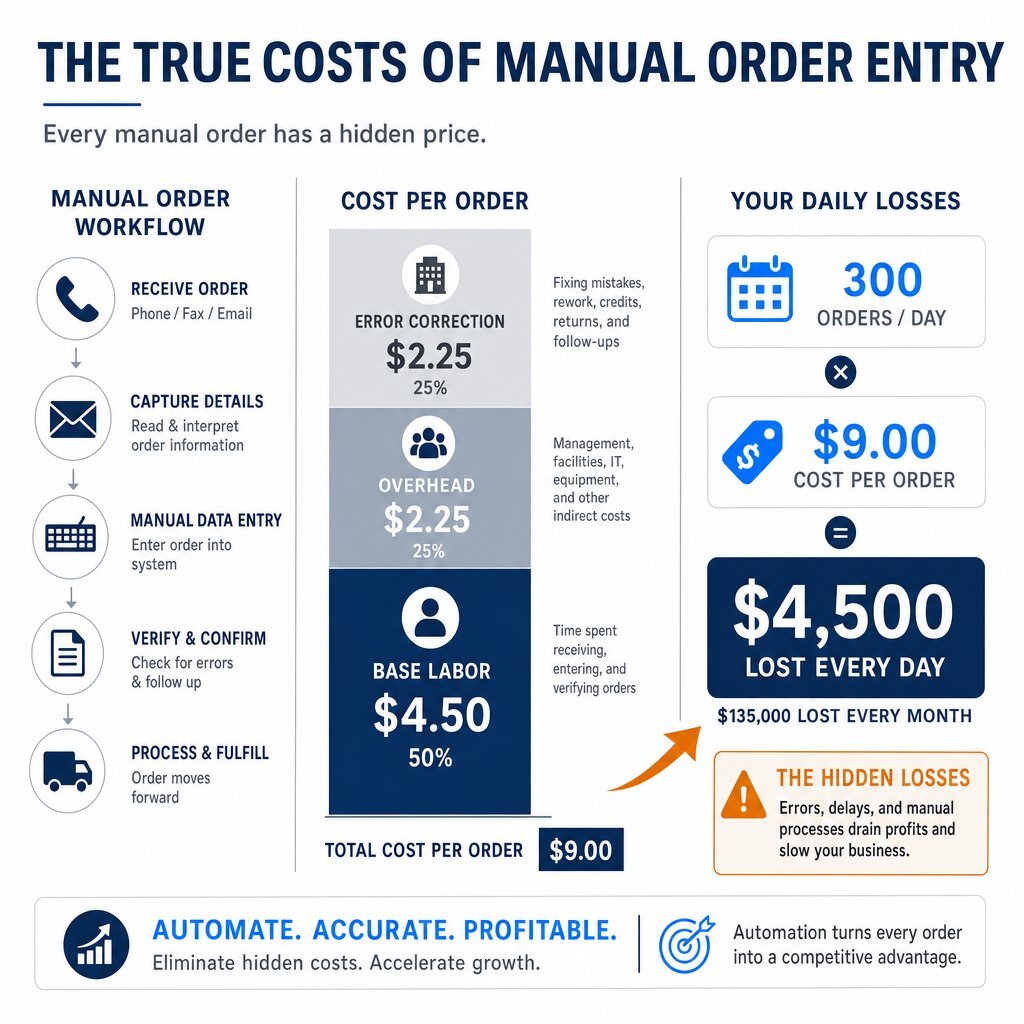
The industry benchmark for manually processing an order sits between 8 and 15, depending on labor rates and overhead. A standard manual order takes between 5 and 8 minutes to process end-to-end: opening the email, identifying the customer, looking up part numbers, checking inventory, applying pricing, entering the order into the ERP, and sending a confirmation. At a fully loaded customer service representative cost of 22 to 28 per hour, the realistic direct labor cost per clean order settles between 4.50 and 6.00, with operational overhead adding another 1.50 to 2.50. For a mid-market distributor processing 300 orders daily, manual entry costs up to $4,500 every single day before a product ever ships.
Manual entry guarantees human error. The established error rate for manual B2B order entry is 3% to 8% of all order lines. Not all errors carry the same financial penalty:
Wrong SKU or Product Code: Accounting for up to 40% of mistakes, these errors require return logistics, emergency reshipping, and extensive labor. The total cost per incident ranges from 80 to 220.
Wrong Pricing Tier: When uncommunicated contract updates or manual overrides lead to discrepancies, under-pricing drains profit margins permanently. Over-pricing damages trust and requires credit notes. The total cost per incident ranges from $40 to $300.
Customer service teams routinely spend 20% to 40% of their week simply transcribing data into the ERP. Shifting repeatable orders to a self-service portal frees this talent to focus on strategic account management and complex upselling instead of clerical work, especially when paired with Agile delivery practices that keep the portal evolving with the business.
What Defines a True B2B Customer Portal?
A fundamental error in digital transformation is conflating a consumer-style e-commerce storefront with a B2B customer portal. Bolting a generic shopping cart onto a complex wholesale business model leads to low adoption rates. Business buyers do not want to "shop" your site; they want to procure efficiently.
A true portal is defined by strict governance, deep ERP integration, and contract awareness.
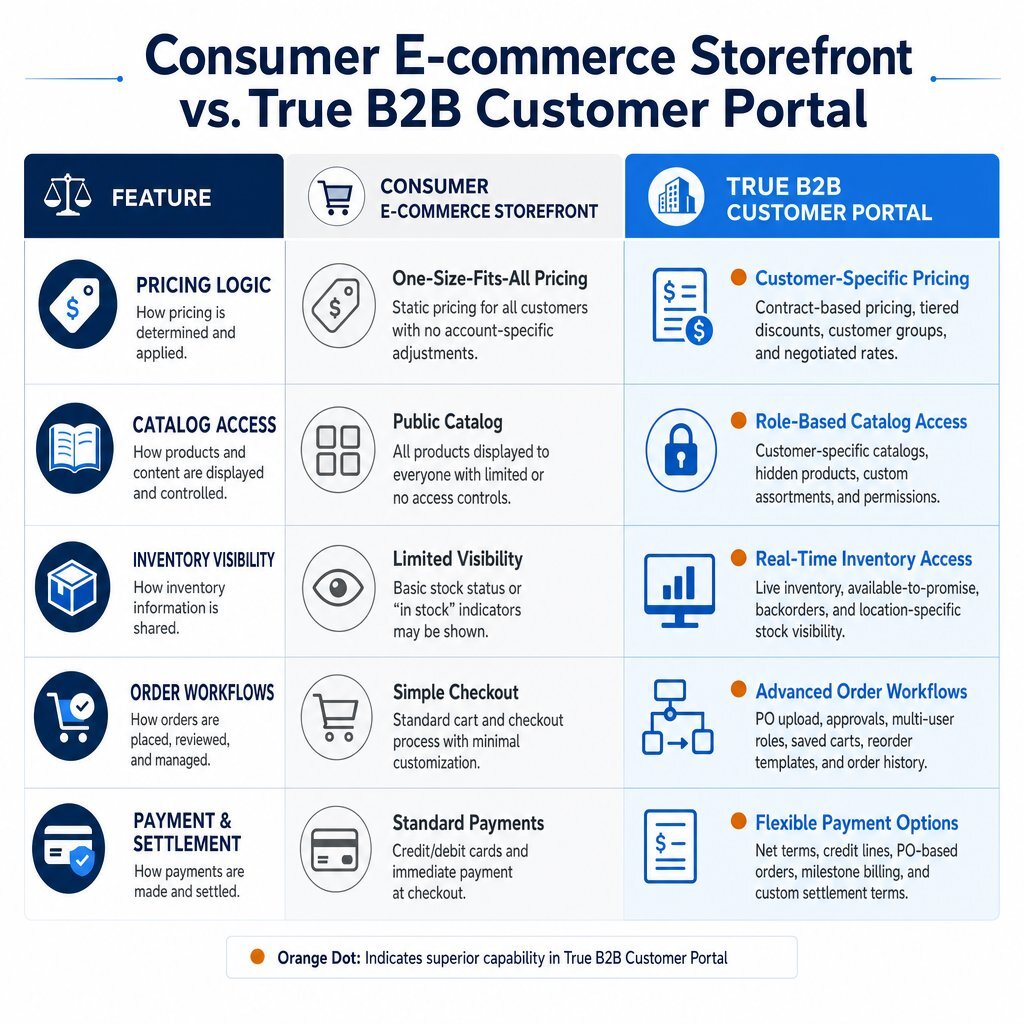
| Feature Category | Consumer E-commerce Storefront | True B2B Customer Portal |
|---|---|---|
| Pricing Logic | Uniform pricing for all visitors, occasional promo codes. | Contract-aware pricing calculated per account, volume tiers, and line-item overrides synced from the ERP. |
| Catalog Access | Fully public, indexed by search engines. | Gated or segmented catalogs; buyers only see products they are authorized to purchase. |
| Inventory Visibility | Simple "In Stock" or "Out of Stock" binary tags. | Real-time Available-to-Promise (ATP) data, multi-warehouse visibility, and precise lead times. |
| Order Workflows | Add to cart and immediate checkout. | Saved requisition lists, one-click reordering from history, and multi-tier manager approval routing. |
| Payment & Settlement | Credit card or digital wallet at checkout. | Net-30/60 terms, credit limit validation, purchase order (PO) number capture, and invoice payment. |
Navigating the CPQ Boundary
As you map portal requirements, you must delineate between standard self-service ordering and Configure, Price, Quote (CPQ) functionality. Portals excel at the transactional, repeatable ordering of standard SKUs. CPQ software is required when products are highly complex, featuring nested dependencies, dimensional variables, and dynamic margin-based pricing rules. An organization should deploy custom CPQ engines only for highly configurable products; forcing CPQ logic onto standard transactions introduces unnecessary friction for the buyer and inflates technical debt in your pricing stack.
The PunchOut Requirement
For enterprise-level buyers utilizing their own procurement systems (like Coupa or Ariba), a standard web login is insufficient. These organizations require a "PunchOut" catalog integration. PunchOut allows a buyer to log into their own corporate procurement system, securely authenticate into your portal, build a cart, and "punch out"—transferring the cart data (via cXML or OCI protocols) directly back into their own system for internal approval. Offering PunchOut eliminates rogue spending and locks you in as a preferred vendor, especially when combined with modern identity and accountability controls for any AI that supports purchasing workflows.
B2B Customer Portal Development: The Build-vs-Buy Framework
Technical leadership faces a critical decision: buy a packaged SaaS platform or build a custom portal. The market offers a wide spectrum of solutions, but total cost of ownership (TCO) scales aggressively as business complexity increases.
Packaged platforms fit standardized catalogs and simple pricing models:
Shopify Plus (B2B): Shopify provides exceptional speed to launch and highly reliable managed infrastructure. It fits direct-to-consumer brands expanding into light wholesale. However, it lacks deep native support for complex corporate account hierarchies, sophisticated quote-to-order workflows, and native ERP connectors.
BigCommerce (B2B Edition): BigCommerce occupies a strong middle ground, offering deeper native B2B functionality without the enterprise overhead of legacy systems. It supports account-specific pricing and quote workflows natively, and it does not charge transaction fees based on the payment gateway.
Adobe Commerce: For organizations with severe B2B complexity, Adobe Commerce natively supports multi-level company hierarchies and negotiated quotes. The trade-off is extreme operational overhead. Licensing, hosting, and development costs are exceptionally high, and version upgrades frequently break custom integrations.
Why Custom Development Wins for Complex Distributors
When a distributor's business logic resides entirely within a heavily customized ERP, forcing that logic into the rigid database schema of a packaged SaaS platform guarantees failure. Replicating complex volume-tier pricing and dynamic inventory allocation in a separate backend creates dual sources of truth that inevitably fall out of sync.
Custom B2B customer portal development utilizing a hybrid SaaS architecture provides the optimal balance. This approach combines composable, API-first frontend frameworks with secure middleware that queries the ERP in real-time. The portal never stores prices; it simply reflects the ERP's logic, which also supports safer AI-powered recommendations and search on top.
Baytech Consulting specializes in this Tailored Tech Advantage. By building custom portals using robust, enterprise-grade tech stacks (such as PostgreSQL and Visual Studio 2022 environments), Baytech allows distributors to maintain total ownership of the source code, deploy highly specific workflows, and scale without incurring the escalating GMV-based licensing fees of enterprise SaaS platforms.
| Platform Model | Target Market | Native B2B Depth | Estimated 3-Year TCO (10M-50M GMV) | Key Cost Drivers |
|---|---|---|---|---|
| Shopify Plus | Hybrid DTC / Light Wholesale | Low/Medium | 300,000 – 790,000 | App subscriptions, custom middleware, transaction fee tiering. |
| BigCommerce B2B | Mid-Market Distributors | Medium/High | 280,000 – 980,000 | B2B Edition licensing, integration development. |
| Adobe Commerce | Complex Enterprise B2B | Very High | 530,000 – 1,650,000 | High implementation cost, intensive ongoing DevOps, painful upgrades. |
| Custom Build | Highly Specialized Logic | Absolute | 250,000 – 800,000+ | Upfront engineering, custom API orchestration, cloud infrastructure. |
The ERP Integration Heart of the Build
A B2B portal is fundamentally an ERP integration project featuring a web-based frontend. The ERP must remain the single source of truth.
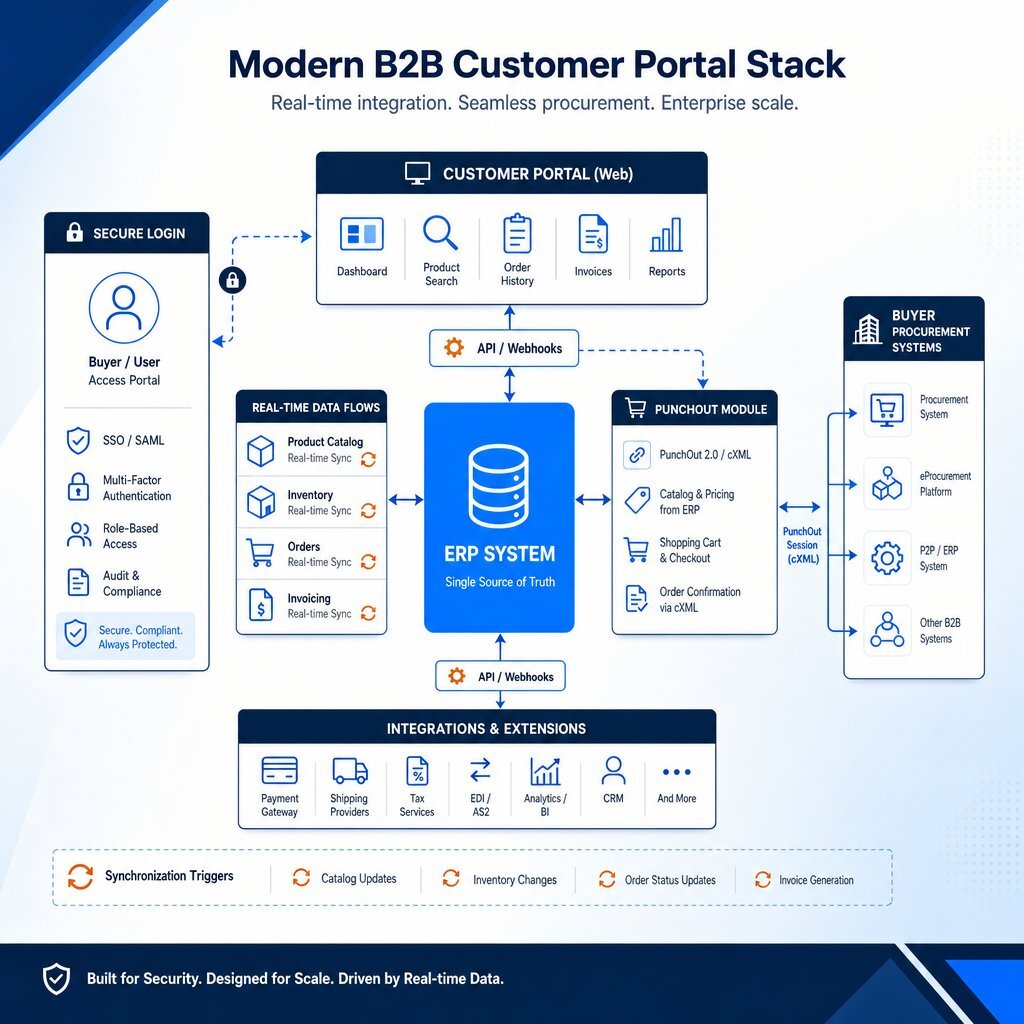
Historically, ecommerce integrations relied on nightly batch syncs. In 2026, this approach is actively dangerous. If an enterprise relies on batch processing, a buyer might log in at 10:00 AM and purchase units based on midnight inventory counts. If a sales representative depleted that stock at 9:00 AM, the portal creates a backorder without notifying the buyer, entirely negating the value of self-service.
Modern architectures demand event-driven, near-real-time synchronization using APIs and webhooks. Product catalogs and inventory levels push from the ERP to the portal via delta updates every few minutes. When a buyer submits an order, a webhook triggers an immediate payload transfer to the ERP, allocating inventory instantly. This kind of design mirrors the patterns used to lock down AI execution layers and keep systems consistent and safe.
Organizations achieve rapid time-to-value by phasing the integration build:
Phase 1: Visibility (Months 1-3). The portal launches with secure login, displaying the catalog, customer-specific pricing, live inventory, and historical invoices read directly from the ERP.
Phase 2: Reordering (Months 3-5). Implementation of cart functionality, allowing buyers to execute one-click reorders from their history.
Phase 3: Advanced Workflows (Months 5-8). Introduction of multi-level approval routing, quote requests, and PunchOut catalog capabilities that align with your broader enterprise application architecture.
Baytech Consulting's Rapid Agile Deployment methodology perfectly aligns with this phased approach, delivering transparent, on-time milestones that establish stable data pipelines before introducing complex transactional logic.
The Payback Model: Calculating B2B Ecommerce ROI
Executive leadership requires a quantifiable business case before authorizing digital transformation. The ROI of a self-service portal flows from three distinct streams.
- Labor Cost Reduction: By shifting transactional volume to the portal, distributors eliminate the direct labor of order entry. If a distributor processes 30,000 manual orders annually at a cost of $10 per order, the baseline processing cost is $300,000. Shifting 60% of that volume to self-service removes $180,000 in operational drag annually.
- Error Elimination: Assuming a 4% error rate on those 30,000 orders, manual entry generates 1,200 errors. At an average correction cost of $100 per error, mistakes drain $120,000 from the bottom line. Because portal orders rely on ERP-validated data, system-generated errors drop to zero, recovering $72,000 annually at a 60% adoption rate.
- Share of Wallet Growth: The most profound financial impact is revenue expansion. When purchasing becomes frictionless, buyers consolidate their spend. Digital portals natively present cross-sell opportunities that human representatives frequently miss. Migrating buyers to self-service routinely increases average order value and order frequency by 5% to 10%, particularly when you continuously refine the experience using insights from UX-led discovery.
Quantified Payback Scenario
Consider a distributor generating $50 million in annual revenue across 30,000 orders.
| Value Stream | Baseline Metric | Portal Impact (Assuming 60% Digital Adoption) | Annual Financial Impact |
|---|---|---|---|
| Manual Order Entry Savings | 30,000 orders @ $10/order | 18,000 orders shifted to digital | +$180,000 savings |
| Error Correction Reduction | 1,200 errors @ $100/error | 720 errors eliminated | +$72,000 savings |
| Rep Time Reallocation | 4,000 hours freed from data entry | Reps pivot to outbound sales, generating 2% net-new revenue | +$1,000,000 new revenue |
| Share of Wallet Expansion | $30M revenue from adopted accounts | 5% growth in AOV/frequency due to frictionless ordering | +$1,500,000 new revenue |
| Total Annual Gross Benefit | +$2,752,000 |
Even if a comprehensive custom portal and ERP integration project requires $450,000 in capital expenditure, the payback period is achieved in a matter of months. The portal transforms the cost center of order processing into a scalable revenue engine and creates a foundation for further AI-enabled productivity gains.
The Next Step in Digital Procurement
The transition toward digital self-service in B2B commerce is the dominant reality of the modern market. Organizations that continue to force buyers through manual, analog channels suffer silent attrition, losing market share to competitors that offer transparent digital procurement.
A successful B2B customer portal is a rigorous exercise in systems architecture. By treating the ERP as the immutable source of truth and utilizing a robust integration layer to present real-time pricing and seamless reorder workflows, distributors structurally lower their operational costs while driving revenue growth.
For organizations ready to architect a scalable digital commerce layer, Baytech Consulting provides the engineering precision required. With a commitment to enterprise-grade quality and strong client communication, Baytech builds secure custom portals that integrate flawlessly with existing operational systems. Reach out to Baytech Consulting to begin mapping your ERP integration and portal development roadmap, or even rescue a stalled project before it impacts revenue.
What requirements push a project toward custom B2B portal development rather than packaged SaaS?
Custom development becomes necessary when a business relies on highly complex, tiered pricing matrices, unique fulfillment logic, or multi-tenant architectures that conflict with the rigid database schemas of packaged SaaS platforms. When integration workarounds and third-party app subscriptions become more expensive and fragile than building natively, a custom architecture lowers the total cost of ownership and guarantees the ERP remains the single source of truth—especially for manufacturers and distributors planning deeper automation or broader software modernization.
Supporting Links
About Baytech
At Baytech Consulting, we specialize in guiding businesses through this process, helping you build scalable, efficient, and high-performing software that evolves with your needs. Our MVP first approach helps our clients minimize upfront costs and maximize ROI. Ready to take the next step in your software development journey? Contact us today to learn how we can help you achieve your goals with a phased development approach.
About the Author

Bryan Reynolds is an accomplished technology executive with more than 25 years of experience leading innovation in the software industry. As the CEO and founder of Baytech Consulting, he has built a reputation for delivering custom software solutions that help businesses streamline operations, enhance customer experiences, and drive growth.
Bryan’s expertise spans custom software development, cloud infrastructure, artificial intelligence, and strategic business consulting, making him a trusted advisor and thought leader across a wide range of industries.