
Stop Losing Cases: Plug Your Law Firm's Revenue Leak
July 31, 2026 / Bryan Reynolds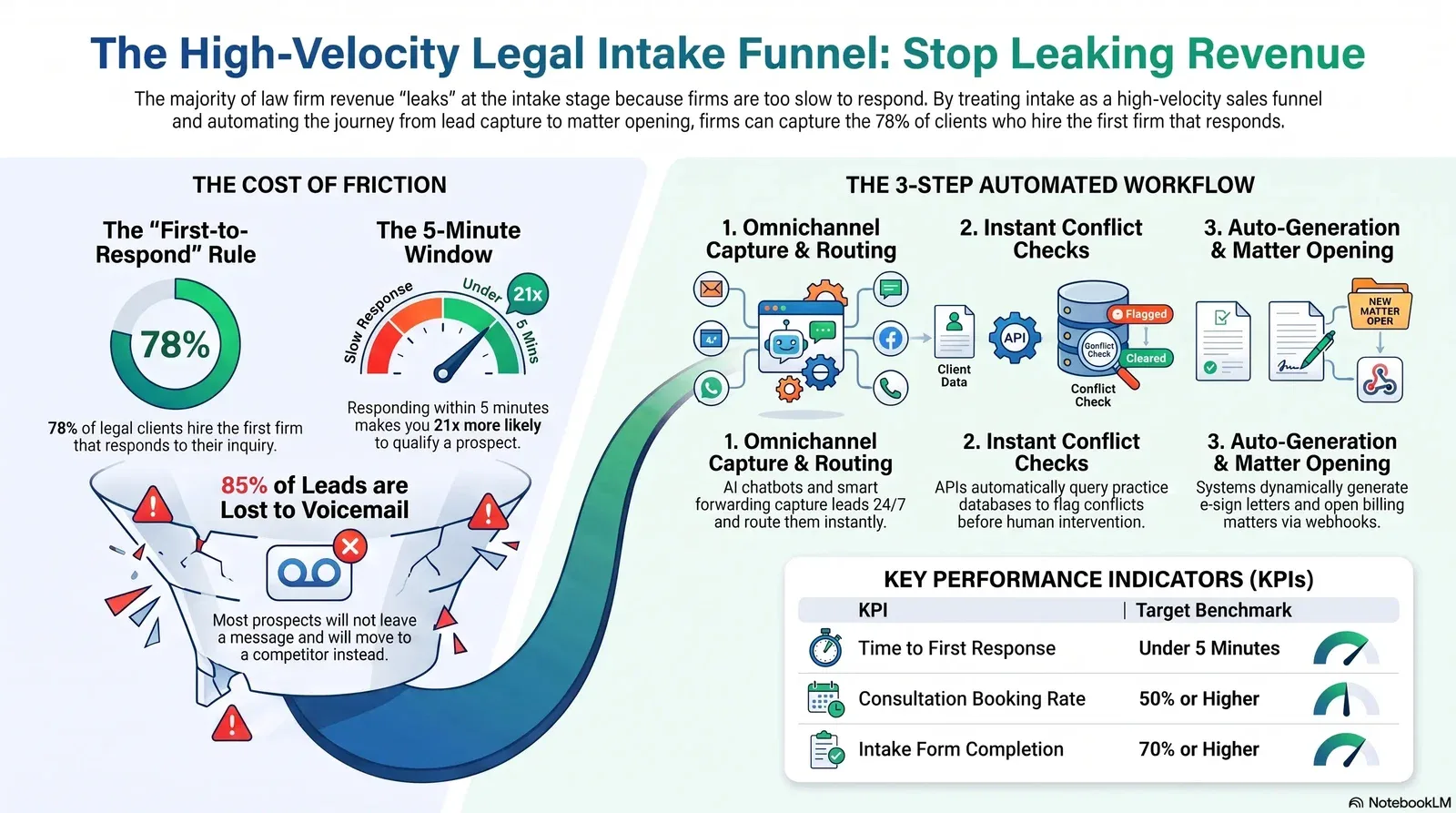
A prospective client who contacts three law firms typically retains the one that responds first. At many firms, however, the concept of "first" is determined by whichever associate happens to check the general inbox between meetings. Intake is not merely an administrative chore; it serves as the absolute top of the revenue funnel. Despite its financial importance, the majority of legal practices have never instrumented or measured their intake leak rate.
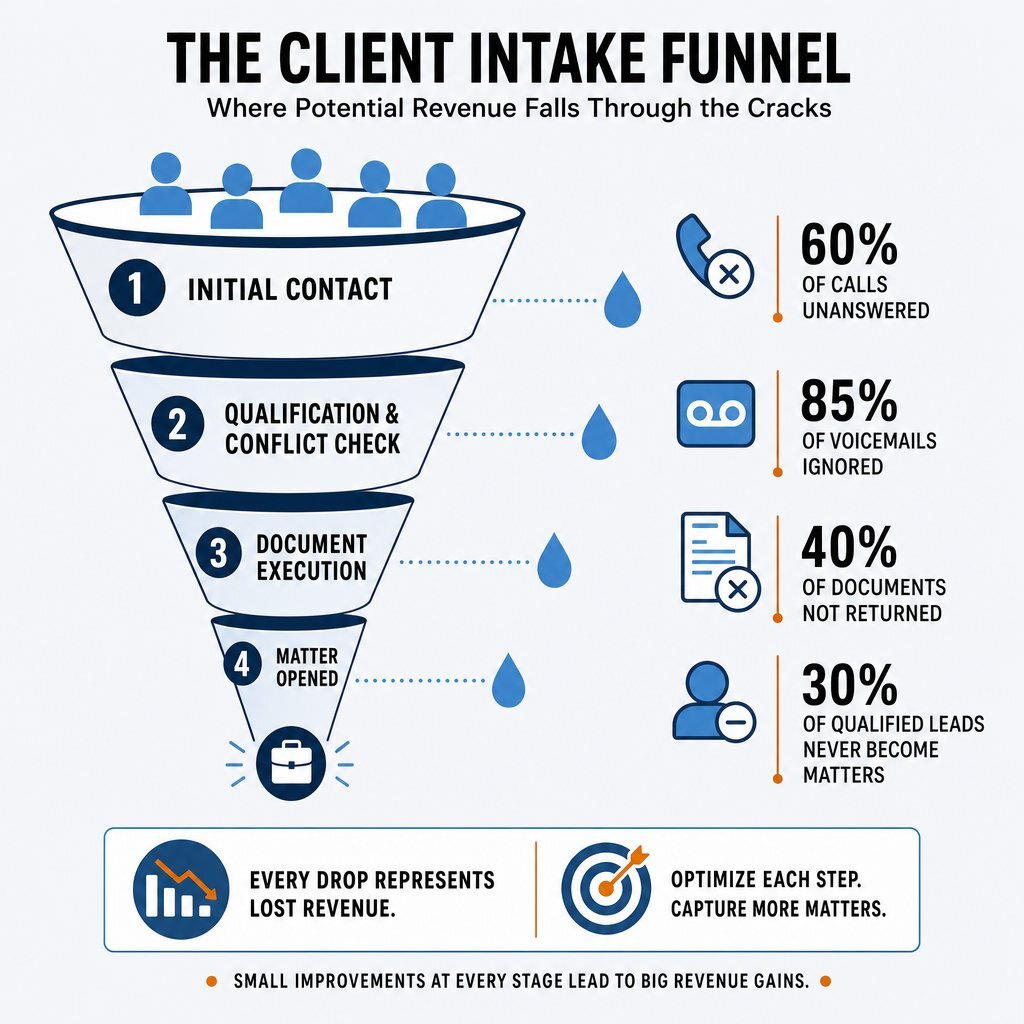
Legal technology coverage frequently fixates on generative artificial intelligence for legal research and document review, yet the highest-return software problem at small and mid-size firms is far more fundamental. The legal client intake process remains unmeasured, slow, and heavily reliant on manual effort. Consequently, firms consistently lose valuable engagements without ever realizing they were competing for them. Industry data confirms this operational failure: 60% of calls to law firms go unanswered, and 78% of legal clients hire the first firm that responds.
Solving this requires treating intake exactly like a B2B sales funnel—instrumented, automated, and relentlessly measured. High-performing law firm intake software must seamlessly handle lead capture, response routing, conflict checks against existing matter data, document collection, engagement letter generation, and automatic matter opening within the practice management system. While packaged legal intake tools function well for standardized, high-volume consumer practices, multi-practice firms with referral-heavy business models and entrenched practice management stacks require custom software integration to transform intake into a durable competitive advantage.
The Unmeasured Funnel: How Clients Actually Choose
The legal industry's relationship with client acquisition is structurally flawed. Consumers, conditioned by on-demand digital services, expect immediate answers. A recent national audit revealed that 48% of law firms are essentially unreachable by phone, and 35% of inbound calls go completely unanswered during standard business hours. The assumption that a distressed caller will leave a voicemail and patiently wait for a callback is obsolete. Statistics show that 85% of callers who reach a voicemail never leave a message, and 34% never attempt to contact the firm again.
Speed directly dictates the probability of conversion. Prospective clients shopping for legal representation operate within a remarkably narrow window of patience.
- Firms that respond to an inquiry within five minutes are 21 times more likely to qualify the prospect than those that wait just 30 minutes.
- A delay of just five minutes results in a 10% drop in lead contact rates.
- After 60 minutes, the likelihood of making successful contact drops by a factor of ten.
When a firm takes hours or days to return a message, the prospect has almost certainly moved to the next Google search result.
Mapping the Leaks in the Client Intake Workflow
To repair the revenue funnel, firm operations leaders must first map the exact stages where prospects abandon the process. The intake funnel leaks at predictable, quantifiable points.
At the top of the funnel, the most severe revenue leak occurs before a conversation even begins. Unreturned first contacts represent immediate capital loss. In the middle of the funnel, prospects frequently stall during the qualification and conflict-check stage. Manual intake processes average three to five business days to fully onboard a new client. A significant portion of this delay stems from administrative staff manually searching practice management databases using disparate spellings to hunt for adverse parties and related business entities. By day two of this manual delay, many highly qualified prospects have already retained a faster competitor.
At the bottom of the funnel, the final leak occurs during document execution. Prospects who verbally agree to representation often go cold while waiting for an associate to manually draft an engagement letter, format a PDF, and send it via email. Furthermore, administrative staff must then re-enter the exact same client data from the initial phone notes into the firm's billing and practice management systems, introducing data entry errors and delaying the start of billable work.
The Intake Funnel Audit Framework
Firms that have never instrumented their intake process must establish an audit framework to diagnose the financial damage. Operations leaders should implement systems to measure four specific key performance indicators (KPIs) over a continuous 30-day period.
| Key Performance Indicator | Definition | Recommended Benchmark |
|---|---|---|
| Time to First Response | Duration between initial contact (form submission, missed call) and the firm's first outbound human or AI-driven communication. | Under 5 minutes |
| Consultation Booking Rate | Percentage of qualified leads that successfully schedule a meeting with an attorney. | 50% or higher |
| Intake Form Completion Rate | Percentage of prospects who finish the required documentation after it is sent. | 70% or higher |
| Consultation-to-Retainer Conversion | Percentage of completed consultations that result in a signed engagement letter and paid retainer. | Monitored by practice area |
End-to-End Automation: Engineering the Intake Chain
End-to-end intake automation connects disparate, manual touchpoints into a single, continuous digital workflow. This architecture removes the administrative burden, ensuring attorneys focus exclusively on legal strategy rather than data entry.
The technical chain of an automated system operates sequentially through five distinct phases:
- Omnichannel Lead Capture: Automation begins the moment a prospect initiates contact. Advanced AI-powered chatbots embed directly onto the firm's website to capture leads 24/7. These tools answer basic questions, extract necessary case details, and screen out unqualified cases before they ever reach human staff. For phone inquiries, integrated answering services utilize smart forwarding to route complex calls directly to an attorney, while relying on AI to handle routine scheduling.
- Dynamic Routing Rules: Once captured, the system categorizes the lead based on practice area, jurisdiction, and urgency. Complex conditional logic automatically assigns the prospect to the correct attorney's calendar and pushes a notification payload to the intake team via internal communication channels (e.g., Microsoft Teams or Slack). This is where modern DevOps-style automation helps keep the whole intake pipeline fast and reliable.
- Automated Conflict Checking: Instead of a paralegal manually executing a database search, the custom software executes an Application Programming Interface (API) call directly to the firm's practice management system (such as Clio Manage, Filevine, or MyCase). The query automatically normalizes data and cross-references the prospective client's name, spouse, employer, and opposing parties against all active and archived matters.
- Document Collection and E-Signature: If the conflict check returns a clean result, the system dynamically generates an engagement letter populated with the exact data captured during the initial chat. It emails a secure e-signature link via integrations with providers like DocuSign, tracks the document's status, and sends automated SMS follow-up reminders if the document remains unsigned.
- Automatic Matter Opening: Upon signature execution, a webhook triggers the automatic creation of a new matter in the practice management system. The software provisions a secure client portal, establishes the billing ledger, and assigns the initial task list to the paralegal team without any human intervention. Over time, this can evolve into a broader automation platform that supports the firm’s AI agents and workflows across other practice operations.
Packaged Law Firm Intake Software vs. Custom Integration
The legal technology market offers several packaged Software-as-a-Service (SaaS) intake tools, including Clio Grow, Lawmatics, and specialized high-volume platforms like Law Ruler. Managing partners and CTOs must determine whether these off-the-shelf platforms align with the firm's operating model, or if the firm requires a custom-built solution integrated directly into its proprietary workflows.
SaaS is typically the correct initial move for standardized consumer practices—such as single-state personal injury or basic estate planning—because it deploys quickly and enforces standard procedures.
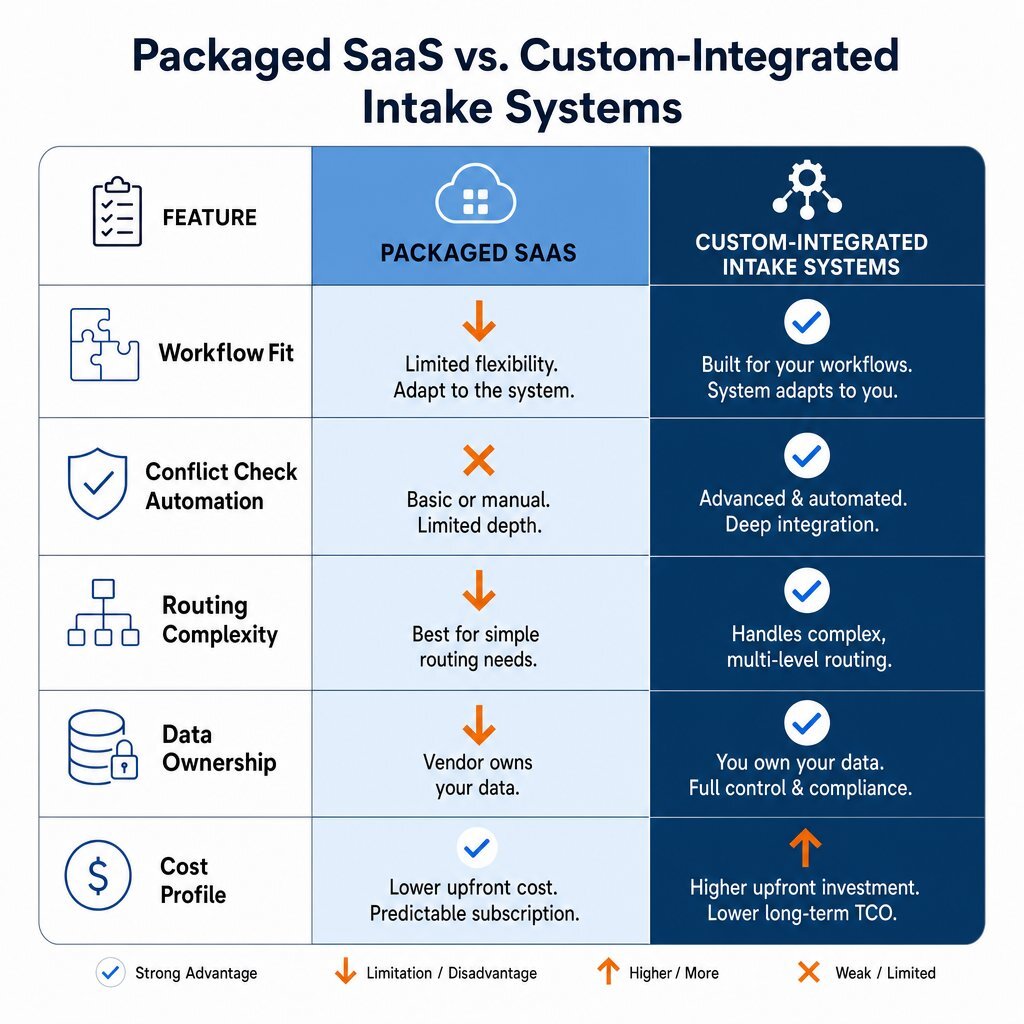
Custom software development becomes a strategic necessity when a firm's operational complexity outgrows generic software constraints. Multi-practice firms, corporate litigation boutiques, and referral-driven models frequently encounter severe limitations with packaged CRM routing rules and basic, single-string conflict checks. When a firm is forced to implement manual workarounds or employ separate spreadsheet trackers to compensate for a SaaS platform's limitations, the true operating cost eclipses the software's monthly subscription fee.
Assessing Fit and Total Cost of Ownership
| Evaluation Variable | Packaged SaaS (e.g., Lawmatics, Clio Grow) | Custom-Integrated System |
|---|---|---|
| Workflow Fit | Generic; forces the firm to adapt its processes to the vendor's limitations. | Tailored; built precisely around how legal work moves within the specific firm. |
| Conflict Check Automation | Basic native checks confined to the vendor's immediate ecosystem. | Deep API integration querying historical matter, billing, and third-party data simultaneously. |
| Multi-Practice Routing | Standardized rule sets, often struggling with cross-departmental lead distribution. | Highly complex conditional logic routing based on firm-specific criteria and attorney capacity. |
| Data Ownership | Trapped in a vendor-controlled ecosystem, creating strategic dependency. | Fully owned proprietary asset ensuring absolute data sovereignty and intellectual property retention. |
| Financial Profile | Low initial cost; high perpetual licensing fees (50-199/user/month) that compound indefinitely. | Higher upfront CapEx; drastically lower 5-year Total Cost of Ownership (OpEx) with zero per-user penalties. For firms facing aggressive AI-related vendor price hikes, the logic mirrors the broader SaaS pricing shift now hitting legal and professional services. |
The most common analytical error leadership teams make during this evaluation is comparing the subscription cost of a SaaS tool directly to the build cost of custom software, while entirely ignoring the hidden operating costs. When accounting for intake friction, client-follow-up pain, reporting cleanup, and the management attention required to maintain a fragmented SaaS stack, custom software frequently presents the more rational financial outcome.
The Custom Build: Architecture, Cost, and Timeline
Designing a custom client intake process requires meticulous architectural planning to ensure security, compliance, and flawless data synchronization with the firm's existing technology stack.
The core of a custom build relies on secure REST APIs and event-driven webhooks. A custom application acts as the orchestration layer, connecting the firm's lead-capture endpoints, communication services, and document management platforms directly into systems of record. A sophisticated implementation normalizes client data upon entry—ensuring that "John Smith" and "Smith, John" resolve to the exact same entity—before executing a simultaneous conflict check query against multiple relational databases. This type of orchestration benefits from the same data readiness and governance standards that underpin successful AI projects in other industries.
Cost Parameters and Phased Delivery
Firms should anticipate custom software development costs to scale strictly based on integration complexity and workflow depth. Based on 2026 pricing benchmarks, a Minimum Viable Product (MVP) focused purely on capturing leads, standardizing data, and automating basic conflict checks typically requires an investment of 40,000 to 120,000, with a development timeline of two to four months. A medium-to-high complexity build that incorporates multi-office routing, advanced conditional logic for disparate practice areas, and deep accounting integrations ranges from 120,000 to 300,000+, requiring four to eight months.
Leading engineering teams, such as Baytech Consulting, execute these builds using Rapid Agile Deployment methodologies. Instead of waiting eight months for a monolithic "big bang" launch, firms receive iterative, highly functional updates. Phase one might solely replace the static web contact form with an intelligent qualification routing engine, immediately capturing lost leads. Phase two introduces the automated conflict check via API, and phase three fully automates the engagement letter and matter creation process. This phased approach, similar to a well-run discovery and delivery cycle, accelerates the realization of business value and strictly mitigates development risk.
The Payback: Conversion Lift and the Analytics Dividend
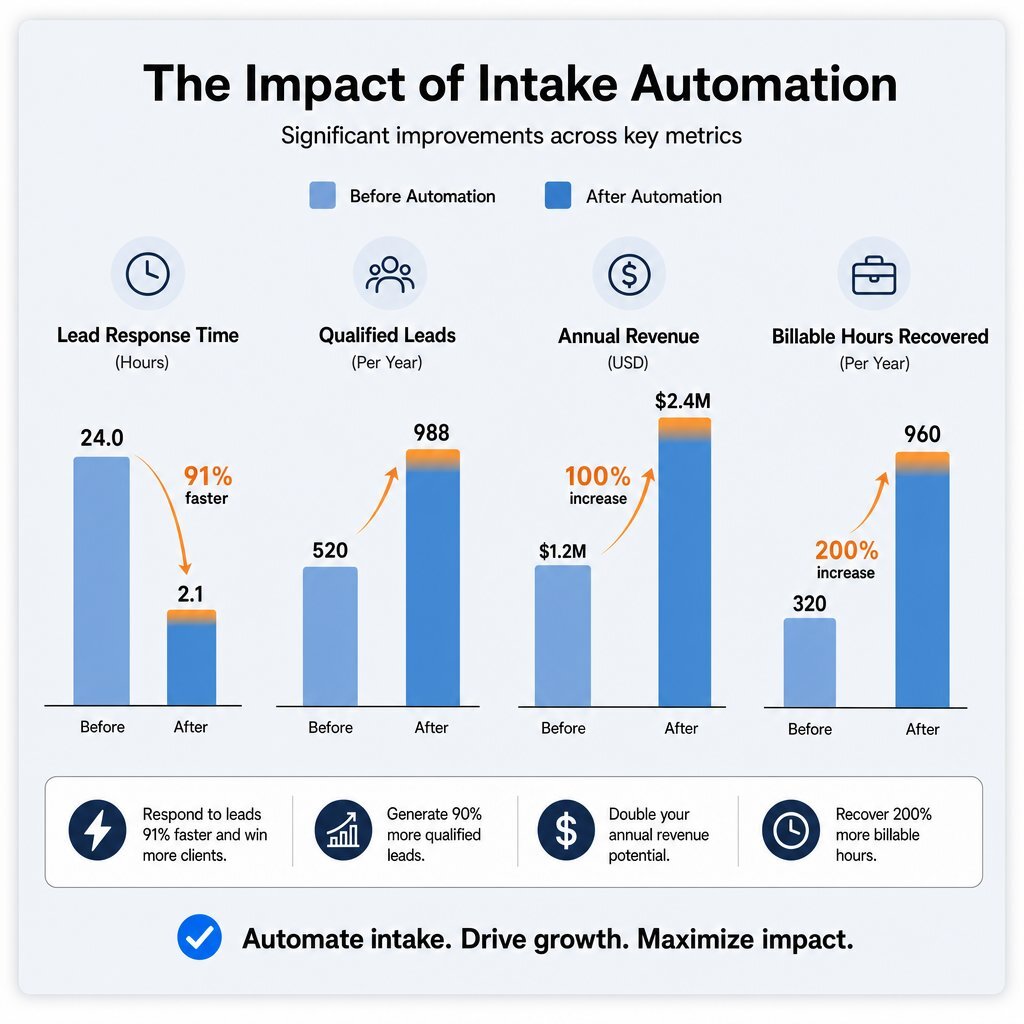
Allocating capital toward an automated intake funnel yields some of the most aggressive payback periods in legal technology. The financial justification rests on three distinct pillars: top-line conversion lift, recovered administrative capacity, and the acquisition of critical business intelligence.
The Mathematics of Conversion Lift
Speed is a direct, measurable multiplier of revenue. Firms utilizing digital intake tools observe 48% more client leads and generate 53% higher revenue than those relying on manual processes. Because 78% of clients retain the first firm to respond, collapsing response times from 42 hours to under five minutes immediately captures market share that was previously defaulting to competitors. Furthermore, achieving a sub-five-minute response time has been shown to increase conversion rates by up to 300%. For a mid-size firm with an average case value of $10,000, recovering just four previously lost prospects a month generates $480,000 in top-line annual revenue—often covering the total cost of a comprehensive custom software build within the first two quarters.
Recovered Administrative Capacity
Legal professionals currently spend a fraction of their workday on actual billable tasks. Recent analyses indicate that attorneys spend an average of only 29% of their time on billable work, with the remainder consumed by administrative friction, data entry, and system switching. Automating the intake chain reclaims hundreds of hours annually per attorney and paralegal. In fact, comprehensive automation can absorb up to 69% of the routine hourly work traditionally performed by paralegals. This recovered capacity allows the firm to scale its active caseload and focus on high-value legal strategy without proportionally increasing administrative headcount, especially when paired with thoughtful UX design that simplifies every step of the process for staff and clients.
The Analytics Dividend
Unmeasured funnels obscure marketing failures and waste capital. An integrated, custom intake system provides exact source-of-business analytics that manual processes simply cannot capture. Leadership gains real-time visibility into which marketing channels—whether organic search, specific referral partners, or paid advertisements—produce the highest-value retained clients, rather than just the highest volume of unqualified calls. This business intelligence allows the Chief Financial Officer and Marketing Director to continuously reallocate budgets away from underperforming campaigns and directly into channels with proven conversion velocity. Over time, these same analytics can inform where to pilot higher-value AI-assisted workflows, ensuring that automation is always tied to measurable financial outcomes.
Conclusion
The distinction between a highly profitable, growing law firm and a stagnant one is rarely the underlying quality of legal representation; it is the operational velocity of the client intake process. Treating the initial client interaction as an unmeasured, administrative afterthought guarantees ongoing revenue leakage. By instrumenting the funnel and engineering a custom, automated progression from capture to matter opening, law firms can permanently secure a Tailored Tech Advantage in an increasingly on-demand market.
The recommended next step for firm executives is to initiate a rigorous inefficiency audit to expose the financial cost of current manual processes. Once the baseline is established, leadership must transition from relying on fragmented off-the-shelf compromises to building proprietary operational infrastructure. Firms seeking to deploy enterprise-grade automation should engage Baytech Consulting to architect a secure, high-velocity intake system that perfectly aligns with specific business objectives and legacy technology stacks, using an Agile methodology that delivers value in clear, low-risk phases.
Frequently Asked Questions
How does custom client intake software handle conflict of interest checks?
Custom software executes automated, multi-field API queries against the firm’s existing practice management and billing databases the moment an intake form is submitted. The system automatically normalizes data and checks prospective client names, spouses, employers, and opposing parties simultaneously, instantly flagging severe conflicts for attorney review while clearing unproblematic leads to proceed to the engagement letter phase.
Supporting Articles
- Transforming Law Firms: Why Custom Software, Security, and AI Are the Future 2025
- Law Firm Transformation 2025: Overcoming Security, Data, and Efficiency Roadblocks
AI Transformation in Law: Executive Playbook for Legal Firms
About Baytech
At Baytech Consulting, we specialize in guiding businesses through this process, helping you build scalable, efficient, and high-performing software that evolves with your needs. Our MVP first approach helps our clients minimize upfront costs and maximize ROI. Ready to take the next step in your software development journey? Contact us today to learn how we can help you achieve your goals with a phased development approach.
About the Author

Bryan Reynolds is an accomplished technology executive with more than 25 years of experience leading innovation in the software industry. As the CEO and founder of Baytech Consulting, he has built a reputation for delivering custom software solutions that help businesses streamline operations, enhance customer experiences, and drive growth.
Bryan’s expertise spans custom software development, cloud infrastructure, artificial intelligence, and strategic business consulting, making him a trusted advisor and thought leader across a wide range of industries.