In this article
- The Mathematics of the Manufacturing Workforce Cliff
- Decoding Tribal Knowledge on the Plant Floor
- Why Generic Knowledge Bases Fail Frontline Workers
- What Works: Structured Capture and the Build vs. Buy Decision
- The Capture Playbook: Managing the People Side of System Migrations
- Measuring the Payback: Ramp Time and Operational ROI
- Securing Operational Continuity
- About Baytech
- About the Author
When a 30-year machinist retires, the machine stays on the floor. The knowledge of why that specific machine drifts out of tolerance every August does not. The manufacturing sector is about to run that exact uncontrolled experiment roughly two million times over the next decade.
Retirements represent the largest unmitigated risk to production stability, transforming decades of undocumented operational expertise into a critical liability. As veteran operators exit the workforce, the resulting gap demands more than aggressive recruitment strategies and human resources initiatives. Closing a labor shortfall of this magnitude requires a systemic shift to make average new hires perform like 10-year veterans in a fraction of the time. This operational mandate firmly positions knowledge management software in manufacturing as a technical and financial imperative, shifting workforce readiness from an administrative task to a software architecture challenge.
The Mathematics of the Manufacturing Workforce Cliff
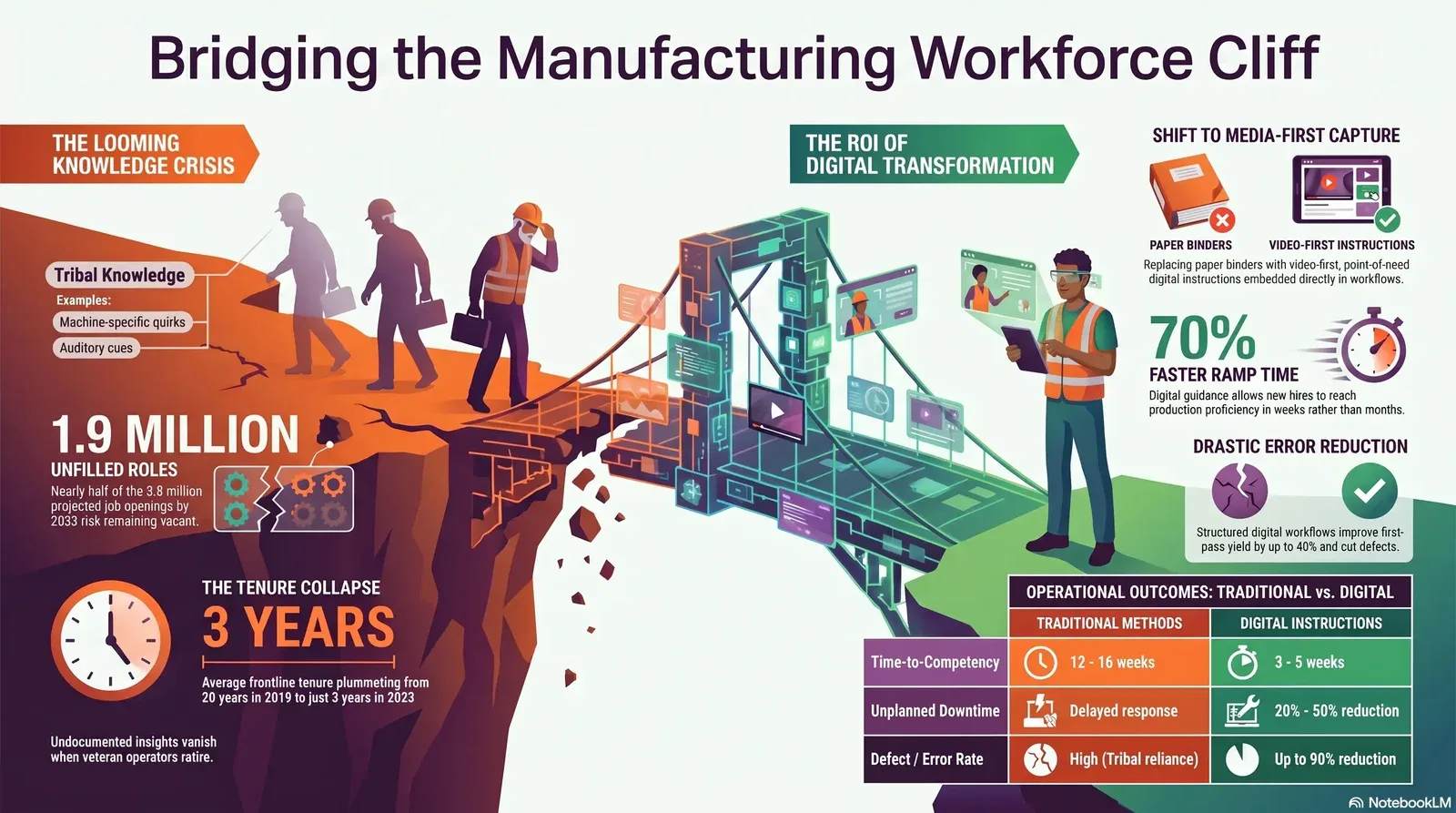
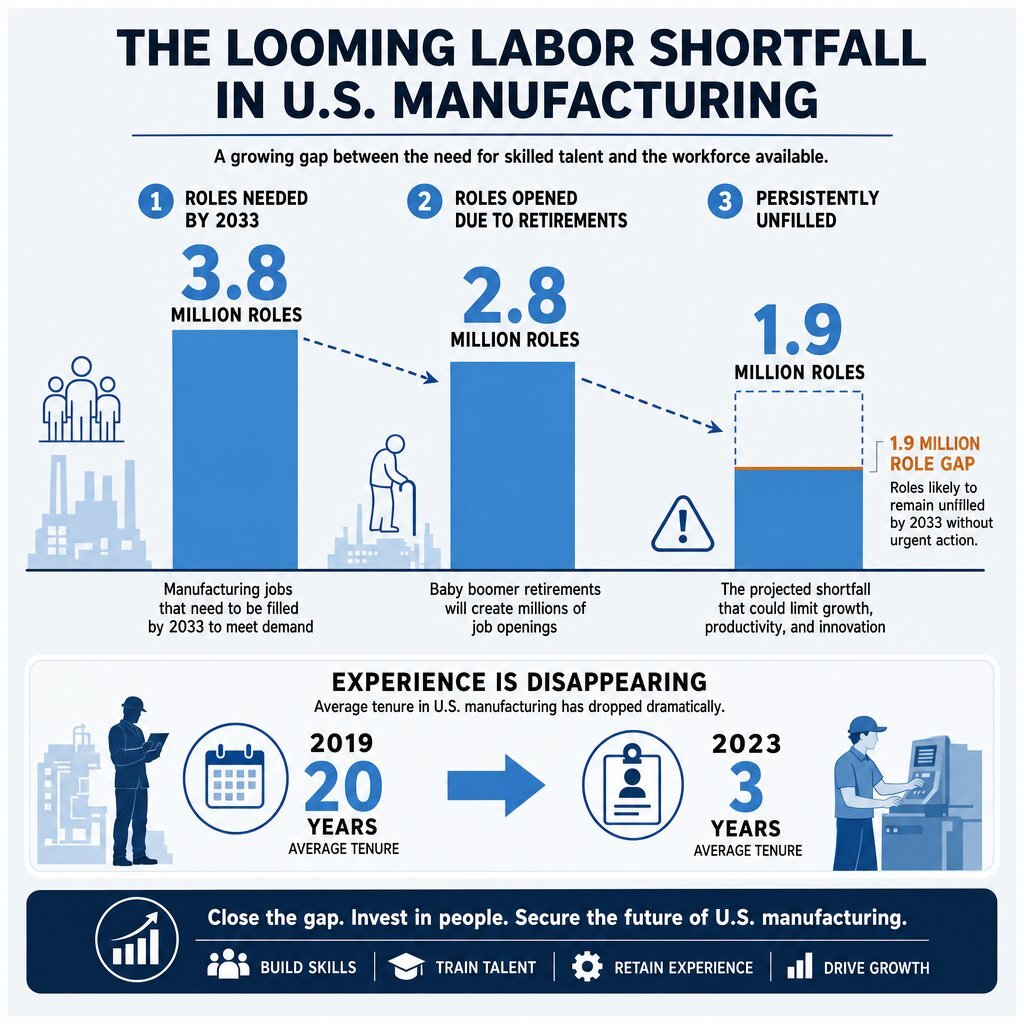
Hiring alone cannot close the impending labor gap. Projections from a joint talent study by The Manufacturing Institute and Deloitte indicate that the United States manufacturing industry will require 3.8 million additional workers between 2024 and 2033. Without structural changes to how industrial knowledge is captured and transferred, up to 1.9 million of these roles will remain persistently unfilled.
The primary driver of this shortfall is not rapid industry expansion; it is demographic attrition. Of the 3.8 million projected openings, 2.8 million stem directly from retiring workers. Simultaneously, the employment landscape on the factory floor has fundamentally altered. According to workforce analysis by LNS Research, the average tenure of a frontline manufacturing employee plunged from twenty years in 2019 to just three years in 2023. Manufacturers can no longer rely on decades-long apprenticeships to yield returns on training investments.
The current business model requires accelerating the time-to-competency for new operators who will likely only remain in their roles for 36 months. As executives confront the reshoring software gap—the misalignment between localized physical production and the digital infrastructure required to support it—upskilling engineers and frontline workers rapidly is the only viable path to maintaining capacity. For many mid-market firms, that also means revisiting whether their data foundation and infrastructure are truly AI-ready before funding large-scale automation.
Decoding Tribal Knowledge on the Plant Floor
Tribal knowledge resists traditional documentation because it is highly contextual, physically bound, and rarely linear. It consists of the undocumented micro-adjustments, the auditory cues that precede a catastrophic machine failure, and the supplier-specific material quirks that veteran operators navigate instinctively.
When a standard operating procedure (SOP) states “tighten the bypass valve,” tribal knowledge dictates exactly how much to tighten it based on the ambient temperature and the specific batch of raw materials running on that shift. This nuanced insight vanishes entirely when an experienced plant manager or lead operator departs without a formal mechanism to transfer their tacit expertise. Engaging in knowledge archaeology—the laborious process of digging through outdated binders to match written procedures against actual shop floor practices—usually reveals that standard procedures fail to capture the ripple effects of process deviations. Consequently, new operators are left blind to the root causes of line breakdowns, leading to elevated scrap rates and prolonged equipment downtime.
Why Generic Knowledge Bases Fail Frontline Workers
Corporate wikis, shared network drives, and generic Learning Management System (LMS) platforms fail on the factory floor because they enforce a fundamental disconnect from the physical work. Manufacturing training software must integrate directly into the workflow, existing at the point of need.
When a critical asset faults out at 2:00 AM, an operator cannot abandon the production line to search a disorganized intranet portal for a 300-page PDF manual. Knowledge on the floor is hyper-contextual. It is tied to a specific machine, running a designated material, exhibiting a unique failure mode. Generic systems treat knowledge as a static library for administrative compliance. Effective frontline systems treat knowledge as a dynamic, interactive utility. Traditional SOP binders and generic wikis require workers to context-switch away from their physical tasks, leading to high error rates, delayed response times, and the inevitable abandonment of the documentation by the workforce. The teams that succeed pair this with an agile methodology for continuous software improvement, so the tools evolve with real-world plant needs.
What Works: Structured Capture and the Build vs. Buy Decision
To preserve tacit expertise effectively, tribal knowledge capture systems must be embedded in the workflow, media-first, and highly searchable. Modern digital work instructions software relies on short-form video, annotated photography, and interactive decision trees rather than text-heavy essay assignments that frustrate machinists. Captured, structured knowledge also serves as the foundational data layer that makes future AI assistants and autonomous manufacturing processes possible, especially when paired with integrated AI assistants that sit on top of that knowledge.
Operations leaders must evaluate whether to deploy packaged Software-as-a-Service (SaaS) tools or develop custom applications tailored to their proprietary floor processes. Packaged platforms offer strong baseline capabilities for connected workers. Dozuki provides strict document control and ISO compliance workflows. VKS excels in complex discrete assembly by integrating with smart tools like torque drivers. Poka, acquired by IFS, functions as a factory communication and social learning hub.
However, environments with legacy equipment, proprietary data models, and highly specialized automation often outgrow off-the-shelf software limits. When generic or packaged SaaS tools lack the flexibility to integrate deeply with legacy Manufacturing Execution Systems (MES), complex quality management systems, or real-time equipment Programmable Logic Controllers (PLCs), custom software development delivers a distinct competitive advantage. In many cases, the right answer is to follow a pragmatic build-vs-buy deployment matrix so you know exactly what to rent and what to build in-house.
Baytech Consulting specializes in custom software development and application management, delivering a Tailored Tech Advantage for complex manufacturing environments. Utilizing enterprise-grade infrastructure—such as Azure DevOps On-Prem for secure deployments, PostgreSQL with pgAdmin for relational data integrity, and .NET, Docker, and Kubernetes for scalable edge computing—Baytech Consulting engineers resilient systems. These custom builds capture critical operational data and serve dynamic work instructions without forcing manufacturers to abandon their established, profitable workflows.
Comparison: Knowledge Management Systems on the Shop Floor
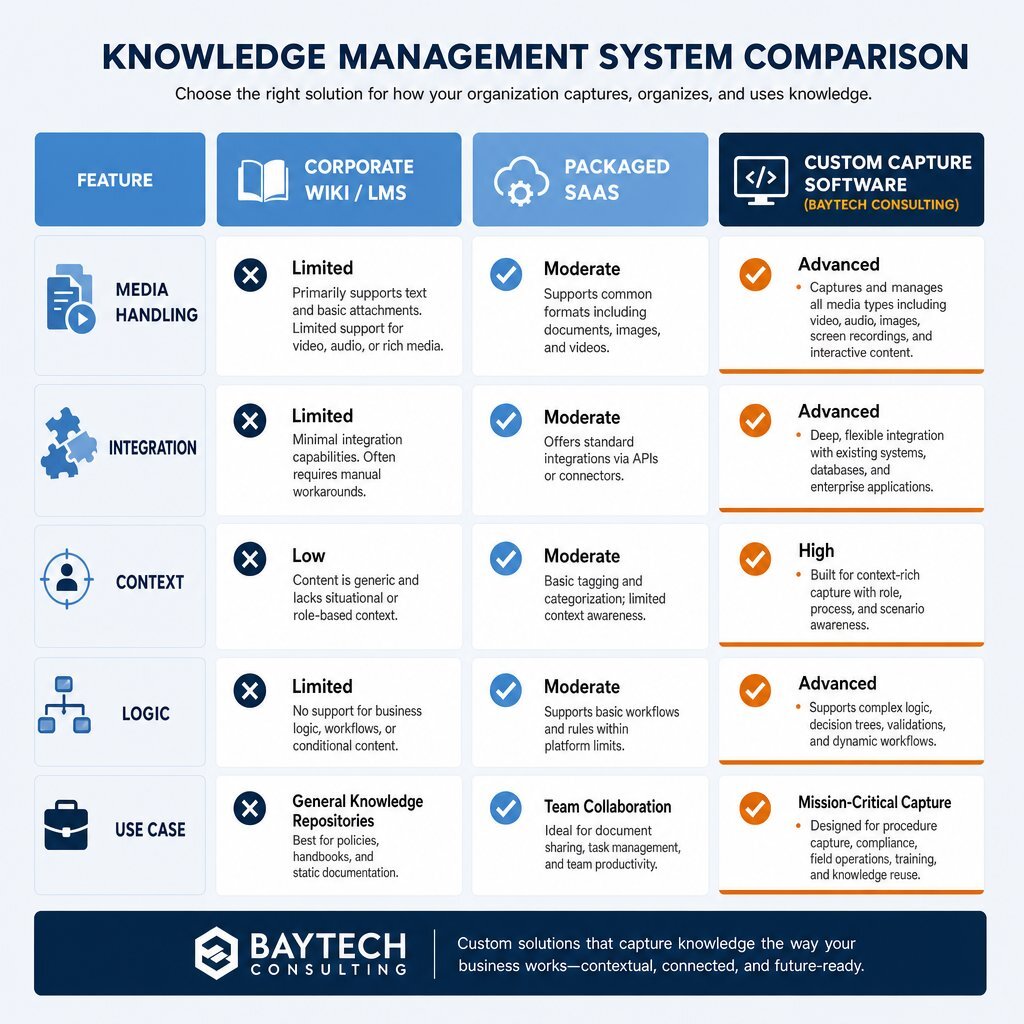
| System Capability | Corporate Wiki / LMS | Packaged SaaS (e.g., Dozuki, VKS) | Custom Capture Software (Baytech Consulting) |
|---|---|---|---|
| Media Handling | Text-heavy, manual PDF uploads | Built-in video and photo capture | Native media, custom augmented reality (AR) protocols |
| System Integration | Standalone database | Basic API endpoints | Deep bi-directional MES, ERP, and IoT data pipelines |
| Workflow Context | Desktop search required | Barcode or QR code lookup | Live machine telemetry triggering specific instructions |
| Business Logic | Static reading assignments | Pre-built approval paths | Custom edge-case routing and proprietary rulesets |
| Primary Use Case | Office HR compliance | Standardized discrete assembly | Highly automated, proprietary, high-mix environments |
The Capture Playbook: Managing the People Side of System Migrations
Treating knowledge capture purely as an administrative mandate guarantees implementation failure. The people side of system migrations is often more complex than the technical deployment. Veteran workers frequently view documentation efforts as an implicit threat to their job security, fearing that once their knowledge is extracted, they will be replaced.
Overcoming this resistance requires a structural playbook that positions veterans as the architects of the system, rather than subjects of data extraction. The first operational step is prioritizing exactly what to record. Attempting to digitize every plant procedure simultaneously creates immediate initiative fatigue. Operations executives should deploy a straightforward risk matrix to identify single-person dependencies on critical equipment, just as they would during a rigorous discovery phase for complex engineering projects.
Tribal Knowledge Risk Matrix
| Risk Level | Proximity to Retirement | Process Criticality | Required Action |
|---|---|---|---|
| Critical Risk | < 12 Months | High (Causes line stoppage or quality escapes) | Immediate video capture; embed in digital work instructions. |
| High Risk | 1 - 3 Years | High | Schedule structured capture workflows; assign apprentices. |
| Moderate Risk | < 12 Months | Low (Administrative or isolated impact) | Standardize via basic SOP forms and checklists. |
| Low Risk | 3+ Years | Low | Monitor and update organically through continuous improvement. |
Once critical tasks are identified, the capture process must be frictionless. Provide operators with ruggedized tablets or mobile devices configured for one-touch video recording. Solicit their input directly, asking them to identify the flaws in existing procedures and construct the new digital workflows. When veterans correct a flawed process in real-time and digitize it, the new system becomes their proprietary architecture. Acknowledging their contributions publicly and tying knowledge capture to performance incentives transforms documentation from a perceived threat into a legacy-building exercise. For plants already running mobile tools, pairing this with thoughtful mobile application development for frontline workers can make participation feel natural instead of burdensome.
Measuring the Payback: Ramp Time and Operational ROI
Evaluating knowledge capture strictly as a human resources exercise obscures its direct financial impact. Knowledge capture is an operational risk mitigation strategy with a highly measurable payback. The headline metric is ramp-time reduction: cutting a new operator’s time-to-competency yields a direct, calculable dollar value on the production floor.
Manufacturers that digitize their shop floor standard operating procedures typically achieve a 3x to 10x return on investment within 12 to 24 months. These financial returns manifest across three distinct operational categories:
Ramp Time Reduction: Digital work instructions reduce the training effort required for new hires by up to 70%. When visual, step-by-step guidance replaces dense paper manuals, operators reach production proficiency in weeks rather than months, directly countering the financial drain of shortened average tenures. Accelerating this ramp is similar to how AI-augmented teams can close the AI productivity gap in software development—the right guidance makes average performers effective much faster.
Quality Escapes: Structured digital workflows cut execution error rates drastically. First-pass yield improves by 15% to 40%, and overall defect rates drop significantly because operators no longer rely on memory for complex torque settings, wiring diagrams, or material changeovers.
Unplanned Downtime: With the cost of unplanned downtime reaching up to $260,000 per hour in heavy manufacturing sectors, faster issue resolution is paramount. Searchable, media-rich troubleshooting guides empower newer operators to address micro-stops immediately without waiting for senior maintenance staff, reducing unplanned downtime by 20% to 50%.
Quantitative Impact of Digital Knowledge Capture
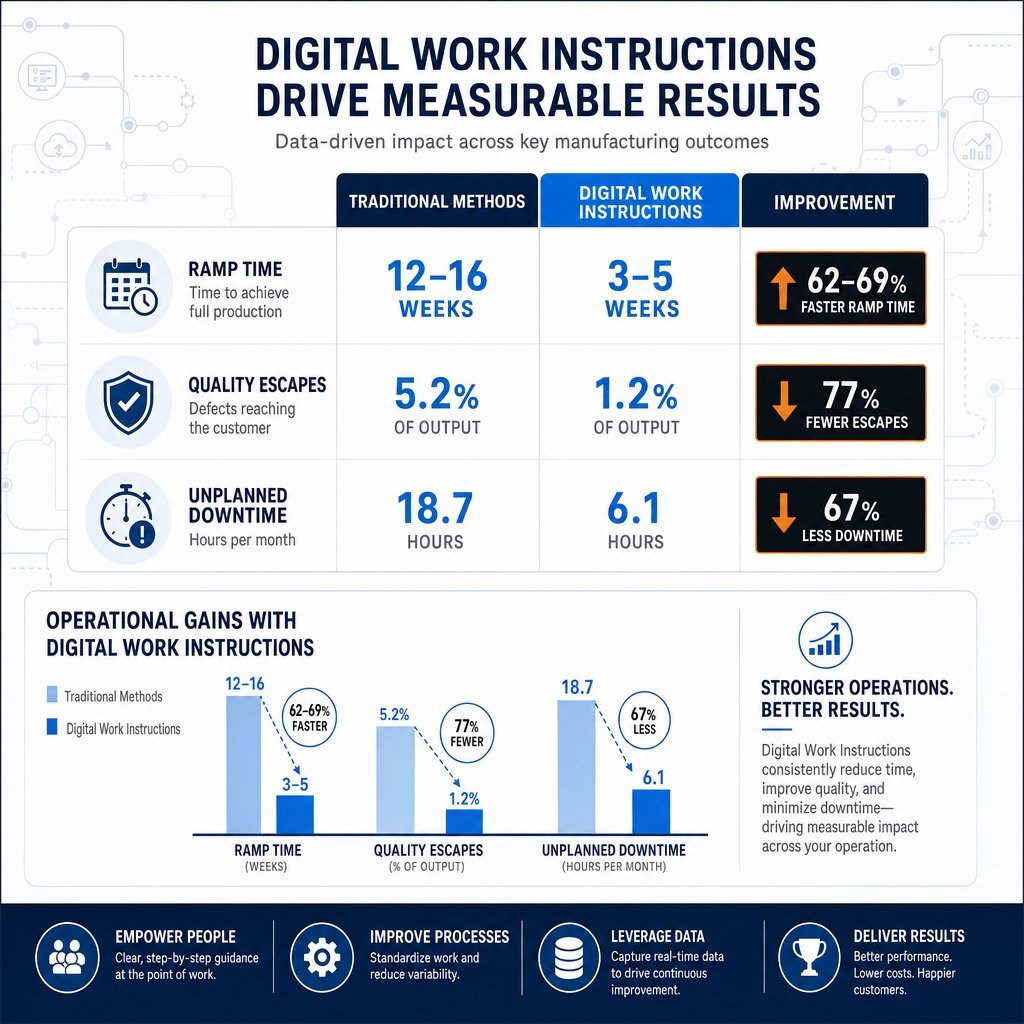
| Operational Metric | Traditional Methods (Paper / Memory) | Digital Work Instructions (Structured Capture) | Net Improvement |
|---|---|---|---|
| Time-to-Competency | 12 - 16 weeks | 3 - 5 weeks | Up to 70% faster ramp time |
| First-Pass Yield | Baseline variability | Consistent, guided execution | 15% - 40% improvement |
| Defect / Error Rate | High reliance on tribal knowledge | Barcode-triggered, digital validation | Up to 90% reduction |
| Unplanned Downtime | Delayed response, escalation required | Immediate troubleshooting at point-of-need | 20% - 50% reduction |
Securing Operational Continuity
The manufacturing workforce cliff is no longer a future warning; it is a present reality actively reshaping output capacity on the factory floor. With 1.9 million roles potentially going unfilled and the average worker tenure shrinking to just three years, aggressive hiring is a mathematically insufficient strategy.
Manufacturers must shift their operational leverage toward software solutions that extract, structure, and distribute tribal knowledge before it walks out the door. Utilizing video-first, point-of-need capture systems safeguards production schedules, minimizes quality escapes, and dramatically shortens the runway to competency for new hires. Organizations ready to protect their institutional knowledge and secure a custom software competitive advantage can partner with Baytech Consulting. By leveraging rapid agile deployment, ongoing project rescue and modernization support, and a tailored technical stack, Baytech builds the exact digital infrastructure manufacturers need to outpace the workforce cliff.
Frequently Asked Question
How do digital work instructions differ from standard operating procedures (SOPs)?
Standard operating procedures are typically static, text-heavy documents stored in physical binders or corporate wikis, detailing compliance requirements and general rules. Digital work instructions are dynamic, media-rich workflows embedded directly at the point of need. They guide an operator step-by-step through a specific task using video, annotated photos, and interactive validations to prevent production errors in real time. When they are informed by a short, focused UX-led discovery phase, these instructions also match how people actually work on the line, not just how the process looks on paper.
Supporting Links
- Manufacturers Need as Many as 3.8 Million New Employees by 2033
- Manufacturing Modernization: Four Trends to Watch in 2026
2025 Manufacturing Industry Outlook
About Baytech
At Baytech Consulting, we specialize in guiding businesses through this process, helping you build scalable, efficient, and high-performing software that evolves with your needs. Our MVP first approach helps our clients minimize upfront costs and maximize ROI. Ready to take the next step in your software development journey? Contact us today to learn how we can help you achieve your goals with a phased development approach.
About the Author

Bryan Reynolds is an accomplished technology executive with more than 25 years of experience leading innovation in the software industry. As the CEO and founder of Baytech Consulting, he has built a reputation for delivering custom software solutions that help businesses streamline operations, enhance customer experiences, and drive growth.
Bryan’s expertise spans custom software development, cloud infrastructure, artificial intelligence, and strategic business consulting, making him a trusted advisor and thought leader across a wide range of industries.