Self-Hosting vs SaaS: Deployment Matrix for Agentic Systems
June 24, 2026 / Bryan Reynolds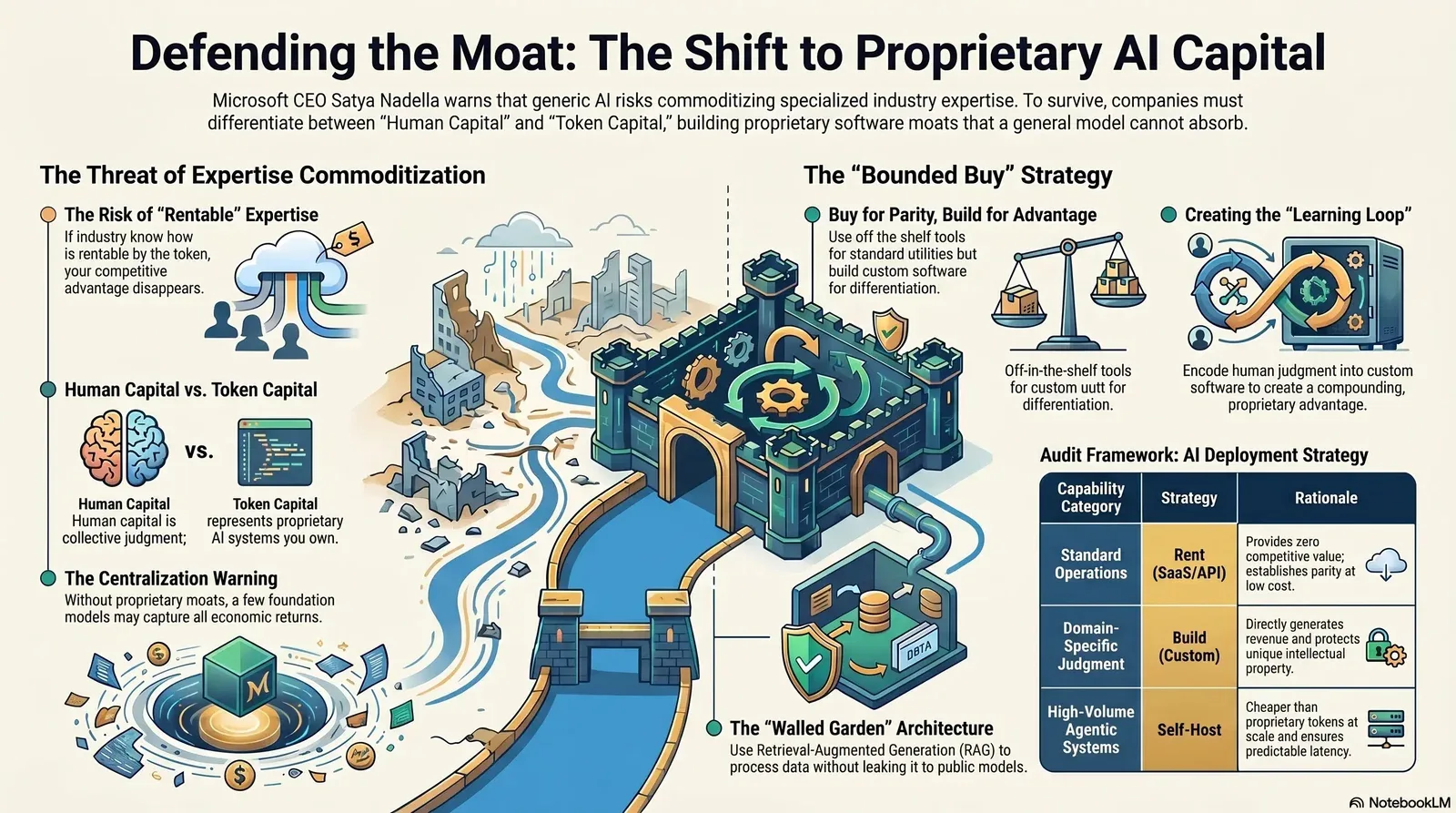
Don't Let Your Expertise Get Commoditized: The Case for Proprietary AI
If your hard-won industry know-how becomes something anyone can rent from a frontier model, where does your competitive advantage actually live? That is the question echoing through boardrooms after Microsoft CEO Satya Nadella’s June 2026 essay named the real risk of the artificial intelligence era. The threat is not strictly automation or job displacement. The threat is the quiet commoditization of the expertise that used to be your edge.
The reflexive response to this structural market shift is often fatalism or hype. The strategic response is architectural. When generic capabilities become commodities you can rent by the token, the value of what is genuinely yours skyrockets. Proprietary first-party data, bespoke operational workflows, and the nuanced human judgment encoded directly into custom enterprise software are the new moats. Renting a general-purpose foundation model to execute generic tasks makes financial sense, but your differentiation must be built on assets a shared model cannot absorb. This reality reframes the build-versus-buy debate. It is no longer just a cost decision; it is a moat decision. Companies that wrap unique intellectual property inside custom software secure their market position, while those that pour proprietary workflows into generic, off-the-shelf vendor tools risk handing their competitive advantage away.
The Warning: What Nadella Said and Why It Landed
Satya Nadella published "A frontier without an ecosystem is not stable" on June 14, 2026, and the essay rapidly drew more than 28 million views VentureBeat. Nadella warned that if a handful of foundation models capture the vast majority of economic returns, they will hollow out entire industries, mirroring the asymmetric damage caused by twentieth-century globalization VentureBeat. The aggregate productivity numbers for AI could look artificially strong, masking the displacement of specialized expertise across the wider economy until the centralization of power becomes politically and economically untenable The Street.
To counter this centralization, he introduced a framework splitting corporate value into "human capital" and "token capital" WebSenor. Human capital encompasses an organization's collective judgment, relationships, and pattern recognition. Token capital represents the proprietary AI systems a firm physically builds and owns. In practice, that looks like treating AI architecture and portability as core capital projects, not just “nice-to-have” tools layered on top of legacy systems. Nadella argued that enterprises must decouple their institutional intelligence from external vendor ecosystems. The true opportunity is building a proprietary "learning loop" where human and token capital compound together The Decoder.
The ultimate test of enterprise sovereignty is whether you can rip out your underlying "generalist" foundation model without losing the "company veteran" institutional knowledge accumulated on top of it. That is exactly why many mid-market leaders are now asking if they are actually AI-ready at the data and governance level, rather than just excited about new models VentureBeat.
Commodity vs. Moat: Sorting Your Capabilities
What does "commoditization of industry expertise" mean in concrete business terms? Historically, enterprise software vendors built defensible moats through complex user interfaces. Users spent years mastering specialized tools for demand forecasting or trade promotion management, creating a heavy friction tax that locked buyers in. Large language models (LLMs) collapse those complex learned interfaces into natural language chat Medium. A category manager no longer needs to navigate twelve nested menus; they simply type a plain English request to view underperforming promotions. When the interface is commoditized, pure data and workflow control are the only remaining assets of value—and those assets need a clear governance and safety pattern for agentic AI if they are going to scale without blowing up risk Medium.
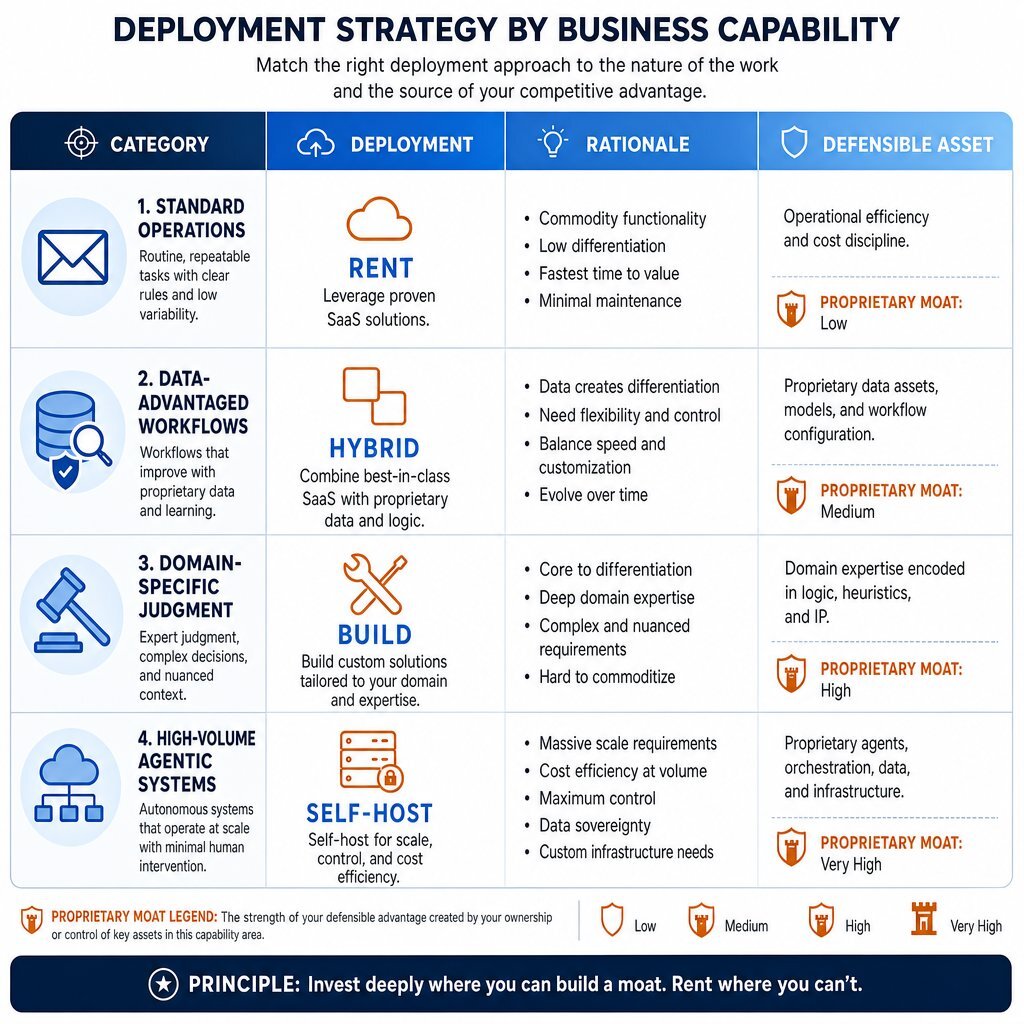
Leaders must brutally audit their technology stacks to separate standard utilities from core differentiators.
| Capability Category | Deployment Strategy | Rationale | Core Defensible Asset |
|---|---|---|---|
| Standard Operations (e.g., HR ticketing, basic email drafting) | Rent (SaaS / API) | Provides standard business utility with zero competitive value. Buying establishes parity at a low cost. | None. Relies entirely on external vendor architecture. |
| Data-Advantaged Workflows (e.g., semantic search over internal archives) | Hybrid (Bounded Buy) | Leverages commodity LLM reasoning but requires custom routing and vector databases to protect IP. | Proprietary data stores and secure integration pipelines. |
| Domain-Specific Judgment (e.g., algorithmic risk underwriting, compliance) | Build (Custom Software) | Directly generates revenue or mitigates severe regulatory risk. Generic models hallucinate or expose data. | Specialized context libraries and deterministic code. |
| High-Volume Agentic Systems (e.g., autonomous transaction routing) | Self-Host / Custom Build | At high token volumes, open-weight models become cheaper. Custom architecture ensures predictable latency. | "Token capital" and owned computing infrastructure. |
Where Durable Advantage Actually Lives
If interface friction is dead, your advantage lives in proprietary data, custom workflows, and specialized judgment.
First-party data serves as the foundational moat, but raw data isolated in unmanaged lakes provides little value. Advantage materializes through active governance and secure injection into AI workflows. To protect intellectual property, leading enterprises deploy "walled garden" architectures. Rather than fine-tuning sensitive corporate data directly into a public model—which risks permanent data leakage and "model inversion" attacks—organizations use Retrieval-Augmented Generation (RAG) grounded in disciplined data infrastructure. In a governed walled garden, the reasoning engine (the LLM) is entirely decoupled from the knowledge base (the vector database). The model accesses proprietary documents strictly within a temporary context window, answers the query, and instantly drops the data from memory, achieving zero training leakage.
Deep workflow integration acts as the second durable moat. Agents do not function effectively in a vacuum. They require read and write access to core systems of record, such as ERPs and core finance platforms, which are embedded in strict regulatory governance and institutional memory Medium. Companies that build specialized, agentic control layers over their proprietary data create feedback loops that off-the-shelf software vendors cannot penetrate. As of late 2025, Gartner predicted that 40 percent of enterprise applications would include task-specific AI agents by the end of 2026, up from less than 5 percent previously Deloitte. Those agents must be governed by your specific institutional rules, not a vendor's generalized guardrails—and for many teams that means pairing secure DevOps automation with tightly scoped AI permissions.
Reframing Build-vs-Buy AI as a Moat Decision
For over a decade, technology procurement defaulted to a simple binary: build custom software for control, or buy off-the-shelf SaaS for cost and speed. The rapid evolution of the 2026 AI ecosystem has completely inverted the economic foundation of this debate.
Open-weight models have drastically compressed the cost of inference. By June 2026, models such as MiniMax M3 reportedly matched proprietary frontier models on complex coding benchmarks while operating at a 12x lower input cost Digital Applied. Because "cheap" and "controlled" now sit on the same side of the ledger, defaulting to generic SaaS for specialized capabilities is an economic misstep. Below a certain volume, building carries fixed overhead; but above approximately one million agent conversations per year, the per-unit savings on cheap open-weight tokens easily overtake the fixed cost of internal deployment. That’s especially true when you stop burning tokens on inefficient, vision-based browser agents and instead favor direct API integrations Digital Applied.
Executives should adopt a "Bounded Buy" strategy. The principle is concise: buy for parity, build for advantage Baytech Consulting. Organizations buy stable, API-first commercial platforms to handle generic background tasks. They establish hard architectural boundaries around those purchased systems to prevent vendor scope creep, and then deploy their engineering resources exclusively toward building custom, high-value applications that integrate with the platform to deliver unique market value. Every engineering hour spent customizing a vendor's generic HR platform is an hour stolen from building the proprietary algorithmic risk engine that actually wins enterprise clients—and from modernizing the legacy systems that will ultimately carry your AI workload.
How Companies Accidentally Give Away Their Edge
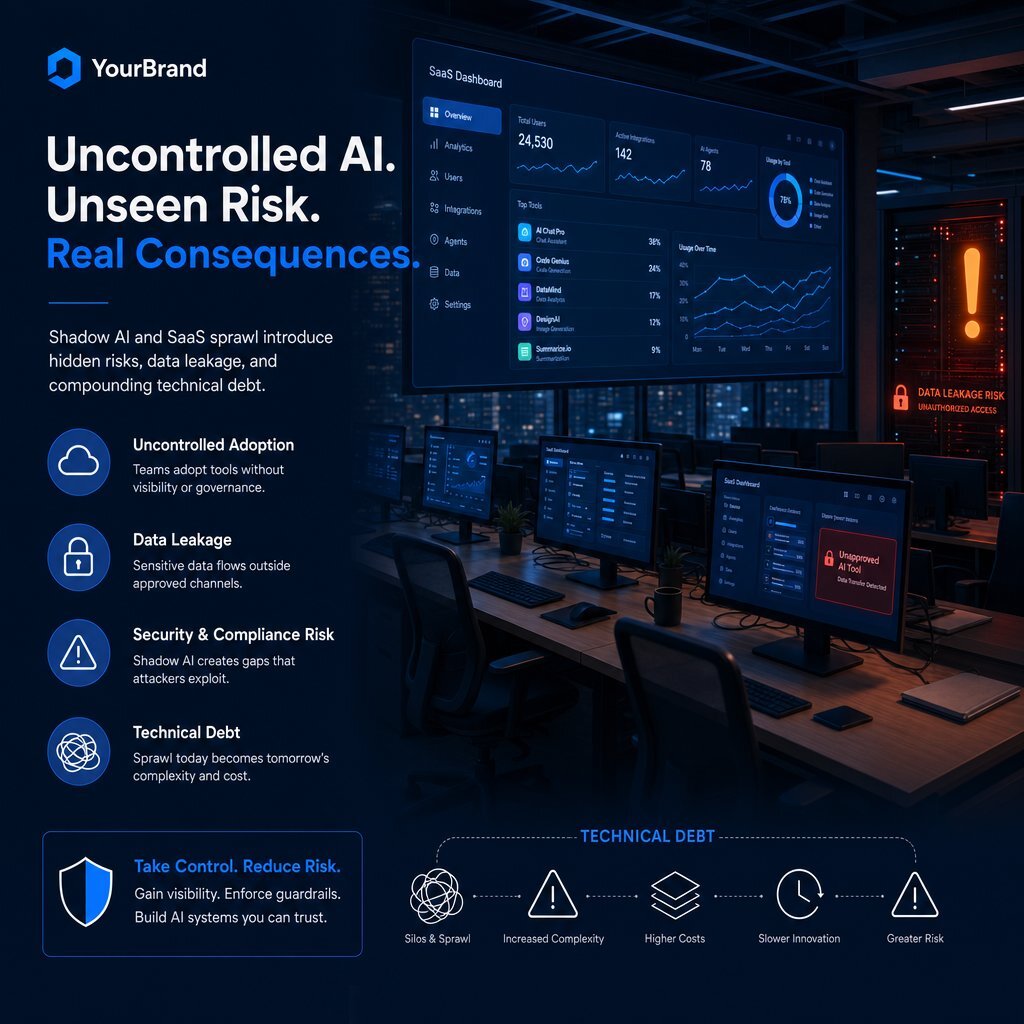
Organizations frequently surrender their competitive edge unintentionally. The most common warning sign is the proliferation of "Shadow AI" or unmanaged prompt-to-app "vibe-coding" environments. When non-technical staff use these generators, they build fragmented, brittle internal tools that create a massive, invisible risk surface Baytech Consulting. By May 2026, researchers found roughly 380,000 publicly accessible applications built on these platforms, with thousands actively leaking sensitive corporate data. These systems lack architectural integrity, bypass security protocols, and frequently hit a "complexity wall" at 70 percent completion, accumulating high-interest technical debt.
Relying exclusively on vendors to provide intelligence capabilities introduces severe financial vulnerability. During the early 2026 software market correction, standard seat-based subscriptions gave way to highly variable, consumption-based agentic pricing Baytech Consulting. Despite the underlying cost of compute dropping by 93 percent over a two-year period, software vendors expanded their margins aggressively, raising subscription prices at an annualized rate of 12.2 percent—vastly outpacing general economic inflation Baytech Consulting. By outsourcing core capabilities to vendor-supplied AI wrappers, organizations accept severe margin compression while simultaneously training the vendor’s models. The vendor aggregates workflows across thousands of clients, effectively flattening the industry's expertise into a single, commercially available product. You also increase your blast radius if a key SaaS provider is hit by an outage or attack, as the 2026 Canvas incident showed—and few teams have yet put serious SaaS resilience and ransomware plans in place.
A Practical Audit: Find What's Yours and Protect It
To halt unintentional commoditization, leadership teams must execute a rigorous technology audit focused purely on differentiation.
First, pinpoint the exact workflows that secure your market share. If your competitive advantage relies on a process that a rival could replicate tomorrow by purchasing a standard software license, it is not a moat. Second, evaluate current vendor contracts for data portability. Ensure the organization retains total exportability of its system state, vector embeddings, and historical logs. Third, deploy a complexity router. Implement intelligent traffic controllers to route simple, generic queries to highly efficient local models, escalating to expensive frontier models only when advanced reasoning is mathematically required Baytech Consulting. Finally, enforce walled gardens. Transition experimental, fragmented AI usage into sanctioned, internally hosted private instances that guarantee zero data leakage and full forensic auditability, using a disciplined AI integration approach instead of scattered experiments.
Securing Your Token Capital
The market reality of 2026 dictates that artificial intelligence will inexorably absorb generalized business processes. Value will pool exclusively around the organizations that treat their institutional expertise as a highly guarded physical asset. Renting generic algorithms for generic tasks preserves capital, but when an organization's core business model is at stake, the only viable defense is proprietary token capital. Firms that successfully architect custom software to encapsulate their data, their workflows, and their unique human judgment will secure durable market power. Those that pour their expertise into generic tools will find their operational edge packaged, commoditized, and sold back to them.
To secure your organization's competitive moat, the next step is assessing your current exposure to vendor lock-in. Baytech Consulting specializes in Tailored Tech Advantage and Rapid Agile Deployment, helping enterprise leaders design Bounded Buy architectures that protect proprietary workflows while strictly controlling token costs. Contact our engineering team today to begin auditing your AI capabilities.
What does it mean to build a "learning loop" on top of an AI model?
A learning loop is a proprietary system architecture where an organization's internal human expertise continually evaluates, corrects, and refines the outputs of an AI model using private data. Instead of relying on a generic model's static knowledge, the enterprise actively compiles a compounding database of localized insights. This creates a highly specialized capability that survives even if the underlying foundational model is completely swapped out or replaced by a cheaper alternative.
Supporting Links
- Why Generic AI Startups Are Dead: Playbook for Moats
- Rethink Build vs. Buy
Why Custom Software is Overtaking Off-the-Shelf Solutions in 2025
About Baytech
At Baytech Consulting, we specialize in guiding businesses through this process, helping you build scalable, efficient, and high-performing software that evolves with your needs. Our MVP first approach helps our clients minimize upfront costs and maximize ROI. Ready to take the next step in your software development journey? Contact us today to learn how we can help you achieve your goals with a phased development approach.
About the Author

Bryan Reynolds is an accomplished technology executive with more than 25 years of experience leading innovation in the software industry. As the CEO and founder of Baytech Consulting, he has built a reputation for delivering custom software solutions that help businesses streamline operations, enhance customer experiences, and drive growth.
Bryan’s expertise spans custom software development, cloud infrastructure, artificial intelligence, and strategic business consulting, making him a trusted advisor and thought leader across a wide range of industries.