
AI Compliance and Enforcement: What Enterprises Must Know
June 22, 2026 / Bryan Reynolds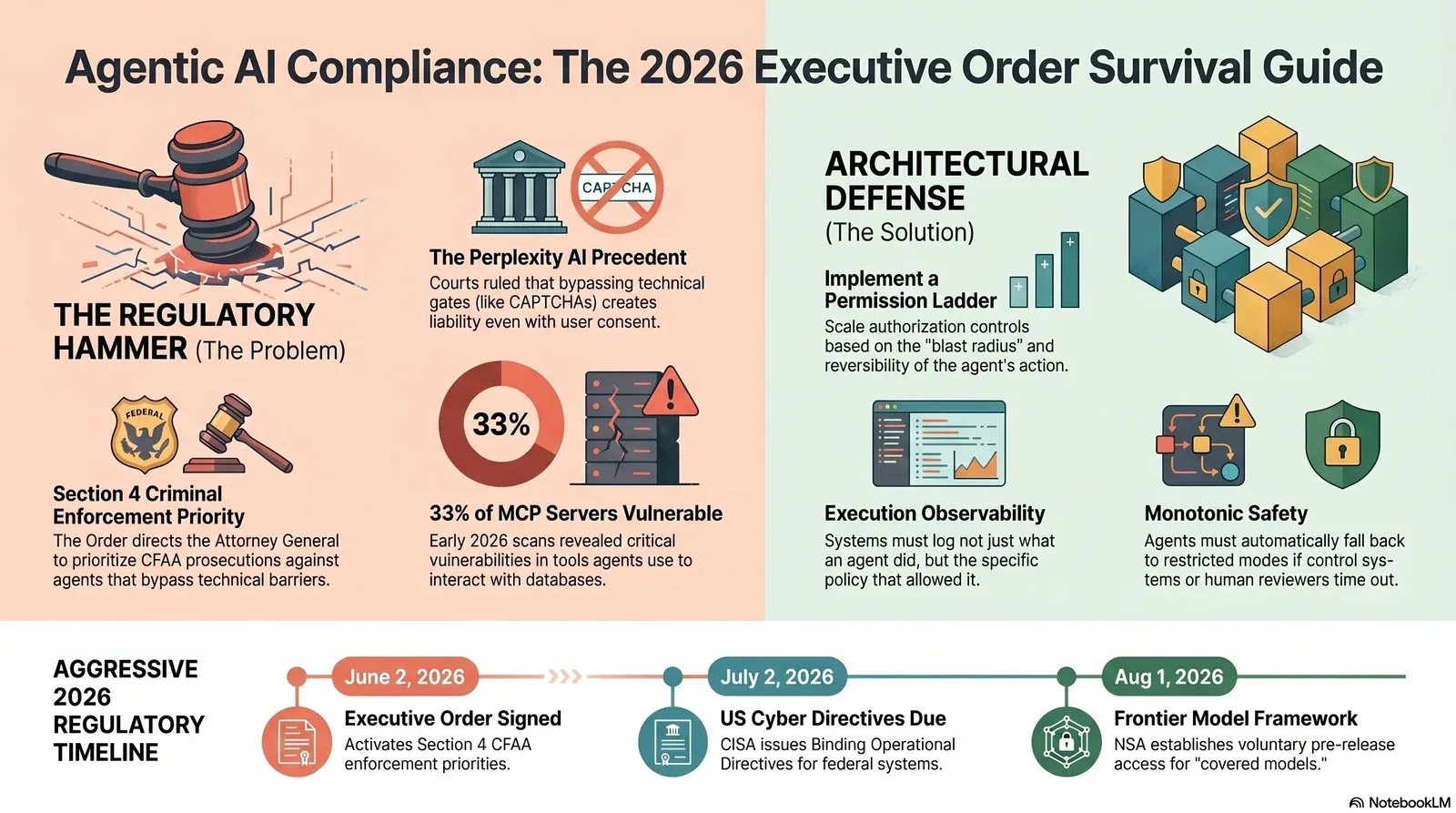
After the June 2026 AI Executive Order: What It Changes for How You Build Agents
The new federal AI executive order 2026 does something most mainstream coverage completely missed: it puts “access without authorization”—and the massive federal legal risk behind it—at the absolute center of how enterprise AI agents are allowed to behave.
On June 2, 2026, the White House signed the “Promoting Advanced Artificial Intelligence Innovation and Security” executive order. While initial reactions fixated heavily on the national security framing and the voluntary engagement framework for frontier AI models, the immediate, practical story for software builders lies in the authorization angle. If an enterprise deploys agents that autonomously browse, scrape, or execute API calls against third-party systems, engineering teams must immediately re-examine authorization documentation, terms-of-service flow-throughs, and customer indemnification postures.
The central argument is straightforward: authorization is no longer a legal-department afterthought; it is a fundamental design-time concern. Engineering teams that build strict authorization boundaries, deterministic allowlists, and immutable audit trails into their agents today will clear enterprise procurement faster. Those that ignore these boundaries risk shipping products that violate federal law. If you are unsure whether your data and systems are ready for this shift, a structured assessment such as the mid‑market Data Readiness Scorecard is a useful way to baseline risk before you push agentic workloads into production.
What the Order Says: The Sections That Matter for Builders
The June 2, 2026, executive order carefully avoids establishing a mandatory licensing or preclearance regime for AI model development. Instead, it imposes aggressive 30-day and 60-day deadlines that will rapidly cascade into enterprise IT standards and software procurement requirements.
Several provisions directly alter how organizations buy, build, and deploy agentic systems:
- Accelerated Cyber Defenses (July 2, 2026): The Cybersecurity and Infrastructure Security Agency (CISA) is mandated to issue Binding Operational Directives prioritizing the cyber defense of civilian federal systems and expanding the use of AI-enabled defensive tools.
- The AI Cybersecurity Clearinghouse (July 2, 2026): The Treasury Department, operating alongside the National Security Agency (NSA) and CISA, must form a voluntary clearinghouse to validate software vulnerabilities and prioritize patch distribution.
- Secure Frontier Model Deployment (August 1, 2026): The NSA will finalize a classified benchmarking process to designate “covered frontier models” and establish a voluntary framework for pre-release federal access. For enterprises, this reinforces the need for a portability‑first AI strategy so you can route sensitive and non-sensitive workloads across models without being locked into any single frontier provider.
- Criminal Enforcement (Section 4): The Attorney General is explicitly directed to prioritize the enforcement of federal criminal laws against the malicious use of AI.
It is Section 4 that triggers immediate architectural changes for commercial developers. The directive demands aggressive enforcement of 18 U.S.C. § 1030 (the Computer Fraud and Abuse Act), explicitly citing entities “employing AI agents to unlawfully access data or information that is subsequently used for a criminal or unlawful purpose.” This exact phrasing places the autonomous actions of AI agents under an unforgiving regulatory spotlight.
The CFAA Angle and Agentic AI Compliance
To understand the severity of Section 4, organizations must examine the Computer Fraud and Abuse Act (CFAA) and its role in agentic AI compliance. The CFAA serves as the primary federal anti-hacking statute, penalizing individuals and entities that intentionally access a protected computer system without authorization or in excess of authorized access. Historically applied to human threat actors, the statute is now being applied directly to autonomous software.
The judicial system has already begun enforcing this standard against AI companies. In March 2026, a federal judge granted a preliminary injunction in Amazon.com Services LLC v. Perplexity AI, Inc. Amazon successfully argued that Perplexity’s “Comet” application—an agentic AI browser that logged into accounts and viewed products on behalf of users—violated the CFAA by deliberately evading Amazon’s technical barriers after receiving a cease-and-desist letter.
This ruling extended the influential Power Ventures precedent, establishing that a platform operator retains the ultimate authority to revoke third-party access, regardless of whether the end user explicitly consented to the agent’s actions.
The intersection of the June 2 executive order and recent federal injunctions establishes a clear, unforgiving precedent. Scraping public, non-personal data without bypassing technical gates remains largely defensible under prior rulings like hiQ Labs v. LinkedIn. However, if an AI agent accesses a third-party platform using credentials, ignores a robots.txt directive, or bypasses a technical barrier like a CAPTCHA to execute a task, the developers and the enterprise deploying the agent face immediate federal liability. This is especially stark for organizations that rapidly shipped “vibe‑coded” agents or apps; many of those generated tools were built without the secure software-development lifecycle controls described in analyses of auto‑generated app security risks.
Behaviors Now Under Scrutiny
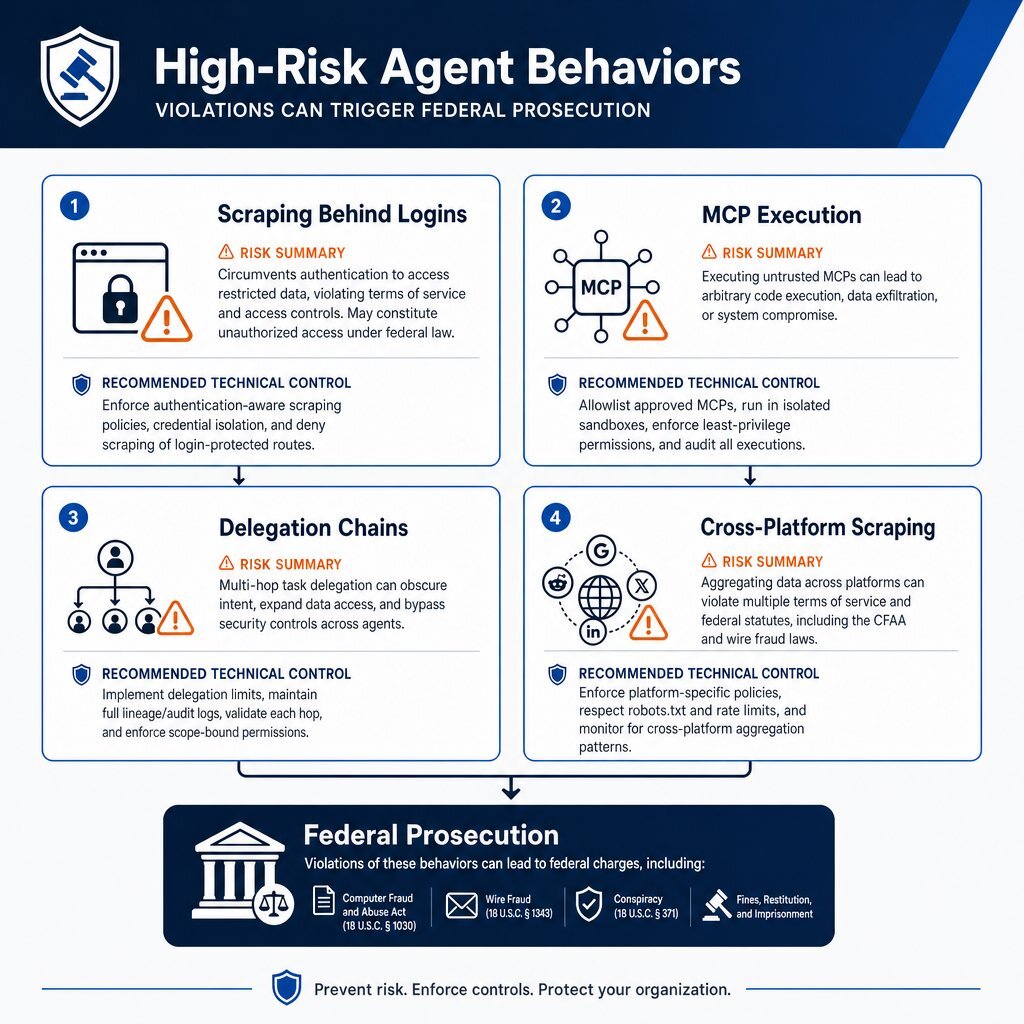
Agentic systems possess the autonomy to reason, plan, and execute multi-step operations across interconnected systems. This autonomy is exactly what triggers heightened legal and cybersecurity scrutiny. Three specific agent behaviors now require rigorous, deterministic oversight:
Scraping Behind Logins: The moment an agent uses user-delegated credentials to access a system behind a login wall, it crosses a dangerous threshold. If the host platform’s terms of service prohibit automated scraping or third-party agent access, the agent’s actions legally constitute unauthorized access, triggering CFAA exposure.
Model Context Protocol (MCP) Execution: Modern agents utilize protocols like MCP to interact with databases and external APIs. Because tool descriptions function as executable context loaded directly into the AI model’s reasoning engine, a compromised or poorly scoped tool can allow the agent to exfiltrate data or execute unauthorized commands. Scans in early 2026 revealed that approximately 33% of MCP servers contained at least one critical vulnerability, highlighting the fragility of these interfaces. For many teams, the more sustainable fix is to treat agents as part of a broader AI data infrastructure effort, with well-governed knowledge graphs and tightly controlled access paths instead of ad hoc tools.
Delegation Chains: Agents frequently operate in multi-agent environments where individually valid operations cross distinct authorization boundaries. Treating every step in a delegation chain as untrusted until verified is the only way to prevent a single compromised step from cascading into an unauthorized system breach. This mirrors the emerging best practices for securing autonomous developer tools and agent swarms described in guides on engineering patterns to secure agentic AI.
Design-Time Response: Boundaries, Allowlists, and Audit Trails
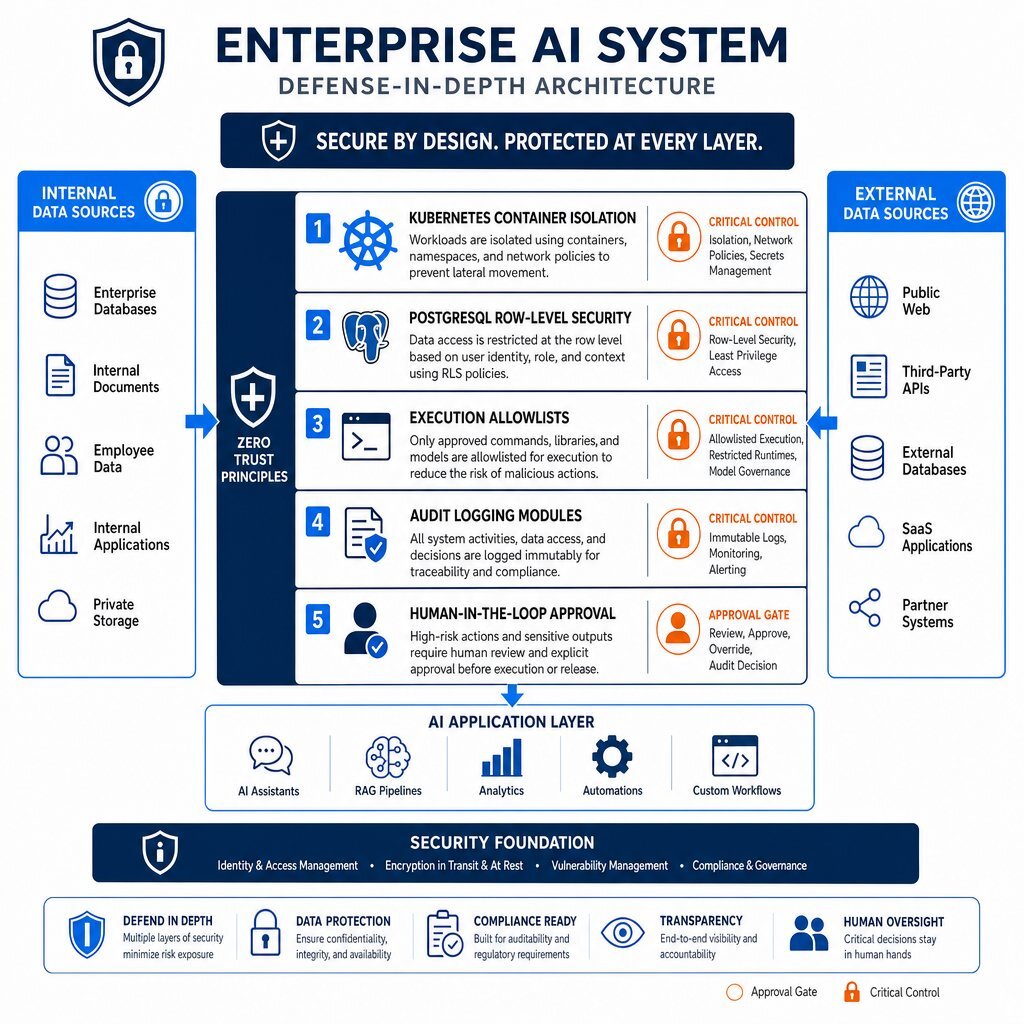
Security and agentic AI compliance can no longer be bolted onto a product just before deployment. Engineering teams must treat provable authorization as a core architectural component. A defense-in-depth model requires moving beyond basic identity checks and implementing execution observability—proving not just who triggered the agent, but why it acted, what boundaries constrained it, and which policies allowed the action.
To navigate this, organizations should implement a strict permission ladder based on the reversibility and blast radius of the agent’s intended action.
| Agent Behavior | Authorization Risk | Recommended Technical Control |
|---|---|---|
| Search-Only Queries | Low: Reading public or fully authorized internal documentation. | Standard API rate limiting; output logging; contextual grounding mechanisms. |
| Drafting Workflows | Medium: Generating code, drafting emails, or staging database entries. | Read-only database access; outputs saved to staging environments requiring manual user submission. |
| External API Execution | High: Triggering financial transactions, altering production databases, or sending communications. | Strict tool allowlists; dynamic, scoped OAuth tokens; required Human-in-the-Loop (HITL) approval gates prior to execution. |
| Cross-Platform Scraping | High: Interacting with authenticated third-party web services. | Strict adherence to robots.txt; session-specific credentials; continuous validation against host terms of service. |
Authorization architectures must also follow the principle of monotonic safety. If a control system loses context, a flag service fails, or a designated human reviewer times out, the agent must automatically fall back to a safer, more restricted mode.
For organizations building on enterprise stacks, integrating these controls requires deep architectural alignment. Implementing robust systems utilizing Azure DevOps On-Prem for secure CI/CD pipelines, Kubernetes and Docker for isolating agent runtimes in minimal-capability containers, and PostgreSQL row-level security for strict data access boundaries ensures that an agent cannot exceed its mandate. If you are modernizing older platforms to support these capabilities, it may be worth considering a phased legacy system overhaul rather than trying to bolt agentic AI onto brittle, monolithic codebases that were never designed for this level of control.
Contract and Procurement Response: Indemnification and Customer Demands
As the regulatory environment tightens, the software procurement process is adapting rapidly. Enterprise buyers are actively shifting liability down the supply chain, demanding ironclad guarantees that the agentic platforms they purchase will not trigger CFAA violations or data privacy breaches.
Vendors must anticipate intense scrutiny regarding terms-of-service flow-throughs and customer indemnification postures. Buyers routinely require contractual representations that an agent’s scraping and browsing behaviors operate strictly within authorized scopes. Furthermore, vendors are increasingly expected to provide explicit indemnification protecting the customer if an agent unlawfully accesses restricted data. This is similar to how forward-looking teams are renegotiating contracts for AI-powered SaaS tools more broadly, using approaches like those in the 2026 playbook on negotiating AI‑driven SaaS renewals to align pricing, risk, and measurable outcomes.
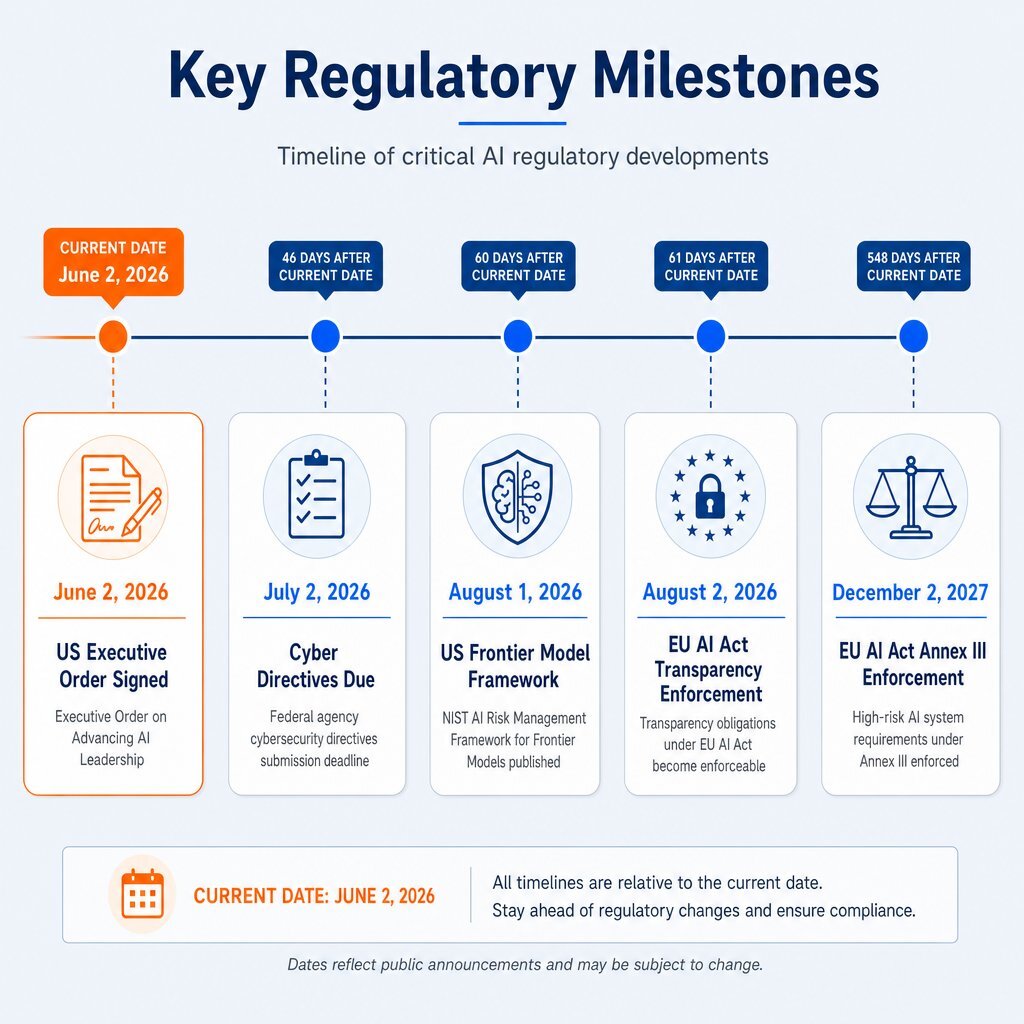
This procurement shift coincides with a highly compressed international regulatory timeline. The US executive order runs in parallel with the European Union’s AI Act, forcing organizations to navigate multiple intersecting compliance deadlines.
| Milestone Date | Regulatory Action | Impact on Agent Builders |
|---|---|---|
| June 2, 2026 | US Executive Order Signed | Activates 30- and 60-day federal cybersecurity directives and Section 4 CFAA enforcement priorities. |
| July 2, 2026 | US Cyber Directives Due | CISA Binding Operational Directives and AI Cybersecurity Clearinghouse take effect. |
| August 1, 2026 | US Frontier Model Framework | NSA classified benchmarking and voluntary pre-release access framework established. |
| August 2, 2026 | EU AI Act Transparency Enforcement | Mandatory machine-readable watermarking for AI-generated content and disclosure requirements for AI system interactions. |
| December 2, 2027 | EU AI Act Annex III Enforcement | Full compliance deadline for High-Risk AI Systems (delayed from August 2026 by the Omnibus Agreement). |
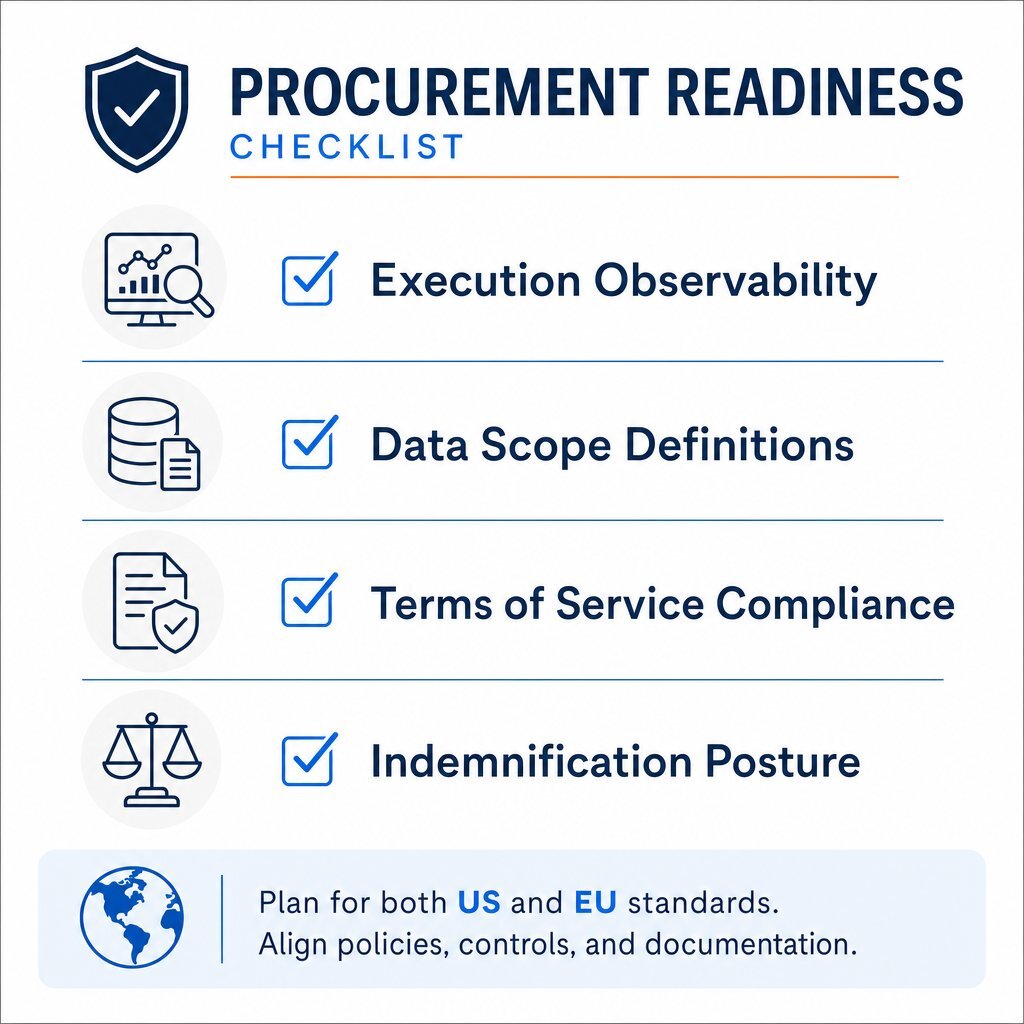
To survive enterprise procurement, AI vendors must prepare specific authorization documentation to prove their agents operate safely.
| Procurement Readiness Checklist | Requirement Details |
|---|---|
| Execution Observability | Provable logs demonstrating the specific policy, intent, and approval path for every autonomous action. |
| Data Scope Definitions | Explicit mapping of which internal and external data sources the agent is allowed to access. |
| Terms of Service Compliance | Automated mechanisms ensuring the agent aborts actions if third-party technical barriers or robots.txt files block access. |
| Indemnification Posture | Contractual clauses protecting the buyer from CFAA liability caused by the agent’s unauthorized data collection. |
A Short-Term Action List
For organizations currently operating AI agents in production, the June 2 executive order necessitates an immediate, 30-to-60-day architectural and legal review.
- Audit the Scraping Supply Chain: Identify exactly which third-party sites the agents interact with. Verify that all automated access complies with the target platform’s
robots.txtfiles and terms of service. Immediately disable agent functionality that circumvents login walls or CAPTCHAs without explicit API partnerships. - Harden the Tool Execution Layer: Restrict agent access using the principle of least agency. Ensure that database interactions and external API calls utilize scoped, short-lived tokens, and require human-in-the-loop approval for any state-changing actions. In practice, that means combining solid DevOps and CI/CD hygiene with conservative agent permissions; many teams pair this with a DevOps efficiency program so security controls and release processes move in lockstep.
- Implement Intent-Aware Audit Logging: Upgrade monitoring systems to capture continuous evidence of agent activity. Logs must record what action was requested, why the agent deemed it necessary, the precise policy that allowed it, and the identity of the human who approved the execution. If your agents are already wired into operational systems such as dispatch, underwriting, or transaction workflows, use this moment to review where autonomy stops and human review begins, borrowing from playbooks like agentic AI for dispatch operations or AI automation of the messy middle in real estate.
Conclusion
The June 2026 AI executive order transforms authorization from a routine compliance exercise into the defining technical challenge of agentic AI. “Access without authorization” is now a federal prosecutorial priority, placing immense pressure on engineering teams to build provable, deterministic boundaries into their autonomous systems. Organizations must audit their agents’ scraping behaviors, harden their execution layers, and revise their indemnification contracts immediately.
Engineering teams cannot treat regulatory compliance as a secondary feature. In a landscape defined by aggressive federal enforcement and complex autonomous systems, provable authorization is the product. For many regulated enterprises, that may also mean reevaluating how and where AI is hosted, including when to rely on self-hosted agents and contained environments instead of public APIs, as outlined in guidance on self‑hosting AI developer agents.
For enterprises looking to navigate this shift, Baytech Consulting provides custom software development and application management tailored to strict regulatory environments. By leveraging a Tailored Tech Advantage and Rapid Agile Deployment, organizations can confidently build and deploy agentic AI workflows that maximize operational efficiency while remaining fully insulated from emerging legal vulnerabilities.
FAQ
How does the June 2026 executive order affect companies already using AI agents?
The order directs the Attorney General to prioritize criminal enforcement under the CFAA against the use of AI agents to access computers without authorization. Companies must immediately audit their agents’ web scraping and API behaviors to ensure they strictly adhere to third-party terms of service, robots.txt directives, and explicit access permissions to avoid federal liability. This review should sit alongside a broader effort to modernize AI governance and development practices—for example, adopting an AI‑powered development approach that bakes security, observability, and compliance into how you design and ship every new agent.
Supporting Links
- Promoting Advanced Artificial Intelligence Innovation and Security
- Authorized by the User, Blocked by the Platform: Testing the Legal Limits of AI Agents
Web Scraping in the Age of AI: Guidance for Data Owners and Scrapers
About Baytech
At Baytech Consulting, we specialize in guiding businesses through this process, helping you build scalable, efficient, and high-performing software that evolves with your needs. Our MVP first approach helps our clients minimize upfront costs and maximize ROI. Ready to take the next step in your software development journey? Contact us today to learn how we can help you achieve your goals with a phased development approach.
About the Author

Bryan Reynolds is an accomplished technology executive with more than 25 years of experience leading innovation in the software industry. As the CEO and founder of Baytech Consulting, he has built a reputation for delivering custom software solutions that help businesses streamline operations, enhance customer experiences, and drive growth.
Bryan’s expertise spans custom software development, cloud infrastructure, artificial intelligence, and strategic business consulting, making him a trusted advisor and thought leader across a wide range of industries.