
In this article
- Real Estate's AI Operating System: Beyond Lead-Gen to Transaction Automation
- The Commodity Trap: Why Real Estate AI Stalled at the Top of the Funnel
- The Transaction Lifecycle Map: Where AI Moves the Needle
- Compliance and Fair-Housing Guardrails: The Necessity of Human-in-the-Loop
- The Data Foundation: Preparing the MLS and CRM for AI
- Build vs. Buy: A Strategic Split Across the Lifecycle
- Measurable Outcomes: Metrics for Brokerage Leaders
- A Pragmatic Roadmap for Mid-Size Brokerages
- Conclusion
- About Baytech
- About the Author
Real Estate's AI Operating System: Beyond Lead-Gen to Transaction Automation
Every real estate vendor sells an artificial intelligence tool designed to capture leads, score prospects, and write property descriptions. Almost none of them touch the part of the business where deals actually die: the messy middle of the transaction.
The competitive edge in real estate technology has moved past prospecting. Off-the-shelf lead-generation tools are now basic commodities, while the transaction and operations layer remains a complex, high-friction environment where a brokerage's proprietary process serves as its primary differentiator. Treating artificial intelligence as a comprehensive operating system across the deal lifecycle—and strategically choosing where to build custom software integrations versus renting point solutions—is the new mandate for real estate executives seeking to protect their margins and scale their operations.
The Commodity Trap: Why Real Estate AI Stalled at the Top of the Funnel
The initial wave of artificial intelligence adoption in the real estate sector clustered heavily at the top of the sales funnel. Brokerages invested massive capital into predictive analytics for lead scoring, automated chatbots for initial website inquiries, and generative text applications for listing descriptions. The motivation for this investment was clear: driving top-line revenue through higher lead conversion. However, as the underlying technology became ubiquitous, the strategic value of these tools collapsed.
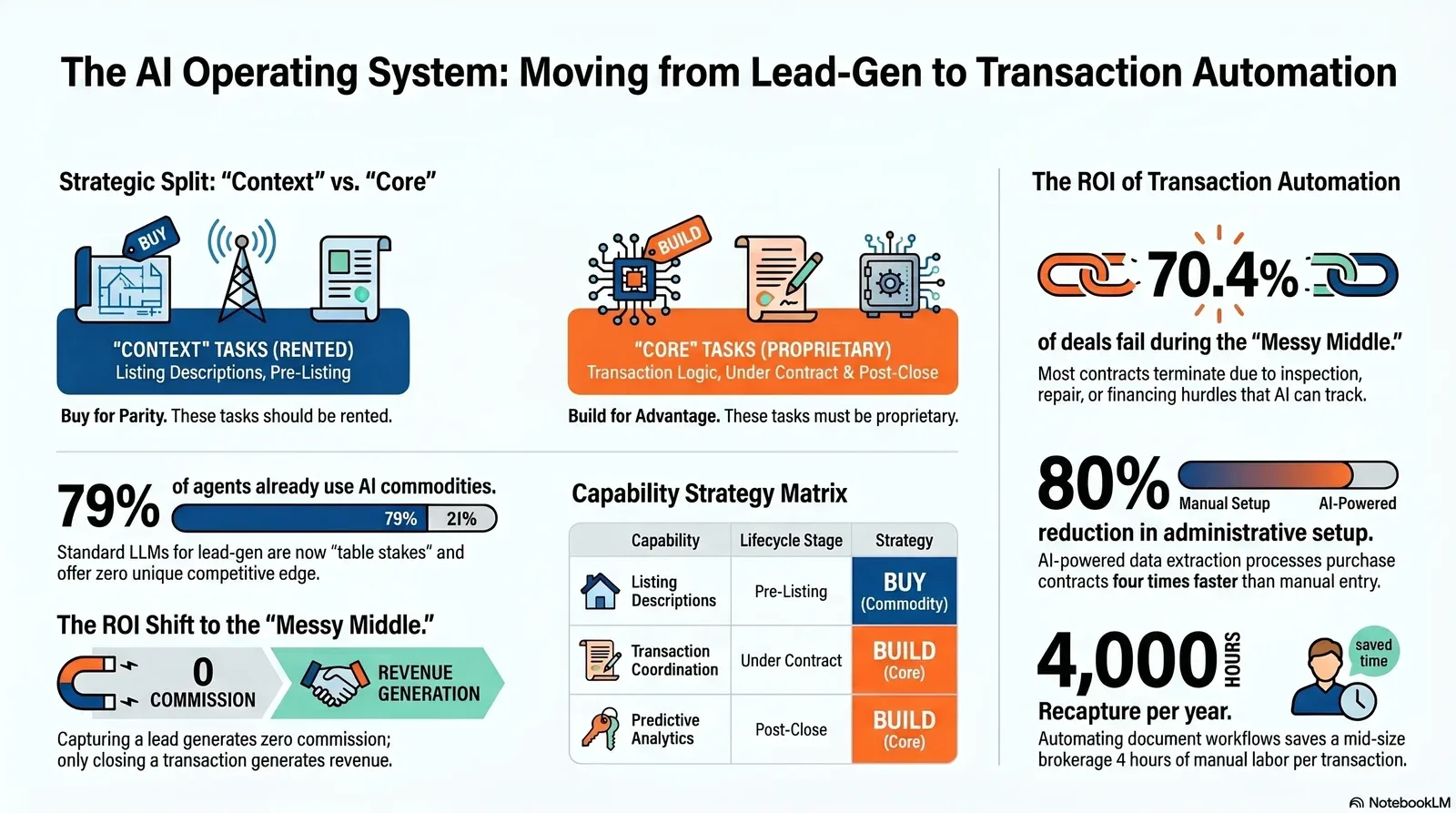
Data from the 2025 NAR Technology Survey reveals the extent of this commoditization. Currently, 79% of agents use eSignature software, 75% leverage social media for business, and 46% rely on AI-generated content for daily tasks. The specific language models driving this adoption are widely accessible consumer products, with 58% of agents using ChatGPT, 20% using Google Gemini, and 15% relying on Microsoft Copilot. While 82% of respondents noted that clients responded positively to the integration of technology in the buying process, and 66% of agents embrace new technology primarily to save time, these figures highlight a structural reality: top-of-funnel AI is now table stakes.
When every competing brokerage in a given market has access to the exact same large language models (LLMs) to write copy and deploy automated follow-up sequences, the capability ceases to be a competitive advantage. It becomes a baseline requirement for operational parity. This represents a classic "context" capability within modern enterprise architecture—a standardized, interchangeable function necessary for business operations but providing no unique proprietary value.
The disproportionate focus on lead generation ignores the fundamental reality of how brokerages secure revenue. Capturing a digital lead does not generate a commission; closing a transaction does. Yet, the vast majority of technology budgets are spent optimizing the beginning of the customer journey, leaving the most labor-intensive, risk-heavy stages of the transaction to manual data entry, fragmented legacy systems, and overwhelmed administrative staff. As demographic shifts bring new buyer profiles into the market—such as Gen Z single women, who currently claim a 35% share of home purchases within their generation—the complexity of financing and advisory services requires agents to spend more time building relationships and less time pushing paperwork.
The Transaction Lifecycle Map: Where AI Moves the Needle
To understand where artificial intelligence generates the highest return on investment, leaders must examine where transactions fail. Deals rarely fall apart because of an unimaginative listing description or a slightly delayed initial email response. Contracts terminate due to tangible hurdles in the middle of the lifecycle.
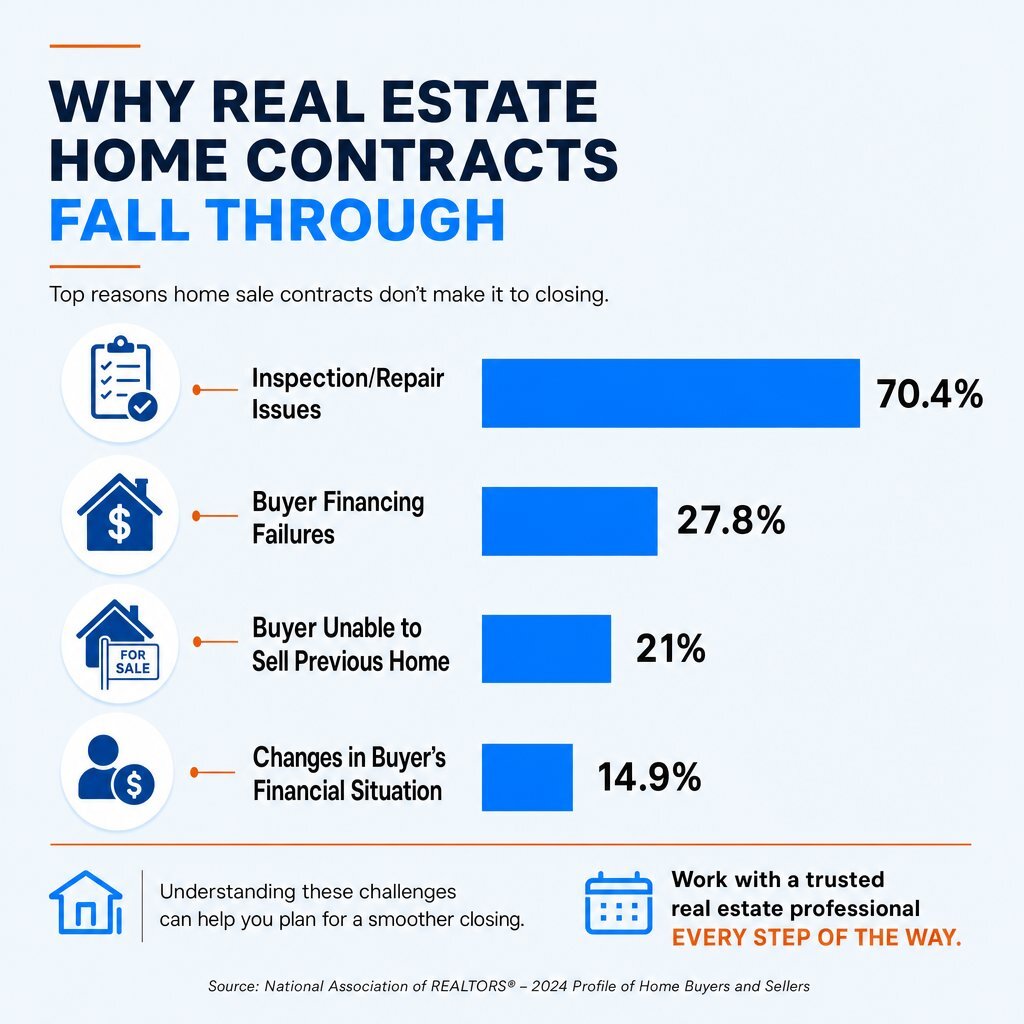
A recent survey of real estate professionals conducted by Redfin revealed that the top reason home contracts fell through was inspection or repair issues, cited by 70.4% of agents. This was followed by buyer financing failures at 27.8%, the buyer being unable to sell their current home at 21%, and changes in the buyer's financial situation at 14.9%. The median time on market for properties sits at roughly 41 days, leaving a wide window for documentation errors, missed contingency deadlines, or compliance oversights to derail a closing.
The highest-ROI targets for AI deployment reside squarely in this transaction and operations layer. Automating these workflows requires shifting from generic text generation to highly structured data extraction and process orchestration. For many firms, this also means rethinking their broader AI roadmap and adopting a portability-first AI strategy that keeps critical transaction logic flexible across vendors and deployment models.
AI in Transaction Coordination
Transaction management has historically relied on static software tools that act primarily as digital filing cabinets. Transaction coordinators (TCs) are forced to manually open purchase agreements, read through dozens of pages of legalese, extract critical dates, identify specific contingencies, and manually populate task checklists across various platforms. This manual extraction is slow, prone to human error, and limits the number of files a single coordinator can manage.
Modern AI-powered transaction coordination alters this workflow entirely. Custom applications can now ingest a complex, 50-page purchase agreement and use specialized machine learning models to automatically extract key variables. The system identifies the exact earnest money deadline, the expiration of the inspection contingency, and the target closing date, then dynamically generates a complete compliance timeline. Platforms focused on this specific niche demonstrate that AI-powered data extraction can process contracts up to four times faster than manual entry, saving approximately 80% of the time previously spent on administrative setup.
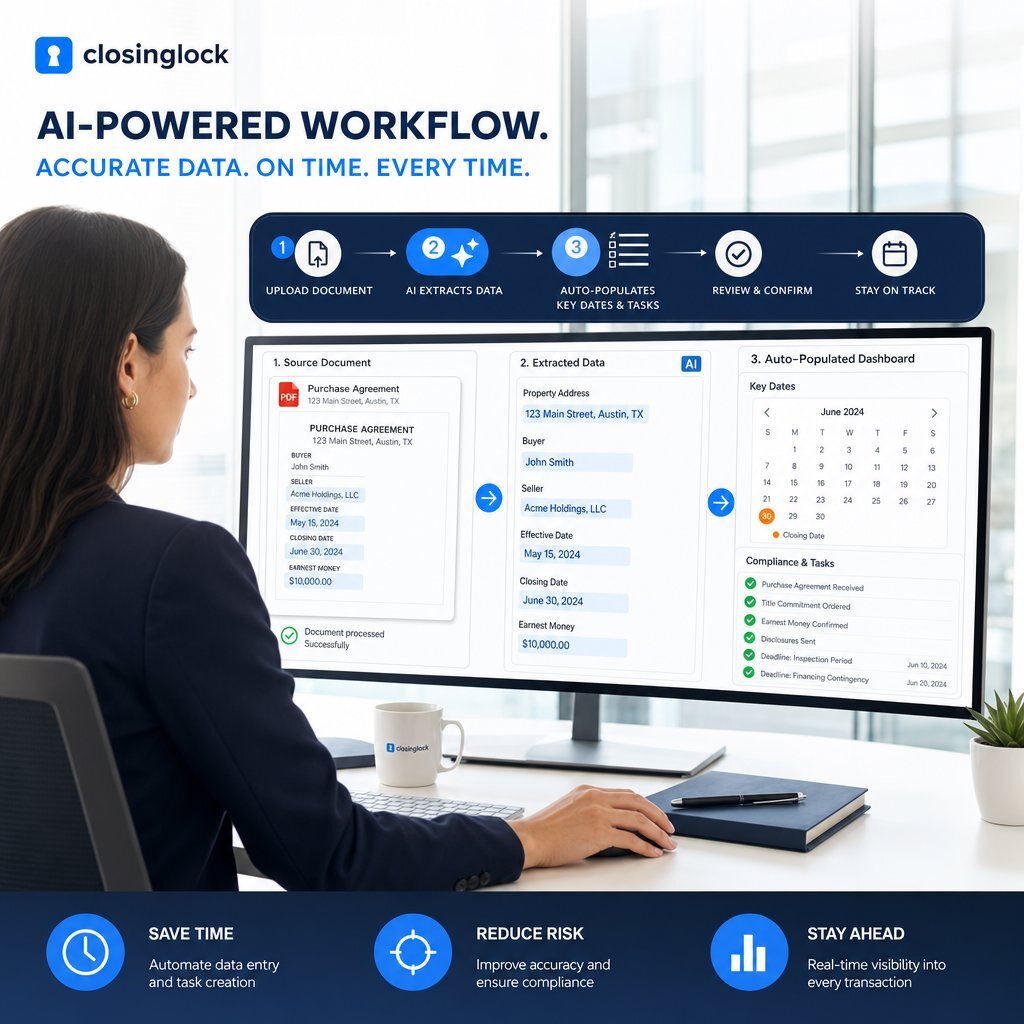
In practice, an AI engine reads a newly uploaded PDF document, recognizes a non-standard financing addendum, cross-references the timelines with the local Multiple Listing Service (MLS) calendar, and automatically updates the agent's CRM and project dashboard without requiring a single keystroke of human data entry. For regulated or higher-risk portfolios, leaders may even choose to self-host AI agents so that sensitive transaction data never leaves their own infrastructure.
Document and Compliance Automation
Brokerages process millions of pages of unstructured data annually, from title commitments and HOA disclosures to lead-paint addendums and appraisal reports. Specialized real estate technology firms have proven that leveraging AI to automate these closing workflows yields dramatic efficiency gains.
Implementations focused on high-volume document processing save an average of four hours of manual work per transaction. For a mid-size brokerage closing 1,000 transactions annually, this equates to 4,000 hours of recaptured administrative capacity. This automation directly reduces operational costs by up to 25%, translating to hard, tangible savings that flow directly to the bottom line. More importantly, it creates elastic capacity. During seasonal volume spikes or sudden market shifts, the brokerage can process a higher volume of active files without needing to rapidly hire, train, and onboard temporary administrative staff. As part of this planning, firms should also account for the security posture of any AI-assisted tooling and guard against the kinds of vulnerabilities exposed in auto-generated apps built on low-code AI platforms.
Compliance and Fair-Housing Guardrails: The Necessity of Human-in-the-Loop
While the operational benefits of transaction automation are profound, real estate remains a heavily regulated sector. Deploying autonomous, "black box" systems to handle tenant screening, client communication, or contract review introduces severe compliance and fair-housing risks. AI models optimize for mathematical efficiency, not legal equity, and unmonitored systems can easily perpetuate historical biases or execute actions that violate federal and state housing laws.
The regulatory environment surrounding AI in real estate is tightening rapidly. In May 2024, the U.S. Department of Housing and Urban Development issued formal guidance addressing the application of the Fair Housing Act to artificial intelligence. This directive specifically targeted tenant screening processes and the advertising of housing opportunities through algorithms. The guidance emphasized that housing providers, advertisers, and tenant screening companies carry the legal responsibility to prevent automated systems from executing discriminatory practices, explicitly warning against algorithms that rely on imprecise or overbroad criteria.
State-level regulators are executing aggressive enforcement actions based on these principles. In early 2026, the California Civil Rights Department secured a major fair-housing settlement against Greystar California, a property management firm operating over 330 multi-family apartment complexes. The enforcement action targeted the company's automated tenant screening policies, which allegedly executed automatic rejections based on unrelated or old criminal offenses. The settlement mandated a complete revision of the screening algorithm and required the firm to submit to three years of active monitoring to ensure compliance. Furthermore, state regulations now explicitly define an "agent" of an employer or housing provider to include automated decision systems, ensuring that companies cannot use the autonomy of an algorithm as a legal shield for discriminatory outcomes.
To mitigate these severe risks, brokerages must design and deploy AI systems using a strict "human-in-the-loop" (HITL) architectural framework. HITL is not a vague corporate policy; it is a hardcoded, technical governance model where trained professionals retain explicit decision-making authority over high-risk AI actions.
In an automated real estate workflow, an agentic AI system must be engineered to pause and escalate to a human reviewer in several specific scenarios:
- Low Confidence or Ambiguity: If an AI assistant cannot definitively classify a client's request—for example, determining whether an email represents a routine maintenance question or a formal legal dispute—the workflow must halt. The system should route the communication to a licensed professional rather than attempting to guess the intent.
- Sensitive and Irreversible Actions: Any automated action that modifies financial figures, alters legal contingencies, overwrites client records, or sends binding agreements to third parties must require a digital signature or manual approval from a human coordinator before execution.
- Regulatory Implications: AI excels at drafting lease addendums, compiling fair-housing disclosures, and formatting custom contract clauses. However, the software must route these drafts to a human lawyer or managing broker for review. The AI acts as the drafter; the human acts as the editor and legal signatory.
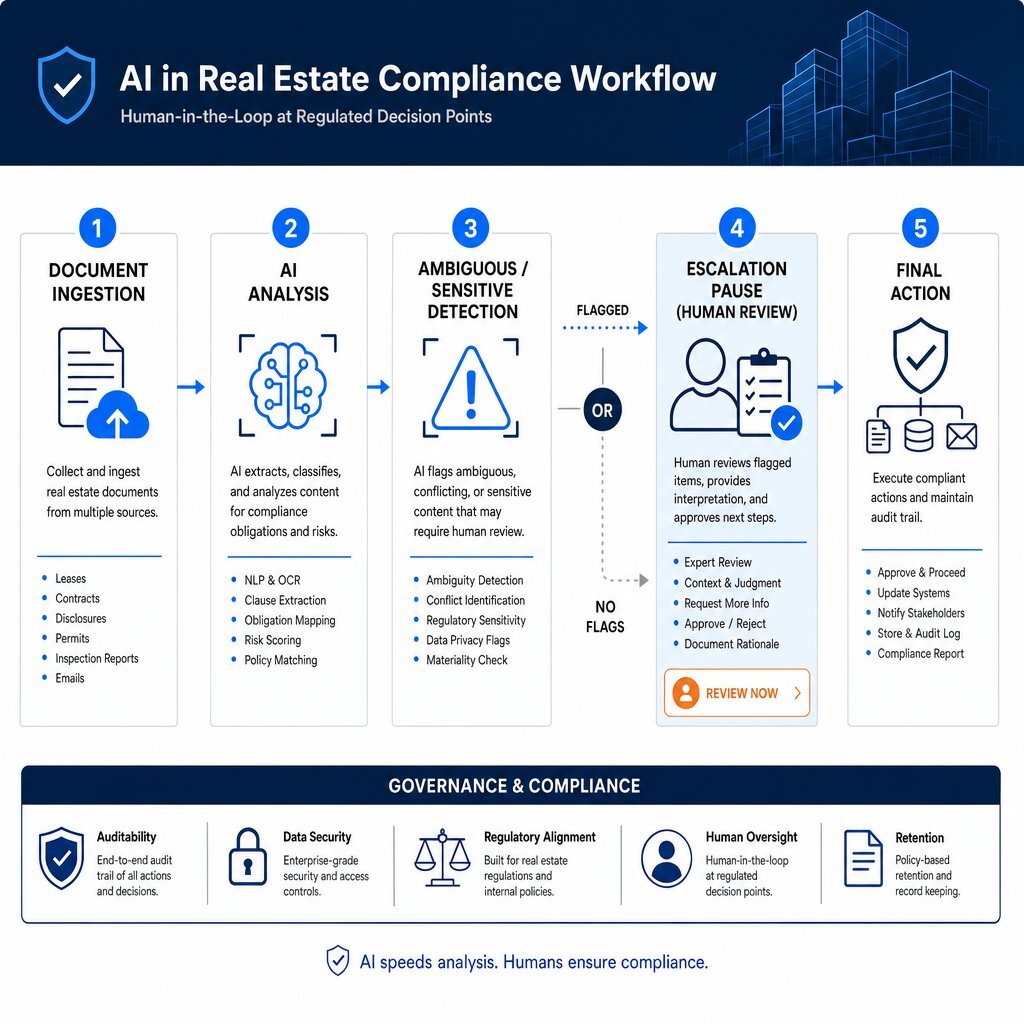
By embedding these HITL checkpoints directly into custom AI applications, brokerages maintain defensible oversight. This design ensures that when regulators or auditors examine a firm's operations, the brokerage can provide a transparent log of every pause, every human decision, and the precise context for every automated action. Many of the same guardrails recommended for securing agentic AI in other regulated industries apply directly to real estate as well.
The Data Foundation: Preparing the MLS and CRM for AI
Artificial intelligence cannot generate accurate insights, draft reliable contracts, or execute seamless automations from fragmented, siloed, or outdated data. The fundamental prerequisite for a functional AI operating system in real estate is a modernized, standardized data architecture. Simply purchasing an AI wrapper and layering it over a messy, decade-old database will only accelerate the speed at which the firm produces errors.
Historically, real estate data was transported via the Real Estate Transaction Standard (RETS). This deprecated protocol forced brokerages and vendors to copy massive listing databases onto local servers and run batch updates to sync inventory. The industry has since transitioned to the RESO Web API and Data Dictionary, a shift initially mandated by the National Association of Realtors in 2016 to ensure data integrity.
The RESO Web API is a modern, RESTful data exchange protocol built on widely used web standards like OData and JSON. It allows software applications to execute live queries against MLS databases, pulling immediate, real-time results without the burden of hosting legacy databases. Coupled with the RESO Data Dictionary—a universal schema that standardizes the vocabulary for property types, statuses, and features across over 500 certified MLSs—the Web API provides the clean, structured data stream that advanced AI models require to function accurately.
For a brokerage, this means the internal Customer Relationship Management (CRM) system and transaction management platform must be completely integrated with the RESO Web API. When building custom AI tools, engineers rely on this structured data to power Retrieval-Augmented Generation (RAG) architecture. RAG is the critical framework that makes generative AI safe and reliable for business use. Instead of allowing an LLM to rely on its broad, pre-trained knowledge base—which often contains outdated or generalized real estate information—a RAG system intercepts the user's prompt, retrieves the exact, current property data from the RESO-connected database, and forces the AI to generate its response based strictly on that retrieved data.
If an AI tool is utilizing RAG to answer a buyer's complex questions about local property taxes, school district boundaries, or historical price-per-square-foot trends, it must pull from a real-time, single source of truth. Without this foundational API layer and strict schema adherence, generative AI is highly prone to hallucinations, confidently inventing property features or relying on stale inventory states. This destroys trust and exposes the brokerage to liability. Building custom data pipelines on robust infrastructure—such as PostgreSQL databases orchestrated via Docker and Kubernetes, or deployed securely on Azure DevOps On-Prem—ensures the AI has a highly available, uncorrupted data source to draw from. In parallel, brokerages should treat their MLS and CRM environment as part of a broader AI data platform, similar to the AI data infrastructure strategies used to reduce hallucinations in other enterprise workflows.
Build vs. Buy: A Strategic Split Across the Lifecycle
As brokerages evaluate their technology stacks, the central dilemma is whether to purchase off-the-shelf software (Buy) or invest in an AI software development company to engineer proprietary solutions (Build). The traditional binary choice between buying a monolithic suite and building everything from scratch is obsolete.
The most effective approach utilizes a composable enterprise architecture, guided by a simple but ruthless strategic principle: "Buy for parity, build for advantage".
Under this framework, real estate executives must audit their workflows to separate "Context" from "Core". Context encompasses the commodity functions necessary to operate the business but providing no unique competitive edge. Core represents the firm's proprietary logic, specialized workflows, and unique intellectual property.
By executing a "Bounded Buy," organizations strategically purchase best-in-class, API-driven software for context tasks, preserving their capital and engineering resources to custom-build the core capabilities that actually differentiate them in the market.
The Real Estate AI Capability Matrix
| Capability | Lifecycle Stage | Classification | Strategic Action | Technical Rationale |
|---|---|---|---|---|
| Listing Descriptions & Basic Copy | Pre-Listing / Top of Funnel | Context (Commodity) | Buy | Consumer LLMs (ChatGPT, Gemini) and standard CRMs handle this flawlessly. Custom building offers zero competitive advantage or ROI. |
| Basic Lead Capture & Chatbots | Prospecting | Context (Commodity) | Buy | Standard proptech vendors offer robust, inexpensive lead-routing AI that integrates easily with existing websites. |
| Document Storage & eSignature | Contract Execution | Context (Commodity) | Buy | Secure document storage and electronic signing are highly regulated, standardized utility functions utilized by 79% of agents. Rent these platforms. |
| Transaction Coordination Automation | The "Messy Middle" | Core (Differentiator) | Build / Custom-Integrate | Every brokerage has a unique compliance checklist, local regulatory quirks, and operational workflow. Custom AI logic here accelerates closings, reduces manual data entry, and directly lowers fall-through rates. |
| Hyper-local Valuation Models | Advisory / Pricing | Core (Differentiator) | Build | Generic Automated Valuation Models (AVMs) fail to capture nuance in specialized neighborhoods. Building custom AI that integrates proprietary historical brokerage data with public records yields superior, defensible pricing accuracy. |
| Client Retention & Predictive Analytics | Post-Close | Core (Differentiator) | Build / Custom-Integrate | Mining past transaction data to accurately predict when a specific client will sell again requires bespoke data modeling tailored to the brokerage's unique client demographic. |
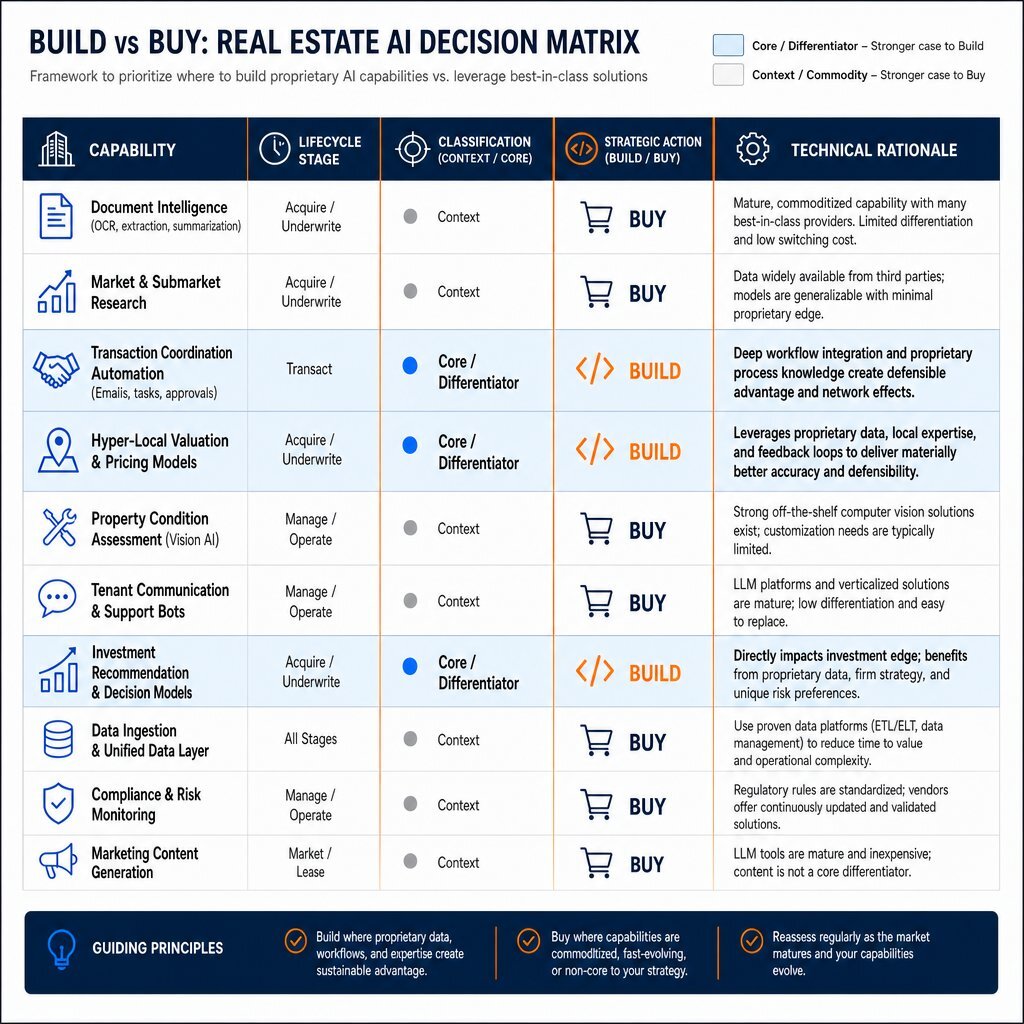
By purchasing inexpensive SaaS for top-of-funnel tasks and directing engineering budgets toward the middle-of-funnel transaction layer, brokerages construct a durable competitive moat. A competing firm can easily buy the same lead-gen chatbot, but they cannot replicate a custom-built, AI-driven transaction engine that perfectly encodes a rival brokerage's operational efficiencies. This same pattern—treating internal AI tools like an internal app store of specialized agents—is already playing out across other enterprise sectors and is rapidly becoming the default for serious AI adopters.
Measurable Outcomes: Metrics for Brokerage Leaders
Investing in the operational layer of artificial intelligence must yield tangible, quantifiable business results. Technology deployments that only offer vague promises of "improved agent experience" without moving financial metrics should be rejected. Executives must hold custom AI integrations accountable by tracking specific key performance indicators (KPIs) that prove the technology's effectiveness:
- Transaction Fall-Through Rate: The primary objective of transaction AI is keeping deals alive. By using automated systems to relentlessly track financing deadlines, trigger appraiser scheduling alerts, and monitor inspection contingency windows, brokerages should see a measurable, statistical decline in contracts terminated due to missed administrative deadlines.
- Cycle Time: Measure the total time elapsed from the mutual acceptance of an offer to the final closing. Automating document routing, data extraction, and timeline generation directly compresses the administrative friction that stalls deals, accelerating the velocity of capital for both the client and the firm.
- Agent and Coordinator Capacity: Track the specific number of active transactions a single coordinator can manage without triggering compliance errors. An AI-assisted TC should be able to handle a significantly larger pipeline. This metric proves that the brokerage can scale revenue without a linear, corresponding increase in administrative headcount.
- Manual Hours Saved: Quantify the reduction in redundant data entry. If an AI platform saves four hours per transaction by eliminating the need to manually copy data from PDFs to CRMs, the hard cost savings can be directly calculated against hourly payroll rates, providing a crystal-clear ROI on the software development investment. When evaluating these savings, leaders can borrow from the vendor selection playbooks used in other modernization projects, such as those outlined in the guide to top enterprise software development partners for IT modernization.
A Pragmatic Roadmap for Mid-Size Brokerages
Mid-size brokerages often operate under the false assumption that enterprise-grade, custom AI is reserved exclusively for national brands with massive, dedicated technology budgets. However, modern API-driven architecture and cloud-native infrastructure make advanced AI highly accessible and cost-effective to deploy.
A pragmatic starting point involves conducting a ruthless, honest workflow audit. Leadership teams must map the entire lifecycle of a typical transaction, specifically identifying the operational bottlenecks that consume the most staff time. In almost every brokerage, this audit points directly to document review, deadline tracking, and redundant compliance data entry.
Next, the firm must ensure its data house is in order. Verify that the current CRM utilizes the RESO Web API for live data feeds and that historical transaction files are cleanly digitized and securely stored. AI models require structured, accessible data to function; deploying custom software over disorganized local servers will fail.
Rather than attempting a monolithic software overhaul that disrupts the entire company, leaders should adopt an agile methodology. Select a single, high-impact business process for automation. Partner with an experienced AI software development company to build a targeted microservice—such as a custom contract-ingestion tool that automatically reads PDFs and updates the firm's existing CRM via API. A tight, focused pilot project delivers immediate business value, builds institutional knowledge, and secures the organizational buy-in necessary for broader architectural evolution.
Once this initial microservice proves successful and delivers a hard ROI, the brokerage can incrementally build out additional custom modules. Over time, this deliberate, phased approach results in a comprehensive, proprietary AI operating system tailored precisely to the brokerage's operational reality, built upon secure infrastructure like Microsoft 365, Google Drive integrations, and managed cloud servers. For more complex deployments that mix edge and on-prem systems, leaders can draw on decision frameworks similar to those used when balancing cost and performance between edge and on-prem AI.
Conclusion
The real estate industry's obsession with top-of-funnel lead generation has left the most critical, revenue-defining phase of the business largely untouched by advanced automation. While generative AI models have fully commoditized the creation of marketing copy and basic property descriptions, the true competitive advantage for modern brokerages lies deep within the transaction lifecycle. By automating complex contract extraction, standardizing compliance timelines, and instituting strict human-in-the-loop governance to navigate fair-housing regulations, firms can drastically reduce transaction fall-through rates and scale their operational capacity without inflating headcount.
Achieving this level of operational excellence requires a deliberate transition from buying generic, one-size-fits-all point solutions to strategically building proprietary workflows. Baytech Consulting's AI solutions team specializes in guiding B2B enterprises through this exact architectural transition. By engineering custom, enterprise-grade AI applications that integrate seamlessly with existing CRM databases and RESO-compliant MLS feeds, Baytech Consulting helps real estate leaders transform disjointed, manual transaction processes into secure, intelligent, and highly profitable operational systems.
Frequently Asked Questions
When should a brokerage build a custom real estate AI tool instead of buying one?
A brokerage should build custom AI solutions for core operational workflows that represent a unique competitive advantage, such as proprietary transaction coordination processes, specialized compliance routing, or hyper-local valuation models. Conversely, commodity functions like basic chatbots, listing description generators, and standard document storage should be purchased off-the-shelf, as building them offers no unique market differentiation and wastes engineering resources. Many firms also choose to integrate AI into the tools they already use, blending bought components with custom-built logic where it matters most.
About Baytech
At Baytech Consulting, we specialize in guiding businesses through this process, helping you build scalable, efficient, and high-performing software that evolves with your needs. Our MVP first approach helps our clients minimize upfront costs and maximize ROI. Ready to take the next step in your software development journey? Contact us today to learn how we can help you achieve your goals with a phased development approach.
About the Author

Bryan Reynolds is an accomplished technology executive with more than 25 years of experience leading innovation in the software industry. As the CEO and founder of Baytech Consulting, he has built a reputation for delivering custom software solutions that help businesses streamline operations, enhance customer experiences, and drive growth.
Bryan’s expertise spans custom software development, cloud infrastructure, artificial intelligence, and strategic business consulting, making him a trusted advisor and thought leader across a wide range of industries.