Top Vibe Сoding AI App Development Companies in the USA
February 13, 2026 / Bryan ReynoldsTop 10 AI App Development Companies in the USA with Vibe Сoding Expertise: List for 2026
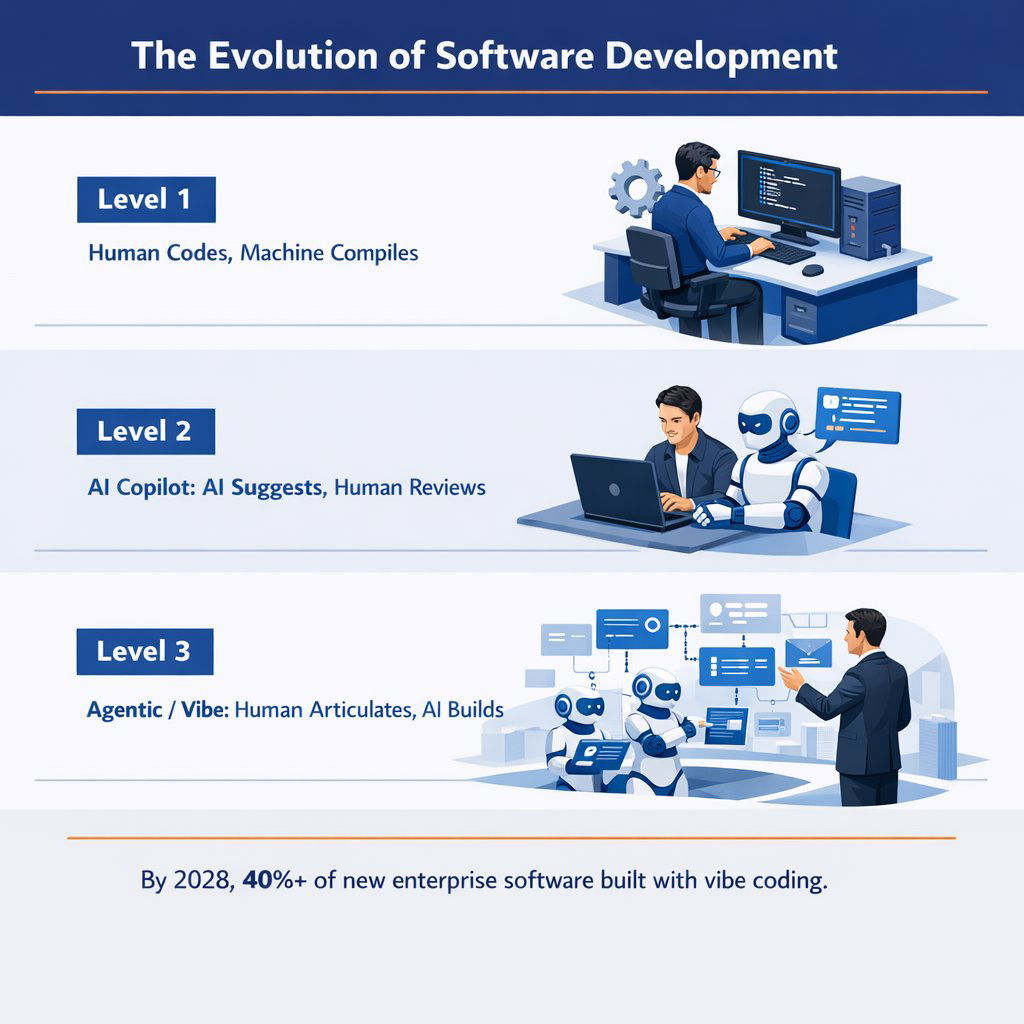
If you feel like the ground is shifting under your engineering team, you’re just early. For twenty years, building software meant wrestling with syntax, squashing bugs, and managing technical debt. But as Andrej Karpathy famously noted, we are entering the era of "vibe coding," where the bottleneck is no longer your ability to write code, but your ability to articulate a vision. The modern founder doesn’t need to know how to center a div or manage memory allocation.
This is not a fun trend for indie hackers. By 2028, Gartner predicts that 40% of new enterprise production software will be created with vibe coding techniques and tools. Think about that: nearly half of all business software will be built by humans managing AI agents. The challenge is that most development agencies in the US are still built for the old world, structured to bill you for hours of manual coding. To win in 2026, you need a partner who treats AI as a teammate.
We analyzed the market to find the top AI app development companies in the USA that have fully embraced vibe coding workflows to build products at the speed of thought without sacrificing security or long-term value.
Why Vibe Coding Expertise is the New Gold Standard
In the traditional agency model, you paid for hours. In the new model, you pay for velocity and vision. The agencies clinging to the old "waterfall" or even standard "agile" methodologies are finding themselves outpaced by small, hyper-specialized teams who understand that code is no longer a scarce resource.
Here is why vibe coding is the only metric that matters in 2026.
Speed vs. Quality
Companies used to measure development cycles in sprints (two weeks). Now, they can be measured in sessions (two hours). A leading AI app development company in the USA markets is deeply integrated with "flow-state" tools like Cursor, Windsurf, and Claude Code.
These AI-assisted tools allow developers to prototype in days by turning the IDE (Integrated Development Environment) into a conversation partner. A developer can now say, "Refactor this entire authentication flow to use Supabase and add error handling for edge cases," and the system executes it instantly. The agency’s role shifts from writing the boilerplate to verifying the logic. If your partner doesn’t use these tools, you are effectively paying for them to reinvent the wheel by hand instead of following an AI‑native software development lifecycle designed for this new era.
The Human-in-the-Loop Necessity
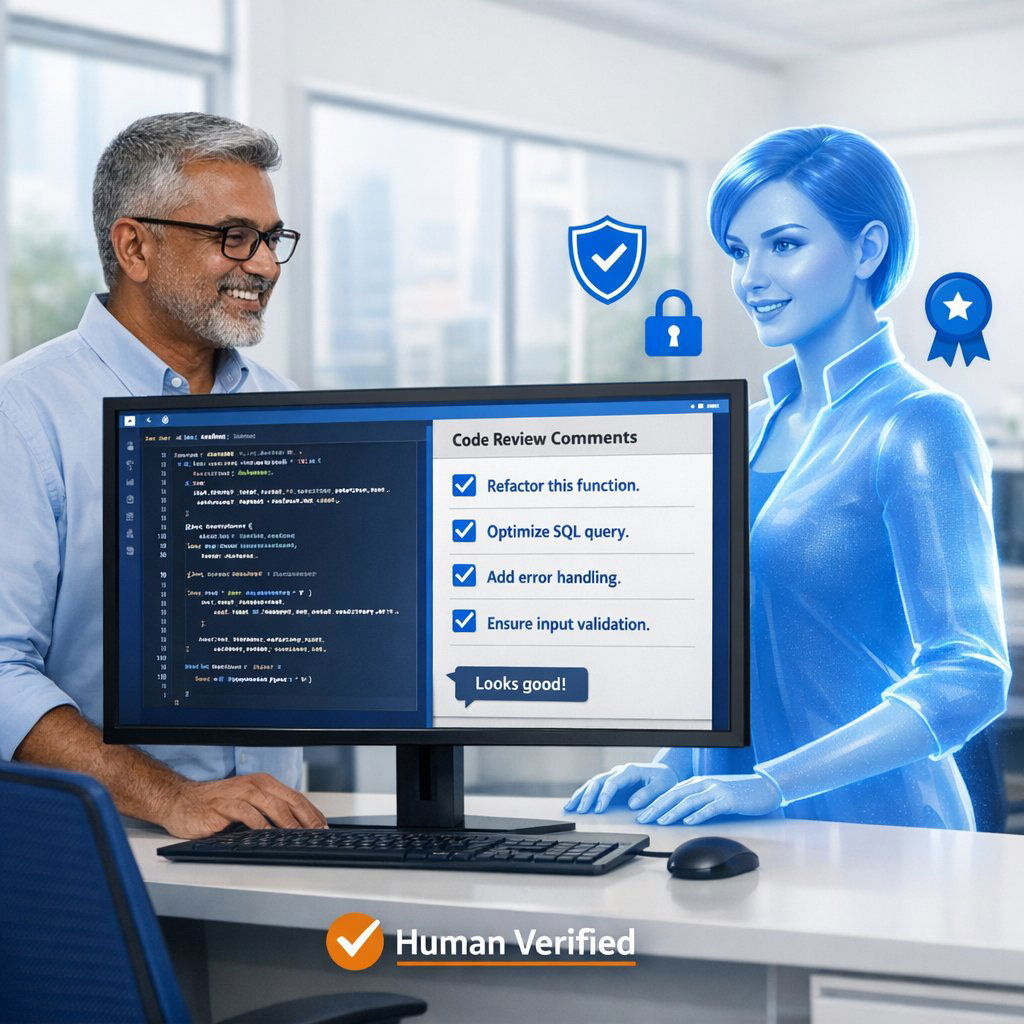
Speed is dangerous without direction. A junior developer with an LLM can generate a lot of code very quickly. Nonetheless, they may create a "spaghetti code" mess that is impossible to maintain. This is where a premium AI app development company the USA founders trust differentiates itself. They have the deep expertise to act as the Editor-in-Chief.
Vibe coding doesn’t mean removing the human. The AI handles the syntax, but the developer deals with the semantics and the soul of the application. They curate the output to ensure security compliance, architectural scalability, and that intangible "vibe" that makes an app feel premium.
From Writing Code to Guiding AI
You can witness a shift in the fundamental autonomy spectrum of software engineering:
Level 1 (traditional): Human types code, machine compiles it.
Level 2 (copilot): AI suggests lines, human accepts/rejects.
Level 3 (agentic/vibe coding): Human defines the goal ("Make the checkout page look like Stripe but behave like Shopify"), and the AI orchestrates the file creation, dependency management, and testing.
The agencies listed below are operating at Level 3. They can manage fleets of AI agents to build it for you, while minimizing the AI technical debt that ruins long-term ROI.
Top 10 AI App Development Companies in the USA Overview
Finding a company that has operationalized vibe coding is difficult. A lot of "AI app development agencies" in 2026 are still just traditional software shops that have added a "AI-driven software development" landing page. They quote in man-hours, rely on bloated teams, and treat code as a manual craft. If you hire them, you aren't getting the speed advantages of the agentic era.
The companies on this list are different. We selected these 10 partners because they have shifted their engineering culture. They use agentic workflows (utilizing stacks like Cursor, Windsurf, and custom LLM orchestration) to compress development timelines by 40–60%. These best AI app development companies in the USA for 2026 are worth watching because they have replaced the junior developer with the AI architect, ensuring that every line of code is supervised by senior talent but generated at machine speed.
Here is a quick comparison of the top-rated AI app development agencies in the US that use agentic workflows:
Company name | Headquarters | Core vibe focus | Pricing | Clutch rating | Industries |
Baytech Consulting | Irvine, CA | Risk-averse speed | $100-149/hr | ⭐ 5.0 | Education, Healthcare, Finance, Construction, Environmental, Energy, Manufacturing, Legal, Startup |
Simform | Santa Clara, CA | Scalable engineering | Min: $50k+ | ⭐ 4.8 | Fintech, Healthcare, Retail, Supply Chain |
Vention | New York, NY | Innovation at scale | Min: $40k+ | ⭐ 4.7 | Fintech, Healthtech, Edtech, IT Services |
10Pearls | Vienna, VA | Digital transformation | Min: $60k+ | ⭐ 4.9 | Energy, Finance, Healthcare, Education |
BairesDev | San Francisco, CA | Top 1% talent | Min: $70k+ | ⭐ 4.9 | Technology, Finance, Healthcare, Advertising |
LeewayHertz | San Francisco, CA | Generative AI | Min: $10k+ | ⭐ 4.8 | Manufacturing, Supply Chain, Insurance, VC |
Prismetric | San Francisco, CA | Mobile-first MVP | Min: $20k+ | ⭐ 4.7 | Fintech, Retail, Logistics, Social |
Coherent Solutions | Minneapolis, MN | Data and analytics | Min: $50k+ | ⭐ 4.7 | Healthcare, Manufacturing, Software, IoT |
Inoxoft | Philadelphia, PA | Democratized dev | $25-49/hr Min: $25k+ | ⭐ 5.0 | Fintech, Logistics, Real Estate, Education |
Dogtown Media | Los Angeles, CA | FDA-compliant vibe coding | Min: $25k+ | ⭐ 4.7 | mHealth, MedTech, IoT, Finance |
Baytech Consulting: Best AI App Development Company in the USA for Safe Vibe Conding
Headquarters: Irvine, California
Team structure: 100% US-based (no offshore risk)
Clutch rating: 5.0/5.0
Ideal client: B2B enterprises (20M–200M revenue) in highly regulated sectors (Healthcare, Finance, Legal) that require custom, secure, and AI-accelerated operational software.
In the "gold rush" of development, Baytech Consulting is arguably the best AI app development company in the USA markets for security-conscious firms. They solve the biggest problem with vibe coding: security and long-term maintainability. While other agencies rush to generate code using public LLMs, Baytech has pioneered the "walled garden" framework. This approach allows them to utilize agentic AI to reduce build times by up to 55%, while ensuring that sensitive data (HIPAA, legal, financial) never leaves the secure environment.
They are the antithesis of the "churn and burn" shop. Founded in 2007 and operating debt-free, this team brings a level of financial and operational stability that startups can’t match. Their vibe-first SDLC (Software Development Life Cycle) is made to minimize the cost of downtime (which they estimate can cost enterprises thousands per minute) by delivering robust, scalable software on the first deployment.
Their Vibe Coding Capabilities
Agentic engineering. The agency uses custom AI agents to handle 20–35% of the heavy lifting in coding, testing, and documentation.
Rapid prototyping. Can move from napkin to native app in weeks rather than months, specifically targeting the MVP gap that stalls many startups.
Debt-free development. Unlike VC-backed agencies that prioritize growth over quality, Baytech focuses on long-term code health.
Simform: Scalable Engineering with Automated Vibe Coding
Headquarters: Santa Clara, California
Team structure: Digital product engineering with global delivery
Clutch rating: 4.8/5.0
Ideal client: Enterprise & scale-ups (Fintech, Retail, Supply Chain)
Simform distinguishes itself by turning vibe coding from a creative process into a scalable manufacturing line. They are a preferred partner for engineering leaders because they leverage proprietary AI frameworks to eliminate the "boring" parts of development. By integrating solutions like their custom "CodeTools" suite, they automate routine boilerplate generation and deployment tasks, allowing their engineers to focus purely on high-value logic, architecture, and DevOps efficiency.
This approach transforms the development lifecycle. Rather than getting bogged down in syntax, this team uses agentic workflows to achieve prototyping cycles that are faster than traditional standards.
Their Vibe Coding Capabilities
Automated boilerplate. Proprietary "CodeTools" handle repetitive setup, ensuring developers start meaningful work on day one.
Cloud-native velocity. Deeply integrates AI with DevOps pipelines to ship code to production faster and more reliably.
Predictive engineering. Embeds AI into the core product to predict user behaviors, moving beyond simple code generation to intelligent product design.
Vention: Innovation at Scale with Co-Pilot Integration
Headquarters: New York, New York
Team structure: Global innovation hubs
Clutch rating: 4.7/5.0
Ideal client: Series A+ startups and enterprise (Fintech, Healthtech, Edtech)
Vention is the go-to partner for leaders who need to scale engineering capacity without losing control. They have mastered the art of "co-piloting" at an enterprise level. While many firms struggle to integrate AI into established teams, Vention seamlessly embeds agentic workflows into your existing processes. This results in measurable efficiency gains without disrupting the team's rhythm. They upgrade the engine that builds it, ensuring that you retain full ownership of both the codebase and the AI tools used to generate it.
Their Vibe Coding Capabilities
AI-enabled teams. Engineers are specifically trained to use coding assistants for rapid debugging and testing, reducing cycle times.
Transparent IP. Unlike "black box" agencies, Vention ensures you own the code and the specific AI configurations used to build it.
Scalable architecture. Focuses on building systems designed to handle millions of users immediately, moving beyond simple prototypes to robust production environments.
10Pearls: Digital Transformation with Governance-First AI
Headquarters: Vienna, Virginia
Team structure: Global innovation labs (USA, LATAM, Europe)
Clutch rating: 4.9/5.0
Ideal client: Growth-Stage and enterprise (Energy, Finance, Healthcare)
10Pearls is the "adult in the room" for enterprises that want to sprint without breaking their legs. While other agencies fixate on raw generation speed, this company wins by embedding a governance-first architecture into their vibe coding process. They have productized this balance with their AI Launchpad, a framework designed to take an idea from concept to Proof of Concept (PoC) in just 90 days.
Their Vibe Coding Capabilities
Lifecycle AI. Injects AI tools into every stage, from automated requirements gathering to intelligent QA testing.
Secure modernization. Uses agentic patterns to rapidly refactor and modernize legacy systems that are often too complex or risky to touch manually.
Compliance frameworks. Ensures that all AI-generated code meets strict industry standards (like HIPAA or SOC2) before it ever reaches production.
BairesDev: Top 1% Talent for Vibe-Driven Staff Augmentation
Headquarters: San Francisco, California
Team structure: Nearshore high-performance teams
Clutch rating: 4.9/5.0
Ideal client: Enterprise and tech giants (Technology, Finance, Healthcare)
Rather than selling you a "process," BairesDev delivers you the specific humans capable of executing it. Their model relies on rigorous vetting to find the top 1% of engineers who are prompt engineers and AI architects. This is critical because vibe coding with average talent leads to generic (and often buggy) results.
BairesDev injects highly specialized talent directly into your existing workflow, giving you immediate access to engineers who know how to wrestle with LLMs to get production-ready code. If you need to scale your team overnight with developers who already speak the language of agentic AI, this is the most efficient path.
Their Vibe Coding Capabilities
Vetted vibe coders. Every engineer is tested on their ability to use AI tools to multiply their output, ensuring you get senior-level productivity.
MLOps integration. Specialized in setting up the Machine Learning Operations pipelines that allow AI models to be deployed, monitored, and updated without downtime.
Rapid staffing. Can deploy a fully capable, AI-fluent engineering team in under 72 hours, drastically reducing the "hiring lag" that kills momentum.
LeewayHertz: The Generative AI and "ZBrain" Powerhouse
Headquarters: San Francisco, California
Team structure: AI-first engineering labs
Clutch rating: 4.8/5.0
Ideal client: Enterprise and VC-backed startups (Manufacturing, Logistics, Insurance)
LeewayHertz is one of the few agencies that has built its own proprietary vibe architecture. They offer ZBrain, an enterprise-grade platform designed to let companies build custom AI agents without writing a single line of code.
For the CTO who wants to move beyond simple "prompting," LeewayHertz is the answer. They specialize in agentic orchestration, which connects multiple AI agents (using frameworks like AutoGen and crewAI) to handle complex, multi-step workflows like supply chain optimization or automated due diligence. This way, you can build "autonomous enterprises" where AI agents talk to each other to get work done.
Their Vibe Coding Capabilities
ZBrain orchestration. Their proprietary platform allows for the rapid creation of context-aware AI apps that connect directly to your enterprise data (Salesforce, Snowflake) without hallucinating.
Multi-agent systems. They are experts in deploying "crews" of specialized agents (e.g., a researcher agent passing data to a writer agent) to automate entire departments like HR or Sales.
Strategic "vibe" roadmaps. They offer a specific AI readiness assessment that visualizes your entire workflow to identify where vibe coding can replace manual effort.
Prismetric: Mobile-First MVP with Emotion-Aware Vibe
Headquarters: San Francisco, California (with global delivery centers)
Team structure: Agile mobile squads
Clutch rating: 4.7/5.0
Ideal client: Early-stage startups and retail brands
Prismetric is the answer for the founder who says, "I don't need a platform; I need an app in the store, now." While enterprise agencies can get bogged down in months of architectural planning, this company uses vibe coding to attack the mobile MVP gap. They excel at using generative UI tools to slash the time it takes to build frontend interfaces by up to 40%.
Another their real "vibe" differentiator is emotion AI. They are one of the few agencies actively integrating sentiment analysis and computer vision into mobile apps, allowing products to react to a user’s mood or engagement level in real-time.
Their Vibe Coding Capabilities
Generative UI design. Uses AI-driven design tools to turn text prompts into functional mobile screens instantly, drastically cutting design-to-code lag.
Emotion-aware apps. Specializes in integrating APIs that detect user sentiment (via text or facial recognition) to create "empathetic" interfaces that adapt to the user.
Rapid MVP delivery. Structured to launch viable products in 4–6 weeks by using AI to handle 80% of the standard boilerplate code (login, database setup, API connections).
Coherent Solutions: Data-First Feasibility and Vibe Strategy
Headquarters: Minneapolis, Minnesota
Team structure: US-based leadership + global delivery
Clutch rating: 4.8/5.0
Ideal client: Mid-market to enterprise (Healthcare, Manufacturing, Software)
If other agencies are the gas pedal, Coherent Solutions is the steering wheel. In the rush to adopt vibe coding, companies build fast but hit a wall because their data infrastructure is a mess. Coherent wins by being the data-first partner. They understand that you can't have effective agentic workflows if your underlying data is siloed or dirty. Before a single line of code is generated, they validate the feasibility of your AI roadmap, ensuring that the speed you were promised doesn't turn into a debugging nightmare.
Their Vibe Coding Capabilities
Vibe feasibility studies. They run rapid "Proof of Value" sprints to test if an AI agent can solve your specific problem before you commit to a full build.
Data-driven coding. Their teams focus on setting up the data pipelines that feed your AI models, ensuring that the code generated by tools like Cursor has context-aware access to your business logic.
Legacy modernization. Expert in using AI to "read" and document old codebases, creating a clean map for modernization that manual teams would take months to decipher.
Inoxoft: Democratized Development with ROI-Driven Vibe
Headquarters: Philadelphia, Pennsylvania (with global delivery centers)
Team structure: Efficient global teams
Clutch rating: 5.0/5.0
Ideal client: Startups and mid-market (Fintech, Logistics, Real Estate)
Inoxoft is the pragmatic choice for leaders who need to see a return on investment yesterday. They stand out by democratizing the development process, using tools like Cursor to handle the heavy lifting of "grunt work" and boilerplate code. This approach allows them to accelerate development timelines by approximately 40%, ensuring that your budget is spent on high-value features rather than basic syntax.
Their stats speak for themselves: 80% of their ML projects reach production in under 3 months. While other agencies get stuck in PoC purgatory, Inoxoft’s vibe coding workflows are made to ship. They can help you deploy custom AI agents in as little as 1–4 weeks to solve immediate business problems like sales automation or customer support.
Their Vibe Coding Capabilities
Cursor-driven velocity. They explicitly leverage Cursor to "democratize" code contributions, allowing for faster iteration loops and cleaner, AI-assisted architecture.
Rapid agent deployment. Specialized in spinning up functional AI agents (e.g., for sales or support) in weeks, cutting operational costs.
Boilerplate automation. Uses vibe coding to automate the initial 30% of project setup (database, API scaffolding), ensuring that developers are solving unique business problems from day one.
Dogtown Media: Ethical AI and Vibe Coding for MedTech
Headquarters: Los Angeles, California
Team structure: US-based mobile and AI specialists
Clutch rating: 4.7/5.0
Ideal client: MedTech, mHealth, Finance (Highly regulated)
It’s a great partner for leaders who are terrified of AI hallucinations in critical scenarios. After all, you can’t just vibe code and hope for the best in MedTech and mHealth.
Dogtown wins by specializing in ethical AI, a disciplined approach to vibe coding that prioritizes user safety and data privacy above all else. They are experts in aligning the speed of AI development with the strict requirements of FDA and HIPAA compliance.
Their Vibe Coding Capabilities
Compliant AI integration. Expert in wrapping AI models in "safety layers" to ensure they meet ISO 13485 (Medical Devices) and HIPAA standards.
Ethical guardrails. They implement strict testing protocols to prevent bias and erratic behavior in AI agents, making them safe for patient-facing or vulnerable user interactions.
Precision mHealth. Uses AI to enhance mobile health apps with features like predictive diagnostics, but always with a human-in-the-loop architecture to verify accuracy.
Tips on How to Choose a Reliable AI App Development Company in the USA
You have the list. Now comes the hardest part: filtering.
On paper, most agencies look remarkably similar. They all promise "generative solutions," quote "agentic workflows," and claim to be faster than traditional shops. But the difference between a successful pilot and a failed prototype often comes down to what happens under the hood of that promise.
You should focus on hiring an architect for your company's intelligence. If you pick the wrong partner, you lose the speed advantage that sent you looking for AI in the first place.
To separate the true engineers from the "wrapper" vendors, you need to interrogate their process. Here is the executive framework for vetting a partner that is ready to build at machine speed.
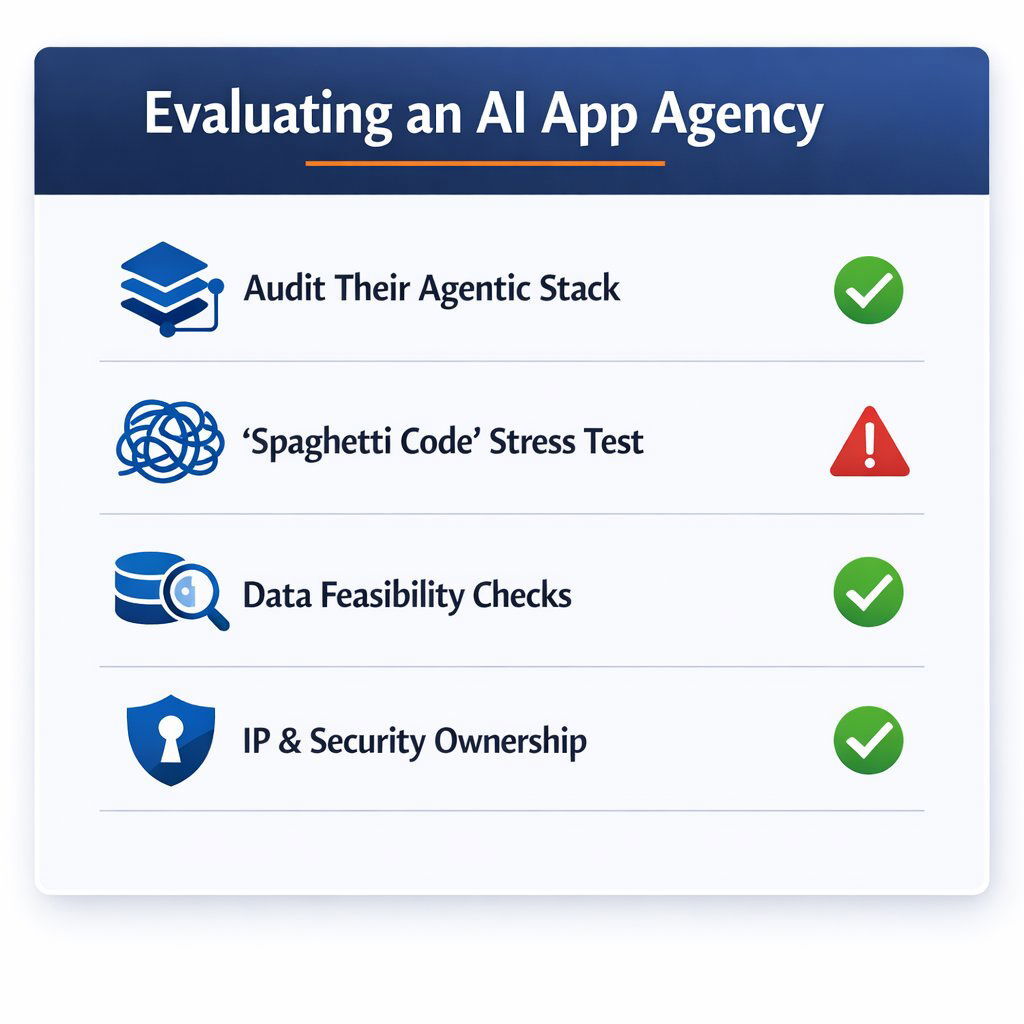
Audit Their Agentic Stack
Don't settle for generic answers like "We use AI tools to speed things up." You need to know how. The best agencies have operationalized specific vibe coding stacks that replace manual grunt work with automated precision.
You can ask one simple question: "What is your specific toolchain for agentic orchestration?"
The red flag: If they say, "We use ChatGPT for coding assistance." That is 2023 thinking. It means they are just typing faster.
The green flag: They explicitly mention modern tools like Cursor, Windsurf, or Claude Code for development, and frameworks like LangChain, CrewAI, or AutoGen for multi-agent orchestration. They should be able to explain exactly how they use these tools to automate the software development lifecycle.
Conduct the "Spaghetti Code" Stress Test
Yes, AI agents can generate code faster than humans can read it. But if unchecked, this leads to massive technical debt, a "sugar high" of fast features followed by a crash of unmaintainable bugs.
To check whether they use a humane approach, you can ask the question: "How do you prevent drift in AI-generated code, and what is your human-in-the-loop protocol?"
The green flag is when they have a strict Editor-in-Chief model where senior engineers review the logic and structure, not just the syntax. They should also mention automated testing pipelines (CI/CD) that reject AI code if it fails security benchmarks or cyclomatic complexity scores.
Don’t forget to ask if they use "walled garden" environments (like Baytech’s approach) to ensure your proprietary code doesn't train public models. You want speed, but not at the cost of your IP.
Align Data Feasibility and “Vibe”
Vibe coding fails if the underlying data is dirty. A partner who promises magic without asking about your infrastructure is lying to you. To prevent this, ask how they assess whether data is ready for agentic AI.
The green flag: They refuse to start a build without a feasibility sprint or data audit. They should ask about your data structure, latency, and governance before quoting a price.
Also, ask them to define "success" for your MVP. If they only talk about "accuracy," be wary. The best partners talk about user vibe, or how the AI feels (latency, tone, helpfulness) to the end user. They understand that a correct answer delivered in 10 seconds is a failure.
Check IP and Security Ownership
Owning the prompts is just as important as owning the code. So, ask your potential partners: "Do we own the custom agent configurations and prompt libraries you build for us?"
You must own the AI BOM (Bill of Materials). These are the specific prompts, agent definitions, and model weights used to build your software. If parting ways with the agency, you need to be able to take the "brain" of your application with you.
Common Pitfalls When Hiring an AI App Development Company
The market is currently flooded with traditional dev shops that have pivoted to AI overnight. They may show you a dazzling demo in a sales call, but lack the engineering depth to deliver a production-ready system.
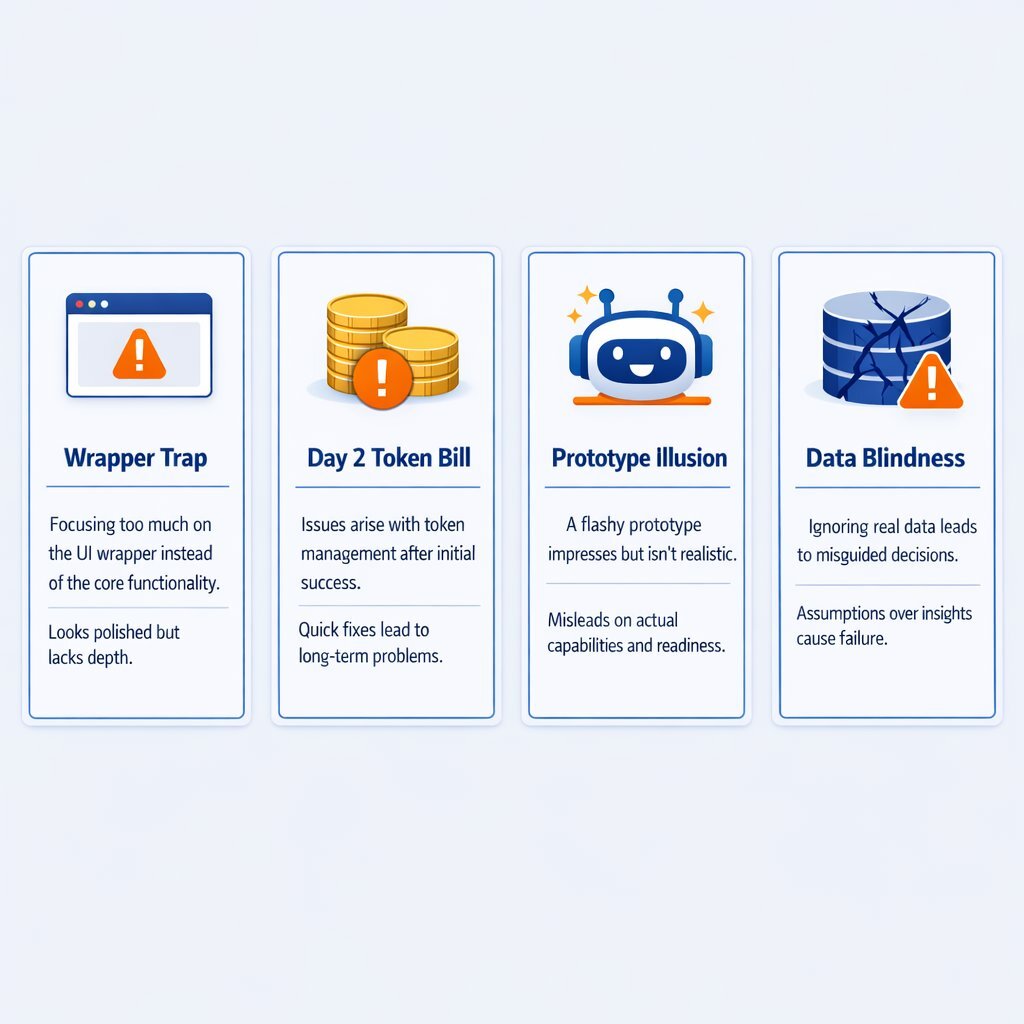
As you navigate your final selection, be vigilant against these four specific traps that often turn promising AI projects into costly liabilities.
The Wrapper Trap
One of the most pervasive risks is inadvertently hiring an agency that sells you a custom AI solution that is just a thin user interface wrapped around a standard OpenAI prompt. In this scenario, you pay enterprise rates for a product that lacks any real intellectual property or differentiation. Such "wrapper" applications are fragile; they rely entirely on the underlying model's general knowledge and often fail when tasked with domain-specific nuances.
To avoid this, challenge potential partners to explain their RAG architecture (Retrieval-Augmented Generation) in detail. A true AI engineering partner will build a sophisticated data retrieval layer that vectorizes your unique company knowledge, ensuring the AI answers with your facts.
The Day 2 Token Bill
Traditional software development has a predictable cost structure: you first pay for the build and then a fixed fee for hosting. AI software introduces a volatile third variable: token costs. Every user interaction, query, and backend logic step consumes computational resources that are billed by the million. An inexperienced agency may build a powerful tool that works perfectly in testing but becomes financially ruinous at scale. This potentially costs tens of thousands of dollars a month in API fees because the prompts were inefficiently coded.
You can mitigate this by demanding a cost-per-query projection during the proposal phase. A sophisticated partner will optimize token usage by implementing caching strategies or routing simpler tasks to smaller, cheaper models (like Llama 3 or Haiku) while reserving expensive "reasoning models" only for complex problems. If an agency can’t provide a token economy model, they are handing you a blank check for your future operating expenses.
The Prototype Illusion
Artificial Intelligence is notorious for following the "80/20" rule of difficulty: getting a chatbot to answer questions correctly most of the time is incredibly easy, but getting it to never hallucinate a fake legal statute or financial figure is exponentially harder. Projects fail because stakeholders fall in love with a flashy prototype that performs well in a controlled demo, only to discover it has a 15% failure rate when exposed to real-world edge cases.
The solution is to move beyond "vibes" and ask for an evaluation framework. You need to know how the agency mathematically scores the AI's accuracy before it goes live. High-maturity teams use automated testing suites (such as Ragas or DeepEval) to run thousands of adversarial test cases against the AI, measuring metrics like faithfulness and answer relevancy. If their quality assurance plan relies solely on humans chatting with the bot to "see if it works," the project is not ready for enterprise deployment.
Data Blindness
Vibe coding is only as effective as the data it consumes. A common point of failure is when an agency promises to build a predictive sales agent or customer support bot without first auditing the cleanliness of your CRM or knowledge base. They spend months building a Ferrari engine, only to realize you don't have the fuel to run it because your data is unstructured, siloed, or riddled with duplicates.
This pitfall is best avoided by looking for partners who prioritize data engineering over pure code generation. The most honest proposals will often include the data cleaning & structuring phase before any AI coding begins.
If an agency is willing to quote a fixed price and timeline without asking to see a sample of your data structure, they are setting you up for a stalled delivery.
Final Thoughts
Manual coding is fading. The question is no longer if you should use AI to build your next application, but who you trust to wield it.
However, speed is dangerous without governance. The biggest risk today is hiring a partner who exposes your proprietary data to public models in a rush to show progress. You need a team that understands that "moving fast" is worthless if it breaks your compliance standards or leaks your IP.
This is where Baytech Consulting distinguishes itself as the "adult in the room." By wrapping the explosive speed of vibe coding within their secure "walled garden" framework, they offer the only viable path for enterprises that refuse to compromise on safety.
If you are ready to build at machine speed without risking your business, start a conversation and don’t wait for the future to build itself.
FAQs
Can I copyright the code generated by an AI development agency?
This is a complex legal area, but the general rule is that purely AI-generated code can’t be copyrighted. However, code that is "modified, arranged, or debugged" by a human engineer is eligible for protection.
This is why it is critical to hire an agency that uses a human-in-the-loop workflow. If they simply copy-paste raw output from an LLM, you may technically own a product that is in the public domain. Ensure your contract specifies that human developers will review and refactor the code to meet the threshold of "human authorship" required by the US Copyright Office.
Is it better to build a new app from scratch or integrate AI into my existing legacy software?
"Retrofitting" is often the smarter financial move for established enterprises. Instead of rewriting your entire monolith, top agencies use a microservices architecture.
They build the AI component (the "brain") as a separate, agile microservice that communicates with your legacy system via secure APIs. This allows you to add features like predictive analytics or natural language search to a 10-year-old ERP system without risking the stability of your core database.
Why do AI development agencies prefer Python over Node.js or Java?
While Node.js is excellent for real-time applications, Python remains the undisputed king of the AI backend. This is because the vast majority of machine learning libraries (PyTorch, TensorFlow, Scikit-learn) and vector database integrations (Pinecone, Milvus) are native to Python.
Building an AI app in Java or C# often requires "bridge" code that slows down development and increases latency. If your agency suggests building the core AI logic in anything other than Python, ask them to justify the potential performance trade-offs.
How does the quality assurance process differ for AI apps vs. standard apps?
Standard apps are deterministic (input A always equals output B). AI apps are probabilistic (input A might equal output B). Therefore, standard unit tests are not enough.
You need golden datasets, which are a collection of hundreds of verified "correct" answers that the AI is tested against every time the code changes. If the agency doesn't mention regression testing on golden datasets, they likely don't have a strategy to prevent the AI from getting "dumber" (model drift) as they add new features.
What is the typical maintenance retainer for an AI application?
Unlike traditional apps, where maintenance is mostly about server uptime, AI maintenance requires model observability. You should expect a retainer that is 15–20% of the initial build cost annually. This fee covers:
Prompt optimization—tweaking prompts as user behavior changes.
Vector re-indexing—updating the AI's "memory" as your company data grows.
Model swapping—upgrading the underlying LLM (e.g., moving from GPT-5 to Claude 4) to improve performance and lower costs.
About Baytech
At Baytech Consulting, we specialize in guiding businesses through this process, helping you build scalable, efficient, and high-performing software that evolves with your needs. Our MVP first approach helps our clients minimize upfront costs and maximize ROI. Ready to take the next step in your software development journey? Contact us today to learn how we can help you achieve your goals with a phased development approach.
About the Author

Bryan Reynolds is an accomplished technology executive with more than 25 years of experience leading innovation in the software industry. As the CEO and founder of Baytech Consulting, he has built a reputation for delivering custom software solutions that help businesses streamline operations, enhance customer experiences, and drive growth.
Bryan’s expertise spans custom software development, cloud infrastructure, artificial intelligence, and strategic business consulting, making him a trusted advisor and thought leader across a wide range of industries.