
Revolutionizing Revenue: Predictive AI in 2026
January 08, 2026 / Bryan ReynoldsExecutive Summary: The Algorithm of Revenue
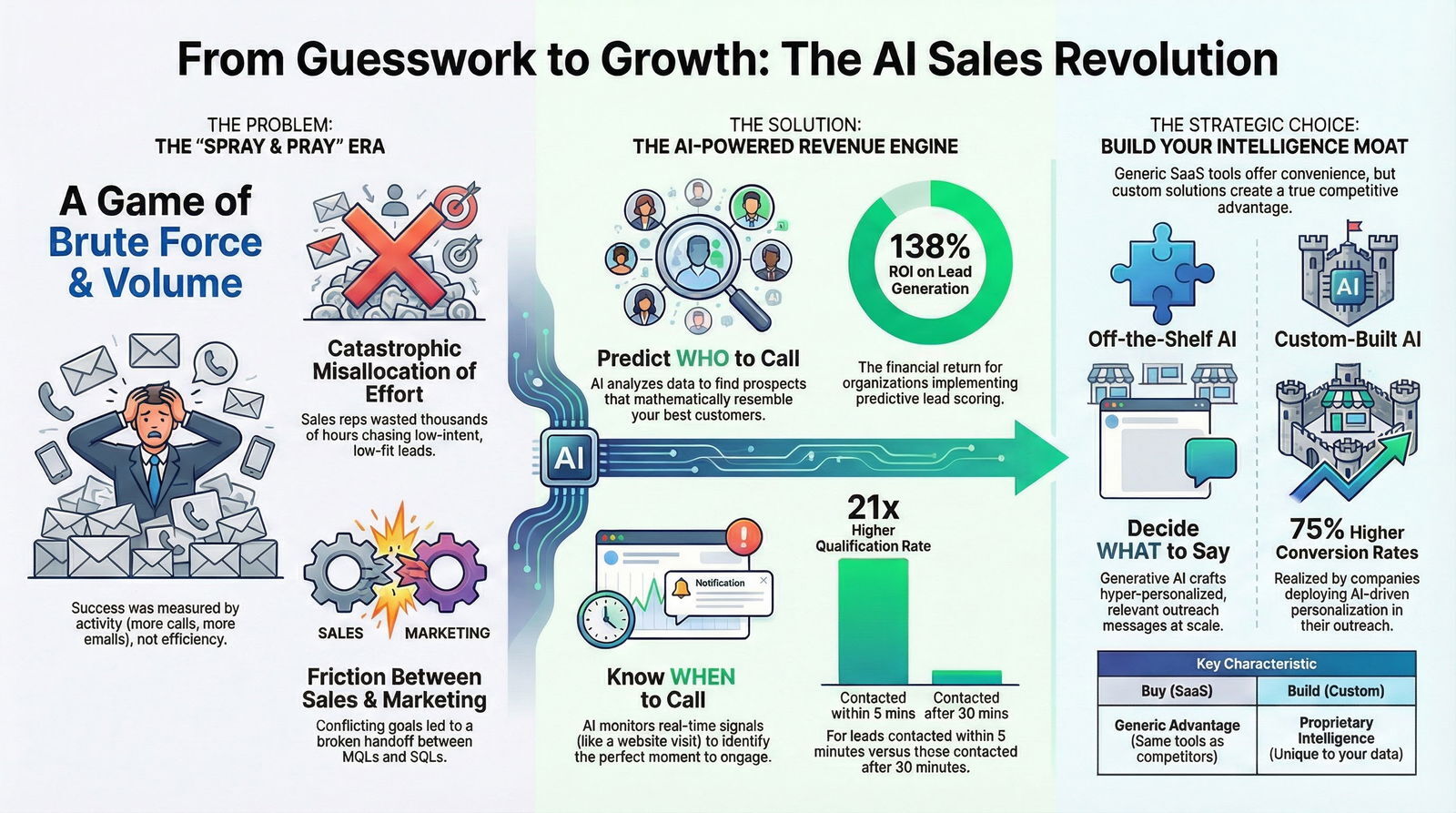
The trajectory of B2B sales and marketing has undergone a fundamental phase shift. For decades, the revenue engine was fueled by volume—more calls, more emails, more leads, more noise. It was a game of brute force, where the "Spray and Pray" methodology reigned supreme, and efficiency was often sacrificed on the altar of activity metrics. In this outdated paradigm, the Chief Revenue Officer (CRO) and Chief Marketing Officer (CMO) operated with distinct, often conflicting, mandates: Marketing generated volume (MQLs), and Sales filtered for quality (SQLs). The friction at this handoff point was not just a process failure; it was a data failure. The fundamental question—Who is actually going to buy?—was answered with lagging indicators, intuition, and broad demographic proxies that treated every Vice President of Engineering as an identical target.
As we navigate through 2025 and look toward 2026, the landscape has shifted tectonically. We have exited the era of simple automation and entered the age of prediction and prescription. The convergence of massive historical datasets, accessible machine learning infrastructure, and Generative AI (GenAI) has created a new operating system for growth. Predictive AI has evolved from an experimental buzzword into the central nervous system of high-performing revenue organizations. It is no longer merely about automating the execution of tasks; it is about automating the decisions behind those tasks. It answers the critical questions of precision: Who to call? When to call them? And, perhaps most revolutionarily, exactly what to say.
For the enterprise leaders reading this—the CROs, CMOs, and Heads of Sales responsible for navigating this transition—the stakes are quantifiable and stark. The delta between the "Predictive Haves" and the "Legacy Have-Nots" is widening into an unbridgeable chasm. Organizations leveraging predictive lead scoring are realizing a staggering 138% return on investment (ROI) for lead generation activities compared to their non-predictive peers. Those deploying AI-driven personalization are witnessing conversion rates surge by 75%, effectively rewriting the economics of customer acquisition.
However, the path to this autonomous future is not paved with generic software subscriptions. The market is flooded with "AI-washed" SaaS tools promising instant transformation, yet many enterprise leaders are discovering that these off-the-shelf solutions offer little in the way of competitive differentiation. This report posits a central strategic thesis: to truly dominate in the algorithmic era, organizations must treat their data and their AI models as proprietary assets. The "Build vs. Buy" dilemma is tilting heavily toward custom, tailored solutions—architected with agile methodologies like those pioneered by Baytech Consulting—that allow companies to build a defensible "intelligence moat" around their revenue operations.
This report serves as a comprehensive strategic roadmap. We will dissect the mechanisms of Predictive AI, moving from the identification of high-value targets ("Who to Call") to the generation of hyper-personalized content ("What to Say"). We will explore the critical transition from merely predicting outcomes to prescribing actions. We will analyze the underlying mathematics that power these engines, the data infrastructure required to sustain them, and the specific implementation strategies that separate the disruptors from the disrupted.
Part I: The Predictive Engine — "Who to Call"
The foundational failure point in most B2B sales processes is rarely a lack of effort; it is a catastrophic misallocation of attention. In the traditional model, Sales Development Representatives (SDRs) act as human filters, burning thousands of valuable cycles chasing low-intent, low-fit leads while high-value prospects drift into the arms of competitors. This inefficiency is codified in traditional lead scoring models—systems that award arbitrary points (+5 for an email open, +10 for a webinar attendance) based on static rules. These rules are brittle, often based on gut feelings rather than data, and fail to capture the complex, non-linear signals of actual buying intent.

Predictive AI fundamentally alters this dynamic. It replaces static rules with dynamic probabilities, moving from a deterministic view of the world ("If A, then B") to a probabilistic one ("Given A, B, and C, there is a 94% probability of D").
1.1 Beyond Rules: The Mechanics of Predictive Lead Scoring
The shift from traditional to predictive scoring is akin to the shift from alchemy to chemistry. Traditional lead scoring asks, "Did the prospect perform this specific action?" Predictive lead scoring asks, "Does this prospect look like our best customers before they bought?" It utilizes sophisticated machine learning algorithms—ranging from Logistic Regression to more advanced Gradient Boosting Classifiers—to analyze vast historical datasets and identify patterns that are invisible to the human eye.
The mechanism works by ingesting and synthesizing data across four primary dimensions:
- Firmographic Data: This is the bedrock of B2B targeting. The AI analyzes industry vertical, company size, annual revenue, employee count, tech stack, and geographic location. But unlike human analysis, which might broadly target "SaaS companies," the AI might identify that "SaaS companies with 50-200 employees using HubSpot and AWS in the EMEA region" have a 3x higher conversion rate.
- Demographic Data: The model examines job titles, seniority, tenure, and past roles. It might discover that a "Senior Director of Operations" is a better entry point than a "VP of Sales" for your specific product, or that prospects who have been in their role for less than 6 months are more open to new technology.
- Behavioral Data: This tracks engagement depth—website activity, content consumption, email interactions, and event attendance. The AI weighs these actions not by arbitrary points, but by their statistical correlation to closed deals. It might learn that visiting the "API Documentation" page is a stronger buying signal than visiting the "Pricing" page for technical buyers.
- Intent Data: Perhaps the most powerful addition, intent data integrates third-party signals indicating active research. The AI monitors the broader web for surges in topic searches (e.g., "Enterprise ERP Migration") or visits to competitor review sites (e.g., G2, Capterra). This alerts the sales team not just to fit, but to active market demand.
The Mathematics of Precision: Inside the Black Box
For the technical strategist, understanding the underlying algorithms helps in selecting the right approach. Early predictive models often relied on Logistic Regression, a statistical method that predicts a binary outcome (Buy/No Buy) based on weighted variables. While transparent, it struggles with complex, non-linear relationships.
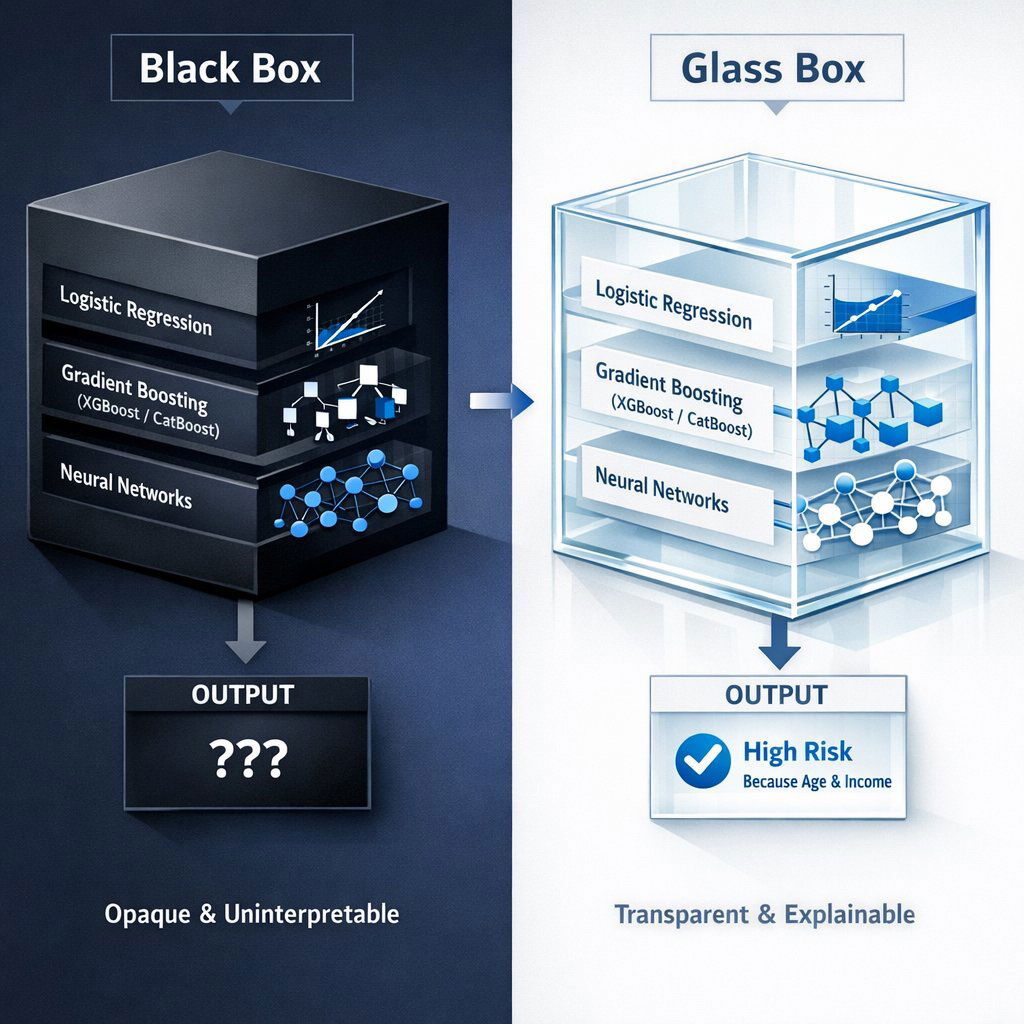
Modern Predictive AI, particularly in custom enterprise deployments, utilizes Gradient Boosting techniques (like XGBoost or CatBoost) or Neural Networks. These models are capable of understanding nuanced interactions. For instance, a model might determine that "Job Title = Intern" is generally a negative signal, unless "Web Activity = 50+ visits" and "Tech Stack = Enterprise Grade," in which case the "Intern" is likely a researcher for a decision-maker—a high-value signal that a rules-based system would miss. This shift from "Human Assumptions" to "Mathematical Truth" is the core of the predictive revolution. It removes ego from the sales process and replaces it with evidence.
1.2 The "Black Box" vs. The Transparent Model
One of the critical distinctions in 2025 is between "Black Box" AI—often found in generic SaaS tools—and "Transparent" or "Glass Box" models, which are frequently the result of custom development. In a Black Box scenario, a lead appears in the CRM with a score of 92. The sales rep, skeptical by nature, asks "Why?" The system offers no answer. This opacity breeds mistrust; if the rep calls a "92" and it turns out to be a bad lead, they lose faith in the entire system.
In contrast, a custom-built solution—such as those architected using Baytech Consulting's tailored methodologies—prioritizes explainability. The model provides a rationale: "Score 92: Driven by C-Level title + Visit to Pricing Page + Competitor Tech Stack detected." This transparency transforms the AI from a mysterious oracle into a trusted analyst. It empowers the rep with context, allowing them to tailor their opening pitch based on the specific factors that drove the high score.
1.3 The ROI of Precision: Quality Over Quantity
The financial impact of shifting from "Who can we call?" to "Who should we call?" is immediate, measurable, and profound. The data is unequivocal: organizations implementing predictive scoring generate a 138% return on investment for lead generation activities compared to just 78% for companies operating without scoring systems.
This efficiency gain is driven by the "Pareto Principle of Pipeline": typically, 80% of revenue comes from 20% of leads. Predictive AI acts as a high-speed centrifuge, separating that 20% gold from the 80% sand instantly. This segmentation allows for drastic resource optimization:
- Tiered Engagement: High-cost field sales reps and senior Account Executives (AEs) focus exclusively on leads scoring 80+. These are the "glengarry leads."
- Automated Nurture: Leads scoring 40-79 are routed to sophisticated, low-cost automated nurture tracks. They are warmed up until their score crosses the threshold for human intervention.
- Disqualification: Leads scoring below 40 are disqualified immediately, saving thousands of hours of SDR time that would otherwise be wasted on dead ends.
This prioritization has a cascading effect on the entire sales funnel. By focusing human energy where it matters most, sales cycles are compressed, and conversion velocity increases. Machine learning lead scoring reports 75% higher conversion rates, with high-performing companies reaching conversion rates of 6% versus the industry average of 3.2%.
1.4 The Data Foundation: Garbage In, Garbage Out
It is impossible to overstate the importance of data hygiene in this equation. No predictive model, regardless of how advanced the algorithm, can survive poor data. A common pitfall for enterprise organizations is attempting to layer advanced AI on top of a "dirty" CRM. If your Salesforce instance is riddled with duplicate entries, missing fields, outdated contact information, and inconsistent naming conventions, the AI will hallucinate confidence where there is none. "Garbage In, Garbage Out" remains the iron law of data science.
Successful implementation requires a rigorous "Data Hygiene" phase. This is often where a specialized partner like Baytech Consulting adds disproportionate value. The challenge is not just in building the AI, but in architecting the underlying data infrastructure —the Data Lakes and Warehouses—that feeds it. As snippet notes, "Data Quality and Compliance... is critical for targeted lead generation." Without clean, enriched, and compliant data, you are simply automating your own confusion.
Part II: The Timing Imperative — "When to Call"
Knowing who to call is a massive advantage, but in the hyper-competitive world of B2B sales, timing is the silent killer of deals. Reach out too early, and you are a nuisance—a vendor pestering a prospect who isn't ready to buy. Reach out too late, and the contract is already signed with a competitor. Predictive AI solves the latency problem by replacing the calendar with the signal.
2.1 The "Speed to Lead" Decay Curve
The statistics on response time are unforgiving and illustrate the razor-thin margins of opportunity in modern sales. A lead contacted within 5 minutes is 21 times more likely to qualify than one contacted after 30 minutes. If you wait just 10 minutes, your success rate drops by 400%. In many organizations, the gap between a lead coming in and a rep picking up the phone is measured in hours or even days. In the algorithmic era, this latency is an existential threat.
Predictive AI bridges this gap through Real-Time Signal Processing. It moves the organization from a batch-processing mindset (reviewing leads once a day) to an event-driven mindset.
- Behavioral Triggers: An AI agent monitors the website 24/7. When a target account—identified via IP address resolution—visits the pricing page, the AI doesn't just log the visit in a report to be read next week. It instantly correlates the visit with the account's predictive score. If the score crosses a defined threshold (e.g., >85), it triggers an immediate alert to the dedicated account executive via Slack, MS Teams, or email. The rep can then engage while the prospect is literally looking at the product.
- Intent Spikes: Beyond your own properties, the AI monitors the broader digital ecosystem. If "Acme Corp" suddenly surges in searches for "Enterprise ERP Migration" or begins engaging with competitor content, the system flags this as an active buying window. It moves the lead from a passive "Nurture" status to an "Active Pursuit" status, prompting immediate outreach.
2.2 Seasonality and Predictive Forecasting
Timing is not just about the micro-moment of a phone call; it is also about the macro-timing of market demand. Predictive analytics revolutionizes sales forecasting by moving it from a political art to a data-driven science.
Traditionally, sales forecasting is a game of "political guessing." Reps sandbag their numbers to lower expectations, while managers inflate them to please leadership. Predictive AI eliminates this bias. By analyzing historical sales data against external market factors—economic indicators, seasonal trends, and even news cycles—AI can predict demand volatility with remarkable accuracy.
For a CRO, this capability is game-changing. It allows for dynamic resource allocation. If the AI predicts a surge in demand from the Financial Services sector in Q3 based on macroeconomic signals, the CRO can pivot marketing spend and sales capacity to that vertical before the trend becomes obvious to competitors. AI forecasting tools have been shown to improve quota accuracy and revenue predictability by over 40%.
2.3 Churn Prediction: The Timing of Retention
The timing imperative extends to the end of the customer lifecycle as well. In the subscription economy, retention is the new growth. Predictive models are exceptionally adept at identifying "at-risk" customers long before they send a cancellation email.
By analyzing usage patterns, support ticket frequency, and engagement with customer success teams, the AI builds a "Health Score" for every account. It can detect subtle anomalies—a drop in daily active users, a change in the champion's job title, a sudden cessation of feature usage—that signal dissatisfaction. By flagging these at-risk accounts early, the Customer Success team can intervene with a prescriptive "save play." Analytics driven by this predictive approach can reduce churn by up to 25% , preserving the recurring revenue that fuels enterprise valuation.
Part III: The Generative Leap — "What to Say"
We have identified the high-value lead (Predictive). We have identified the perfect moment to reach out (Timing). Now we face the hardest part of the equation: Relevance.
For years, "personalization" in B2B marketing was a shallow exercise. It meant inserting {First_Name} and {Company_Name} into a generic template. Today, buyers are immune to these tricks; they are a fast track to the spam folder or the "delete" key. To break through the noise, communication must be hyper-relevant, addressing the specific pains and context of the individual.
Generative AI (GenAI) has bridged the gap between structured data and unstructured content. It takes the insights from the predictive models and translates them into human-like communication. This marks the shift from "Predictive" (knowing what will happen) to "Prescriptive" (knowing what to do about it).
3.1 Hyper-Personalization at Scale
Generative AI doesn't just write emails; it constructs narratives based on data. It allows for what was previously impossible: the scaling of bespoke, one-to-one communication to thousands of prospects simultaneously.
Imagine an AI agent—let's call it "SalesBot 3000"—tasked with preparing an outreach email to a VP of Engineering at a mid-sized Logistics firm. A human rep might spend 30 minutes researching this prospect. The AI does it in milliseconds.
- Input (Predictive Data): The firm recently expanded to Europe (News Signal). They use AWS (Tech Stack). The VP posted on LinkedIn about "reducing cloud costs" (Social Signal). The Lead Score is 94.
- Processing (GenAI): The Large Language Model (LLM) synthesizes these disparate facts into a coherent strategy.
- Output (Prescriptive Message): "Hi [Name], I saw your recent post about the challenges of reducing cloud costs. Given [Company]'s recent expansion to Europe, I imagine managing AWS spend across multiple regions is becoming a headache. We recently helped [Competitor] reduce their multi-region cloud bill by 20% by optimizing their instance usage..."
This is Contextual Messaging Optimization. It is not a template; it is a unique message generated for that specific individual at that specific moment. B2B marketers using this level of personalization see a 77% increase in ROI.
3.2 Automated Objection Handling and "Battle Cards"
The application of GenAI extends beyond email and into the sales call itself. Real-time Natural Language Processing (NLP) is revolutionizing the concept of the "ride-along." Platforms integrated with Zoom or Microsoft Teams can now listen to sales calls in real-time, transcribe the conversation instantly, and analyze the sentiment and objections being raised.
If a prospect says, "Your pricing is too high compared to Competitor X," the AI acts as a "Virtual Coach." It instantly recognizes the objection and flashes a "Battle Card" on the rep's screen: "Competitor X has hidden fees for support. Pivot conversation to Total Cost of Ownership (TCO). Mention our 24/7 included support and the recent TCO case study." .
This capability, often referred to as Agentic AI, moves beyond passive analysis to active participation in the deal flow. It democratizes expertise. A new hire on day one has access to the same objection-handling genius as the top performer with ten years of experience. This consistency reduces ramp time and ensures that the best "play" is run on every call, every time.
3.3 The "Content Supply Chain"
Marketing teams are often the bottleneck in sales enablement. Sales needs a case study now for a specific vertical in a specific region. Marketing says it will take two weeks to draft, design, and approve. Generative AI collapses this timeline. By ingesting existing whitepapers, technical documentation, and successful sales emails, the AI can generate "micro-content"—tailored one-pagers, slide decks, or email sequences—on demand. This concept of the AI-Powered Content Supply Chain ensures that the "What to Say" is always available, always on-brand, and always compliant.
It allows for the creation of thousands of variations of a single asset. Instead of one "Banking Case Study," the AI can generate a "Retail Banking Case Study," an "Investment Banking Case Study," and a "Fintech Case Study," each tweaking the language and value proposition to fit the specific sub-vertical.
Part IV: The Strategic Dilemma — Build vs. Buy
For the C-Suite executive, the decision to adopt AI is easy; the benefits are undeniable. The decision of how to adopt it—the implementation strategy—is excruciating. The market is flooded with SaaS tools promising "AI in a box," "instant implementation," and "magic results." Why, then, would a company consider the seemingly slower and more expensive path of building a custom solution?
4.1 The Limits of "Off-the-Shelf" (SaaS)
"Buy" strategies (SaaS) offer speed and convenience. You can turn on a feature in HubSpot, Salesforce, or a dedicated AI tool like Gong or Outreach tomorrow. However, for the mid-to-large enterprise, this convenience comes with significant strategic downsides that can cap long-term growth:
- The "Generic Advantage" Problem: If you use the same AI model, trained on the same public data, available to all of your competitors, you have no competitive advantage. Your "predictive insights" are commoditized. If everyone has a Ferrari, the Ferrari is just traffic.
- The "Walled Garden" Problem: SaaS vendors have a vested interest in keeping your data within their ecosystem. Extracting insights or combining data from disparate systems—for example, merging CRM data with proprietary ERP logistics data or legacy mainframe records—is often difficult, expensive, or impossible. You end up with fragmented intelligence.
- Opacity: As discussed earlier, SaaS models are typically "Black Boxes." You rarely see why the model made a decision. This lack of transparency can be a major liability when trying to diagnose pipeline failures.
- Cost Scaling: SaaS pricing often scales with seats or usage volume. As your company grows, the "rent" on your AI intelligence increases indefinitely. A custom solution has a higher upfront cost (CAPEX), but the marginal cost of scaling it is significantly lower (OPEX).
4.2 The Case for "Build" (Custom Software)
Custom development, or "Tailored Tech," is the strategic path for organizations that view data as a core asset rather than a byproduct. It is about moving from being a consumer of software to being the architect of your own success.
- Proprietary Intelligence: With a custom solution, you train models on your unique historical data, capturing the nuances of your business logic, your sales cycles, and your customer behaviors that a generic model would miss. This creates a model that is uniquely tuned to your reality.
- Total Ownership: You own the Intellectual Property (IP). You own the model weights. You own the code. There are no licensing fees that scale with your success. You are building an asset on your balance sheet, not renting a service.
- Integration Agility: A custom solution can pull data from anywhere—legacy mainframes, modern APIs, proprietary databases, and obscure industry feeds—without waiting for a vendor to build a connector. You have total control over the data pipeline.
The Baytech Advantage: Rapid Agile Deployment
The historical argument against "Build" is time and risk. "Custom software takes too long, costs too much, and fails too often." This is a legacy mindset. Modern software development consultancies like Baytech Consulting have revolutionized the process through Rapid Agile Deployment.
Instead of a massive, multi-year "waterfall" project where you wait 12 months to see a result, Baytech breaks the AI integration into small, value-driven sprints. You might deploy a simple "Lead Scoring v1" in 6 weeks. It might not be perfect, but it provides value immediately. Then, based on real-world feedback, you iterate. This mitigates risk, accelerates Time-to-Value (TTV), and ensures that the software evolves in lockstep with the business needs.
4.3 The "Hybrid" Compromise: Buy the Engine, Build the Car
For many enterprises, the optimal strategy lies in the middle. You do not need to build your own Large Language Model (LLM) from scratch—that requires billions of dollars in R&D. Instead, you "Buy" the commodity components (e.g., use OpenAI's GPT-4 or Anthropic's Claude via API as the 'brain') but "Build" the architecture around it.
You build the "Context Engine" (the RAG vector database), the integration layer that feeds it your proprietary data, and the user interface that your sales reps interact with. This is a "Buy the Engine, Build the Car" strategy. It leverages the massive R&D spend of tech giants while retaining the flexibility, differentiation, and control of custom software.
Part V: Implementation Roadmap — Turning Strategy into Code
Implementing Predictive AI is not a plug-and-play exercise. It requires a fundamental shift in operations, culture, and infrastructure. It is a journey, not a destination.
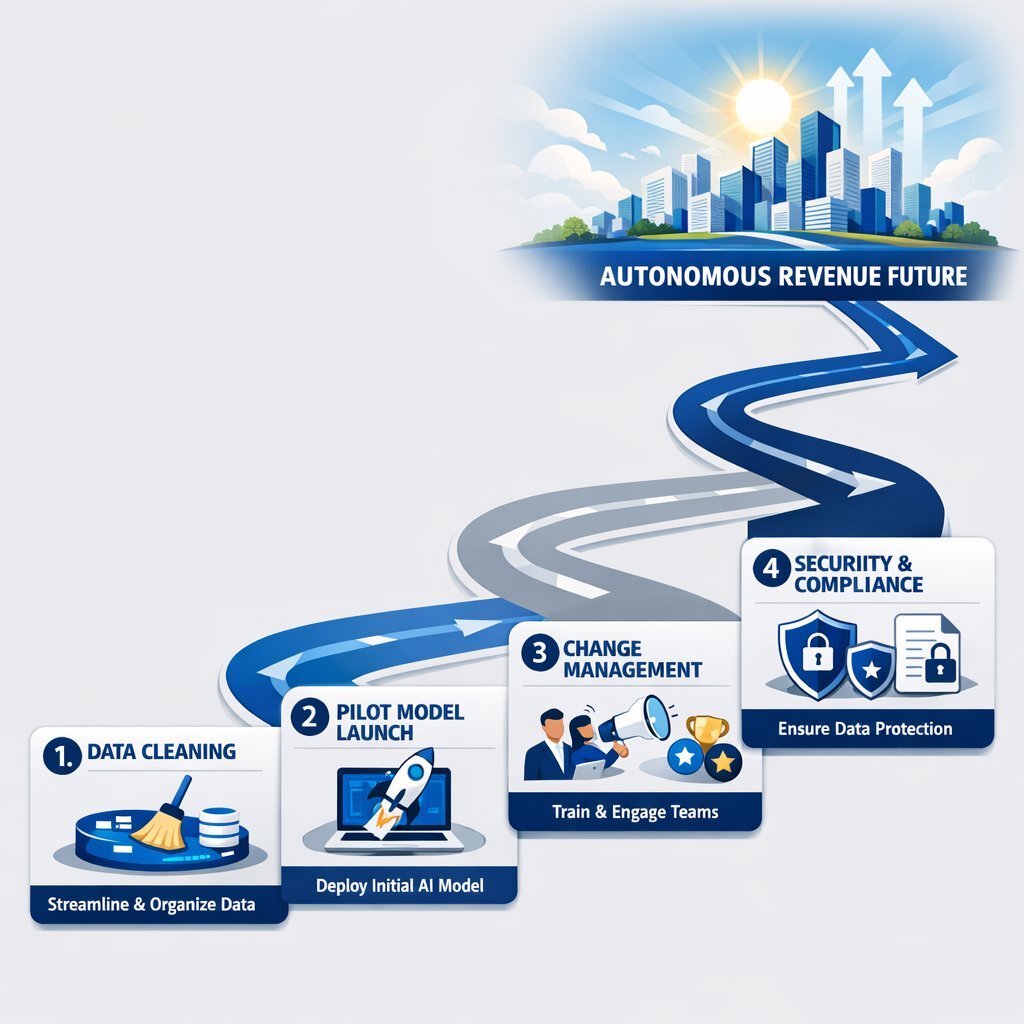
5.1 Step 1: Data Readiness and "The Cleaning"
Before you hire a data scientist, hire a data cleaner. AI amplifies data quality. It makes good data great, but it makes bad data catastrophic.
- Unify Data Sources: You must break down the silos. Marketing data (Marketo/HubSpot), Sales data (Salesforce), and Customer Success data (Zendesk/Gainsight) must flow into a unified repository (Data Lake/Warehouse). This provides the "Single Source of Truth."
- Enrichment: Use third-party providers (Clearbit, ZoomInfo) to systematically fill in the gaps in your historical data. You cannot predict based on "unknown" fields. If 40% of your leads are missing "Industry" data, your model is flying blind.
5.2 Step 2: The Pilot (Agile Approach)
Do not try to boil the ocean. Do not attempt to launch a fully autonomous AI agent across the entire global sales force on day one. Select a single, high-impact use case—for example, "Predictive Scoring for Inbound Mid-Market Leads in North America."
- Sprint 1-2: Build a basic model using historical data. Test it against the last 3 months of closed deals (backtesting). Did it predict them accurately?
- Sprint 3-4: Deploy the model to a small "Tiger Team" of your most tech-savvy sales reps. Gather qualitative feedback. "Why did it score this lead high? This lead is junk."
- Iterate: Refine the model based on rep feedback. This feedback loop is essential. This is the Baytech "Tailored Tech" philosophy in action—adapting the software to the reality of the business, rather than forcing the business to adapt to the software.
5.3 Step 3: Change Management and Trust
The biggest barrier to AI adoption in sales is rarely technical; it is cultural. Sales reps are naturally skeptical. They fear the "Robot Boss." They fear that the AI is there to replace them or to police them.
- Transparency: Show the "Why." As discussed, use transparent models that explain the score.
- Augmentation, Not Replacement: Position the AI as a "Co-pilot" or "Super-SDR" that handles the grunt work—the data entry, the research, the scheduling—so the human can focus on what humans do best: building relationships, negotiating, and closing.
- Gamification: Use extensive training and highlight early wins. "Look at how Team A crushed their quota using the new scores." Success breeds adoption. To foster buy-in, consider leveraging principles from gamification to enhance engagement throughout your rollout.
5.4 Privacy, Security, and Ethics
In the rush to adopt AI, do not forget the lawyers. B2B data is less regulated than consumer health data, but regulations like GDPR (Europe) and CCPA (California) still apply.
- SaaS Risk: When you put sensitive customer data into a public LLM (like the free version of ChatGPT), you may inadvertently be training the model for everyone else. Your secrets could become part of the public domain.
- Custom Security: Custom solutions allow you to host open-source models (like Llama 3 or Mistral) within your own private VPC (Virtual Private Cloud). Your data never leaves your perimeter. This is a critical selling point for enterprise clients in highly regulated industries like finance, healthcare, or defense.
Conclusion: The Autonomous Future
We are standing at the precipice of the "Autonomous Revenue" era. By 2026, we will look back at manual lead scoring, template-based emails, and "gut feeling" forecasting as quaint relics of a bygone age. The predictive engines of tomorrow will not just recommend; they will act. They will autonomously nurture leads, schedule meetings, and even negotiate preliminary terms, handing off to humans only when high-level empathy and complex strategy are required.
For the CRO and CMO, the mandate is clear: You cannot opt out of this revolution. The only choice is whether to be a passenger in a generic vehicle—using the same tools as everyone else—or the architect of your own high-performance machine. Partners like Baytech Consulting offer the blueprint for the latter. They provide the expertise to build custom, agile, and secure AI solutions that turn your unique data into your most formidable competitive advantage.
The question is no longer "Who to call?" or "What to say?" The machine knows. The question is: Are you ready to listen?
Deep Dive: The Mathematics of Prediction
For the technical reader, let us briefly look under the hood.
From Logistic Regression to Gradient Boosting
Early lead scoring was often based on Logistic Regression—a simple statistical method that predicts a binary outcome (Buy / No Buy) based on weighted variables. It is transparent but struggles with complex, non-linear relationships.
Modern Predictive AI uses Gradient Boosting (e.g., XGBoost, CatBoost) or Neural Networks.
- Non-Linearity: These models understand that "Job Title = Intern" is a negative signal unless "Web Activity = 50 visits," in which case it might be a researcher for a decision-maker.
- Feature Importance: These algorithms automatically determine which variables matter. You might think "Industry" is important, but the model might find that "Time on Pricing Page" is 10x more predictive.
- Look-alike Modeling: The AI finds prospects in your database that mathematically resemble your best customers, even if they don't match the traditional "Persona" criteria.
This shift from "Human Assumptions" to "Mathematical Truth" is the core of the predictive revolution. It removes ego from the sales process and replaces it with evidence.
Glossary of Terms
- Predictive AI: Uses statistical algorithms and machine learning to identify the likelihood of future outcomes based on historical data.
- Prescriptive AI: Goes beyond prediction to suggest specific actions to take to maximize the result.
- Generative AI (GenAI): AI that can create new content (text, images, code) based on patterns learned from training data. Used for "What to say."
- Agentic AI: AI systems capable of autonomous action and decision-making within defined parameters.
- MQL (Marketing Qualified Lead): A lead judged more likely to become a customer compared to other leads based on intelligence.
- SQL (Sales Qualified Lead): A prospective customer that has been vetted by the marketing and sales teams and is deemed ready for the next stage in the sales process.
- Rapid Agile Deployment: A project management methodology (favored by Baytech) that emphasizes quick iteration and tangible delivery over long, rigid planning cycles.
- Tailored Tech Advantage: The strategic benefit gained by building custom software that perfectly fits business needs, as opposed to using generic off-the-shelf tools.
Key Takeaways for the C-Suite
| Pillar | Action Item | Strategic Impact |
|---|---|---|
| Prediction | Stop Guessing. Replace "Spray and Pray" with Predictive Lead Scoring . | Can double lead gen ROI by focusing resources on high-probability targets. |
| Timing | Speed Kills. Implement real-time intent signal monitoring. | Responding in <5 minutes increases qualification rates by 21x. |
| Content | Content is King. Use GenAI to hyper-personalize outreach at scale. | Hyper-personalized campaigns see up to 77% higher ROI. |
| Strategy | Own Your Brain. Adopt a "Build" or "Hybrid" software strategy. | Partners like Baytech help build a proprietary intelligence moat, avoiding SaaS commoditization. |
| Data | Clean Your Data. Invest in data infrastructure before models. | Dirty data leads to model hallucination; clean data is the prerequisite for AI success. |
About Baytech
At Baytech Consulting, we specialize in guiding businesses through this process, helping you build scalable, efficient, and high-performing software that evolves with your needs. Our MVP first approach helps our clients minimize upfront costs and maximize ROI. Ready to take the next step in your software development journey? Contact us today to learn how we can help you achieve your goals with a phased development approach.
About the Author

Bryan Reynolds is an accomplished technology executive with more than 25 years of experience leading innovation in the software industry. As the CEO and founder of Baytech Consulting, he has built a reputation for delivering custom software solutions that help businesses streamline operations, enhance customer experiences, and drive growth.
Bryan’s expertise spans custom software development, cloud infrastructure, artificial intelligence, and strategic business consulting, making him a trusted advisor and thought leader across a wide range of industries.