Gamify or Die: Captivating Customers in 2025 and Beyond
December 29, 2025 / Bryan Reynolds1. The Engagement Crisis in the Digital Economy
In the contemporary digital landscape, the scarcity of human attention has emerged as the defining economic constraint for enterprises. Chief Marketing Officers (CMOs) and Heads of Product are navigating an environment where the traditional levers of engagement—advertising volume, frequency of touchpoints, and superficial loyalty programs—are yielding diminishing returns. The modern user, inundated with an estimated 6,000 to 10,000 commercial messages daily, has developed sophisticated cognitive filters to block out corporate noise. In this context, passive consumption has become a relic of a broadcast era; the new currency of brand equity is active, voluntary participation.
The crisis is not merely one of distraction but of emotional disconnection. As digital channels proliferate, the depth of the relationship between the brand and the consumer often becomes shallower. Transactional interactions, while efficient, fail to build the emotional resilience required to prevent churn in competitive markets. This report posits that gamification—the strategic application of game mechanics, psychological dynamics, and behavioral design principles to non-game contexts—represents the most effective methodology for bridging this engagement gap. It is not a superficial layer of "pointsification" but a fundamental re-architecture of the user experience that aligns corporate objectives with the user’s intrinsic motivations.
For B2B technology leaders, the stakes are particularly high. The consumerization of enterprise software means that business users now expect the same level of fluidity, feedback, and engagement from their procurement platforms and CRM tools as they do from their consumer apps. The disconnect between these expectations and the reality of legacy enterprise systems creates a "UX debt" that manifests as low adoption rates, poor data quality, and high churn. Gamification, when executed with architectural precision, offers a solution to liquidate this debt.
However, the path to successful gamification is fraught with misconceptions. The market is saturated with off-the-shelf SaaS solutions that offer generic badges and leaderboards without considering the unique motivational drivers of a specific audience or the complex integration requirements of enterprise ecosystems. For organizations aiming to build defensible competitive advantages—particularly in high-stakes sectors like Healthcare, Fintech, and B2B SaaS—the decision to build custom, integrated gamification solutions versus adopting generic platforms is a critical strategic inflection point.
This comprehensive analysis explores the neuroscience of engagement, the economic impact of gamified systems, sector-specific applications, and the technological imperatives for building secure, scalable, and effective gamification engines. It serves as a strategic roadmap for leaders seeking to harness the power of game mechanics to drive customer engagement and loyalty in the coming decade.
2. The Theoretical Core: Neuroscience and Psychology
To understand why gamification works, one must look beyond the mechanics of games and delve into the mechanics of the human mind. The efficacy of gamification is rooted in well-established psychological frameworks that explain human motivation, specifically Self-Determination Theory (SDT) and the neuroscience of feedback loops.
2.1 Self-Determination Theory: The Engine of Intrinsic Motivation
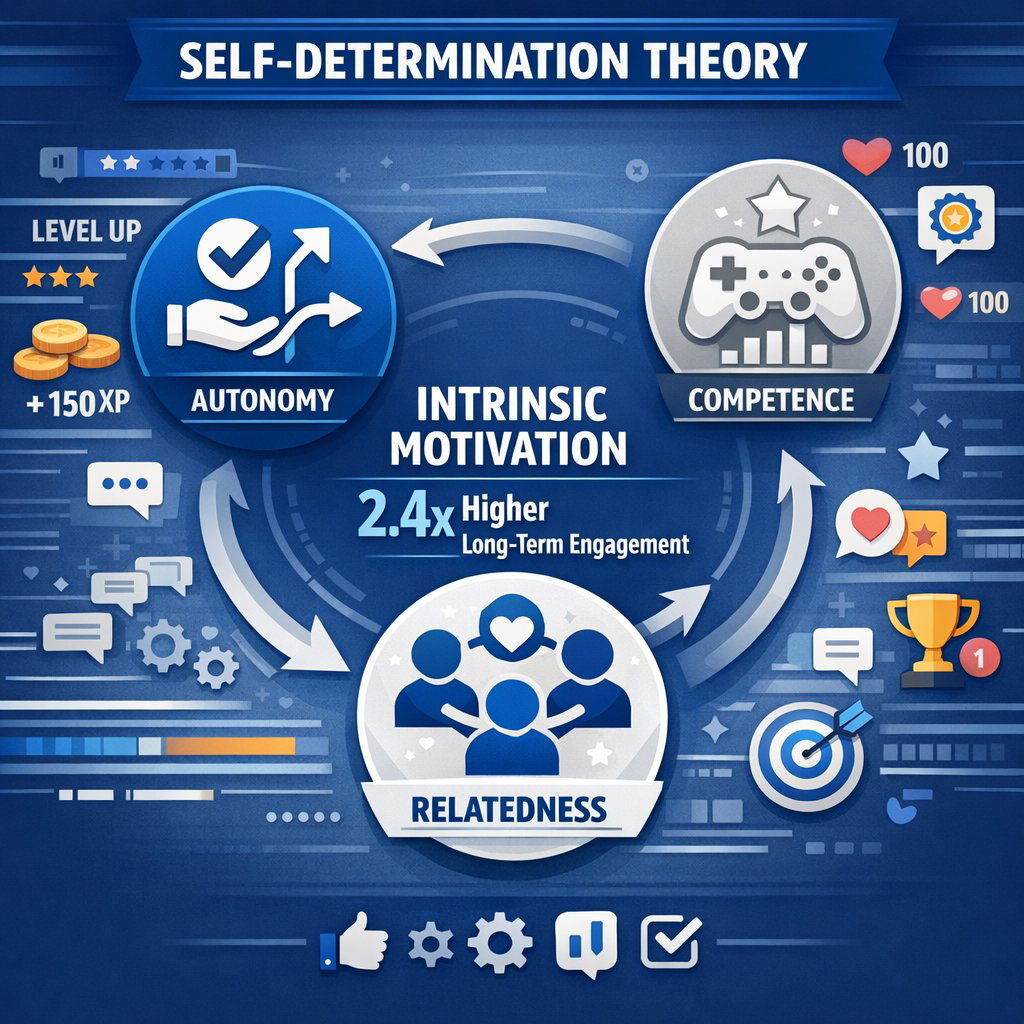
At the heart of successful gamification lies Self-Determination Theory (SDT), a macro theory of human motivation developed by psychologists Edward Deci and Richard Ryan. SDT suggests that sustainable engagement is not driven solely by external rewards (extrinsic motivation) but by the satisfaction of three innate psychological needs: Autonomy, Competence, and Relatedness. 1
2.1.1 Autonomy: The Need for Volition
Autonomy refers to the user's need to feel control over their own actions and choices. In a digital product context, this means providing users with meaningful choices rather than forcing them down a linear path. A 2024 study by the Gamification Research Network revealed that systems focused on intrinsic motivation, which heavily rely on autonomy, achieved 2.4 times higher long-term engagement rates compared to those emphasizing external rewards alone. 1
When a user chooses their own avatar, selects a specific learning path in a training module, or decides which "quest" to undertake next, they are exercising autonomy. Poorly designed gamification often undermines this by creating "controlling" environments where users feel manipulated by algorithms, leading to a phenomenon known as the "overjustification effect." This occurs when external rewards (like points for reading a manual) actually diminish intrinsic interest in the activity, turning a voluntary act of learning into a transactional labor. 1
2.1.2 Competence: The Need for Mastery
Competence involves the need to feel effective in interacting with the environment and to experience a sense of growth and mastery. Games excel at this by providing immediate feedback loops—points, progress bars, and visual cues—that signal to the user that they are improving. This feedback satisfies the brain's craving for validation of effort.
The psychological concept of "flow," popularized by Mihaly Csikszentmihalyi, is critical here. Flow occurs when there is a perfect balance between the challenge presented by a task and the skill level of the user. If the challenge is too easy, the user gets bored; if it is too hard, they get anxious. Custom gamification algorithms can dynamically adjust difficulty levels to keep users in this "flow channel," ensuring sustained engagement. Research indicates that the satisfaction of competence needs accounts for a significant variance in user enjoyment, with one study finding that these psychological needs accounted for 48.9% of the variance in enjoyment. 4
2.1.3 Relatedness: The Need for Connection
Relatedness is the desire to feel connected to others. In a B2B context, this often manifests through social competition, team-based challenges, or community contributions. Platforms like the SAP Community have successfully utilized this by awarding badges not just for individual achievement, but for contributions that help others, such as answering technical questions. This fosters a sense of belonging and altruism, which are powerful drivers of loyalty. 5
The integration of these three elements creates a self-sustaining loop of engagement. When a user feels they chose to participate (Autonomy), are getting better at the task (Competence), and are recognized by their peers (Relatedness), the engagement becomes intrinsic. They participate because they want to, not because they are being paid to.
2.2 The Neuroscience of the "Game Cycle"
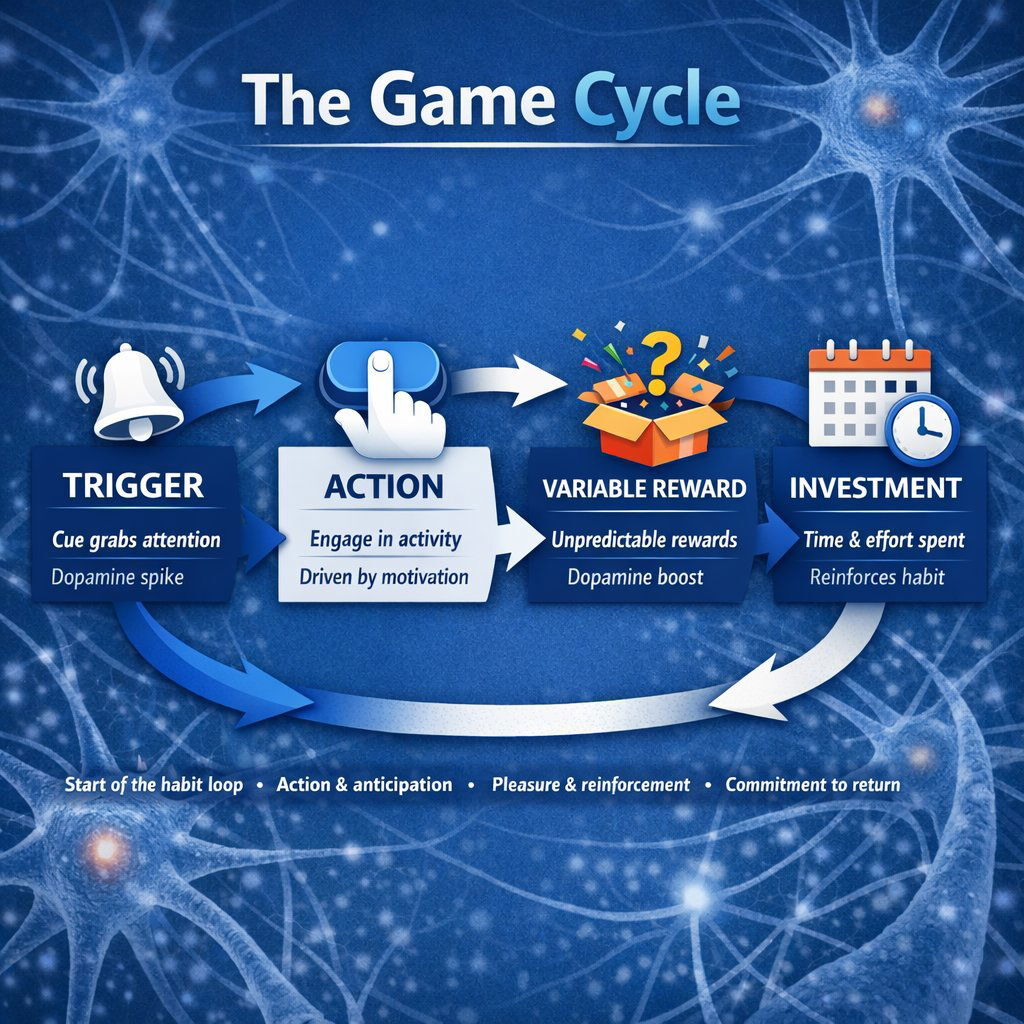
The "Game Cycle" described by Garris et al. is the cornerstone of engagement. 4 It operates on a neurological loop consisting of a trigger, an action, a reward, and an investment.
- Trigger: An external or internal cue prompts the user (e.g., a push notification or a desire to check progress).
- Action: The user performs the desired behavior (e.g., completing a training module, logging sales data).
- Variable Reward: The user receives feedback. Crucially, variable rewards (unpredictable outcomes) stimulate the release of dopamine in the brain more effectively than predictable ones. This is the same mechanism that makes slot machines—and social media feeds—addictive. The uncertainty of the reward ("Will I get a gold badge or a silver one?") heightens the emotional response.
- Investment: The user puts something into the system (time, data, social capital), increasing their commitment and the likelihood of the cycle repeating.
This cycle leverages the brain's reward system. Dopamine regulates motivation and pleasure; oxytocin is released during social bonding (cooperative games); and serotonin is linked to status and social importance (leaderboards). Effective gamification is, in essence, neuro-optimization of the user experience.
2.3 Behavioral Economics and Cognitive Biases
Gamification also exploits cognitive biases to drive behavior, turning human irrationality into a feature rather than a bug.
- Loss Aversion: Humans are statistically more motivated to avoid losing status or points they have already earned than to gain new ones. Streaks (e.g., maintaining a 30-day login record) leverage this powerful bias. If a user misses a day, they "lose" the streak, which is a potent psychological penalty.
- The Zeigarnik Effect: People remember uncompleted or interrupted tasks better than completed ones. Progress bars that show a profile as "85% complete" nag at the human brain, driving users to fill in the missing data to achieve closure. Trello, for example, masters this by visually displaying task progress, compelling users to move cards to the "Done" column. 7
- Scarcity and Exclusivity: Limited-time events or "Platinum" tiers create a sense of urgency and perceived value, driving immediate action. The fear of missing out (FOMO) is a driving force in both B2C and B2B sales contests.
3. The Business Case: Economic Impact and ROI
The adoption of gamification is not merely a design choice; it is a financial imperative. The market data from 2023-2025 paints a clear picture of a technology that has moved from the experimental fringe to the core of enterprise strategy.
3.1 Market Growth and Projections
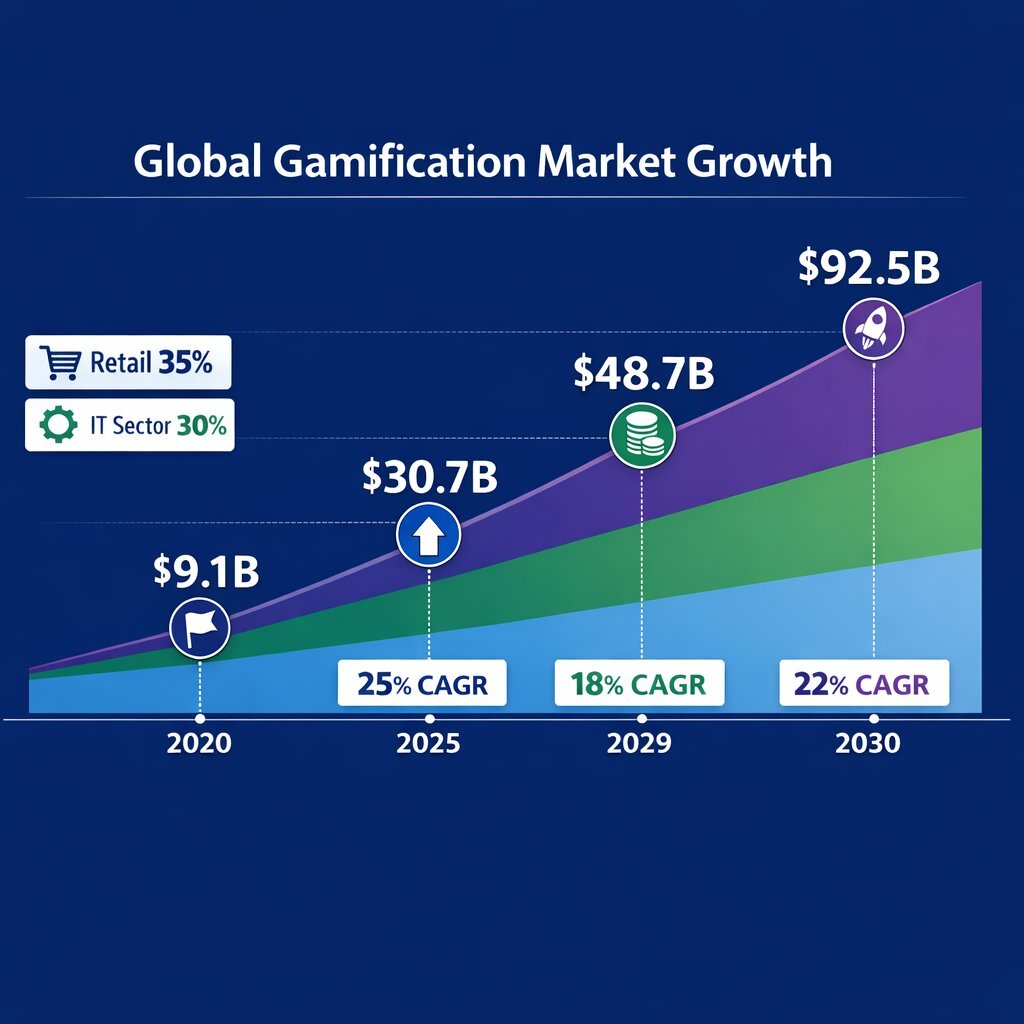
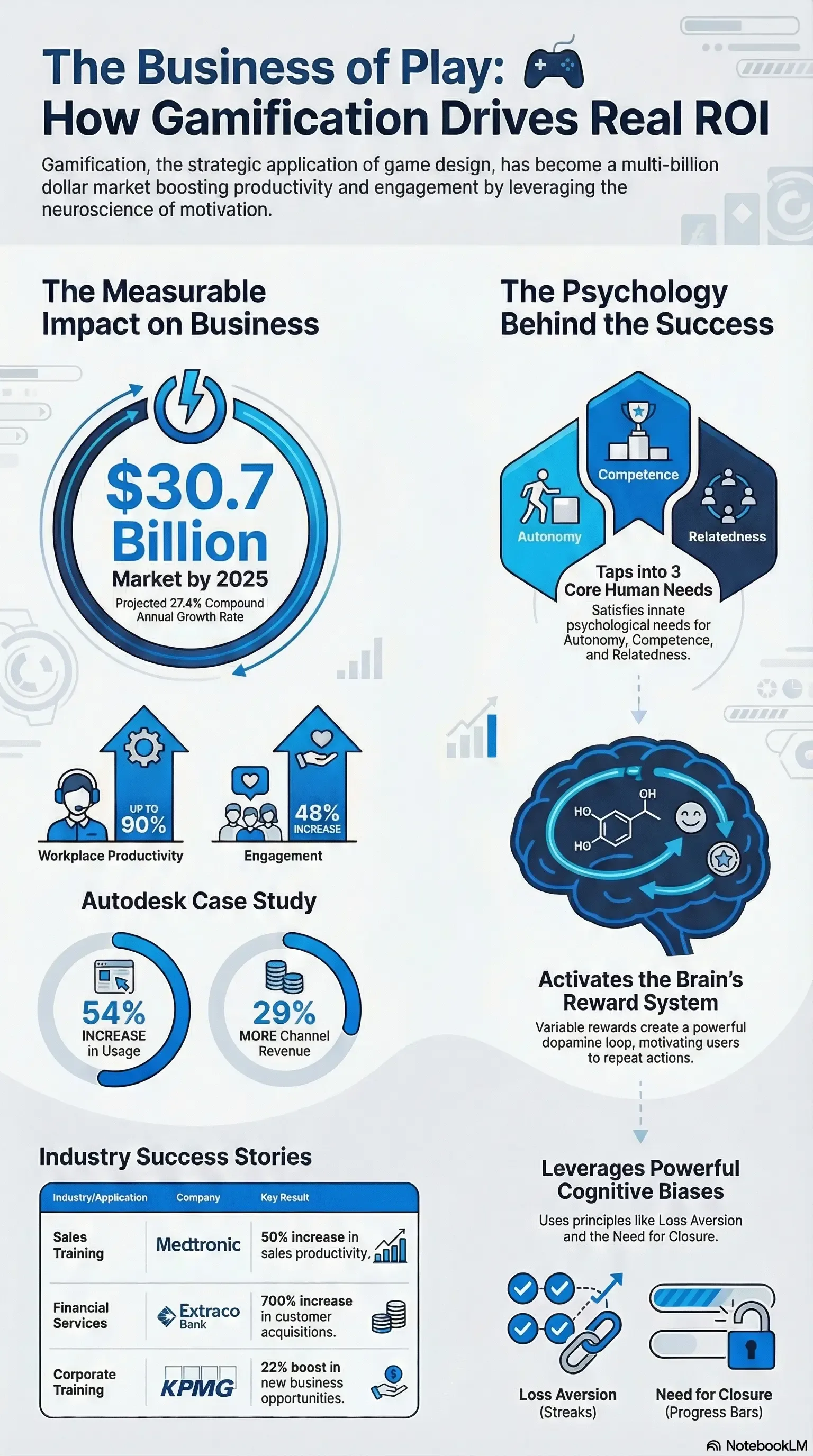
The global gamification market is experiencing explosive growth, reflecting its transition from a novelty to a necessity. Valued at approximately $9.1 billion in 2020, it is projected to reach over $30.7 billion by 2025, growing at a Compound Annual Growth Rate (CAGR) of 27.4%. 8 Other estimates are even more bullish, suggesting the market could reach 48.72 billion by 2029 or even 92.5 billion by 2030, driven by widespread adoption across diverse sectors. 9
This growth is driven by widespread adoption across diverse sectors:
- Retail: Holds approximately 28% of the market share, fueled by loyalty ecosystems that have moved beyond simple "buy 10, get 1 free" cards to complex digital economies. 11
- IT and Telecom: Predicted to grow at a 29.34% CAGR, driven by the need for rapid employee onboarding and customer retention in high-churn environments. 11
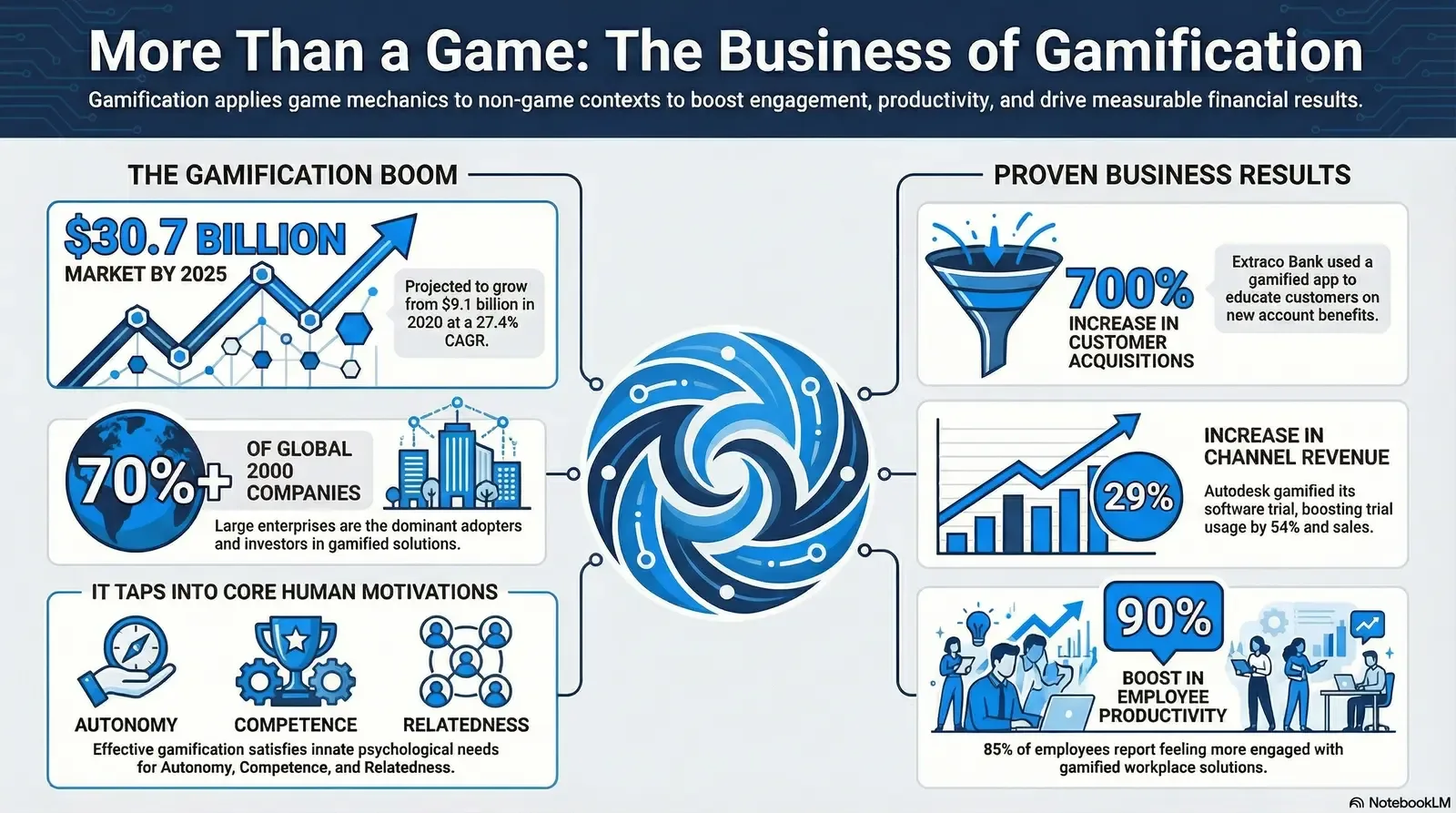
- Corporate Training: The efficacy is undeniable; 90% of employees report that gamification makes them more productive, and 85% are more engaged when gamification solutions are applied to their workplace. 8
3.2 ROI and Business Outcomes
The return on investment (ROI) for well-implemented gamification strategies is substantial and measurable across the customer lifecycle. It is not just about "likes" or "shares"; it is about hard financial metrics.
3.2.1 Customer Acquisition and Conversion
Gamification acts as a powerful differentiator in the acquisition phase, often converting passive browsers into active users through interactive value propositions.
- Extraco Bank: This institution faced a challenge common to legacy banks: communicating a change in account fees and structures. Instead of a dry letter, they implemented a gamified process to educate customers about the changes. The game walked users through the reasons and benefits of the new system. The result was a conversion rate increase from 2% to 14% and a 700% increase in customer acquisitions. 12
- Autodesk: In a B2B context, Autodesk gamified its free trial experience for the complex 3ds Max software. By guiding users through tutorials framed as "missions" in a game called "Undiscovered Territory," they increased trial usage by 54%, buy clicks by 15%, and channel revenue by 29%. This demonstrates that even for complex, professional-grade software, game mechanics can significantly impact the bottom line. 15
3.2.2 Retention and Loyalty
Retention is where gamification generates long-term value by creating "sticky" experiences that are difficult for competitors to replicate.
- Starbucks & Retail: Loyalty members in gamified retail programs are among the most engaged globally. In contrast, traditional airline programs, which often lack interactive game elements beyond basic mileage accrual, see members redeeming points only four times per year on average. 9
- SaaS Churn Reduction: By introducing progress tracking and "missions" for feature adoption, SaaS platforms can significantly reduce churn. Users who are guided to "unlock" advanced features are more likely to perceive value and remain subscribed. For example, Prodpad uses progress bars to visually represent task completion, providing a sense of accomplishment that motivates continued interaction. 17
3.2.3 Employee Productivity and Training
Internal gamification leads to direct operational efficiencies, reducing the cost of training and increasing the speed to competency.
- KPMG: The "Globerunner" gamified training platform led to a 25% increase in fee collection and a 22% increase in new business opportunities among offices with high participation. This clearly links internal training engagement with external revenue generation. 18
- McDonald's UK: A gamified till-training program generated £23.7 million in additional revenue through improved service efficiency and reduced training costs, showcasing the scale at which gamification can operate. 11
3.3 Comparative Impact by Industry
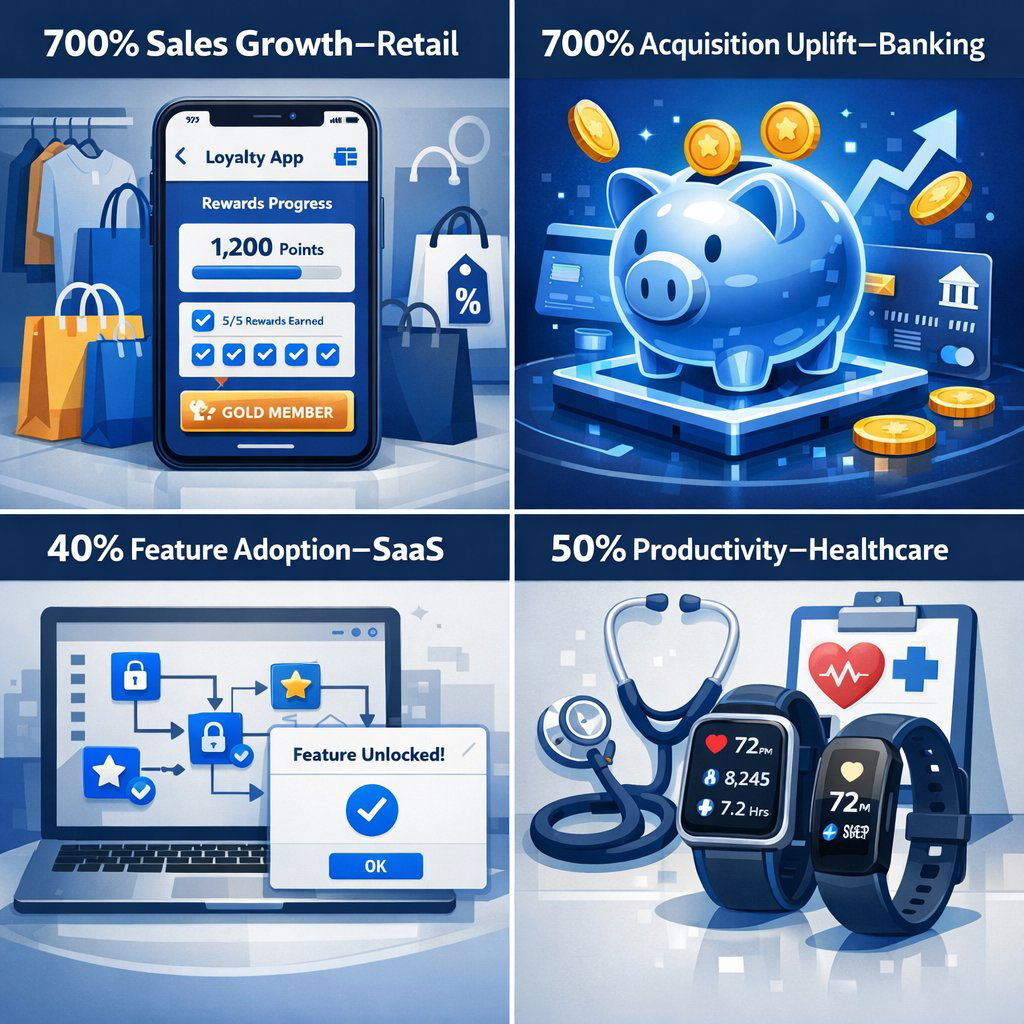
| Metric | Retail | Banking/Fintech | SaaS/B2B | Healthcare |
|---|---|---|---|---|
| Primary Goal | Repeat Purchase | Financial Literacy / Trust | Feature Adoption | Treatment Adherence |
| Key Mechanic | Points/Tiers | Educational Quests | Progress Bars/Badges | Streaks/Biometric Feedback |
| Notable Stat | 28% Market Share 11 | 700% Acquisition Uplift (Extraco) 12 | 40% Trial Conversion (Autodesk) 21 | 50% Sales Productivity (Medtronic) 22 |
| Engagement Trend | High frequency (Daily/Weekly) | Trust-based (Monthly/Lifecycle) | Workflow integrated (Daily) | Critical health outcomes (Daily) |
4. Strategic Mechanics: Beyond Points and Badges
For the CMO or Head of Product, understanding which mechanics to deploy is as important as the decision to gamify. The "PBL" triad (Points, Badges, Leaderboards) is the most common starting point, but sophisticated strategies require a more nuanced approach. Relying solely on PBL can lead to "gamification fatigue" where users become bored with superficial rewards.
4.1 Progression and Narrative
Humans are storytelling creatures. Wrapping tasks in a narrative context significantly increases engagement by providing a "why" behind the "what."
- The "Hero's Journey": In B2B training, instead of simply completing "Module 1," a user might be "Onboarding as a Junior Consultant" and leveling up to "Partner." This narrative framing gives meaning to the mundane tasks of compliance training or data entry. 23
- SAP Community: Uses a "Mission" structure where users earn badges not just for activity, but for specific behaviors like "Solver" or "Teacher," creating a narrative of professional expertise. Their badge system is tiered—earning the first badge for starting a discussion, a second for three, a third for ten, and so on—encouraging sustained contribution over time. 5
4.2 Social Discovery and Influence
Social mechanics leverage peer pressure and the desire for recognition, which are powerful motivators in professional settings.
- Collaborative Quests: Requiring teams to work together to unlock a reward fosters collaboration. This is particularly effective in sales teams, where individual competition can sometimes be toxic. By setting team-based goals, organizations can encourage knowledge sharing and mentorship. 25
- Social Proof and Status: Displaying "X user just achieved Y" can trigger a desire to conform and compete. In sales gamification, visible leaderboards (when designed correctly) can drive performance by making success visible. However, care must be taken to avoid demotivating the "middle 60%" of performers who may feel they can never catch the top performers. 26
4.3 Scarcity and Impatience
Artificial scarcity drives immediate action. This lever is potent for product launches or end-of-quarter sales pushes.
- Limited-Time Challenges: "Complete this certification by Friday to earn the 'Fast Track' badge."
- Exclusivity: "Platinum" tiers that are only available to the top 10% of users create a sense of elite status that users will work hard to maintain. This utilizes the "Scarcity" drive in the Octalysis framework.
4.4 Designing for User Types in B2B
Richard Bartle's taxonomy of player types (Achievers, Explorers, Socializers, Killers) is often cited in gaming. In a B2B context, this translates to distinct personas that require tailored loops:
- The Achiever (Sales Reps): Motivated by status, leaderboards, and tangible rewards. They want to be #1 and will respond well to competitive leaderboards and clear, linear progression paths. 7
- The Explorer (Developers/Engineers): Motivated by discovery, hidden features, and deep mastery. They often dislike superficial badges but love unlocking "power user" capabilities or "easter eggs" within the software. For this group, gamification should focus on competence and autonomy, avoiding manipulative "carrots". 1
- The Socializer (Community Managers/HR): Motivated by connection, peer recognition, and helping others. They thrive in systems that reward collaboration, mentoring, and community building. 4
- The Philanthropist (Executive Leadership): Motivated by legacy, mentoring, and organizational impact. They may be motivated by mechanics that allow them to "gift" points or recognition to others.
A "one-size-fits-all" leaderboard will alienate the Explorer and the Socializer. A successful B2B gamification strategy must offer different "loops" for different personas to ensure broad adoption.
5. Sector-Specific Deep Dive: Fintech and Banking
In financial services, the challenge is twofold: products are intangible, and consumer trust is fragile. Gamification acts as a bridge between complex financial concepts and user understanding, transforming anxiety into competence.
5.1 The Challenge: Complexity and Trust
Banking is inherently viewed as a utility—necessary but often boring or anxiety-inducing. The goal of gamification here is "Ed-FinTech": using game mechanics to educate users and build financial literacy, which in turn breeds trust and loyalty.
5.2 Case Study: Extraco Bank
Extraco Bank serves as a canonical example of gamification's power in a conservative industry. They needed to migrate customers away from free checking accounts—a move that typically generates customer backlash and churn.
- The Mechanic: They built a "bonus banking" game. Instead of a letter explaining the fees, the game allowed users to simulate their spending habits (e.g., paying bills online vs. in-branch) to see how they could avoid fees and earn bonuses.
- The Result: The interactive simulation reduced the cognitive load of understanding the new terms. The conversion rate for the new account type jumped to 14% (compared to an industry average of 2%), and customer acquisition soared by 700%. 12
5.3 Case Study: PNC Bank
PNC Bank introduced "Punch the Pig," a virtual wallet feature.
- The Mechanic: A virtual piggy bank appears on the screen. Users can "punch" it to transfer money from their spending account to their savings account.
- The Insight: This utilizes a tangible, satisfying interaction (the "punch") to reinforce a positive behavior (saving). It turns the abstract concept of a transfer into a concrete, fun action. 27
Strategic Insight: In Fintech, gamification should focus on Competence. Making users feel smart about their money reduces anxiety and builds deep loyalty.
6. Sector-Specific Deep Dive: Healthcare and MedTech
In healthcare, engagement is literally a matter of life and death. For B2B MedTech companies, the focus shifts to training medical professionals and sales teams who must master complex devices and regulations.
6.1 The Challenge: Compliance and Safety
Medical devices are complex; regulations (HIPAA) are strict; and doctors are incredibly busy. Traditional training methods (long manuals, seminars) suffer from low retention rates.
- Demographic Factor: Fitness tracking apps achieve highest engagement among users aged 25-35, but participation drops among users over 55 if systems are too complex. However, 78% of consumers aged 25-34 are open to gamified healthcare treatments. 1
6.2 Case Study: Medtronic
Medtronic, the world's largest medical device manufacturer, faced the challenge of ensuring their sales force was up-to-date on an ever-expanding portfolio of complex products.
- The Mechanic: They partnered with custom developers to create a mobile-first, gamified training platform. It used "Jeopardy-style" quizzes, progress bars, and competitive leaderboards to reinforce product knowledge during downtime.
- The Result: Sales productivity increased by 50%. The "fun" factor reduced the friction of mandatory training, leading to higher completion rates and better retention of complex medical specifications. 22
6.3 Patient Engagement Applications
Beyond B2B, gamification drives patient adherence.
- MySugr: Transforms diabetes management into a game where users "tame the diabetes monster" by logging blood glucose levels.
Mango Health: Rewards medication adherence with points that can be redeemed for charitable donations or gift cards.
These applications use Relatedness (community challenges) and Loss Aversion (streaks) to maintain daily engagement with chronic conditions.26
Strategic Insight: In Healthcare, gamification must be mobile-first and bite-sized. The target audience (surgeons, reps) has zero tolerance for wasted time. Privacy is paramount; systems must be HIPAA-compliant by design. 29
7. Sector-Specific Deep Dive: B2B SaaS and Enterprise Software
For SaaS companies, the primary metrics are Customer Acquisition Cost (CAC), Lifetime Value (LTV), and Churn. Gamification is a tool for "feature adoption"—getting users to use the sticky features that prevent churn.
7.1 The Challenge: The "Empty State" Problem
New SaaS users often face an "empty state"—a dashboard with no data. This is where most churn happens. Gamified onboarding guides users to populate the system.
7.2 Case Study: Autodesk
Autodesk's software (3ds Max) is notoriously complex. New users often felt overwhelmed during the 30-day trial and dropped off.
- The Mechanic: They created "Undiscovered Territory," a game that framed learning the software as a mission to explore a new world. Users had to use specific software features to "clear the fog" and reveal the map.
- The Result: A 40% increase in trial usage and a 29% increase in channel revenue per trial. By guiding users to competence, Autodesk converted them into paying customers. This "nurture approach" proved far more effective than aggressive sales tactics. 15
7.3 Case Study: Prodpad
Prodpad, a product management tool, uses gamification to encourage "good" product management behaviors.
- The Mechanic: Progress bars visually represent the completeness of a task or goal. They also use "in-app rewards" where users get more trial time for completing setup tasks (e.g., "Add a product line" = +2 days free).
- The Insight: This aligns the user's incentive (saving money/getting free time) with the company's incentive (getting the user addicted to the platform). 17
Strategic Insight: For SaaS, gamification is an onboarding accelerator. It should guide users to the "sticky" features that correlate with long-term retention.
8. Sector-Specific Deep Dive: Corporate Training and Sales Enablement
Internal gamification is perhaps the most mature sector, transforming "mandatory fun" into actual performance gains.
8.1 The Challenge: Disengagement with L&D
Sales training and compliance modules are notoriously dull. However, sales reps are naturally competitive.
- Stat: Gamified training can lead to a 60% increase in engagement and improve skills retention by 40%. 18
8.2 Case Study: KPMG
KPMG implemented a gamified training platform called "Globerunner."
- The Mechanic: Users created avatars and traveled around the world answering questions about KPMG's services to unlock new regions.
- The Result: Offices with high participation saw a 25% increase in fee collection and a 22% increase in new business opportunities. The game directly correlated knowledge retention with revenue generation. 19
8.3 Case Study: SAP Community
SAP rewards community engagement (answering questions, writing blogs) with a sophisticated badge system.
- The Mechanic: A progression of badges (1, 3, 10, 20, 50 discussions started) and "Missions."
- The Result: This crowdsources support, reducing the burden on SAP's own support teams while building a fervent ecosystem of experts who feel valued and recognized. 5
9. The Technology Decision: Custom Software vs. SaaS
For the CMO or Head of Product at a company like Baytech Consulting, the "how" is as critical as the "what." A fundamental strategic decision exists: Should we buy an off-the-shelf gamification platform or build a custom solution?
9.1 The Limitations of Off-the-Shelf Platforms
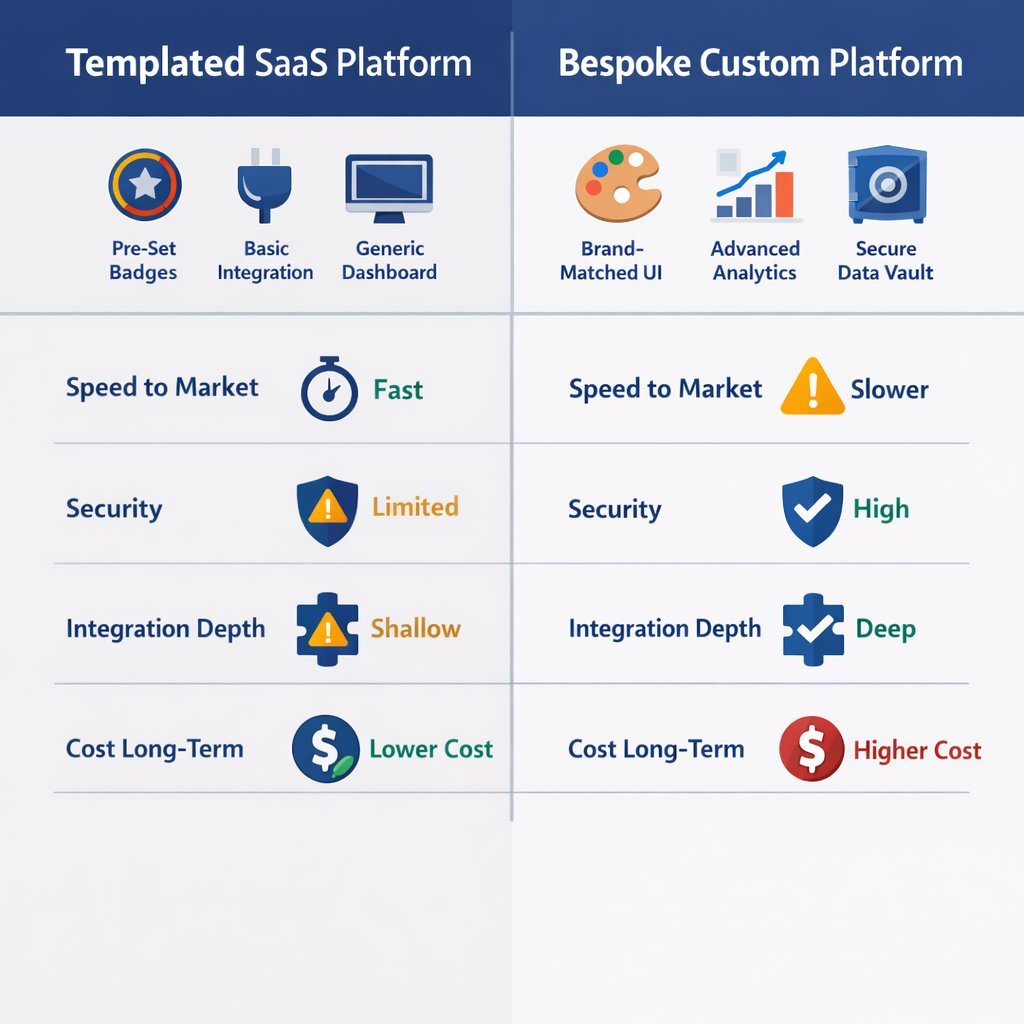
SaaS gamification platforms (e.g., Bunchball, Badgeville) offer speed to market, but they come with significant ceilings for enterprise application.
- Generic Mechanics: These platforms often force a "points and badges" overlay onto existing processes. They lack the flexibility to create deep, narrative-driven experiences like Autodesk's "Undiscovered Territory." They are often limited to standard APIs that may not support complex game logic. 31
- Integration Friction: Integrating a third-party SaaS tool with legacy ERPs, CRMs, or proprietary banking cores can be a nightmare of API calls and data synchronization issues. Legacy systems often require middleware to bridge the gap, which generic platforms may not provide. 32
- Security Risks: In regulated industries (Healthcare, Finance), passing user data to a third-party gamification vendor introduces a new attack vector. Third-party risk is a leading cause of data breaches in healthcare. 34
- Vendor Lock-In: Reliance on a SaaS provider means renting the engagement engine. If the vendor changes pricing or shuts down, the historical data (the users' badges and status) is at risk. Migration is difficult and costly. 36
- Long-Term Cost: While initial costs are lower, subscription fees scale with users. Over a 5-year period, total spending on SaaS often exceeds custom development by up to 72%. 31
9.2 The Case for Custom Software Development
Custom development, the domain of firms like Baytech Consulting, offers strategic advantages that align with long-term enterprise goals.
- Total Control and IP Ownership: A custom solution is an asset on the balance sheet. The algorithms, the data, and the user experience are proprietary. This allows for the creation of a "Unique Competitive Edge" that competitors cannot simply license. 36
- Deep Integration with Legacy Systems: Custom software can be built to sit directly on top of legacy infrastructure (mainframes, on-prem databases) using custom middleware, ensuring real-time data flow without the latency or security risks of external API calls. 32
- Security by Design: For clients in HIPAA or GDPR jurisdictions, a custom solution can be architected from the ground up to meet specific compliance requirements (e.g., on-premise hosting, specific encryption standards) that SaaS vendors may not support. Custom apps can implement device hardening and app sandboxing tailored to the specific threat model. 38
- Brand Alignment: A custom game feels like part of the brand, not a plugin. It allows for pixel-perfect design alignment, which is crucial for luxury or high-trust brands.
- Compensation Strategy: For developer talent, working on custom app development often commands different salary structures and skill sets compared to configuring SaaS platforms like Salesforce or ServiceNow, impacting the talent pool available for maintenance. 40
9.3 Comparative Analysis: Build vs. Buy
| Feature | Off-the-Shelf SaaS | Custom Solution (Baytech Approach) |
|---|---|---|
| Speed to Market | High (Weeks) | Medium/Low (Months) |
| Upfront Cost | Low | High |
| Long-term Cost | High (Subscription fees scale with users) | Low (Maintenance only) 31 |
| Customization | Limited (Configurable templates) | Unlimited (Bespoke code) |
| Security | Shared Tenant / Third-Party Risk | Dedicated / Zero Trust Compatible |
| Integration | Standard APIs | Deep / Legacy / Native |
| Differentiation | Low (Competitors can buy the same tool) | High (Unique IP) |
Strategic Recommendation: For simple, short-term campaigns, SaaS is sufficient. For core product differentiation, deep integration with legacy systems, or regulated industries requiring strict data sovereignty, custom development is the superior long-term strategy.
10. The Dark Side: Ethics, Risks, and Compliance
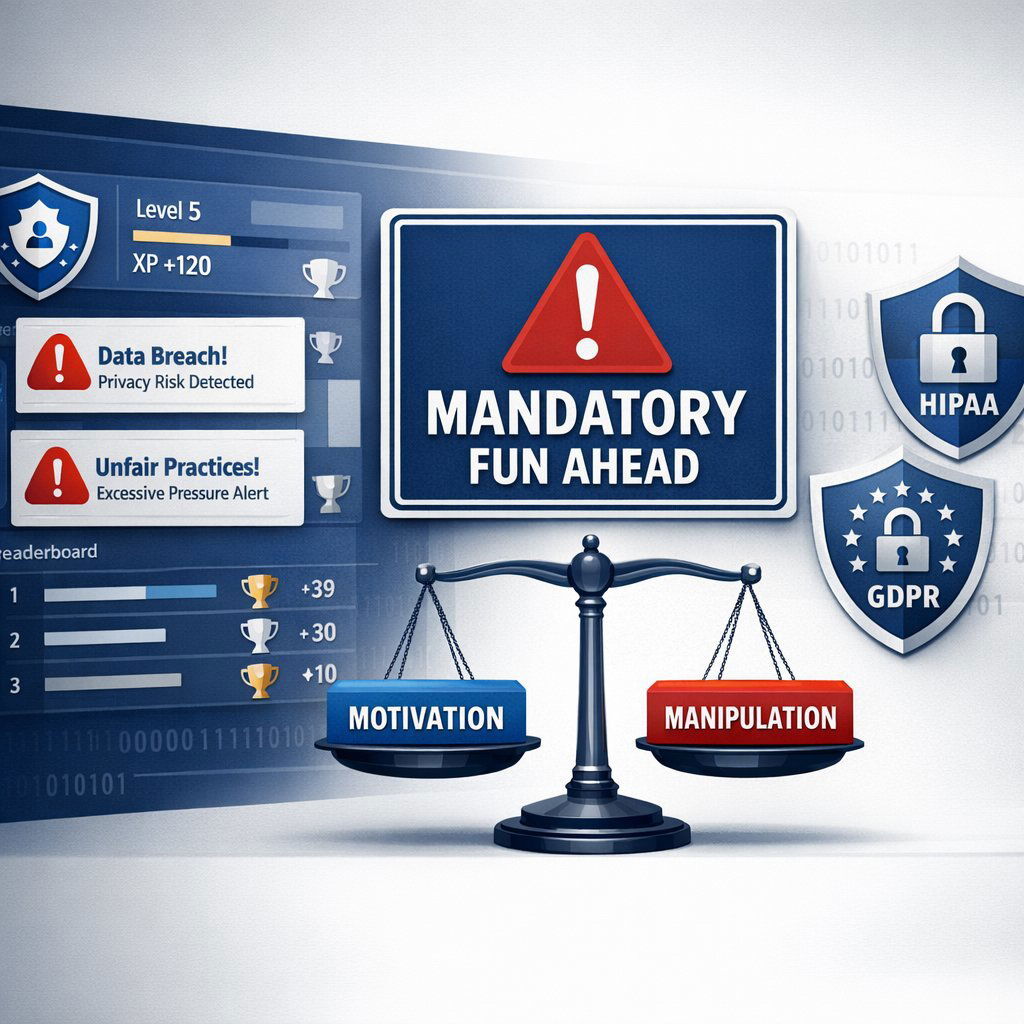
Implementing gamification is not without risk. Poorly executed strategies can backfire, leading to "gamification fatigue," active resentment, or regulatory fines.
10.1 The "Mandatory Fun" Paradox
In corporate settings, forcing employees to play games can be perceived as patronizing or dystopian. If the "game" is just a surveillance tool to track productivity (e.g., tracking keystrokes for points), it will destroy morale. A 2023 study found that poorly designed systems decreased long-term motivation by undermining autonomy. Users report higher satisfaction when they perceive elements as supporting their learning journey rather than manipulating their behavior. 1
Mitigation: Ensure participation is voluntary or that the value exchange (training, rewards) is genuinely beneficial to the employee, not just the employer.
10.2 The Overjustification Effect
As noted in SDT research, replacing intrinsic motivation with extrinsic rewards (points) can devalue the activity. If a developer loves coding, giving them points for every line of code might actually make them enjoy it less, as it becomes a transaction.
Mitigation: Use rewards to acknowledge competence, not to bribe behavior. Focus on "informational feedback" (e.g., "You have mastered Python Level 3") rather than "controlling rewards" (e.g., "Do this to get $5").
10.3 Data Privacy and Compliance Risks
Gamification generates vast amounts of behavioral data. In the age of AI, this data can be used to predict and manipulate behavior.
- HIPAA & GDPR: In healthcare and finance, gamification apps often fall under strict scrutiny. A SaaS platform that inadvertently shares patient data via tracking pixels or weak API security can lead to massive fines. Healthcare organizations have faced over $100 million in fines recently due to unauthorized data sharing by tracking pixels. 41
- Third-Party Risk: Hackers increasingly target third-party vendors to access healthcare networks. A custom-built, on-premise or private cloud solution mitigates this risk by reducing the surface area of attack. 34
11. Future Horizons: 2025-2030
As we look toward 2030, gamification is evolving from a standalone feature to an invisible layer of the user experience.
11.1 AI-Driven Personalization
Generative AI will enable "hyper-personalized" gamification. Instead of a static leaderboard, an AI game master could generate unique quests for every user based on their real-time behavior, learning style, and psychographics. This moves beyond "User Segments" to "Segments of One," creating a tailored experience that evolves with the user. 42
For a deep dive into how AI is transforming enterprise engagement, see Harnessing Generative AI for Enterprise Success.
11.2 The Metaverse and Immersive Training
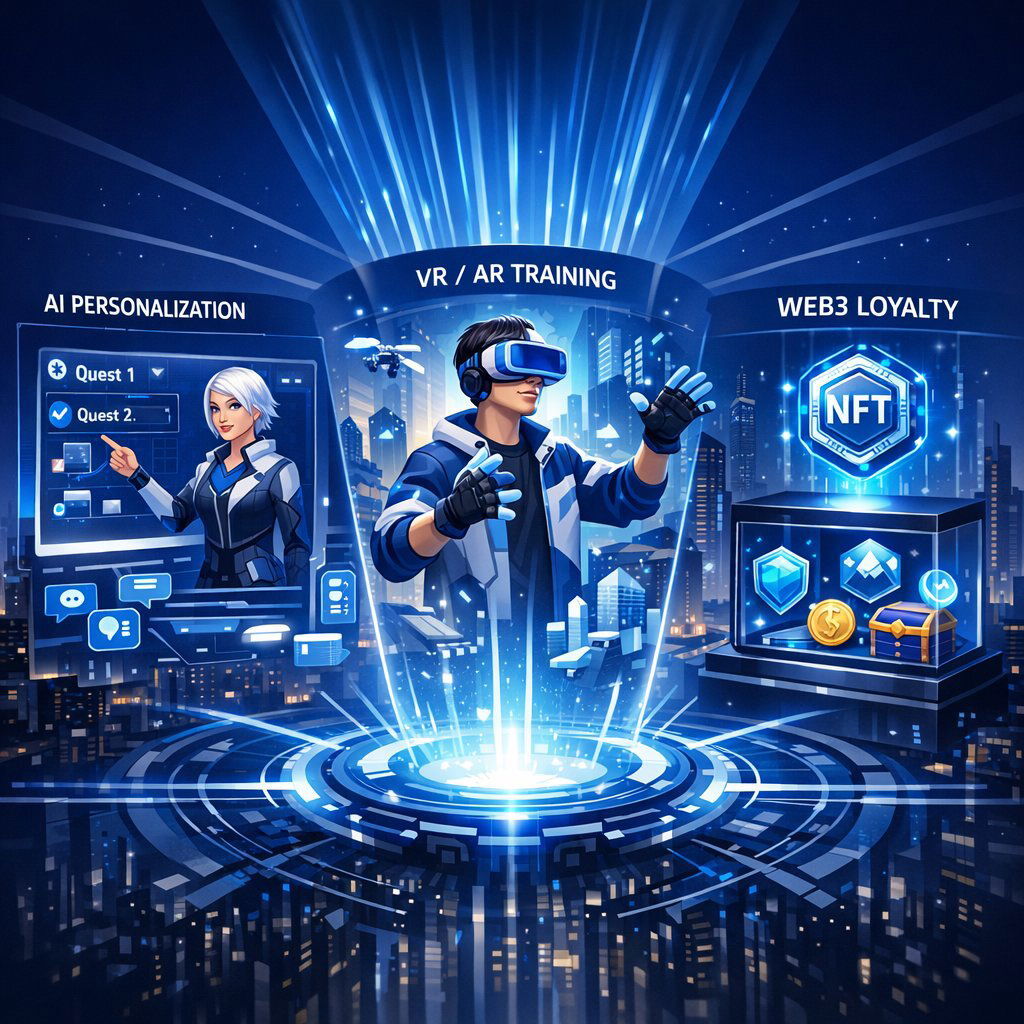
In sectors like manufacturing and healthcare, gamification is merging with VR/AR. Training a surgeon in a gamified VR simulation offers a safe environment to fail and learn, with game mechanics providing instant feedback on precision and speed. The immersive nature of these technologies deepens the "investment" phase of the Game Cycle. 43
11.3 Tokenization and Web3 Loyalty
While the crypto hype cycle fluctuates, the underlying technology of digital ownership remains relevant. Future loyalty programs may allow users to own their status and assets (as NFTs or tokens), allowing them to trade or port their "reputation" across different platforms. This interoperability could redefine the concept of brand loyalty, turning customers into stakeholders.
Conclusion
Gamification is no longer a novelty; it is a critical component of the digital engagement stack. For the CMO or Head of Product, the imperative is clear: move beyond superficial "pointsification" and design systems that respect the user's psychology and intelligence.
Key Takeaways:
- Start with Psychology, Not Technology: Define the behavior you want to drive and the intrinsic motivation that aligns with it (Autonomy, Competence, Relatedness). For businesses in fast-moving industries, check out why waiting is no longer an option for AI adoption in 2025.
- Measure ROI Holistically: Look beyond engagement vanity metrics to hard business outcomes: CAC reduction, LTV increase, and operational efficiency.
- Choose the Right Architecture: In complex, regulated, or high-stakes environments, the "Buy vs. Build" decision should lean toward custom solutions. The long-term benefits of data ownership, security, and differentiation outweigh the initial convenience of SaaS. Consider partnering with an AI-powered development team to design secure, compliant, and scalable solutions for your business.
- Iterate and Optimize: A game is never finished. Use the data generated by the system to continuously refine the difficulty, rewards, and narrative to keep users in the "Flow Zone." Need help defining your strategy? Our Agile Methodology ensures your gamification projects evolve along with your business needs.
By treating gamification as a serious business discipline—one that combines behavioral science, data analytics, and custom software engineering—organizations can unlock a powerful engine for loyalty that competitors cannot easily replicate.
Recommended Next Steps for Strategy Execution
- Understanding the Impact of Gamification in Corporate Learning
https://www.chieflearningofficer.com/2024/09/18/understanding-the-impact-of-gamification-in-corporate-learning/ - Sales Training Meets Gamification at Medtronic
https://peopleproductions.com/insights/sales-training-meets-gamification-at-medtronic/ - Gamification in Financial Services: The Extraco Bank Case
https://www.disruptionbanking.com/2021/03/16/gamification-in-financial-services-by-equitech/ - Autodesk’s Gamification Strategy to Convert Trial Users
https://www.gamification.co/2013/09/11/autodesk-great-tutorial-game-to-convert-trial-users/ - Gamification Trends 2022-2025: Top Stats and Examples
https://www.growthengineering.co.uk/19-gamification-trends-for-2022-2025-top-stats-facts-examples/
About Baytech
At Baytech Consulting, we specialize in guiding businesses through this process, helping you build scalable, efficient, and high-performing software that evolves with your needs. Our MVP first approach helps our clients minimize upfront costs and maximize ROI. Ready to take the next step in your software development journey? Contact us today to learn how we can help you achieve your goals with a phased development approach.
About the Author

Bryan Reynolds is an accomplished technology executive with more than 25 years of experience leading innovation in the software industry. As the CEO and founder of Baytech Consulting, he has built a reputation for delivering custom software solutions that help businesses streamline operations, enhance customer experiences, and drive growth.
Bryan’s expertise spans custom software development, cloud infrastructure, artificial intelligence, and strategic business consulting, making him a trusted advisor and thought leader across a wide range of industries.