
Unlocking Developer Happiness and Productivity in 2025
December 31, 2025 / Bryan ReynoldsExecutive Summary: The Silent Crisis in Engineering
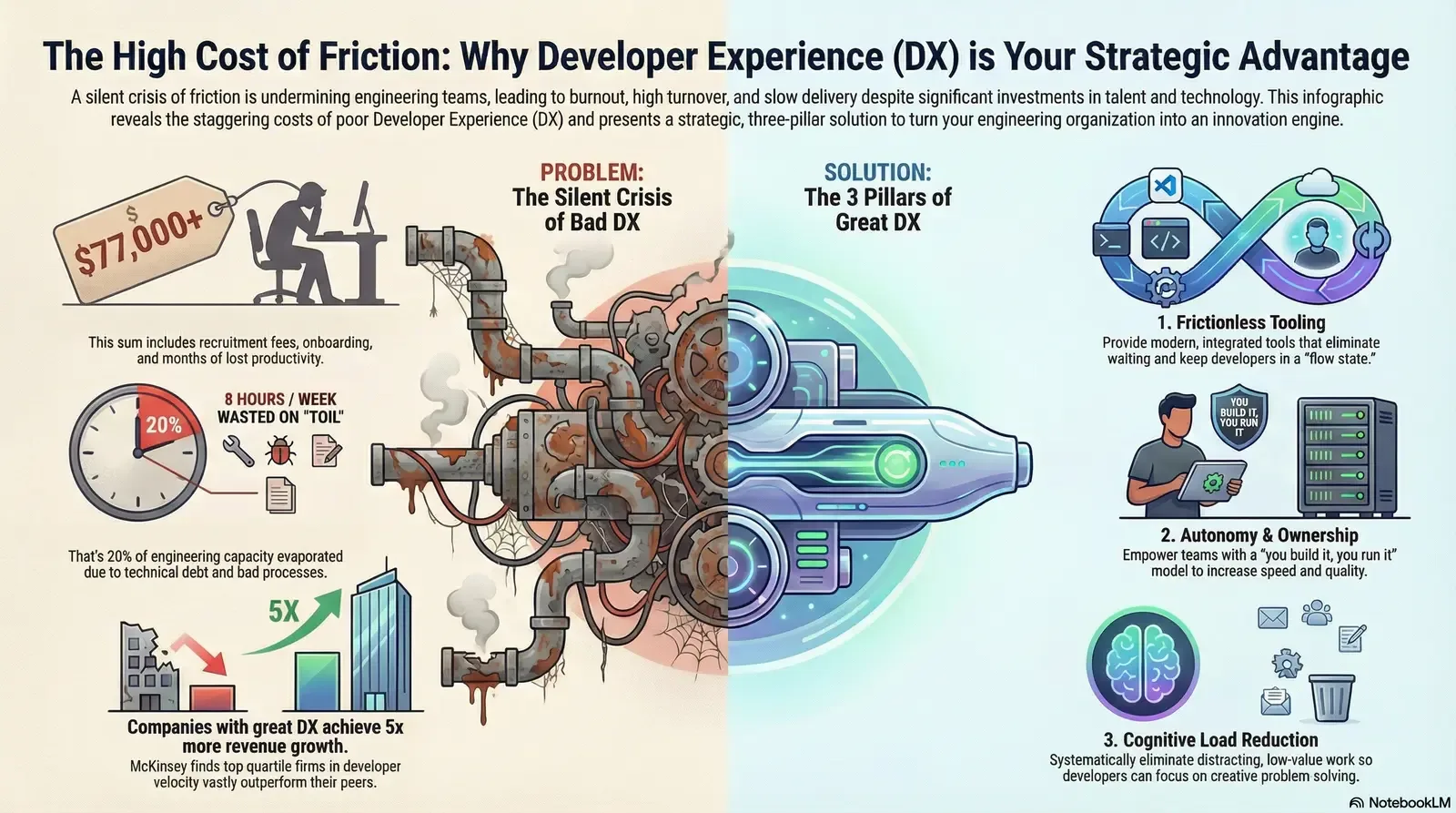
In the high-stakes arena of modern software development, a silent crisis is eroding the potential of engineering organizations. It’s not a crisis of capability; the global market is flooded with brilliant minds and increasingly powerful technologies. Nor is it a crisis of capital; despite economic headwinds, investment in digital transformation remains a non-negotiable line item for the C-suite. It is, fundamentally, a crisis of friction.
For the Vice President of Engineering or the Chief Technology Officer, the daily reality is often a paradox. You hire the best talent available, often engaging in bidding wars to secure senior engineers. You pay top-tier salaries that have risen significantly—median wages for developers now exceed $133,000, with total compensation packages often doubling that figure.1 You invest in cutting-edge infrastructure and cloud contracts. Yet, despite these inputs, delivery timelines slip. Technical debt accumulates like plaque in the organizational arteries. Your most senior engineers, the architects of your digital future, show signs of burnout—not from the complexity of the problems they are solving, but from the difficulty of simply getting their work done.
This environment—the sum total of tools, processes, culture, and friction—is the Developer Experience (DX).
This report argues that in the fierce competition for tech talent, creating a superior DX is no longer a “nice-to-have” perk—it is a critical competitive advantage and a strategic imperative. We move beyond the superficial definition of DX—often confused with free snacks, ping-pong tables, or casual Fridays—to a rigorous, metrics-driven understanding of how engineering teams actually function. We posit that DX is the primary driver of business velocity, code quality, and talent retention.
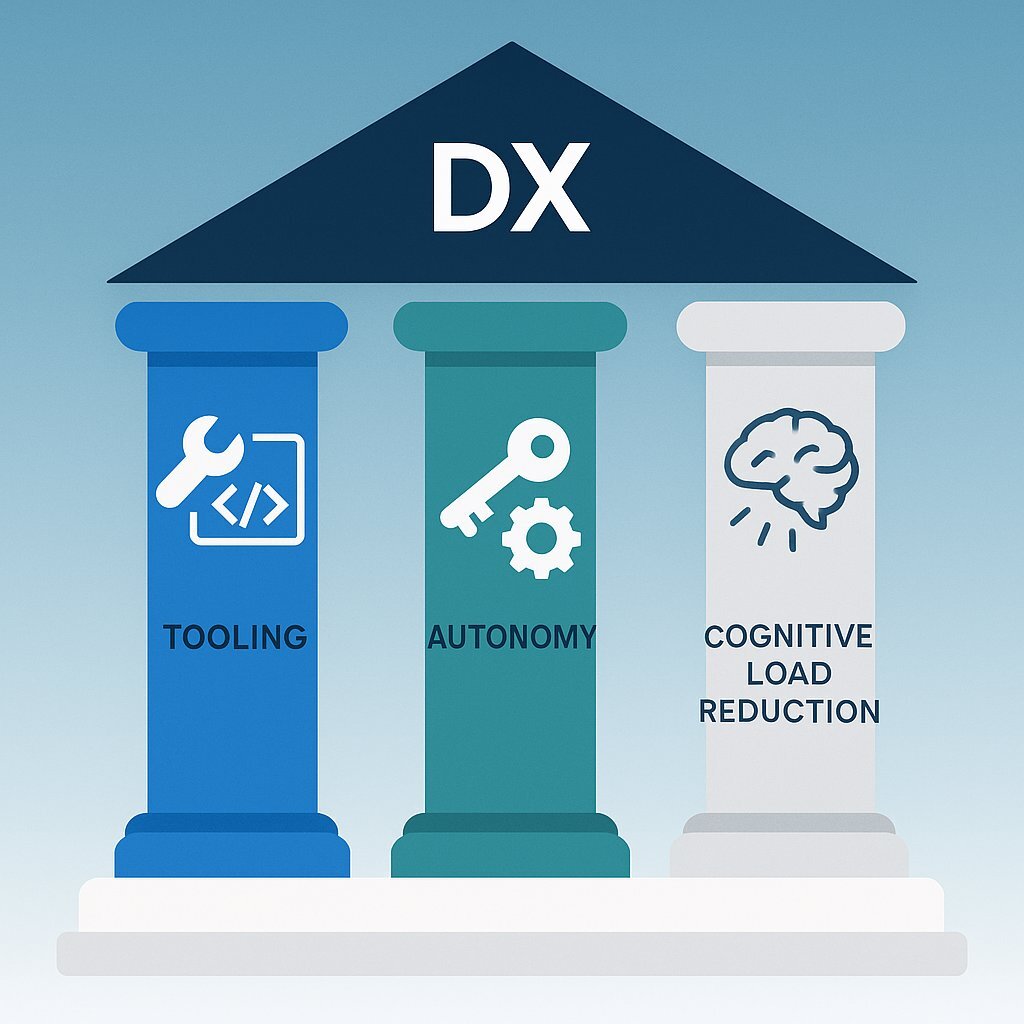
Drawing on exhaustive data from 2024 and 2025 industry reports by McKinsey, Gartner, Stack Overflow, Atlassian, and others, this analysis demonstrates that a great DX leads to higher quality code, faster delivery, and, crucially, better talent retention. We’ll deconstruct the DX imperative into three structural pillars that define the modern engineering ethos:
- Frictionless Tooling: Why the choice between Visual Studio 2022 and legacy environments, or Azure DevOps and Jenkins, is a productivity decision, not just a preference.
- Autonomy and Ownership: How modern infrastructure stacks like Harvester HCI and Rancher empower developers to own their services, breaking down the wall between “Dev” and “Ops.”
- Cognitive Load Reduction: Applying the principles of Team Topologies to minimize “toil” and maximize “flow.”
For mid-sized and smaller firms, particularly those working with agile partners like Baytech Consulting, the payoff is existential. You cannot always compete with Big Tech on raw salary or restricted stock units. You can, however, outcompete them on experience. You can offer a workplace where an engineer can deploy code in minutes, not days; where documentation is a map, not a maze; and where the tools get out of the way of the craft.
Part I: The Economic Reality of Developer Experience
The “war for talent” has become a boardroom cliché, but the economic data underlying it is stark and unforgiving. As we move through 2025, the labor market for software engineers remains tight, and the cost of losing a developer has skyrocketed. To understand the ROI of Developer Experience, we must first quantify the staggering cost of the status quo.
The High Cost of Attrition and the “Hollow Senior” Effect
Attrition is the silent killer of engineering velocity. When a developer leaves, the organization loses more than just a resource; it loses institutional memory, context, and momentum. The “Hollow Senior” effect happens when attrition strips a team of its architectural guardians, leaving junior developers to navigate complex codebases without guidance, which in turn leads to more errors, slower delivery, and eventually, more attrition.
The Financial Toll of Turnover
Recent labor statistics indicate that the median annual wage for software developers has surpassed $133,000.1 However, the cost of replacing an engineer is estimated to be far greater than their salary. Industry analysis suggests that replacing a single software engineer costs between 50,000 and 77,000 in direct recruitment fees, onboarding costs, and productivity losses.2
When we factor in the “ramp-up” period—which experts estimate can take months for a developer to become fully effective—the true cost of turnover becomes a massive drag on the P&L.4 If an engineering team of 50 developers experiences a 20% annual turnover rate (a common figure in high-stress environments), the organization is hemorrhaging nearly $770,000 annually in direct replacement costs alone, not counting the lost revenue from delayed product features.
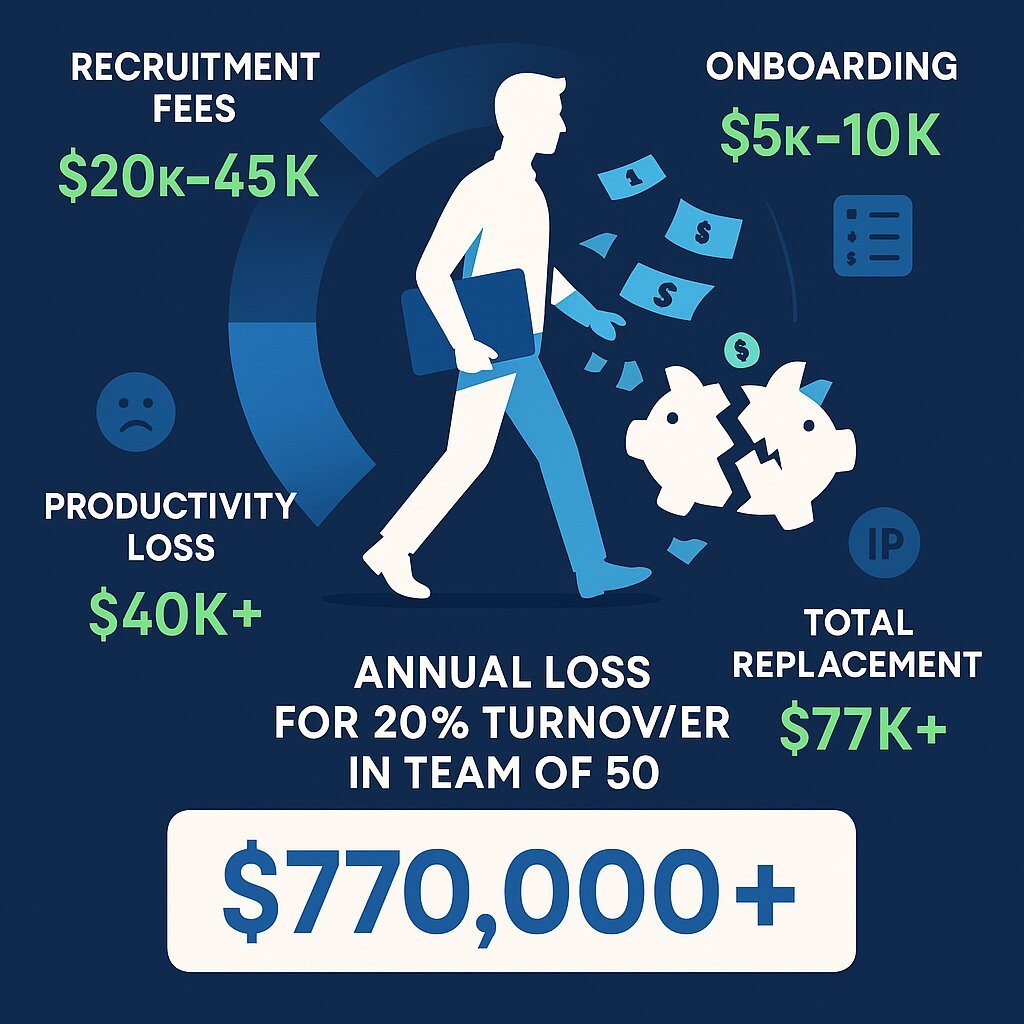
The table below illustrates the compounding costs of developer turnover:
| Cost Component | Estimated Value | Description |
|---|---|---|
| Recruitment Fees | 20,000 - 45,000 | Agency fees typically run 15-30% of the first-year salary.2 |
| Onboarding Expenses | 5,000 - 10,000 | Hardware provisioning, software licensing, administrative time, and training materials.3 |
| Productivity Loss | $40,000+ | The "ramp-up" period where a new hire consumes team resources without delivering full value (3-6 months).3 |
| Total Replacement Cost | $77,000+ | Per Developer (excluding impact on team morale and lost IP).3 |
This data suggests that DX is not an HR metric; it is a CEO-level concern. Gartner’s 2024 research highlights that teams with high-quality developer experiences are 20% more likely to retain their talent.5 In an era where the U.S. is projected to face a shortage of over 1.2 million software engineers by 2026, retention is the new recruiting.
The Productivity Multiplier: McKinsey’s Developer Velocity Index (DVI)
The business case for DX extends beyond cost savings to revenue generation. McKinsey’s research into “Developer Velocity” provides the most compelling quantitative evidence to date. The Developer Velocity Index (DVI) measures a company’s software development capabilities across technology, working practices, and organizational enablement.
The findings are unambiguous and startling for those who view IT solely as a cost center:
- Revenue Growth: Companies in the top quartile of the DVI outperformed bottom-quartile peers by up to five times in revenue growth.7
- Innovation Edge: Top-quartile companies scored 55% higher on innovation, indicating that when developers are not fighting their tools, they are building the future.8
- Market Cap: The correlation extends to shareholder value, with high-DVI companies showing consistently stronger market performance.9
- Talent Retention: High-velocity environments are magnets for talent. Developers want to work where they can be productive. The ability to ship software efficiently is directly tied to the ability to capture market share and attract the best minds.7
The “Toil Tax” and Burnout
If DVI measures speed, “Toil” measures the friction that slows it down. Google’s Site Reliability Engineering (SRE) teams define toil as work that is manual, repetitive, tactical, devoid of enduring value, and scales linearly with service growth.10
A 2024 report by Harness revealed a startling statistic: Developer burnout is straining organizational resources, with “toil” cited as a primary driver.11 When developers spend their time manually restarting servers, wrestling with flaky CI/CD pipelines, or searching for outdated documentation, they are paying a “Toil Tax.”
- Wasted Time: Developers waste up to 8 hours weekly on inefficiencies like technical debt and bad processes.12 That is 20% of your engineering capacity—one day every week—evaporated.
- The Frustration Gap: The 2025 Stack Overflow survey notes that 66% of developers cite “Almost Right” solutions and debugging time-consuming issues as top frustrations.13
- Cognitive Drain: The sheer volume of manual interventions required in low-DX environments depletes the cognitive resources needed for creative problem solving, leading to a state of chronic exhaustion.14
Strategic Insight: For a VP of Engineering, the math is simple. Investing in DX to reduce toil by 20% is mathematically equivalent to hiring 20% more engineers, but at a fraction of the cost and with zero onboarding time. It is the most efficient lever for increasing capacity.
Pillar 1: Tooling – The Foundation of Flow
The first pillar of Developer Experience is the toolchain. In the physical world, a master carpenter would not tolerate a dull saw or a bent hammer. In software, the Integrated Development Environment (IDE), the CI/CD pipeline, and the database are the tools of the trade. If these are subpar, productivity halts. An optimized DevOps toolchain is foundational.
For Baytech Consulting, and for any forward-thinking engineering organization, the selection of the “Modern Microsoft Stack”—Azure DevOps, Visual Studio 2022, and VS Code—is not arbitrary. It’s a calculated choice to maximize integration and minimize friction.
The Cockpit: Visual Studio 2022 vs. Legacy Environments
The IDE is where the developer lives. It’s their cockpit. A superior IDE reduces the micro-latency between “thought” and “code,” maintaining the developer’s “flow state.”
The 64-Bit Revolution: Performance as a Feature
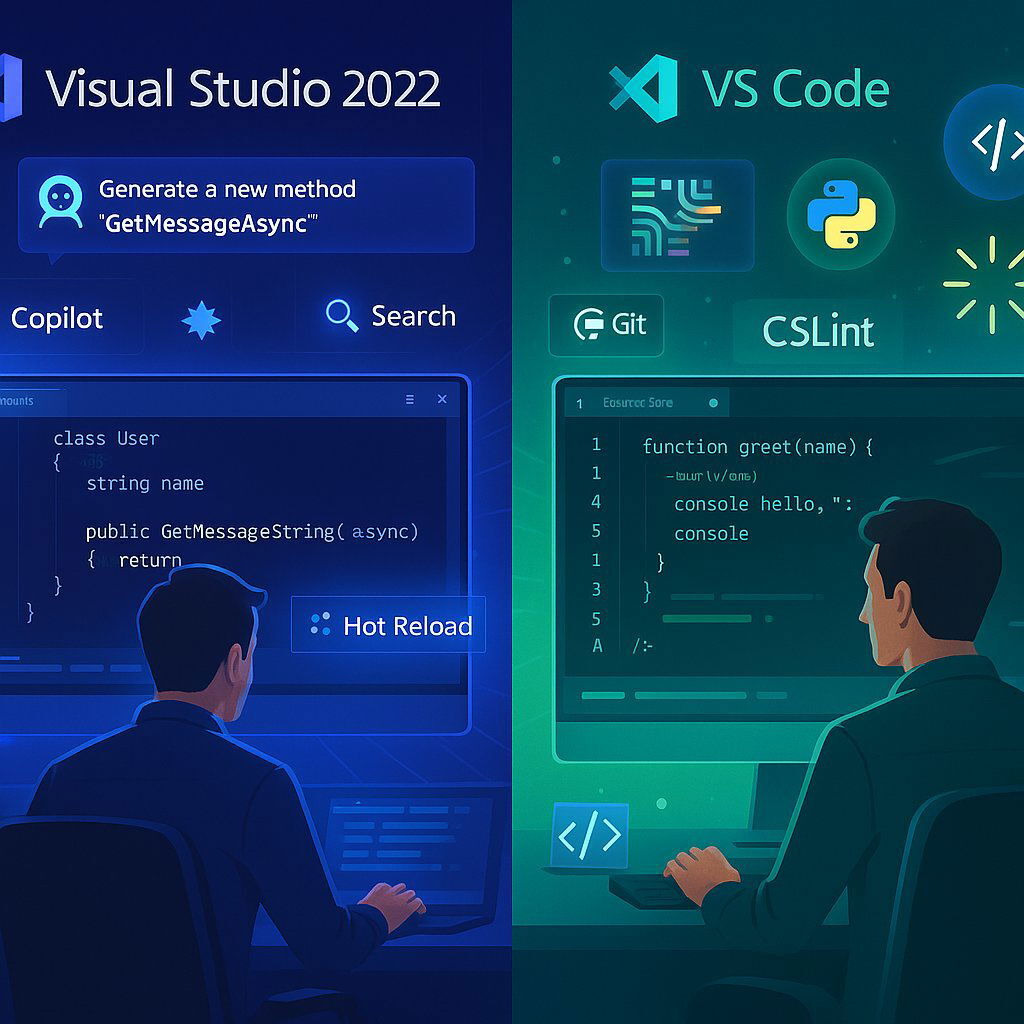
Visual Studio 2022 represents a quantum leap over its predecessors. As the first 64-bit version of the venerable IDE, it’s no longer limited by a 4GB memory ceiling, enabling it to open massive solutions—containing thousands of projects and millions of lines of code—without stuttering or crashing.15
- Search Velocity: The “Find in Files” feature in VS 2022 is up to 3x faster than in previous versions.16 It saves nearly an hour a week—and more importantly, it preserves the developer’s focus.
- AI-Assisted Coding: The integration of IntelliCode and GitHub Copilot into VS 2022 transforms the IDE into a true coding partner. Copilot uses AI to suggest code, reducing time spent on boilerplate and repetitive tasks.17
- Hot Reload: This feature allows developers to modify running code without pausing execution—a major boost for rapid experimentation and feedback.16
VS Code: The Lightweight Champion
While Visual Studio 2022 handles complex backend architectures, VS Code is the industry standard for frontend and lightweight services. Used by 75.9% of developers in 2025,13 its extensibility and cross-platform flexibility make it vital for any high-performing team.
The Pipeline: Azure DevOps vs. Jenkins
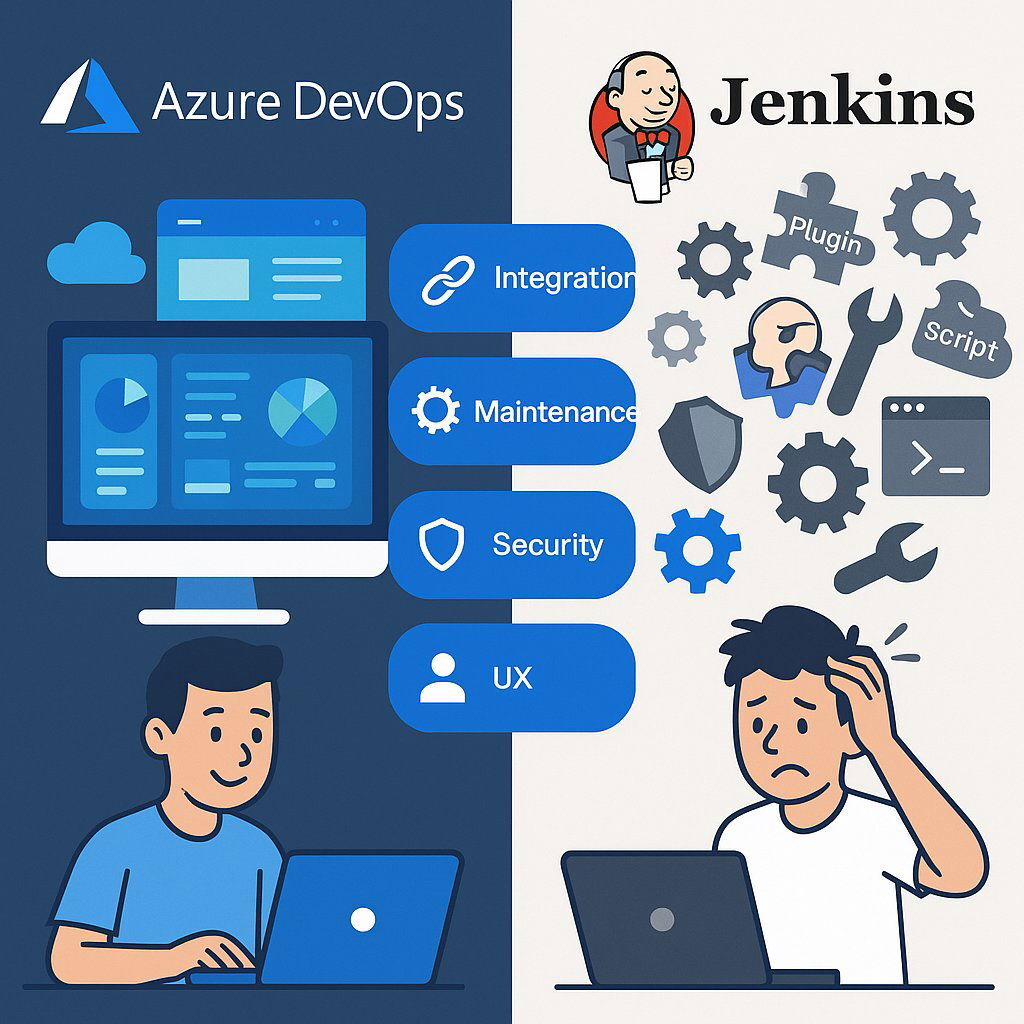
The Continuous Integration/Continuous Deployment (CI/CD) pipeline is the heartbeat of the engineering team. A stopped pipeline is a stopped factory. The debate between Azure DevOps (ADO) and Jenkins is a study in managed simplicity versus do-it-yourself complexity.
The Hidden Cost of "Free" (Jenkins)
Jenkins is the venerable open-source standard. But for DX-focused organizations, Jenkins often becomes a trap—its flexibility comes at the expense of time spent on plugin maintenance, troubleshooting Groovy scripts, and context switching among tools. In the era of modern software outsourcing, friction in toolchains is a silent cost.
The Integrated Advantage (Azure DevOps)
Azure DevOps, by contrast, offers a cohesive, managed experience—from Boards to Pipelines and Repos—all in one UI. Everything integrates cleanly, reducing cognitive load and security worries and letting your engineers focus on shipping code rather than maintaining scripts or servers.
The Database: The Postgres Renaissance
Data is the gravity of any application. The choice of database engine profoundly affects developer happiness. In 2025, PostgreSQL leads as the most admired and desired database for professional developers.23
Why Developers Love Postgres
- Open Source Purity: Totally free, with no licensing hassles—offering autonomy for rapid spins and prototyping.
- Extensibility: Through extensions like PostGIS and JSONB, Postgres flexes between relational and NoSQL worlds, streamlining your backend architecture to empower teams, particularly for projects that need to move fast on mobile or cloud.
- Reliability: Rock-solid ACID compliance makes Postgres trusted for business-critical code.
- Innovation Pace: Frequent updates and innovations—window functions, advanced queries, full-text search—keep Postgres at the leading edge.
The AI Factor: Tooling in the Age of GenAI
2025 is clearly the era of Generative AI. Yet, here’s the twist: 84% of developers use AI tools, but sentiment has dipped to just 60%. Why? The “Almost Right” problem—AI writes fast, but debugging is harder than writing it yourself. Tackling this AI trust paradox in software development is a major challenge for leaders seeking true productivity gains.
Implication for DX: The goal isn’t to provide just any AI, but to offer well-integrated, contextual AI guardrails. Tools like VS 2022 are moving in this direction, bridging the gap between convenience and reliability.
Pillar 2: Autonomy and Ownership
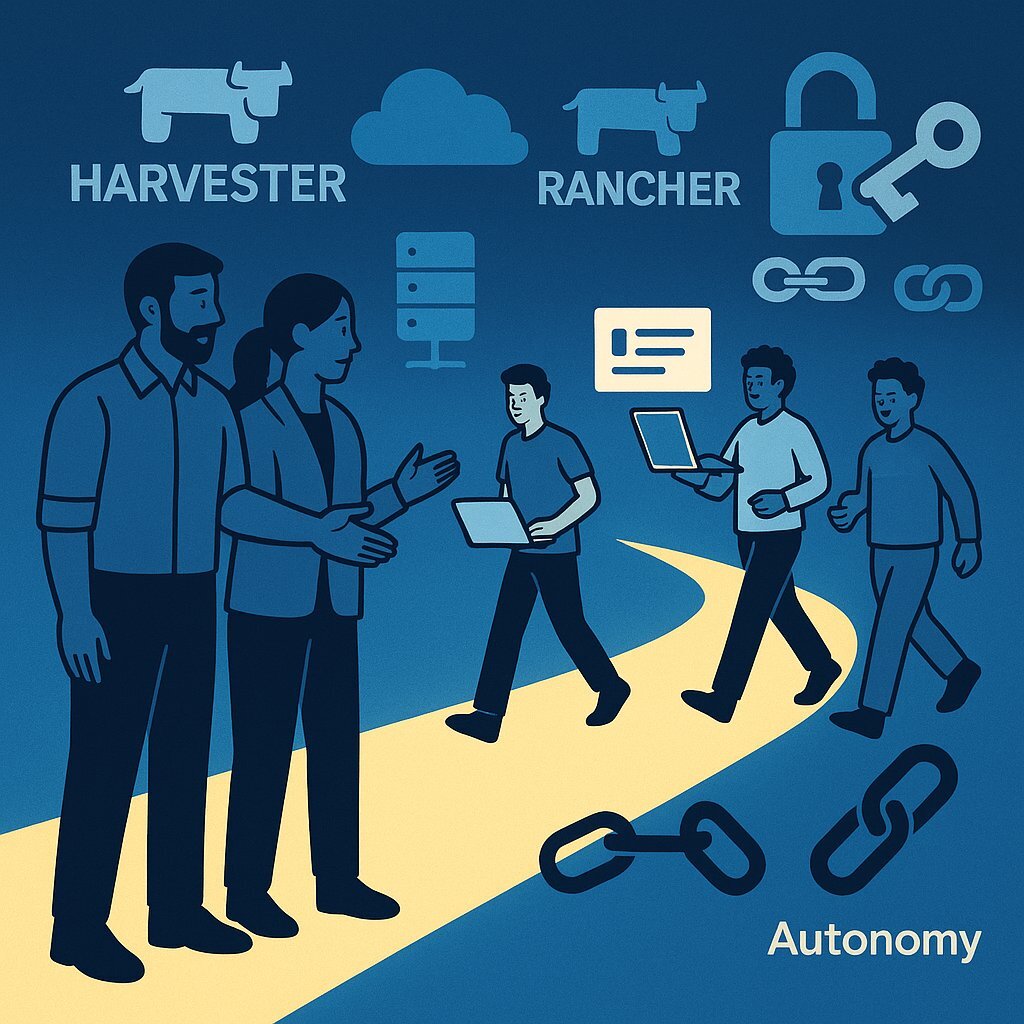
Great tools enable individuals; great infrastructure enables teams. The second pillar of DX is Autonomy. In traditional “throw-it-over-the-wall” organizations, developers write code and “Ops” deploys it. When it breaks, no one knows who’s responsible. This lack of ownership kills morale and slows delivery. The rising expectation of CTOs as value creators can’t be met without empowering true infrastructure autonomy.
The modern DX approach employs a Service Ownership model supported by Platform Engineering.
Breaking the Silos: The Service Ownership Model
Service ownership means the team that builds the service runs the service. As Amazon CTO Werner Vogels put it: “You build it, you run it.”
- Accountability: When the team that writes the code also gets the pager at 3 AM, they write better code and pay close attention to quality.27
- Speed: Removing handoffs to Ops removes bottlenecks. Developers can deploy when they are ready—a main driver for satisfaction.28
- Customer Connection: Service ownership puts developers much closer to user outcomes, speeding up learning and motivation.29
However, “You run it” can become a burden if developers are forced to manage low-level infrastructure. Here’s where the right stack is a DX enabler.
The Hybrid Bridge: Harvester HCI and Rancher
For many mid-sized enterprises, moving 100% to public cloud isn't feasible due to cost or compliance. Yet, developers want a cloud-like experience. That’s exactly what Harvester HCI and Rancher offer—a bridge between on-premise constraints and cloud-native agility.
Platform Engineering: The “Golden Path”
To support autonomy without chaos, many organizations are adopting Platform Engineering. They’re building internal developer platforms (“IDP”) with standardized tools, templates, and self-service resources—creating the "golden path" for team productivity. This trend is supercharged by the surge in SaaS and hybrid authentication needs, as security and autonomy must coexist.
Pillar 3: Reducing Cognitive Load
The human brain can only process so much. In software development, we call this Cognitive Load.
- Intrinsic Load: The effort to do the actual task (think: designing a pricing algorithm)—this is productive, creative load.
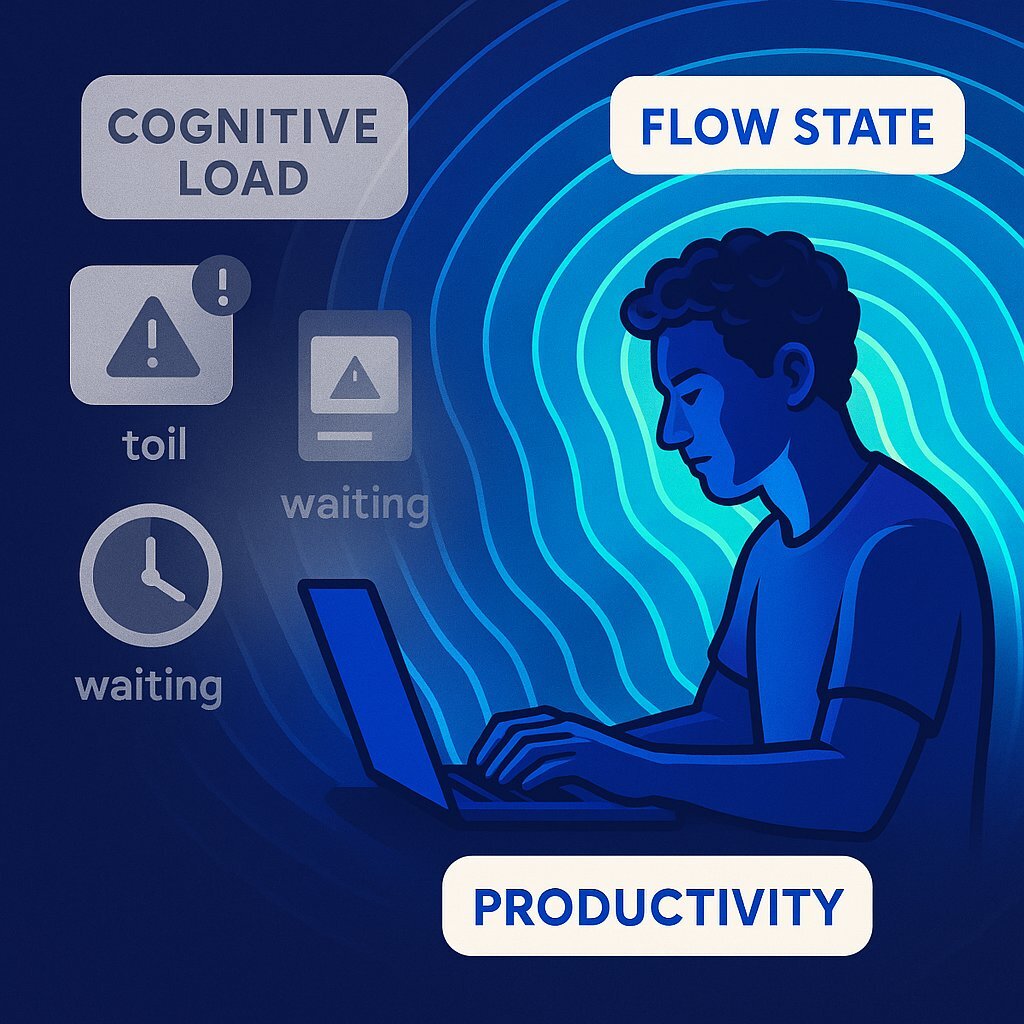
- Extraneous Load: The wasted energy dealing with your environment—tracking down credentials, wrestling with failed builds, or hunting for documentation. This is the load to relentlessly eliminate.40
A superior Developer Experience eliminates extraneous load, freeing your team for true innovation. Thoughtful UX design makes a concrete impact here—clean platforms, good documentation, and intuitive flows drive real results.
The Science of "Flow"
Psychologist Mihaly Csikszentmihalyi called “Flow” the state of deep immersion and focus. For developers, Flow is where magic happens. Every interruption—a ping, a failed build—breaks flow and productivity drops.
Team Topologies: Structuring for Cognitive Load
The book Team Topologies revolutionized thinking about team structure in relation to DX. Platform teams exist to cut cognitive load for stream-aligned teams, enabling a focus on the work that matters.
Documentation as DX
One of the most overlooked yet impactful areas is documentation. A lack of clear docs creates daily friction. Proper platforms—including well-maintained wikis and internal developer portals—help developers spend more time creating value and less retracing steps.
The Payoff: Why This Matters for Mid-Sized Firms
For a mid-sized company or a smaller firm, hearing about “Platform Engineering” and “Internal Developer Portals” might sound excessive. “We aren’t Google,” you might say. Yet, this is exactly where DX is your leverage.
The "Davids" vs. The "Goliaths"
You can’t out-pay Google. You can’t out-scale Amazon. But you can out-maneuver them on experience. While the Goliaths struggle with bureaucracy, a nimble firm running the Baytech stack (Azure DevOps, Harvester, VS 2022) offers an engineer a world-class environment:
- “Day One Deploy”: Tell a candidate, “You will deploy code to production on your first day.” That’s powerful.
- Modern Stack: Keeping skills sharp is core for recruitment and retention. Show you invest in up-to-date agile and modern engineering, and your team’s market value goes up.
- Sanity: Offering a workplace that respects Flow appeals to senior engineers tired of burnout.
Reassessing the Value Proposition
A great DX allows you to:
- Recruit Senior Talent: Attract those leaving the “big company blues.”
- Onboard Faster: Reduce ramp-up time from months to weeks.
- Punch Above Your Weight: A team of 10 engaged, happy developers can out-ship a team of 50 who are stuck fighting their tools.
Actionable Strategy: A Roadmap for the VP of Engineering
What are your next steps? Here’s a 90-day roadmap based on these core principles:
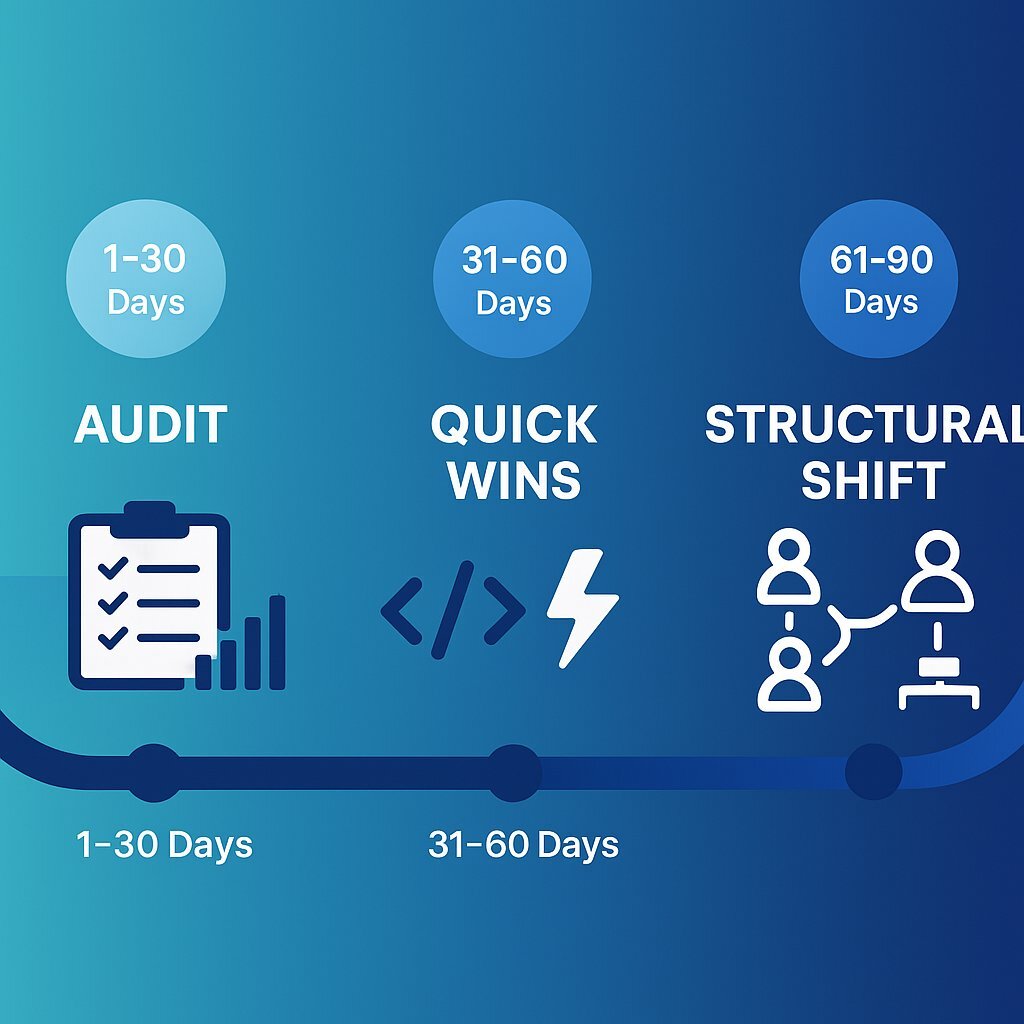
Phase 1: The Audit (Days 1-30)
- Measure Toil: Survey your developers. Ask: What’s the most frustrating thing you do every week? How much time is spent waiting? Find the top 3 friction points.
- Metric Baseline: Establish baselines for DORA Metrics (Deployment Frequency, Lead Time, Time to Restore, Change Failure Rate). You can only improve what you measure.
- Tooling Inventory: Audit your current tools. Are you paying for legacy solutions that no one likes, or using Jenkins when Azure DevOps is available and easier to manage?
Phase 2: The Quick Wins (Days 31-60)
- Standardize the IDE: Roll out VS 2022 and Copilot. Having everyone on the same (modern) tool eliminates “works on my machine” drama.
- Fix the Build: If your CI/CD pipeline is slow, invest in Azure DevOps parallel jobs or faster build agents. 10+ minute queue times are big productivity killers.
- Documentation Sprint: Dedicate a “hackathon” just to documentation. Clean up your wiki, centralize knowledge, and archive obsolete pages.
Phase 3: The Structural Shift (Days 61-90)
- Adopt Service Ownership: Identify a pilot team to take full ownership of a service—including deployment and on-call support.
- Infrastructure Review: Evaluate Harvester/Rancher for on-prem or hybrid workloads to make infrastructure management seamless.
- Create a Platform Team: Even two senior engineers can start as a “platform squad”—dedicated to empowering other developers, not shipping product features, but enabling the whole org to move faster.
Conclusion: The DX Mandate
Developer Experience is not a soft metric. It’s the engine room of digital business. As we look ahead, the divide won’t be “tech companies versus the rest”—it’ll be “frictionless organizations” versus bureaucratic ones.
By investing in Tooling, Autonomy, and Cognitive Load Reduction, you build resilience and speed—and you attract the best talent on the market. Your engineering team becomes a source of innovation, not overhead.
The war for talent is won on the battlefield of experience. Make yours a victory.
About Baytech
At Baytech Consulting, we specialize in guiding businesses through this process, helping you build scalable, efficient, and high-performing software that evolves with your needs. Our MVP first approach helps our clients minimize upfront costs and maximize ROI. Ready to take the next step in your software development journey? Contact us today to learn how we can help you achieve your goals with a phased development approach.
About the Author

Bryan Reynolds is an accomplished technology executive with more than 25 years of experience leading innovation in the software industry. As the CEO and founder of Baytech Consulting, he has built a reputation for delivering custom software solutions that help businesses streamline operations, enhance customer experiences, and drive growth.
Bryan’s expertise spans custom software development, cloud infrastructure, artificial intelligence, and strategic business consulting, making him a trusted advisor and thought leader across a wide range of industries.