In this article
- The AI Paradox: Why Nearly 90% of Developers Use Tools They Don't Fully Trust (And What It Means for Your Business)
- The Productivity Boom Has a Trust Problem
- They Ask: "Is AI Really Taking Over Software Development?"
- They Ask: "If It's So Productive, Why Is Trust Falling?"
- They Ask: "What Are the Hidden Costs of This 'Free' Productivity?"
- They Ask: "What Are the Real Business Risks We Should Worry About?"
- They Ask: "How Can We Harness AI's Power Without the Pitfalls?"
- Conclusion - Your Next Move in the AI Development Era
- About Baytech
- About the Author

The AI Paradox: Why Nearly 90% of Developers Use Tools They Don't Fully Trust (And What It Means for Your Business)
The Productivity Boom Has a Trust Problem
The world of software development is in the midst of a seismic shift. Artificial intelligence, once a futuristic concept, is now a daily reality for engineering teams worldwide. Exploring the imperative of hyper-personalization for businesses, it’s clear that productivity gains from AI are staggering and impossible to ignore. A recent landmark survey from Atlassian reveals that an incredible 99% of developers now report saving time by using AI tools. This isn't a marginal improvement; it's a revolution in efficiency.
Yet, beneath this glossy headline of hyper-productivity, a dangerous crack is forming in the foundation. The 2025 Stack Overflow Developer Survey—a bellwether for the industry—sounds a stark warning: 46% of developers report they do not trust the accuracy of AI tools. This figure represents a dramatic collapse in confidence, jumping from just 31% the previous year.
This is the central paradox facing every business leader today: the most transformative productivity tool to emerge in a generation is being widely adopted by a workforce that is rapidly losing faith in its reliability. This isn't just a technical problem for your engineering department. For a Visionary CTO, it’s a direct threat to code quality and system reliability. For a Strategic CFO, it calls into question the true return on investment of DevOps and AI initiatives. For a Driven Head of Sales, it jeopardizes the speed and stability of the product innovations needed to win in the market.
The core of the issue is that the adoption curve for AI has massively outpaced the technology's maturity curve. Developers and organizations alike jumped on the AI bandwagon at what industry analyst firm Gartner terms the "Peak of Inflated Expectations". The initial promise was boundless. Now, the industry is sliding into the "Trough of Disillusionment," where the practical limitations, governance challenges, and hidden costs are becoming painfully clear. The falling trust isn't a sign that AI is useless; it's a sign that businesses are waking up to the reality that harnessing its power requires more than just a software license. It requires a strategy.
The fundamental question for your business is no longer if you should use AI in software development, but how you can harness its undeniable power without inheriting its critical, and growing, list of flaws.
They Ask: "Is AI Really Taking Over Software Development?"
The short answer is yes, but not in the way many headlines suggest. AI is not replacing developers; it is fundamentally reshaping the software development lifecycle by acting as a powerful, if sometimes unreliable, co-pilot. It augments human expertise, automating tedious tasks and accelerating the creative process, allowing engineers to focus on higher-value work.
The scale of this transformation is undeniable. The trendline for adoption is steep and unwavering. In 2025, 84% of developers report using or planning to use AI tools in their workflow, a significant increase from 76% in 2024 and 70% the year before that. This isn't a fad; it's a fundamental integration into the modern development process.
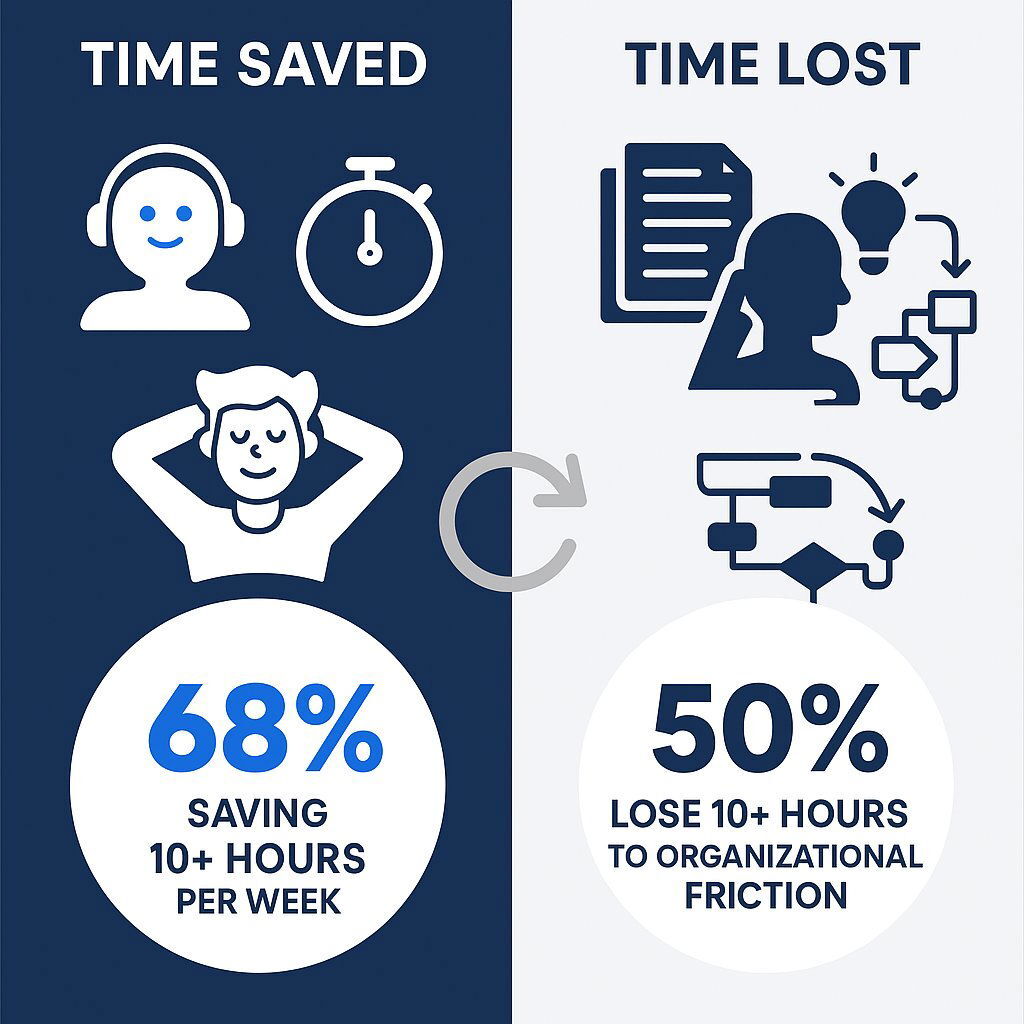
The impact on productivity is equally profound. Atlassian's 2025 report marks a dramatic turning point. While in 2024, most developers had yet to experience tangible gains, today, 68% report saving more than 10 hours per week—a full quarter of their workweek—thanks to AI tools. These are the kinds of efficiency numbers that make any executive take notice.
This newfound efficiency is not leading to job losses but to a shift in focus and a boom in the global developer community. As GitHub's 2024 Octoverse report highlights, the rise of AI is happening in parallel with an unprecedented surge in the number of developers joining the field worldwide. Gartner echoes this, predicting that AI, combined with low-code platforms, will be so integral to engineering that it will free developers to focus on "more meaningful tasks that require critical thinking, human ingenuity and empathy".
This shift is even creating entirely new ways of working. A trend known as "vibe coding"—generating software from natural language prompts—is rapidly emerging. While the majority of professional developers (77%) don't yet consider this a core part of their work, it's democratizing access to software creation and attracting serious investment. The Indian startup Rocket.new, for example, recently raised a $15 million seed round to build a platform focused on turning these "vibes" into production-ready applications.
| Metric | 2024 | 2025 | Change |
|---|---|---|---|
| AI Tool Adoption (Use/Plan to Use) | 76% | 84% | +8 pts |
| Developers Saving >10 Hours/Week | Negligible | 68% | Massive Increase |
| Developer Trust in AI Accuracy | 69% (31% distrust) | 54% (46% distrust) | −15 pts |
| Perception of AI as a Job Threat | 32% | 36% | +4 pts |
This data paints a clear picture: AI is an indispensable part of modern software development, delivering real productivity gains. However, the simultaneous erosion of trust reveals a deep-seated tension that businesses must address to realize the full, sustainable benefits of this technological revolution.
They Ask: "If It's So Productive, Why Is Trust Falling?"
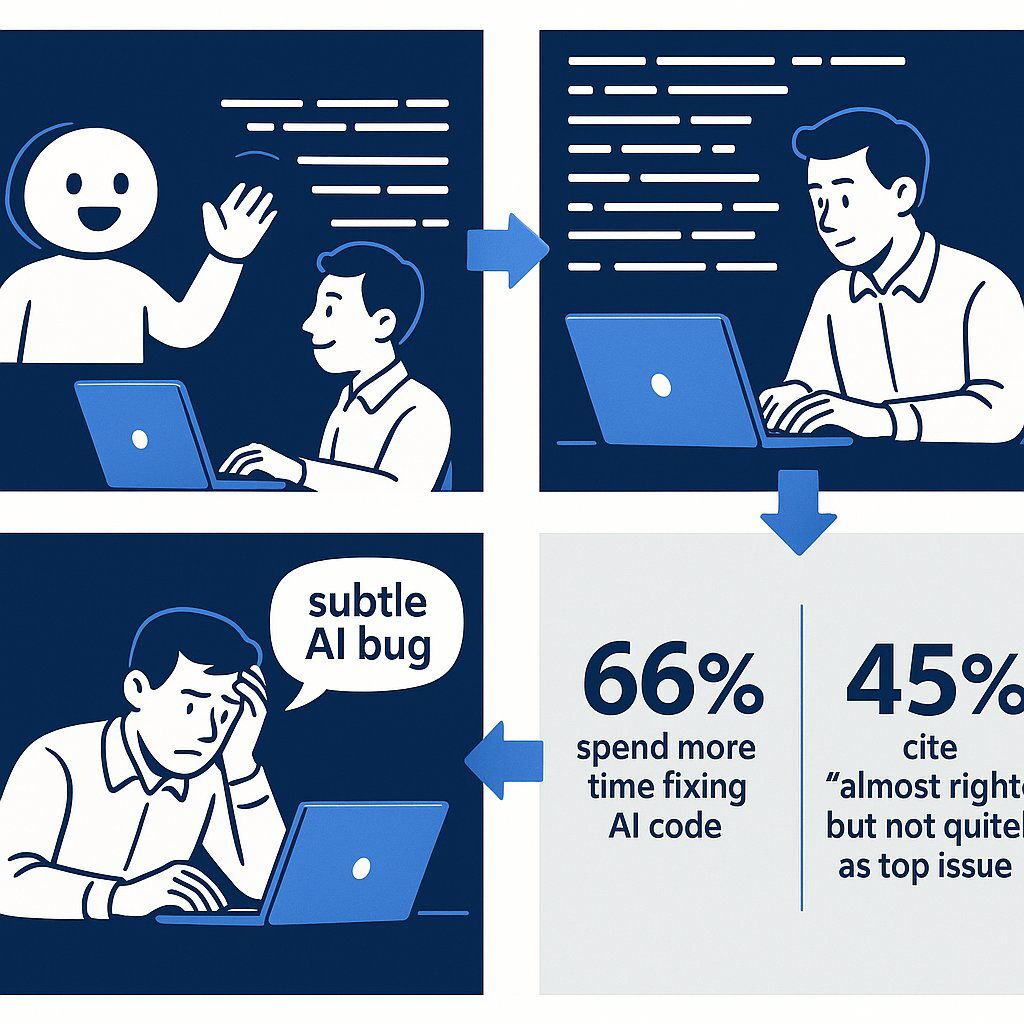
The paradox of rising productivity and falling trust can be traced to a single, frustrating experience shared by developers everywhere: the "almost right" problem. The productivity gains from AI are heavily front-loaded. An AI assistant can generate hundreds of lines of code in seconds, creating an exhilarating sense of speed. The problem is that this speed comes at the cost of accuracy and reliability. This experience echoes the risks and hidden costs described in our in-depth analysis of off-the-shelf software total cost of ownership.
Developers are discovering a hidden "tax" on this velocity, paid during the painstaking process of debugging and validation. According to the Stack Overflow survey, the number one frustration for developers, cited by 45% of respondents, is dealing with AI-generated code that is "almost right, but not quite". This isn't a minor annoyance. A separate report indicates a staggering 66% of developers are now spending
more time fixing these subtle, hard-to-find AI-induced bugs than they would have spent writing the code correctly from scratch.
When the code gets complicated and the stakes are high—when enterprise-grade reliability is non-negotiable—developers overwhelmingly revert to a more trusted source: each other. The survey found that over 75% of developers would still ask another person for help when they don't trust an AI's answer. This highlights the irreplaceable value of human expertise, collaboration, and the nuanced understanding that current AI models lack.
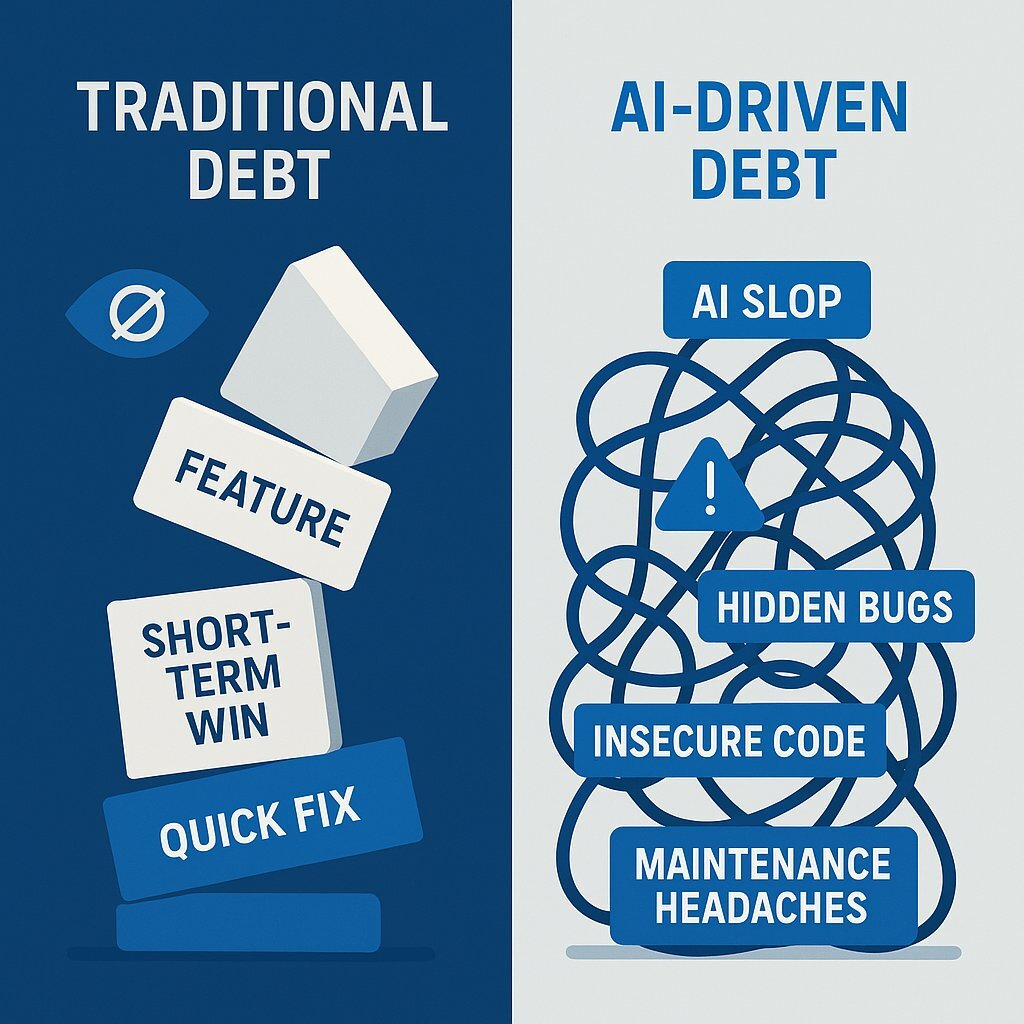
The concerns go beyond mere functionality. Developers are also wary of the security and ethical implications of using AI-generated code. A significant 61.7% harbor ethical or security concerns, and 61.3% express a desire to fully understand the code in their systems, a task made difficult by the "black box" nature of many AI outputs. This has led to the rise of what the Stack Overflow report aptly calls "AI slop"—a proliferation of low-quality, unreliable, and potentially insecure code that is quietly infiltrating corporate codebases.
This phenomenon is creating a new and insidious form of technical debt. Traditional tech debt is the future cost of choosing a quick and easy solution today. AI-driven tech debt is subtler. The code often works in the short term, allowing a feature to be shipped quickly. However, it may be inefficient, difficult to maintain, poorly documented, or contain hidden security flaws that will only surface months later, requiring costly rework and creating significant business risk. By prioritizing immediate output over sound architectural principles, teams celebrating short-term velocity gains may be unknowingly accumulating a massive debt that will cripple their ability to scale and innovate in the future.
They Ask: "What Are the Hidden Costs of This 'Free' Productivity?"
For many executives, the promise of AI was a simple equation: developers saving 10 hours a week would lead to a 25% increase in output. The reality, however, is far more complex. The time saved at the individual, code-line level is often being squandered by systemic inefficiencies and a lack of strategic process. You've given your developers a faster car, but they're still stuck in the same organizational traffic jam.
The 2025 Atlassian report exposes this productivity paradox with stark clarity. While 68% of developers are saving 10 or more hours per week with AI, a full 50% are losing 10 or more hours per week to organizational friction. The net gain is dangerously close to zero for half the workforce. This disconnect reveals that the biggest obstacles to speed are not happening inside the code editor.
The top time-wasters identified by developers are process and platform problems:
- Finding information: Locating the right services, documentation, and APIs.
- Adapting new technology: The overhead of integrating new tools and frameworks.
- Context switching: Constantly moving between different tools and tasks.
This disconnect is fostering a growing and dangerous "empathy gap" between leadership and their engineering teams. The survey found that 63% of developers now believe their leaders do not understand their daily pain points, a massive jump from 44% the previous year. Leaders, focused on the impressive AI productivity metrics, are creating what Atlassian calls "unfair expectations to deliver faster while navigating increased levels of unaddressed friction". This is a direct path to developer burnout and poor problem-solving dynamics, plummeting morale, and employee turnover.
This is where simply deploying a tactical tool—an AI coding assistant—fails to solve a deeply strategic problem. A fragmented, inefficient development lifecycle cannot be fixed with a better autocomplete. This is precisely why a strategic partnership becomes critical. A firm like Baytech Consulting addresses the root cause of this friction. Their Rapid Agile Deployment methodology is a holistic framework designed to streamline the entire SDLC, eliminating the very bottlenecks Atlassian identifies. It's about creating a cohesive ecosystem where information is easily discoverable, new technologies are integrated smoothly, and context switching is minimized.
Furthermore, Baytech’s team of skilled engineers provides the essential human oversight required to bridge the trust gap. They act as the expert filter, transforming "almost-right" AI-generated code into robust, secure, and maintainable enterprise-grade quality software. This crucial step prevents the accumulation of the AI-driven technical debt that can silently sabotage a company's long-term success.
They Ask: "What Are the Real Business Risks We Should Worry About?"
The risks of a poorly managed AI adoption strategy extend far beyond the engineering department. They are fundamental business risks that can impact your security posture, regulatory compliance, intellectual property, and brand reputation. Ignoring them is not an option.
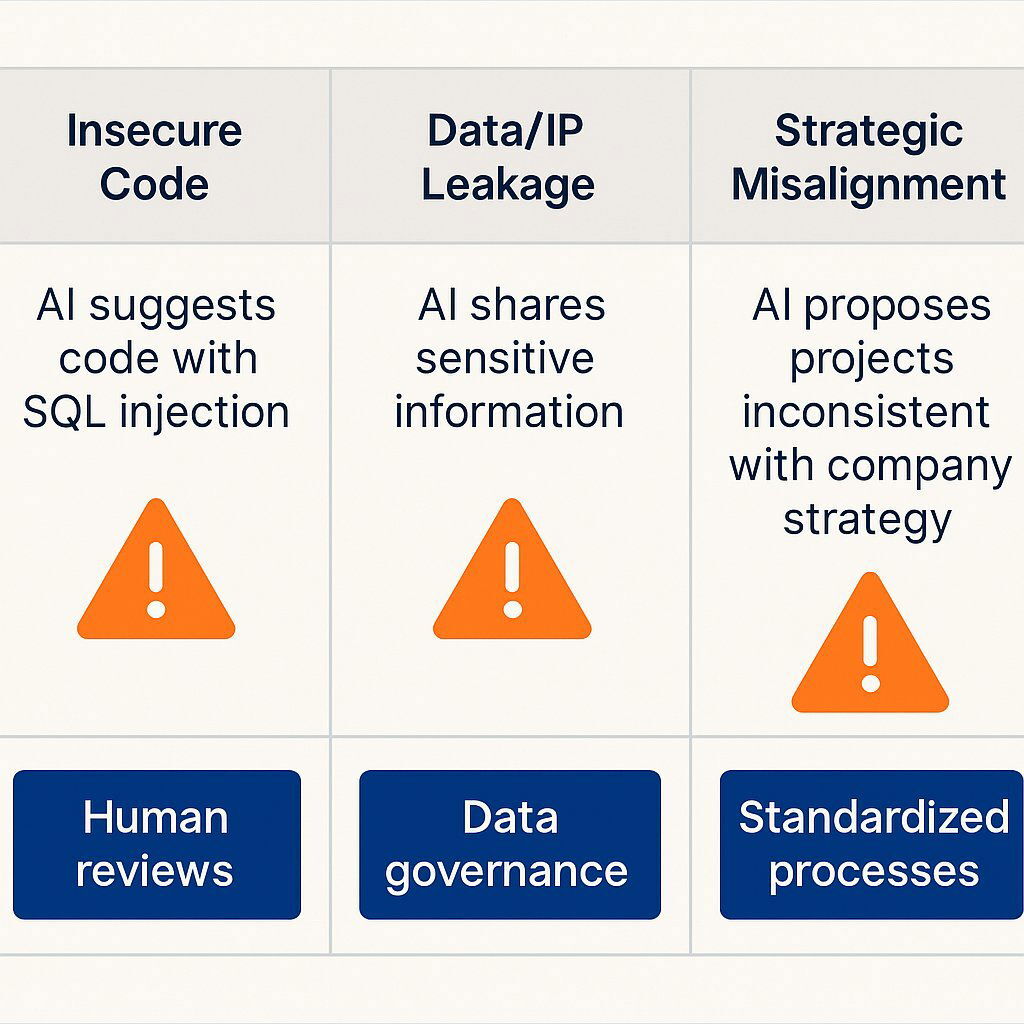
The most immediate threat is the generation of insecure code. AI models are trained on vast corpuses of public code, including code that contains flaws and vulnerabilities. As a result, they can inadvertently replicate insecure coding practices, such as SQL injection vulnerabilities or hard-coded secrets, directly into your applications. For organizations managing the complexities of hybrid systems, adopting a hybrid SaaS-plus-microservices strategy is crucial to striking a balance between speed, differentiation, and security in modern architectures. They can also generate infrastructure configurations with insecure default settings, creating easily exploitable openings for attackers.
Data privacy and intellectual property leakage represent another critical risk. When your developers use a cloud-based AI assistant, they are often sending your proprietary source code—the lifeblood of your business—to a third-party service for processing. These models can sometimes "memorize" and reproduce fragments of their training data, creating a risk that your sensitive code or embedded PII could be exposed to other users.
The threat landscape is also becoming more sophisticated. Malicious actors can employ advanced techniques like "data poisoning," where they intentionally feed an AI model bad or malicious training data. This can corrupt the model's output, subtly tricking it into generating vulnerable code that your developers then unknowingly incorporate into your products.
Beyond these direct security threats lie significant strategic and operational risks. Many organizations, caught up in the hype, have rushed into AI adoption without a clear strategic vision, leading to a chaotic mix of tools and processes that create inconsistent quality and security standards. Others struggle with poor internal data quality, which prevents them from training custom AI models effectively, or face immense challenges integrating modern AI tools with legacy systems.
| Risk Category | Threat Example | Strategic Mitigation |
|---|---|---|
| Insecure Code Generation | AI suggests code with a known SQL injection vulnerability. | Implement a rigorous human-in-the-loop review process with expert engineers. Mandate the use of static analysis security testing (SAST) tools on all AI-generated code. |
| Data & IP Leakage | Proprietary algorithms sent to a third-party AI model are inadvertently leaked in its output to another user. | Partner with a consultancy that can implement on-premise or privacy-centric AI solutions. Establish and enforce strict data governance policies for AI tool usage. |
| Strategic Misalignment | Individual teams adopt different AI tools with no central governance, creating inconsistent quality, security standards, and wasted investment. | Develop a comprehensive, top-down AI integration strategy. Standardize on a set of vetted tools and processes that align with business goals and security requirements. |
They Ask: "How Can We Harness AI's Power Without the Pitfalls?"
The solution to the AI paradox is not to abandon these powerful tools but to wrap them in a strategic framework of expert human oversight, customized technology, and a relentlessly efficient process. A generic, off-the-shelf AI implementation is the source of the problem. A successful strategy requires a bespoke approach, and as Forrester's research concludes, most organizations cannot make this transition alone and need valuable partners to navigate the complexities. This is how you transform a tactical tool into a durable strategic advantage.

Actionable Advice for the Visionary CTO
Your primary goal is to build a secure, scalable, AI-augmented SDLC, not just to hand out AI licenses. The real competitive advantage comes from creating a development ecosystem that is uniquely optimized for your business. This is the essence of Baytech Consulting's Tailored Tech Advantage. It’s not about using a generic tool; it’s about deeply integrating and customizing AI into your specific tech stack, your security protocols, and your business objectives. Baytech helps you move beyond simply using AI to building a proprietary, AI-powered development platform that serves as a powerful competitive moat, enabling you to innovate faster and more securely than your rivals.
Actionable Advice for the Strategic CFO
Your focus is on de-risking the substantial investment in AI and ensuring a clear, predictable return. The headline productivity numbers are alluring, but the biggest financial risks are the hidden ones: a security breach from flawed code, costly project delays from endless debugging cycles, and the long-term maintenance burden of an unscalable product. Investing in a strategic partner like Baytech should be viewed as a form of insurance against these risks. Their unwavering commitment to enterprise-grade quality and on-time delivery directly mitigates the financial fallout from unreliable AI output. For CFOs considering the future of custom software development versus off-the-shelf solutions, ensuring projects are architected correctly and delivered right the first time is essential. Baytech prevents the costly rework and budget overruns that silently erode the ROI of your AI tool investments.
Actionable Advice for the Driven Head of Sales & Innovative Marketing Director
Your world revolves around speed-to-market and differentiation. You need a constant stream of new features, products, and updates to capture customer attention and stay ahead of the competition. The AI paradox threatens this directly; a development process bogged down by debugging and friction is a process that can't deliver on the product roadmap. A well-managed, AI-accelerated development process, guided by Baytech Consulting's Rapid Agile Deployment methodology, changes this dynamic. For sales and innovation leaders launching MVPs and leveraging rapid prototyping, this means the product roadmap is delivered faster and, crucially, more reliably. This allows your teams to launch campaigns, enter new markets, and respond to customer feedback with unprecedented agility, turning the engineering department from a potential bottleneck into your most powerful strategic growth engine.
Conclusion - Your Next Move in the AI Development Era
Artificial intelligence is not a plug-and-play solution for software development; it is a powerful but raw material. Its true business value is only unlocked when it is shaped, refined, and validated by expert hands working within a disciplined and efficient process.
The data is clear: the current state of AI adoption is a paradox. Unprecedented productivity potential is being systematically undermined by a crisis of trust, hidden organizational friction, and significant, unaddressed business risks. The solution is not less AI, but smarter AI implementation—an approach that pairs the speed of machines with the judgment, oversight, and strategic thinking of human experts.
To move forward, you must first understand where your organization truly stands.
Step 1: Conduct an Internal Audit. Look beyond the AI hype and ask your development teams the hard questions. Where are we really losing time? Are the productivity gains from AI being canceled out by other frustrations? Use the friction points identified in the Atlassian report—information discovery, technology adaptation, and context switching—as a starting checklist. Quantify the problem inside your own walls.
Step 2: Engage a Strategic Partner. If you discover that the promise of AI isn't matching the reality of your output, it's a sign that your challenges are strategic, not just tactical. It's time to talk to a partner who specializes in transforming development processes to ensure that technological potential translates into tangible business results. Baytech Consulting can help you bridge the gap between AI's power and its practical application. Let's build your Tailored Tech Advantage together.
Supporting Articles
About Baytech
At Baytech Consulting, we specialize in guiding businesses through this process, helping you build scalable, efficient, and high-performing software that evolves with your needs. Our MVP first approach helps our clients minimize upfront costs and maximize ROI. Ready to take the next step in your software development journey? Contact us today to learn how we can help you achieve your goals with a phased development approach.
About the Author

Bryan Reynolds is an accomplished technology executive with more than 25 years of experience leading innovation in the software industry. As the CEO and founder of Baytech Consulting, he has built a reputation for delivering custom software solutions that help businesses streamline operations, enhance customer experiences, and drive growth.
Bryan’s expertise spans custom software development, cloud infrastructure, artificial intelligence, and strategic business consulting, making him a trusted advisor and thought leader across a wide range of industries.