
In this article
- From Budget Holder to Value Creator: How the Modern CTO Drives Revenue
- The Unmistakable Evolution: From Cost Center to Growth Engine
- The Four Pillars of Revenue Generation for the Modern CTO
- The CTO's Manifesto: An Action Plan for Value Creation
- Conclusion: The Future is Forged by the Business-First CTO
- About Baytech
- About the Author
From Budget Holder to Value Creator: How the Modern CTO Drives Revenue
The era of the back-office Chief Technology Officer is over. For decades, the CTO was the steward of systems, the guardian of uptime, and the manager of a carefully controlled cost center. Success was measured in server reliability, budget adherence, and the speed of internal ticket resolution. The boardroom conversation, if it happened at all, was about mitigating risk and containing expense. That world has vanished.
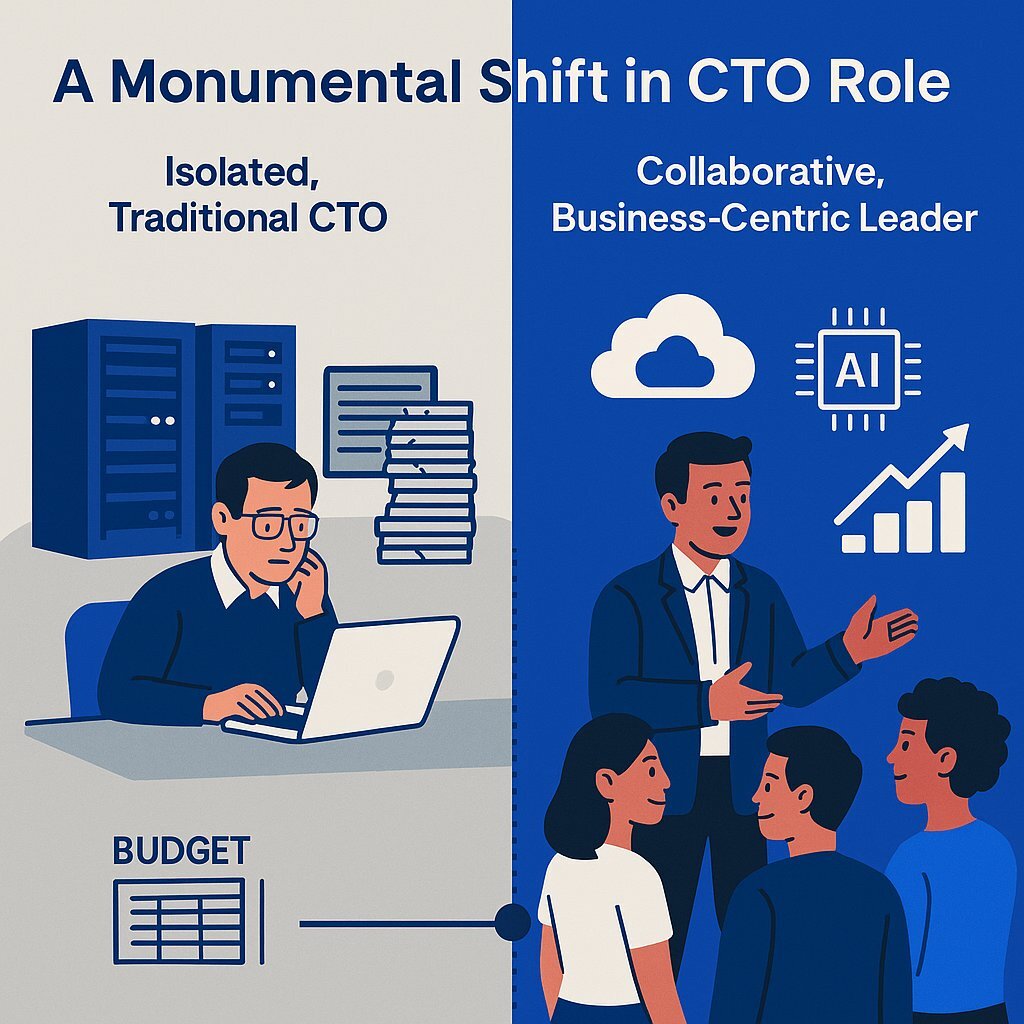
In today's digital-first economy, the CTO is no longer just supporting the business; they are the business. Technology has moved from a supporting function to the primary driver of competitive advantage, customer acquisition, and top-line growth. The modern CTO's mandate has undergone a radical transformation—from managing infrastructure to architecting revenue. This is not a subtle evolution; it is a fundamental shift in corporate power and strategic importance. The CTO's role is evolving faster than ever, demanding a new mindset where technology leadership is synonymous with business leadership.
This is a manifesto for the new breed of business-centric technology leaders. It outlines the journey from budget holder to value creator, detailing the four pillars through which the modern CTO actively drives revenue: spearheading technology-led innovation, weaponizing the customer experience, engineering business velocity, and creating entirely new digital revenue streams. For the CEO, this is a guide to unlocking the most powerful growth engine in your organization. For the CTO, this is your playbook for claiming a seat at the center of strategic value creation.
The Unmistakable Evolution: From Cost Center to Growth Engine
The transformation of the CTO role can be defined by a series of unmistakable shifts in mandate, metrics, and mindset. Historically, the CTO was a builder and a manager, focused on the internal mechanics of the organization. Today, the CTO is a strategist and a business leader, focused on external market impact. This evolution is not merely a change in title but a redefinition of success, moving from operational efficiency to direct P&L accountability.
McKinsey identifies two critical new archetypes for the modern tech leader that capture this shift: the Orchestrator , who shapes how the company generates value and holds P&L accountability for business outcomes, and the Builder , who creates entirely new digital- and AI-first businesses that generate revenue. Both roles place the CTO at the heart of the company's commercial strategy, a stark departure from the traditional view of technology as a siloed service department. This new reality demands that business acumen is no longer a "nice-to-have" but the key differentiator for a successful CTO, who must now be fluent in customer journeys, pricing models, and go-to-market strategy.
The most tangible evidence of this paradigm shift lies in the metrics used to measure the technology function's performance. The conversation has moved from technical outputs to business outcomes. A CTO who primarily reports on system availability is signaling that their function is a cost center. A CTO who reports on the engineering team's direct contribution to Annual Recurring Revenue (ARR) is signaling that their function is a growth engine. This change in the language of measurement is the definitive sign of strategic relevance in the modern enterprise.
The following table crystallizes this transformation, contrasting the traditional budget holder with the modern value creator.
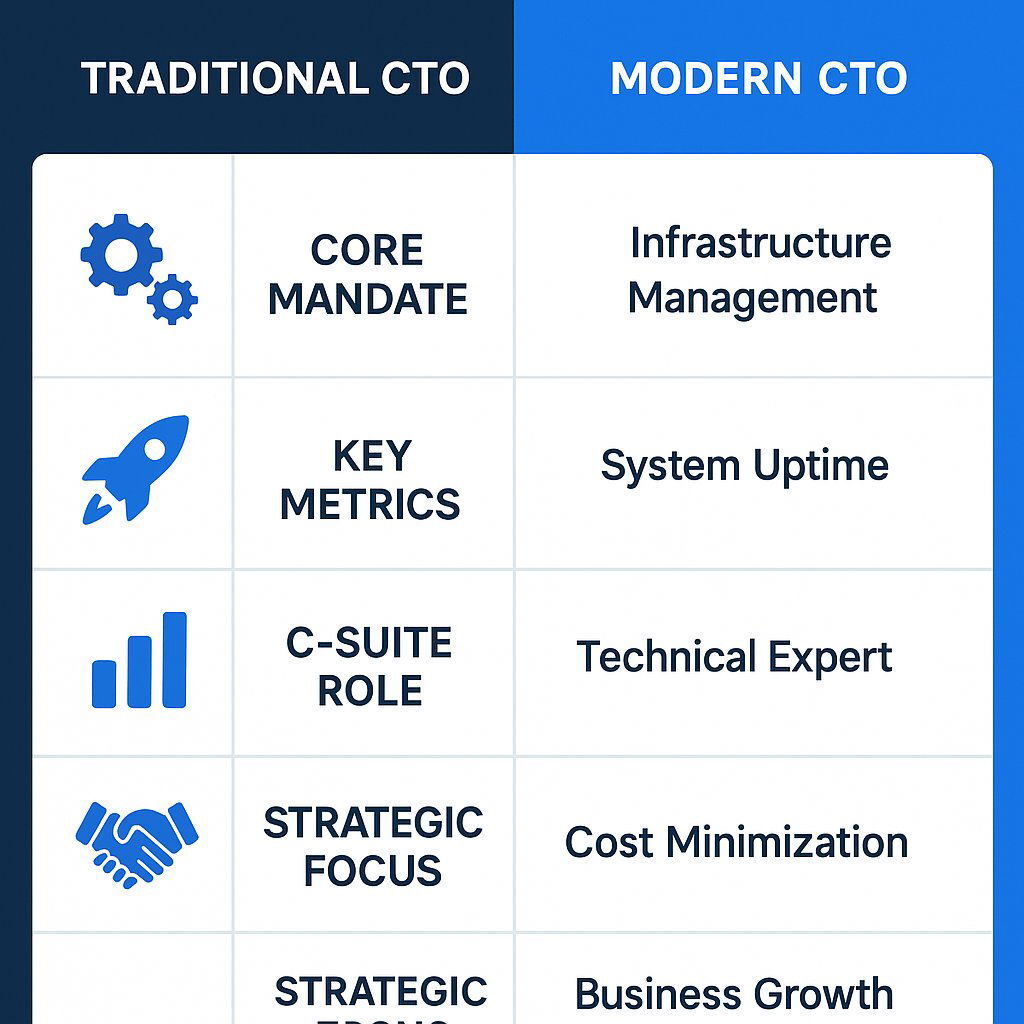
| Attribute | The Traditional CTO (Budget Holder) | The Modern CTO (Value Creator) |
|---|---|---|
| Core Mandate | Manage infrastructure, ensure system uptime, control IT costs. | Drive top-line growth, create new digital products, shape business strategy. |
| Key Metrics | System availability, code delivery speed, budget adherence, ticket resolution time. | Revenue per Engineer (RPE), Contribution to ARR, Time-to-Value, Customer Lifetime Value (CLV), Innovation ROI. |
| C-Suite Role | A technical service provider; an order-taker executing on business requests. | A strategic business partner; a co-creator of company vision with P&L accountability. |
| Strategic Focus | Internal Operations: "Keeping the lights on." | External Impact: "Winning the market." |
The Four Pillars of Revenue Generation for the Modern CTO
The modern CTO's mandate to create value is not an abstract goal; it is executed through four distinct, technology-led strategies. These pillars represent the primary fronts on which technology is deployed to directly impact top-line growth.
Pillar 1: Spearheading the Innovation Offensive
Innovation is the lifeblood of growth, a fact universally acknowledged in the C-suite. An overwhelming 96% of executives believe innovation will be a primary source of achieving growth in the coming years. Yet, a staggering disconnect exists between ambition and reality: only 21% of organizations report that they are definitively meeting their innovation goals. This chasm is the "innovation-execution gap," and the modern CTO is the leader singularly positioned to close it.
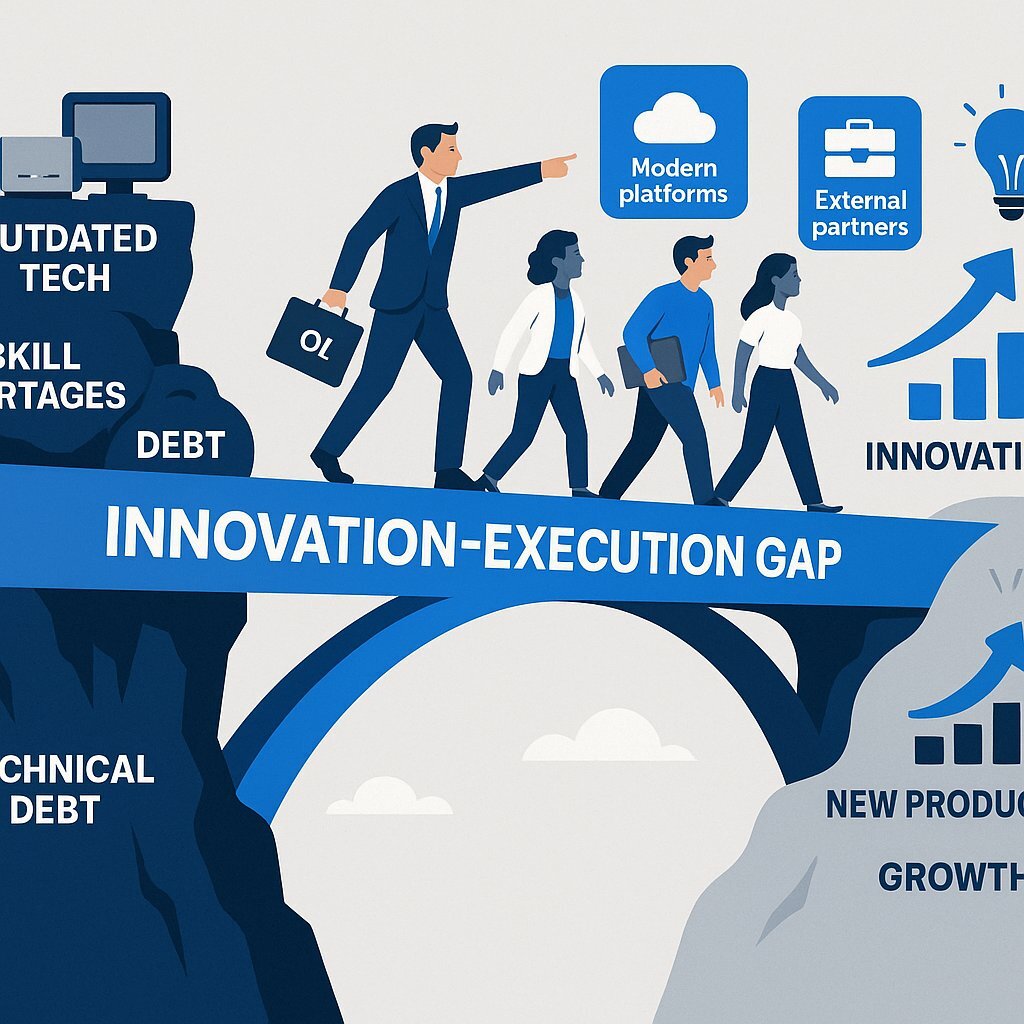
The barriers to innovation are primarily technological and organizational. Research reveals a consistent pattern of constraints: 88% of executives cite a lack of employee skills, 86% point to outdated technology, 78% blame a poor organizational culture, and 70% admit an inability to use data effectively. This is compounded by a structural financial problem: across the industry, an average of 72% of IT budgets are consumed by maintaining existing systems, leaving a mere 28% for new projects and innovation.
This creates a self-perpetuating cycle of technical debt. Outdated systems consume the budget and talent required for modernization, which in turn prevents innovation and widens the gap with more agile competitors. The CTO's most strategic imperative is to break this cycle. This requires championing investments in modern platforms, fostering a data-literate culture, and, critically, addressing the skills gap. With 87% of organizations already facing or expecting to face a skills shortage, waiting to hire is not a viable strategy. This is the innovation-execution gap where a strategic development partner becomes a force multiplier. For many CTOs, augmenting their in-house teams with specialized experts from firms like
Baytech Consulting is the most effective way to de-risk innovation, access critical skills on demand, and accelerate the execution of revenue-generating projects without the overhead of a prolonged hiring cycle. This strategic intervention injects the necessary capabilities to break the cycle of technical debt and unlock the organization's trapped innovation potential. For a deeper dive into transforming technical excellence into real business value, see Smart Factory Transformation: The Executive Blueprint for Industry 4.0 Success.
Pillar 2: Weaponizing the Customer Experience (CX)
In the digital economy, the customer experience is the product. The modern CTO understands that technology is the primary tool for creating the personalized, seamless, and immediate interactions that directly translate into higher revenue and defensible market share. The role has evolved to become a co-owner of the customer journey, responsible for architecting the systems that deliver superior experiences.
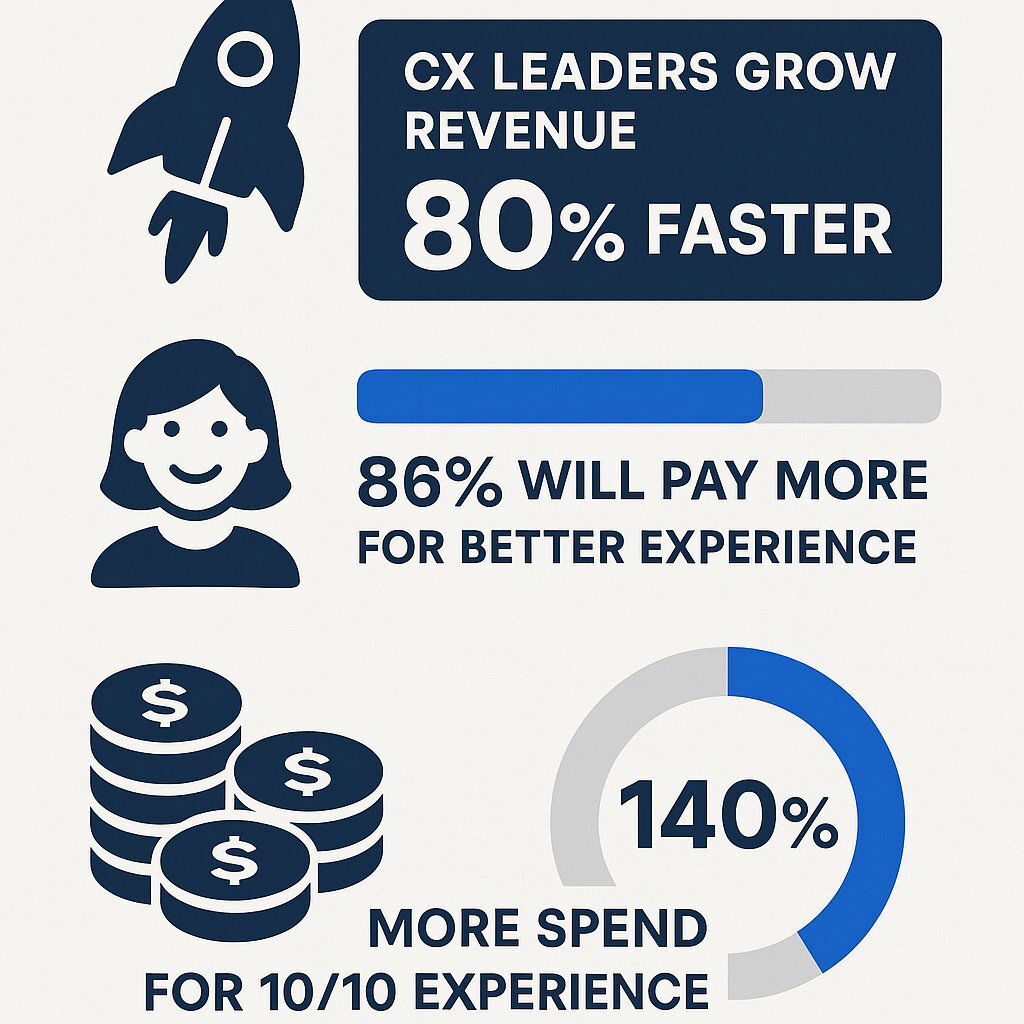
The financial case for investing in CX is undeniable. Brands that deliver a great customer experience can achieve revenue growth that is 4-8% higher than their industry average. More strikingly, companies identified as CX leaders grow revenue 80% faster than their competitors. This is because a superior experience is something customers are willing to pay for—86% of buyers say they will pay more for it, and those who have a top-tier experience spend 140% more.
At the heart of modern CX is personalization. It is no longer a novelty but a baseline expectation. 71% of consumers expect personalized interactions, and 76% become frustrated when this expectation is not met. Companies that master personalization at scale see a dramatic impact on their top line, generating 40% more revenue from these efforts than their peers.
The engine for delivering personalization at scale is Artificial Intelligence. AI algorithms can analyze vast datasets of customer behavior to predict needs and tailor interactions in real-time. The results are transformative. Amazon's AI-powered recommendation engine is estimated to drive 35% of its e-commerce revenue. Netflix's personalization algorithms are credited with saving the company approximately $1 billion annually by reducing subscriber churn. Delivering these hyper-personalized experiences isn't possible with off-the-shelf software. It requires sophisticated, custom-built data pipelines and applications that can unify disparate data sources—from CRM and web analytics to social media interactions. This is where a partner like
Baytech Consulting becomes critical, architecting the bespoke software that turns raw customer data into a revenue-generating asset.
The data below provides a compelling, board-ready summary of the financial imperative to invest in a technology-driven customer experience.
| The Metric | The Business Impact |
|---|---|
| Revenue Growth | Companies leading in CX grow revenue 80% faster than competitors. |
| Profitability | Customer-centric brands report profits that are 60% higher than their peers. |
| Willingness to Pay | 86% of buyers will pay more for a better customer experience. |
| Increased Spend | Customers who rate their experience 10/10 spend 140% more . |
| Personalization Premium | Companies that excel at personalization generate 40% more revenue from those efforts. |
| Customer Loyalty | 60% of consumers become repeat buyers after a personalized experience. |
| Competitive Advantage | 73% of consumers say CX is a key factor in purchasing decisions, overtaking price and product. |
Pillar 3: Engineering Velocity: Accelerating Time-to-Market
In a market where first-mover advantage is paramount, speed is a competitive weapon. The ability to rapidly ideate, build, and deploy new products and features allows a business to capture market opportunities before competitors can react. A majority of businesses—52%—now cite accelerating time-to-market as a key reason for adopting modern software development practices. The modern CTO's role is to re-engineer the entire software delivery lifecycle, transforming it from a slow, project-based endeavor into a high-velocity, continuous flow of value.
The mechanism for achieving this speed is the adoption of DevOps and cloud-native principles. This represents the "industrialization" of software development, moving it from an unpredictable craft to a measurable and optimizable manufacturing process for digital value. Elite-performing DevOps teams can deploy changes to production multiple times per day, with a lead time from code commit to deployment of less than a day. This stands in stark contrast to traditional organizations, where release cycles can take six to nine months. The business impact is profound. Capital One, through its DevOps transformation, reduced deployment times from months to mere days, enabling a pace of innovation previously unthinkable in the financial services industry. OfferUp, a mobile marketplace, used a modernized DevOps platform to reduce its service deployment time from one hour down to just five minutes.
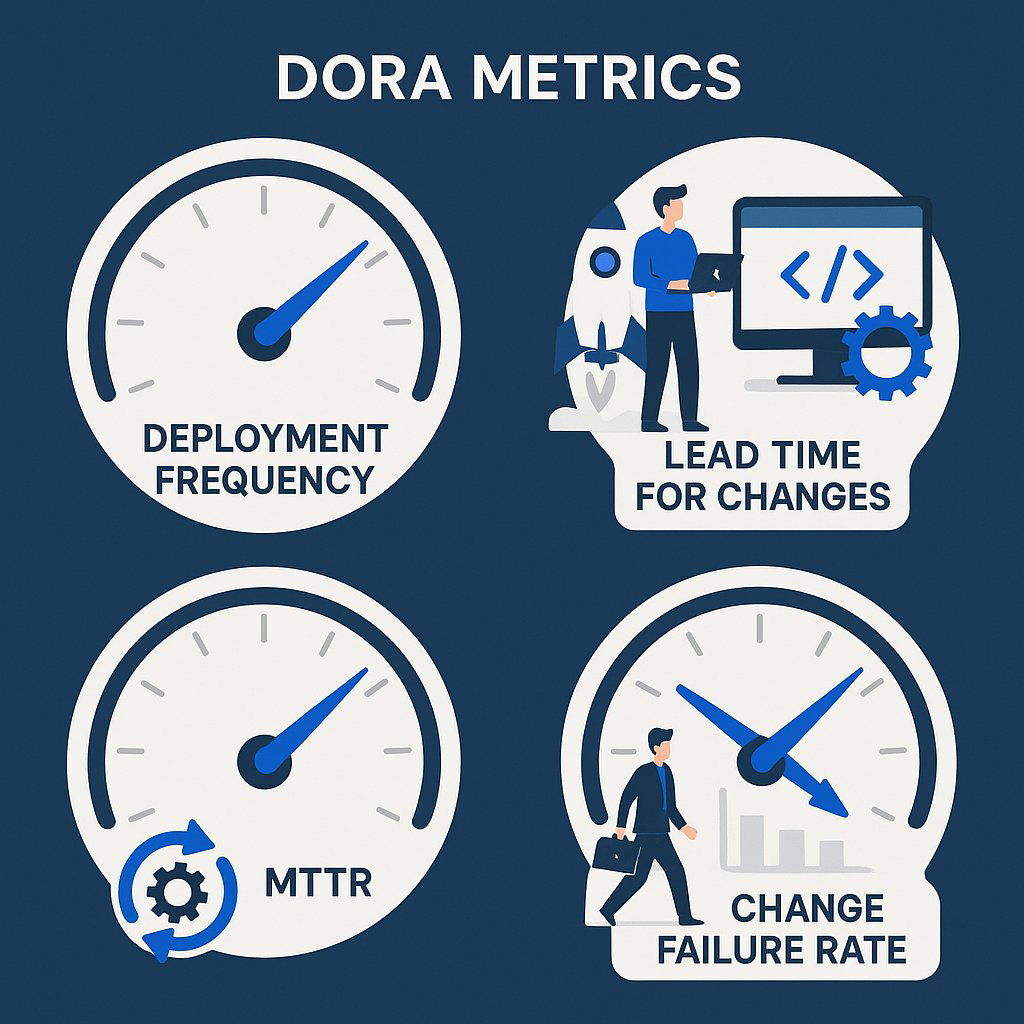
To manage this new paradigm, CTOs rely on a set of key performance indicators known as the DORA metrics. These are not just technical measures; they are direct indicators of business agility and resilience:
- Deployment Frequency: How often an organization successfully releases to production.
- Lead Time for Changes: The amount of time it takes a commit to get into production.
- Mean Time to Recovery (MTTR): How long it takes to restore service after a service incident.
- Change Failure Rate: The percentage of deployments causing a failure in production.
By optimizing these metrics, the CTO provides the business with a predictable and reliable "digital factory" capable of delivering a continuous stream of features and improvements. Achieving this level of engineering velocity requires more than just new tools; it demands a deep expertise in cloud-native architecture, CI/CD automation, and platform engineering. For organizations looking to make this leap without the costly trial-and-error, partnering with a specialist firm like Baytech Consulting provides a proven roadmap and the hands-on expertise to build a high-performance delivery engine.
Pillar 4: Architecting New Revenue Streams
The final and most profound evolution for the CTO is the transition from optimizing existing business models to creating entirely new ones. This is the frontier of value creation, where the technology function moves beyond supporting revenue to originating it. The modern CTO is now expected to be a "Builder," proactively identifying opportunities to turn internal data and platform capabilities into commercial products. This transforms technology from a cost center into a P&L-owning business unit.
Two dominant strategies have emerged in this space:
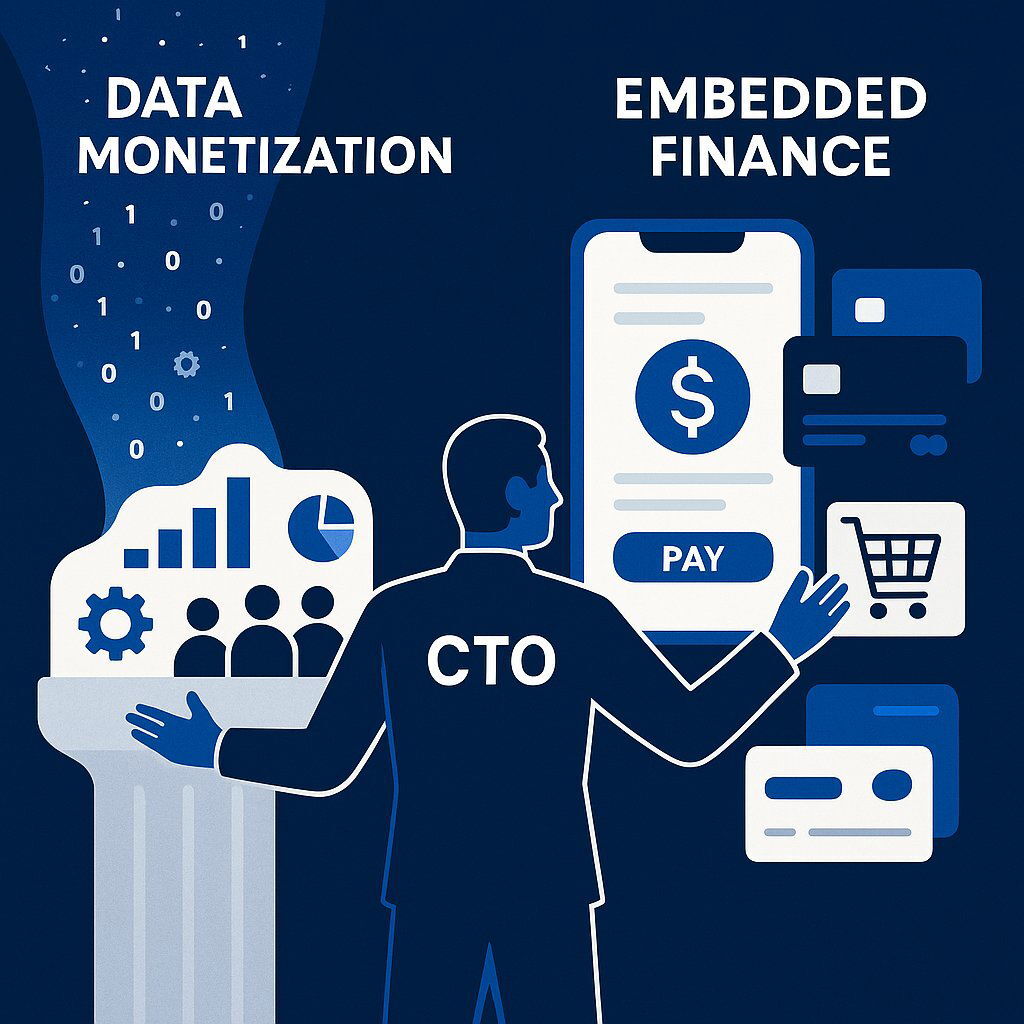
1. Data Monetization: This involves packaging a company's unique, proprietary data into a commercial product or service. This is not about selling raw customer lists; it's about creating high-value intelligence products that solve problems for other businesses. The quintessential example is Walmart's Scintilla platform. Developed by its Walmart Data Ventures unit, Scintilla allows the retailer's suppliers to access deep insights into shopper behavior, helping them optimize their own marketing and product strategies. Within its first year, revenue from the product grew 80% quarter over quarter, demonstrating the immense value locked within a company's data assets. Similarly, Uber monetizes its vast repository of anonymized traffic and movement data, providing it to city planners to help improve urban infrastructure.
2. Embedded Finance and Banking-as-a-Service (BaaS): This represents one of the largest and fastest-growing opportunities in the digital economy. Embedded finance is the integration of financial services—like payments, lending, or insurance—directly into the user experience of a non-financial product. The market is projected to be colossal, exceeding $7 trillion in transaction value in the US alone by 2026 and potentially generating $3.6 trillion in revenue globally by 2030. By embedding these services, companies can dramatically increase customer lifetime value—by as much as 2x to 5x—while creating powerful new revenue streams. E-commerce platform Shopify, for example, offers Shopify Balance, an embedded business bank account for its merchants, while ride-hailing company Grab leveraged its user base to launch Grab Pay, an integrated digital wallet.
Building a data monetization platform or an embedded finance solution is not a simple software project; it is the creation of a new business. It requires enterprise-grade architecture, uncompromising security, and flawless scalability. This is the pinnacle of custom software development, where a strategic partner like Baytech Consulting is essential to architect, build, and launch these transformative—and highly lucrative—new ventures. If you're preparing to justify or map out investment in these initiatives, don't miss our executive guide on how to budget for custom software in 2026.
The CTO's Manifesto: An Action Plan for Value Creation
To transition from a budget holder to a value creator, the modern CTO must operate from a new set of principles. This manifesto serves as an actionable guide for embedding a revenue-first mindset into the technology organization.
- Speak the Language of Business: In the boardroom, abandon technical jargon. Frame every technology investment and initiative in terms of its direct impact on revenue, margin, and market share. Shift your reporting from operational metrics like uptime to business-outcome metrics like Revenue per Engineer (RPE), Contribution to ARR, and Customer Lifetime Value (CLV). For practical examples, check out our recent comparison of Agile vs. traditional development and their business value.
- Forge Cross-Functional Alliances: Silos are the enemy of value creation. Proactively build strategic partnerships across the C-suite. Work with the CFO on ROI analysis for tech investments, collaborate with the CMO to architect the technology for CX personalization, and partner with the CHRO to build the talent and culture necessary for a high-velocity tech organization.
- Treat Your Tech Stack Like a P&L: Your portfolio of technologies is not just an expense; it's a collection of assets that must generate a return. Continuously evaluate the ROI of every platform and tool. Aggressively consolidate to reduce cost and complexity, and double down on investments in platforms that directly enable the four pillars of revenue generation. Explore the real costs and benefits of modern SaaS adoption with our analysis on consumption-based software pricing.
- Build a Value-Creation Engine, Not a Project Backlog: Shift your team's focus from "shipping features" to "shipping outcomes." Embrace Agile and DevOps not as rigid methodologies, but as the fundamental operating system for business velocity. The goal is a continuous, predictable flow of value to the customer, not just the completion of a project plan.
- Invest in Your Builders: The skills gap is the single greatest threat to your innovation agenda. Champion the strategic insourcing of talent for core, differentiating capabilities like product management and data science. Create a culture of continuous learning and upskilling to ensure your team can master the next wave of technology.
- Look Outward for Opportunity: Your company's data, platforms, and customer relationships are latent assets waiting to be commercialized. Proactively identify opportunities for data monetization, embedded services, and other tech-first business models. Develop the business case and champion these new ventures with the CEO and the board.
Conclusion: The Future is Forged by the Business-First CTO

The evolution of the Chief Technology Officer is complete. The role has irrevocably shifted from a technical support function to a central pillar of business strategy and growth. The ability of a CTO to balance forward-looking innovation with operational excellence has become a cornerstone of modern corporate performance. The future of every enterprise, regardless of industry, rests on the shoulders of a CTO who is, first and foremost, a business leader.
This transformation is not an option; it is a necessity for survival and growth in an economy where the digital experience is the primary competitive battleground. The journey from budget holder to value creator requires a new vision, a new set of metrics, and a relentless focus on business outcomes.
The question for every CEO and CTO is no longer 'How much will this technology cost?' but 'How much revenue are we leaving on the table by not acting?' The modern CTO doesn't just manage a budget; they build the future. And in today's economy, building requires the right partners to turn vision into value. For guidance on preserving your organization's crown jewels as you scale or partner, see our executive checklist for IP protection when outsourcing software development.
Further Reading
- McKinsey & Company - "A new dawn for the technology officer" : A deep dive into the strategic frameworks and new archetypes defining the modern technology leader.
- NTT DATA - "Only 21% of Organizations Achieve Their Innovation Goals" : The foundational research report detailing the "innovation-execution gap" and its primary causes.
- Bain & Company - "Embedded Finance: What It Takes to Prosper in the New Value Chain" : A comprehensive analysis of the multi-trillion-dollar embedded finance opportunity for companies looking to create new revenue streams.
About Baytech
At Baytech Consulting, we specialize in guiding businesses through this process, helping you build scalable, efficient, and high-performing software that evolves with your needs. Our MVP first approach helps our clients minimize upfront costs and maximize ROI. Ready to take the next step in your software development journey? Contact us today to learn how we can help you achieve your goals with a phased development approach.
About the Author

Bryan Reynolds is an accomplished technology executive with more than 25 years of experience leading innovation in the software industry. As the CEO and founder of Baytech Consulting, he has built a reputation for delivering custom software solutions that help businesses streamline operations, enhance customer experiences, and drive growth.
Bryan’s expertise spans custom software development, cloud infrastructure, artificial intelligence, and strategic business consulting, making him a trusted advisor and thought leader across a wide range of industries.