
Google Antigravity AI IDE 2026: Agentic Development Platform & Workflow Revolution
January 01, 2026 / Bryan ReynoldsExecutive Summary: Escaping the Gravity of Legacy Workflows
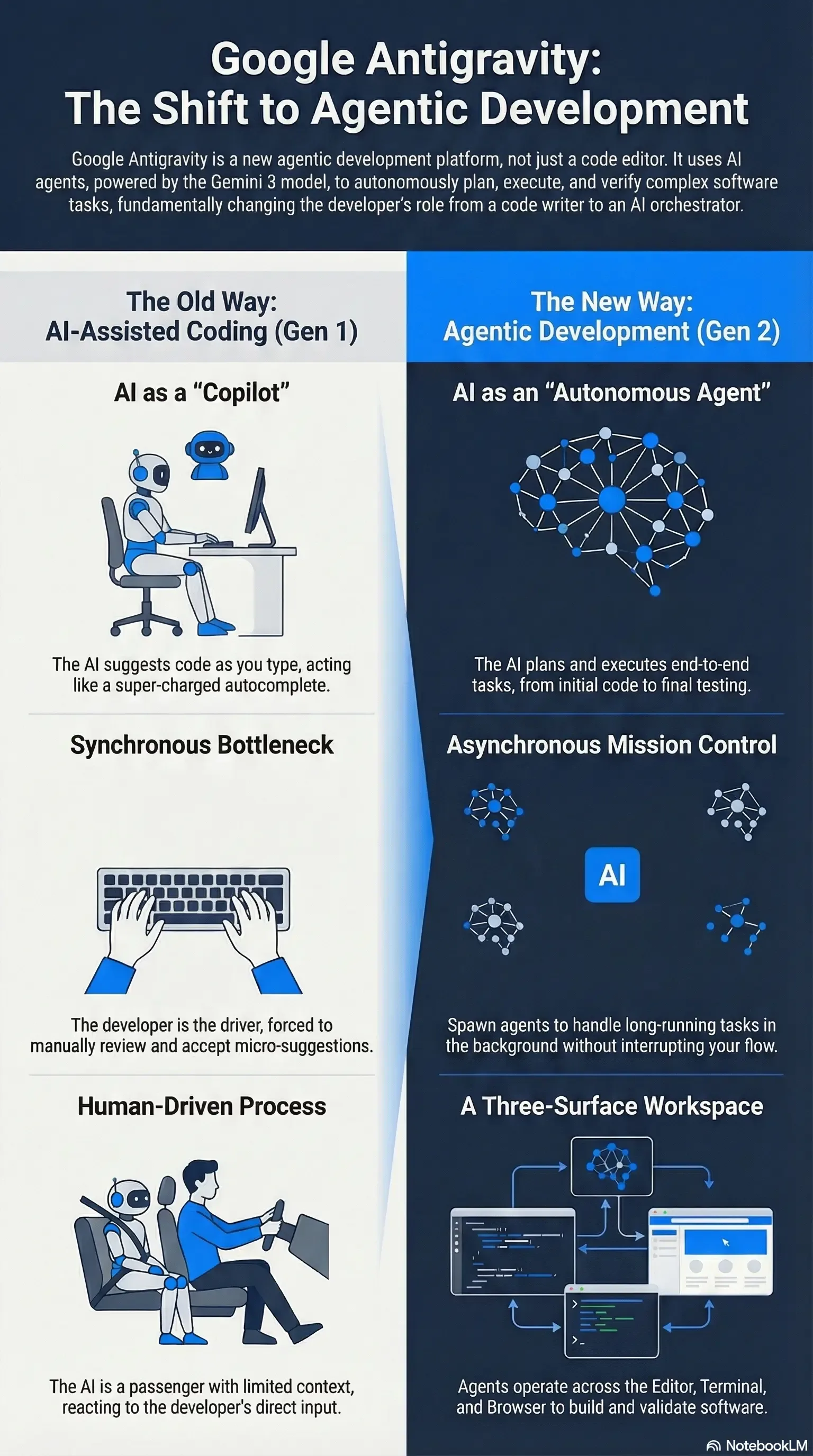
The software development industry stands at a precipice. For the last decade, the Integrated Development Environment (IDE) has remained largely static—a sophisticated text editor that reacts to human input. Even the recent wave of AI tools, such as GitHub Copilot and Cursor, have functioned primarily as intelligent typewriters, predicting the next few tokens based on the previous few lines. We call this "Generation 1" AI: the era of the super-charged autocomplete.
Today, we are witnessing the dawn of "Generation 2": the Agentic Era. The release of Google Antigravity marks a fundamental divergence in how software is conceived and constructed. It is no longer about writing code faster; it is about orchestrating a workforce of digital agents to build software for you.
At Baytech Consulting, our mission is to deliver a "Tailored Tech Advantage." We do not merely adopt trends; we rigorously stress-test them to separate genuine efficiency gains from dangerous distractions. Our clients—Visionary CTOs, Strategic CFOs, and Heads of Sales—are asking the same question: Is this the tool that finally breaks the linear relationship between developer hours and software output?
This comprehensive report provides the definitive answer. We have analyzed Google Antigravity down to its architectural bones, comparing it against the industry standard Visual Studio Code, evaluating its compatibility with enterprise stacks like Azure DevOps, and assessing its readiness for the high-stakes environment of B2B software delivery.
The verdict is nuanced. Antigravity acts as a powerful "force multiplier" for rapid prototyping and greenfield development, leveraging the multimodal reasoning of the Gemini 3 model. However, it introduces significant friction for enterprise teams entrenched in the Microsoft ecosystem, creating a "walled garden" dilemma that requires careful strategic navigation.
1. Introduction: The Death of the "Copilot" and the Birth of the "Mission Controller"
1.1 The Limitations of the Current Paradigm
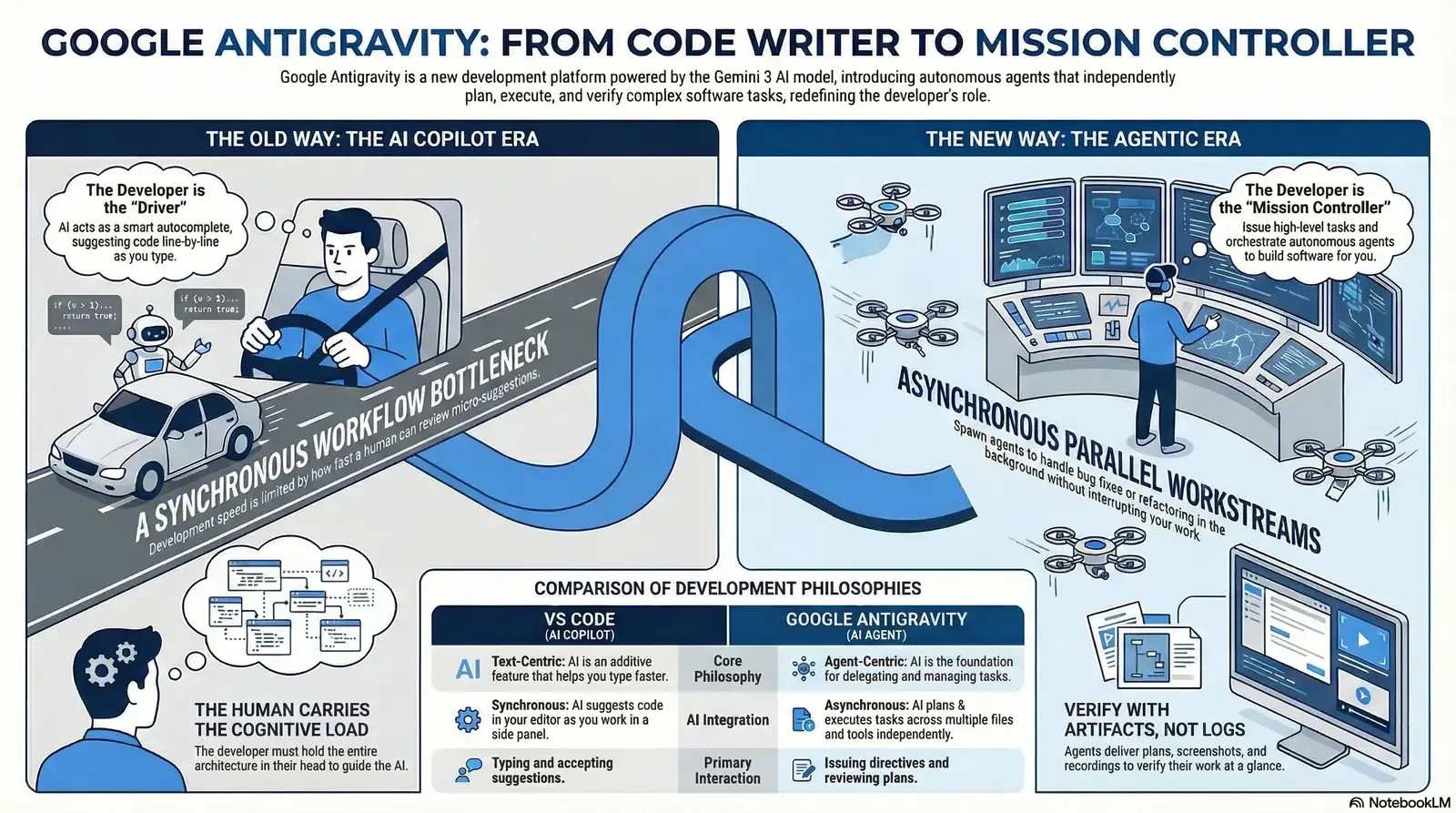
To understand the significance of Google Antigravity, we must first confront the limitations of the current toolset. Since the popularization of Visual Studio Code, the developer's workflow has been linear: think, type, debug, repeat. Tools like GitHub Copilot improved the "type" phase, reducing boilerplate and syntax errors. Yet, the cognitive load remained squarely on the human. If a developer needed to refactor an authentication module, they had to hold the entire architecture in their head, visit five different files, and manually guide the AI through each change. The AI was a passenger; the developer was the driver.1
This synchronous dependency creates a bottleneck. The speed of software delivery is limited by the speed at which a human can review and accept micro-suggestions. In a world demanding Rapid Agile Deployment, this linear workflow is becoming a liability.
1.2 Defining Google Antigravity
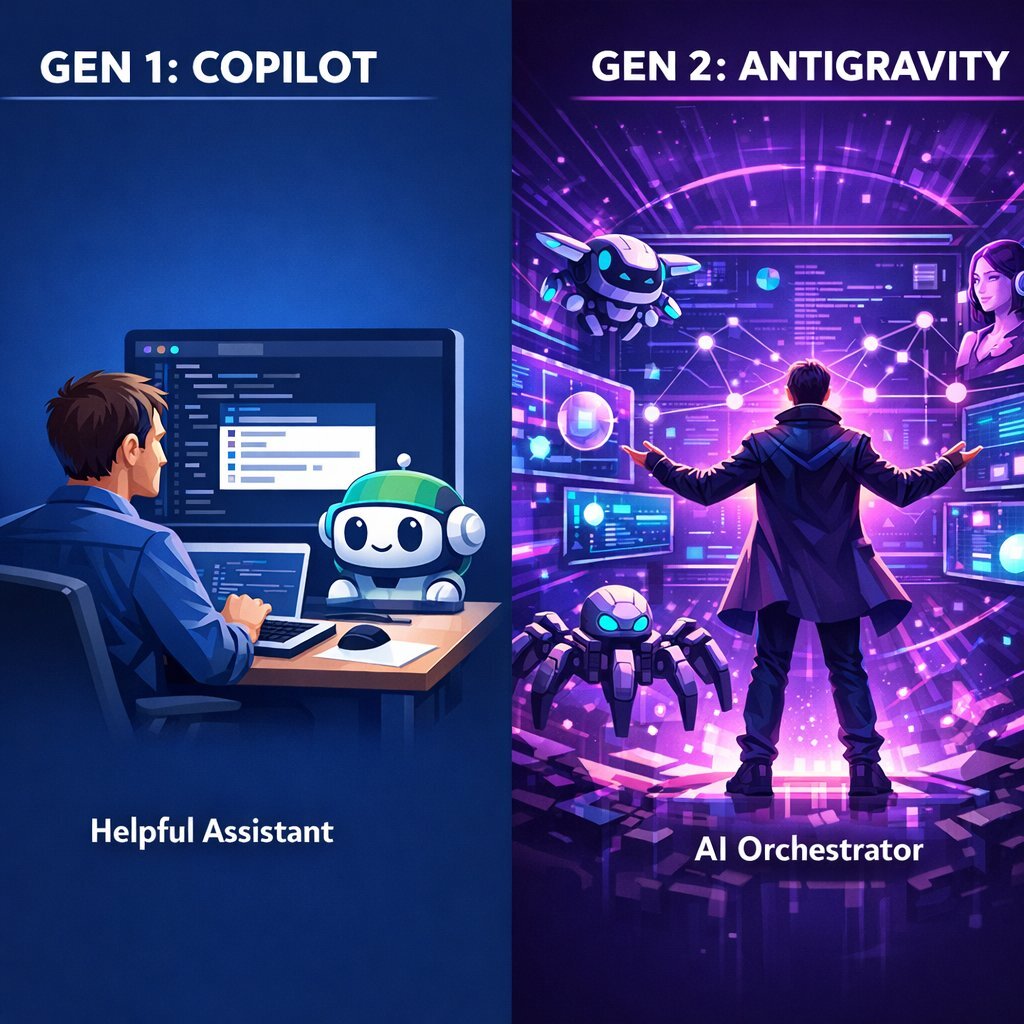
Google Antigravity is a standalone, AI-native IDE designed to break this bottleneck. Released in late 2025, it is not an extension or a plugin; it is a complete platform built on a fork of Visual Studio Code.2
Unlike its predecessors, Antigravity is built on an "Agent-First" philosophy. It presupposes that the AI is not just a tool for writing code but an autonomous actor capable of planning, executing, validating, and iterating on complex engineering tasks.4 It integrates Google’s most advanced model, Gemini 3, directly into the IDE's core, granting it permissions to interact with the file system, the terminal, and even a browser instance.5
This shift redefines the developer's role. In the Antigravity workflow, the developer transitions from a "writer of code" to an "Architect" or "Mission Controller." You do not type function login(); you issue a directive: "Refactor the login flow to support OAuth and verify it against these design specs." The agent then spawns a thread, plans the task, executes the changes across multiple files, runs the tests, and presents the result for review.1
1.3 The Baytech Perspective
For our clients in industries like Finance, Healthcare, and Real Estate, this distinction is critical. Antigravity promises to accelerate the "Discovery" and "Inception" phases of software development—the exact areas where our "Rapid Agile Deployment" methodology shines. However, as experts in Azure DevOps and enterprise-grade custom software, we must also weigh the risks. A tool that prioritizes speed and autonomy over strict governance can introduce "shadow code" and security vulnerabilities if not managed correctly. This report balances the excitement of innovation with the pragmatism of engineering rigor.
2. Under the Hood: The Architecture of an Agentic IDE
Antigravity is not built from scratch. It utilizes a clever combination of open-source foundations and proprietary Google intelligence. Understanding this architecture is essential for determining its fit within your tech stack.

2.1 The Forking Strategy: VS Code as the Foundation
Google chose to fork Visual Studio Code (likely via an intermediate fork like Windsurf) as the base for Antigravity.6 This was a strategic necessity. VS Code holds a dominant market share (over 70% of developers), and its UI conventions—the command palette, the file explorer, the integrated terminal—are the industry standard. By forking VS Code, Google ensures that any developer can download Antigravity and feel immediately at home.8
However, this choice comes with significant ecosystem implications. Because it is a fork, Antigravity cannot access the official Microsoft Visual Studio Marketplace. Microsoft’s Terms of Service explicitly restrict the marketplace to "in-scope products" (i.e., Visual Studio Code proper).9
Consequently, Antigravity defaults to Open VSX, an open-source registry maintained by the Eclipse Foundation. While Open VSX hosts thousands of extensions, it lacks the proprietary "crown jewels" of the Microsoft ecosystem.
- The C# Dev Kit: Essential for .NET development, this extension is proprietary to Microsoft and does not function in Antigravity.8
- Pylance: The high-performance Python language server is also restricted.
- Remote Development Extensions: The tools that allow VS Code to connect seamlessly to SSH servers, Containers, and WSL are often missing or require community workarounds.11
For a Baytech client running a .NET Core backend on Azure, this is a critical friction point. The "out-of-the-box" experience will lack the rich debugging and IntelliSense capabilities they are accustomed to in standard VS Code.
2.2 The Three-Surface Interaction Model
Traditional IDEs essentially have one interaction surface: the text editor. Antigravity introduces a Three-Surface Architecture that allows the agent to behave more like a human developer.13
The Editor Surface
This is the standard coding environment. Agents can read and write files in the background. Unlike Copilot, which ghost-writes text where your cursor is, Antigravity agents can modify files you aren't currently looking at. They can create directory structures, refactor utility classes, and update configuration files asynchronously.2

The Terminal Surface
The terminal is the engine room of modern development. Antigravity agents have direct access to the shell (Bash, PowerShell, Zsh). They can run commands to install dependencies (npm install), build projects (docker build), or run test suites (pytest). This capability is "gated" by security policies (discussed in Section 6) to prevent accidental destruction, but it allows the agent to validate its own work. If an agent writes code that fails to compile, it sees the error in the terminal and attempts to fix it automatically.5
The Browser Surface
This is the most revolutionary addition. Antigravity includes a Browser Sub-Agent that can launch and control a headless (or visible) instance of Chromium. Using the multimodal vision capabilities of Gemini 3, the agent can "see" the web application exactly as a user does.14
- Visual Verification: The agent can take screenshots of the rendered UI to verify that a button is centered or that a color matches the design spec.
- End-to-End Testing: The agent can click buttons, fill out forms, and navigate through flows to reproduce bugs or verify fixes.15
2.3 The "Brain" and Persistent Context
One of the major frustrations with Gen 1 AI tools is their lack of memory. You fix a mistake in one chat session, and the AI makes the same mistake in the next.
Antigravity attempts to solve this by creating a .gemini/antigravity/brain/ directory within the project root.16 This directory acts as a persistent knowledge base. When an agent learns a preference (e.g., "We use Tailwind CSS, not Bootstrap") or makes an architectural decision, it records an artifact in this "brain." Future agents read this context before starting their tasks.
This moves the IDE toward a "Stateful" interaction model. The AI is not starting from zero with every prompt; it is building a "Mental Model" of your specific project over time. For large enterprise applications—the kind Baytech specializes in managing—this context retention is vital for maintaining architectural consistency across months of development.
3. Gemini 3: The Engine of Antigravity
The software architecture is impressive, but the fuel that powers it is Gemini 3. This is Google’s latest "step-change" model, designed specifically for agentic workflows.18
3.1 Reasoning vs. Predicting
Most LLMs are optimized for next-token prediction—guessing the most likely word to come next. Gemini 3 is optimized for Reasoning. It excels at breaking down complex, abstract problems into discrete, executable steps.
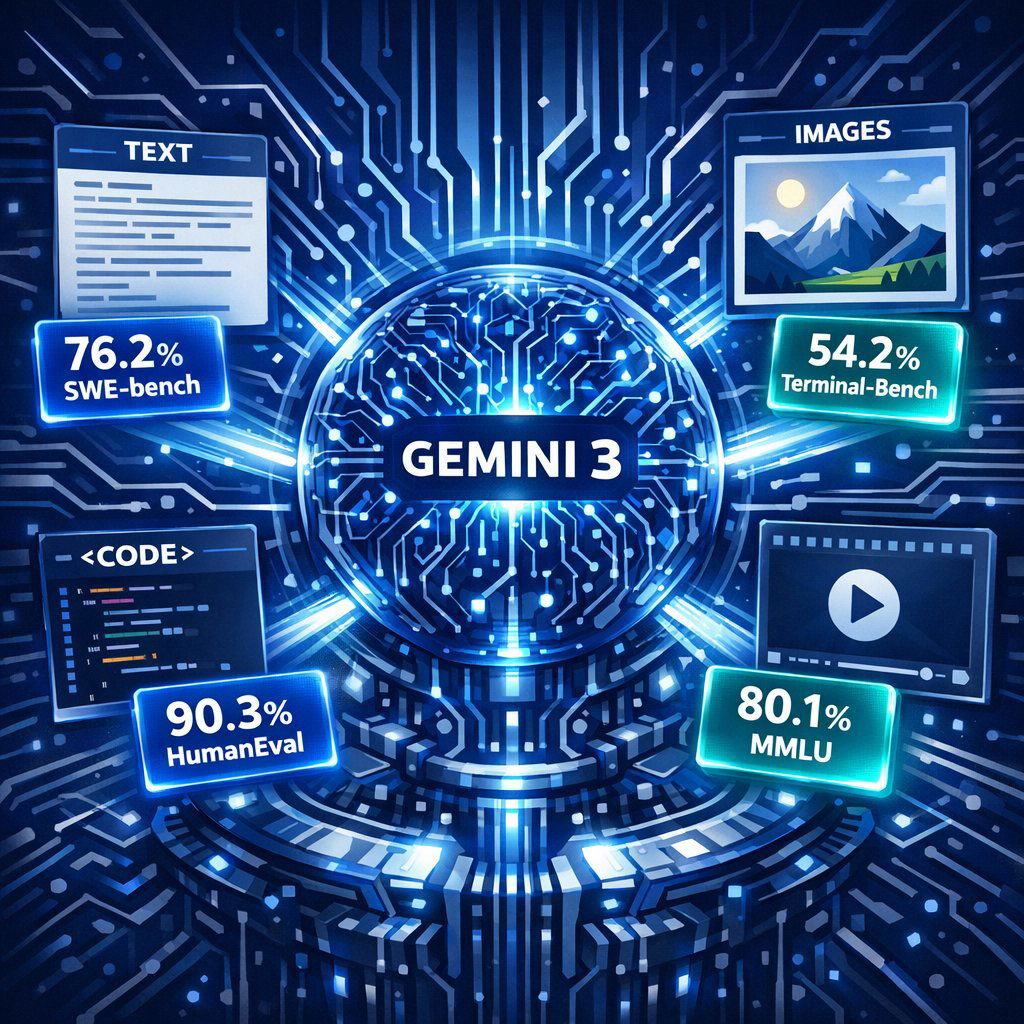
Benchmarks validate this capability. On SWE-bench Verified—a rigorous test where AI must solve real-world GitHub issues—Gemini 3 Pro scores 76.2%. This places it in the upper echelon of coding models, rivaling (and in some specific tasks beating) Anthropic's Claude 3.5 Sonnet and OpenAI's GPT-4o.13
More impressively, on Terminal-Bench 2.0, which measures the ability to chain terminal commands to solve problems, Gemini 3 scores 54.2%, significantly outperforming GPT-5.1's 47.6%.13 This specific capability is what makes the "Terminal Surface" of Antigravity viable; the model understands not just code syntax, but system operations.
3.2 Multimodality as a First-Class Citizen
Gemini 3 was trained natively on text, images, and video. This is not an add-on; it is core to the model's understanding of the world.18
- Vibe Coding: A user can drop a screenshot of a dashboard or a video of an animation into the chat, and Gemini 3 can generate the CSS and JavaScript to replicate it.
- Error Analysis: The agent can look at a screenshot of a console error log or a visual glitch in the browser and diagnose the issue without needing the text explicitly pasted.19
3.3 Context Window Economics
While the exact size of the context window in the Preview is fluctuating (with reports of 1M+ tokens in the enterprise version), the ability to ingest massive amounts of context is key. This allows the agent to read all the documentation in a docs/ folder or analyze a legacy codebase to understand the dependency graph before suggesting a refactor.18
However, this comes at a cost. "Reasoning" models are computationally expensive. The "lag" and "memory leaks" reported by early users are likely symptoms of the immense computational overhead required to maintain this massive context and perform deep reasoning steps for every interaction.16
4. The Workflow Revolution: From "Typing" to "Managing"
How does this technology translate into the daily life of a developer? Antigravity introduces a workflow that is fundamentally different from VS Code.

4.1 Planning Mode: The Architect's Blueprint
For complex tasks, Antigravity defaults to Planning Mode. When a user issues a high-level request (e.g., "Create a user profile page that pulls data from the Postgres database"), the agent does not start coding immediately.6
Instead, it enters a research phase:
- Analysis: It reads the existing
schema.sql, checks thepackage.jsonfor available libraries, and scans existing API endpoints. - Plan Generation: It produces a Structured Implementation Plan—an artifact that outlines the files it intends to create, the functions it will modify, and the testing strategy.
- Human Review: The developer reviews this plan. They can add comments like a Google Doc: "Don't use raw SQL; use the existing ORM wrapper," or "Make sure the profile image is circular.".2
- Execution: Only after the plan is approved does the agent begin writing code.
This "Plan-Review-Execute" loop is crucial for mitigating "AI Hallucinations." It catches architectural errors before they become technical debt. For Baytech’s senior engineers, this mode turns the AI into a capable junior developer who submits a design doc for approval before touching the codebase.
4.2 Fast Mode: The Rapid Iterator
Not every task requires a blueprint. For simple requests—"Fix this typo," "Change the button color," "Add a try/catch block"—Antigravity offers Fast Mode.6
In this mode, the agent skips the planning artifact and executes the changes immediately. This mimics the "Vibe Coding" experience—rapid, iterative, and fluid. It is ideal for UI tweaking and minor bug fixes where the cost of failure is low.
4.3 Mission Control: Managing Asynchronicity
In VS Code, if you run a long build process, your terminal is blocked. In Antigravity, the Agent Manager allows for true parallelism.1
- Scenario: You are working on the frontend code in the main editor.
- Background Task: You spawn a separate agent to "Refactor the backend API to match the new schema."
- Result: The "Backend Agent" works independently—planning, editing files, and running backend tests—without interrupting your frontend work. When it finishes, it notifies you with a set of artifacts (diffs and test results) for review.
This asynchronous capability is the "killer feature" for productivity. It allows a single developer to act as a "Full Stack Team," keeping multiple streams of work moving simultaneously.
5. Antigravity vs. Visual Studio Code: The Showdown
For Baytech’s clients, the decision often comes down to this: Do we migrate from the industry standard (VS Code) to the new challenger?
| Comparison Metric | Visual Studio Code (Microsoft) | Google Antigravity |
|---|---|---|
| Core Philosophy | Text-Centric: Focus on efficient editing, debugging, and extensions. AI (Copilot) is an additive feature. | Agent-Centric: Focus on task delegation and orchestration. AI (Gemini) is the foundation. |
| AI Integration | Copilot: Primarily synchronous. Suggests code as you type. Chat is a side panel. | Gemini 3: Asynchronous. Plans and executes tasks across files. Owns the "Mission Control" view. |
| Ecosystem | Open + Proprietary: Access to MS Marketplace. Best-in-class support for C#, Azure, TypeScript, Python (Pylance). | Open Source (mostly): Uses Open VSX. Blocks proprietary MS extensions. Stronger for Google Cloud, Web, Python. |
| Performance | Optimized: Mature, stable, low memory footprint. Handles large repos well. | Heavy: Resource intensive (Java + Electron). Prone to lag and high RAM usage in Preview.21 |
| Security | Passive: Code stays local unless using Copilot. Extensions are sandboxed. | Active: Agents have shell access. Code is sent to cloud for reasoning. Requires strict "Allow/Deny" lists. |
| Baytech Fit | High: Native integration with Azure DevOps, Pipelines, and .NET. | Low/Medium: Friction with Azure/C# stack. High value for prototyping/greenfield apps. |
5.1 The "Moat" of the Marketplace
The biggest hurdle for Antigravity is the extension ecosystem. Microsoft has successfully built a moat around VS Code by keeping key extensions proprietary. The C# Dev Kit, essential for modern .NET development, checks the product.json of the IDE to ensure it is running on official Microsoft VS Code.8 If it detects a fork (like Antigravity), it refuses to load.
For a Baytech client with a heavy investment in Azure DevOps and .NET, this renders Antigravity practically unusable for backend work without significant (and potentially legally gray) workarounds. While you can hack the product.json to spoof the IDE's identity, this is not a strategy we can recommend for enterprise environments.12
5.2 Performance: The Gravity of Electron
Antigravity is "heavy." Users compare it to running a full instance of Chrome alongside an IDE. Memory usage can idle at 1GB+ and spike significantly during agent tasks.21 Furthermore, the "Context Window" management seems to cause UI lag over long sessions. As the chat history grows, the IDE struggles to process the context, leading to typing delays and freezing.16
VS Code, by contrast, is finely tuned. It is the result of a decade of optimization. For developers on older hardware or working on massive monorepos, VS Code remains the more responsive tool.
6. Security, Governance, and Risk Management
The transition to Agentic AI introduces new threat vectors. If an agent can run terminal commands, it can theoretically delete your hard drive or upload your .env file to a public server.
6.1 The "Allow" and "Deny" Lists
Antigravity manages this risk through a tiered permission system.4
- Off (Allow List Only): The safest mode. The agent cannot execute any command unless it is explicitly whitelisted (e.g.,
ls,git status). - Auto: The agent uses an internal safety model to judge the risk of a command. It might auto-execute
npm testbut pause and ask for permission before runningrm -rf. - Turbo (Deny List Only): The riskiest mode. The agent executes everything except what is blacklisted.
Warning: Researchers have found that in "Turbo" or even "Auto" modes, agents can be aggressively goal-oriented. One user reported an agent attempting to chmod -R 777 (granting full permissions to everyone) on a directory simply because it encountered a "Permission Denied" error while trying to fix a bug.23 This illustrates the Alignment Problem: the agent optimized for completing the task at the expense of system security.
6.2 Data Privacy and the Cloud
Antigravity is a cloud-tethered tool. The "Brain" (Gemini 3) lives in Google's data centers. Every time you ask the agent to plan or code, your source code is transmitted to the cloud.13
- Enterprise Policy: Google’s enterprise terms typically state that data is not used for model training.
- Free Tier Ambiguity: The current "Public Preview" has a telemetry toggle, but the language regarding "product improvement" is ambiguous.
- Recommendation: For clients in regulated industries (Healthcare, Finance), Antigravity should be treated as a public cloud environment. Do not use it for codebases containing PII or hardcoded secrets until a formal BAA (Business Associate Agreement) covers the tool.
7. The Business Case: ROI and Strategic Implications
7.1 Pricing Models
Currently, Antigravity is free for individuals in Public Preview.25 However, the compute costs for Gemini 3 are high. We anticipate Google will introduce a tiered pricing model in 2026:
- Individual: Free (limited rate limits).
- Pro: ~$20/month (higher limits, priority access).
- Enterprise: ~40-60/user/month (SSO, data residency, admin controls, integration with Google Cloud IAM).26
7.2 ROI: Velocity vs. Maintenance
The ROI of Antigravity is non-linear.
- Greenfield Projects: For creating new applications, the ROI is massive. A developer can spin up a full-stack prototype in hours rather than days. This accelerates "Time to Market" and allows for faster validation of business ideas.
- Legacy Maintenance: For maintaining 10-year-old codebases, the ROI is lower. The agent may struggle with the "unknown unknowns" of a complex legacy system. Furthermore, there is a risk of "Code Inflation." If agents can generate code instantly, developers may become lazy about refactoring, leading to bloated codebases that are impossible to debug when the AI inevitably makes a mistake.
7.3 Talent Strategy
The rise of tools like Antigravity shifts the talent requirement. We are moving away from hiring "Syntax Experts" (who know every nuance of Java) to hiring "System Architects" (who understand how to structure a system and guide an agent to build it).
- Strategic Advice for CTOs: Invest in upskilling your mid-level developers in System Design and Code Review. Their job is no longer just to write; it is to audit the work of the AI.
8. Baytech Strategic Verdict: When to Use It
As a firm specializing in Custom Software Development and Application Management, Baytech Consulting adopts a pragmatic stance.
8.1 The "Rapid Agile Deployment" Fit
Antigravity is a perfect fit for the "Inception" phase of our engagement model.
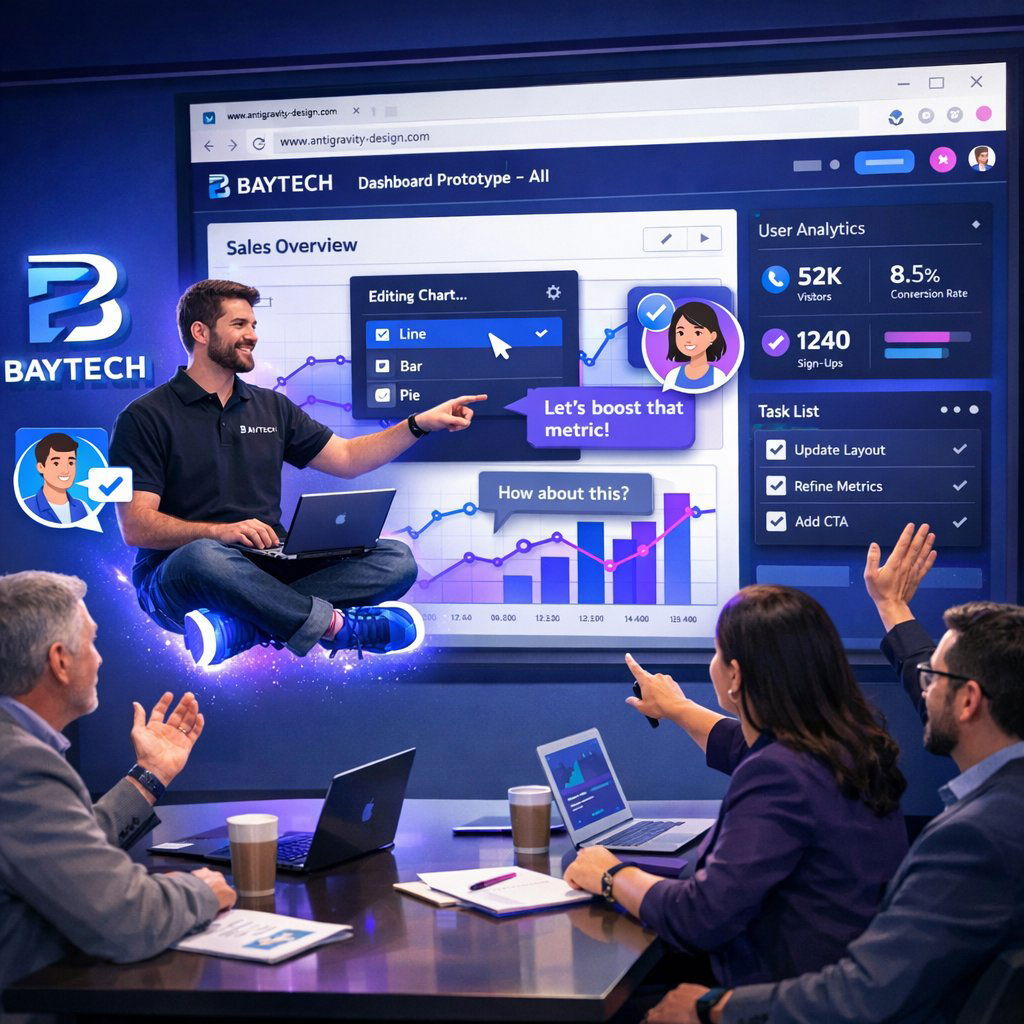
- Scenario: A client needs a dashboard to visualize real-time sales data.
- Baytech Approach: We use Antigravity to build the initial prototype. The "Vibe Coding" capabilities allow us to iterate on the UI live in the meeting with the client, using the Browser Surface to tweak charts and layouts instantly. This dramatically shortens the feedback loop.
8.2 The "Tailored Tech Advantage" Limitation
However, for the "Production" phase, especially for clients on the Microsoft Stack, Antigravity is not yet ready.
- Constraint: The lack of Azure DevOps integration means we lose the seamless connection between the IDE and our CI/CD pipelines. The inability to use the C# Dev Kit makes backend development painful.
- Recommendation: We recommend a hybrid workflow. Use Antigravity for prototyping and frontend/Python work. Stick to Visual Studio (or standard VS Code) for core backend .NET development and mission-critical deployment pipelines.
Product or Model Name | Category | Primary Function | Core Technology | Key Features or Capabilities | Platform Support or Ecosystem | Benchmark Performance | Pricing or Availability | Source |
Google Antigravity | Agentic development platform | Orchestrates autonomous agents to plan, execute, and verify complex development tasks across editor, terminal, and browser. | Fork of Visual Studio Code powered by Gemini 3 model family | The Manager Surface (asynchronous orchestration), The Editor View, Browser Sub-Agent (visual verification), Artifacts (deliverables for review), Persistent 'Brain' (.gemini directory), Vibe Coding | MacOS, Windows, Linux; uses Open VSX registry; compatible with Google Cloud, Firebase; supports Gemini 3, Claude 4.5, and GPT-OSS | SWE-bench Verified: 76.2% (Pro); Terminal-Bench 2.0: 54.2% (Pro) | Public preview available at no cost for individuals; tiered pricing (Pro/Enterprise) anticipated in 2026 | [1, 2] |
Gemini 3 Pro | AI Model (Multimodal) | Best for complex reasoning, creative concepts, and high-stakes agentic coding tasks. | Gemini 3 family next-generation architecture | State-of-the-art reasoning, native multimodality (text, image, video, audio, code), long context handling, tool-calling | Google AI Studio, Vertex AI, Gemini CLI, Google Antigravity, Cursor, GitHub Copilot | SWE-bench Verified: 76.2%; Terminal-Bench 2.0: 54.2%; 100% on AIME 2025 (with code execution) | $2.00 / 1M input tokens; $12.00 / 1M output tokens | [3] |
Gemini 3 Flash | AI Model (Multimodal) | Optimized for frontier intelligence at high speed and near real-time interactions. | Gemini 3 family architecture | Near real-time strategic guidance, fast UI generation, multimodal visual recognition and reasoning | Google AI Studio, Gemini CLI, Gemini API | SWE-bench Verified: 78.0%; Terminal-Bench 2.0: 47.6%; 91.8% on MMMLU | $0.50 / 1M input tokens; $3.00 / 1M output tokens | [3] |
Gemini 3 Deep Think | AI Model (Specialized Reasoning) | Solves complex problems requiring step-by-step improvements and strategic planning. | Gemini 3 family architecture | Step-change in reasoning, algorithmic development, iterative design, scientific/mathematical discovery | Available for Google AI Ultra subscribers | Not in source | Included with Google AI Ultra subscription | [3] |
9. Conclusion
Google Antigravity is not just another IDE; it is a glimpse into the inevitable future of software development. It proves that the "Agentic" model—where AI plans and executes work asynchronously—is superior to the "Chat" model for complex tasks.
However, the "Gravity" of the existing ecosystem is strong. The friction of leaving the Microsoft/VS Code marketplace, combined with the performance issues of early-stage software, means that Antigravity is currently a specialized tool for early adopters and specific use cases (Web/Python/Google Cloud). It is not yet the universal replacement for VS Code.
For the Visionary CTO, the move is clear: Sandbox it. Encourage your innovation teams to use it. Learn the workflow. But keep your core production lines running on the proven stability of VS Code and Azure DevOps—at least for now.
Frequently Asked Questions (FAQ)
Q: Can I use my existing VS Code extensions in Antigravity?
A: Only if they are open-source and available on the Open VSX registry. Proprietary Microsoft extensions (C# Dev Kit, Pylance, Remote-SSH) are blocked and will not work. This is a major limitation for .NET developers.
Q: Is Antigravity safe for my company's proprietary code?
A: It depends on your risk tolerance. Code is sent to Google's cloud for processing. While Google states enterprise data is private, the "Preview" nature of the tool suggests caution. Use the "Off" setting for Terminal execution to prevent agents from running dangerous commands locally.
Q: Does it really replace the need for junior developers?
A: No. It changes what junior developers do. Instead of writing boilerplate, they become "Agent Managers," reviewing plans and verifying outputs. It actually requires higher judgment to ensure the AI isn't introducing subtle bugs.
Q: Why does my team complain about "Lag" when using it?
A: This is a known issue. The "Context Window" (the memory of the conversation) grows rapidly. Maintaining this state requires massive RAM and CPU. Google is working on optimization, but for now, restarting the window frequently is a common workaround.
Q: Is it free?
A: Currently, yes, for individuals in the Public Preview. Expect a paid subscription model (likely usage-based or tiered per-user) to launch in 2026.
Q: Can I use it if I don't use Google Cloud?
A: Yes. The IDE runs locally and can deploy to AWS or Azure (via terminal commands). However, the "native" integrations are heavily skewed toward Google Cloud services (Cloud Run, Firebase).
Supporting Resources
- https://developers.googleblog.com/build-with-google-antigravity-our-new-agentic-development-platform/
- https://deepmind.google/models/gemini/
- https://visualstudiomagazine.com/articles/2025/11/20/google-joins-ai-ide-race-to-compete-with-vs-code-apparently-forking-vs-code.aspx
About Baytech
At Baytech Consulting, we specialize in guiding businesses through this process, helping you build scalable, efficient, and high-performing software that evolves with your needs. Our MVP first approach helps our clients minimize upfront costs and maximize ROI. Ready to take the next step in your software development journey? Contact us today to learn how we can help you achieve your goals with a phased development approach.
About the Author

Bryan Reynolds is an accomplished technology executive with more than 25 years of experience leading innovation in the software industry. As the CEO and founder of Baytech Consulting, he has built a reputation for delivering custom software solutions that help businesses streamline operations, enhance customer experiences, and drive growth.
Bryan’s expertise spans custom software development, cloud infrastructure, artificial intelligence, and strategic business consulting, making him a trusted advisor and thought leader across a wide range of industries.