Beyond Chat: The Rise of Action Agents in 2026
February 13, 2026 / Bryan Reynolds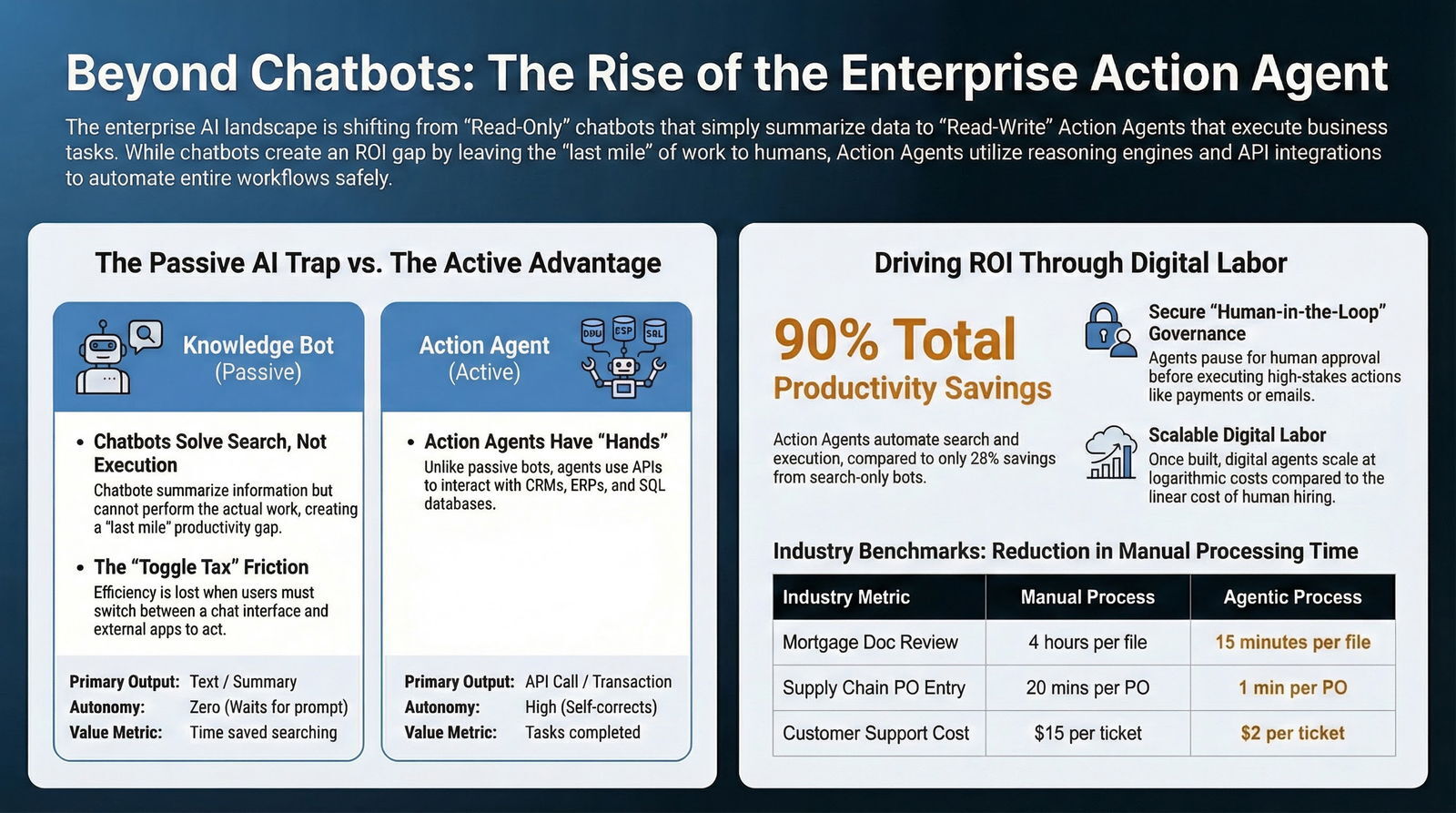
The End of the Chatbot Era: Why the Future of Enterprise AI is Active, Agentic, and Autonomous
Executive Summary
For the past two years, the corporate world has been locked in a collective experiment, a rush to adopt Generative AI driven by the fear of obsolescence and the promise of productivity. We introduced "Knowledge Bots"—chat interfaces powered by Large Language Models (LLMs)—into our Slack channels, our intranets, and our customer support portals. We fed them thousands of PDFs, gigabytes of SharePoint data, and decades of email archives. We promised our boards and our employees a revolution.
The result has been a revolution in summarization, but a stagnation in execution.
We built libraries of Alexandrian scale, accessible by natural language. An executive can ask their corporate bot, "What is our travel policy for international flights?" and it will dutifully retrieve paragraph 4, section B of the employee handbook. But ask that same bot, "Book me a flight to London for the Q3 summit and add the expense to my department code," and the illusion collapses. The bot apologizes. It claims it "cannot perform actions." It retreats into passivity.
This is the "Passive AI Trap." Enterprises are currently awash in passive intelligence—systems that can read, write, and summarize, but cannot do. They are brains in jars, disconnected from the hands and feet required to move the business forward.
We are now standing on the precipice of the next major shift in computing, a shift as significant as the move from command-line interfaces to GUIs, or from on-premise servers to the cloud. We are moving from Passive AI (Chat) to Active AI (Execution). We are moving from chatbots that talk to Action Agents that work.
This comprehensive report details that transition. It explains why the "Chatbot" is a dead-end for enterprise ROI, defines the architecture of the new "Action Agents," and provides a blueprint for how forward-thinking executives—visionary CTOs and strategic CFOs—can deploy these autonomous workers safely. It positions the role of specialized builders, like Baytech Consulting, in crafting these bespoke digital workforces using "Tailored Tech Advantage," leveraging a robust stack of Microsoft Azure, SQL, and containerized infrastructure to bridge the gap between legacy data and future autonomy. For a deeper economic and governance view, you can also explore how the Vibe Coding revolution is changing build-vs-buy decisions for CFOs and why cheap AI code can quietly inflate long-term costs.
Chapter 1: The ROI Gap — Why "Knowledge Bots" Are Failing the Enterprise
To understand where the industry is going, one must brutally assess where it currently stands. The initial wave of Generative AI adoption in the enterprise was characterized by "RAG" (Retrieval-Augmented Generation). This architecture allowed companies to ground their LLMs in proprietary data, reducing hallucinations and providing context-aware answers. While technically impressive, this approach has hit a ceiling in terms of business value.
1.1 The "Knowledge Bot" Architecture
Most enterprise AI deployments today follow a specific, limited pattern:
- Ingest: The company scrapes its unstructured data—PDFs, Wikis, Notion pages, and Word documents.
- Vectorize: This text is turned into mathematical vectors and stored in a database.
- Chat: A user asks a question, the system finds relevant text chunks, and the LLM summarizes them.
This is a "Knowledge Bot." It is essentially a very charismatic, hyper-efficient librarian. It knows everything written down in the company's archives but can do absolutely nothing about it. It operates in a "Read-Only" state. It can tell a user how to process a refund, citing the correct policy, but it cannot process the refund.
1.2 The Failure of Passive AI
Recent studies indicate a growing disillusionment with this model. Gartner predicts that over 40% of agentic AI projects (often confused with chatbots) will be canceled by 2027 due to unclear business value. That aligns with what we see across the broader AI-driven software development landscape in 2026.
The reasons for this failure are structural and psychological.
The "Last Mile" Problem
A chatbot can identify a problem, but it cannot fix it. It might tell a sales representative, "You need to update the CRM for the Acme Corp account because their revenue guidance has changed." However, the AI stops there. The human worker must still close the chat window, open Salesforce or HubSpot, log in, navigate to the account, and manually type the data. The AI has saved the search time but not the execution time. In high-volume environments, execution is where the cost lies.
The "Toggle Tax" and Context Switching
Every time a user has to leave the AI interface to perform a task, friction occurs. This "toggle tax"—the cognitive load of switching between applications—erodes the efficiency gains the AI provided.
If an employee has to switch windows 50 times a day to act on the advice of a chatbot, the workflow is fundamentally broken. The promise of AI was to unify work, not to add another layer of distraction.
Data Isolation
Chatbots often sit on top of unstructured data (documents). But the heartbeat of the business—orders, transactions, inventory, payroll—lives in structured databases (SQL, ERPs, CRMs). Passive chatbots rarely bridge this gap effectively.
They can summarize a PDF about inventory management, but they cannot query the live SQL database to see how many widgets are actually in the warehouse.
The "Blank Page" Paralysis
Chatbots rely on the user to prompt them. They are reactive. If the user doesn't know what to ask, or forgets to ask, the bot sits idle. Passive AI waits; the business needs systems that initiate.
1.3 The Financial Reality of the ROI Gap
For a Strategic CFO, the math of a Knowledge Bot is often underwhelming.
- Cost: High GPU inference costs, vector database management, and API fees.
- Gain: "Better access to information." This is an intangible benefit that is notoriously hard to quantify on a P&L statement.
- Result: The "ROI Gap." Companies are spending millions on compute to generate text, not revenue.
Baytech Consulting's Perspective: This pattern is prevalent in the market. Clients often approach development firms asking for a "ChatGPT for their documents." While such systems work perfectly for their intended purpose, usage often drops after the novelty wears off. Employees do not want to read about work; they want the work done. This realization is the catalyst for the shift toward "Action Agents," and it’s also why we emphasize AI-powered custom development over generic chatbots.
Chapter 2: Enter the "Action Agent" — From Reading to Doing
If a Chatbot is a librarian, an Action Agent is a skilled executive assistant or a specialized knowledge worker.
2.1 Defining the Action Agent
An Action Agent (or "Agentic AI") is a system that uses an LLM as a "reasoning engine" to plan and execute tasks using external tools. It shifts AI from answering questions to truly driving workflows.
It is not defined by what it knows, but by what it can touch.
- It has Hands: It can call APIs (Stripe, HubSpot, SAP, Twilio, SendGrid).
- It has Eyes: It can browse the web, read screens, or process computer vision feeds to understand the environment.
- It has Memory: It remembers past interactions, user preferences, and the current state of a complex, multi-step workflow.
- It has Agency: It can break a high-level goal ("Plan a webinar") into sub-tasks (Create landing page, email list, set up Zoom) and execute them sequentially without constant human hand-holding.
2.2 The Core Difference: "Large Action Models" (LAMs)
While LLMs predict the next word in a sentence, the emerging field of Large Action Models (LAMs) focuses on predicting the next action in a workflow.
This shift requires the model to understand the syntax of API calls, the logic of business processes, and the consequences of its actions.
Comparative Analysis: Passive vs. Active AI
| Feature | Knowledge Bot (Passive) | Action Agent (Active) |
|---|---|---|
| Input | User Question | High-Level Goal |
| Primary Output | Text / Summary | API Call / Database Transaction |
| Connection | Read-Only (RAG) | Read-Write (Tools/Functions) |
| Autonomy | Zero (Waits for prompt) | High (Self-corrects & Iterates) |
| Value Metric | Time saved searching | Tasks completed |
| Underlying Tech | Vector DB, LLM | Semantic Kernel, SQL, APIs, LLM |
This is also where disciplined Agentic Engineering practices matter, so that your agents move fast without creating a new wave of AI-driven technical debt.
2.3 The Philosophy of Agency
The transition to agency is a philosophical shift in software design. Traditional software is deterministic: "If X, then Y." Passive AI is probabilistic but contained: "Based on text X, the likely answer is Y." Agentic AI is goal-oriented: "To achieve Goal Z, I will try Strategy A. If A fails, I will try Strategy B."
This "Goal-Oriented" architecture allows the agent to handle ambiguity. If a traditional automation script tries to click a button and the button moved, the script crashes. An Action Agent "looks" at the screen, sees the button has moved, and clicks it anyway. It adapts. This adaptability is key to Enterprise Automation, where systems are rarely static and data is often messy.

Chapter 3: Under the Hood — The Architecture of Autonomy
How does an Action Agent actually work? It is not magic; it is sophisticated engineering. For builders like Baytech Consulting, creating an Action Agent involves a rigorous architectural pattern, often leveraging the Microsoft stack (Azure OpenAI, Semantic Kernel, .NET) or robust open-source frameworks depending on client needs. This approach fits naturally into a modern AI-native software development lifecycle.
3.1 The Reasoning Engine (The Brain)
The LLM (e.g., GPT-4o, Claude 3.5 Sonnet) is used not for its knowledge base, but for its logic. The developer provides the LLM with a list of available tools (e.g., send_email, query_sql, update_crm) and a user's goal. The LLM "thinks" and decides which tool to call to satisfy the request.
- Example: User says "Update the Q3 forecast."
- LLM Reasoning: "To update the forecast, I first need to get the current data. I will call
get_forecast. Then I will need to calculate the new values. Then I will callupdate_forecast." - Output: A structured command:
call_tool: update_forecast(quarter="Q3").
3.2 The Tool Registry (The Hands)
This is the most critical differentiator. The "Tools" are standard code functions (Python, C#, TypeScript) that wrap enterprise APIs.
- Baytech Differentiator: This is where "Tailored Tech Advantage" becomes a competitive edge. Off-the-shelf agents often come with generic connectors that fail when they encounter legacy complexity. A generic agent cannot connect to a customized, 20-year-old on-premise SQL Server instance protected by a complex firewall. Custom builders can. They build secure, bespoke API wrappers around legacy ERPs, custom SQL databases, and specific internal workflows. This is the heart of our enterprise application architecture services.
3.3 The Memory Stream (The Context)
A chatbot has a "context window" that typically wipes clean (or is summarized) after the chat session ends. An Agent requires "Long-term Persistence" to function as a reliable worker.
- Vector Memory: Stores semantic concepts (e.g., "The client prefers email communication" or "Project X is high priority").
- State Memory: Tracks the progress of a multi-step task (e.g., "Step 1: Data pulled. Step 2: Pending approval. Step 3: Not started."). This allows the agent to pause, wait for a human email reply, and resume days later without forgetting the mission.
3.4 The Orchestrator (The Manager)
In complex enterprise scenarios, one agent is rarely enough. The industry is moving toward "Multi-Agent Systems" where a "Manager Agent" breaks down a massive task and assigns it to specialized "Worker Agents".
- Scenario: "Onboard a new employee."
- Manager Agent: Deconstructs the goal.
- Delegate 1 (HR Agent): Generates contract, collects signature.
- Delegate 2 (IT Agent): Provisions laptop, creates email account, sets up Active Directory.
- Delegate 3 (Security Agent): Configures badge access and firewall permissions.
- Manager Agent: Verifies all steps are complete and notifies the hiring manager.
3.5 The Technical Stack for Action
To build a robust Action Agent, developers move beyond simple scripts. A production-grade "Action Stack" typically looks like this:
- Orchestration Layer: Semantic Kernel (C#/.NET) or LangChain (Python). This handles the "Plan" phase.
- Reasoning Core: Azure OpenAI (GPT-4o) for high-complexity reasoning; smaller models (Phi-3) for routine tasks to optimize cost.
- Tool Interface: Custom API wrappers deployed as Azure Functions or Docker containers (managed via Rancher/Kubernetes).
- Memory Store:
pgvector(PostgreSQL) for long-term semantic memory; Redis or SQL Server for short-term state management. - Safety Layer: Azure Content Safety filters plus Custom Logic Apps for Human-in-the-Loop approvals.

Chapter 4: Safety First — Solving the "Rogue Agent" Problem
The terrifying question for every CIO is: "What if the agent deletes my database?" or "What if it refunds the wrong customer?".
This fear is the primary blocker to mass adoption of Agentic AI. The answer is not "smarter AI," but "stricter governance." Organizations must treat AI Agents not as software tools, but as junior employees. One would not give a new intern root access to the production database on day one. One should not give it to an AI either. This mindset is central to avoiding the kind of AI technical debt that quietly drives up total cost of ownership.
4.1 The "Human-in-the-Loop" (HITL) Protocol
For any high-stakes action (writing to a database, sending an external email, spending money), the Agent must be architected to pause and request explicit approval.
The "Interrupt" Pattern:
- Plan: Agent plans action: "I will refund Order #123 for $500 due to customer complaint."
- Pause: System halts execution. It sends a structured notification to a human supervisor via Teams, Slack, or Email.
- Review: The human reviews the context. They click "Approve" or "Reject."
- Execute: Only upon receipt of the secure token generated by the "Approve" click does the agent execute the API call.
Over time, as trust builds and the agent proves reliable, this "approval threshold" can be raised (e.g., auto-approve refunds under 50, but flag anything over 50).
4.2 Sandboxing and Least Privilege
An Action Agent should never log in as "Admin." It requires a dedicated Service Account with Role-Based Access Control (RBAC).
- Principle of Least Privilege: If the agent is built to update customer addresses, its database permissions should be restricted to
UPDATE users SET address. It should strictly not haveDROP TABLEorDELETEpermissions. - Baytech Standard: Agents are deployed in isolated containers (Docker/Kubernetes) with strict network egress rules. The agent can talk to the specific API it needs (e.g., the CRM), and nothing else. It cannot browse the open web or access other internal servers unless explicitly whitelisted.
4.3 The "Kill Switch"
Every agentic workflow must have a hard-coded "kill switch" that instantly revokes the agent's authentication tokens and terminates its process. This is a non-negotiable requirement for enterprise deployment.
This switch must be accessible to operations teams outside of the AI interface itself (e.g., a button in the Azure DevOps dashboard).
Chapter 5: Vertical Transformations — Active AI in the Wild
The true power of Action Agents is revealed when applied to specific industry verticals. Generic tools struggle here; they lack the context of the "domain." Customized agents, built with vertical expertise, thrive. The following sections detail how Action Agents are revolutionizing key sectors.
5.1 Real Estate & Mortgage: The "Underwriting" Agent
The real estate finance industry is buried in paperwork. Mortgage officers spend countless hours manually reviewing hundreds of PDF pages—bank statements, pay stubs, tax returns—to calculate debt-to-income ratios and verify assets.
The Problem: Manual document review is slow, prone to human error, and creates a bottleneck that delays closings.
The Action Agent Solution:
- Trigger: A new loan application is submitted via the portal.
- Perception: The Agent opens the uploaded PDFs. utilizing OCR (Optical Character Recognition) tools to "read" the documents. It identifies them (e.g., "This is a W2," "This is a Chase Bank Statement").
- Reasoning: It extracts specific data points: Gross Income, YTD Earnings, Average Monthly Balance, Non-Sufficient Funds (NSF) fees. It compares these against the loan program's guidelines (e.g., "Max DTI is 43%").
- Action: The Agent logs into the Loan Origination System (LOS). It updates the applicant's record with the extracted data. It flags "Risk: High" if recent overdrafts are found. It drafts a "Missing Documents" email to the borrower if a page is missing.
- Result: Processing time drops from days to minutes. Risk assessment becomes standardized, removing subjective human variance.
- Efficiency Metric: Document review times can drop by over 80% using this agentic approach, allowing loan officers to focus on client relationships rather than data entry.
5.2 Supply Chain & Logistics: The "Autonomous Procurement" Agent
Supply chain managers act as "human routers," constantly checking inventory levels against demand forecasts and manually cutting POs (Purchase Orders).
The Problem: Stockouts occur because humans cannot monitor thousands of SKUs in real-time. Conversely, excess inventory piles up due to conservative over-ordering.
The Action Agent Solution:
- Trigger: Inventory for "Widget A" in the Warehouse Management System (WMS) drops below the safety stock threshold.
- Perception: The Agent queries the ERP for preferred vendors for Widget A. It checks the vendor's API for real-time stock availability and current pricing.
- Reasoning: It calculates the optimal order quantity based on the current sales velocity and lead time. It compares the vendor's price against the last 3 purchases to ensure cost consistency.
- Action: The Agent drafts a PO in the ERP. It sends a Slack message to the Purchasing Manager: "Stock low on Widget A. Vendor Y has availability. PO #998 drafted for $5,000. Price is 2% lower than last order. Approve?"
- Result: The Manager clicks "Approve." The Agent transmits the PO via EDI or email.
- Impact: This workflow drastically reduces manual data entry and optimizes inventory levels, directly impacting working capital.
5.3 Marketing & Advertising: The "Campaign Orchestrator" Agent
Marketing teams are overwhelmed by the number of channels they must manage—Social, Email, Search, Display. Keeping messaging consistent across all of them is a logistical nightmare.
The Problem: A campaign launch requires updating five different platforms manually. Data is siloed, and "personalization" is often limited to "Hi [First Name]."
The Action Agent Solution:
- Trigger: A new campaign theme is approved by the CMO.
- Perception: The Agent analyzes the campaign assets (images, copy) and the target audience segments in the CDP (Customer Data Platform).
- Reasoning: It determines the best format for each channel. "LinkedIn needs a professional tone; Instagram needs a visual focus." It decides on the posting schedule based on historical engagement data.
- Action: The Agent logs into the Ad Manager (Facebook/Google). It uploads the creative. It sets the budget. It drafts the email sequence in the Marketing Automation Platform (e.g., HubSpot/Marketo). It sends a proof link to the Creative Director.
- Result: "Hyper-Personalized Campaign Execution". The team focuses on strategy and creative, while the agent handles the mechanical distribution.
- Impact: Speed to market increases. Agents can continuously monitor engagement signals and reallocate budget in real-time (e.g., "Pause Ad A, Boost Ad B"), acting as a 24/7 media buyer.
5.4 Education & LMS: The "Student Success" Agent
Higher education faces a crisis of retention. Students drop out because they feel unsupported, and faculty are too overworked to provide individual attention to hundreds of students.
The Problem: Identifying "at-risk" students often happens too late—after they have failed a midterm or stopped attending.
The Action Agent Solution:
- Trigger: A student misses two consecutive assignments or their login frequency drops by 50%.
- Perception: The Agent scans the Learning Management System (LMS) data. It checks the student's historical grades and forum participation.
- Reasoning: It identifies a pattern of disengagement. "This student is showing signs of withdrawal." It references the syllabus to see upcoming deadlines.
- Action: The Agent sends a personalized, empathetic message to the student: "Hi Alex, noticed you missed the last quiz. Is everything okay? Here are two resources that might help with the upcoming exam." Simultaneously, it flags the student to the Academic Advisor's dashboard.
- Result: "Proactive Intervention." The system acts before the failure occurs.
- Impact: Institutions using AI for retention see improvements in student engagement and success rates.
5.5 Gaming & Software: The "DevOps" Agent
In the software and gaming industries, "crunch time" is notorious. Developers spend huge amounts of time on testing, debugging, and infrastructure management.
The Problem: Quality Assurance (QA) is a bottleneck. Manual testing cannot cover every possible user interaction path.
The Action Agent Solution:
- Trigger: A developer pushes new code to the repository.
- Perception: The Agent analyzes the code changes. It identifies which modules are affected.
- Reasoning: "This change impacts the login flow. I need to run the authentication test suite."
- Action: The Agent spins up a test environment (using Docker/Kubernetes). It acts as a "user," attempting to log in, click buttons, and break the system. It records a video of any bugs found, creates a Jira ticket with the error logs, and assigns it to the developer.
- Result: "Autonomous QA." Feedback loops shorten from days to minutes.
- Impact: In gaming, agents can also act as "NPCs" (Non-Player Characters) that test level difficulty by playing the game thousands of times, providing heatmaps of where players might get stuck.
Chapter 6: The Economic Argument — ROI, TCO, and the CFO's Perspective
For the C-Suite, the adoption of Action Agents is not a technology decision; it is a capital allocation decision. Why invest in building custom agents rather than hiring more staff or buying off-the-shelf SaaS?
6.1 The Cost of Manual Labor vs. Digital Labor
The economic case for AI Agents is rooted in the "Zero Marginal Cost" of scaling.
- Human Labor: Linear cost scaling. To handle 2x volume, you generally need 2x people (or pay 2x overtime). Hiring involves recruiting fees, training time (3-6 months), benefits, and overhead.
- Digital Labor: Logarithmic cost scaling. Once an agent is built, handling 2x volume requires only incrementally more compute (cloud server costs).
Data Point: Industry analysis suggests that AI agents can reduce transaction costs significantly. While a human interaction in a B2B contact center might cost 5–25, an AI agent interaction can cost 0.50–5, depending on complexity.
6.2 The "ROI Gap" Revisited
As noted earlier, traditional Chatbots often fail to deliver ROI because they don't displace labor; they just augment it slightly. Action Agents deliver ROI by displacing tasks.
ROI Comparison:
- Chatbot: Saves 2 minutes per interaction (Search time). Human still spends 5 minutes executing. Total savings: ~28%.
- Action Agent: Saves 2 minutes search + 4.5 minutes execution (Human just approves). Total savings: ~90%.
6.3 ROI Data and Benchmarks
The financial impact of Agentic workflows is measurable and significant across industries.
| Metric | Manual Process | Agentic Process | Improvement |
|---|---|---|---|
| Mortgage Doc Review | 4 hours per file | 15 minutes per file | 93% Reduction |
| Supply Chain PO Entry | 20 mins per PO | 1 min per PO | 95% Reduction |
| Customer Support Cost | $15 per ticket | $2 per ticket | 87% Savings |
| ROI Timeline | N/A | Compounding after 12–18 mos | High Velocity |
Note: Data derived from industry benchmarks in Real Estate, Logistics, and Support.
6.4 Total Cost of Ownership (TCO): Build vs. Buy
Executives often ask: "Why not just use Microsoft Copilot or Salesforce Agentforce?"
The "Buy" Trap:
- High OpEx: Per-user license fees (e.g., $30/user/month) add up quickly.
- Generic Limits: These platforms work great for standard tasks (email, basic CRM) but fail at complex, custom workflows (e.g., "Log into our 2005 Legacy ERP").
- Data Lock-in: You are training their model, not yours.
The "Build" Advantage (Baytech Approach):
- Higher Upfront CapEx: Custom development costs.
- Lower Long-term OpEx: You pay for Azure consumption (compute), which is cheaper than per-seat licensing at scale.
- Asset Value: The Agent is IP (Intellectual Property) that belongs to the company. It is an asset on the balance sheet.
- Perfect Fit: The agent is built to handle the exact eccentricities of your business process.
If you're weighing risk and return, it can help to frame this within a broader software investment risk strategy for 2026, rather than treating agents as a one-off tool purchase.
Chapter 7: The Builder's Guide — Why Custom Agents Win
The market is flooding with "Agent Platforms." These are powerful, but they suffer from the "Generalist Curse." They are designed to work for everyone, which means they are optimized for no one.
7.1 The Vertical AI Imperative
Research shows that "Horizontal AI" (generic tools) often fails to deliver ROI because it lacks deep integration with specific business processes.
A generic "Sales Agent" doesn't know your specific qualification criteria, your legacy SQL schema, or your unique compliance rules.
Vertical AI—agents built for a specific industry or specific company workflow—outperforms generic models significantly.
- Generic Bot: "Draft a contract." (Result: Generic legal boilerplate).
- Vertical Agent: "Draft a Series B term sheet using our 2025 standard clauses and the deal terms from the HubSpot record." (Result: Usable business document).
7.2 Baytech as the Artisan Builder
This is where Baytech Consulting positions itself. We are not selling a "platform"; we are selling Digital Labor Construction.
Tailored Tech Advantage
We do not force your process into a pre-built box. We build the box around your process. Using the Microsoft Stack (Azure DevOps, VS 2022, .NET), we craft agents that are native to your enterprise environment and align with Agile delivery practices your teams already understand.
- Legacy Integration: If your critical data lives in an on-premise SQL Server instance that hasn't been touched in a decade, we can build the secure API "bridge" to let the agent access it.
- Hybrid Cloud: We leverage tools like Harvester HCI and Rancher to manage containerized agents that can run on-premise (for security) or in the cloud (for scale).
Rapid Agile Deployment
Agents are not monolithic software projects that take years to ship. They are iterative.
- Minimum Viable Agent (MVA): We build a limited-scope agent in weeks.
- Test & Learn: We deploy it to a small group with strict Human-in-the-Loop guardrails.
- Iterate: We use the feedback to refine the "Reasoning Engine" and expand the "Tool Registry."
- Scale: We deploy via Kubernetes/Docker for high availability.
Data Hygiene
Agents choke on bad data. "Garbage in, Garbage Squared out". We spend the initial phase cleaning and structuring your data (using tools like Postgres & pgAdmin) so the agent can actually use it. A chatbot can bluff its way through bad data; an Action Agent cannot. This data work often overlaps with creating modern DevOps pipelines and automation that keep your systems healthy long-term.
Chapter 8: The Roadmap to Active AI
For the executive reading this, the path forward is not "buy a tool," but "build a capability." This is a strategic transformation.
Phase 1: Audit for Action
Don't look for where you need answers; look for where you need clicks. Where are your people acting as "human APIs," just moving data from Email to ERP? That is your target. Look for high-volume, rule-based tasks with defined outcomes.
Phase 2: Clean the Core
Agents need structured data. If your SQL server is a mess, the agent will fail. The first step of any Baytech engagement is often a data architecture review. We use tools like SQL Server and Postgres to normalize data and create the views/APIs the agent needs.
Phase 3: Pilot with Guardrails
Build a "Read-Only" agent first. Let it suggest actions (draft the email, draft the PO) but not send them. Only when the human approval rate hits 95%+ do you turn on "Auto-Execute." This builds organizational trust.
Phase 4: Partner for Scale
Building robust, secure agents requires a mix of Software Engineering (DevOps, API design) and AI Engineering (Prompting, RAG). Most internal IT teams are good at the former, but new to the latter. A partner like Baytech bridges this gap, bringing the specialized "Action Stack" expertise required to go from prototype to production. If you’re currently choosing a vendor, you may find it useful to apply the same criteria you’d use when selecting a long-term software development partner.
Conclusion: The Agentic Future
The era of the chatbot is ending. The novelty of "chatting with data" has worn off, replaced by the urgent business need for ROI. We are entering the age of the Action Agent—autonomous software that doesn't just describe the world, but changes it.
This shift requires courage. It requires trusting code to execute business logic. But the companies that master this transition—moving from passive knowledge to active execution—will build a level of operational velocity that competitors cannot match. They will not just have smarter employees; they will have a digital workforce that never sleeps, never forgets, and scales infinitely.
The question is no longer "What can AI tell me?" It is "What can AI do for me?"
At Baytech Consulting, we are ready to help you answer that.
Frequently Asked Questions
Q: What is the difference between a chatbot and an AI agent? A: A chatbot is passive; it processes text to answer questions or summarize information (e.g., "Summarize this PDF"). An AI agent is active; it uses tools to perform tasks and execute workflows (e.g., "Log into the ERP, check inventory, and order more parts"). Think of a chatbot as a librarian and an agent as an employee.
Q: Why do chatbots often fail to deliver ROI for businesses? A: Chatbots often fail because they solve the "search" problem but not the "execution" problem. They leave the "last mile" of work—the actual data entry and clicking—to the human. This "toggle tax" (switching between bot and apps) reduces efficiency gains. Furthermore, generic chatbots often lack the deep integration with business data (SQL/ERP) required to be truly useful.
Q: How can an AI agent safely execute tasks in my software? A: Safety is achieved through "Human-in-the-Loop" (HITL) architecture and Sandboxing. Agents are given "Least Privilege" access (only the permissions they need). For high-stakes actions (e.g., refunds, emails), the agent is programmed to pause and request human approval before executing. This ensures you maintain control while benefiting from automation.
Key Resources
- https://www.ibm.com/think/topics/ai-agents
- https://www.salesforce.com/agentforce/ai-agent-vs-chatbot/
- Gartner: 40% of Agentic AI Projects will fail by 2027 (and how to avoid it)
About Baytech Consulting
Baytech Consulting specializes in custom software development and application management. We help visionary leaders build "Tailored Tech Advantages" by crafting bespoke Action Agents that integrate deeply with your existing Azure, SQL, and Enterprise infrastructure. We move beyond the hype to deliver engineered, secure, and rapid ROI, grounded in modern AI integration practices and long-term partnership.
About Baytech
At Baytech Consulting, we specialize in guiding businesses through this process, helping you build scalable, efficient, and high-performing software that evolves with your needs. Our MVP first approach helps our clients minimize upfront costs and maximize ROI. Ready to take the next step in your software development journey? Contact us today to learn how we can help you achieve your goals with a phased development approach.
About the Author

Bryan Reynolds is an accomplished technology executive with more than 25 years of experience leading innovation in the software industry. As the CEO and founder of Baytech Consulting, he has built a reputation for delivering custom software solutions that help businesses streamline operations, enhance customer experiences, and drive growth.
Bryan’s expertise spans custom software development, cloud infrastructure, artificial intelligence, and strategic business consulting, making him a trusted advisor and thought leader across a wide range of industries.