
Agentic Engineering: Boost Speed & Safeguard Long-Term Value
February 04, 2026 / Bryan Reynolds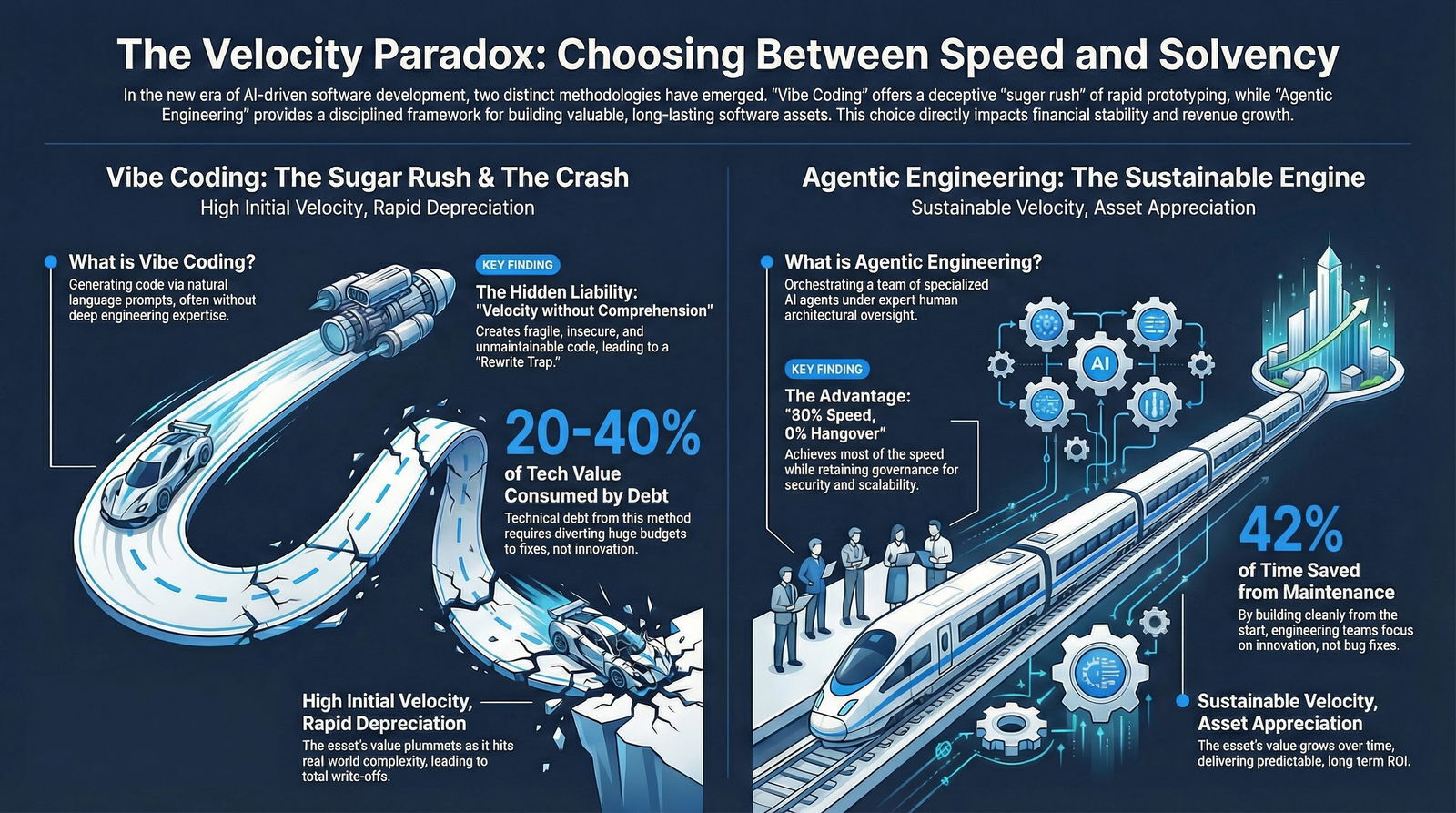
The Velocity Paradox: Navigating the shift from Vibe Coding to Agentic Engineering
Executive Overview: The New Economic Physics of Software
The strategic landscape of enterprise software development underwent a seismic shift in 2025, fundamentally altering the calculus of build-versus-buy, time-to-market, and capital efficiency. For the Chief Financial Officer (CFO) and the Head of Sales, this shift presents a paradox that is as seductive as it is dangerous. On one hand, the barrier to entry for creating software has collapsed; the phenomenon known as Vibe Coding allows nearly anyone to generate functional applications through natural language prompts, promising a velocity of innovation that was previously unimaginable.
This report, prepared for Baytech Consulting, provides a rigorous analysis of these two competing methodologies: the unrestrained acceleration of Vibe Coding versus the disciplined industrialization of Agentic Engineering. Our central thesis is that while Vibe Coding offers a quick “sugar rush” of immediate results, it creates a fragile asset class that depreciates rapidly. In contrast, Agentic Engineering, specifically the frameworks employed by Baytech, harnesses the generative power of Artificial Intelligence (AI) to achieve 80% of the raw velocity of Vibe Coding, but does so within a governance structure that ensures long-term solvency, security, and scalability.
For the modern executive, the choice is not merely technical; it is financial. It is a choice between a high-variance, high-risk workflow that produces “disposable software” and a predictable, optimized workflow that produces enduring revenue-generating assets. By understanding the mechanics of Agentic Engineering—where autonomous AI agents operate under strict human architectural oversight—leaders can secure a competitive advantage that balances the aggressive demands of the sales cycle with the prudent risk management required by the balance sheet.
Part I: The Rise of the Vibe Economy
1.1 The Democratization of Code and the Illusion of Zero Cost
To understand the allure of Vibe Coding, one must first appreciate the economic inversion it represents. Historically, the production of software was constrained by the scarcity of syntax knowledge. If an organization wanted to build a new sales dashboard or a customer portal, it required access to individuals who were fluent in specific languages like Python, JavaScript, or C++. These individuals were expensive, scarce, and their work was slow. The “Cost of Syntax” was the primary friction in the innovation cycle.
The arrival of advanced Large Language Models (LLMs) in the mid-2020s effectively drove the marginal cost of syntax to near zero. “Vibe Coding,” a term solidified by the Collins Dictionary as the word of the year for 2025, describes a workflow where the human operator need not know how to write code, but simply what they want the code to achieve. The operator provides the “vibe”—the intent, the feeling, the desired outcome—and the AI handles the implementation line-by-line.
This shift has profound implications for the sales organization. In the traditional model, a Head of Sales might wait months for a prototype to show a prospect. In the Vibe Economy, a solution engineer or even a tech-savvy sales rep can theoretically “vibe” a prototype into existence over a weekend, using tools like Replit or Cursor to generate a working application that looks and feels complete.
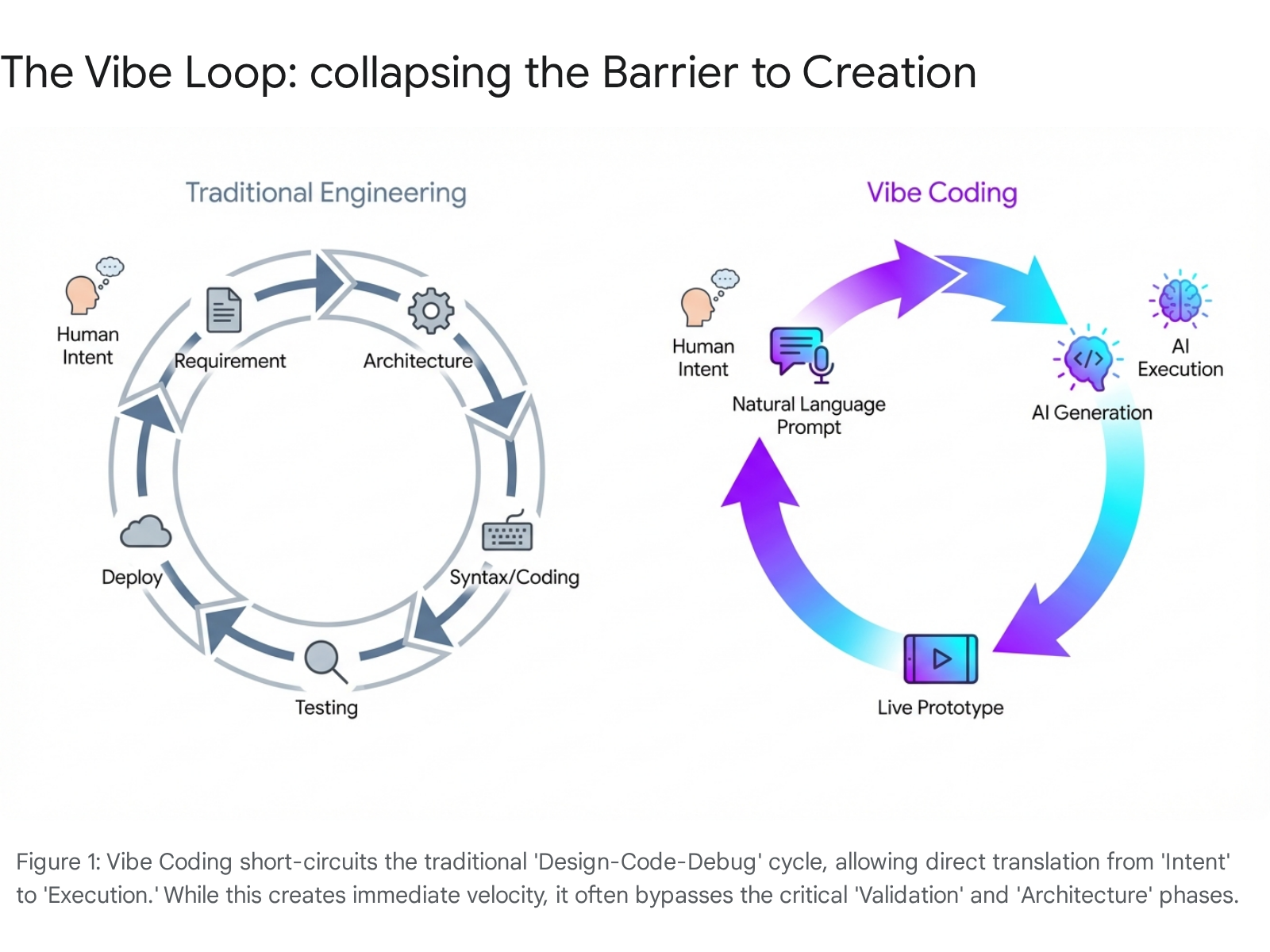
The feedback loop between “idea” and “artifact” has been compressed from weeks to minutes. When paired with modern AI-driven software development practices, the apparent acceleration can be dramatic.
The immediate impact on the “Time-to-Market” (TTM) metric is undeniable. Early adopters of these methodologies report reducing prototyping cycles by orders of magnitude. For a CFO reviewing quarterly efficiency metrics, the data points are intoxicating: development costs appear to plummet while output volume skyrockets. However, this apparent efficiency is often a mirage, masking a deeper systemic risk that does not appear on the P&L until it is too late.
1.2 The Mechanics of the “Sugar Rush”
The problem with Vibe Coding is not that it doesn’t work; it is that it works too easily for the wrong reasons. LLMs are probabilistic engines—they are designed to predict the next most likely token in a sequence. When asked to write a software function, they default to the “Happy Path,” the scenario where users behave perfectly, data is always formatted correctly, and systems never fail.
This creates a “Sugar Rush” effect in software development. The application comes together rapidly and looks impressive in a demo environment. It functions exactly as requested—provided you don’t deviate from the script. But enterprise software is defined not by how it handles the Happy Path, but by how it survives the edge cases: the network timeout, the malicious SQL injection attack, the sudden spike in user traffic, or the legacy database with inconsistent schema.
Because the Vibe Coder typically lacks the deep engineering expertise to scrutinize the AI’s output, they accept the code as “valid” simply because it runs. They are, in effect, outsourcing their understanding to a black box. This phenomenon has been described by industry observers as “velocity without comprehension.” The code is generated faster than it can be understood, creating a deficit of knowledge that accumulates silently within the codebase.
Furthermore, Vibe Coding thrives in isolation but struggles in complexity. It is excellent for “Greenfield” projects—starting from scratch with no legacy constraints. But most enterprise value is generated in “Brownfield” environments—integrating with existing ERPs, CRMs, and proprietary data lakes. When a Vibe Coder attempts to force AI-generated code into a complex, pre-existing architecture without a deep understanding of system dependencies, the result is often “spaghetti code”—a tangled mess of logic that is fragile, unmaintainable, and fundamentally insecure. This risk only grows as organizations push toward ambitious AI milestones like the 25% AI-generated enterprise coding threshold.
1.3 The Shadow IT Risk and Security Hallucinations
For the CFO, the rise of Vibe Coding introduces a new vector of “Shadow IT.” In the past, Shadow IT was limited to spreadsheets and unauthorized SaaS subscriptions. Today, it involves entire applications built and deployed by non-engineers using AI tools that may not adhere to corporate governance standards. A marketing manager might “vibe” a customer data collection tool that inadvertently violates GDPR or HIPAA compliance because the AI was never instructed to encrypt the data at rest.
These “Security Hallucinations” are a critical risk. An AI model, unless explicitly constrained, will happily generate code that uses deprecated libraries or hard-coded credentials, simply because that pattern appeared frequently in its training data. Without an engineering layer to intercept and sanitize this output, the organization exposes itself to significant liability. The speed of deployment becomes the speed of vulnerability, as seen in many AI-driven enterprise security failures linked to vibe coding.
Part II: The Hidden Balance Sheet — The Liability of Technical Debt
2.1 Quantifying the Debt Load
Technical debt is often discussed in abstract terms, but for the CFO, it must be understood as a financial instrument. It is a loan taken out against the future productivity of the engineering team. Every time code is shipped without proper testing, documentation, or architectural forethought—common characteristics of Vibe Coding—the organization incurs a debt. The “principal” is the work that was skipped; the “interest” is the extra time required to work with that code in the future.
In 2025, CIOs estimated that technical debt accounted for 20% to 40% of the value of their entire technology estate. This is not merely a theoretical concern; it is a direct drag on EBITDA. When technical debt is high, a significant portion of the technology budget—often estimated between 10% and 20% of new product funding—is diverted solely to servicing this debt.
The “interest rate” on Vibe Coding debt is particularly usurious. Traditional technical debt might involve a poorly optimized database query that slows the system down by 10%. Vibe Coding debt often involves fundamental structural flaws—logic that is so convoluted or dependent on specific AI context windows that it cannot be modified by human engineers. This leads to a state of “Technical Bankruptcy,” where the cost of fixing the system exceeds the cost of rewriting it entirely. At that point, you are no longer strategically investing in software; you are paying to escape a bad decision, instead of following forward-looking risk strategies for software investment.
2.2 The Depreciating Asset Curve
Consider the asset value of a software application over time. In a Vibe Coding scenario, the “perceived value” of the asset spikes early. The prototype is ready in days, and stakeholders are thrilled. However, as the application moves toward production and encounters the realities of scale and integration, its value plummets. The lack of tests means that every new feature breaks an old one. The lack of documentation means that when the original “prompter” leaves, the knowledge leaves with them.
Data indicates that software projects prioritizing speed over quality in this manner often face a “Rewrite Trap” within 6 to 12 months. The initial velocity is negated by a catastrophic stall where the team must stop all new feature development to stabilize the platform. For a Sales Head, this is the nightmare scenario: selling a roadmap that the engineering team cannot deliver because they are buried in an avalanche of bugs.
In contrast, Agentic Engineering—the disciplined approach advocated by Baytech Consulting—follows a different trajectory. The initial build phase is slower than the Vibe approach because it requires architectural setup and the definition of guardrails. However, once established, the asset value appreciates. The code is modular, tested, and documented. New features can be added with linear or even sub-linear effort, rather than the exponential effort required in a debt-laden codebase.
The comparison is stark:
- Vibe Coding: High initial velocity, rapid depreciation, high risk of total write-off.
- Agentic Engineering: Sustainable velocity, asset appreciation, predictable long-term ROI.
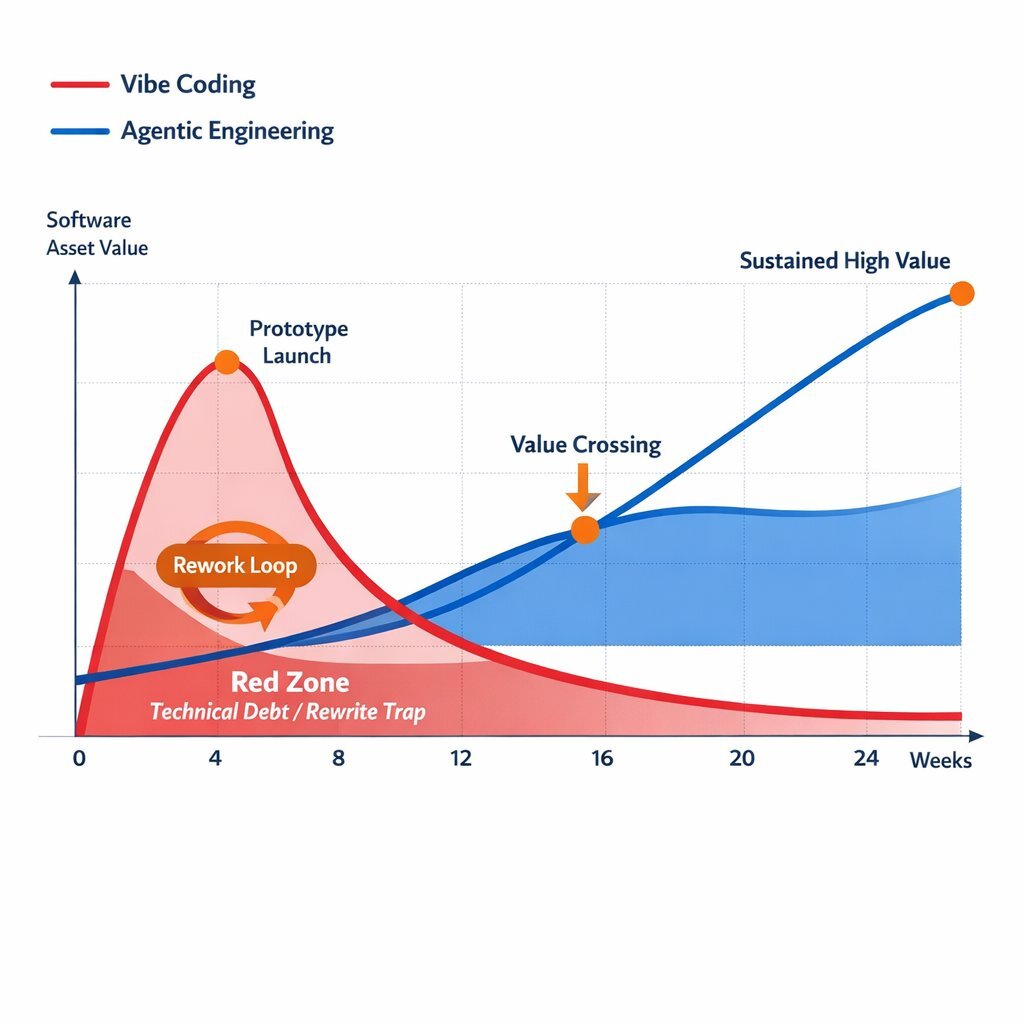
The data supports this “Value Crossing” concept. While Vibe Coding projects might launch in Week 4, they frequently encounter critical “rework loops” by Week 8 that halt progress entirely. Agentic Engineering projects, perhaps launching in Week 6, continue to scale smoothly through Week 20 and beyond, ultimately delivering more value over the fiscal year. This “missing” speed at the start is actually an investment in the removal of future friction.
2.3 The Opportunity Cost of Fragility
The most insidious cost of technical debt is not the money spent fixing bugs; it is the revenue lost from innovation that never happens. When an engineering team spends 42% of their time on maintenance—a common figure in high-debt organizations—they are not building the next generation of products.
For the CFO, this is an efficiency metric that demands attention. If the organization is paying for 100 engineering hours but only getting 58 hours of innovation, the effective cost of development is nearly double the nominal cost. Vibe Coding exacerbates this ratio over time. What starts as a way to bypass engineering bottlenecks eventually creates the biggest bottleneck of all: a legacy codebase that is too fragile to touch.
Furthermore, in a market where agility is paramount, fragility is fatal. If a competitor launches a new AI feature, a debt-laden company cannot respond quickly because their systems are brittle. This “agility drag” translates directly into lost market share. The 80% speed of Agentic Engineering is “agile speed”—velocity that can change direction without breaking the machine, especially when supported by mature DevOps efficiency practices that keep delivery pipelines stable.
Part III: Agentic Engineering — The Industrialization of AI
3.1 Defining the Agentic Shift
If Vibe Coding is the “Wild West” of AI adoption, Agentic Engineering is the establishment of civilization. It represents the transition from ad-hoc, prompt-based interactions to systematic, autonomous workflows. In an Agentic Engineering model, the human developer does not merely chat with a bot; they orchestrate a team of specialized AI agents, each with a defined role, a persistent memory, and a specific set of tools.
This approach, championed by Baytech Consulting, acknowledges that while LLMs are powerful reasoning engines, they require rigid structures to produce enterprise-grade output. It moves the human “out of the loop” of writing individual lines of code and “on to the loop” of system architecture and quality assurance. In other words, the human becomes the designer of the AI-powered system, much like a conductor guiding an AI-powered development orchestra rather than playing every instrument.
The core components of an Agentic Engineering system typically include:
- The Planner: An agent responsible for breaking down high-level business requirements into detailed technical specifications. It validates constraints, identifies dependencies, and outlines the implementation strategy before a single line of code is written.
- The Coder: Specialized agents that execute the plan, generating syntax in the required languages (e.g., Python, React, SQL). These agents are often scoped to specific domains to minimize hallucinations.
- The Reviewer: A critical governance agent that analyzes the generated code against established coding standards, security protocols (like OWASP), and architectural patterns. It acts as a “digital gatekeeper,” rejecting code that does not meet quality thresholds.
- The Tester: An agent that autonomously generates unit and integration tests to verify that the code not only looks correct but functions as intended.
3.2 The Baytech Methodology: Rapid Agile Deployment
Baytech Consulting has integrated these agentic principles into a proprietary framework known as Rapid Agile Deployment. This methodology is designed to solve the specific challenge of “Enterprise Velocity”—how to move fast without breaking things.
The Rapid Agile Deployment framework operates on a “Foundation-First” architecture. Unlike Vibe Coding, which often starts with the user interface (the “paint”), Baytech starts with the structural integrity of the application. The system leverages modern, scalable technologies like Node.js, Docker, and Kubernetes from Day One. This ensures that the “prototype” built in the first sprint is not a throwaway toy, but the actual kernel of the production system, aligned with proven .NET, Docker, and Kubernetes architecture practices.
Central to this approach is the concept of User Story Mapping. Before the AI agents are unleashed, Baytech employs a collaborative process to visualize the entire user journey. This human-led strategic phase ensures that the agents are directed toward solving the right business problems. It prevents the common AI pitfall of “building the wrong thing faster.”
The “80% Speed” metric cited by Baytech is a calculated trade-off. By retaining human oversight for architecture, security governance, and strategic alignment, the process sacrifices the raw, uninhibited speed of “Vibe Coding.” However, this 20% “slowdown” is where the risk is mitigated. It is the time spent ensuring that the software is secure, maintainable, and aligned with business goals.
3.3 Context Engineering: The Antidote to Amnesia
One of the fatal flaws of Vibe Coding is “Context Amnesia.” LLMs have finite context windows; as a conversation gets longer, the model “forgets” earlier instructions or loses track of the broader codebase. This leads to conflicting logic and bugs that are difficult to trace.
Agentic Engineering solves this through Context Engineering and persistent memory systems. In Baytech’s workflow, agents have access to a structured “Instruction Directory” and a shared repository of project context. They “know” the database schema, the API contracts, and the business rules established in previous sprints.
This persistence allows the system to scale. A Vibe Coder might struggle to add a feature to a 50,000-line codebase because the LLM cannot ingest the whole thing. An Agentic system can handle this complexity because specialized agents can retrieve only the relevant context needed for a specific task, much like a human engineering team divides labor. This capability is what allows Baytech to deliver software that scales to millions of users, rather than stalling at the prototype phase—especially when combined with scalable enterprise application architecture that is designed for long-term growth.
3.4 The Human-in-the-Loop Governance
Crucially, Agentic Engineering does not eliminate the human; it elevates them. In the Baytech model, the human acts as the Architect and the Supreme Court. They define the high-level goals and adjudicate on complex edge cases that the agents cannot resolve.
This governance layer is essential for the CFO and Head of Sales. It provides a chain of accountability. If the software fails, it is not because “the AI did it”; there is a clear audit trail of decisions and approvals. This “Human-in-the-Loop” structure creates a bridge of trust, allowing traditional enterprises to adopt AI speed without abandoning corporate governance. It also reinforces an agile way of working that stays grounded in the values of a modern Agile methodology, rather than reverting to purely ad-hoc experimentation.
Part IV: The Baytech Proposition — 80% Speed, 0% Hangover
4.1 The Math of the 80/20 Advantage
The central value proposition Baytech offers to the C-Suite is the 80/20 Speed Advantage. This is not a marketing slogan; it is an operational metric derived from the reduction of rework.
Let us deconstruct the timeline of a typical software project:
- Vibe Coding (100% Speed): The project moves from idea to functioning code with near-zero friction. There are no specification documents, no architectural reviews, and minimal testing. The velocity is maximized, but the vector is uncontrolled.
- Traditional Development (20% Speed): The project moves methodically. Weeks are spent on requirements gathering, architecture review boards, and manual coding. The quality is high, but the pace is glacial compared to market demands.
- Agentic Engineering (80% Speed): The project uses AI to automate the syntax generation and testing (the heavy lifting), retaining the 80% acceleration. The “missing” 20% is the time allocated to the Agentic Control Plane—the planning, reviewing, and governing steps.
The argument for the CFO is that the “missing” 20% of speed is the most valuable time spent on the project. It is the insurance premium that prevents the 100% loss of the asset.
4.2 Eliminating the “Rebuild Trap”
The most expensive phase of software development is not the build; it is the rebuild. Vibe Coding projects often hit a “complexity wall” where the accumulation of technical debt makes further development impossible. The team is forced to declare “bankruptcy” and rewrite the application from scratch—a process that destroys ROI and kills sales momentum.
Baytech’s Rapid Agile Deployment avoids this trap by enforcing “Clean Code” principles from the very first line. Because the Code Reviewer agent enforces standards before code is merged, the codebase remains sanitary. This means that in Month 12, the development velocity is just as high as in Month 1.
The financial implication is a dramatic reduction in the Total Cost of Ownership (TCO). While the initial build cost of an Agentic project might be marginally higher than a Vibe project (due to the setup of the agentic architecture), the TCO over 2 years is significantly lower because the maintenance burden is minimized. Rather than watching budgets get swallowed by rework, organizations can direct more of their spending into new capabilities, advanced AI features, or even modernizing their DevOps and repository intelligence stack.
4.3 The Tailored Tech Advantage
Generic AI tools yield generic results. A key differentiator in Baytech’s approach is the Tailored Tech Advantage. Vibe Coding typically relies on off-the-shelf models (like standard ChatGPT) which have no specific knowledge of a client’s business.
Baytech customizes the Agentic workflow to the specific domain of the client.
- For a Fintech Client: The agents are pre-configured with security rules compliant with PCI-DSS and financial reporting standards. The “Reviewer Agent” knows to reject any code that logs sensitive customer data.
- For a Healthcare Client: The workflow enforces HIPAA compliance, ensuring that data handling patterns meet regulatory requirements.
- For a Retail Client: The agents are optimized for high-concurrency transaction handling to survive Black Friday traffic spikes.
This customization transforms the AI from a general-purpose tool into a specialized domain expert, creating a “competitive moat” for the business. The software built is not just fast; it is uniquely fit for purpose and can plug into broader predictive AI revenue strategies across sales and marketing.
Part V: The Financial & Sales Impact — Monetizing Predictability
5.1 The Cost of Delay Calculation
For the Head of Sales, the primary enemy is the Cost of Delay (CoD)—the revenue lost for every week the product is not in the market. Vibe Coding is often sold as the ultimate solution to CoD because it promises the earliest possible start date.
However, CoD must be calculated based on value realization, not just deployment. A product that launches in Week 4 but crashes in Week 5 and requires a month of emergency patching has effectively delayed revenue recognition. The “churn” caused by a buggy release can be more damaging to the brand than a later launch date.
Baytech’s Agentic Engineering reduces the variance in delivery outcomes. It offers a predictable launch date that Sales can bank on. By rigorously defining the MVP scope and using agents to execute it flawlessly, Baytech ensures that when the Sales team demos the product, it works.
The chart above illustrates the net impact. While the Vibe approach enters the market sooner, the “Red Zone” of rework destroys the revenue advantage. The Agentic approach, represented by the green timeline, delivers a steady, uninterrupted stream of value.
5.2 ROI and the “One-Pizza” Myth
A popular narrative in the Vibe Coding community is the return of the “One-Pizza Team”—the idea that one or two developers with AI can replace a whole department. While true for simple apps, this is a dangerous fallacy for enterprise revenue engines.
The ROI of software is not just (Revenue - Cost). It is (Revenue - Cost - Risk). Vibe Coding minimizes Cost but maximizes Risk. Agentic Engineering optimizes the entire equation.
By using Agentic Engineering, Baytech allows organizations to maintain leaner teams (reducing Cost) without accepting the fragility of the “One-Pizza” model (reducing Risk). The “Agent Swarm” effectively acts as a force multiplier, giving a small team of 3–4 engineers the output capacity of a team of 20, but with the architectural rigor of a large enterprise. This creates a sustainable high-margin structure for the CFO and supports a healthier, more productive engineering culture than simply chasing developer happiness and productivity through heroics.
5.3 The Sales Confidence Factor
Nothing kills a deal faster than a failed Proof of Concept (POC). In the Vibe Economy, sales teams are often tempted to build their own POCs using AI tools to bypass the engineering queue. While this shows initiative, it creates a “Confidence Gap.” The prospect sees a demo that looks good, but when they ask technical due diligence questions—“How is data isolated?”, “What is your disaster recovery plan?”—the Vibe solution falls apart.
Baytech’s approach bridges this gap. Because the Rapid Agile Deployment process creates production-ready code even at the MVP stage, the Sales team can answer “Yes” to the hard technical questions. The POC is not a facade; it is a slice of the real product. This significantly increases conversion rates in B2B enterprise sales, where trust and security are paramount and where buyers increasingly expect robust subscription-ready digital products rather than one-off custom builds.
Part VI: Strategic Implementation & Future Outlook
6.1 Pivoting from “Vibe” to “Agentic”
For organizations that have already dabbled in Vibe Coding, the transition to Agentic Engineering does not mean throwing away progress. It means maturing the process. The core recommendation for executives is to shift the focus from Generation to Orchestration.
The first step is to audit the current “Shadow AI” footprint. CFOs should work with IT leaders to identify where unmanaged AI tools are being used and bring them under an Agentic governance framework. This stops the accumulation of new technical debt.
The second step is to invest in the Platform, not just the Prompt. Partnering with firms like Baytech allows organizations to leverage pre-built Agentic architectures rather than trying to build them from scratch. This accelerates the maturity curve, allowing the business to reap the benefits of 80% speed immediately, while aligning with broader strategies for mastering the AI code revolution that are reshaping the software industry.
6.2 The Future of the Full-Stack Developer
Looking ahead to 2026–2030, the role of the developer will continue to evolve. The “Full-Stack Developer” is becoming the “Agentic Orchestrator.” Their value will no longer be measured by lines of code written, but by the efficiency of the agent swarms they manage.
Baytech is at the forefront of this shift, training its engineers to be architects of intelligence. For the client, this means access to a tier of talent that is uniquely capable of navigating the AI age. These are not just coders; they are systems thinkers who can translate business strategy into autonomous technical execution.
6.3 The Compounding Cost of Inaction
The chart above serves as a final warning. The red area represents the “Interest” payments on Vibe Coding debt—money that flows out of the organization without producing new value. Over eight quarters, this liability can consume the entire innovation budget.
The choice facing the C-Suite is clear. Vibe Coding offers a short-term burst of speed that mortgages the future. Agentic Engineering, as practiced by Baytech, offers a sustainable, high-velocity path to revenue that protects the balance sheet. In a world where software is the primary driver of enterprise value, choosing the right production engine is the most significant strategic decision an executive can make.
6.4 Executive Recommendations
- Redefine “Speed”: Update corporate KPIs to measure “Time to Reliable Revenue” rather than “Time to Code Complete.” Speed without stability is a vanity metric.
- Audit Technical Debt: Commission a formal audit of any software assets built using “Vibe” methodologies. Identify the “Interest Rate” currently being paid on those assets.
- Invest in Governance: Shift budget toward Agentic platforms and partners that provide the architectural guardrails missing from raw AI tools.
- Embrace the Hybrid Model: Accept the 80% speed of Agentic Engineering as the optimal operating point—the “Efficient Frontier” of software production.
- Partner for Maturity: Leverage Baytech Consulting’s “Tailored Tech Advantage” to leapfrog the learning curve and deploy enterprise-grade Agentic systems immediately, ideally inside secure, private AI environments such as modern corporate AI walled gardens.
The era of “coding by vibes” is ending. The era of the “Agentic Enterprise” has begun. Leaders who recognize this shift and adapt their capital and operational strategies accordingly will dominate the markets of the late 2020s. Those who chase the illusion of free speed will find themselves servicing a debt they can never repay.
About Baytech
At Baytech Consulting, we specialize in guiding businesses through this process, helping you build scalable, efficient, and high-performing software that evolves with your needs. Our MVP first approach helps our clients minimize upfront costs and maximize ROI. Ready to take the next step in your software development journey? Contact us today to learn how we can help you achieve your goals with a phased development approach.
About the Author

Bryan Reynolds is an accomplished technology executive with more than 25 years of experience leading innovation in the software industry. As the CEO and founder of Baytech Consulting, he has built a reputation for delivering custom software solutions that help businesses streamline operations, enhance customer experiences, and drive growth.
Bryan’s expertise spans custom software development, cloud infrastructure, artificial intelligence, and strategic business consulting, making him a trusted advisor and thought leader across a wide range of industries.