In this article
- Introduction: The Morning After the AI Gold Rush
- Part I: The Anatomy of Vibe Coding
- Part II: The Data of Decline—The "Vibe Hangover"
- Part III: The Architecture Gap—Why AI Struggles with Systems
- Part IV: The Philosophy of Code—Why Syntax is Not Enough
- Part V: Baytech’s Approach—The Tailored Tech Advantage
- Part VI: The Visionary CTO’s Playbook for 2026
- Conclusion: The Future is Hybrid
- About Baytech
- About the Author
Introduction: The Morning After the AI Gold Rush
The year is 2026. The technology sector has spent the last eighteen months in a state of fervent acceleration, propelled by the promise of generative artificial intelligence. We have moved beyond the initial novelty of chatbots and image generators into a profound transformation of how software is built. The industry buzzword that defined 2025 was "Vibe Coding"—a term that captured the zeitgeist of a new era where natural language prompting replaced syntax, and the sheer velocity of creation seemed to render traditional engineering constraints obsolete.
For the Visionary CTO, the initial allure was undeniable. The promise of "Vibe Coding" was not just speed; it was the democratization of creation. It offered a vision where ideas could be transmuted into functional applications in hours rather than weeks, where the barrier between "business intent" and "software execution" was dissolved by the universal translator of the Large Language Model (LLM). Executives saw a future of zero-friction development, drastically reduced headcounts, and an explosion of digital products.
However, as the dust settles on the initial explosion of AI-generated code, a more complex and sobering reality is emerging in the enterprise landscape. The "vibe" is fading, and what remains is a phenomenon we term the "Vibe Hangover." Across the B2B sector, organizations are waking up to a landscape littered with "almost-right" software—systems that function on the happy path but crumble at the edges, codebases that have grown exponentially in size but declined in maintainability, and a new generation of technical debt that is more opaque and insidious than anything we have seen before.
This report is not a rejection of artificial intelligence. On the contrary, at Baytech Consulting, we view AI as the most significant force multiplier in the history of software engineering. But we argue that the prevailing narrative of "Vibe Coding"—the idea that AI can replace the human architect—is a dangerous fallacy. It is a misunderstanding of what code actually is.
Drawing on exhaustive data from 2024 and 2025, including landmark analyses of hundreds of millions of lines of code, this report demonstrates that without a "Human-in-the-Loop" architecture, Vibe Coding accelerates the creation of unmaintainable legacy code at a scale previously unimaginable. We also connect this to broader market shifts in AI-driven software development in 2026, where winners are the ones who combine speed with disciplined engineering.
We posit a fundamental truth often forgotten in the rush for automation: Code is not merely functional instructions for a machine; it is a communication medium between humans.
In the following pages, we will contrast the commoditized act of "generating code" with the strategic discipline of "engineering systems." We will detail why Baytech’s approach—Tailored Tech Advantage and Rapid Agile Deployment—offers the only sustainable path forward for B2B enterprises seeking secure, scalable, and maintainable software assets. The Visionary CTO must now pivot from the intoxication of raw speed to the sobriety of architectural integrity.
Part I: The Anatomy of Vibe Coding
1.1 Defining the Phenomenon: When the Prompt Becomes the Program
To understand the current crisis, we must first dissect its origin. The term "Vibe Coding" was formally introduced to the lexicon in February 2025 by Andrej Karpathy, a founding figure at OpenAI and a luminary in the AI community. His definition was both descriptive and provocative: Vibe Coding is a software development method where the user "fully gives in to the vibes, embraces exponentials, and forgets that the code even exists".
In this paradigm, the primary interface for software creation shifts from the Integrated Development Environment (IDE) to the chat window. The developer—or increasingly, the "prompter"—describes a desired outcome in plain English. The LLM, such as Claude 3.7 Sonnet or GPT-5, generates the implementation. The human role shifts from "writer" to "manager," accepting all changes, often without reading the difference files (diffs), and relying on the AI to fix its own bugs through iterative prompting.
The psychological shift here is profound. Karpathy described the experience as "magical," noting that for "throwaway weekend projects," the speed is an order of magnitude faster than skilled human coding. The user asks for the "dumbest things," like decreasing padding or changing colors, because they are "too lazy to find it" in the code. When errors occur, the error message is simply copy-pasted back into the chat with no comment, trusting the AI to self-correct.

1.2 The Two Faces of Vibe Coding
It is critical to distinguish between the two emerging schools of thought regarding this phenomenon, as outlined by industry observers and cloud platforms like Google Cloud.
1. "Pure" Vibe Coding: This is the exploratory, radical form described by Karpathy. It is characterized by a "forgetting that the code exists" mentality. It is best suited for rapid ideation, "throwaway weekend projects," or prototypes where long-term maintainability is irrelevant. In this mode, the code is treated as a transient byproduct of the prompt—a means to an end that can be discarded and regenerated at will.
2. Responsible AI-Assisted Development: This is the practical, professional application of the concept, often conflated with "Vibe Coding" but distinct in execution. Here, AI acts as a "pair programmer" or a force multiplier. The human remains the pilot, reviewing code, understanding the logic, and maintaining architectural oversight. This model aligns with the "force multiplier" philosophy that Baytech Consulting advocates, yet the market trend has alarmingly drifted toward the "Pure" model due to the seductive speed it offers. It also aligns with broader enterprise patterns for integrating AI into business applications rather than handing them the keys.
1.3 The Allure of "Zero-Friction" Creation
For the Visionary CTO, the "Pure" Vibe Coding narrative is incredibly potent. It seemingly addresses the three perennial bottlenecks of software development:
- The Talent Gap: The industry has long suffered from a shortage of senior engineers. Vibe Coding promises to elevate junior developers or even non-technical staff to the productivity levels of seasoned engineers, fulfilling the "English is the hottest new programming language" prophecy. This echoes the promise many executives see in enterprise generative AI adoption, where tools appear to compress years of expertise into a prompt.
- Time-to-Market: In a hyper-competitive B2B landscape, speed is currency. The ability to pivot and prototype in real-time allows businesses to test hypotheses cheaply. As noted in industry reports, Vibe Coding allows businesses to "cheaply experiment with ideas" and reduce sunk costs.
- The "Magical" User Experience: There is a visceral satisfaction in seeing an application materialize from a sentence. This "magic" can blind stakeholders to the underlying structural rot. As Microsoft’s research highlights, the ability to tap into "exploratory creativity" is powerful and democratizing.
However, the danger lies in the category error of applying "throwaway" methodologies to "enterprise" systems. When the "Accept All" mentality—where diffs are not reviewed—is applied to core business logic, the lack of rigor becomes a ticking time bomb. The "Pure" Vibe Coding approach assumes that if the code runs, the code is good. As we will see in the data from 2025, this assumption is demonstrably, and dangerously, flawed.
Part II: The Data of Decline—The "Vibe Hangover"
2.1 The AI Quality Gap: A Statistical Reality
While the anecdotal evidence of Vibe Coding’s speed is plentiful, the empirical data regarding its quality is alarming. We are currently witnessing what researchers at GitClear have termed "The AI Quality Gap".
In a landmark study updated for 2025, GitClear analyzed 211 million lines of code changed between 2020 and 2025, from repositories owned by tech giants like Google, Microsoft, and Meta, as well as enterprise C-Corps. The results provide a stark counter-narrative to the "productivity" hype and mirror what many leaders are seeing as they rethink their software investment risk strategies for 2026.
The data reveals three critical trends that signal a degradation in the fundamental health of codebases globally:
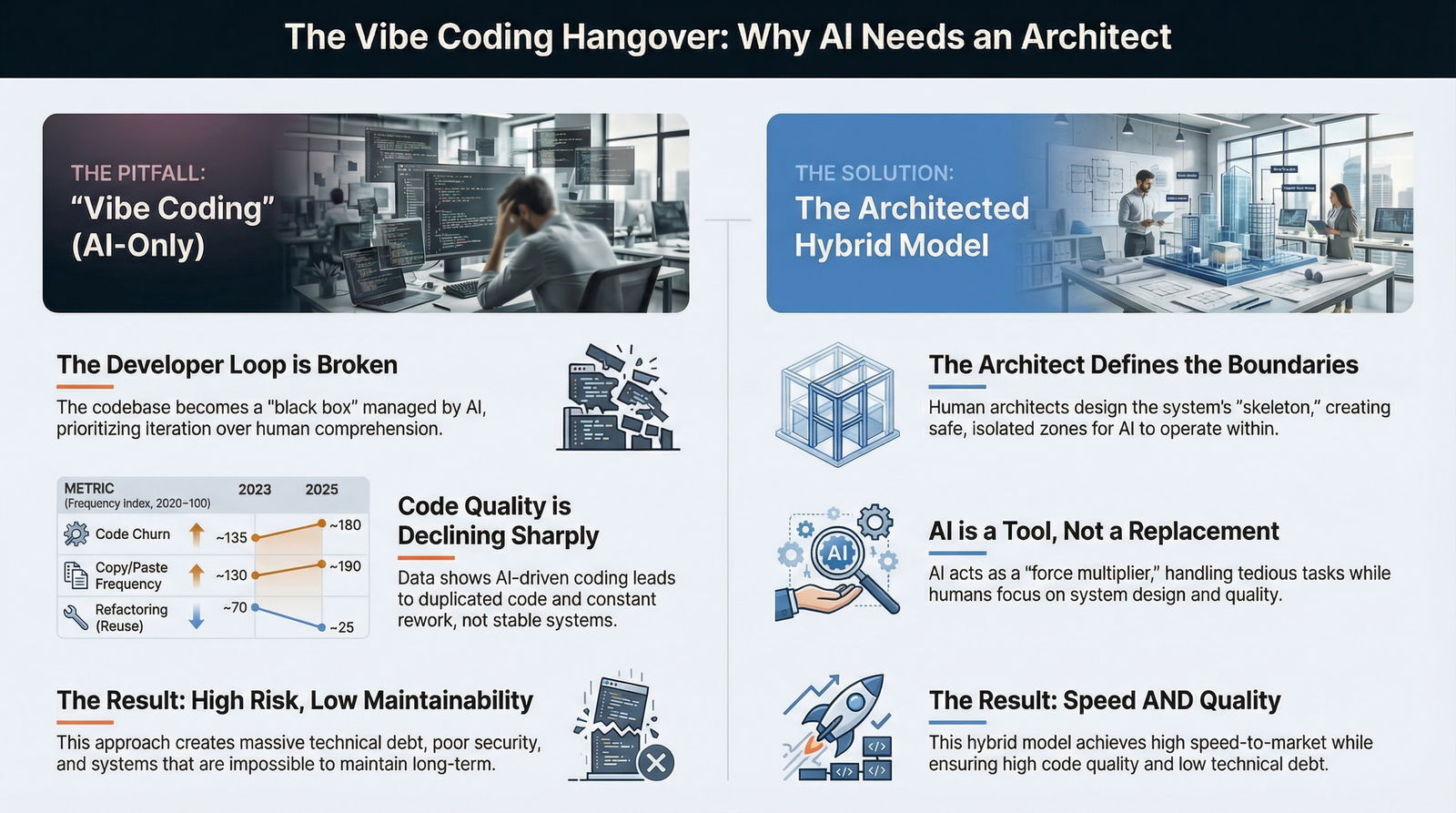
1. The Explosion of Code Churn: "Code Churn"—the percentage of code that is added and then deleted or significantly modified within two weeks—has doubled between 2021 and 2024.
High churn is a classic proxy for "thrashing." It suggests that while AI is helping developers write code faster, that code is frequently wrong, ill-conceived, or poorly integrated, requiring immediate rework. This "fast to write, fast to delete" cycle creates an illusion of velocity while actually slowing down net value delivery.
2. The Rise of the Copy-Paste Culture: For the first time in the history of software engineering, the percentage of lines classified as "copy/pasted" (cloned) exceeded the percentage of lines classified as "moved" (refactored).
In 2024, copy/pasted lines rose to 12.3%, while refactoring sank to less than 10%.
This is a devastating metric for long-term maintainability. "Moving" code implies a developer is recognizing a pattern, abstracting it, and creating a reusable function—the hallmark of "Don't Repeat Yourself" (DRY) principles. "Copying" code implies a developer is blindly duplicating logic. AI tools, by their nature, encourage duplication; it is easier to ask the LLM to "write a function to do X" again than to find and adapt an existing function. The result is a bloated codebase where a single bug fix must be applied in ten different places—a maintenance nightmare.
3. The Decline of Code Reuse: The GitClear data indicates a "continued decline of moved lines," which serves as a proxy for code reuse.
As developers rely more on generation, they rely less on the existing architecture. The codebase becomes a collection of disjointed scripts rather than a cohesive system.
2.2 The "Almost Right" Paradox
The most insidious issue with Vibe Coding is not that the code is broken—it is that the code is "almost right." AI is probabilistic; it predicts the next token based on statistical likelihood. It generates code that looks correct, adheres to syntax rules, and often runs correctly for the "happy path" (the standard, expected user behavior). However, it frequently fails at the edges.
According to Stack Overflow's 2025 Developer Survey, 66% of developers cite "dealing with AI solutions that are almost right, but not quite" as their primary frustration. This creates a dangerous "Productivity Illusion."
- The Debugging Trap: Debugging AI-generated code is often significantly harder than debugging human-written code. When a human writes code, they build a mental model of how and why it works. When they debug it, they retrace their mental steps. When a developer debugs AI code, they are essentially reverse-engineering a stranger's logic without the benefit of comments or context. They are investigating a "black box".
- The Stability Cost: A study by Harness found that while AI speeds up raw code generation, it decreased delivery stability by 7.2%. The time saved in typing is lost in "fixing," "stabilizing," and "firefighting" in production.
2.3 The Security Blind Spot
Vibe coding, by definition, prioritizes speed and functionality over security and compliance. Without a "human-in-the-loop" architect to enforce security standards, AI tends to introduce vulnerabilities that a seasoned engineer would instinctively avoid.
- Insecure Patterns: AI models are trained on the entire internet, including bad code. They often suggest insecure coding patterns, such as SQL injection vulnerabilities or hardcoded credentials, if not explicitly guardrailed.
- Dependency Bloat: AI agents often "hallucinate" imports or suggest unnecessary libraries to solve simple problems, increasing the software's attack surface and supply chain risk.
- Governance Risk: For B2B firms in regulated industries (finance, healthcare), the "Black Box" nature of Vibe Coding is a compliance nightmare. If the CTO cannot explain why the software makes a certain decision because the logic was "vibe coded" by an opaque model, the company faces significant legal and governance risks.
The accumulation of this low-quality, duplicated, insecure, and poorly understood code creates what Baytech Consulting identifies as "AI Slop"—a mess of unmaintainable digital waste that creates a new form of technical debt. This debt is not just financial; it is a "knowledge debt" that can paralyze a company's ability to innovate in the future.
Part III: The Architecture Gap—Why AI Struggles with Systems
3.1 Generating Code vs. Engineering Systems
The fundamental failure of Vibe Coding lies in the confusion between "generating code" and "engineering systems." AI excels at the tactical level: writing a function to sort a list, generating a regex for an email validator, or creating a React component. These are discrete, contained tasks. However, software engineering is not a collection of discrete tasks; it is the construction of an interconnected system.
AI models, even the most advanced ones, struggle with strategic system design due to the "Context Window Limitation." While context windows are growing (Claude 3.7 boasts 200k tokens), they are still finite. An LLM cannot "hold" the entire domain model, historical context, and architectural constraints of a massive enterprise system in its working memory simultaneously. It sees the tree (the file), but it is blind to the forest (the distributed system). This is why human-led enterprise application architecture is still non-negotiable for serious systems.
3.2 The Distributed Systems Trap
Modern B2B software relies heavily on Distributed Systems and Event-Driven Architecture (EDA)—architectures where independent services communicate via asynchronous messages. This is the domain where Vibe Coding most frequently fails.
- The Context Gap: In a distributed system, a bug often manifests as an inconsistency between services. To diagnose it, one must understand the flow of data across boundaries—from the front end to the API gateway, through the message queue, to the microservice, and into the database. An AI tool, presented with a single service's code, lacks the context to "see" the issue. It can check the syntax, but it cannot check the system state.
- Eventual Consistency: Concepts like "eventual consistency" (where data may be temporarily out of sync across services) are nuanced and require careful design of retry logic, idempotency (ensuring a repeated action doesn't have unintended effects), and "dead letter queues." AI agents often write "happy path" code that assumes the network is reliable and the database is always instant. When these assumptions fail in production, the system collapses. Teams building real-time data flows often turn instead to deliberate patterns such as those in our Kafka real-time data processing guide.
- The "Spaghetti" of Events: Without a human architect to define the schema and flow of events, AI-generated event consumers can become a tangled web of dependencies. This leads to a system where a change in one service triggers a cascade of failures across the enterprise—a phenomenon known as "distributed monolith" behavior.
3.3 Domain-Driven Design (DDD) and the Loss of Meaning
Domain-Driven Design (DDD) is the practice of mapping complex business requirements into software models. It relies on the concept of "Bounded Contexts"—linguistic boundaries where terms have specific, distinct meanings.
For example, the word "User" means something different to the "Billing Context" (someone with a credit card) than it does to the "Support Context" (someone with a ticket history).
- AI ignores Boundaries: Without explicit guidance, LLMs tend to blur these boundaries. They might create a monolithic "User" object that contains both credit card data and support tickets, creating tight coupling between unrelated parts of the system.
- The Human Role: The architect's primary job is to define these Bounded Contexts. They must interview business stakeholders, distill the "Ubiquitous Language," and enforce the boundaries. AI cannot do this negotiation; it can only operate within the boundaries we set.
- Structure as a Guardrail: If you ask an LLM to "build a trading app," it will likely generate a monolith. If a Human Architect defines the Clean Architecture (separating entities, use cases, and interfaces), the AI can be used to fill in the specific methods within that structure effectively. Vibe coding attempts to grow the "meat" (code) without the "skeleton" (architecture), resulting in an amorphous blob.

Part IV: The Philosophy of Code—Why Syntax is Not Enough
4.1 Code is a Communication Medium
To understand why Vibe Coding fails for long-term enterprise value, we must revisit a fundamental principle of software engineering espoused by thought leaders like Martin Fowler, Robert C. Martin ("Uncle Bob"), and the authors of The Pragmatic Programmer: "Code is communication."
Code has two distinct audiences:
- The Machine: The compiler or interpreter that executes the instructions.
- The Human: The future developer (or your future self) who must maintain, extend, and debug the system.
Vibe coding optimizes entirely for Audience #1. It produces syntax that the machine accepts. The code compiles. The app runs. However, it fails catastrophically for Audience #2.
- Readability vs. Functionality: A machine doesn't care if code is "spaghetti." It doesn't care about variable names, modularity, or the nuance of "Clean Architecture." Humans do. If code is not readable, it is not maintainable. As Robert C. Martin famously noted, "Truth can only be found in one place: the code." If that truth is obscured by AI-generated obfuscation, the business loses its grip on its own logic.
- Intent vs. Implementation: AI generates implementation (the "how") but lacks the intent (the "why"). When a human writes code, they are encoding their understanding of the business domain. They choose variable names like
isOverduerather thanflagbecause they are communicating a business state. When AI writes code, it is statistically predicting the next token. It mimics the form of intent but lacks the substance. The "soul" of the software—the alignment with business goals—is lost.
"Any fool can write code that a computer can understand. Good programmers write code that humans can understand." — Martin Fowler
4.2 The Loss of "Tacit Knowledge" and the "Bus Factor"
Software development is not just about typing text; it is a learning process. As a developer builds a system, they build a mental model of how it works—the "tacit knowledge" of the system's quirks, constraints, and edge cases. This knowledge is what allows them to troubleshoot a production outage at 3 AM.
- Vibe Coding Erases Learning: When you "forget the code exists", you also fail to learn how your own product works. You become a passenger in your own vehicle.
- The Maintenance Nightmare: When the system inevitably breaks (and it will), the "Vibe Coder" is helpless. They did not build the engine; they just asked for it to appear. They cannot fix it without asking the AI, which—as established—may not have the context to solve complex, systemic failures. This creates a terrifying "Bus Factor": if the AI cannot solve the problem, no one can.
4.3 Clean Architecture as a Survival Strategy
In the age of AI, Clean Architecture is not an obsolete artifact of the "manual coding" era; it is a survival strategy.
Without strict architectural patterns, AI-generated code tends to drift toward entropy. It couples the database to the UI; it mixes business logic with framework code. A Human Architect must enforce patterns like Hexagonal Architecture or Onion Architecture to ensure that the "core domain" remains pure and testable, regardless of who (or what) wrote the implementation details. This is the same discipline that separates chaotic "vibes" from the structured approach we use in our Agile methodology on real client projects.
Part V: Baytech’s Approach—The Tailored Tech Advantage
5.1 AI as a Force Multiplier, Not a Replacement
At Baytech Consulting, we reject the binary choice between "Slow Traditional Coding" and "Fast but Flawed Vibe Coding." Our philosophy is grounded in the concept of AI as a Force Multiplier.
We utilize the same advanced AI tools that drive the Vibe Coding craze—GitHub Copilot for Business, ChatGPT, and custom agents within the Microsoft Azure ecosystem. These tools allow our developers to code up to 55% faster. However, we do not abdicate responsibility.
- The Expert Filter: Every line of AI-generated code is reviewed by a senior engineer. We use AI to remove the drudgery (boilerplate, regex, unit test generation, data mapping), freeing our architects to focus on the art (system design, security, user experience, complex business logic).
- Proprietary AI Platforms: We don't just use off-the-shelf AI; we build Tailored Tech Advantages. We integrate AI deeply into your specific tech stack and business rules. For example, using Azure OpenAI Service, we can index your internal documentation and legacy codebases, creating a custom "Copilot" that knows your business, not just generic coding patterns.
This approach is part of a broader shift we’re seeing in how organizations pursue predictive and generative AI for revenue growth—not as toys, but as tightly governed, domain-aware systems.
5.2 Rapid Agile Deployment (RAD) in the AI Era
Our Rapid Agile Deployment (RAD) methodology is uniquely suited to tame the chaos of AI-driven development.
- Time-Boxed Discipline: AI can lead to endless "tinkering" or "gold-plating." Our Sprint-based model fixes time and cost, forcing prioritization. We use AI to fill the sprints with more value, not just more code. We focus on shipping working software, not just generating text.
- Continuous Feedback Loops: We implement short feedback loops (Human Review → Automated Test → Stakeholder Demo). AI accelerates the coding phase, but the feedback phase remains deeply human-centric, ensuring that the software we build is the software you actually need.
5.3 Combatting Technical Debt from Day One
Baytech explicitly fights the "AI Slop" phenomenon through rigorous standards.
- Strict Code Standards: We enforce "Clean Code" principles. If the AI generates a 200-line function, our engineers reject it. We force the AI (and our devs) to refactor it into small, readable, single-responsibility components.
- Security-First Integration: We use automated security filtering to block insecure AI suggestions (like SQL injection risks) before they ever reach the repository. We leverage the security features of the Azure ecosystem to ensure that speed never comes at the cost of safety.
Part VI: The Visionary CTO’s Playbook for 2026
6.1 The "AI Governance" Checklist
To harness the speed of Vibe Coding without inheriting its debt, the Visionary CTO must implement a robust governance framework. This is not about slowing down; it is about steering the ship, much like you would when evaluating partners using a structured software proposal evaluation framework.
- Define the "No-Fly Zones": Identify the core business logic—your "Secret Sauce"—where "Vibe Coding" is forbidden. Areas like pricing engines, payment processing, and proprietary algorithms require 100% human review and strict architectural design. These are high-risk, high-value zones where "almost right" is unacceptable.
- Elevate the "Architect" Role: Stop hiring "coders" who just convert Jira tickets to syntax. Hire "System Architects" who can design Bounded Contexts and review AI output. The new "Senior Developer" is primarily a code reviewer, a mentor, and a system designer. They are the "Human in the Loop".
- Mandate "Explainability": Implement a cultural rule: "If you can't explain how the code works, you can't merge it." This prevents the "Accept All" mentality of Vibe Coding. Developers must be able to walk through the logic of an AI-generated block during code reviews.
- Invest in "Refactoring" Sprints: Dedicate at least 20% of your roadmap to refactoring AI-generated code. AI creates "technical inflation"; you must actively pay down this debt to prevent bankruptcy. Use this time to consolidate duplicated logic and improve system modularity.
6.2 The Communication Imperative
Finally, the Visionary CTO must champion the philosophy that Code is Communication.
- Documentation is King: In an AI world, documentation (the "Why") is more important than the code (the "How"). AI can generate the code if the documentation is clear. Invest in keeping your architectural decision records (ADRs) and domain models up to date.
- The "Human-Readable" Standard: Enforce style guides that prioritize readability over cleverness. If an AI generates a complex "one-liner" that is efficient but obscure, reject it. Ask the AI to "rewrite this to be easily understood by a junior developer." Optimizing for human cognitive load is the single best investment you can make for the longevity of your software. This mindset is also key when you choose a software partner in 2026, because you’re not just buying features—you’re buying clarity and maintainability.
Conclusion: The Future is Hybrid
The allure of Vibe Coding is a siren song. It promises a destination of effortless creation but hides the jagged rocks of unmaintainable systems and technical bankruptcy. For the hobbyist or the solo entrepreneur building a prototype, it is a miracle tool. For the enterprise executive responsible for the long-term health of a business, it is a risk that must be managed with precision.
The future of software does not belong to the "Vibe Coder" who blindly accepts AI output, hoping for the best. Nor does it belong to the "Luddite" who refuses to use AI tools, clinging to the manual practices of the past. It belongs to the AI-Augmented Architect—the professional who uses AI to type fast, but uses their human intellect to design smart. These leaders are also the ones already exploring modern architectures like headless CMS platforms and other decoupled systems that keep their options open.
At Baytech Consulting, we are those architects. We don't just generate code; we engineer systems. We use AI to give you the Tailored Tech Advantage—software that is fast to build, safe to run, and easy to maintain for decades to come.
Code is communication. Let's make sure we're saying something worth keeping.
Recommended Resources
- https://www.baytechconsulting.com/blog/custom-software-competitive-advantage – Understanding the strategic value of custom architecture.
- https://www.baytechconsulting.com/blog/preventing-scope-creep-software-projects – How we control scope while maximizing speed.
- https://www.baytechconsulting.com/blog/mastering-ai-code-revolution-2026 – Deep dive into the AI code revolution and the productivity paradox.
- https://www.baytechconsulting.com/blog/unlocking-developer-happiness-productivity-2025 – Why great developer experience matters when AI enters the stack.
- https://www.gitclear.com/ai_assistant_code_quality_2025_research – The definitive data on AI's impact on code quality.
About Baytech
At Baytech Consulting, we specialize in guiding businesses through this process, helping you build scalable, efficient, and high-performing software that evolves with your needs. Our MVP first approach helps our clients minimize upfront costs and maximize ROI. Ready to take the next step in your software development journey? Contact us today to learn how we can help you achieve your goals with a phased development approach.
About the Author

Bryan Reynolds is an accomplished technology executive with more than 25 years of experience leading innovation in the software industry. As the CEO and founder of Baytech Consulting, he has built a reputation for delivering custom software solutions that help businesses streamline operations, enhance customer experiences, and drive growth.
Bryan’s expertise spans custom software development, cloud infrastructure, artificial intelligence, and strategic business consulting, making him a trusted advisor and thought leader across a wide range of industries.