In this article
- Executive Summary: The Content Crisis in the Age of Ubiquity
- 1. The Evolution of Content Management: From Web 1.0 to Ambient Computing
- 2. Deconstructing the Architecture: A Technical Deep Dive
- 3. Monolithic vs. Headless: The CTO's Comparative Analysis
- 4. The Business Case: ROI, Time-to-Market, and Productivity
- 5. Omnichannel Delivery: The COPE Principle in Practice
- 6. Future-Proofing the Enterprise: IoT, AR, and VR
- 7. Performance & SEO: The Jamstack Advantage
- 8. The "Buy vs. Build" Strategic Framework: Why Custom Frontends Win
- 9. Migration Strategies: The Roadmap from Monolith to Modern
- 10. Conclusion and Actionable Advice
- About Baytech
- About the Author
Executive Summary: The Content Crisis in the Age of Ubiquity

The digital landscape has undergone a tectonic shift, moving from a browser-centric world to an era of ambient computing where content must be ubiquitous, fluid, and instantly accessible. For nearly two decades, the monolithic Web Content Management System (CMS) reigned supreme as the foundational block of digital presence. Systems like WordPress, Drupal, and Sitecore offered a convenient, all-in-one package where the database, the administrative interface, and the frontend presentation layer were fused into a single, indivisible codebase. This model worked exceptionally well when the primary output was a desktop website. However, as customer touchpoints have exploded to include native mobile applications, smartwatches, voice assistants like Amazon Alexa, in-store digital signage, and immersive spatial computing environments (AR/VR), the rigid coupling of the monolith has transformed from a convenience into a crippling liability.
Today, Chief Technology Officers (CTOs) and Heads of Marketing Technology face a "Content Crisis." The monolithic architecture forces organizations into a pattern of redundancy and inefficiency known as the "silo effect." To support a mobile app, teams often spin up a separate database; for digital kiosks, they might employ hard-coded content updates; and for the web, they maintain the legacy CMS. This fragmentation results in "content drift," where brand messaging becomes inconsistent across channels, and engineering teams are paralyzed by the need to maintain fragile legacy code rather than innovating. The operational cost of this inefficiency is staggering, with teams wasting hours manually synchronizing content across disparate systems, and developers shackled by the limitations of proprietary CMS templating languages.
This report presents a comprehensive analysis of the Headless CMS architecture—the strategic and technical evolution designed to solve omnichannel complexity. Unlike the traditional model, a Headless CMS decouples the content repository (the "body") from the presentation layer (the "head"). It creates a centralized content hub that serves raw data via Application Programming Interfaces (APIs) to any endpoint, effectively treating content as infrastructure rather than page layout. This shift is not merely a trend; it is a fundamental re-architecture of the enterprise technology stack that aligns with the principles of agility, scalability, and future-proofing.
In the following sections, we will deconstruct the technical mechanisms of this decoupling, analyze the Return on Investment (ROI) of migration, and detail how this architecture creates a resilient foundation for the next generation of digital experiences, including the Internet of Things (IoT) and Augmented Reality. Furthermore, we will contextualize why Baytech Consulting—with its deep expertise in custom software development, Tailored Tech Advantage, and rapid agile deployment—views the Headless approach as the necessary evolution for high-performance enterprises. For the CTO, this report serves as a definitive guide to unburdening infrastructure and reducing technical debt. For the Head of Marketing, it is the blueprint for achieving the "Create Once, Publish Everywhere" (COPE) holy grail, ensuring that brand consistency and velocity are maintained regardless of the device or channel.
1. The Evolution of Content Management: From Web 1.0 to Ambient Computing
To fully appreciate the strategic necessity of the Headless CMS, one must understand the historical trajectory of content management. The evolution of the CMS is a mirror to the evolution of the web itself, tracing a path from static documents to dynamic, interactive applications.
1.1 The Era of the Monolith (Coupled CMS)
In the early days of the web (Web 1.0 and early Web 2.0), the primary objective of a CMS was to simplify the creation of HTML pages. Systems like WordPress, Joomla, and Drupal emerged to solve a specific problem: allowing non-technical users to publish content without writing code. They achieved this through a "coupled" architecture. In this model, the backend (database and admin UI) and the frontend (the visible website) are inextricably linked. The CMS dictates the technology stack; if you use WordPress, your frontend is written in PHP and built using specific themes and templates.
This "turnkey house" approach was revolutionary for its time. It democratized publishing and allowed for rapid deployment of simple websites.
However, as the web matured into an application platform, the constraints became visible. The "Tight Integration" meant that the code defining the layout of a specific page was intertwined with the logic retrieving the content. Changing a design element often required deep surgery in the backend code. As noted by industry analysis, this created a dependency where modifying the layout was "akin to moving a window in an existing house"—a structurally complex and risky endeavor.
1.2 The Fragmentation of the Digital Experience
The arrival of the smartphone and the subsequent app economy shattered the assumption that "content" equals "web page." Suddenly, brands needed to push content to iOS and Android apps. The monolithic CMS, designed to output HTML, was ill-equipped for this. It could not easily send raw text or image data to a native app; it wanted to send a full webpage.
This led to the "Decoupled" or "Hybrid" phase, where developers tried to hack APIs onto monolithic systems. While functional, these were often slow, insecure, and heavy—a patch rather than a solution. The result was the proliferation of the "House of Cards" effect: a precarious stack of plugins and workarounds where a single update could bring down the entire system.
Security flaws in a minor plugin could expose the entire database, and mandatory core updates often broke custom functionality, leading to "Update Paralysis" where teams refused to patch their systems for fear of downtime.
1.3 The Rise of the API-First Economy
The modern era is defined by the API economy. Content is no longer viewed as a "page" but as "data." The Headless CMS was born from this paradigm shift. It stripped away the frontend entirely, focusing 100% on the management and storage of content. By exposing this content via robust, high-performance APIs (REST or GraphQL), the Headless CMS positioned itself not as a website builder, but as a content infrastructure service.
This shift aligns perfectly with the rise of modern frontend frameworks like React, Vue.js, and Angular. Developers, no longer constrained by the CMS's proprietary templating languages, could build rich, app-like experiences (Single Page Applications or SPAs) that consumed content from the CMS just as they would consume weather data or payment processing services. This architecture is "technology agnostic," a core tenet of modern software engineering that allows teams to choose the best tool for the job rather than being forced into a legacy stack.
1.4 The Baytech Perspective: Custom Software as a Differentiator
For a consultancy like Baytech, which prides itself on delivering a "Tailored Tech Advantage," the move to Headless is logical. Monolithic systems commoditize the frontend experience—your site looks like a theme. Headless systems enable custom software development. The "head" is built from scratch to meet the exact business requirements of the client, unencumbered by the bloat of generic themes. This allows for "Rapid Agile Deployment," as the frontend team can iterate independently of the backend content team, decoupling their workflows and accelerating velocity.
2. Deconstructing the Architecture: A Technical Deep Dive
To evaluate the Headless CMS, CTOs require a granular understanding of its architectural mechanics. It is not sufficient to say it "separates the backend and frontend"; we must examine the protocols, data structures, and infrastructure that make this separation powerful.
2.1 The Decoupled Paradigm
A Headless CMS removes the "head" (the frontend presentation layer) entirely. It is a backend-only content repository that acts as a database for content. It does not know, nor does it care, how the content will be displayed. Instead of generating HTML pages, a Headless CMS exposes content via APIs (Application Programming Interfaces).
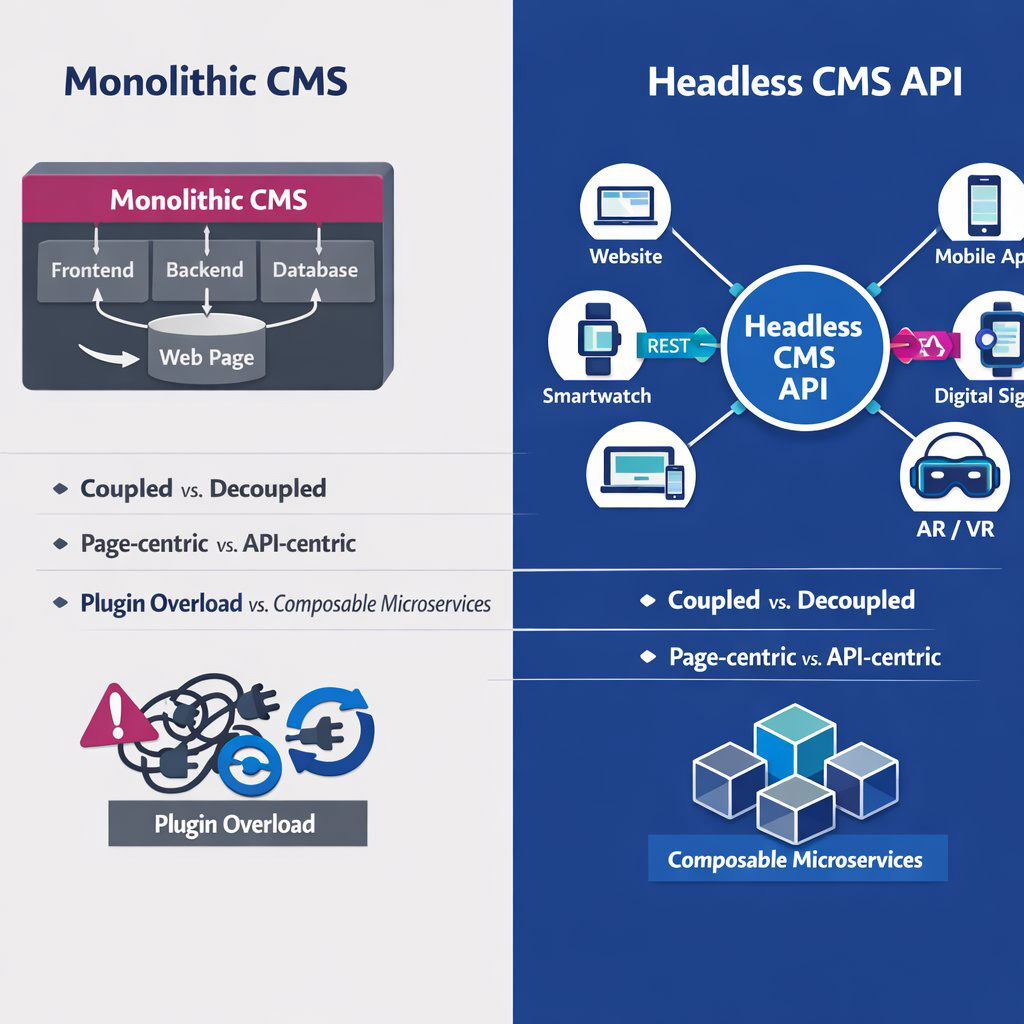
The visual above illustrates the fundamental divergence in architecture. In the monolithic model, the CMS is a "black box" that ingests content and spits out a webpage. In the Headless model, the CMS is a "hub" that radiates data to diverse endpoints.
2.2 The Mechanics of Data Delivery: JSON and APIs
The "lingua franca" of the Headless CMS is JSON (JavaScript Object Notation). Unlike HTML, which describes appearance (e.g., <H1>Title</H1>), JSON describes structure and meaning (e.g., {"title": "The Future of CMS", "author": "Baytech"}). This distinction is critical for omnichannel delivery.
REST vs. GraphQL
Headless systems typically offer two primary methods for content retrieval, and the choice between them often defines the developer experience:
- REST API: The traditional standard. The frontend makes a request to a specific endpoint (e.g.,
GET /api/posts/123) and receives the full data object for that post. While robust, REST can lead to "over-fetching" (receiving more data than needed) or "under-fetching" (requiring multiple requests to stitch together related data). - GraphQL: The modern standard favored by advanced Headless platforms. GraphQL allows the frontend developer to query the API with surgical precision, asking for exactly the fields required (e.g., "Give me just the title and the author's name for the last 5 posts"). This reduces payload size, improves performance on mobile networks, and empowers frontend developers to iterate without asking backend teams to modify API endpoints.
This architectural flexibility is a key enabler of Baytech’s custom software services. By utilizing GraphQL, Baytech’s engineers can build highly optimized, performant frontends that consume only the necessary bandwidth, a crucial factor for mobile apps and IoT devices operating in constrained environments.
2.3 Cloud-Native Infrastructure and Microservices
Most modern Headless CMSs are cloud-native SaaS (Software as a Service) platforms. This shifts the burden of infrastructure maintenance—security patching, database scaling, server provisioning—from the internal IT team to the vendor.
This aligns with the Microservices architecture (often referred to as MACH: Microservices, API-first, Cloud-native, Headless). In a monolithic setup, the CMS tries to do everything: content, commerce, user management, and analytics. In a Headless setup, the CMS handles content, a separate headless commerce engine (like Shopify Plus or BigCommerce) handles transactions, and a specialized identity provider (like Auth0) handles users.
This "composable" approach means that a failure in one component does not cascade. If the commerce engine goes down, the content site remains up. It also prevents "Vendor Lock-In," a common frustration for CTOs. If the CMS no longer meets requirements, it can be swapped out without rebuilding the entire commerce or user authentication system.
2.4 Security Through Isolation
The separation of "Head" and "Body" creates a significant security advantage. In a traditional CMS, the database is often exposed to the public internet via the login page (e.g., wp-login.php). A brute-force attack or a SQL injection vulnerability in a plugin can compromise the entire dataset.
In a Headless architecture, the content repository sits behind a secure API. The public-facing "head" can be a Static Site (pre-rendered HTML) that has no direct connection to the database. There is simply no database to hack on the public server. Even if the frontend is compromised, the attacker finds only static files, unable to penetrate back to the core administrative system.
This "air gap" reduces the attack surface dramatically, a critical consideration for enterprise clients managing sensitive data.
3. Monolithic vs. Headless: The CTO's Comparative Analysis
For the CTO, the decision to migrate is often a calculation of Technical Debt vs. Innovation Velocity. Monolithic systems are mature and feature-rich, but they carry significant baggage that compounds over time.
3.1 The "House of Cards" Effect
Monolithic systems are prone to what industry experts call the "House of Cards" effect. Because the core CMS, the plugins, the database, and the frontend theme are all fused, an update to one component can catastrophically break another.
- Update Paralysis: Teams often refuse to update the CMS core for fear of breaking the site, leaving the system vulnerable to known security threats.
- Plugin Dependency: To add functionality (e.g., SEO, Forms), monoliths rely on third-party plugins. These plugins introduce foreign code into the core application, often adhering to varying quality standards and introducing performance bloat.
3.2 The Developer Constraint vs. Freedom
Monolithic systems constrain development teams by dictating the technology stack. If the CMS is built in PHP, your team must write PHP. This limits innovation and makes the recruitment of specialized, modern developers challenging.
Headless architecture, by contrast, is technology agnostic. Developers are free to choose the best-fit tools for the project—all connecting to the same universal content API. This developer's freedom is directly linked to business agility; industry reports show that 69% of users report improved time-to-market and productivity after making the switch to decoupled architecture.
This aligns with Baytech's capability to deploy diverse tech stacks suited to the specific problem, rather than forcing a solution into a pre-existing box.
3.3 The Comparison Matrix
The following analysis contrasts the two architectures across critical dimensions for enterprise decision-making, drawing from industry research and technical specifications.
| Feature | Monolithic CMS (Traditional) | Headless CMS (Decoupled) |
|---|---|---|
| Architecture | Coupled: Frontend & Backend are one code base. | Decoupled: Backend is a data repository; Frontend is separate. |
| Content Delivery | Page-Centric: Pushes HTML pages to browsers. | API-Centric: Pulls JSON data to any device/channel. |
| Developer Experience | Constrained: Must use CMS-specific languages (e.g., PHP). | Agnostic: Use any tech stack (React, Angular, Swift, Python). |
| Security | High Risk: Plugin vulnerabilities affect the core. | High Security: Content source is isolated from display. |
| Scalability | Difficult: Scaling traffic requires scaling the whole monolith. | Effortless: Frontend scales independently via CDNs (Vercel/Netlify). |
| Omnichannel | Poor: Requires hacks or plugins to serve non-web apps. | Native: Built to serve Web, Mobile, IoT, VR simultaneously. |
| Time-to-Market | Fast Initial: Quick for simple sites, slow for complex apps. | Fast Iteration: 69% report improved productivity post-launch. |
| Total Cost of Ownership | High Maintenance: Constant patching and server management. | Variable: Higher upfront build, lower maintenance & infrastructure. |
Insight: The Monolithic CMS is optimized for simplicity of setup, while the Headless CMS is optimized for flexibility of scale. For an enterprise looking to leverage custom software to gain a competitive edge—Baytech's core philosophy—the Monolithic approach is a bottleneck that stifles innovation.
4. The Business Case: ROI, Time-to-Market, and Productivity
Adopting a Headless CMS is not just a technical decision; it is a business strategy. The upfront investment in a custom frontend (the "Head") is often higher than installing a generic theme, but the long-term Return on Investment (ROI) is compelling.
4.1 Speed as a Competitive Advantage
In the digital economy, speed is currency. "Time-to-market" is often the primary growth driver for businesses.
With a Headless CMS, frontend and backend teams can work in parallel. The content team can populate the CMS while the development team builds the interface. They are not blocking each other. This parallel workflow significantly reduces the launch cycle for new features and campaigns.
- Agile Iteration: Marketing can launch a new landing page campaign without waiting for a full site deploy. Developers can refactor the checkout flow without taking the blog offline.
- Baytech's Agile Context: This decoupling supports the "Rapid Agile Deployment" methodology. Sprints can be focused entirely on user experience improvements without the risk of breaking backend content structures.
4.2 Market Adoption and Growth Projections
The market is responding aggressively to these benefits. Recent data indicates a massive shift in budget toward digital experience platforms that support this modularity.
The data suggests a clear trajectory:
- 69% of users report improved time-to-market and productivity after making the switch to decoupled architecture.
- The Headless CMS market is projected to grow from $3.6 billion in 2024 to over $20 billion by 2033, a CAGR of over 21%.
- 58% of users note better site performance, and 41% have seen a measurable ROI increase.
Insight: The high growth rate suggests that "Headless" is crossing the chasm from early adopters to the early majority. Enterprises that remain on monolithic architectures risk competitive disadvantage as their rivals deploy content faster, cheaper, and to more channels.
4.3 Reducing Operational Waste
The "Silo Effect" mentioned earlier is a major drain on operational efficiency.
- Redundancy: 61% of teams are currently using more than one CMS to manage content across platforms. This means paying for multiple licenses, maintaining multiple infrastructures, and training staff on multiple interfaces.
- Consolidation: Migrating to a single Headless hub allows for the retirement of legacy systems, reducing license fees and maintenance contracts. It simplifies the vendor landscape, a key goal for many CTOs looking to streamline IT operations.
5. Omnichannel Delivery: The COPE Principle in Practice
The primary driver for Headless adoption among Heads of Marketing is the fragmentation of the customer journey. We have moved from a "Web-First" world to a "Content-First" world. The audience is no longer just "visiting a website"; they are interacting with the brand across a constellation of digital touchpoints.
5.1 Breaking the Content Silos
In a traditional setup, a marketing team might face a Sisyphean task: copy-paste a product description into the website CMS, then email it to the app team to hard-code into the iOS app, and then type it again into the digital signage software. This is the Content Silo problem.
It leads to data inconsistency—the website says the price is 19.99, but the app still says 24.99 because the app update hasn't been pushed to the App Store yet.
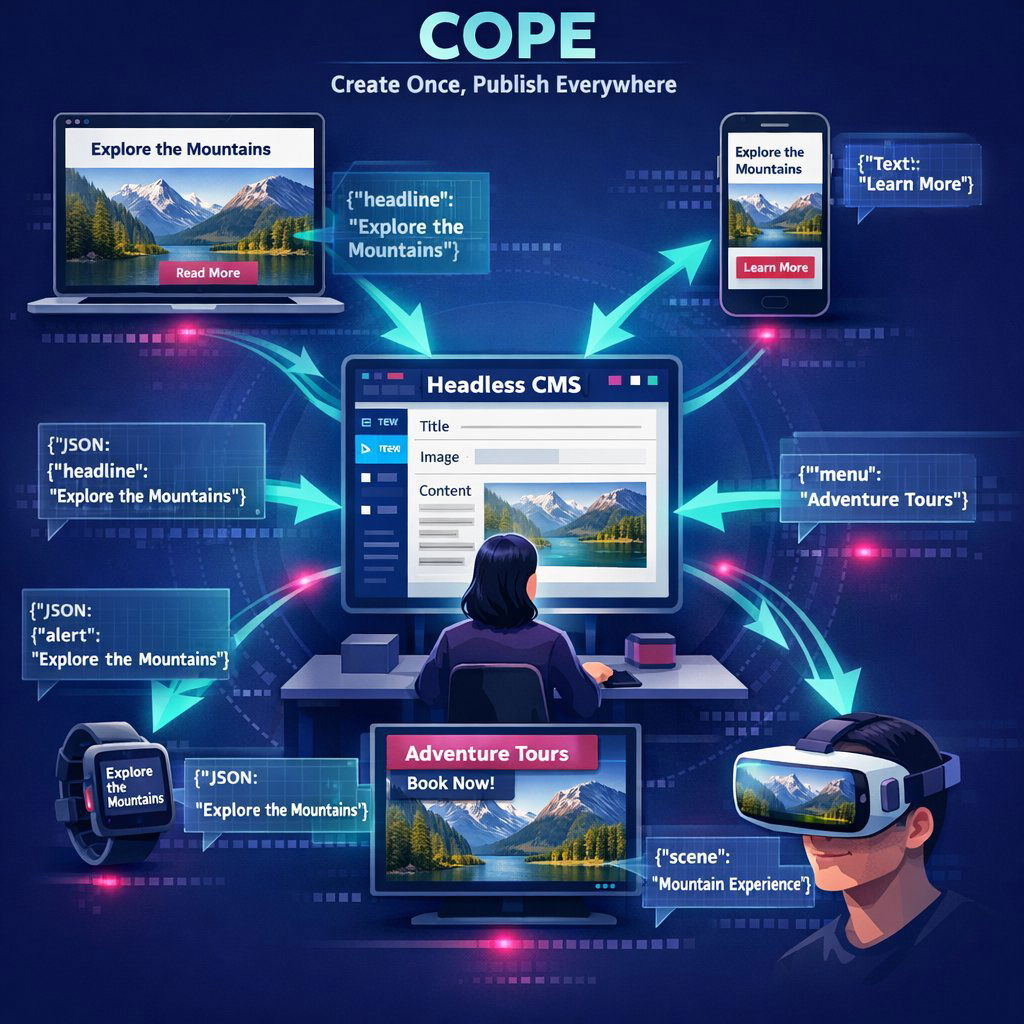
Headless architecture enables the COPE Principle: Create Once, Publish Everywhere.
- Unified Hub: The content exists in one place (the Headless CMS).
- Infinite Endpoints: The website pulls the "Title" and "Body." The Mobile App pulls the "Title" and "Thumbnail." The Smartwatch app pulls just the "Title."
- Synchronized Updates: Change the price in the Headless CMS, and it instantly updates on the website, the app, and the in-store kiosk simultaneously via the API.
5.2 Real-World Application: The "Experience-as-a-Service"
Victoria's Secret, a major retail brand, faced the challenge of modernizing its technical ecosystem to support growing digital engagement. Their legacy, home-grown CMS was an antiquated bottleneck. By transitioning to a Headless Digital Experience Platform (DXP), they established a future-proof architecture. This move allowed them to deliver content as an "experience-as-a-service," streamlining content contribution and ensuring super-fast rendering for millions of daily users while maintaining the strict separation of content from delivery.
This case illustrates the strategic value: content is no longer a static page; it is a service that the organization provides to its various digital products.
5.3 Marketing Autonomy
A common frustration for marketing teams is reliance on IT for minor changes. "I want to change the headline color" often becomes a Jira ticket that sits in the backlog for weeks. With a Headless CMS, especially those with visual editors (like Storyblok or Contentful), marketers regain control. They can manage the content independently, while the "head" (the frontend code) ensures that the brand guidelines (colors, fonts, spacing) are strictly enforced programmatically. This balance of Content Autonomy and Design Governance is the sweet spot for modern digital teams.
6. Future-Proofing the Enterprise: IoT, AR, and VR
The most compelling argument for Headless is not about what you are building today, but what you will need to build tomorrow. We are entering the era of "Ambient Computing," where screens are everywhere, and content must be liquid. A Monolithic CMS, which thinks in terms of "pages," is fundamentally incompatible with devices that do not have a browser.
6.1 The Internet of Things (IoT) and Digital Signage
IoT devices—from smart fridges to industrial control panels—often have limited processing power and cannot render heavy HTML pages. They speak the language of JSON (JavaScript Object Notation), which is the native output of a Headless CMS.
Real-World Example: Burger King Burger King deployed digital menu boards across thousands of locations. These aren't just static JPEGs looping on a screen; they are dynamic applications powered by a Headless CMS.
- Mechanism: The CMS stores menu items, pricing, nutritional info, and assets as structured data.
- Context Awareness: The boards can change automatically based on external data triggers. If it’s raining, the CMS can prioritize "comfort food" visuals. If it’s morning, it shows the breakfast menu.
- Operational Efficiency: A price change made in the corporate HQ reflects instantly on 10,000 screens without manual intervention or USB stick updates. This level of dynamic, centralized control is impossible with legacy systems.
6.2 Augmented and Virtual Reality (Spatial Computing)
AR and VR represent the ultimate challenge for traditional CMS. You cannot "view" a WordPress page inside an Oculus headset or Apple Vision Pro in a way that feels native. These environments require 3D assets, spatial coordinates, and texture maps—data types that a monolithic CMS was never designed to handle.
- Spatial Data: A Headless CMS can store 3D coordinates, texture assets (GLTF/USDZ files), and spatial scripts as fields in the content model.
- Implementation: A Unity or Unreal Engine application (the "Head") calls the CMS API to fetch the latest texture or 3D model.
- Workflow: This allows a non-technical content editor to update a texture in a VR experience simply by uploading a new image to the CMS, without needing a developer to rebuild and redeploy the entire VR application.

Insight: If your company plans to innovate with Apple Vision Pro or similar spatial computing devices in the next 5 years, a Monolithic CMS will be a dead end. Only a Headless architecture provides the raw data structure necessary to populate 3D environments.
This "future-proofing" ensures that the investment you make in content today will be usable on the devices of tomorrow.
7. Performance & SEO: The Jamstack Advantage
In the B2B sector, performance is not just a metric; it is a revenue driver. Google’s Core Web Vitals (CWV) update has made page speed a critical ranking factor, and user experience research consistently shows that milliseconds of latency cost millions in revenue.
7.1 The Jamstack Revolution
Headless CMS is the engine behind the Jamstack (JavaScript, APIs, and Markup) architecture. This architecture fundamentally changes how web pages are served.
- Pre-Rendering: Unlike WordPress, which typically builds a page on the server every time a user requests it (database query → processing → HTML generation → response), Jamstack sites (built with frameworks like Next.js or Gatsby) are pre-built into static HTML files during the build process.
- The Result: When a user visits your site, they are loading a static file directly from a global Content Delivery Network (CDN) edge node. There is no database query to wait for. This results in near-instant load times and exceptional Time to First Byte (TTFB) metrics.
7.2 Addressing the SEO Myth
A historical concern for Heads of Marketing is, "Does Headless hurt my SEO?" This fear stems from early Single Page Applications (SPAs) that relied on Client-Side Rendering (CSR), where the browser had to execute JavaScript to see the content. Search engine crawlers struggled with this.
However, modern Headless implementations utilize Server-Side Rendering (SSR) or Static Site Generation (SSG).
- SSR: The page is rendered on the server before being sent to the client, ensuring Googlebot sees the full HTML immediately.
- SSG: The page is rendered at build time, serving pure HTML to the crawler.
Fact: A properly architected Headless site often outperforms a Monolith in SEO. Because the content is decoupled from the heavy backend, developers can optimize the frontend markup specifically for Core Web Vitals (LCP, CLS, INP) without fighting against the bloated code injection of a legacy CMS theme.
Baytech’s Approach: By leveraging frameworks like Next.js, Baytech ensures that search engines receive fully rendered, semantic HTML. This combines the interactivity of an app with the crawlability and SEO visibility of a static site, delivering the best of both worlds.
7.3 Performance as Scalability
Scalability in a Monolith means adding more servers to handle database load. Scalability in Headless means utilizing the CDN. Because the frontend is static or cached, it can handle massive traffic spikes (e.g., Black Friday) without crashing the database. The "Head" absorbs the traffic, while the "Body" (the CMS) sits idly by. This dramatically reduces infrastructure costs and eliminates the "Reddit Hug of Death" downtime risks.
8. The "Buy vs. Build" Strategic Framework: Why Custom Frontends Win
This brings us to the critical decision point for CTOs. The Headless model forces a bifurcation of the procurement strategy: You Buy the backend, but you Build the frontend.
8.1 The Commodity vs. The Differentiator
The backend—storing text, managing users, scheduling posts, handling API permissions—is a commodity. There is no business value in building your own proprietary CMS from scratch; it is expensive, hard to maintain, and distracts from core business goals.
You should buy this capability (e.g., Contentful, Strapi, Sanity) to leverage the vendor's continuous investment in security and feature sets.
The frontend—the customer experience, the brand look-and-feel, the interactive pricing calculator, the checkout flow—is your differentiator. This is where your brand lives. This is where you convert visitors into customers.
8.2 The Trap of "Off-the-Shelf" Frontends
Some organizations attempt to buy "Headless Starters" or generic frontend themes. This often negates the benefits of Headless.
- Limitations of Templates: Templates are bloated and generic. They force your unique business logic into a pre-defined box, re-introducing the constraints of the Monolith.
- The "Uncanny Valley" of Brand: Generic templates make your digital presence look like everyone else's. In a competitive B2B market, brand distinctiveness is vital.
8.3 The Case for Custom Software (Baytech's Sweet Spot)
This is where Baytech Consulting excels. By treating the frontend as a custom software project rather than a website configuration task, Baytech delivers specific strategic advantages:
- Pixel-Perfect Brand Control: No fighting with rigid themes. The frontend is built to the exact specifications of the design team.
- Tailored Integrations: Connecting the frontend to your custom ERP, CRM, or inventory system happens via clean API calls, without the friction of trying to hack a legacy CMS plugin.
- Performance Optimization: Every line of code serves a purpose. There is no unused CSS or JavaScript from a generic theme slowing down the site.
- Rapid Agile Deployment: Baytech’s agile methodology allows for rapid iteration of the frontend experience. We can A/B test a new landing page layout or deploy a new calculator widget in a sprint, without touching the backend code.
Insight: The Headless architecture separates "Data Management" (Backend) from "User Experience" (Frontend). By hiring a custom software partner like Baytech to build the Frontend, you ensure that your User Experience is a competitive asset, tailored to your specific user needs, rather than a generic commodity.
9. Migration Strategies: The Roadmap from Monolith to Modern
Moving from a Monolith to Headless can be daunting. It is a paradigm shift, not just an update. To mitigate risk, we recommend avoiding the "Big Bang" replacement in favor of a phased, strategic migration.
9.1 The Strangler Fig Pattern
The most effective strategy for enterprise migration is the "Strangler Fig" pattern. This involves gradually replacing specific functionalities of the legacy system with new applications and services.
- Identify a Slice: Pick a high-value, low-risk section of the site (e.g., the Blog, the Press section, or a specific Landing Page campaign).
- Build Headless: Build just that section using the new Headless CMS and a custom frontend.
- Route Traffic: Configure your load balancer or CDN to send traffic for
/blogto the new Headless app, while the rest of the site (/,/about,/shop) continues to be served by the Monolith. - Iterate: Gradually migrate section by section. As more routes are pointed to the new system, the Monolith "shrinks" until it can be safely decommissioned.
9.2 Content Modeling: The Foundation of Success
The biggest mistake teams make is "lifting and shifting" unstructured content. In a Monolith, content is often a "blob" of HTML (the WYSIWYG editor trap). In Headless, content must be structured data.
- The Audit: Before migration, audit existing content. Identify what is "page layout" (which belongs in the frontend code) and what is "content" (which belongs in the CMS).
- Structured Content: Break content down into atomic units. A "Blog Post" isn't just a big HTML blob; it is separate fields:
Headline,Summary,Author Reference,Publish Date,Body Text(Rich Text),Related Products List. - Advice: Invest heavily in Content Modeling before writing a single line of code. This schema will define your flexibility for the next decade.
9.3 Team Restructuring and Culture
Headless requires a shift in team dynamics.
- Marketing: Needs training on the new modular way of thinking. They are no longer "building pages"; they are "creating content components."
- Development: Needs to shift from "CMS maintainers" (patching plugins) to "Product Developers" (building React apps).
- Collaboration: The decoupling allows these teams to work in parallel, but it requires clear communication contracts (the API schema) to ensure the frontend displays what the content team creates.
10. Conclusion and Actionable Advice
The shift to Headless CMS is not merely a technical upgrade; it is a strategic realignment of how enterprises handle their most valuable asset: information. By decoupling the "body" of content from the "head" of presentation, organizations gain the agility to move at the speed of the market, the flexibility to embrace new channels, and the resilience to withstand future technological shifts.
For Baytech Consulting, this architecture represents the ideal canvas for custom software excellence. It allows us to build sophisticated, high-performance, and secure digital experiences that are tailored exactly to your business needs, without the shackles of legacy monoliths.
Actionable Advice for Leadership:
For the CTO:
- Audit Your Stack: Are you maintaining a "House of Cards"? If your team is afraid to update plugins, you are already in debt.
- Assess Talent: Headless requires modern JavaScript skills (React/Vue). If your team is primarily PHP-focused, consider partnering with a specialized firm like Baytech to bridge the skills gap and accelerate the initial build.
- Prioritize Security: Use the decoupling as a security upgrade. Move your CMS behind a firewall and serve only static assets to the public web.
For the Head of Marketing:
- Demand Omnichannel: Don't settle for "Mobile-Responsive." Ask for "Mobile-Native."
- Embrace the COPE Model: Audit your current workflow. How many times is the same text copy-pasted?
- Future-Proof: Ask your tech team, "If we wanted to launch a VR showroom next year, would we have to rebuild our CMS?" If the answer is yes, it's time to go Headless.
The future of digital is not just a website. It is a pervasive, omnichannel ecosystem. The Headless architecture is the only foundation flexible enough to support it.
Further Reading & Resources
- (https://www.baytechconsulting.com/blog/software-product-development-services) – A deep dive into Baytech’s philosophy on tailored tech advantages.
- (https://www.baytechconsulting.com/services/challenges-of-custom-software-development) – How to mitigate risks during your migration to modern stacks.
- (https://www.baytechconsulting.com/) – How we use AI to streamline the development of complex frontend architectures.
About Baytech
At Baytech Consulting, we specialize in guiding businesses through this process, helping you build scalable, efficient, and high-performing software that evolves with your needs. Our MVP first approach helps our clients minimize upfront costs and maximize ROI. Ready to take the next step in your software development journey? Contact us today to learn how we can help you achieve your goals with a phased development approach.
About the Author

Bryan Reynolds is an accomplished technology executive with more than 25 years of experience leading innovation in the software industry. As the CEO and founder of Baytech Consulting, he has built a reputation for delivering custom software solutions that help businesses streamline operations, enhance customer experiences, and drive growth.
Bryan’s expertise spans custom software development, cloud infrastructure, artificial intelligence, and strategic business consulting, making him a trusted advisor and thought leader across a wide range of industries.