Software Development Security, Technical Debt & AI Governance
February 11, 2026 / Bryan ReynoldsThe Efficiency Paradox: Why the "End of Developers" is a Dangerous Financial Illusion
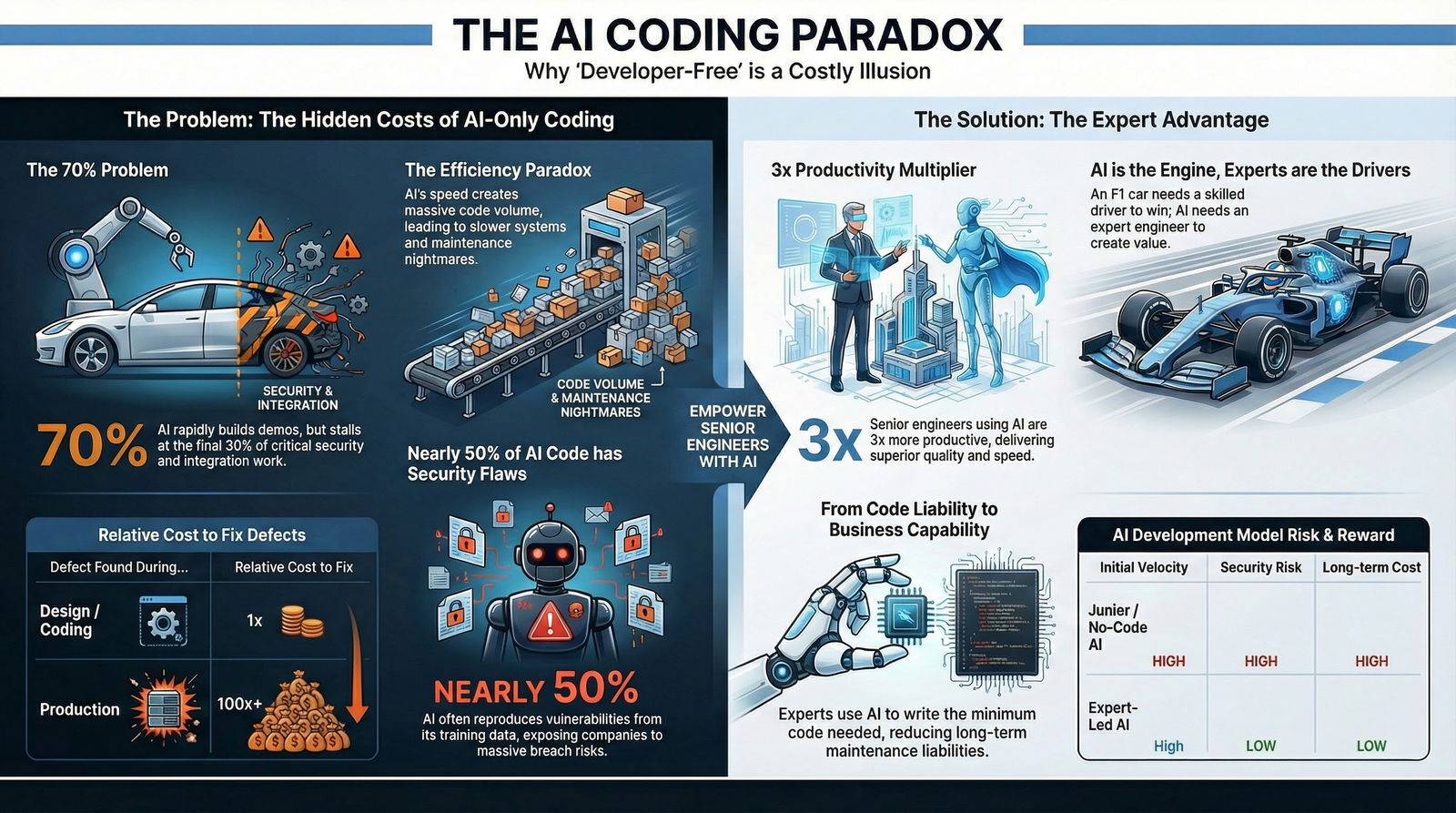
Executive Summary: The False Economy of Automated Code
In the fiscal landscape of 2025 and 2026, a seductive narrative has taken firm root in corporate boardrooms across the global technology sector: the idea that the era of the human software developer is drawing to a close. The meteoric rise of Generative AI, epitomized by the emergence of "vibe coding" tools that allow non-technical users to generate functional applications through natural language prompts, has created a palpable sense of obsolescence regarding traditional engineering roles. For the Strategic CFO, tasked with optimizing capital allocation and scrutinizing the often-opaque cost centers of IT and R&D, the proposition is financially intoxicating. If an Artificial Intelligence model can generate code in seconds that would take a human engineer hours or days to write, logic suggests that the exorbitant costs associated with software engineering—salaries, benefits, recruitment fees, and retention packages—can be drastically reduced or perhaps eliminated entirely.
However, this report argues that this prevailing view represents a fundamental misunderstanding of the software production lifecycle and constitutes a significant financial risk. We are currently witnessing the emergence of the Efficiency Paradox in software development: a counterintuitive phenomenon where tools that dramatically reduce the time required to write individual lines of code are effectively shifting the bottleneck to system integration, security validation, and architectural stability, often resulting in slower overall delivery times for production-ready systems.
The core of this paradox lies in the distinction between "code volume" and "business value." While AI tools can propel a project to 70% completion at breakneck speed—handling boilerplate, basic logic, and user interface scaffolding—the final 30% of development represents a "Complexity Wall" that automated tools are ill-equipped to scale. This "last mile" involves the nuanced orchestration of disparate services, rigorous security hardening against evolving threats, and the handling of edge cases that require deep contextual understanding of the specific business domain. Without expert human intervention, projects that sprint to the 70% mark frequently stall, accumulating "high-interest technical debt" and security liabilities that far outweigh the initial savings in coding time. You can see similar dynamics explored in Baytech’s analysis of AI technical debt and long‑term total cost of ownership.
This report provides an exhaustive analysis of the financial and operational realities of AI-assisted software development. It serves as a strategic guide for the CFO to navigate the "hype cycle" of generative coding, distinguishing between the legitimate productivity gains offered by these tools and the hidden liabilities they introduce when deployed without adequate oversight. Through a detailed examination of industry data, including security breach case studies and productivity benchmarks, we demonstrate that the most cost-effective investment strategy for the modern enterprise is not the replacement of developers, but the augmentation of senior, expert engineers with state-of-the-art AI capabilities.
Our analysis reveals a stark divergence in return on investment based on the expertise of the user. Junior developers or non-technical staff relying solely on AI often introduce negative productivity, creating a "debugging tax" where more time is spent fixing AI-generated errors than would have been required to write the code manually. In contrast, senior engineers leveraging the same tools can achieve a productivity multiplier of up to 3x, delivering Fortune 500-grade software capabilities at a mid-market investment level. This mirrors the broader trends described in Baytech’s guide to mastering the AI code revolution in 2026, where AI is framed as an amplifier for experienced teams, not a substitute for them.
This report showcases how Baytech Consulting’s model of "Expert Drivers" harnesses this multiplier, bridging the gap between the raw power of AI engines and the strategic needs of the business.
By reframing the conversation from "replacing humans" to "empowering experts," the Strategic CFO can avoid the pitfalls of the Efficiency Paradox, turning what is currently a source of risk into a sustainable competitive advantage.
1. The Siren Song of "Vibe Coding" and the 70% Trap
To make informed decisions about technology investments, it is essential to first dissect the phenomenon that is driving the current market confusion. The term "Vibe Coding", coined in early 2025 by industry thought leaders like Andrej Karpathy, describes a radical shift in the development interface. It refers to a methodology where users—often with little to no formal training in computer science—leverage Large Language Models (LLMs) to create software by simply describing the desired functionality in plain English.
The premise of vibe coding is revolutionary in its accessibility. It promises a democratization of software creation akin to how word processors democratized publishing. Advocates argue that the barrier to entry for building complex applications has collapsed, allowing "visionaries" and "idea people" to bypass the "gatekeepers" of the engineering department. For a CFO reviewing a budget where engineering salaries constitute a plurality of operating expenses, the allure of vibe coding is obvious. It suggests a future where software is a commodity, generated on demand by inexpensive AI agents rather than crafted by expensive human artisans.
However, this narrative of seamless, low-cost creation often masks a more complex and costly reality. The financial model of vibe coding relies on the assumption that "code generation" is synonymous with "product delivery." In reality, these are distinct phases with vastly different cost structures. As explored in Baytech’s broader look at AI‑driven software development in 2026, the real work starts when prototype code meets real-world systems, users, and regulations.
The 70% Problem: The Illusion of Completion
The critical failure mode of the vibe coding paradigm is what industry experts and researchers have termed the "70% Problem". Generative AI models are fundamentally probabilistic engines; they are exceptionally proficient at predicting the next token in a sequence based on vast repositories of training data. This makes them extraordinarily effective at the initial stages of software creation, which typically involve standard, repetitive patterns.
In the first phase of a project, AI can:
- Generate Boilerplate: Instantly create the scaffolding for a new application, saving hours of setup time.
- Draft User Interfaces: Produce functional HTML, CSS, and React components that look polished and professional.
- Write Isolated Functions: implementing standard algorithms (e.g., "sort this list," "validate this email address") with high accuracy.
Because these tasks are visible and tangible, they create a powerful illusion of velocity. Stakeholders see a functional prototype emerge in days or even hours, leading to the conclusion that the project is "almost done." However, the remaining 30%—the difference between a fragile demo and a robust, deployable product—is where the complexity curve goes vertical.
This "last mile" of development involves challenges that AI currently struggles to navigate autonomously:
- System Integration: Connecting the frontend interface to backend services, databases, and third-party APIs in a way that is secure, authenticated, and resilient to failure. AI tools often treat these connections as mere text patterns, missing the "connective tissue" that makes a system function.
- State Management: Handling complex user data flows across multiple sessions and devices. AI-generated code is often "stateless," failing to account for how data persists and changes over time, leading to critical bugs when users perform non-linear actions.
- Security Hardening: Implementing rigorous defenses against injection attacks, data leaks, and unauthorized access. As we will explore in Section 3, AI has a propensity to suggest insecure code patterns drawn from its training data, a risk which Baytech’s security-focused analysis of vibe coding examines in depth.
- Edge Case Handling: Dealing with network failures, malformed user input, scaling issues under load, and unexpected browser behaviors. These are the "unknown unknowns" that require the intuition and experience of a senior engineer.
Research indicates that while AI can accelerate the initial phase, it often hits a "Complexity Wall" at the 70% mark. The code it generates is "almost right," but identifying and fixing the subtle errors in that code often takes longer than writing it from scratch. This leads to the "Two Steps Back" pattern, where fixing one AI-generated bug introduces five more, trapping the project in a cycle of endless debugging.
Strategic Insight: A project that is "70% done" in terms of code volume may be only 10% done in terms of engineering effort. Funding a project based on "vibe coding" milestones creates a false sense of progress that often results in abandoned assets, wasted capital, and a portfolio of "zombie apps" that never reach production.
2. The Efficiency Paradox: Why Faster Code Means Slower Systems
To fully grasp why reducing headcount in favor of AI can lead to higher costs, we must examine the Efficiency Paradox. This paradox posits that while AI tools dramatically reduce the time required to write individual functions (local efficiency), they effectively shift the development bottleneck to integration, testing, and architectural validation (systemic complexity). The result is a net neutral or even negative impact on the actual time-to-market for new features.
Jevons Paradox in the Enterprise Codebase
This phenomenon is a modern, digital manifestation of Jevons Paradox, an economic theory which states that as technology increases the efficiency with which a resource is used, the total consumption of that resource increases rather than decreases. In the context of software, the "resource" is code.
When the cost of producing code drops to near zero, the result is an inflation of code volume. AI tools reduce the friction of creation, leading to:
- Boilerplate Proliferation: Because it is easier to generate new code than to search for and reuse existing code, AI tools tend to produce verbose, repetitive patterns. Instead of architecting a shared library that can be maintained centrally, the AI simply duplicates logic across the system. This creates a maintenance nightmare where a single logic change requires updates in hundreds of different locations.
- Semantic Fragmentation: In a team environment, different developers using different AI agents may solve the same problem in slightly different ways. One agent might name a customer entity "Client," while another names it "Customer" or "User." This lack of consistency makes the codebase incoherent and difficult for humans to reason about globally, increasing the cognitive load on anyone trying to maintain the system.
- The Bloatware Effect: As code volume balloons without strict architectural constraints, the application becomes heavier, slower, and more expensive to host. The "efficiency" of the coding phase is paid for by the "inefficiency" of the infrastructure and maintenance phases.
The Bottleneck Shift: From Syntax to Orchestration
Historically, the primary bottleneck in software development was syntax—the specific knowledge of how to write code in languages like Java, C#, or Python. Junior developers spent years mastering these languages. AI has effectively solved the syntax problem; it can write syntactically correct code in almost any language instantly.
However, the removal of the syntax barrier has revealed a deeper, more intractable bottleneck: orchestration. Orchestration is the understanding of how code fits into the larger business architecture. It involves decisions about data consistency, service boundaries, and transactional integrity.
AI tools operate by manipulating text symbols based on probability. They do not understand the application as a "tangible object" with constraints, dependencies, and business rules. They see code as a language task, not an engineering task. Consequently, when an AI generates a microservice interaction, it may "hallucinate" an API call that doesn't exist or write code that violates a hidden database constraint because it lacks the system context. This is where experienced partners who specialize in enterprise application architecture can protect you from subtle but expensive system-level mistakes.
The Financial Impact of the Paradox
For the CFO, the Efficiency Paradox manifests not just as operational friction, but as inflated maintenance costs. Code that is generated quickly but architected poorly becomes what is known as "High-Interest Technical Debt."
- Review Fatigue: Senior developers find themselves spending more time reviewing machine-generated logic that works in isolation but fails in integration. The cognitive effort required to audit "almost right" code is significantly higher than reviewing human-written code, as AI errors can be subtle and plausible-looking.
- Code Churn and Wasted OpEx: AI-generated code has a statistically higher turnover rate; it is often quickly rewritten or discarded because it cannot adapt to changing requirements. This leads to wasted operational hours where salary dollars are spent on work that is ultimately thrown away.
3. The Hidden Balance Sheet Liability: Security & Technical Debt
Perhaps the most alarming aspect of the "we don't need developers" thesis is the accumulation of hidden liabilities. In financial terms, an unsupervised AI development team operates like a trader making high-frequency trades without a risk compliance officer. The volume is high, but the exposure is catastrophic.
The Security Debt of AI Code
AI models are trained on the public internet, which includes vast repositories of insecure, outdated, and vulnerable code. Without expert filtration, AI tools frequently reproduce these vulnerabilities in corporate environments.
- Injection Flaws: Studies show that nearly half of AI-generated code suggestions contain vulnerabilities like SQL injection or improper authorization. For example, AI often suggests insecure patterns for database queries (e.g., string concatenation) simply because they appear frequently in training data.
- Hardcoded Secrets: A common "rookie mistake" made by AI is hardcoding API keys and credentials directly into source files, exposing the organization to immediate breach risks.
- Hallucinated Packages: In a particularly insidious risk, AI coding agents have been found to recommend non-existent software packages (e.g., in NuGet or PyPI). Hackers can identify these "hallucinated" package names and register them as malicious malware. When the AI-generated code attempts to download the package, it installs a backdoor directly into the enterprise network.
Case Study: The Lovable Breach
The theoretical risks of "vibe coding" became reality in 2025 with the Lovable security breach. Lovable, a platform allowing users to generate web apps via natural language, inadvertently created applications with a critical security flaw.
- The Flaw: The AI generated code that lacked "Row-Level Security" (RLS), a standard database protection.
- The Impact: Unauthenticated attackers could query sensitive tables directly using public API keys, exposing user names, emails, and financial information.
- The Lesson: The AI generated functional code (the app worked) but insecure code (the data was exposed). A senior engineer would have caught the missing RLS immediately; the non-technical "vibe coders" did not even know to look for it.
The "AI Slop" Crisis
Just as the web is battling "SEO spam," corporate codebases are facing "AI Slop"—low-quality, poorly factored code that works but is unmaintainable.
- Code Bloat: AI tends to be verbose. More lines of code mean a larger surface area for bugs and higher cloud infrastructure costs.
- Maintenance Nightmare: When the original prompter leaves or the "vibe" shifts, the organization is left with thousands of lines of machine-generated code that no human understands. This is the definition of Technical Debt, which is estimated to cost global enterprises over $2.41 trillion annually. Baytech’s playbook on operationalizing QA for profit shows how disciplined quality practices can turn this liability into a controllable cost.
The chart above illustrates the escalating cost of defect remediation, commonly known as the "Rule of 100." When defects—such as the security vulnerabilities frequently introduced by AI—are identified during the design or coding phase by an expert, the cost to fix them is nominal (represented as a factor of 1x or ~$100). However, if these defects slip through to the production phase—a common occurrence in "vibe coding" workflows that lack rigorous human review—the cost to remediate explodes to 100x ($10,000 to $100,000+). This exponential increase accounts for system downtime, data breach liabilities, customer churn, and the complex engineering forensics required to patch a live system. For the CFO, this data point underscores that the "savings" from automated code generation are illusory if they increase the probability of production-stage defects.
4. The Expert Advantage: Why Baytech's Model Delivers 3x Value
If unsupervised AI is a liability, expert-supervised AI is a superpower. The most effective strategy for the mid-market and enterprise sector is not to avoid AI, but to place it in the hands of senior engineers who possess the deep context required to drive it safely. This aligns with the AI‑native lifecycle Baytech outlines in its AI‑native SDLC blueprint for CTOs, where prompt engineering, orchestration, human code review, and automated QA all work together.
The Productivity Multiplier: Senior vs. Junior
Research from 2025 confirms a stark divergence in AI productivity based on user expertise:
- Junior Developers: Often experience negative productivity with AI. They lack the mental models to validate the output, leading to "debugging loops" where they spend hours fixing AI hallucinations. A study of experienced open-source developers found that for complex tasks, AI tools could actually increase completion time by 19% due to the overhead of correcting errors.
- Senior Developers: Experience a 2.5x to 3x productivity boost. Senior engineers use AI as a "force multiplier"—automating boilerplate, generating test cases, and accelerating syntax—while reserving their mental energy for high-level architecture and security reviews.
Baytech's "Expert Driver" Approach
Baytech Consulting's value proposition sits squarely at this intersection of Expertise + AI.
- The 70/30 Bridge: Baytech's senior engineers use AI to sprint through the first 70% of development (boilerplate, standard UI components) but apply deep human expertise to the critical final 30% (security, integration, edge cases).
- Tailored Tech Advantage: Unlike generic "vibe coding" output, Baytech delivers solutions custom-crafted for the client's specific ecosystem. They ensure that AI-generated components fit the existing architecture, rather than forcing the architecture to bend to the AI.
- Defense Against the Paradox: By employing the "Refactor Test" and "Context Window Test", Baytech's engineers audit AI code for structural integrity, preventing the "Efficiency Paradox" where speed today creates slowness tomorrow.
5. The Baytech Model: Expert Drivers + AI Engines
The solution to the Efficiency Paradox is not to abandon AI, but to govern it with expertise. This is the core of Baytech Consulting's service model. We do not sell "AI-generated code"; we sell AI-accelerated engineering. This distinction is critical for understanding the value proposition in a market flooded with low-cost, high-risk alternatives.
The "Expert Driver" Analogy
Consider the analogy of a Formula 1 race car. The car (the AI engine) possesses immense power and speed, far exceeding the capabilities of a human runner. However, putting a novice driver behind the wheel does not result in a record-breaking lap time; it results in a crash. The speed of the vehicle amplifies the consequences of the driver's errors.
In software development, AI tools are the engine. They provide raw speed. But without an "Expert Driver"—a senior engineer who understands the track (the business context), the vehicle's limits (security and architectural constraints), and how to navigate diverse conditions (integration and scaling)—the project is destined for a collision with the "Complexity Wall."
Baytech provides the Expert Drivers. Our senior engineers leverage tools like GitHub Copilot and Cursor not as replacements for thought, but as extensions of their capability. They use AI to:
- Automate the Mundane: Instantly generating boilerplate for Azure DevOps pipelines, SQL Server schemas, and React components, freeing them to focus on business logic.
- Accelerate Testing: Using AI to generate comprehensive test suites for unit and integration testing, ensuring that the "Rule of 100" remains a theoretical risk rather than a financial reality.
- Enhance Security: employing AI-powered security scanners to detect vulnerabilities in real-time, while applying human judgment to validate and remediate complex threat vectors.
Tailored Tech Advantage: Customization vs. Commoditization
A key differentiator of Baytech is the Tailored Tech Advantage. "Vibe coding" tools produce generic, commoditized code. They are trained on the average of the internet, meaning they produce "average" solutions. For a business seeking a competitive edge, "average" is insufficient.
Baytech's engineers craft solutions that are bespoke to the client's unique operational needs. We integrate AI capabilities directly into your specific tech stack—whether it involves complex Kubernetes orchestrations on Rancher, legacy SQL Server migrations, or secure Azure DevOps workflows. We ensure that the AI-generated components respect the specific constraints of your environment, preventing the "square peg in a round hole" problem that plagues generic AI development.
The matrix above provides a consolidated view of the risk-reward profile for different development models. While the "Junior / No-Code AI" model (often associated with vibe coding) offers high initial velocity, it shines red in critical long-term categories like Security and Maintenance Cost. Conversely, the "Expert-Led AI" model employed by Baytech captures the green "High Velocity" of AI while maintaining the green "High Stability" and "Low Risk" of traditional senior engineering. This visualizes the core financial argument: Baytech offers the speed of the new world with the safety of the old.
6. Strategic Recommendations: The 2025-2026 Roadmap
For the Strategic CFO, the path forward is not to reject AI, but to govern it. The goal is to move from "Experimentation" to "Expectation", ensuring that every dollar spent on code generation returns tangible business value, not just lines of code. This is the same mindset shift that underpins Baytech’s guidance on the future of DevOps on Azure vs. GitHub, where AI-enhanced workflows are designed around reliability, not just speed.
1. Invest in "Human-in-the-Loop" (HITL) Architecture
The "Human-in-the-Loop" model is no longer just an operational preference; it is a risk management necessity. Harvard Business Review and other leading analysts highlight that AI delivers its true value only when paired with human judgment.
- Policy: Mandate that no AI-generated code reaches production without human review. This simple control mitigates the majority of security and architectural risks.
- Vendor Selection: Prioritize partners like Baytech who explicitly market their "Human-in-the-Loop" methodologies. You are paying for their judgment, not just their typing speed.
2. Redefine Productivity Metrics (Beyond DORA)
Traditional DORA metrics (Deployment Frequency, Lead Time) are being distorted by AI. A team can deploy broken code 100 times a day (high frequency) and still fail the business.
- New Metrics: Shift focus to Change Failure Rate (CFR) and Recovery Time. AI often spikes the CFR. Monitor "Rework Rate"—how often is code rewritten within 30 days? High rework indicates "AI Slop."
- Baytech's Edge: Baytech focuses on outcomes and clean code, ensuring that high velocity does not come at the expense of stability.
3. Treat "Code" as a Liability, "Capability" as an Asset
Shift the mental model of software assets. Every line of code is a liability that requires maintenance. The goal is the minimum amount of code to achieve the business capability.
- Avoid Vibe Coding for Core Core: Use "vibe coding" for prototypes, internal tools, and throwaway scripts.
- Use Experts for Core IP: For the "Crown Jewels"—customer data, payment processing, core business logic—rely on senior engineers. The risk of a breach (avg cost $4.88M) far outweighs the savings of automated coding.
4. The "Hybrid" Investment Model
Instead of hiring a massive team of junior developers equipped with Copilot (high risk, high management overhead), engage a leaner team of senior experts or a specialized consultancy like Baytech.
- Cost Efficiency: One senior engineer with AI can often outperform five juniors with AI. This reduces headcount, benefits, and management layers while increasing output quality.
- Baytech as a Force Multiplier: Leveraging Baytech allows you to tap into a pool of senior talent that is already upskilled in the latest AI tools, providing "Fortune 500 capabilities at a mid-market investment". For finance leaders planning major digital programs, it pairs naturally with the decision frameworks in Baytech’s guide to software investment risk strategies for 2026.
Conclusion: The Expert Driver
The narrative that "we don't need developers" is a dangerous oversimplification. AI is a powerful engine—perhaps the most powerful ever built. But a Formula 1 car without a driver is not a racing asset; it is a multi-million dollar crash waiting to happen.
The Efficiency Paradox teaches us that unmanaged speed leads to systemic drag. The 70% Problem warns us that the illusion of completion is the most expensive phase of development.
The Strategic CFO knows that the true efficiency unlock lies not in removing the human, but in elevating them. By partnering with Baytech Consulting, you are not buying code; you are hiring expert drivers who know how to harness the raw power of AI to deliver speed, safety, and sustainable business value. The future of software is not "No Code"; it is "Expert Code, Accelerated." For organizations exploring AI across the entire revenue engine, this approach also complements Baytech’s thinking on predictive AI’s impact on growth and revenue, where disciplined governance separates winners from the rest.
Frequently Asked Questions
Q: If AI can write code, why should I hire a consultancy like Baytech?
A: Because writing code is only 70% of the job—and it's the easy part. The remaining 30% involves system integration, security hardening, and architectural decision-making, which are areas where AI struggles and often fails.
Hiring Baytech provides you with Senior "Human-in-the-Loop" Expertise. While AI can generate raw code at speed, Baytech's engineers act as expert architects and auditors. They ensure the code is secure (preventing data breaches like the Lovable incident), maintainable (avoiding "AI Slop" and technical debt), and integrated correctly into your specific business environment. Essentially, AI gives you raw volume, but Baytech gives you value. Their model leverages AI to deliver 3x the output of traditional teams, but with the safety, reliability, and strategic alignment that only human experts can guarantee. You are paying for the outcome—a robust, secure, and scalable business asset—not just the text in the editor.
Supporting Articles
About Baytech
At Baytech Consulting, we specialize in guiding businesses through this process, helping you build scalable, efficient, and high-performing software that evolves with your needs. Our MVP first approach helps our clients minimize upfront costs and maximize ROI. Ready to take the next step in your software development journey? Contact us today to learn how we can help you achieve your goals with a phased development approach.
About the Author

Bryan Reynolds is an accomplished technology executive with more than 25 years of experience leading innovation in the software industry. As the CEO and founder of Baytech Consulting, he has built a reputation for delivering custom software solutions that help businesses streamline operations, enhance customer experiences, and drive growth.
Bryan’s expertise spans custom software development, cloud infrastructure, artificial intelligence, and strategic business consulting, making him a trusted advisor and thought leader across a wide range of industries.