Build Your AI Team of Autonomous Bots 2026
February 20, 2026 / Bryan Reynolds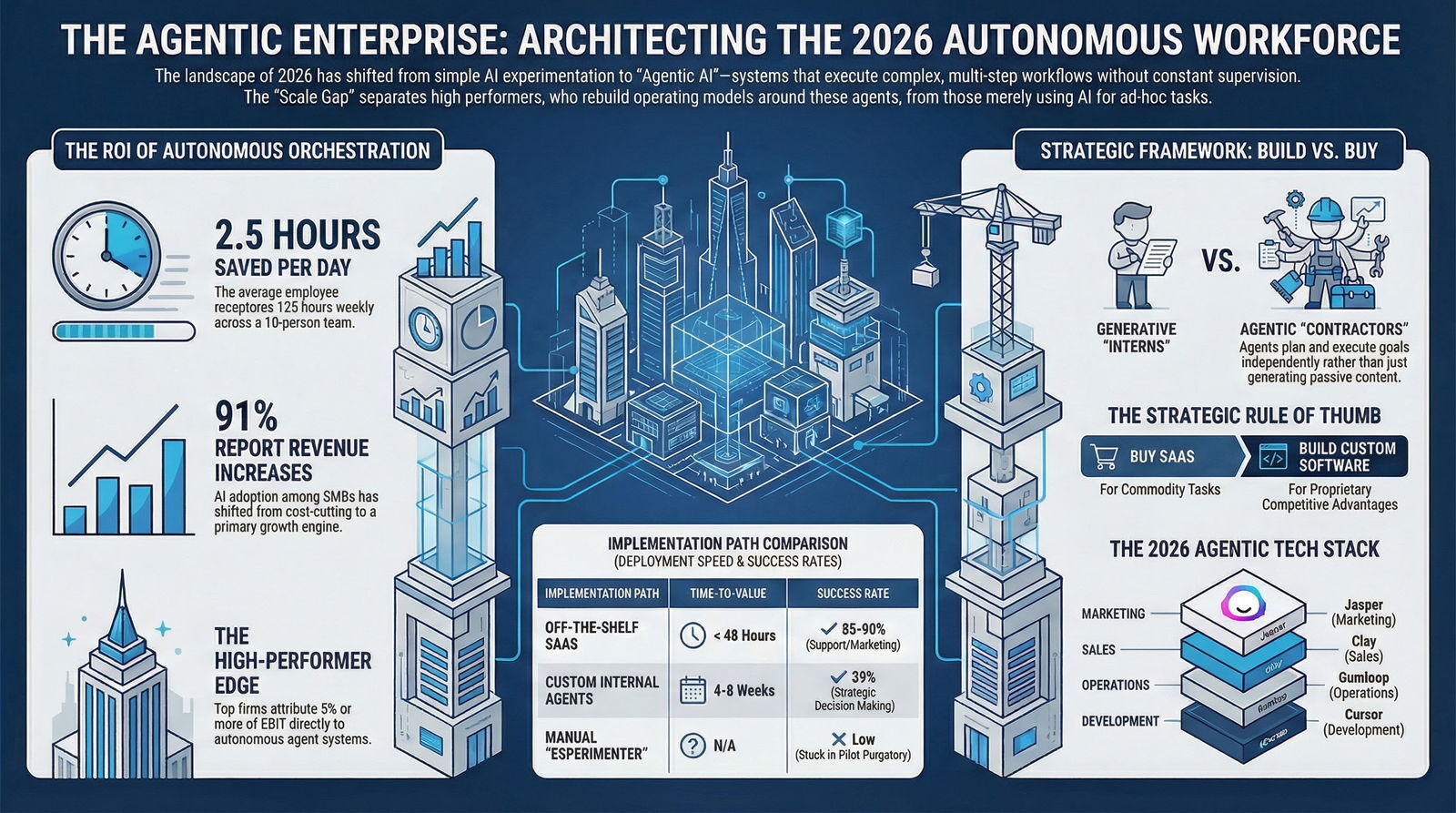
The Agentic Enterprise: A Definitive Guide to AI Bots, Tools, and Assistants for Entrepreneurs in 2026
Introduction: The Year the "Pilot" Died
If 2023 was the year of awe and 2024 was the year of experimentation, 2026 is unequivocally the year of orchestration. For the B2B executive—the CTO managing technical debt, the CFO scrutinizing SaaS sprawl, or the Founder seeking exit velocity—the conversation has shifted fundamentally. We are no longer asking if artificial intelligence can generate a poem or summarize an email. The novelty of "chatting" with a bot has faded, replaced by a sharper, more practical demand: Can this agent execute a complex, multi-step workflow without my constant supervision?
The entrepreneurs winning in 2026 are not "power users" of ChatGPT. They are system architects. They are assembling diverse "teams" of AI agents—some for coding, some for outreach, some for data analysis—and orchestrating them into a cohesive digital workforce. This shift mirrors the broader patterns described in AI-driven software development in 2026, where success depends less on any single tool and more on how well leaders design the overall system.
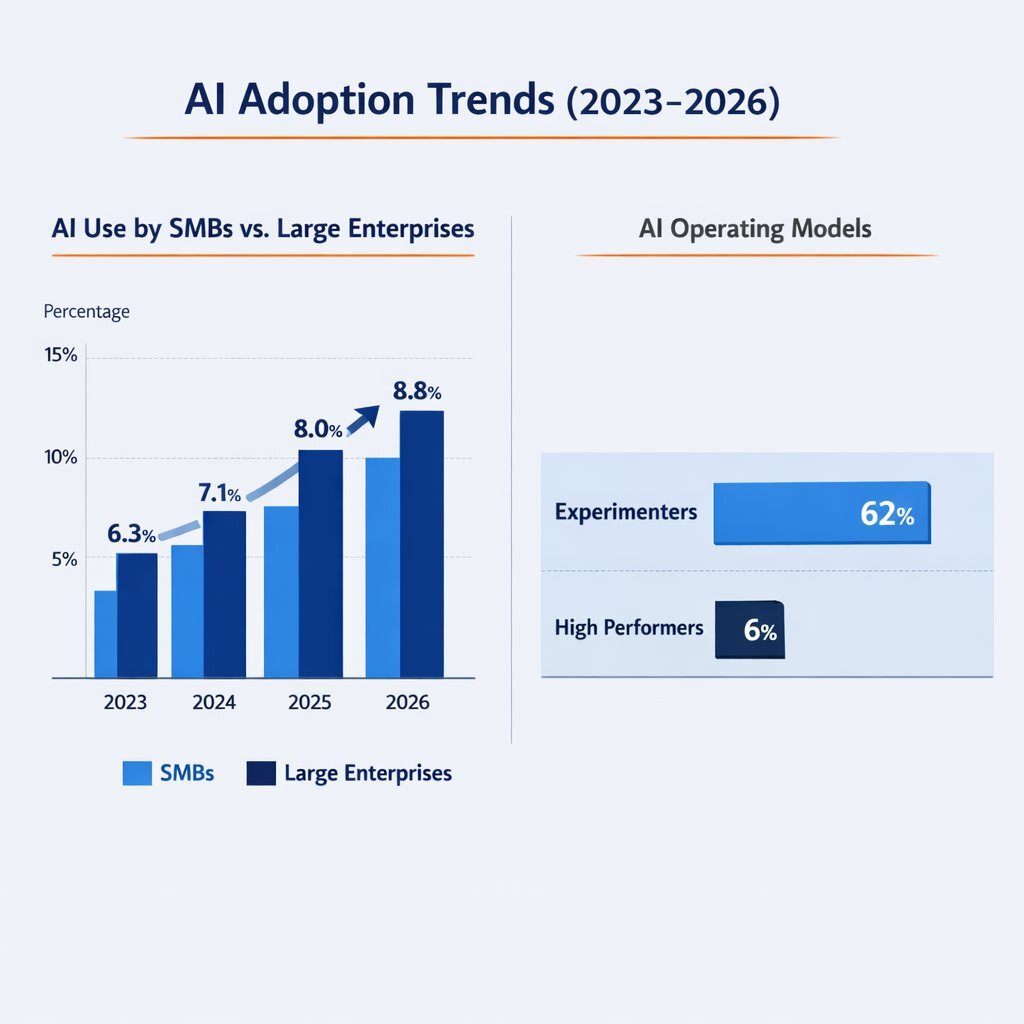
This shift is not merely anecdotal; it is structural. The "Scale Gap" is the new digital divide. On one side are the "Experimenters" (62% of firms) who use AI for ad-hoc tasks. On the other are the "High Performers" (6% of firms) who have rebuilt their entire operating models around autonomous agents, attributing 5% or more of their EBIT directly to these systems.
This report serves as a strategic compass for that transition. We have analyzed the landscape to weed out the noise—the "wrapper" startups and the vaporware—to focus strictly on what works. We will explore the rise of "Agentic AI"—systems that don't just talk, but do—and analyze the critical strategic decision every company now faces: the choice between off-the-shelf SaaS convenience and the competitive moat of custom-built software solutions. In this context, partners like Baytech Consulting, known for strategic software partnerships and rapid agile deployment of custom software, become pivotal for those hitting the ceiling of generic tools.
The Core Thesis: From Tool User to System Builder
The narrative of 2026 is defined by a specific technological leap: the move from Generative AI (creating content) to Agentic AI (executing workflows).
- Generative AI (The "Intern"): You ask it to write an email. It writes the email. It waits for your next command. It is passive.
- Agentic AI (The "Contractor"): You give it a goal: "Research this prospect, draft a personalized outreach sequence, find their email, and add them to our CRM." The agent plans the steps, executes them, handles errors (e.g., "email not found, trying LinkedIn"), and reports back upon completion.
This capability has triggered a massive acceleration in adoption among small and medium businesses (SMBs). Data from the U.S. Chamber of Commerce and SBA reveals a hockey-stick adoption curve: SMB AI adoption jumped from 6.3% to 8.8% in a mere six-month window.
This is not gradual; it is exponential. The gap between large enterprise adoption (10.5%) and SMB adoption (8.8%) has shrunk dramatically, suggesting that agility is allowing smaller firms to deploy these tools faster than their bureaucratic counterparts. For many of these organizations, rethinking architecture and governance along the lines of an AI-native SDLC is what turns scattered experiments into a durable competitive edge.
Section 1: The Methodology & Market Sentiment
Before dissecting individual tools, we must ground our strategy in market reality. To produce this report, we didn't just look at feature lists. We analyzed the "digital watercooler"—the raw, unfiltered discussions on Reddit (r/automation, r/entrepreneur), LinkedIn, and developer forums where B2B executives share what actually happens after the contract is signed.
1.1 The "Digital Fatigue" and the Trust Crisis
A prevailing theme in 2026 discussions is "Trust." As AI-generated content floods the internet, B2B buyers have developed a sharper "sixth sense" for synthetic media and low-effort automations.
- The "Uncanny Valley" of Sales: On platforms like LinkedIn, automated outreach that feels automated is being punished. The most successful tools in 2026 are not those that spam the most, but those that use AI to facilitate hyper-personalization, echoing the way predictive AI is reshaping B2B sales and marketing.
- Verification as a Luxury: There is a growing premium on "verified human connection." The irony of the AI age is that using AI to automate the drudgery (data entry, scheduling) is the only way to free up enough time to have genuine human interactions.
1.2 The ROI Reality Check
Is it actually making money? The answer is a resounding "Yes," but with caveats regarding implementation depth.
- Direct Cost Savings: 66% of business owners report saving between 500 and 2,000 monthly solely through AI implementation. For a lean startup, this is capital that can be reinvested into product development.
- Time Recapture: The average employee using AI saves 2.5 hours per day. Across a 10-person team, that is 125 hours a week—essentially adding three full-time employees for the cost of a few software subscriptions.
- Revenue Impact: Salesforce findings indicate that 91% of AI-using SMBs report revenue increases. This challenges the notion that AI is purely a cost-cutting mechanism; it is a growth engine and a key enabler of the subscription-based revenue models that are dominating 2026.
1.3 The "Scale Gap"
McKinsey’s "State of AI 2025" report identifies a critical distinction. While nearly 90% of organizations rely on AI regularly, most are stuck in "pilot purgatory". They use the tools, but they haven't integrated them.
- The Experimenters: Use ChatGPT for emails.
- The High Performers: Use "Agent Swarms" to run entire departments. The difference is workflow redesign. High performers don't just overlay AI on old processes; they fundamentally rebuild the process around the AI agent, often guided by structured evaluation frameworks similar to those used in modern software proposal evaluation.
Section 2: Marketing & Content – The "Infinite Media" Engine
The Problem: The need for high-volume, high-quality, personalized content across multiple channels (LinkedIn, TikTok, Email, Blog) without expanding headcount. The 2026 Solution: Marketing has moved beyond "writing blog posts" to "orchestrating campaigns." The best tools in this space function as a Brand Operating System.
2.1 Jasper AI (The Enterprise Marketer)
While many dismissed Jasper as a "ChatGPT Wrapper" in 2024, it has evolved into a robust enterprise platform by 2026.
- Market Position: It is the tool of choice for marketing teams requiring strict brand voice adherence and collaboration.
- Why It Wins: Unlike raw LLMs, Jasper allows you to upload style guides, previous best-performing assets, and "memories" about your products. It acts as a guardrail, ensuring that every piece of content—from a tweet to a whitepaper—sounds like your company, not a generic robot.
- Success Metric: Teams report a shift from "creating content" to "editing content," effectively doubling output capacity while maintaining quality control.
2.2 Taplio (The LinkedIn Authority)
For B2B founders and sales executives, LinkedIn is the new golf course. Taplio has emerged as the "undisputed leader" for this specific channel.
- The Workflow: It doesn't just schedule posts. Its "Ghostwriter" agent analyzes your niche's top-performing posts and suggests content that mathematically has a higher probability of engagement.
- Agentic Feature: It automates the "engagement" loop—identifying high-value leads and interacting with their content to build familiarity before you ever send a connection request. This "warm-up" automation is critical in an era where cold DMs are ignored.
- User Sentiment: Discussions on Reddit highlight Taplio as essential for "building a personal brand on autopilot," allowing executives to maintain thought leadership presence even during crunch times.
2.3 HeyGen & ElevenLabs (The Faceless Media Empire)
Video is the highest-trust medium, but also the most expensive to produce. Or it was.
- The Disruption: Tools like HeyGen and ElevenLabs allow for the creation of video assets without a studio, camera, or actors.
- The Workflow: You write a script (or have Jasper write it). You upload it to HeyGen. An avatar (which can be a digital twin of your CEO) delivers the message in perfect fluent Spanish, Japanese, or English. ElevenLabs provides the hyper-realistic voice that captures intonation and emotion.
- Use Case: A CEO can now deliver personalized "video voicemails" to their top 100 prospects. "Hey John, I saw your report on Q3 logistics..." spoken by the CEO's avatar, generated in minutes.
- Cost vs. Value: For a monthly subscription of ~$50 (combined), companies are producing assets that previously required a $5,000 production day.
2.4 ContentShake AI (SEO Automation)
For organic growth, ContentShake (by Semrush) has become a staple. It combines real-time search data with LLMs.
- Problem Solved: "Writer's Block" regarding what to write for SEO.
- Function: It identifies trending topics in your niche, generates an optimized outline based on competitive analysis, and drafts the article.
- Integration: It connects directly to WordPress, streamlining the publish loop and pairing well with more flexible architectures like a headless CMS setup when you want omnichannel reach.
Section 3: Sales & CRM – The Autonomous Revenue Team
The Problem: Sales Development Reps (SDRs) burn out. They hate data entry. They miss follow-ups. The Solution: AI agents that never sleep, never complain, and have perfect memory. The goal is "Data Hygiene" and "Speed to Lead."
3.1 HubSpot Breeze & ChatSpot
For companies already in the HubSpot ecosystem, "Breeze" (HubSpot's embedded AI) is the path of least resistance.
- Capabilities: It doesn't just draft emails; it enriches data. If a new lead comes in, Breeze scours the web to find their recent news, company funding status, and tech stack, then populates the CRM fields automatically.
- Why It Matters: Bad data kills sales. Breeze ensures the CRM is always pristine, allowing human reps to focus on the conversation, not the admin.
3.2 Clay (The Data Enrichment Orchestrator)
Clay has exploded in popularity among outbound sales teams for its ability to build hyper-targeted lists.
- The Workflow: Clay acts as a spreadsheet on steroids. You give it a list of domains. It uses an agent to visit each website, read the "About Us" page, determine if they use Shopify or Magento, find the VP of Marketing on LinkedIn, and then use GPT-4 to write a personalized opening line referencing a recent blog post found on their site.
- Success Rate: Users report conversion rates on cold outreach mirroring manual outreach, but at 100x the scale. The "Waterfall" enrichment method ensures you pay for data only when you find it.
3.3 Chatfuel (The 24/7 Closer)
For e-commerce and high-volume B2B inbound, Chatfuel has moved beyond simple FAQs.
- Why It Works: It connects to payment gateways (Stripe). It can answer questions, recommend products based on quiz answers, and take the payment directly in the chat window (WhatsApp, Instagram, or Web).
- AI Feature: It interprets misspelled or non-grammatical responses to trigger helpful replies, reducing the "I don't understand" loops that frustrate users and aligning with the broader trend of integrating AI into customer-facing applications.
Section 4: Operations & Workflow – The "Glue" of the Enterprise
The Problem: "App Fatigue." Companies use 150+ SaaS tools that don't talk to each other. The Solution: AI Orchestration platforms that bind these tools into a cohesive system.
4.1 Gumloop (The No-Code AI Builder)
Gumloop has become the darling of the "AI Ops" community on Reddit and Twitter.
- The Function: It allows you to drag-and-drop AI workflows without writing code.
- Example Workflow: "When a PDF invoice arrives in Gmail -> Extract data using OCR -> Add row to Google Sheets -> If amount > $1000, Slack the CFO for approval -> Else, upload to QuickBooks."
- The Value: It democratizes "Custom Software." You don't need a dev team to build complex logic pipelines. It connects any LLM (GPT-4, Claude, Grok) to your internal tools.
- User Sentiment: Users praise the UI as "tasteful and clean," and appreciate that it includes access to premium LLMs without needing separate API keys.
4.2 Fireflies.ai (The Corporate Memory)
In meeting-heavy cultures, Fireflies.ai is essential.
- Beyond Transcription: It creates a searchable "Knowledge Base" of every conversation your company has ever had.
- Agentic Feature: "AskFred." You can ask the bot, "What did the client say about budget constraints in our last three meetings?" and it synthesizes an answer across multiple transcripts.
- ROI: It eliminates the need for a dedicated note-taker and ensures that "action items" never fall through the cracks by automatically syncing them to project management tools like Asana or Jira.
4.3 Zapier (The Backbone)
Zapier remains the heavyweight champion of connectivity.
- 2026 Update: Zapier's new "Natural Language Actions" allow you to build zaps by simply describing them in plain English. It has moved from a logic-builder to an AI-agent-builder.
- Best For: Connecting the thousands of niche SaaS apps that don't have native AI integrations, and fitting neatly into broader DevOps efficiency initiatives where automation and reliability matter.
Section 5: Development & Product – The 10x Engineer Multiplier
The Problem: Engineering is expensive, slow, and talent is scarce. The Solution: AI Coding Agents that act as "Pair Programmers" or even independent junior developers.
5.1 Cursor & Windsurf (The New IDE Standards)
The consensus in 2026 is that the era of the standalone code editor is over. Cursor (a fork of VS Code) and Windsurf have integrated AI natively.
- Capability: These tools understand your entire codebase. You can say, "Refactor the authentication module to use Supabase instead of Firebase," and the agent will plan the file changes, write the code, and even debug its own errors.
- Impact: Reddit users report "tripling developer output". It enables a single senior engineer to function as a team of three, fundamentally changing the unit economics of software startups and intensifying concerns about AI-driven technical debt and TCO.
- Abacus AI Deep Agent: For more complex tasks, Abacus AI's agent scores top marks on benchmarks, capable of building full SaaS products—including auth, database, and payments—from a simple problem definition.
5.2 Lovable / v0 (The Idea-to-App Accelerators)
For prototyping and internal tools, Lovable and v0 are game changers.
- Function: You prompt a UI idea ("A dashboard for tracking solar panel efficiency with dark mode"), and it generates the fully functional React/Tailwind code instantly.
- Use Case: Marketing teams building landing pages without bothering the engineering department, or Product Managers testing a UI concept before committing dev resources. These accelerators sit alongside a wider shift toward full-stack JavaScript and unified stacks that keep teams fast and focused.
Section 6: The "Build vs. Buy" Dilemma – A Strategic Framework
As an executive, one of the most critical decisions you will make in 2026 is determining where to rely on SaaS and where to invest in custom development. The market is flooded with "off-the-shelf" agents, but they have distinct ceilings.
6.1 The Limits of SaaS Agents
While tools like Gumloop and HubSpot are powerful, they face the "SaaS Ceiling":
- Data Silos: A SaaS agent usually lives on the vendor's cloud. Integrating it deeply with your legacy on-premise ERP or secure financial data can be a security nightmare.
- Generic Logic: Off-the-shelf agents are trained on general business practices. They struggle with highly specific, nuanced business logic (e.g., a complex proprietary pricing model for industrial logistics).
- Vendor Lock-in: Building your entire operation on a startup's API is a risk. If they pivot or change pricing (a common occurrence in the volatile AI market), your operations stall.
- Feature Overload: Enterprises often pay for bloatware they don't use, while missing the one specific feature they actually need.
6.2 The Case for Custom Software (The Baytech Approach)
For core competencies—the unique processes that differentiate your business—custom AI development is the superior path. This is where firms like Baytech Consulting are seeing a resurgence. Executives are realizing that while they can subscribe to a chatbot, they need experienced software architects to build the secure infrastructure that allows that chatbot to safely access the company's crown jewels (data).
Why Custom?
- Security & Sovereignty: You can host an open-source model (e.g., Llama 3) on your own private cloud. Your data never leaves your perimeter, supporting modern AI walled-garden strategies.
- Perfect Fit: The agent is trained specifically on your documents, your Slack history, and your code. It understands your acronyms and your culture.
- Cost at Scale: While initial development is higher, you avoid the "token tax" of paying a SaaS vendor a markup on every interaction. You own the asset.
- Rapid Agile Deployment: Partners like Baytech specialize in "SaaS speed" for custom builds. They use pre-built modules and agile methodologies to deliver enterprise-grade custom agents in weeks, not months, bridging the gap between the speed of off-the-shelf and the power of custom.
Strategic Rule of Thumb:
- Is the task a commodity (e.g., writing emails, scheduling meetings)? BUY (SaaS).
- Is the task a competitive advantage (e.g., proprietary drug discovery, algorithmic trading, unique customer service workflow)? BUILD (Custom). When in doubt, treat major AI systems as long-term investments and evaluate them with the same rigor you would apply to any software investment risk strategy.

Section 7: Industry Spotlights – Real Estate & Gaming
To illustrate the versatility of these tools, we examine two vertical markets where AI is currently disrupting the status quo.
7.1 Real Estate: The "Always-On" Agent
Real estate is a high-touch, relationship-based industry that is notoriously data-heavy. It is the perfect testing ground for Agentic AI.
- The Tool: Jotform AI Agents & Crescendo.ai.
- The Use Case: Imagine an agent that wakes up, reviews the MLS for new listings matching your top 10 clients' criteria, drafts a personalized email for each ("Hey Sarah, this one has the southern exposure you wanted"), and schedules the viewing.
- Virtual Staging: Tools like REimagineHome allow agents to take a photo of an empty living room and instantly "furnish" it in Mid-Century Modern or Scandinavian style to match the prospective buyer's taste. This personalization happens in seconds.
- Transaction Management: Platforms like Dotloop now use AI to track deadlines and compliance documents, ensuring that a missing signature doesn't kill a deal.
7.2 Gaming: The "Live" Universe
In 2026, gaming isn't just about "generative assets" (making textures faster). It's about Live Ops.
- The Tool: Unity Muse and Scenario.
- The Shift: AI is reshaping production velocity. 87% of game developers are using AI agents to streamline tasks like playtesting and localization.
- Use Case: AI agents are used for Playtesting. Instead of hiring 100 human testers to run into walls to find bugs, you deploy 1,000 AI agents that "play" the game 24/7, logging bugs and performance issues automatically.
- Personalization: AI Directors analyze a player's skill level in real-time and adjust the game difficulty and pacing to keep them in the "Flow State".
Section 8: ROI, Stats, and Future Outlook
To move beyond anecdotal evidence, we must look at the hard data driving investment decisions in 2026. The shift from "cool demo" to "core infrastructure" is driven by measurable financial outcomes.
8.1 The "Time-to-Value" Collapse
In 2024, deploying an AI solution often took months of data cleaning and model fine-tuning. In 2026, the "Time-to-Value" has collapsed.
- Off-the-shelf agents: (e.g., Chatfuel, Taplio) show value in < 48 hours.
- Custom Agents: (e.g., internal knowledge retrieval built by agencies like Baytech) now deploy in 4-8 weeks, down from 6-12 months.
8.2 Success Rates by Sector
Data from recent reports reveals disparate success rates across functions:
- Customer Support: 90% Success Rate. Deployments here reliably reduce ticket volume. It is a solved problem.
- Content Marketing: 85% Success Rate. Teams report increased output and consistency.
- Strategic Decision Making: 39% Success Rate. Only a minority of executives report AI successfully aiding in high-level strategic decisions. This remains a "human-centric" domain where AI provides data, but humans provide judgment.
8.3 Future Outlook (2027 and Beyond)
As we look toward the horizon, three trends are solidifying:
- The "Blue Collar" AI: Robotics and AI are merging. The next wave of "Assistants" won't just be on screens; they will be in warehouses and kitchens.
- Agent-to-Agent Economy: We will soon see marketing agents negotiating ad rates with publisher agents without human intervention.
- The "Trust" Premium: As content becomes infinite and cheap, verified human connection becomes the luxury good. Using AI to free up time for face-to-face interaction will be the ultimate competitive advantage. Executives who pair that human trust with disciplined agentic engineering practices will be best positioned to win.
FAQ: They Ask, You Answer
Q: Are these AI tools safe for my company data? A: It depends. "Public" tools like the free version of ChatGPT use your data to train their models. Enterprise versions (ChatGPT Enterprise, Microsoft Copilot) contractually guarantee they do not. For maximum security, custom solutions (hosted on your private cloud) are the gold standard.
Q: Will these tools replace my employees? A: They will replace tasks, not necessarily roles. However, the role descriptions will change. A "Copywriter" becomes a "Content Editor & Strategist." A "Junior Dev" becomes a "Code Reviewer." The employees who refuse to adapt to using these tools are at risk; those who master them will become 10x more valuable.
Q: How much should I budget for AI in 2026? A: High performers are allocating ~20% of their digital budget to AI. For a small startup, a stack of essential tools (Jasper, HubSpot, Fireflies, Gumloop) might run 500-1,000/month. Custom development projects typically start in the 20k-50k range but offer long-term asset value.
Q: I'm non-technical. Can I really use "Agent" tools? A: Yes. The biggest breakthrough in 2026 is Natural Language Programming. Tools like Gumloop and Zapier let you build workflows by writing English sentences ("When a lead comes in, do this..."). If you can write a clear SOP (Standard Operating Procedure), you can build an AI agent.
Q: Why shouldn't I just build everything in ChatGPT? A: ChatGPT is a generalist interface. It lacks "state" (remembering long-term project details across different chats) and "integrations" (it can't natively update your specific Salesforce fields without complex setup). Specialized tools offer the "last mile" connectivity that makes the AI actually useful for business.
Comparison Table of Top Tools
| Tool Category | Top Pick | Best For | Pricing Model | Key Advantage |
|---|---|---|---|---|
| Marketing | Jasper | Enterprise Teams | Seat-based | Brand Voice Security |
| Social | Taplio | Personal Brands | Monthly Sub | LinkedIn Algorithm Mastery |
| Video | HeyGen | Faceless Content | Usage-based | Realistic Avatars |
| CRM/Sales | HubSpot Breeze | Integrated Sales | Platform Add-on | Data Enrichment |
| Outbound | Clay | Cold Outreach | Usage/Credits | "Waterfall" Data Finding |
| Automation | Gumloop | Ops/Workflow | Freemium | Drag-and-Drop Agents |
| Coding | Cursor | Dev Teams | Seat-based | Codebase Awareness |
| Meeting | Fireflies | Mgmt/Admin | Seat-based | Searchable Voice Knowledge |
Relevant External Resources
- https://www.mckinsey.com/capabilities/quantumblack/our-insights/the-state-of-ai - A deep dive into the "Scale Gap" and high-performer behaviors.
- https://www.uschamber.com/co/run/technology/ai-powered-growth-engines - Data on SMB adoption rates and economic impact.
- https://www.deloitte.com/us/en/what-we-do/capabilities/applied-artificial-intelligence/content/state-of-ai-in-the-enterprise.html - Analysis of AI investment trends and ROI across industries.
Conclusion: The Architect's Mindset
The era of being dazzled by AI is over. We are now in the era of deploying it. The tools listed in this report—Gumloop, Jasper, Cursor, Clay—are the bricks. But you, the entrepreneur, must be the architect.
Success in 2026 comes down to a simple equation: Vision + Orchestration.
Don't just buy the tools. Build the system. Whether you stitch it together with SaaS connectors or partner with experts like Baytech Consulting to forge a custom engine, the goal remains the same: to build a business that operates with the speed of silicon and the soul of a human. And as recent shifts in CFO build-versus-buy strategies show, the organizations that treat AI systems as core, owned assets will be the ones that pull ahead.
The future belongs to the builders. Go build.
About Baytech
At Baytech Consulting, we specialize in guiding businesses through this process, helping you build scalable, efficient, and high-performing software that evolves with your needs. Our MVP first approach helps our clients minimize upfront costs and maximize ROI. Ready to take the next step in your software development journey? Contact us today to learn how we can help you achieve your goals with a phased development approach.
About the Author

Bryan Reynolds is an accomplished technology executive with more than 25 years of experience leading innovation in the software industry. As the CEO and founder of Baytech Consulting, he has built a reputation for delivering custom software solutions that help businesses streamline operations, enhance customer experiences, and drive growth.
Bryan’s expertise spans custom software development, cloud infrastructure, artificial intelligence, and strategic business consulting, making him a trusted advisor and thought leader across a wide range of industries.