
In this article
- The Number in the Deck and Where It Usually Comes From
- Five Questions That Separate a Measured Claim from a Marketed One
- Activity Versus Outcome Metrics
- The Costs the Financial Model Left Out
- The Prerequisites The Claim Silently Assumes
- Designing a Pilot That Can Actually Fail
- Contracting for Outcomes in an AI Era
- Applying the Audit to Custom Development
- The One-Page Audit Checklist
- Conclusion
- About Baytech
- About the Author
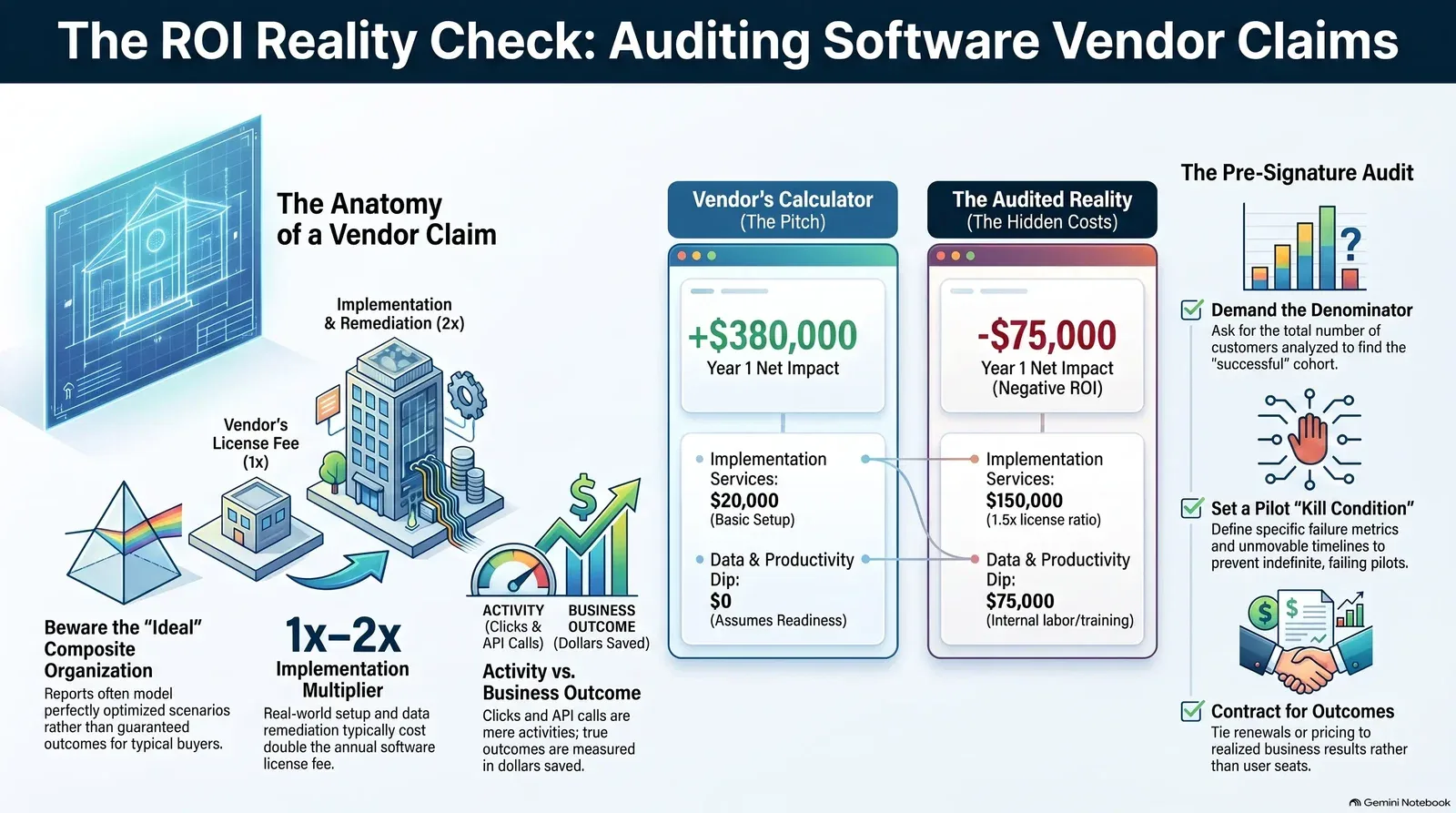
Every enterprise software pitch arrives with a percentage attached—hours saved, cycle time reduced, productivity lifted. These numbers routinely become the business case Chief Financial Officers (CFOs) sign and the standard against which subsequent deployments are judged. When procurement teams ask vendors for the study behind their headline numbers, the response typically consists of a customer case study lacking a denominator, a survey of the vendor's active users, or a commissioned analyst report. All three sources can be factually accurate while remaining completely useless for a specific buyer's business case.
Procurement scrutiny has tightened sharply as budget reviews catch tools incapable of documenting returns. Scrutiny, however, is mostly applied post-purchase during the renewal cycle, which is an expensive time to discover a claim was soft. This analysis argues that the audit belongs before the signature. The goal is not to assume vendors fabricate data, but to recognize that a metric generated from a highly favorable deployment at a different company is not empirical evidence of future performance. Applying a repeatable framework to test a vendor's ROI claim reveals where the number originated, the population it describes, the costs it excludes, and how to convert it into a pilot designed to be falsifiable.
The Number in the Deck and Where It Usually Comes From
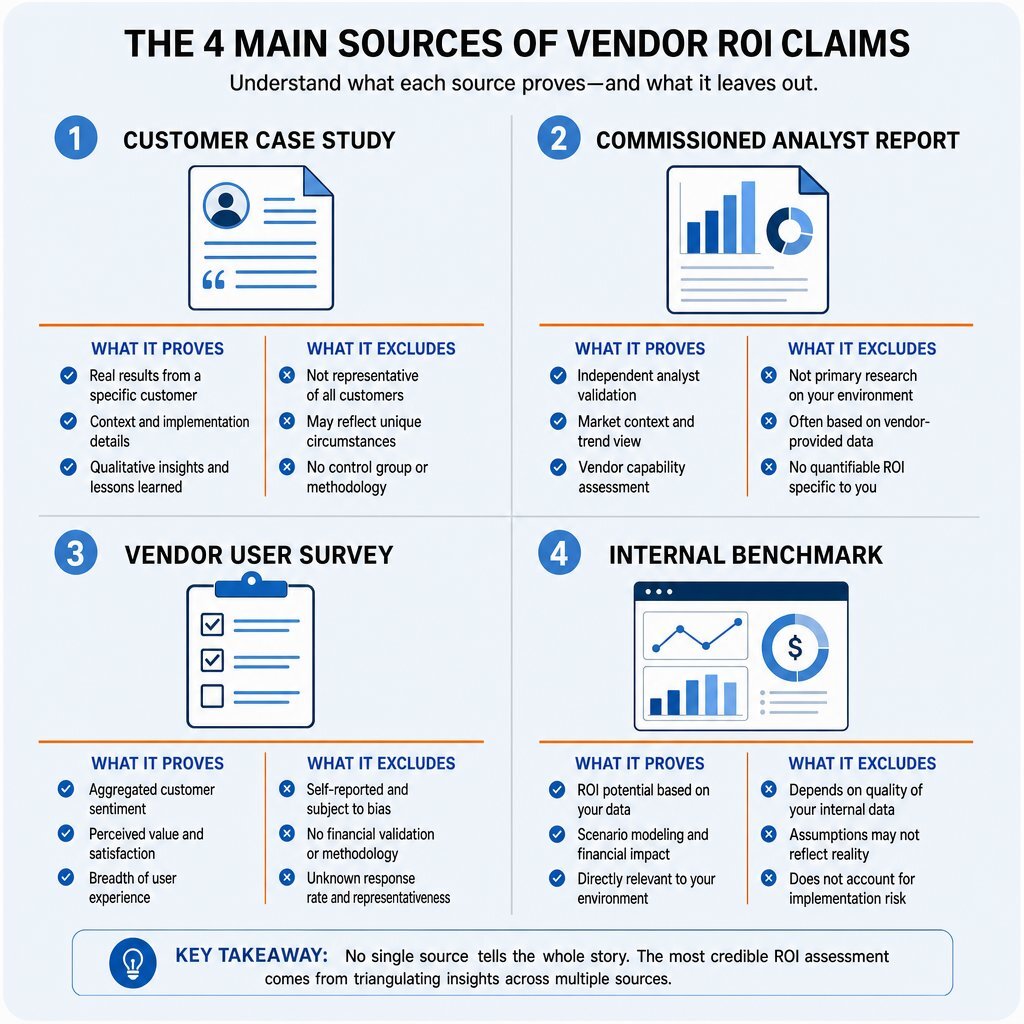
Most vendor ROI figures represent real measurements of specific events. The problem lies almost exclusively in the selected population, the baseline, or the exclusions. When deconstructing a vendor deck, the headline metric typically originates from one of three standard methodologies, each carrying distinct biases.
For example, major analyst firms routinely produce commissioned research, such as the Forrester Total Economic Impact (TEI) studies. These reports are highly structured and meticulously modeled, yet software buyers frequently misunderstand what they represent. Forrester constructs a composite organization as a meticulously designed profile representing an ideal customer profile, explicitly not a generic statistical average. A delivery team conducts interviews with decision-makers from four to six selected organizations that fit a precise target audience and use the technology exactly as intended. While the resulting ROI figures—such as a 335% ROI for an enterprise planning platform or a 133% ROI for a governance tool—are mathematically accurate for the composite, they do not represent a guaranteed outcome for a random buyer operating in a different environment. Understanding the source material immediately recontextualizes the claim and should feed into a broader, rigorous discovery phase on your side.
| Claim Source | Methodology | What It Actually Proves | What It Systematically Excludes |
|---|---|---|---|
| Customer Case Study | A narrative built around a single, highly successful deployment. | The software is capable of working under ideal conditions with a highly motivated champion. | Average expected results, typical implementation timelines, and baseline failure rates. |
| Commissioned Analyst Report (e.g., TEI) | A financial model based on a composite "ideal customer" built from 4–6 successful interviews. | The theoretical financial impact when the tool is utilized exactly as intended by a mature organization. | A guaranteed baseline for a company with lower data quality or fragmented process maturity. |
| Vendor User Survey | A self-reported questionnaire sent to the vendor's active user base. | Subjective user sentiment and perceived time savings among the surviving customer base. | Objective financial returns. It suffers heavily from survivorship bias, as churned users do not reply. |
| Internal Benchmark | Aggregated telemetry data from the vendor's platform. | How fast a specific activity occurs inside the software tool itself. | The broader business impact, since faster task completion does not automatically equal reduced headcount. |
Five Questions That Separate a Measured Claim from a Marketed One
To effectively separate a measured claim from a marketed one, procurement teams must subject the vendor to five specific inquiries and make that questioning part of a disciplined, agile evaluation process rather than a one-off meeting.
First, determining the denominator is critical. If a vendor claims a specific efficiency gain, evaluating the total number of customers analyzed to find that successful cohort reveals the actual success rate. An evasive answer deflects to a single optimized case study.
Second, identifying exclusions is necessary. Removing failed or churned deployments from an ROI average artificially inflates the reported success rate.
Third, defining the baseline prevents manipulated starting points. Baselines are often rough guesses provided by users rather than empirical time-tracking data.
Fourth, uncovering silent prerequisites forces the vendor to define the required state of data cleanliness, necessary system integrations, and minimum internal headcounts needed to administer the tool.
Finally, proposing that contract renewals be tied to the specific marketed metric serves as the ultimate stress test. If the vendor claims a tool increases revenue by 10%, requesting an outcome-based SLA around that metric immediately reveals the vendor's actual confidence in their marketing materials.
Activity Versus Outcome Metrics
Claims measuring activity are frequently presented as though they measure outcomes. Separating the two eliminates a large share of weak claims immediately and mirrors the way you should evaluate internal projects such as AI-assisted development work, where raw output is not the same as business value.
Consumption pricing charges for product activity, such as API calls, credits used, messages sent, or workflow runs. Outcome pricing charges for a customer-recognized business result, such as a resolved support issue, a qualified lead, or recovered revenue. Vendors frequently blur this line. For example, a generative AI tool might boast a 40% reduction in document drafting time. Drafting a document is merely an activity. If an employee spends that saved time browsing the internet or in unstructured meetings, the business outcome remains zero.
A credible ROI claim ties directly to a measurable business result. When evaluating a claim, organizations must ask whether the metric reflects a completed workflow the business actually values. If the metric is "AI replies generated," it is an activity. If the metric is "support tickets resolved without human intervention," it is a tangible outcome. The atomic billing event should be easy to count and map directly to the buyer's operating model.
The Costs the Financial Model Left Out
Any credible business case must include the costs the vendor's model excludes. Software licensing represents only one fraction of the total cost of ownership. The most critical omission in vendor ROI calculators is the implementation cost, which often shows up later as "technical debt" and rushed rework if you underestimate it during a modernization or rollout project.
Industry data indicates that for mid-market and enterprise platforms, implementation services typically cost one to two times (1x to 2x) the annual software license fee, and can stretch to three times (3x) for highly complex scopes. Furthermore, up to 50% of companies underestimate these implementation costs. A vendor's calculator demonstrating a positive ROI in month six almost universally ignores the initial capital expenditure required to reach go-live.
A comprehensive budget accounts for professional services required to map workflows and configure the system. Custom scripts and workflows are labor-intensive and are effectively paid for twice: once to build during implementation, and again during every future software release cycle they must survive. Data migration and remediation also carry heavy costs, as industry research indicates data preparation frequently consumes 60% to 75% of total project effort. Integrations require building custom connectors to existing enterprise applications and architecture. Finally, the productivity dip must be calculated, representing the hours internal subject matter experts spend away from their daily roles to perform user acceptance testing and system training.
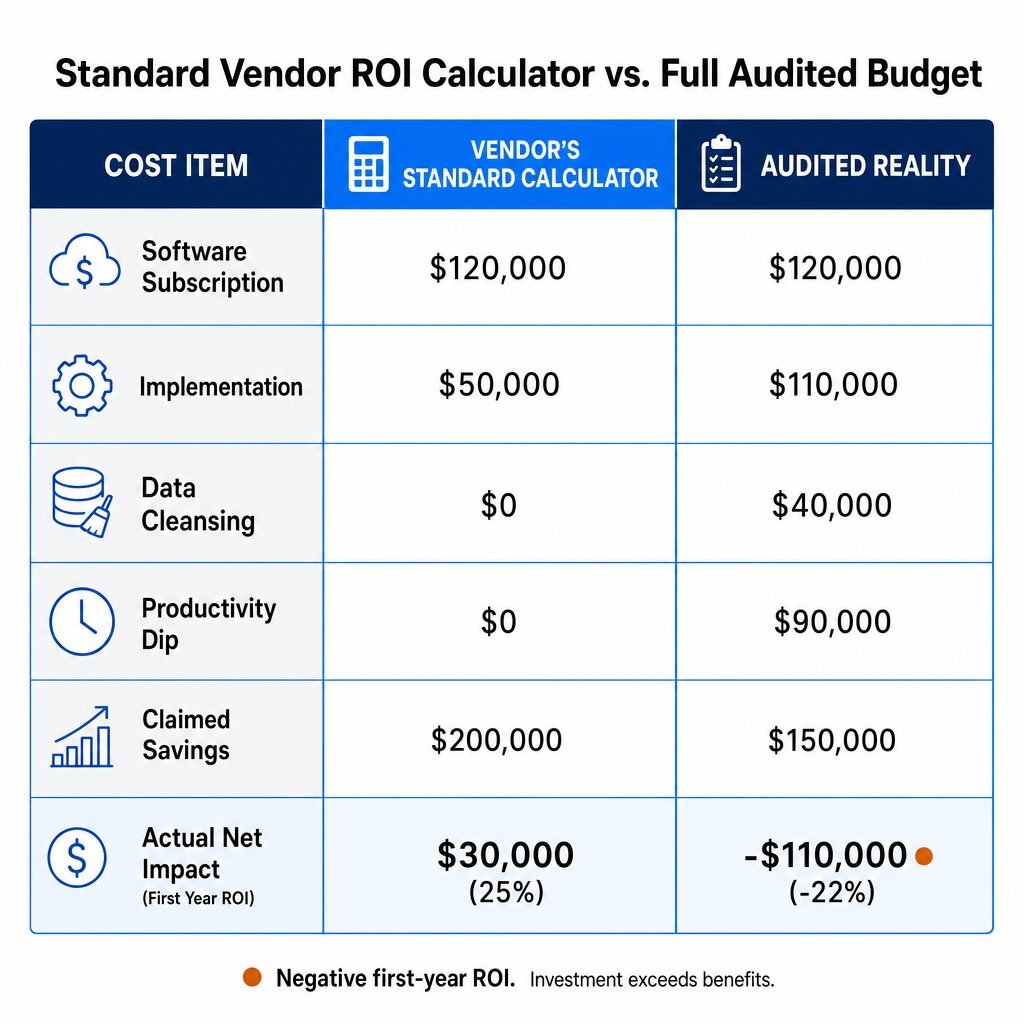
| ROI Component | Vendor's Standard Calculator | The Audited Reality |
|---|---|---|
| Software Subscription (Year 1) | $100,000 | $100,000 |
| Implementation Services | $20,000 (Basic Setup) | $150,000 (1.5x license ratio for mid-market) |
| Data Cleansing & Integrations | $0 (Assumes clean data) | $50,000 (Hidden internal/external cost) |
| Productivity Dip / Training | $0 | $25,000 (Internal time deficit) |
| Claimed Year 1 Savings | $500,000 | $250,000 (Adjusted for 50% actual user adoption) |
| Actual Year 1 Net Impact | +$380,000 | -$75,000 (Negative ROI in Year 1) |
The math demonstrates how a genuinely effective tool can still produce a negative return in its first year once the excluded costs are accurately modeled.
The Prerequisites The Claim Silently Assumes
Software success rarely depends entirely on the code; it depends on the environment within which it operates. This reality is particularly critical in the current wave of artificial intelligence procurement, where many teams are still building basic AI integration patterns and data pipelines.
The failure rates for AI implementations are staggering. The RAND Corporation reports that more than 80% of AI projects fail to reach meaningful production deployment, roughly twice the failure rate of traditional non-AI IT projects. Gartner predicts that at least 30% of generative AI projects will be abandoned after proof of concept by the end of 2025. S&P Global Market Intelligence found that 42% of companies abandoned most of their AI initiatives in 2025. MIT research indicates that 95% of generative AI pilots fail to scale to production or deliver measurable financial returns.
The primary obstacle is not the vendor's algorithm; it is the buyer's data foundation. Most AI initiatives stall because production data is fragmented across multiple systems, definitions of basic metrics are inconsistent, and data governance is absent. Approximately 63% of organizations lack AI-ready data infrastructure. Vendors assume the purchasing organization possesses clean, centralized, AI-ready data. If the organization does not meet this unstated prerequisite, the vendor's ROI claim is nullified before the software is installed.
Designing a Pilot That Can Actually Fail
A pilot program that cannot fail is not a test; it is merely a delayed purchase. If a pilot lacks a pre-registered success threshold and a defined kill condition, the implementation will simply confirm whatever the internal sponsor already believes. To prevent pilot paralysis, the evaluation must be structured with clinical precision and supported by DevOps practices that make it easy to deploy, measure, and roll back.
| Pilot Component | Definition | Example Application |
|---|---|---|
| The Baseline | The exact, empirical measurement of the current state before the software is introduced. | Current manual invoice processing takes an average of 14.2 minutes per invoice. |
| The Threshold | The minimum viable improvement required to justify the total cost of ownership. | The software must reduce processing time to under 8.0 minutes per invoice. |
| The Duration | A strict, unmovable timeline for the evaluation. | 45 days. Extensions are not permitted unless caused by technical vendor outages. |
| The Kill Condition | The specific failure metric that automatically cancels the procurement process. | If the tool requires human intervention on more than 25% of invoices by Day 45, the pilot is killed. |
Without a kill condition, teams will continually move the goalposts, citing learning curves and data issues to justify keeping a failing tool alive.
Contracting for Outcomes in an AI Era
When an audit reveals that a vendor's ROI claim relies heavily on perfect execution, buyers can shift the risk back to the vendor through outcome-based contracting. This is especially powerful for AI systems where, much like in clinical documentation or other high-volume workflows, the real value shows up only when end-to-end tasks are actually completed.
Outcome-based pricing charges for results rather than access. A prime example is Intercom's pricing model for its AI agent, Fin, which charges $0.99 per successful ticket resolution rather than charging per message sent or per active seat. This model inherently aligns the vendor's revenue with the buyer's success. If the software fails to resolve the issue and escalates to a human, the vendor is not paid.
While outcome-based pricing is highly effective for discrete, measurable tasks like customer support resolutions or fraud prevention, it requires strict definitions. The contract must clearly define what constitutes a resolution, outline how a measurement window functions (such as waiting 72 hours to ensure a ticket is not reopened), and build in failure forgiveness where abandoned sessions are completely non-billable. Vendors confident in their ROI claims are increasingly willing to entertain these models; vendors who refuse signal that their tools carry significant execution risk.
Applying the Audit to Custom Development
There are instances where the vendor's claim survives the audit, but the internal sponsor's business case still fails. This occurs when the technology works perfectly, but the organization lacks the maturity, discipline, or executive sponsorship to adopt it. The same pattern shows up in internal projects, from scope and contract choices to how teams handle change and governance.
This rigorous auditing framework is not reserved exclusively for third-party Software-as-a-Service vendors. Baytech Consulting, specializing in custom software development and application management, recognizes that internal proposals for custom builds must face the exact same scrutiny. Whether buying off-the-shelf software or building bespoke solutions utilizing technologies like PostgreSQL, Docker, or Kubernetes, a proposed ROI that ignores the friction of user adoption, the cost of data remediation, and the reality of complex integrations is a liability, regardless of who authored the deck.
Organizations evaluating custom software require partners that embrace transparency. By leveraging a Tailored Tech Advantage and Rapid Agile Deployment, Baytech Consulting ensures that technology investments align directly with measurable business realities, mitigating the risks that plague bloated software claims. That starts with strong UX design and discovery, clear metrics, and contracts that reflect how value is truly created.
The One-Page Audit Checklist
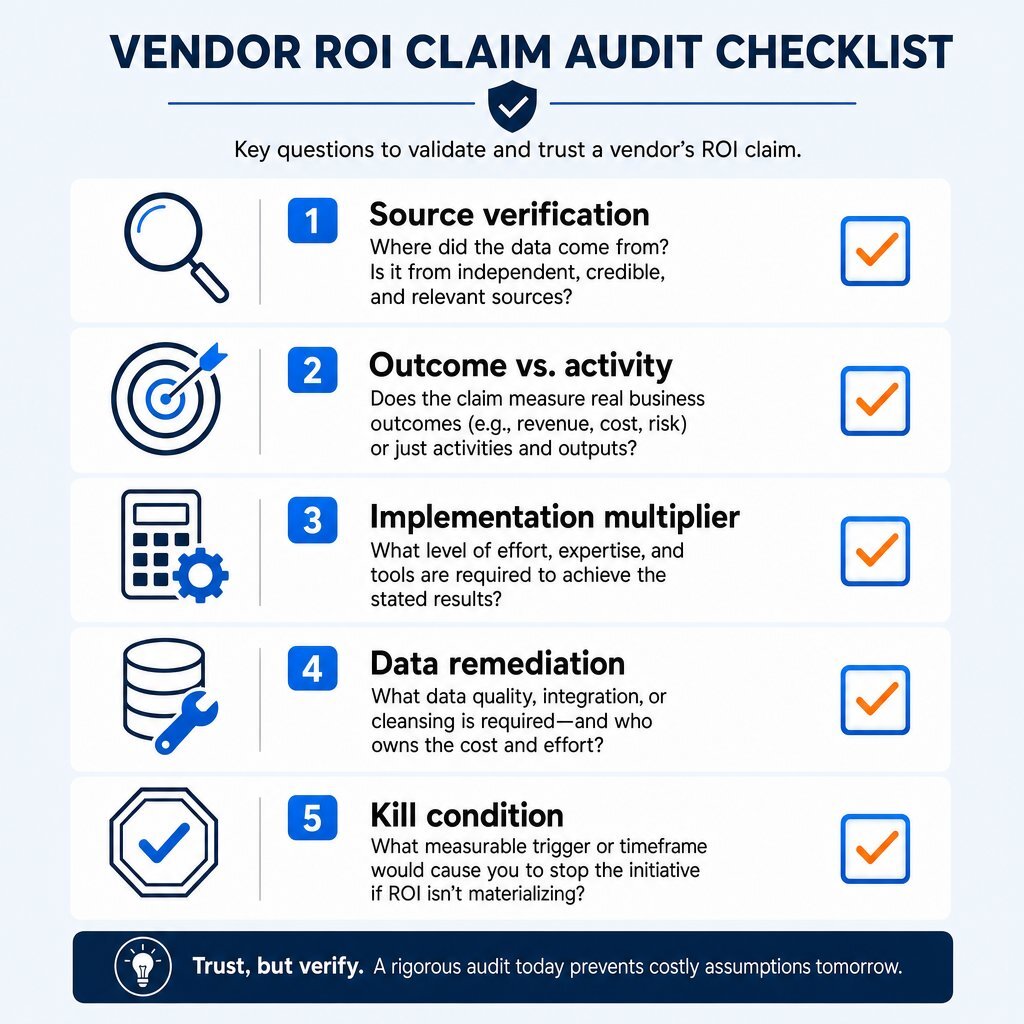
Procurement and IT leaders can deploy the following framework during the evaluation phase to systematically dismantle weak ROI claims:
| Audit Category | Evaluation Questions |
|---|---|
| Source Verification | Is the headline number from a controlled composite study, a single best-case scenario, or a broad user survey? What was the exact denominator? |
| Outcome Assessment | Does the claim measure a business result (dollars saved, tickets resolved) or a product activity (messages sent, API calls)? |
| Implementation Multiplier | Has a 1x to 2x multiplier been added to the annual license cost to account for professional services, configuration, and integrations? |
| Data Remediation | Is there a designated budget line for the internal labor required to clean, map, and migrate historical data—especially if you are modernizing legacy systems in phases? |
| AI Data Foundation | If evaluating an AI tool, does the organization currently possess the centralized, governed data required to feed the model? |
| Pilot Kill Condition | Does the proof of concept have a hard deadline and a pre-registered metric that triggers an automatic cancellation? |
| Outcome Contracting | Has the vendor been challenged to tie a percentage of the contract value or renewal terms to the realization of their marketed ROI? |
Conclusion
Auditing a software vendor's ROI claim before signature is a fundamental requirement of modern technology procurement. Moving past marketed averages and composite organizations determines exactly how a tool will perform within a specific, imperfect corporate environment. By demanding the denominator, calculating the hidden costs of implementation, establishing strict kill conditions for pilots, and separating mere activity from true business outcomes, organizations protect their budgets from optimistic marketing.
The immediate next step for technology executives is to apply this framework to the software currently sitting in the procurement pipeline. Refuse to accept isolated case studies as guarantees, and mandate that every business case reflects the total cost of ownership. Where there is uncertainty, consider a limited pilot, a phased rollout, or even a smaller custom build—such as a focused CPQ or workflow sidecar—that you can measure and adjust before you commit at full scale.
FAQ
How do I verify a software vendor's ROI claim?
To verify a vendor's ROI claim, demand the methodology behind the number, specifically asking for the sample size, the baseline measurements, and the criteria for which customers were excluded from the study. Furthermore, recalculate the business case by adding the costs the vendor likely omitted, such as data remediation, internal training time, and implementation fees—which routinely cost one to two times the annual software license. If you are still uneasy about the numbers, treat the initiative like a process-automation project with clear revenue goals and ask the vendor to stand behind concrete outcome metrics.
Supporting Links
- Why AI Projects Fail
- Channeling Main Character Energy: Your Guide To The TEI Composite
Outcome Based Pricing Strategies
About Baytech
At Baytech Consulting, we specialize in guiding businesses through this process, helping you build scalable, efficient, and high-performing software that evolves with your needs. Our MVP first approach helps our clients minimize upfront costs and maximize ROI. Ready to take the next step in your software development journey? Contact us today to learn how we can help you achieve your goals with a phased development approach.
About the Author

Bryan Reynolds is an accomplished technology executive with more than 25 years of experience leading innovation in the software industry. As the CEO and founder of Baytech Consulting, he has built a reputation for delivering custom software solutions that help businesses streamline operations, enhance customer experiences, and drive growth.
Bryan’s expertise spans custom software development, cloud infrastructure, artificial intelligence, and strategic business consulting, making him a trusted advisor and thought leader across a wide range of industries.