
In this article
- The Two Numbers That Tell the Story — Volume Up, Replies Down
- What Changed on the Buyer's Side
- Why Agent-to-Agent Outbound Reframes Sales from Copywriting to Systems
- The Deliverability Mechanism Nobody Budgets For
- CRM Data Remediation: What It Actually Means, Field by Field
- Buy vs. Build: Enrichment Vendors, CRM-Native AI, and Custom Plumbing
- A Sequenced Roadmap with the Prerequisites Named
- Better Metrics for an Agent-Mediated Funnel
- Where the Agent-to-Agent Argument Is Overstated
- Designing for the Classifier First
- About Baytech
- About the Author
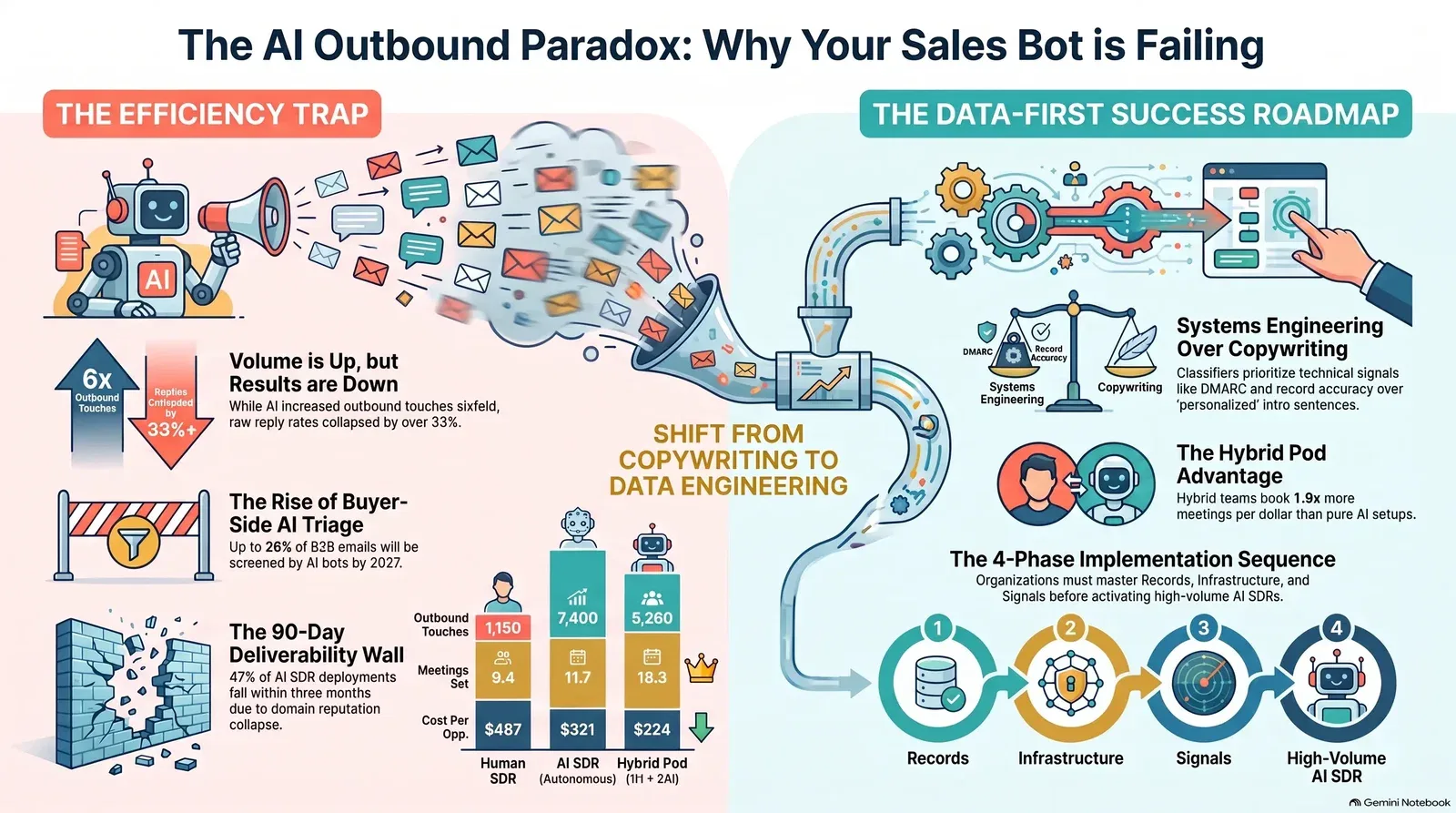
Enterprise sales teams added artificial intelligence to their outbound motions and received exactly what they asked for: a monumental increase in messages per representative. Per-rep outbound touches have jumped roughly sixfold over the past two years, yet raw reply rates collapsed by more than a third over the exact same period. Both figures tell the same story: the supply of automated messaging scaled faster than human attention, forcing the buyer's side to automate its triage process in self-defense.
The dominant advice for falling reply rates insists on better copy, sharper personalization, and longer sequencing. That advice aims at a human reader who, increasingly, is not the first entity to see the message. Outbound sales is migrating from a copywriting discipline to an engineering and systems discipline. What determines whether a message lands is now record accuracy, sender infrastructure, signal quality, and structured legibility to a machine classifier. Ensuring AI SDR data quality is now an engineering investment, yet most sales organizations still fund outbound operations strictly as a content investment.
The Two Numbers That Tell the Story — Volume Up, Replies Down
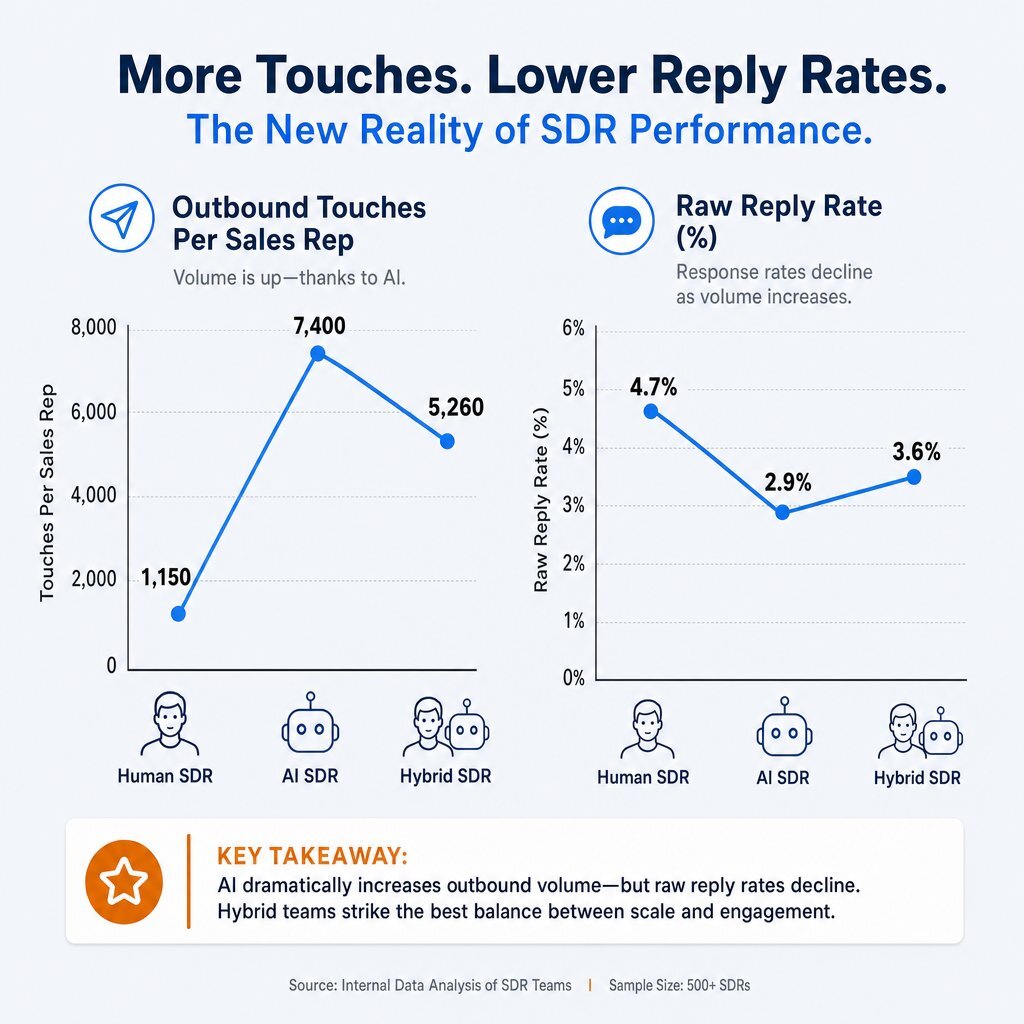
The shift in B2B outbound reply rates 2026 has fundamentally redrawn the economics of pipeline generation. A comprehensive analysis of outbound performance reveals a distinct trade-off between scale and conversion.
The most effective configurations are not fully autonomous; they rely heavily on human-in-the-loop architectures.
| Metric (Per Seat, Monthly) | Human SDR | AI SDR (Fully Autonomous) | Hybrid Pod (1 Human + 2 AI) |
|---|---|---|---|
| Outbound Touches Sent | 1,150 | 7,400 | 5,260 |
| Raw Reply Rate | 4.7% | 2.9% | 3.6% |
| Positive Reply Rate | 1.3% | 0.9% | 1.4% |
| Meetings Set Per Month | 9.4 | 11.7 | 18.3 |
| Cost Per Qualified Opp. | $487 | $321 | $224 |
| Meeting → Opp. Conversion | 47% | 28% | 41% |
| Closed-Won Conversion | 21% | 11% | 19% |
According to Apollo.io and ZoomInfo 2026 outbound benchmarks, per-seat monthly outbound volume rose from a human baseline of 1,150 touches to an AI-augmented mean of 7,400. Concurrently, raw reply rates fell from 4.7% to 2.9%. Pure AI SDRs win on sheer volume and dramatically lower the cost per send, but they suffer from plunging closed-won conversions. The data shows that hybrid pods—where AI handles the prospecting grind and human representatives manage complex relationships—book 1.9x more meetings per dollar than pure AI setups. If you are modernizing your broader sales stack and legacy tools at the same time, a phased approach similar to the patterns in phased legacy modernization roadmaps for mid-market enterprises helps you scale without breaking what already works.
What Changed on the Buyer's Side
The drop in reply rates represents a structural change in how inbound communication is managed. B2B buyers now deploy their own software to screen the flood of automated vendor outreach. Forrester projects that 19% to 26% of B2B inbound replies will pass through a buyer-side AI agent by the end of 2027.
A buyer-side triage agent is software that filters, summarizes, and categorizes outbound mail on behalf of the recipient before the human user ever opens their inbox. Modern AI email assistants, such as AiMail or Gmail's native AI summaries, do not simply skim subject lines for spam keywords. They parse the entire message to extract intent and semantic relevance. They cross-reference the incoming email against the recipient's digital footprint, calendar context, and internal priority rulesets. If a cold pitch offers no immediate utility, the algorithm moves the message to a low-priority folder without triggering a notification. For teams whose products must behave well on phones and tablets where these assistants live, it’s worth pairing this shift with a mobile-first plan like the one in the B2B mobile app modernization playbook.
Why Agent-to-Agent Outbound Reframes Sales from Copywriting to Systems
When the first reader is a machine classifier, traditional outbound strategies fail. Agent-to-agent outbound strips away the effectiveness of synthetic flattery. Scraping a LinkedIn bio to generate an introductory sentence about a prospect's recent podcast appearance does not trick a machine. Classifiers recognize templated mail-merge logic and easily route the message away from the primary inbox.
Instead, classifiers look for properties that prove credibility. They assess structured legibility, looking at clean HTML code and clear H1/H2 header tags that quickly signal the topic. They rely on verified sender history and Brand Indicators for Message Identification (BIMI) to establish trust. Most importantly, they evaluate actual semantic relevance based on zero-party data and true business signals, filtering out generic persona-based targeting. The optimization target for an outbound message has shifted from psychological persuasion to algorithmic compliance. That shift mirrors what happens in broader engineering projects, where a strong Agile software development methodology and tight feedback loops beat one-off campaigns every time.
The Deliverability Mechanism Nobody Budgets For
Adding an AI SDR allows a sales team to send thousands of emails overnight. Without corresponding infrastructure investments, this volume triggers an immediate domain reputation collapse. Roughly 47% of attempted AI SDR deployments stall or fail inside the first 90 days because they hit a domain-reputation wall from over-sending.
The mechanism destroying these domains is poor data hygiene leading to hard bounces. B2B contact data decays at approximately 2.1% per month, with technology-sector churn reaching 40% annually. When an AI SDR emails thousands of contacts using an unverified list, the bounce rate spikes. Google Postmaster and Microsoft SNDS interpret sustained hard-bounce rates above 2% to 3% as evidence of purchased lists and poor sender hygiene. Microsoft has actively escalated unauthenticated bulk mail penalties from junk-folder routing to outright 550-class rejections for senders who push high volume without DMARC alignment. Stale records actively damage the sender infrastructure required for tomorrow's outreach to land. The pattern is similar to the hidden line items that quietly blow up IT budgets, like the ones called out in this analysis of why modernization costs often exceed the sticker price.
CRM Data Remediation: What It Actually Means, Field by Field
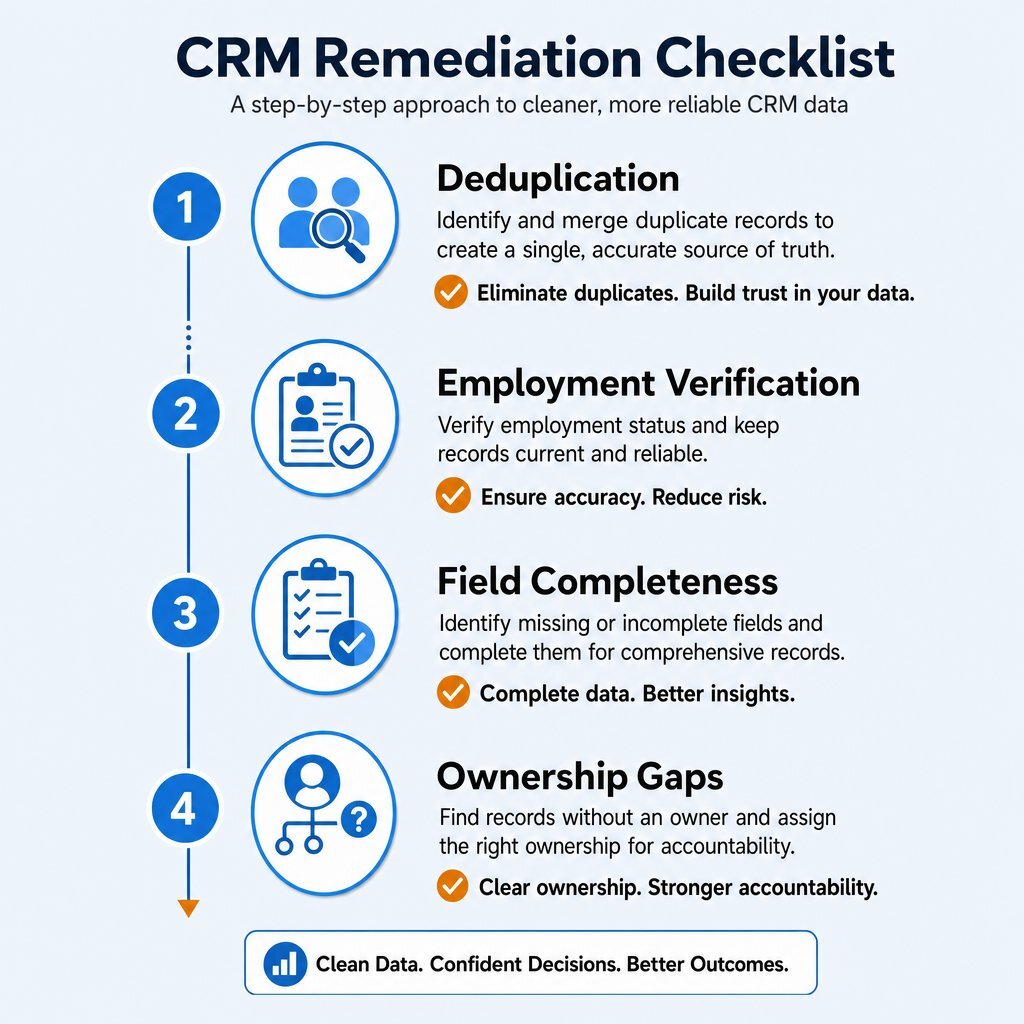
Deploying an AI SDR on top of an unremediated CRM is a documented failure pattern. The tool simply amplifies the data problem rather than compensating for it, scaling errors at ten times the speed of a human. CRM data remediation requires an exact, field-by-field sanitization process before any automated agent is granted sending authority.
The remediation sequence involves strict programmatic checks. Identity resolution merges duplicate records and ensures leads are accurately matched to the correct parent accounts. This prevents multiple automated agents from emailing the same prospect simultaneously. Employment verification requires running contacts through real-time waterfalls to confirm current employment and active email status, pushing pre-send bounce risk below the 2% threshold. Field completeness demands that the specific fields the AI agent relies on for scoring—such as technographics, recent funding rounds, or specific industry codes—are fully populated and standardized. Finally, fixing ownership gaps involves reassigning or archiving records owned by representatives who have left the company to prevent automated follow-ups from dead accounts. In practice, this is a UX problem as much as a data problem, which is why aligning it with thoughtful UX design for internal tools and CRM workflows is so important.
Buy vs. Build: Enrichment Vendors, CRM-Native AI, and Custom Plumbing
Addressing the data problem forces a structural decision regarding sales engagement architecture. The market divides into monolithic data vendors, all-in-one engagement platforms, and custom orchestration layers utilizing waterfall enrichment.
| Investment Option | Cost Profile | Time to Value | Control & Customization | Core Limitation |
|---|---|---|---|---|
| Monolithic Enrichment (e.g., ZoomInfo) | ~$15,000+/year, annual lock-in | High (2-4 weeks setup) | Low (access to one proprietary database) | Expensive for narrow ICPs; lacks multi-source cross-validation. |
| All-in-One Outbound (e.g., Apollo) | ~$49/user/month, monthly available | Very Fast (under 30 minutes) | Medium (built-in templates and sequences) | Deliverability limits; less granular intent signaling. |
| Custom Data Plumbing (e.g., Clay + Custom APIs) | Variable (credit usage + engineering costs) | Moderate (requires initial workflow engineering) | Very High (waterfall routing across 130+ API sources) | Requires dedicated engineering or RevOps maintenance. |
For startups and small teams, all-in-one tools provide sufficient accuracy at a manageable price. Large enterprise teams heavily utilizing account-based marketing often justify the premium of monolithic data vendors due to their proprietary intent signals and deep organizational charts.
However, organizations pushing the limits of machine-to-machine outbound increasingly require custom data layers. Waterfall enrichment queries dozens of providers sequentially until a record is accurately filled, circumventing the coverage gaps of any single database. Building this infrastructure correctly requires sophisticated data management. This is exactly where Baytech Consulting delivers measurable value. Standard GTM platforms frequently lack the capability to execute complex identity resolution or synchronize securely with enterprise databases. Baytech Consulting specializes in custom application development, providing a Tailored Tech Advantage. By engineering resilient data pipelines using PostgreSQL, SQL Server, and containerized deployments via Docker and Kubernetes, GTM teams achieve an outbound architecture that is accurate, compliant, and structurally optimized for AI classification. Those same skills show up when modernizing complex pricing or quoting workflows, like the custom CPQ systems described in the guide on how custom CPQ can move quotes from days to minutes.
A Sequenced Roadmap with the Prerequisites Named
A Head of Sales must sequence investments strictly across a phased roadmap. Reversing this order guarantees a deliverability collapse. Sales leaders should refuse to fund AI SDR volume increases until these prerequisites are met.
| Phase | Focus Area | Required Prerequisites Before Advancing |
|---|---|---|
| Phase 1: Records | Hygiene & Identity Resolution | CRM deduplication complete; employment verification workflows active; stale contacts archived. |
| Phase 2: Infrastructure | Deliverability & Authentication | Transactional and marketing streams separated; multi-domain sender pools established (8-14 domains); SPF, DKIM, and DMARC aligned at p=reject. |
| Phase 3: Signals | Intent Capture & Enrichment | Zero-party data integrated; waterfall logic established to feed the AI agent actual business context rather than generic persona data. |
| Phase 4: Volume | AI SDR Activation | Mailbox volumes capped at 30-40 messages daily; spam complaint rate strictly monitored below the 0.3% threshold. |
In practice, this roadmap looks less like a one-time project and more like an ongoing program. Treat it the way strong engineering teams treat discovery and planning: with clear gates, feedback loops, and room to adjust. The same discipline that keeps custom software projects on track—outlined in the rigorous discovery phase checklist for engineering teams—also keeps AI outbound from turning into a noisy, expensive experiment.
Better Metrics for an Agent-Mediated Funnel
In an environment where bots email bots, raw reply rate ceases to be an honest measure of outbound health. Activity volume simply tracks how much compute an organization purchased. Revenue leaders must transition to metrics that measure actual pipeline velocity and infrastructure health.
Positive reply rate replaces raw reply rate by filtering out automatic out-of-office messages, hard bounces, and algorithmic rejections to track genuine human interest. Inbox placement rate tracks the percentage of emails successfully bypassing spam folders, heavily dependent on maintaining a post-warmup hard bounce rate below 1%. The ultimate test of efficiency is the cost per qualified opportunity, which balances the low cost of AI sends against the variable quality of the meetings booked. Finally, meeting-to-opportunity conversion tracks whether the AI SDR is booking qualified buyers or simply tricking lower-level employees into taking calls—a metric that notably drops from 47% to 28% when switching from human to pure AI setups. If the numbers start to drift, it’s usually a sign to slow down, revisit scope, and tighten governance—exactly the kind of contract and model hygiene discussed in the piece on why scope creep is really a contract problem.
Where the Agent-to-Agent Argument Is Overstated
While the transition to automated triage is well underway, framing it as the complete end of the human seller is vastly overstated. Human-in-the-loop systems consistently outperform pure automation, particularly at the enterprise level.
The data confirms a steep seniority gradient in AI SDR effectiveness. While autonomous agents can achieve reply rates within 1.2 points of human SDRs at the manager level, the gap widens significantly past 1.7 points for Vice Presidents, and exceeds 2 points for C-suite executives. Senior buyers demand high-context personalization, multi-threaded reasoning about current business initiatives, and a level of credible specificity that current frontier models cannot consistently manufacture without hallucinating. The operational rule dominating the enterprise is clear: automate below the VP level, use hybrid pods for VPs, and deploy named human representatives for the C-suite. The work that ultimately closes deals—navigating objections, building trust, and parsing organizational politics—remains strictly human. In many ways, this looks like what’s happening in healthcare and other expert domains, where smart teams use AI to assist but still rely on clinicians or specialists to make the final call, as explored in the guide to reclaiming clinicians’ evenings beyond just adding AI scribes.
Designing for the Classifier First
The sixfold increase in outbound volume has permanently altered B2B sales. As buyers deploy their own AI triage agents to defend their inboxes, outbound success no longer hinges on writing clever subject lines. It depends on delivering structured, signal-rich data from a technically flawless sender infrastructure. Organizations that treat AI as a quick fix for broken sales processes will only accelerate their own irrelevance, flooding inboxes with generic messaging until their domains are blacklisted.
The immediate next step for revenue leaders is to halt volume scaling and initiate a rigorous audit of the CRM data layer and sender authentication infrastructure. Fix the records, fortify the infrastructure, and capture accurate intent signals before ever authorizing an AI to send a message on the company's behalf.
For organizations ready to build custom, resilient data architectures that outpace standard vendor capabilities, Baytech Consulting provides the enterprise-grade engineering required to succeed. Leveraging Rapid Agile Deployment and deep expertise in scalable data management, businesses can ensure their outbound operations are built on a foundation of absolute data integrity. That includes taming AI-generated technical debt and keeping models from quietly degrading your systems over time, as covered in the discussion of the AI-code debt bomb and how to defuse it.
Frequently Asked Question
Why is AI SDR data quality the absolute prerequisite for automated outbound?
Adding an AI SDR on top of an unremediated CRM amplifies the data problem rather than solving it. If a database is filled with stale contacts and missing fields, the AI agent simply executes outreach mistakes at a vastly accelerated pace, leading to high bounce rates, spam complaints, and inevitable domain reputation collapse. The only reliable way to scale safely is to treat AI as an extension of your core systems and architecture—not a shortcut—and align it with the kind of disciplined .NET, Docker, and Kubernetes engineering practices you would expect from any other mission-critical platform.
About Baytech
At Baytech Consulting, we specialize in guiding businesses through this process, helping you build scalable, efficient, and high-performing software that evolves with your needs. Our MVP first approach helps our clients minimize upfront costs and maximize ROI. Ready to take the next step in your software development journey? Contact us today to learn how we can help you achieve your goals with a phased development approach.
About the Author

Bryan Reynolds is an accomplished technology executive with more than 25 years of experience leading innovation in the software industry. As the CEO and founder of Baytech Consulting, he has built a reputation for delivering custom software solutions that help businesses streamline operations, enhance customer experiences, and drive growth.
Bryan’s expertise spans custom software development, cloud infrastructure, artificial intelligence, and strategic business consulting, making him a trusted advisor and thought leader across a wide range of industries.