
In this article
- Where the Pressure is Actually Landing
- Why the SIS Says No
- The Shadow System of Record and What It Costs
- What Employer-Sponsored Programs Need That Nothing in the Stack Provides
- The Sidecar Approach: Scope and Integration Points
- Identity, Records, and the Path from Non-Credit to Degree-Seeking
- Build Scope, Timeline, and Cost
- When Replacement Really is the Answer
- Measuring Whether the New Revenue is Profitable
- About Baytech
- About the Author
An institution can launch a non-degree workforce program in a single quarter. Getting the registration, billing, and credentialing for that program out of a spreadsheet takes considerably longer. That operational gap is exactly where the higher education revenue diversification strategy quietly stalls.
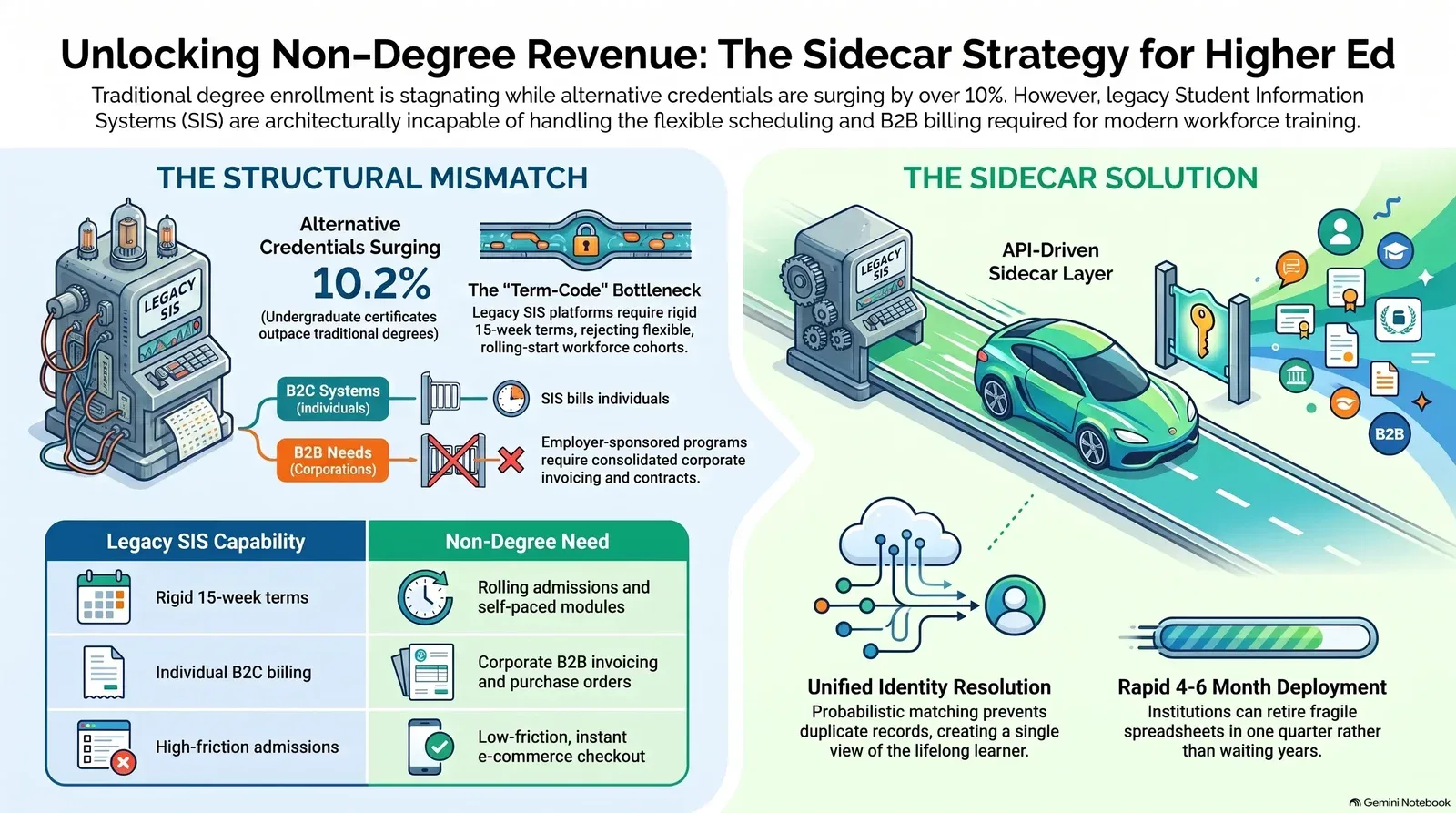
Facing a shrinking pool of traditional-age students, colleges and universities are aggressively pursuing workforce training, certificates, badges, and corporate partnerships. Market demand exists. Program design is fast. The binding constraint on non-degree program management is the administrative software stack. The core student information system (SIS) was designed around 15-week semesters, credit hours, and degree audits. None of those concepts fit a six-week, employer-sponsored cohort.
This structural mismatch forces institutional IT teams into an impossible corner. They either wait years for their legacy SIS vendor to ship a continuing education software module, or they stand up a brittle shadow system of spreadsheets and manual invoicing until the volume breaks the back-office staff.
Neither default response is sustainable. Modernizing this infrastructure requires acknowledging the specific architectural limitations of the legacy SIS and building a targeted, sidecar program-management layer alongside it.
Where the Pressure is Actually Landing
The popular narrative of a catastrophic, uniform “enrollment cliff” is factually inaccurate. Aggregate college enrollment has not collapsed. Spring 2026 data from the National Student Clearinghouse Research Center shows total enrollment grew 1.0% to 18.6 million students, following a similar 1.0% growth pattern in Fall 2025.
The pressure is entirely structural. Traditional degree pathways are stagnant, while alternative credentials are surging. In Spring 2026, undergraduate certificate programs grew by 10.2%—adding 86,000 students and significantly outpacing associate (+1.3%) and bachelor's degree (+1.0%) growth.
This shift in learner preference is colliding with worsening institutional finances. Aggregate stability is masking severe institution-level divergence. Public community colleges and state universities are capturing much of the workforce training growth, while tuition-dependent private nonprofit and for-profit institutions are bleeding students and facing a rising cadence of closures. The demographic baseline driving this tension is stark: the Western Interstate Commission for Higher Education (WICHE) projects that the national population of high school graduates will peak in 2025 before entering a steady 13% decline through 2041. Consequently, Fitch Ratings issued a “deteriorating” credit outlook for the U.S. higher education sector for 2026, citing intense net tuition pressure.
Simultaneously, state funding has failed to keep pace with enrollment rebounds. The State Higher Education Executive Officers Association (SHEEO) reported that inflation-adjusted public higher education appropriations resulted in a 1.0% decline in per-student funding for fiscal year 2025—the first reduction in per-student public support since 2012.
Higher education leaders know they must tap into corporate and non-credit revenue streams to survive this margin compression. Their technology infrastructure, however, fundamentally rejects the data models required to operate them.
Why the SIS Says No
Legacy SIS platforms encode operational assumptions that non-credit and employer-sponsored programs violate on nearly every dimension.
At a database level, systems like Ellucian Banner and Oracle PeopleSoft are structurally bound to the academic term. In Banner, the student base table (SGBSTDN) and the course registration table (SFRSTCR) rely entirely on the STVTERM validation table. A student cannot exist, and a registration cannot occur, without a valid term code. In PeopleSoft, the primary STDNT_CAR_TERM table mandates that a learner is tied to a formal academic program, an institution, and a specific term.
A six-week corporate training cohort that begins on a random Tuesday in October has no corresponding term code. It carries no credit hours. It requires no degree audit. It has no Title IV financial aid census date. When an institution attempts to force non-credit operations into a credit-based SIS, the structural mismatches immediately surface.
| Requirement | Typical SIS Capability | Structural Mismatch |
|---|---|---|
| Pacing & Scheduling | Absent | SIS requires rigid 15-week or 8-week terms. Non-degree programs use rolling admissions, self-paced modules, or non-standard durations. |
| Data Architecture | Partially Supported | SIS requires term codes (STVTERM) and degree pathways (ACAD_PROG). Non-credit learners require flat, non-term duration tracking. |
| Financial Accounting | Absent | SIS bills individual students via B2C tuition tables. Non-degree requires business-entity (B2B) invoicing and purchase order processing. |
| Curriculum Approval | Partially Supported | SIS integrates with multi-year academic governance catalogs. Non-degree needs rapid, market-responsive course creation. |
| Identity Management | Absent | SIS assumes a linear, high-friction admissions funnel. Non-degree requires instant, low-friction e-commerce checkout registration. |
The Shadow System of Record and What It Costs
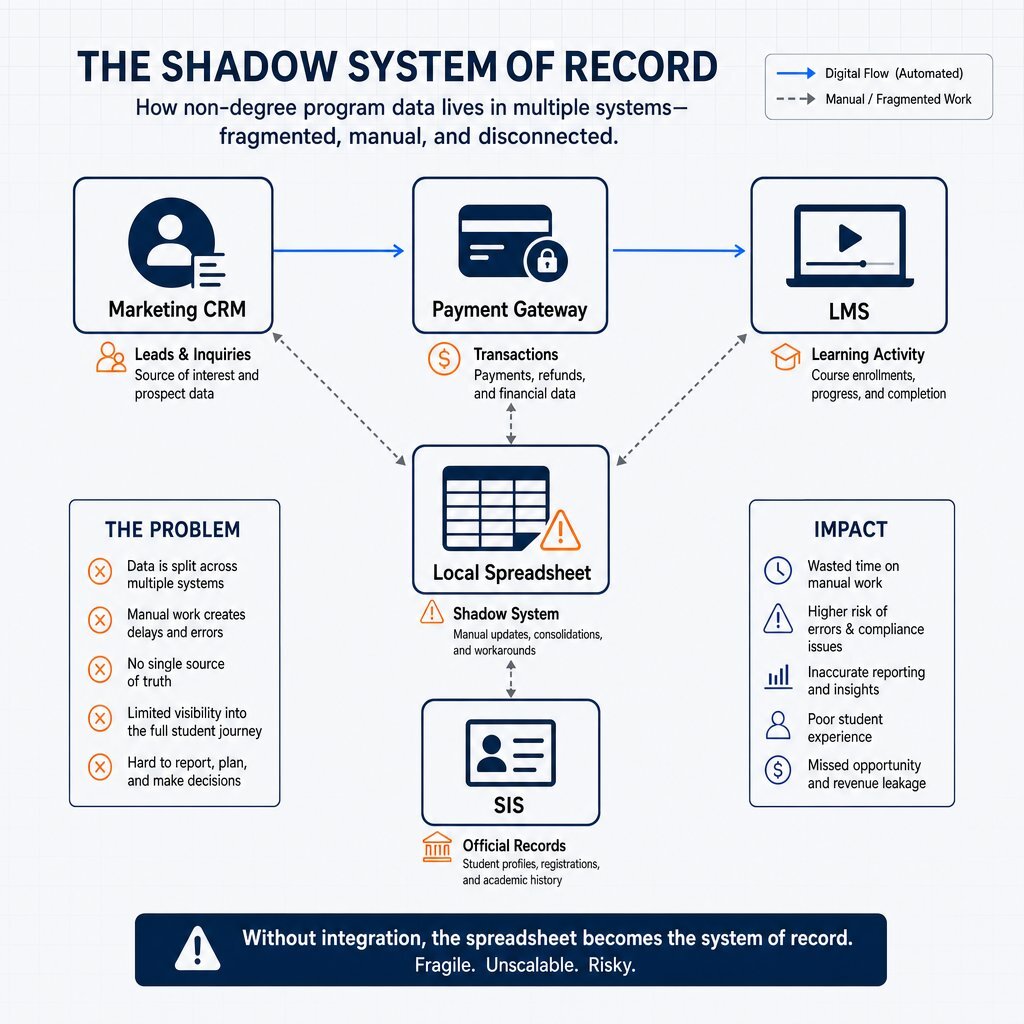
When the SIS rejects the non-degree data model, operational units invariably build a shadow system of record. At first, it looks like a pragmatic workaround to hidden legacy software costs. The continuing education department uses a consumer event-registration tool for checkout. They manually provision access to the Learning Management System (LMS). They track corporate invoicing in a localized spreadsheet.
This fragmentation creates a disjointed technical architecture where the same learner exists in multiple unconnected states.
| Node | System Function | Data Reality in the Shadow Architecture |
|---|---|---|
| Marketing CRM | Lead Capture | Holds the learner's personal email, but cannot confirm if they actually paid. |
| Payment Gateway | Transaction | Processes the credit card, but lacks data on which specific cohort the learner is joining. |
| Local Spreadsheet | Cohort Roster | Acts as the fragile, manual master record for corporate purchase orders and completion status. |
| LMS | Course Delivery | Requires IT to manually batch-upload CSVs every Friday to provision access. |
| Core SIS | Institutional Record | Remains entirely blind to the learner's existence and the generated revenue. |
This fragmentation carries severe downstream costs. Reconciliation becomes a manual, error-prone effort at month-end. Leadership receives unreliable reporting because revenue data lives in a spreadsheet while expense data lives in the general ledger. Most critically, the institution loses the ability to answer basic strategic questions about the new revenue line, such as customer lifetime value or corporate account profitability.
What Employer-Sponsored Programs Need That Nothing in the Stack Provides
Corporate cohorts expose the most glaring gap in traditional higher education technology: the complete lack of B2B functionality.
When a hospital system sponsors 50 nurses for a specialized credential, the transaction logic changes. The employer requires a single, consolidated invoice tied to a corporate purchase order. The SIS, engineered exclusively for Business-to-Consumer (B2C) operations, generates 50 individual student tuition bills, creating an administrative nightmare for both the university bursar and the hospital's accounts payable department.
Employer-sponsored programs introduce strict requirements that traditional education stacks simply do not possess:
- Business-Entity Billing: Managing corporate accounts, processing net-30 invoices, and handling bulk seat purchases without requiring 50 individuals to pull out personal credit cards.
- Cohort-Level Contracts: Applying custom, negotiated discount rates to specific employee groups based on a master service agreement.
- Corporate Reporting: Delivering automated progress and completion reports directly to the employer's HR or Learning & Development department to justify their return on investment.
Without these capabilities, administrative overhead scales linearly with revenue. A program cannot grow if every corporate contract requires manual invoicing and custom spreadsheet reporting.
The Sidecar Approach: Scope and Integration Points
Waiting for legacy SIS vendors to redesign their core architecture for B2B non-credit operations is a failing strategy. Running shadow spreadsheets invites data governance disasters.
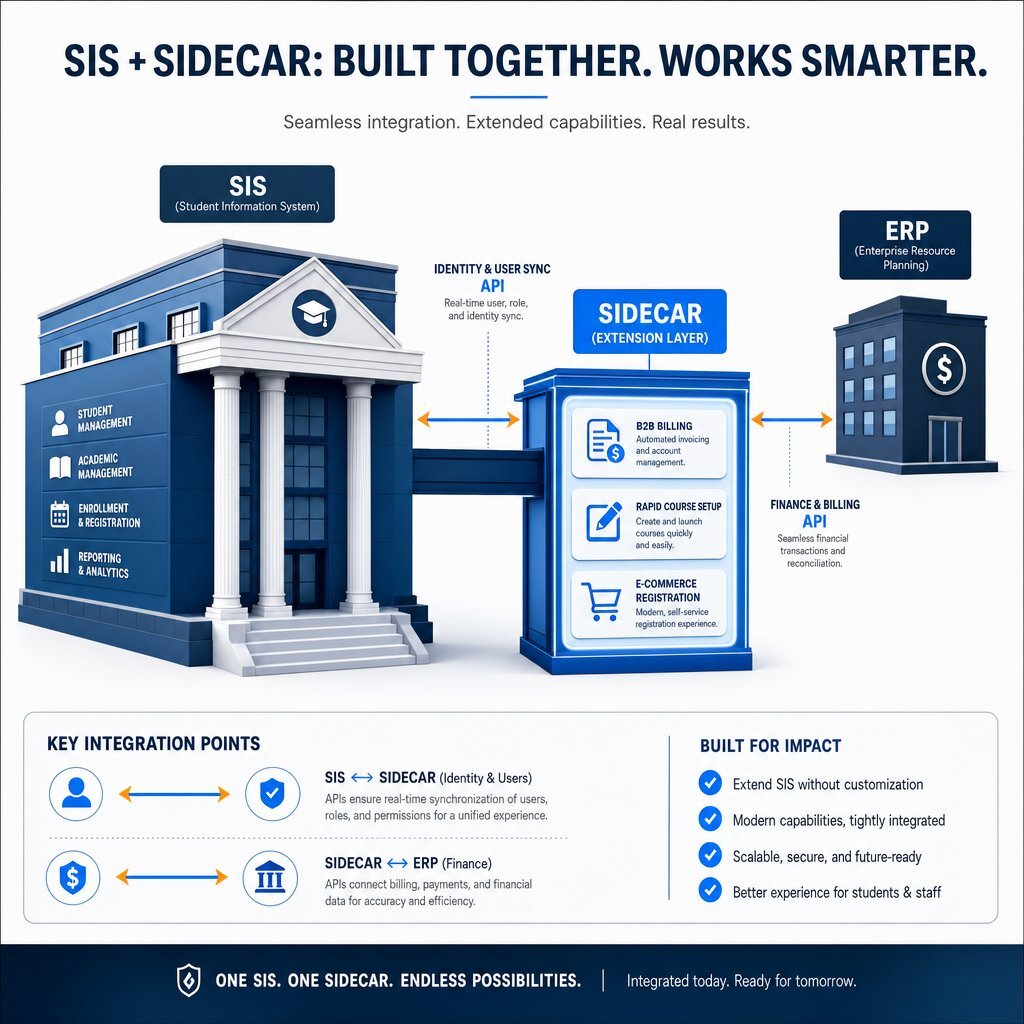
The most effective architectural response is building a program-management layer alongside the SIS. As established in our previous analysis of the SIS/LMS sidecar pattern, a sidecar architecture preserves the legacy system's role for compliance and degree-seeking operations while offloading non-standard workflows to a purpose-built, agile application.
Student information system integration is the technical linchpin of this approach. The sidecar layer assumes ownership of the non-degree lifecycle: rapid course catalog publishing, B2B invoicing, shopping-cart registration, and non-credit credentialing. It treats the SIS purely as the master system of record for identity, while the sidecar acts as the system of record for the transaction. In practice, this often dovetails with a broader, phased legacy modernization roadmap that lets institutions modernize without a risky “big bang” rewrite.
Integration points must be tightly controlled via API (e.g., Ellucian Ethos or PeopleSoft Integration Broker). When a learner registers via the sidecar, the application pings the SIS to check for an existing profile. If no match is found, it writes a basic biographical record to the SIS (e.g., to the SPRIDEN table in Banner) and generates an institutional ID. Financial transactions remain in the sidecar's ledger, and a daily aggregate journal entry is passed to the institutional ERP.
Identity, Records, and the Path from Non-Credit to Degree-Seeking
Identity resolution is the exact point where commercial continuing education software frequently fails.
A non-credit learner takes a corporate-sponsored project management certificate. Two years later, that same individual applies for a traditional MBA program. If the non-credit system was isolated, the institution inadvertently creates a duplicate identity. Duplicate records corrupt institutional reporting, frustrate the learner, and severely complicate financial aid compliance. Standard vendor systems often struggle with this; platforms like Modern Campus Destiny One frequently require staff to submit manual intervention forms just to merge duplicate learner profiles based on matching criteria.
The sidecar architecture solves this by enforcing a strict probabilistic matching protocol before any record creation. The layer queries the SIS using weighted matching logic (evaluating name, date of birth, and personal email). If the learner exists, the sidecar links the new non-degree enrollment to the established institutional ID.
This preserves the lifelong learning pathway. The institution maintains a single, unified view of the learner, seamlessly bridging their non-credit upskilling and their formal degree-seeking journey without polluting the master database.
Build Scope, Timeline, and Cost
Institution leaders often assume custom software development is prohibitively expensive compared to an off-the-shelf vendor module. In reality, a focused sidecar application frequently undercuts vendor licensing over a five-year total cost of ownership, while delivering exact organizational fit and eliminating annual per-seat licensing creep.
For a mid-sized institution, a custom program-management layer typically requires a 4-to-6-month deployment timeline. Development costs generally range from 150,000 to 350,000, depending on the complexity of the legacy SIS APIs and the depth of B2B billing requirements.
At Baytech Consulting, our Tailored Tech Advantage and Rapid Agile Deployment methodologies sequence this build carefully. The architecture usually relies on a scalable, enterprise-grade stack—utilizing PostgreSQL for robust transactional data integrity, containerized microservices via Docker and Kubernetes for high availability, and secure API gateways to handle bidirectional SIS traffic. These principles echo our broader work in enterprise application architecture, where stability, scalability, and clear integration patterns are non-negotiable.
This phased modernization roadmap ensures rapid time-to-value:
- Phase 1 (Months 1-2): Stand up the shopping-cart registration, implement identity matching against the SIS API, and finalize payment gateway integration.
- Phase 2 (Months 3-4): Deploy the corporate B2B billing engine, purchase order processing workflows, and cohort management tools.
- Phase 3 (Months 5-6): Automate LMS provisioning and implement digital credentialing write-backs.
This sequence allows the institution to retire their most fragile spreadsheets in quarter one, rather than waiting for a multi-year IT transformation to conclude.
When Replacement Really is the Answer
A sidecar architecture is highly effective, but it is not a permanent substitute for a fundamentally failing core platform. Institutions must evaluate whether their legacy SIS has simply reached end-of-life before layering new applications on top of it.
| Indicator | Sidecar Layer is the Best Path | Full SIS Replacement Required |
|---|---|---|
| Financial Aid Processing | Current system handles Title IV aid accurately and efficiently. | Current system requires heavy manual intervention for standard federal aid packaging. |
| API Availability | SIS provides reliable REST APIs or event-publishing frameworks (e.g., Ellucian Ethos). | SIS relies strictly on flat-file (CSV) batch uploads and lacks modern integration endpoints. |
| Core Stability | Degree-seeking registration, grading, and graduation auditing run smoothly. | Routine semester registrations cause system crashes or severe performance degradation. |
| Budget Constraint | CapEx limited to $500k; immediate time-to-market required to capture market share. | Multi-million dollar capitalization available; 3-to-5-year transition timeline accepted by the board. |
If the legacy system cannot execute its primary directive—managing credit-bearing degree programs—adding a sidecar layer is akin to putting a spoiler on a car with a blown transmission. In those cases, leaders should step back and follow an intentional, cost-aware modernization plan that accounts for hidden migration, integration, and change-management costs.
Measuring Whether the New Revenue is Profitable
Finally, institutions must confront how they measure the financial success of non-degree programs.
Higher education finance operates almost exclusively on credit-hour cost allocation. Budgets are distributed, and overhead is calculated, based on full-time equivalent (FTE) student metrics. This model completely collapses when applied to a non-credit, competency-based corporate training program that generates revenue without generating a single credit hour.
To determine if non-degree revenue is actually profitable, institutions must shift to activity-based costing (ABC). This methodology requires identifying the true, isolated cost drivers of the program: curriculum development time, direct instructional compensation, corporate sales acquisition costs, and specific technological overhead.
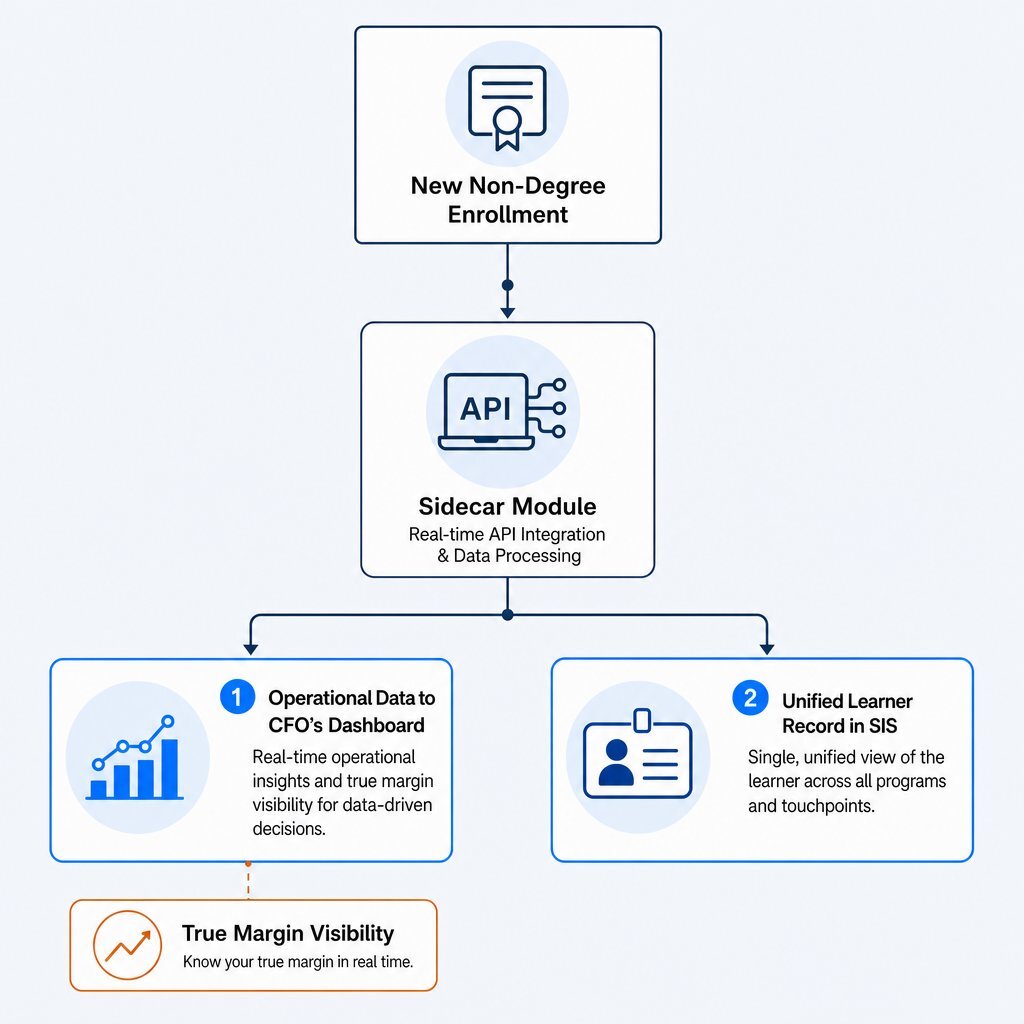
The sidecar program-management layer inherently enables this financial visibility. By isolating the revenue and direct operational expenses of the non-credit unit away from the sprawling general ledger of the main campus, the CFO can finally see the true margin on a corporate cohort. Without this segregated data, institutions risk chasing top-line revenue diversification while quietly bleeding operational cash.
The Bottom Line Institutions cannot capture the massive growth in workforce and certificate programs using software built for 1990s semester scheduling. But tearing out a functional legacy SIS is an extreme, high-risk reaction to a localized problem. Building a custom, API-driven sidecar layer delivers the B2B billing, flexible scheduling, and rapid registration these programs require, while preserving the master data integrity of the core institution. Done well, the approach also reduces long-term technical debt—avoiding the kind of fragile, AI-generated “quick fixes” that can create an AI-code debt bomb in your most critical systems.
Do not let your revenue diversification strategy stall in a spreadsheet. Engaging in a targeted discovery phase with a specialized software engineering partner can map the exact integration points required to unlock your non-degree programs and secure the institution's financial future. The same disciplined, UX-led discovery practices that prevent rework in other industries—like those outlined in our guide to skipping UX discovery in software—apply directly to SIS sidecar projects as well.
FAQ
How does a non-degree program sidecar handle student information system integration without creating duplicate records?
A properly designed sidecar layer utilizes strict identity-matching rules via API before creating any new records. When a non-credit learner registers, the sidecar queries the SIS using probabilistic logic (evaluating data points like name, date of birth, and personal email). If a match is found, the transaction is seamlessly tied to the existing institutional ID; if no match exists, a new identity record is pushed to the SIS, preventing database duplication and preserving the lifelong learner record. This kind of careful integration work parallels how we approach DevOps efficiency, where automation, guardrails, and clear ownership keep complex systems reliable over time.
Supporting Links
- Spring 2026 Enrollment Trends: Undergraduate Growth Continues as Graduate Enrollment Levels Off
- US Public Finance Higher Education Outlook 2026
State Higher Education Finance Report (FY 2025)
About Baytech
At Baytech Consulting, we specialize in guiding businesses through this process, helping you build scalable, efficient, and high-performing software that evolves with your needs. Our MVP first approach helps our clients minimize upfront costs and maximize ROI. Ready to take the next step in your software development journey? Contact us today to learn how we can help you achieve your goals with a phased development approach.
About the Author

Bryan Reynolds is an accomplished technology executive with more than 25 years of experience leading innovation in the software industry. As the CEO and founder of Baytech Consulting, he has built a reputation for delivering custom software solutions that help businesses streamline operations, enhance customer experiences, and drive growth.
Bryan’s expertise spans custom software development, cloud infrastructure, artificial intelligence, and strategic business consulting, making him a trusted advisor and thought leader across a wide range of industries.