In this article
- The Build vs. Buy AI Dilemma: Preserving Your Competitive Advantage in 2026
- The Paradigm Shift: From Generic Utility to Strategic Differentiator
- Why Standard SaaS Tools Fail for Complex Workflows
- The CFO's Perspective: Unmasking the Total Cost of Ownership
- The CTO's Perspective: Architecture for Disposability and Data Sovereignty
- The Head of Sales & Marketing Director's Perspective: Orchestrating the Buyer Journey
- Industry Deep Dives: Where Bespoke Automation Preserves Competitive Advantage
- Building the Foundation: The Baytech Consulting Approach
- Conclusion
- Frequently Asked Questions
- About Baytech
- About the Author
The Build vs. Buy AI Dilemma: Preserving Your Competitive Advantage in 2026
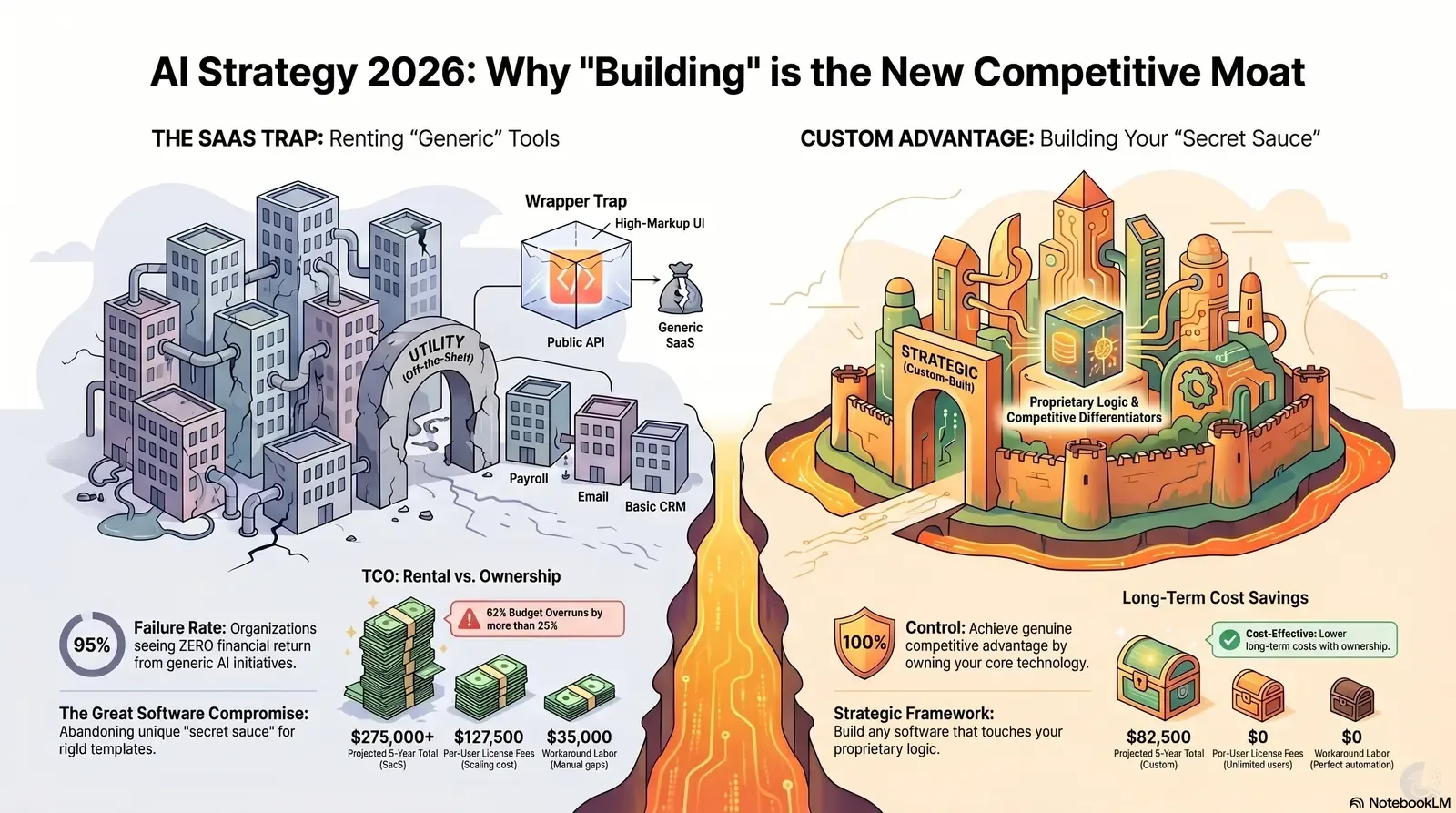
The enterprise technology landscape has reached a critical inflection point. Across boardrooms and engineering floors, organizations in every sector are wrestling with a fundamental, high-stakes strategic question: Should I buy an AI tool or build my own?
For decades, the standard enterprise playbook dictated a clear, comfortable separation of concerns. Standard business functions were managed by purchasing off-the-shelf Software as a Service (SaaS), while proprietary, mission-critical workflows were supported by custom-built solutions. The variables were predictable, the risks were contained, and the financial models were well understood. However, the explosive emergence of generative artificial intelligence has shattered this clean division. Today, the $300 billion global SaaS market is undergoing a seismic shift as generic artificial intelligence tools proliferate at a breakneck pace.
Yet, despite massive investments and near-universal curiosity, the data reveals a startling disconnect. Nearly 95% of organizations report seeing zero measurable financial return on their generative AI initiatives. According to comprehensive global surveys by Boston Consulting Group (BCG) and McKinsey, while 88% of organizations are experimenting with AI in at least one business function, only a mere 5% to 7% have successfully scaled these technologies across their enterprises to achieve a genuine competitive advantage.
The root cause of this widespread failure is fundamentally architectural and strategic. Off-the-shelf SaaS tools inherently force organizations to change their internal processes to fit the software's rigid parameters. They demand compliance with a generalized template. In stark contrast, custom AI automation adapts entirely to an organization's unique operational "secret sauce." Bespoke software does not just digitize a workflow; it preserves, scales, and compounds an organization’s competitive advantage.
This comprehensive report explores the data-driven reality of the build-versus-buy decision in 2026. Following the They Ask, You Answer philosophy, we will transparently dissect why standard SaaS platforms frequently fail to support complex business workflows, how bespoke software architectures deliver superior long-term Total Cost of Ownership (TCO), and precisely how custom development guarantees that your proprietary business logic remains your most valuable asset.
The Paradigm Shift: From Generic Utility to Strategic Differentiator
To understand the current crisis in enterprise AI adoption, we must first revisit the foundational theory of software categorization. The legendary software architect Martin Fowler famously popularized the "Utility vs. Strategic Dichotomy".
Fowler posited that there are essentially two types of IT projects: utility and strategic. Utility software provides functions that are absolutely necessary to run a business but offer absolutely zero competitive differentiation. A classic example is a payroll system or basic corporate email.
Every business needs it, and every business wants it to "just work." In these domains, the best approach is universally to buy. You want reliable "sewage pipes" and do not need to know how they operate.
However, a strategic asset is entirely different. If the underlying business function is a core differentiator—the precise mechanism that makes your company faster, smarter, or more profitable than the competition—then the software supporting that function must be as unique and optimized as the business itself. If your unique selling proposition lies in how you process data, serve customers, or underwrite risk, adopting the exact same off-the-shelf SaaS tool as your primary competitor instantly neutralizes your advantage.
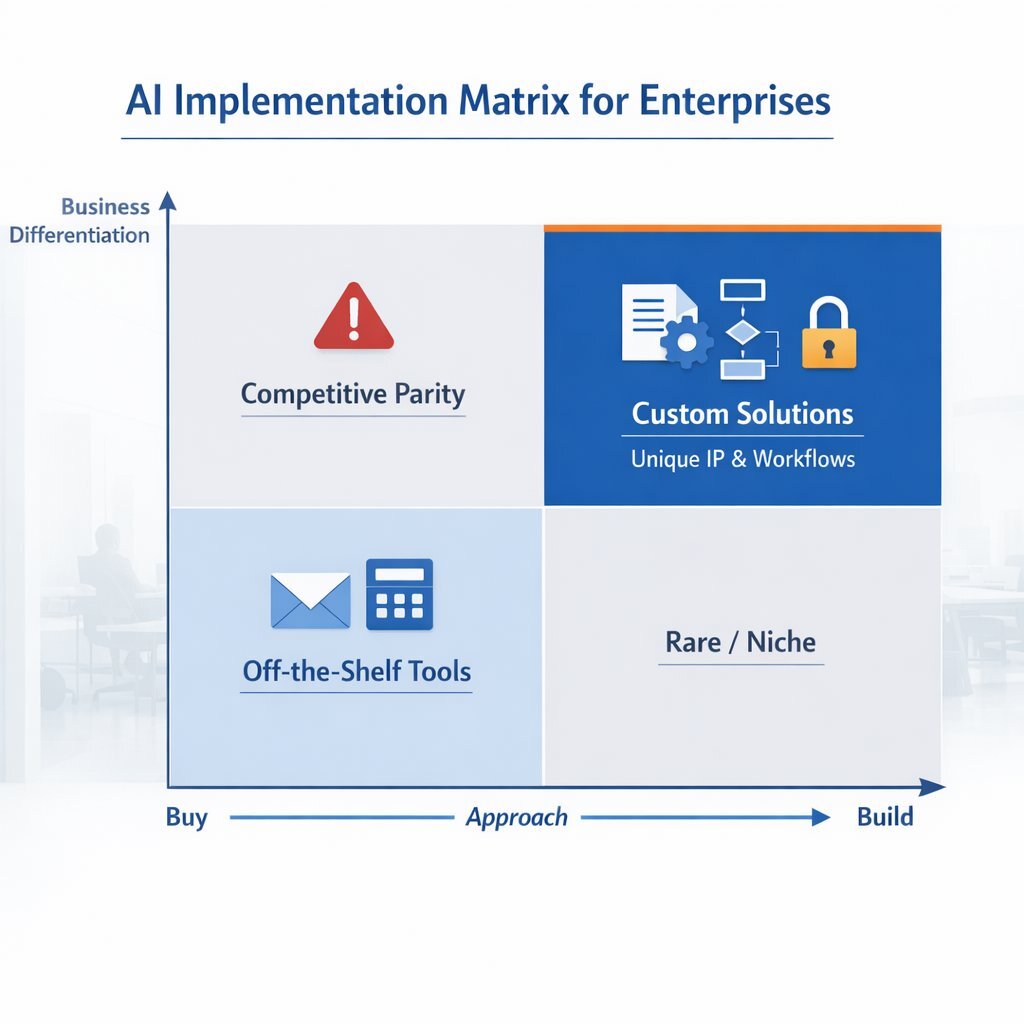
In the era of artificial intelligence, this dichotomy is more critical than ever. The binary choice of "build everything" or "buy everything" is dead. The most successful organizations—the 5% characterized by BCG as "Future-Built"—are aggressively selective. They purchase best-in-class utility SaaS for non-core operations, but they fiercely protect and custom-build the software that touches their proprietary logic. They redesign workflows, align leadership ownership, and invest in specialized tech talent to ensure their AI behaves exactly as their top-performing human experts would.
Why Standard SaaS Tools Fail for Complex Workflows
To understand the necessity of custom development, we must examine the specific mechanics of SaaS failure within complex enterprise environments. For years, businesses have faced an uncomfortable reality known as "The Great Software Compromise".
When a company adopts a massive, feature-rich SaaS platform—such as a leading Enterprise Resource Planning (ERP) or Customer Relationship Management (CRM) system—they are purchasing software engineered to satisfy the median needs of thousands of disparate companies. Because no two businesses operate identically, the adopting organization is forced into a corner. They must either severely compromise their unique business logic to fit the software's rigid, predefined architecture, or they must waste thousands of hours creating elaborate, manual workarounds in disconnected spreadsheets.
The introduction of artificial intelligence into SaaS has dramatically amplified these shortcomings. While AI-driven SaaS providers market their solutions as seamless and intelligent, they consistently fail to deliver true innovation for complex workflows due to several structural flaws.
The "Wrapper Trap" and the Commoditization of Intelligence
Organizations that rely exclusively on pre-packaged AI tools—often categorized as employing a "Takers" strategy in enterprise architecture—frequently fall into what analysts call the "Wrapper Trap". This occurs when an enterprise pays premium, marked-up prices to a SaaS vendor for AI capabilities that are nothing more than a thin user interface wrapped around a generic, public API (like OpenAI's GPT models).
The fatal flaw here is commoditization. If your SaaS vendor provides you with a generic AI assistant to write marketing copy, generate sales emails, or summarize reports, they are selling the exact same capability to your direct competitors. There is zero competitive advantage in adopting a tool that brings you to mere baseline parity with the rest of the market. Off-the-shelf AI SaaS operates on generic models trained across all customers, inherently limiting effectiveness and failing to leverage your organization's unique historical data. For example, simply slapping a chat widget on your app is very different from designing a true AI copilot that is tightly woven into your workflows—an approach explored in depth in From Chat Widgets to Copilots: The SaaS AI Revolution.
Rigid Workflows and the 10-20-70 Rule
Successful artificial intelligence implementation is rarely a purely technical challenge. It is governed by the 10-20-70 rule, which states that actual business impact is derived from 10% algorithms, 20% technology and data, and 70% people and process change.
Standard SaaS forces an organization to violently alter its 70% (the people and processes) to accommodate the vendor's 20% (the standardized technology). Custom software gracefully reverses this dynamic. Bespoke automation builds the technology entirely around the optimized, pre-existing processes of the business, ensuring high adoption rates and eliminating friction. Up to 90% of AI SaaS projects fail due to unclear goals, messy data, and an inability to map the tool to real-world workflows. This is why getting your information house in order—often through a proper data readiness for enterprise AI program—is such a critical precursor to any serious build.
Integration Complexity and Data Fragmentation
Artificial intelligence is entirely dependent on the quality, accessibility, and continuity of the data it processes. Traditional B2B SaaS environments inherently fragment data across siloed, department-specific tools. Marketing uses one platform, Sales uses another, and Customer Success uses a third.
Integrating these disparate SaaS applications with existing on-premises infrastructure is a major operational hurdle. According to an IDC survey, 39% of organizations struggle specifically with incompatibility between different SaaS providers. This poor integration leads to operational bottlenecks, disrupts information flow, and creates costly inefficiencies. When an off-the-shelf AI tool cannot access the full, unified context of a customer's journey, its outputs become irrelevant, hallucinated, or dangerously inaccurate.
The "Pilot-to-Production Chasm"
The enterprise AI landscape is currently defined by an massive attrition rate. While nearly 80% of organizations have explored generative AI, and 60% evaluate enterprise-grade vendor systems, only roughly 20% reach the pilot stage, and a mere 5% actually achieve scalable, enterprise-wide production.
Most off-the-shelf initiatives die in this "Pilot-to-Production Chasm." They fail because they involve brittle workflows, lack contextual learning, and fail to align with day-to-day operations. Standard systems are repeatedly described by users as "science projects" that fail to retain feedback, adapt to shifting contexts, or gracefully handle the complex edge cases that define real-world business.
Security, Sovereignty, and the "Shadow AI" Epidemic
Data privacy and intellectual property ownership represent massive barriers for standard SaaS adoption, particularly in highly regulated industries. Multi-tenant SaaS architectures inherently route proprietary corporate data through shared external cloud systems. For organizations handling sensitive financial data, intellectual property, or Protected Health Information (PHI), sharing core logic with third-party SaaS vendors introduces severe compliance risks under frameworks like HIPAA, GDPR, and the stringent EU AI Act.
Furthermore, when official, enterprise-sanctioned SaaS tools are heavily locked down, rigid, or simply less capable than free consumer alternatives, adoption craters. Employees inevitably bypass these clunky systems, turning to public, consumer-grade AI tools (like personal ChatGPT or Claude accounts) to automate their daily tasks. This creates a vicious cycle of "Shadow AI," leading to massive data leakage risks that trigger more restrictive corporate policies, further widening the gap between terrible enterprise tools and flexible consumer experiences. Custom software eliminates this by providing an internal, secure, and highly capable platform tailored specifically to what employees actually need to do—and often layered behind an AI firewall that stops prompt injection and data leakage.
The CFO's Perspective: Unmasking the Total Cost of Ownership
For Strategic CFOs evaluating technology acquisitions, the initial price tag often dominates the conversation. When comparing a custom development quote of 400,000 to 800,000 against a SaaS platform offering an entry point of 50,000 to 150,000 annually, the math initially seems to favor the SaaS model. However, this surface-level comparison is dangerously incomplete and ignores the exponential, compounding costs baked into the subscription software model.
The true Total Cost of Ownership (TCO) of enterprise SaaS is consistently underestimated. According to comprehensive industry analyses, SaaS buyers routinely overlook 50% to 70% of the actual lifecycle expenses prior to purchase. Only 35% of SaaS buyers calculate a comprehensive TCO, leading to a reality where 62% of SaaS implementations exceed their initial budget projections by more than 25%.
The actual SaaS TCO averages three to five times the base subscription price over a three-year period. To understand why SaaS is a financial drain at scale, we must break down the hidden cost components.
The Exponential Curve of SaaS Scaling
Subscription pricing models are not designed for your efficiency; they are intentionally engineered to penalize your growth. As an organization scales—whether by hiring more employees, processing higher transaction volumes, or requiring advanced API integrations to connect siloed tools—SaaS vendors force aggressive upgrades into premium pricing tiers. A platform that costs a few hundred dollars during a startup phase can rapidly balloon into a multi-million-dollar annual OpEx liability as a company reaches enterprise scale.
Let us examine a realistic, data-driven 5-year TCO projection comparing an enterprise SaaS subscription (scaling from 20 to 50 users) against a custom-built, wholly owned software asset:
| Cost Component (5-Year Projection) | SaaS Subscription Model | Custom Software (Owned Asset) |
|---|---|---|
| Initial Setup & Configuration | $2,500 (One-time onboarding) | $55,000 (One-time development investment) |
| Per-User License Fees | 127,500 (50/user/mo, assuming growth & vendor price hikes) | $0 (Unlimited users, no per-seat fees) |
| Premium Features & Add-on Modules | $45,000 (Required upgrades for advanced workflows) | $0 (Features are built to exact specification) |
| Third-Party Integrations & APIs | $28,000 (Connectors, middleware, API rate limits) | $12,500 (One-time, natively integrated architecture) |
| Workaround Labor & Efficiency Loss | $35,000 (Cost of manual processes bridging SaaS gaps) | $0 (System perfectly automates unique workflows) |
| Ongoing Support & Upgrades | $24,000 (Vendor premium support plans) | $15,000 (Managed maintenance & iterative improvements) |
| Data Access & Exit Migration | $18,000 (Data export fees, format retraining) | $0 (Full ownership of system and database) |
| Projected 5-Year Total Cost | $275,000+ (Recurring Operational Expense) | $82,500 (Initial Capital Investment + Predictable OpEx) |
Note: Data aggregated from comparative TCO studies. Figures serve as a baseline comparison model; actual enterprise costs scale exponentially higher.
As the data clearly demonstrates, custom software provides incredible long-term ROI. While the initial capital expenditure (CapEx) is higher, the recurring operational expenditure (OpEx) stabilizes beautifully. Custom software completely eliminates punitive per-user licensing fees, premium feature gates, and the massive costs associated with integration middleware.
API Economics and the Build-to-Last Strategy
The economics of the artificial intelligence era further complicate the SaaS calculation. As organizations scale their generative AI usage, reliance on third-party SaaS vendors who charge markup fees on underlying foundation model APIs can quickly become cost-prohibitive.
For high-volume applications, the variable costs of continuous API queries (paying per token) rapidly exceed the fixed costs of hosting proprietary or open-source models internally. Consider the extreme end of the spectrum: running intensive deep learning workloads. Renting cloud GPUs at $2.99 per hour seems cheap initially, but building a dedicated, fully-owned NVIDIA H100 GPU cluster reaches a financial break-even point after approximately 7 weeks of continuous usage.
Strategic enterprises follow a highly deliberate temporal sequence: "Buy to learn, build to last". They utilize off-the-shelf SaaS tools briefly to validate initial use cases and prove internal demand. However, they aggressively transition to custom-built infrastructure the moment a workflow proves valuable and reaches scale. This strategy protects their profit margins from endless software rental fees while maintaining complete sovereignty over their data. It also pairs naturally with disciplined efforts to cut model spend through techniques like LLM cost optimization and token reduction, so your owned stack stays affordable as usage grows.
The CTO's Perspective: Architecture for Disposability and Data Sovereignty
For the Visionary CTO, the decision to build bespoke software is fundamentally about architectural control, security, and future-proofing the enterprise against rapid technological obsolescence. The 5% of organizations achieving breakthrough results focus their engineering energy exclusively on areas of differentiation while surrendering commodity layers to standard providers.
The "AI Tech Sandwich" Architecture
Organizations that successfully generate alpha in the market employ what Gartner conceptually describes as the "AI Tech Sandwich" approach. Visionary CTOs recognize that trying to build foundational Large Language Models (LLMs) from scratch (competing with OpenAI or Google) is a massive, unnecessary, and mathematically impossible capital expenditure for most firms.
Instead, they buy the commodity "bread"—API access to foundational models—but they dedicate their internal engineering talent to building their own highly proprietary "filling". This proprietary filling consists of the surrounding cognitive architecture that grounds the generic AI in the company's specific business reality:
- Vector Databases and RAG (Retrieval-Augmented Generation): Custom pipelines that securely connect the AI to the company's specific historical data, proprietary research, and operating logic, ensuring outputs are hyper-relevant and hallucination-free. Patterns like the AI sidecar—adding “chat with data” to legacy systems without rewrites—are covered in Minimize Risk and Maximize ROI with Sidecars.
- Agentic Workflows and Orchestration Logic: Engineering sophisticated systems where AI agents autonomously chain tasks together based exactly on the company's highly specific standard operating procedures (SOPs).
- Prompt-Engineering Libraries: Maintaining strict, version-controlled libraries of systemic prompts that dictate exactly how the AI interacts with internal data and external customers, preserving brand voice and compliance.
Architecture for Disposability
The artificial intelligence landscape is evolving at a frantic pace, with state-of-the-art models changing on a weekly basis. Custom builds using platform abstraction layers ensure "Architecture for Disposability." This means that underlying foundational models and vendors can be swapped out instantly without ever having to rewrite the core business logic. If a SaaS vendor changes their pricing, alters their algorithm, or goes out of business, the custom-built enterprise is entirely insulated.
Engineering the Tailored Tech Advantage
Delivering this level of bespoke, resilient automation requires robust infrastructure. Firms that specialize in custom software development and application management, such as Baytech Consulting, illustrate perfectly how enterprise-grade quality intersects with rapid, agile deployment. Achieving a genuine Tailored Tech Advantage relies on a highly sophisticated engineering stack rather than generic SaaS dashboards.
For instance, organizations maintaining tight control over their intellectual property frequently deploy custom applications using Azure DevOps On-Prem, writing proprietary logic within secure VS Code or VS 2022 environments. To completely eradicate the data silos common in fragmented SaaS deployments, data architectures are unified using highly reliable databases such as Postgres (managed via pgAdmin) and robust SQL Server implementations.
Furthermore, to ensure these custom AI applications are infinitely scalable and resistant to vendor lock-in, infrastructure is cleanly decoupled using modern containerization. Deployments leveraging Docker and Kubernetes, orchestrated seamlessly by tools like Rancher on Harvester HCI, allow for unparalleled operational agility. Hosting on dedicated OVHCloud servers, secured by robust pfSense firewalls, guarantees that the proprietary "secret sauce" remains fiercely protected from both competitors and the inherent vulnerabilities of multi-tenant SaaS environments. Integrating seamlessly with ubiquitous enterprise tools like Microsoft 365, Teams, and OneDrive ensures that the sophisticated backend remains highly accessible to the end-user. If your internal team needs help building or rescuing this kind of platform, partnering with a .NET, Docker, and Kubernetes engineering team can dramatically reduce risk.
The Head of Sales & Marketing Director's Perspective: Orchestrating the Buyer Journey
For Driven Heads of Sales and Innovative Marketing Directors, generic SaaS represents a massive bottleneck to revenue orchestration. The traditional B2B go-to-market playbook has remained remarkably static for two decades, relying on a linear model: Marketing automation platforms generate leads, SDRs qualify them, and Account Executives attempt to close them.
This linear model is breaking down. Today's B2B buyers expect hyper-personalized, non-linear journeys. Standard SaaS CRM and marketing platforms force teams into rigid, disconnected workflows. Sales uses Salesforce, Marketing uses HubSpot, and Customer Support uses Zendesk. Even when natively integrated, the underlying data remains fragmented.
Bridging the Gap with Custom Revenue Intelligence
Custom AI software bridges the data divide by orchestrating the entire customer journey. Instead of relying on a fragmented stack of SaaS marketing tools that fail to share accurate pipeline data, custom automation creates unified revenue intelligence platforms.
These bespoke systems utilize proprietary AI to generate dynamic, personalized marketing assets instantly. Imagine launching a new feature and having a custom AI agent instantly cross-reference CRM data to create separate, highly targeted pitch decks, email sequences, and ROI calculators tailored to specific target accounts in real-time. Off-the-shelf tools cannot achieve this level of cross-functional orchestration because they lack access to the deep, proprietary logic that defines an organization's specific value proposition. In many cases, the same agentic RAG patterns used to build an AI sales engineer for instant RFP responses can be repurposed to power this kind of revenue intelligence.
Dominating SEO with Custom AI Workflows
The impact of custom automation is particularly evident in modern SEO and content workflows. Currently, 80% of marketers have integrated AI tools into their operations, realizing up to a 4x increase in content output. However, the blind reliance on generic SaaS AI content generators has led to a sea of homogenized, low-value content that fails to rank.
To succeed in AI-driven search, E-E-A-T (Experience, Expertise, Authoritativeness, and Trustworthiness) is paramount. Pure AI content cannot fake genuine experience. Custom software solutions allow marketing teams to build proprietary SEO workflows that blend AI efficiency with mandatory human expertise.
A bespoke SEO software pipeline can systematically crawl competitor sites, map keyword intent to the specific buyer journey, and generate highly structured content briefs. It can seamlessly automate the technical insertion of internal links based on strict, custom-coded semantic rules. By automating the heavy lifting of technical SEO and research, custom tools free human experts to focus entirely on injecting unique thought leadership, ensuring the content ranks higher and converts better than competitors relying on generic SaaS outputs. And when those teams also adopt modern developer productivity and flow metrics, they can measure how content and engineering together move real business outcomes—not just vanity activity.
Industry Deep Dives: Where Bespoke Automation Preserves Competitive Advantage
The theoretical and financial advantages of bespoke software become undeniable when examined through the lens of specific, complex industry verticals. Standard SaaS inevitably fails to accommodate the strict regulatory environments, intricate buying cycles, and highly unique data structures required by advanced sectors.
Healthcare: Navigating Compliance and Complex Stakeholders
The B2B healthcare sector is characterized by immense stakeholder complexity. Decisions involve a sprawling matrix of clinical directors, hospital administrators, IT procurement teams, and compliance officers. Off-the-shelf SaaS CRM platforms frequently fail to map the nonlinear, account-based buying journeys of these institutions, resulting in lost deals and frustrated sales teams.
More importantly, healthcare operates under incredibly strict data privacy regulations. Custom AI automation allows healthcare organizations to design intelligent, trigger-based workflows that parse electronic health records (EHR) and internal data without ever routing Protected Health Information (PHI) through third-party cloud servers. Custom platforms ensure strict adherence to HIPAA and GDPR while deploying data-driven segmentation. They can automatically parse roles and deliver dynamic, compliant content recommendations tailored to specific medical use cases—a level of precision that generic marketing automation software simply cannot securely process.
Finance: Proprietary Risk and Fraud Detection
In the financial sector, competitive advantage is measured in milliseconds and basis points. Standard SaaS solutions are entirely inadequate for core financial functions. While a bank might use a generic SaaS tool for employee HR, it would never use a generic SaaS algorithm for high-frequency trading or complex portfolio wealth management.
Custom AI excels at pattern recognition, making it an essential capability for fraud detection. By building bespoke machine learning models trained specifically on an institution's historical transaction data, custom software can flag subtle, evolving anomalies that generic rule-based SaaS systems miss. In wealth management, bespoke Generative AI is being deployed to sift through massive internal knowledge bases to build real-time portfolios tailored to each individual client's highly specific risk appetite—a service that generic tools cannot replicate securely.
Real Estate and Mortgage Lending: Precision Underwriting
The modern mortgage and real estate industry is heavily reliant on massive document processing and risk modeling. A standard off-the-shelf SaaS platform may offer basic Optical Character Recognition (OCR), but it lacks the contextual understanding required to underwrite a complex, multi-million dollar commercial loan.
Custom artificial intelligence serves as a powerful engine for structural transformation in lending. Bespoke machine learning models execute automated underwriting and predictive default modeling. Proprietary generative AI tools can process hundreds of pages of unstructured data—from tax returns to pay stubs—and match them against the exact risk appetite and lending criteria of the specific institution. Real estate investors utilize custom models trained on proprietary data regarding tenant behavior and hyper-local community metrics to identify hidden market opportunities at lightning speed.
Gaming and Entertainment: Dynamic Player Retention
The gaming industry operates on the bleeding edge of technological adoption, where player retention metrics directly dictate financial survival. Standard customer service SaaS is wildly ill-equipped to handle the specialized, high-volume workflows of the gaming sector, such as resolving loyalty balance discrepancies, verifying in-game wallet balances, or managing complex promotional payouts across millions of concurrent users.
Studios leveraging custom AI gain a massive edge. They develop Dynamic Difficulty Adjustment (DDA) algorithms that learn from a player's real-time behavior, seamlessly altering in-game challenges, narrative arcs, and rewards to maintain the optimal state of flow and maximize long-term retention. Furthermore, bespoke AI customer service agents, deeply integrated into the game's proprietary database via custom APIs, can autonomously resolve account verifications and rules clarifications instantly, freeing human developers to focus on creative expansion.
Advertising, Media, and Telecom: Evolving from Telco to Techco
In B2B advertising and telecommunications, the primary operational hurdle is massive data volume and the demand for real-time personalization. Telecommunications operators are rapidly transitioning from traditional "telcos" into "techcos," massively increasing their capital expenditure to deploy custom AI for network virtualization, predictive maintenance, and cybersecurity. A generic SaaS network monitor cannot handle the bespoke hardware configurations of a massive telecom provider.
In advertising, agencies rely on custom AI to parse millions of real-time bidding data points. Standard programmatic SaaS tools offer parity, but custom algorithmic bidding models—built on proprietary historical campaign data—allow agencies to lower Customer Acquisition Costs (CAC) significantly below the industry average.
Education (LMS) and Software/High-Tech Startups
In the Education Technology space, standard Learning Management Systems (LMS) are often rigid repositories of video files. Custom AI development allows educational institutions to build dynamic, personalized learning paths. By analyzing student interaction data, bespoke AI can predict dropout risks and automatically tailor curriculum difficulty or recommend highly specific supplementary resources, transforming a static LMS into an active, intelligent tutor.
For Software and High-Tech startups, agility is the only currency. Relying on an expansive suite of SaaS tools introduces dangerous vendor lock-in that can derail a startup if the vendor changes their API terms or pricing structure. By building a custom, composable core architecture early, startups maintain the extreme flexibility required to pivot their product offerings instantly based on market feedback, ensuring their intellectual property remains entirely their own. In an environment where generic AI startups with thin wrappers are already “dead on arrival”, this kind of defensible, custom-built core is often the difference between funding and failure.
Building the Foundation: The Baytech Consulting Approach
Recognizing the undeniable superiority of custom software is only the first step; executing the vision requires a partner capable of navigating profound technical complexity.
Baytech Consulting specializes explicitly in the nexus of custom software development and sophisticated application management. We understand that standard SaaS tools force you to change your business, while custom automation adapts to you. Our approach is defined by two core differentiators: Tailored Tech Advantage and Rapid Agile Deployment.
We do not simply write code; we architect solutions custom-crafted with cutting-edge technology that directly targets your operational bottlenecks. Our teams of highly skilled engineers are praised for their transparent communication, extreme efficiency, and unwavering commitment to on-time delivery. We build enterprise-grade quality into every layer of the stack. Whether leveraging Azure DevOps On-Prem for maximum security, orchestrating highly scalable containerized environments with Kubernetes and Docker, or ensuring rock-solid data integrity with SQL Server and Postgres, we deploy the exact infrastructure required to preserve your competitive edge. We build software that works for you, so you never have to work for your software. For many organizations, that also includes ongoing collaboration through a structured service contract to keep critical AI systems secure, compliant, and evolving with the business.
Conclusion
The pursuit of meaningful financial return from artificial intelligence relies entirely on how the technology is strategically deployed. Relying on off-the-shelf SaaS forces organizations into the "Great Software Compromise," demanding that they abandon their unique, highly optimized workflows to fit a generic template. This commoditized approach systematically strips away your competitive advantage and results in spiraling, hidden licensing costs over the software's lifecycle.
Conversely, investing in custom AI development—architecting bespoke solutions specifically around an enterprise's proprietary logic and data—preserves and scales your operational "secret sauce." While the initial investment requires capital expenditure, custom software scales infinitely without punitive per-user fees, ensures absolute data sovereignty, and embeds deep, specialized intelligence directly into the business model. For B2B organizations looking to dominate their respective industries in 2026 and beyond, transitioning from rented generic platforms to owned, bespoke technological assets is the ultimate strategic imperative.
Stop changing your business to fit your software. Build software that fits your business.
Frequently Asked Questions
Should I buy an AI tool or build my own? The answer depends on whether the workflow is a "utility" or a "strategic differentiator." For standard, non-differentiating tasks (like basic email drafting or general HR inquiries), buying a standard SaaS tool is highly efficient. However, if the workflow involves your core business logic, proprietary data, or unique customer experience—the "secret sauce" that sets you apart from competitors—you must build your own custom AI. Building ensures you retain ownership of the intelligence and prevents competitors from simply buying the exact same capabilities.
Why do standard SaaS tools fail for complex workflows? Standard SaaS tools are engineered to meet the median needs of thousands of different companies, meaning they are inherently rigid. When applied to a complex, highly specific enterprise workflow, they fail because they cannot adapt to unique edge cases, specialized compliance requirements, or proprietary data structures. This rigidity forces teams to create inefficient manual workarounds, leading to poor adoption, data silos, and a failure to progress from pilot to production.
How does custom software preserve my competitive edge? Custom software is built explicitly around your organization's unique operational processes rather than forcing your processes to change. By utilizing architectures like Retrieval-Augmented Generation (RAG) and connecting AI directly to your proprietary databases, custom software delivers insights and automation that no off-the-shelf tool can match. It completely eliminates vendor lock-in, shields you from escalating per-user subscription fees as you grow, and ensures that your unique intellectual property remains entirely under your control. Combined with disciplined AI readiness and scaling practices for CTOs, this is what turns AI from a cost center into a durable moat.
Recommended Reading
- https://www.forbes.com/councils/forbestechcouncil/2026/03/30/the-buy-versus-build-decision-in-artificial-intelligence/
- https://devrev.ai/blog/modern-business-challenges-with-ai-driven-saas
https://www.bcg.com/publications/2025/are-you-generating-value-from-ai-the-widening-gap
About Baytech
At Baytech Consulting, we specialize in guiding businesses through this process, helping you build scalable, efficient, and high-performing software that evolves with your needs. Our MVP first approach helps our clients minimize upfront costs and maximize ROI. Ready to take the next step in your software development journey? Contact us today to learn how we can help you achieve your goals with a phased development approach.
About the Author

Bryan Reynolds is an accomplished technology executive with more than 25 years of experience leading innovation in the software industry. As the CEO and founder of Baytech Consulting, he has built a reputation for delivering custom software solutions that help businesses streamline operations, enhance customer experiences, and drive growth.
Bryan’s expertise spans custom software development, cloud infrastructure, artificial intelligence, and strategic business consulting, making him a trusted advisor and thought leader across a wide range of industries.