From Chat Widgets to Copilots: The SaaS AI Revolution
April 01, 2026 / Bryan Reynolds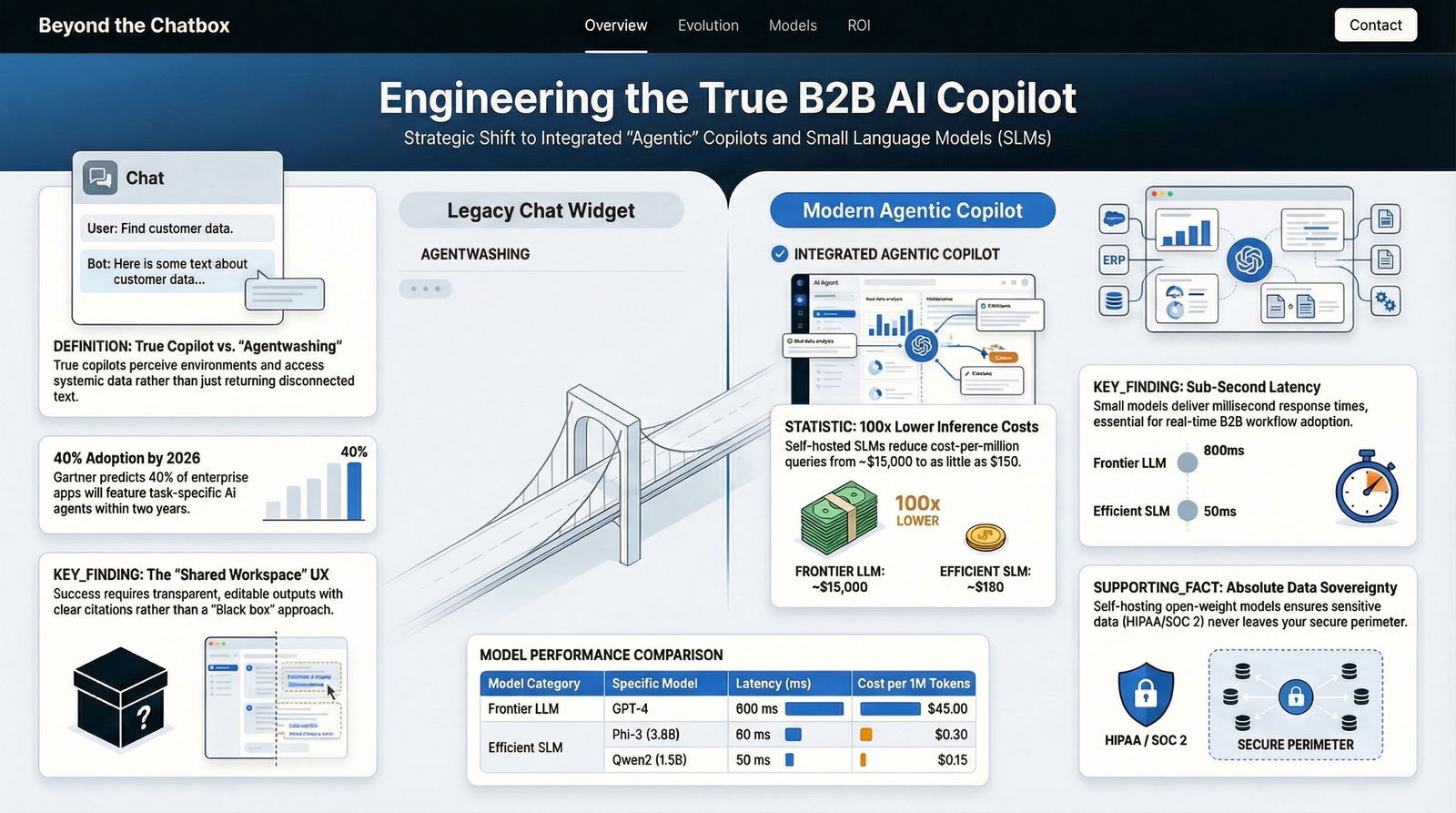
Building AI Copilots Into Your Existing Software: A Guide for SaaS and Internal Apps
If you are a technology executive, product leader, or visionary founder navigating the software landscape today, you are likely feeling the immense, gravitational pull of artificial intelligence. You are not alone. Across boardrooms and engineering stand-ups, the most pressing question has shifted from “Should we use generative AI?” to “How quickly can we embed a secure, reliable AI copilot into our existing application without alienating our users or bankrupting our cloud budget?”
The software industry is undergoing a platform shift as fundamental and disruptive as the migration from on-premise servers to the cloud, or the transition from perpetual licenses to Software-as-a-Service (SaaS). By the end of 2025, global spending on enterprise generative AI skyrocketed to $37 billion, making it the fastest-scaling software category in human history. We have moved past the era of experimental prompt engineering. Today, end-users—whether they are mortgage brokers, marketing directors, clinical educators, or financial analysts—expect the software they use to act as an intelligent partner, not just a static digital filing cabinet.
However, the path to building a true AI copilot is fraught with expensive pitfalls. The market is littered with applications suffering from “agentwashing”—the practice of slapping a generic, disconnected chat widget onto a legacy interface and marketing it as “AI-powered.” Users see right through this. A bolted-on chatbot that hallucinates data and ignores the user’s workflow context is not a copilot; it is a liability.
To win in this new era, B2B firms must thoughtfully integrate AI deeply into their proprietary workflows. This exhaustive guide explores the strategic, technical, and psychological frameworks required to build an AI copilot into your SaaS product or internal business app. We will dismantle the hype, answer your most critical questions regarding model selection, UX design, and data governance, and demonstrate how partnering with seasoned experts like Baytech Consulting for AI integration can accelerate your deployment with tailored, enterprise-grade technology.
Part I: What is a True AI Copilot? (Hint: It’s Not Just a Chat Widget)
To understand what we must build, we must first clearly define what an AI copilot actually is within the context of a sophisticated B2B application.
In the early days of the generative AI boom, the default implementation strategy was simple: embed an API call to a major cloud language model, place a chat box in the bottom right corner of the screen, and allow users to type open-ended questions. While this provided a veneer of modernity, it fundamentally failed to enhance user productivity. These widgets lacked context. They did not know what screen the user was on, they could not access the proprietary data locked in the application’s database, and they possessed no ability to take meaningful action on the user’s behalf.
The Evolution from Assistive to Agentic AI
A true AI copilot is an assistive entity deeply integrated into the user’s workflow. It acts as a collaborator that perceives its environment, accesses relevant systemic data, and takes autonomous or semi-autonomous actions to achieve specific goals.
The industry is currently progressing along a clearly defined maturity continuum:
Assistive AI: These are intelligent assistants embedded within specific features. They simplify tasks, such as drafting an email or summarizing a meeting, but they remain highly dependent on continuous human input and prompting.
Agentic AI (The Autonomous Copilot): This represents the next frontier. Agentic AI involves task-specific agents capable of operating and performing complex, end-to-end tasks independently. These agents function as a “federation of real-time workflow services,” learning from user interactions and proactively suggesting optimizations.
By 2026, Gartner predicts that 40% of enterprise applications will feature these task-specific AI agents, a staggering leap from less than 5% in 2025. A true copilot understands the user’s intent, pulls data from the underlying Postgres or SQL Server databases, cross-references it against company policies, and presents a fully formed, actionable draft or recommendation directly within the application’s native interface.
Leveling the Playing Field for SMBs
For small and midsized businesses (SMBs) and mid-market SaaS providers, building a true copilot is a strategic imperative to level the playing field against enterprise behemoths. SMBs are inherently lean. By integrating generative AI, they can scale operations, drive massive productivity gains, and offer highly personalized customer experiences without requiring the vast financial resources typically available to massive conglomerates. If you need a structured roadmap for this, our SMB AI adoption guide walks through low-risk pilots and a 90-day rollout plan.
Ignoring this paradigm shift carries quiet, yet fatal, risks. Competitors utilizing AI copilots will simply work faster and sell smarter. Furthermore, modern talent expects to work with modern, AI-augmented tools; forcing employees to rely on manual, static software will increasingly hinder recruitment and retention.
Part II: High-Impact Features: What Should You “AI-Assist”?
One of the most common mistakes product teams make is wanting an AI copilot without a clear understanding of what it should actually do. The vision is often a vague desire for a “smart assistant that knows everything.” In reality, AI copilots are not ideal for every task. For complex, heavily structured account configurations, a traditional UI often remains superior.
The most successful AI-assisted features target repetitive, high-volume tasks where cognitive load can be reduced. When deciding which features to augment, consider your ideal user persona and their daily friction points.
Cross-Industry Baseline Capabilities
Regardless of your specific vertical, certain baseline generative features consistently deliver immediate “quick wins” for productivity.
Data Synthesis and Summarization: The ability to condense large amounts of unstructured data—such as long email threads, call transcripts, or complex analytics dashboards—into succinct, actionable reports.
Contextual Form-Filling and Drafting: Automating routine communication processes. A copilot should be able to look at a client’s history and instantly draft a highly personalized follow-up email, sales deck, or product brochure.
Workflow Automation: Back-end tasks across sales, IT, and support are prime candidates for agentic automation. This includes intelligent routing of support tickets based on sentiment analysis or automatically scheduling follow-ups based on specific trigger events.
Domain-Specific Use Cases by Industry
The true power of a copilot is unlocked when it is intricately domain-tuned to specific industry workflows. Let us examine how this manifests across key B2B sectors.
Real Estate and Mortgage SaaS The commercial real estate and mortgage lending industries are historically burdened by massive volumes of complex documentation. A copilot in this space completely alters operational velocity.
Lease Abstraction: This is widely considered the highest-impact use case in real estate operations. Reviewing commercial leases to extract critical data points traditionally consumes four to eight hours per document. A specialized AI agent can reduce this abstraction time to 15–30 minutes while maintaining lending-grade accuracy standards of 95–99%.
Automated Property Valuations: AI tools can process vast amounts of historical market data to generate accurate property valuations 50% faster than traditional appraisals.
Immersive Marketing: Copilots can transform standard 2D floorplans and photos into immersive 3D walkthroughs, instantly adjust digital staging, and generate highly targeted listing copy optimized for local SEO.
Real-World Context: Baytech Consulting has extensive experience modernizing platforms in this sector. For clients like RealSource, CashCall, and New American Funding, custom software solutions have resolved severe workflow bottlenecks, unified siloed lead data, and ensured rigorous regulatory compliance across distributed lending teams.
Education and Learning Management Systems (LMS) Educational technology is shifting from static video repositories to dynamic, hyper-personalized learning environments.
AI-Driven Content Creation: Instructors and corporate trainers can utilize copilots to automatically generate bite-sized microlearning modules, quizzes, and assessments from a single uploaded document or keyword.
Adaptive Learning Paths: An AI-powered LMS analyzes a learner’s behavior, performance, and specific struggles in real-time. If a corporate employee repeatedly fails questions regarding data privacy, the copilot will automatically intervene, recommending a specific micro-course or suggesting a coaching session to close the knowledge gap.
Real-World Context: Baytech Consulting has successfully architected advanced LMS solutions for institutions like American Allied Health and Petra Medical College. These custom platforms integrate sophisticated student portals, complex online exam proctoring, and automated certification generation, proving that a tailored tech advantage is crucial for modern educational delivery.
Advertising and Marketing Technology Marketing SaaS platforms are becoming increasingly agentic. Generative AI now powers over 17% of all marketing efforts globally, a figure that is rapidly accelerating.
Asset Generation and Personalization: Copilots assist marketing directors by instantly generating ad copy, social media captions, and localized visual assets at scale.
Campaign Optimization: Beyond content creation, these agents automate social media strategies by determining optimal posting times for maximum visibility and conducting continuous, rapid A/B testing to evaluate which creative assets yield the highest conversion rates. Nearly 95% of B2B marketers report utilizing some form of AI-powered tools to streamline these operations.
Finance and Operations In the financial sector, where accuracy is paramount, startups utilizing AI captured a stunning 91% of the market share for new software deployments in 2025. Financial copilots excel at ingesting complex data arrays, performing rapid account reconciliations, and generating instant compliance reports. They provide intelligent automation that significantly enhances risk management and fraud detection while drastically reducing the human capital required for intensive manual ledger entries.
Gaming and High-Tech SaaS For platforms serving software engineers and game developers, copilots act as highly advanced pair programmers. They excel at code generation, real-time bug detection, and managing complex cloud-focused development environments. By automating the generation of boilerplate code and providing instant documentation lookup, these copilots allow developers to focus on high-level architecture and bleeding-edge feature development.
Part III: The Engine Room: Cloud LLMs vs. Domain-Specific SLMs
Once you have defined the features your copilot will execute, you face the most consequential architectural decision in your product’s lifecycle: What type of “brain” will power it?
Initially, the default strategy was to connect the SaaS application to a massive, frontier Large Language Model (LLM) via a cloud API—such as OpenAI’s GPT-4o, Anthropic’s Claude, or Google’s Gemini. However, as organizations moved from pilot programs to full-scale production, they encountered severe roadblocks regarding operational costs, unacceptable latency, and strict data sovereignty concerns. To keep those costs in check and protect margins, many teams also explore an “AI cost playbook” that looks a lot like what we outline in The Token Tax: Stop Paying More Than You Should for LLMs.
This has driven a massive industry trend toward self-hosted, domain-tuned Small Language Models (SLMs). An SLM typically ranges from 1 billion to 15 billion parameters, compared to the hundreds of billions or trillions of parameters found in frontier LLMs. Choosing between embedding a major cloud LLM or a smaller, domain-specific SLM requires analyzing the trade-offs across four critical dimensions: Accuracy, Latency, Cost, and Data Control.
1. Accuracy, Capabilities, and Task Complexity
LLMs dominate complex, multi-step reasoning benchmarks. They are unparalleled for open-ended generation, creative tasks, and queries that require broad, generalized world knowledge. If your copilot needs to act as a general-purpose oracle capable of answering questions about any topic under the sun, an LLM is required.
However, SaaS copilots rarely need to be general-purpose oracles. They need to be highly competent specialists in a specific domain. Accuracy does not scale linearly with model size. When an SLM is fine-tuned on your proprietary, domain-specific data, it can match or even exceed the accuracy of an LLM for structured, narrow tasks. For example, if you need an AI to extract dates and financial figures from commercial leases, a heavily fine-tuned 7-billion parameter SLM will perform this task with exceptional accuracy, without carrying the computational dead weight of knowing how to write a sonnet in 16th-century French.
2. Latency and The User Experience
Latency shapes the user experience. If a user clicks a button to “Summarize Account History” and is forced to stare at a loading spinner for three seconds, the illusion of a helpful, fluid assistant is broken. Friction is introduced, and user adoption plummets.
SLMs are specifically designed for efficiency. Because they have a smaller parameter footprint, they can be deployed on single GPUs, standard CPUs, or even edge devices. Consequently, they deliver lightning-fast, sub-second responses, often serving tokens in tens of milliseconds.
Conversely, relying on a cloud-hosted LLM means your application’s responsiveness is entirely at the mercy of external vendor infrastructure and network round-trip delays. Cloud LLMs frequently experience latencies of hundreds of milliseconds, or even multiple seconds during peak usage times. For real-time applications—like an autocomplete coding feature or a live customer support agent—the ultra-low latency of an SLM is not just preferable; it is mandatory.
3. The Economics of Inference Costs
The financial burden of continuous API calls to cloud LLMs can completely destroy SaaS unit economics. As of late 2023, high-volume usage of advanced LLM APIs could easily scale to hundreds of thousands—or even millions—of dollars annually. If a single user query costs $0.09, and you have 100,000 active users making 20 queries a day, your monthly API bill will instantly wipe out your gross margins.
SLMs drastically alter these economics. While there is an initial capital expenditure to train and fine-tune an SLM (typically between 1,000 and 50,000), the variable cost of inference drops exponentially. SLMs can reduce the cost-per-million queries by over 100x compared to frontier LLMs. A million business conversations that might cost $15,000 to process via an LLM API could cost as little as $150 using a self-hosted SLM.
Detailed Performance and Cost Comparison (2025 Benchmarks)
The following data illustrates the stark contrast between frontier LLMs and efficient SLMs across key performance metrics, highlighting why B2B vendors are rapidly adopting smaller models for production workloads.
| Model Category | Specific Model | Parameter Size | Accuracy (MMLU %) | Inference Speed (Tokens/sec) | Average Latency (ms) | Cost per 1M Tokens ($) |
|---|---|---|---|---|---|---|
| Large Language Model (LLM) | GPT-4 | ~1.7 Trillion | 86.4% | 15 | 800 ms | $45.00 |
| Large Language Model (LLM) | GPT-4 Turbo | ~1.7 Trillion | 85.0% | 20 | 750 ms | $50.00 |
| Small Language Model (SLM) | Phi-3 | 3.8 Billion | 69.0% | 250 | 80 ms | $0.30 |
| Small Language Model (SLM) | Mistral 7B | 7 Billion | 60.1% | 200 | 100 ms | $0.25 |
| Small Language Model (SLM) | Qwen2-1.5B | 1.5 Billion | 52.4% | 400 | 50 ms | $0.15 |
As the data indicates, while LLMs maintain an edge in general reasoning benchmarks (MMLU), SLMs offer an overwhelming advantage in speed and cost. For a real-time SaaS chatbot requiring responses under 100 ms, an SLM like Qwen2 or Phi-3 is the only economically and technically viable solution. If you are already running on Microsoft infrastructure, pairing SLMs with a strategic .NET and Semantic Kernel AI stack can further simplify rollout and long-term maintenance.
4. Data Control and Enterprise Sovereignty
For B2B applications handling sensitive, regulated data—such as financial records, patient health information, or proprietary source code—data sovereignty is paramount.
When you utilize an API-based LLM, you are sending your customers’ proprietary data across the public internet to be processed on external vendor servers. You cannot control where that data goes, what hardware processes it, or whether the model version changes overnight.
Self-hosting an open-weight SLM solves this. Organizations can download the model weights and deploy them within their own secure perimeters. Whether utilizing an on-premise Kubernetes cluster or isolated cloud environments, the sensitive data never leaves your infrastructure. This level of deployment control is absolute table stakes for vendors operating in healthcare, finance, defense, and legal sectors.
Part IV: Designing the UX: Trust, Explainability, and Reversibility
Integrating a powerful language model is only the backend of the equation. The user interface (UX) is where the copilot will ultimately succeed or fail. Unlike traditional software, which operates on deterministic, rule-based logic (if X, then Y), generative AI systems are probabilistic. They exhibit variability, unpredictability, and they will occasionally hallucinate incorrect information.
Consequently, you must fundamentally rethink your UI design. You cannot treat the copilot as an infallible oracle; you must design it as an assistive collaborator. Building user trust requires prioritizing transparency, explainability, and total human control.
Breaking the “Blank Chat Box” Paradigm
One of the most profound UX failures in early AI integration was the reliance on the empty chat box. Dropping a user into an interface with a blinking cursor and the text “Ask me anything” creates massive cognitive overload. Ambiguity kills momentum. Users do not know what the AI is capable of, what data it has access to, or how to phrase their prompts effectively.
Instead, modern copilot UX design relies on Guided Input. You must shape the user’s input to shape the output. This involves utilizing multi-step forms, contextual prompts, and smart defaults based on prior behavior. For example, if a user is viewing a financial dashboard, the copilot should not present an empty chat; it should offer intent-driven shortcuts like buttons that say, “Generate Q3 Variance Report,” or “Analyze churn by segment.” The UI must show the AI’s intent before acting, reducing friction and guiding the user toward successful outcomes.
The Shared Workspace Model: Designing Transparent Outputs
When the AI generates an output, it must be treated as a first draft, never a final answer. The “Shared Workspace” UX pattern ensures that outputs are entirely transparent, editable, and traceable.
To build trust, users must be able to:
See exactly what input parameters and system data were used to generate the output.
View citations, embedded links, and data provenance. If the AI claims a specific metric, it must provide a clickable link directly to the source document or database query.
Revise or re-prompt seamlessly. The interface should allow inline editing of the generated text or provide quick refinement buttons (e.g., “Make this tone more professional,” “Shorten to one paragraph”).

Explainability and Counterfactuals
The “black box” nature of AI decision-making creates anxiety for enterprise users. Transparency doesn’t mean exposing raw Python code or neural network weights to the end-user; it means providing contextual cues that explain why the AI arrived at a specific conclusion.
Even brief, simple copy such as “Recommended because you liked X,” or “This projection is based only on data up to Q2,” profoundly demystifies the AI’s logic.
Advanced copilots deploy Counterfactual UIs to push explainability further. Imagine an AI copilot assisting a loan officer. If the AI recommends denying a mortgage application, it should not simply return a “Denied” status. It should provide a counterfactual: “If the applicant’s declared income were $5,000 higher, or if their debt-to-income ratio was 3% lower, this loan would meet automated approval criteria.” This allows users to tweak inputs, understand the boundaries of the algorithm, and shift the experience from passive reception to active learning.
Failure Containment and Safe Modes
When your AI copilot evolves from assistive (drafting text) to agentic (executing actions like updating databases or sending bulk emails), the risk profile changes dramatically. A single AI failure can cascade across systems. If a user delegates a task to an AI and it makes a catastrophic error, the user will learn to never trust the system again.
Designing for reversibility requires implementing strict Failure Containment patterns. This means limiting the “blast radius” when something goes wrong.
Dry Run Modes: High-impact tasks should default to a “dry run” or sandbox execution mode. The UI must explicitly show the affected scope before execution.
Explicit Commit Points: The interface must force the user to acknowledge the scale of the action. Distinguishing between “This action will update 3 records” and “This action will update 847 records” forces human oversight at critical junctures.
Audit Logs as Undo Buttons: Today’s undo button becomes tomorrow’s comprehensive audit log. Every action taken by the agent must be logged, visible, and entirely reversible by a human administrator with a single click.
The Trap of Over-Humanization
Finally, avoid the temptation to over-humanize your copilot. Giving the AI a human name, a cartoon avatar, or programming it to use emotional phrasing (e.g., “I feel that…” or “I completely understand how you feel”) is highly detrimental. It creates a false mental model, tricking the user into attributing human empathy and understanding to a statistical probability engine. Stick to a neutral, direct tone. The AI is a powerful tool, not an employee. Establishing this clear boundary ensures long-term user trust and aligns with the kind of human-in-the-loop trust architectures we outline in our 90/10 automation, 10% humanity framework.
Part V: Security, Privacy, and Enterprise Governance
Integrating generative AI directly into your SaaS product introduces a host of unprecedented security challenges. Employees and early adopters did not wait for IT policy before using AI; tools like ChatGPT landed in workflows quietly and quickly, leaving a massive trail of data exposure in their wake as employees pasted sensitive corporate data into public prompt windows.
As a SaaS vendor, you cannot afford “shadow AI.” If you are selling to B2B clients, particularly in healthcare, finance, or enterprise technology, your AI copilot must adhere to rigorous compliance frameworks, including SOC 2, HIPAA, and GDPR. You are retrofitting advanced security over tools that handle your clients’ most sensitive data.
The Five Pillars of GenAI Data Governance
Before a copilot can be safely deployed, you must establish a holistic data governance framework. This framework must decisively answer five essential questions: What data is sensitive? Where does it live? Who can access it? How might it reach a GenAI model? And what happens if it does?
If you cannot answer these questions, your AI is ungoverned and poses a critical risk to your organization and your customers.
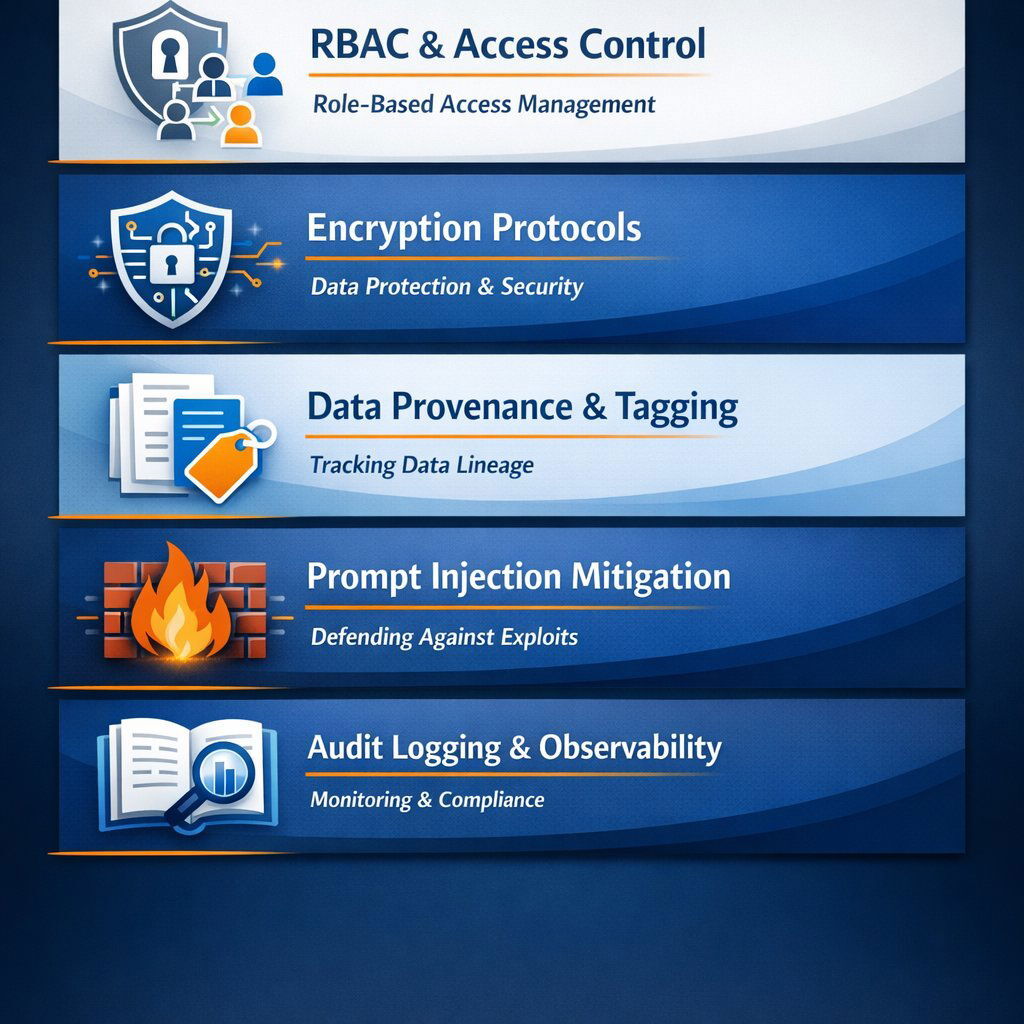
1. Strict Access Management and RBAC Your AI copilot must perfectly inherit the Role-Based Access Controls (RBAC) of your existing application. If a junior analyst does not have permission to view executive payroll data in the standard UI, the copilot must absolutely not possess the ability to read, summarize, or expose that data via a conversational prompt. Integrating the copilot’s identity management with your existing authentication protocols is mandatory.
2. Encryption Protocols To satisfy SOC 2 and HIPAA requirements, data protection must be flawless. All data at rest—including the vector databases used to store the context for your AI—must be encrypted using AES-256 or stronger algorithms. Furthermore, all data in transit between your application and the language model must utilize TLS 1.2+ protocols. If you control the encryption keys, they must be managed securely via Hardware Security Modules (HSMs) or secure cloud Key Management Services (KMS), with strict rotation policies enforced.
3. Data Tagging and Provenance Enterprise governance requires knowing exactly where your data originated. You must implement metadata tagging for all data used to train, fine-tune, or provide context to the generative AI application. This supports provenance tracking, ensures verifiable consent management (crucial for GDPR compliance), and allows for automated regulatory compliance assessments to prove that unauthorized data was not consumed by the model.
4. Vulnerability Mitigation and Prompt Injection Generative AI introduces novel attack vectors that traditional web application firewalls cannot catch. The most prominent is prompt injection, where a malicious user inputs crafted text designed to override the copilot’s system instructions, potentially tricking it into leaking sensitive data or executing unauthorized commands. Your engineering team must catalog these generative AI-specific risks and implement robust input sanitization and output validation guardrails to prevent malicious use cases. For a deeper dive into this, see our guide on deploying an AI firewall to stop prompt injection at the middleware layer.
5. Comprehensive Logging and Observability In the event of an audit, you must be able to prove exactly how the AI operated. SOC 2 demands comprehensive logging and monitoring. Every user prompt, every contextual data retrieval, and every output generated by the copilot must be securely logged. This unalterable audit trail is necessary to ensure processing integrity—proving that data processing was accurate, authorized, and complete.
Part VI: The Economics of AI: ROI and Pricing Disruption
The deployment of sophisticated AI agents is acting as a massive catalyst for corporate budget reallocation. In 2025, surveys revealed that 57% of organizations were already dedicating between 21% and 50% of their annual digital transformation budgets specifically to AI automation. By 2026, half of all organizations are predicted to allocate more than 50% of these budgets to AI. For large enterprises, this represents hundreds of millions of dollars in highly targeted technology investments.
For B2B SaaS providers, this influx of capital represents a massive opportunity, but it also necessitates a fundamental disruption of how software is priced and sold.
The Death of the “Seat-Based” Model
Historically, the software industry relied on “seat-based” subscription models, where a company paid a fixed monthly fee for every human employee who needed a login. However, agentic AI shatters this economic logic. If an autonomous AI agent can perform the workload of five human operators in a fraction of the time, the client organization needs significantly fewer “seats.”
If SaaS vendors cling strictly to per-seat pricing while rolling out highly efficient AI copilots, they will paradoxically cannibalize their own revenue streams. The more efficient the software makes the client, the fewer licenses the client will buy.
The Pivot to Usage and Outcome-Based Pricing
To align value with revenue, the industry is rapidly transitioning toward flexible, usage-based pricing (charging by tokens processed or API calls made) and hybrid outcome-based models.
This evolution is leading to “resolution-based pricing.” Under this model, a vendor charges the client for specific, measurable results achieved by the AI agent. For instance, customer support software providers like Zendesk have introduced models where customers pay a fee for every ticket the AI successfully resolves without human intervention, rather than paying for access to the software interface. Gartner predicts that by 2030, at least 40% of all enterprise SaaS spending will transition to these types of dynamic, outcome-driven consumption models.
Measuring the Return on Investment (ROI)
While the capital expenditure required to architect, train, and securely deploy AI copilots is significant, the proven financial returns justify the investment. Organizations across all sectors are viewing autonomous AI agents as a pathway to massive, measurable business impact. If you want to understand how data quality, infrastructure, and AI investments connect to ROI, our article on enterprise data readiness for AI is a useful companion read.
The data indicates that for every $1 invested in generative AI initiatives, companies realize an average return of $3.70. However, achieving these exceptional multipliers—such as the 4.2x ROI seen in financial services—requires viewing AI not as a standalone silver bullet, but as an integrated operational enhancement. Executive leaders note that AI rarely delivers its full value in isolation. The highest returns are achieved when the implementation of an AI copilot is paired with parallel initiatives to improve overall data quality, streamline legacy workflows, and restructure team responsibilities to take advantage of the newly automated capacity.
Part VII: Partnering for Execution: How Baytech Consulting Accelerates AI Integration
The mandate is clear: you must build secure, highly capable AI copilots tailored to your specific industry domain. However, achieving this does not require you to hire a massive, highly expensive internal AI research team. In fact, doing so is often a recipe for bloated budgets and sluggish time-to-market. By 2025, 76% of all enterprise AI use cases involved organizations opting to purchase or partner for ready-made, expertly integrated solutions, recognizing that established technical tech stacks reach production significantly faster.
Partnering with a specialized custom software development firm is the most reliable strategy to mitigate execution risk. Baytech Consulting stands out in this arena by providing a Tailored Tech Advantage—delivering solutions custom-crafted with cutting-edge technology—and utilizing a Rapid Agile Deployment methodology that ensures timelines are met with transparency and adaptability. If you need a long-term collaborator rather than a one-off vendor, our partnership approach explains how we structure these engagements.
The Baytech Integration Process
Baytech does not just implement off-the-shelf AI; they build custom solutions that integrate seamlessly into your existing systems. Their process is structured to handle the intense complexities of modern enterprise software architecture.
Discover and Estimate: The process begins not with coding, but with a rigorous “meeting of the minds” to understand the precise business problem at hand. Baytech ensures every project starts with an upfront agreement on scope, cost, and timing, eliminating the financial unpredictability that plagues many AI projects.
Architecting for Scale and Security: The core of their expertise resides in system architecture. When building an AI copilot, data security is paramount. Baytech leverages robust infrastructure technologies. They can orchestrate highly secure deployments using Azure DevOps On-Prem for strict CI/CD pipeline control, containerize custom Small Language Models using Docker and Kubernetes to ensure scalability, and manage massive, proprietary datasets within isolated Postgres and SQL Server environments to guarantee that sensitive client data never leaks to public models. This mirrors the kind of modernization work we discuss in our piece on using AI sidecars instead of risky rewrites, Minimize Risk and Maximize ROI with Sidecars.
Building with Precision: Baytech’s highly skilled engineers tackle the nuances of AI integration head-on. To combat the pervasive issue of AI hallucination, they utilize advanced machine learning techniques, including transfer learning, supervised learning, and Proximal Policy Optimization (PPO), to fine-tune model accuracy and ensure the copilot’s outputs are deeply grounded in reality.
Launch and Iterate: Utilizing Agile, SCRUM, or Kanban methodologies, the deployment is managed iteratively, ensuring the software remains highly adaptive to user feedback and changing market conditions.
A Portfolio of Industry Transformation
Theoretical knowledge is useless without a track record of execution. Baytech Consulting has successfully guided complex software transformations across highly regulated industries, proving their ability to solve deep-seated operational challenges.
Finance and Real Estate: They have revolutionized lead management, operational visibility, and compliance tracking for major lenders and real estate firms like RealSource, CashCall, and New American Funding. By resolving issues with siloed data and manual workarounds, their custom platforms have driven massive efficiency gains and revived revenue streams.
Education: Baytech has architected enterprise-grade Learning Management Systems for institutions such as American Allied Health and Petra Medical College. These comprehensive platforms feature interconnected student and partner portals, online examination systems, and secure certificate generation.
By relying on a proven partner, you acquire the expertise of a seasoned architecture team capable of navigating the complex web of AI model selection, SOC 2 compliance, and intricate UX design, allowing you to focus on your core business strategy. For organizations comparing partners, our guide to the top software development companies in California shows how to evaluate vendors for AI-heavy builds.
Conclusion
The integration of an AI copilot into your SaaS platform or internal business application is no longer an optional innovation; it is a foundational requirement for survival in the modern software ecosystem. The market has definitively moved beyond the novelty of conversational widgets. Today’s users demand intelligent, autonomous partners capable of executing complex workflows, interpreting massive datasets, and drastically accelerating their daily productivity.
However, execution is everything. Success requires a meticulous, multi-disciplinary approach. You must strategically identify which specific features will yield the highest ROI when augmented by AI. You must carefully navigate the technical and financial trade-offs between utilizing massive, cloud-hosted Large Language Models and deploying lightning-fast, highly secure Small Language Models. You must architect a user experience that prioritizes absolute transparency, explainability, and failure containment to foster unwavering user trust. Above all, you must encase your AI initiatives within a flawless enterprise data governance framework to ensure rigorous compliance with standards like SOC 2 and GDPR.
You do not have to undertake this monumental shift alone. By partnering with experienced custom software development experts like Baytech Consulting, you can leverage proven architectural frameworks, rapidly deploy secure, tailored technology, and confidently deliver an AI copilot that drives measurable business value and solidifies your competitive advantage for years to come.
The era of manual, static software is over. It is time to build the intelligent tools your users deserve.
Frequently Asked Question
What is the real difference between a standard chat widget and a true AI copilot for my B2B application?
A standard chat widget is essentially a generic interface overlay; it passes a user’s typed question to a language model and returns a block of text. It typically possesses no understanding of the software’s specific domain, the user’s current workflow context, or the proprietary data housed within the application. It is disconnected from the core functionality and requires the user to constantly copy and paste information back and forth.
A true AI copilot is deeply integrated into both the application’s backend architecture and its user interface. It is highly context-aware—meaning it inherently knows exactly what screen the user is viewing, what database permissions they possess, and the historical usage patterns associated with their account. Instead of merely answering questions, a true copilot takes proactive action. It can autonomously fill out complex forms, instantly analyze specific datasets within the platform, initiate multi-step workflows, and generate highly specialized drafts based entirely on your proprietary company logic. Most importantly, a copilot is governed by strict enterprise security protocols, ensuring that all interactions remain fully compliant with rigorous standards like SOC 2 and GDPR, and that the AI operates within safely defined boundaries to mitigate errors and protect sensitive data.
Supporting Articles
- https://www.deloitte.com/us/en/insights/industry/technology/technology-media-telecom-outlooks/software-industry-outlook.html
- https://www.dsolutionsgroup.com/smbs-embrace-genai-powered-productivity-tools/
- https://menlovc.com/perspective/2025-the-state-of-generative-ai-in-the-enterprise/
About Baytech
At Baytech Consulting, we specialize in guiding businesses through this process, helping you build scalable, efficient, and high-performing software that evolves with your needs. Our MVP first approach helps our clients minimize upfront costs and maximize ROI. Ready to take the next step in your software development journey? Contact us today to learn how we can help you achieve your goals with a phased development approach.
About the Author

Bryan Reynolds is an accomplished technology executive with more than 25 years of experience leading innovation in the software industry. As the CEO and founder of Baytech Consulting, he has built a reputation for delivering custom software solutions that help businesses streamline operations, enhance customer experiences, and drive growth.
Bryan’s expertise spans custom software development, cloud infrastructure, artificial intelligence, and strategic business consulting, making him a trusted advisor and thought leader across a wide range of industries.