In this article
- 10 Top AI Development Agencies in the US with Expertise in Legacy Software Modernization Services
- Key Takeaways
- Why Legacy Software Has Become an AI-Era Emergency
- What AI Changes in a Modernization Project
- The List of the Top AI Development Agencies in the US with Legacy Software Modernization Expertise
- Comparison of the AI Development Agencies in the US with Expertise in Legacy Software Modernization Services
- Why Legacy Modernization Projects Still Fail
- How to Evaluate an AI Agency for Legacy Modernization
- Final Thoughts
- FAQs
- About Baytech
- About the Author
10 Top AI Development Agencies in the US with Expertise in Legacy Software Modernization Services
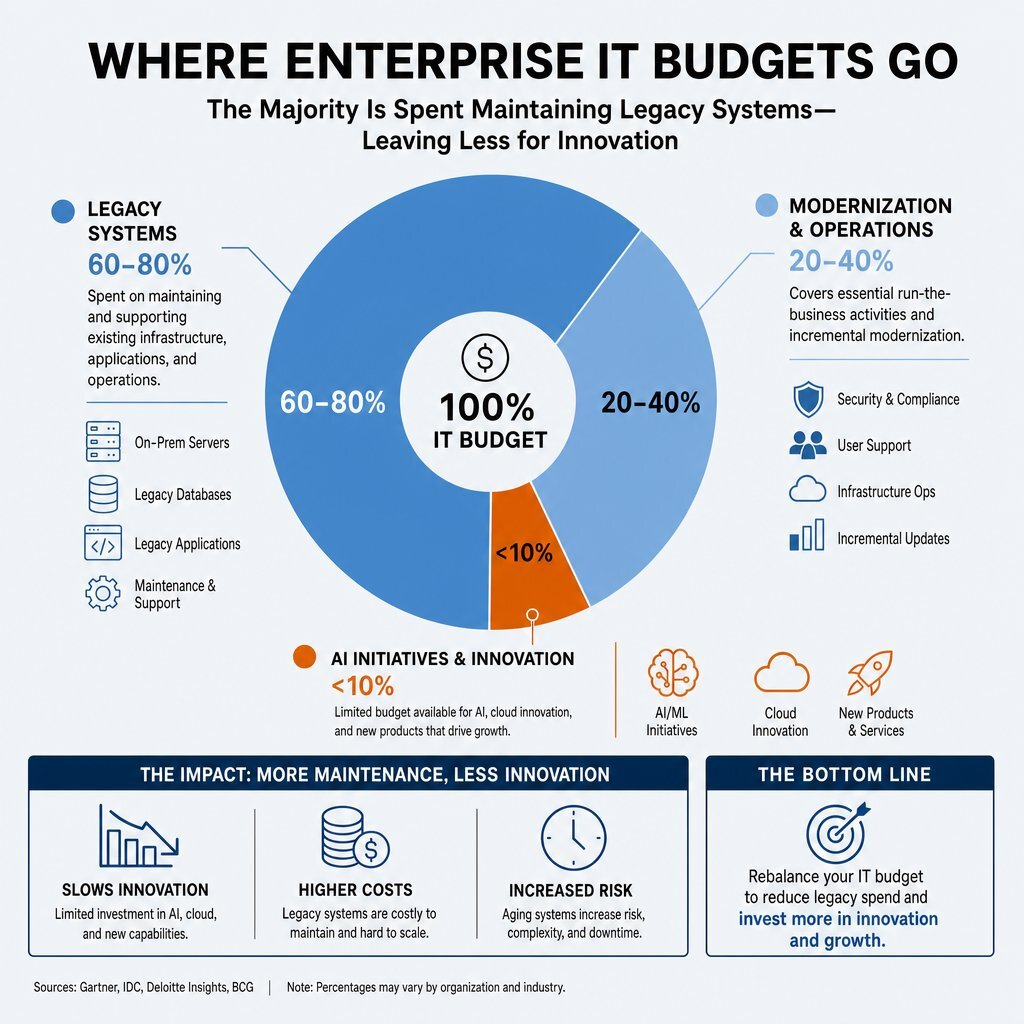
US enterprises spend 60-80% of their IT budget just keeping old systems alive. This leaves little for work that moves the business forward: new products, AI initiatives, and competitive infrastructure. Although the systems don’t collapse, they consume all resources.
AI has changed the economics of modernization. According to McKinsey, AI tools cut project timelines by 40-50% and reduce technical debt costs by a similar amount, so a $100M project from 3 years ago can be delivered for less than half the price today. What hasn’t changed is the failure rate: 68% of legacy modernization projects still miss their original scope, timeline, or budget. The main constraint is the partner you choose. Meanwhile, agencies that understand both AI development and live legacy environments are rare.
This list covers the top AI development agencies in the US with expertise in legacy software modernization services. They have documented experience mapping undocumented codebases, migrating live systems without outages, and building AI-ready infrastructure on the other side.
Key Takeaways
This list covers the top 10 AI development agencies in the US, each with expertise in legacy software modernization services tailored to different types of clients, systems, and budgets. Baytech for mid‑market fixed‑cost AI‑first delivery; Cognizant and Infosys for large mainframe estates; Grid Dynamics for Fortune 1000 outcome‑based programs; Centric and Trigent for mid‑market agentic modernization; Hexaware for BFSI mainframes; ScienceSoft for compliance‑heavy regulated industries; Keyhole for long‑duration US‑based work; EffectiveSoft for incremental long‑term migration.
60–80% of enterprise IT spend goes toward keeping legacy systems running, leaving little for AI, new products, or competitive infrastructure.
89% of AI leaders name legacy integration as the main barrier to agentic AI, and only 24% of enterprises say their current stack can support AI at scale.
AI‑assisted modernization can cut timelines by 40-50% and technical‑debt costs by about 40%, so a $100M project from 3 years ago can often be delivered for less than half that amount.
68% of modernization projects still fail or miss scope and budget. The issue is usually partner selection and approach.
5 signals of a credible agency: they assess before they propose, use phased delivery by default, show production case studies with clear outcomes, keep architects in charge of AI tooling, and put knowledge transfer in the contract.
Why Legacy Software Has Become an AI-Era Emergency
60% of organizations that still use COBOL cite finding developers as their biggest challenge. That’s because the average COBOL developer is 62, and when they leave, the systems stay, but the knowledge goes. About 42% of critical business logic in legacy systems is at risk the moment a key developer walks out. This looks like a staffing challenge; however, in reality, it’s an architecture issue.
Legacy systems were built to process transactions, not to share data in real time. They rely on batch jobs, siloed databases, and monolithic code that was never designed for APIs. This worked in 1995. In 2025, it’s a main reason AI projects stall before production: 59% of AI leaders name legacy integration as the top barrier to deploying agentic AI, and only 24% of enterprises say their current stack can support AI at scale. The models and computation exist, while the AI data pipelines and governance don’t.
Between 60% and 80% of enterprise IT budgets now go to keeping legacy systems running. For organizations with 10-15 legacy apps, direct maintenance costs run $400,000-800,000 a year, and the true total is often 2-3x higher once talent premiums, lost productivity, security exposure, and compliance risk are included. IT teams spend about 17 hours a week on legacy maintenance, roughly half their time. These hours don’t move the business forward.
The security story is similar. Ransomware groups target unpatched legacy modules that can’t run modern endpoint protection. Companies with legacy systems are 40% more likely to have compliance failures. For example, in healthcare, breaches average $9.77M in remediation costs and take about 279 days to detect when legacy systems can’t be patched.
The good news is that the cost of an alternative has changed. The question is no longer whether to modernize. It is who you trust to do it.
What AI Changes in a Modernization Project
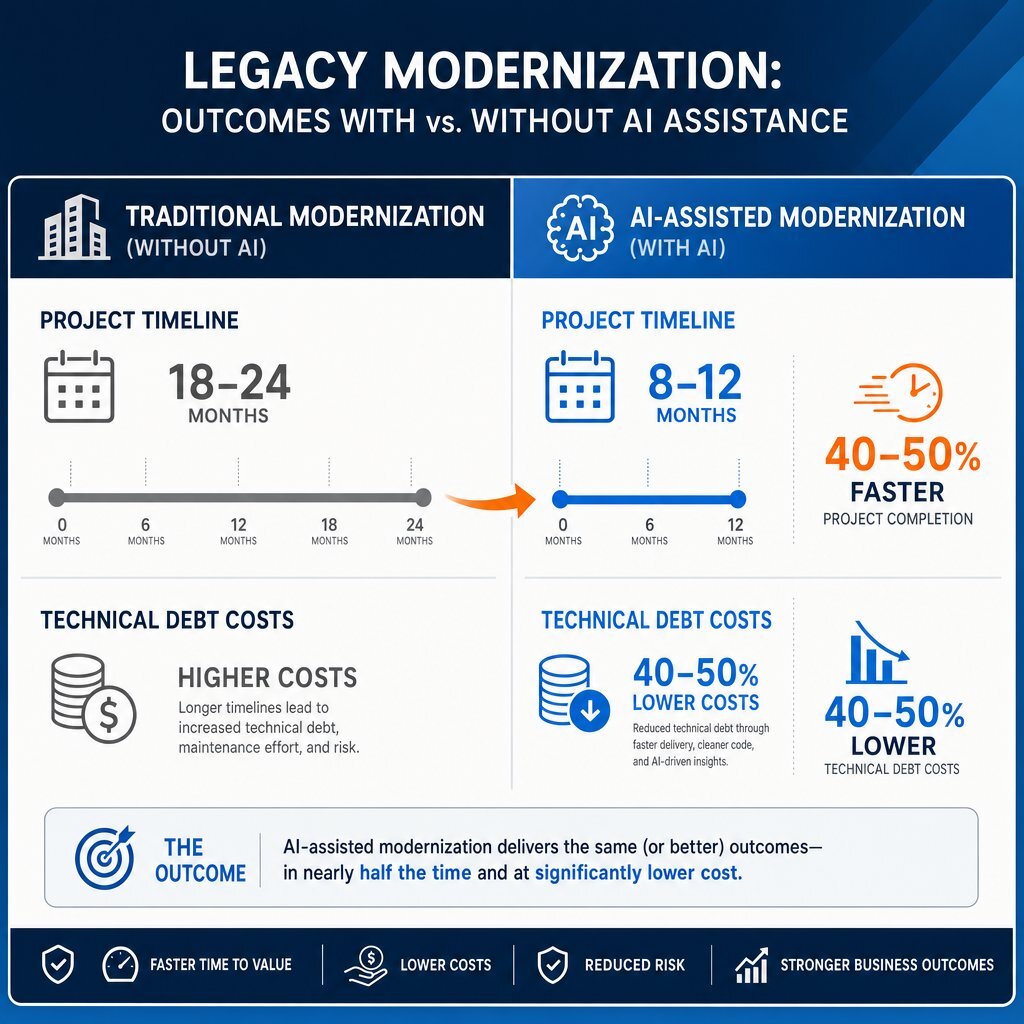
Modernizing a legacy system has always had three hard parts: understanding what you have, converting it into something modern, and making sure nothing breaks along the way. Each step used to be slow, expensive, and dependent on a small pool of senior engineers. AI has changed the economics of all three. McKinsey reports that AI‑assisted modernization cuts timelines by 40-50% and reduces technical debt costs by about 40%.
Understanding the codebase
A lot of legacy systems have little or no current documentation. The people who built them have retired. What remains is the code itself, often hundreds of thousands of lines spread across modules that nobody fully understands anymore. AI tools can scan the entire codebase, map component dependencies, flag dead code, and generate readable documentation in days rather than months. Work that used to consume 30-40% of a modernization budget can now be completed before the first architecture decision is made.
Converting the code
Translating COBOL to Java, VB6 to C#, or PL/SQL to Python was traditionally a line‑by‑line manual job. AI now handles the first pass automatically, converting large portions of a codebase while preserving business logic. In a documented McKinsey fintech case, a team migrating 20,000 lines of mainframe code cut 40% off an estimated 700-800 hours of work by using AI agents. These are no longer edge cases; this is how the work is getting done.
Making sure nothing breaks
Regression risk is the biggest concern in any modernization project. A change to one module can break something 3 layers away that nobody knew was connected. AI can generate tests that capture how the current system behaves before any changes. Every modification is then checked against that baseline. This doesn’t remove risk, but it makes it visible and manageable.
Nonetheless, what AI doesn’t replace is the need for experienced architects to make decisions about domain boundaries, data ownership, and system structure. Agencies that treat AI as a substitute for engineering judgment tend to rebuild technical debt in a newer language. The code looks modern, but the problems remain. The firms that use AI well treat it as an accelerator inside a disciplined engineering process.
The List of the Top AI Development Agencies in the US with Legacy Software Modernization Expertise
The agencies below were selected based on verified Clutch ratings, documented modernization case studies, proprietary AI tooling, and industry recognition from ISG, Gartner, or Microsoft. Each profile explains what the firm actually does, highlights a real outcome when available, and clarifies which type of client it best fits.
Baytech Consulting leads for mid‑market companies that want AI‑first delivery, fixed costs, and direct access to engineers. Cognizant and Infosys focus on large enterprise mainframe estates with proprietary AI platforms and extensive reference work. Grid Dynamics offers outcome‑based pricing and an AI‑native model for Fortune 1000 environments. Centric Consulting and Trigent Software serve mid‑market buyers with purpose‑built agentic frameworks and three decades of legacy experience. Hexaware targets mainframe‑heavy estates with ISG‑recognized GenAI tooling. ScienceSoft serves compliance‑heavy regulated industries with a long history of delivery and multiple certifications. Keyhole Software suits long‑duration programs that require US‑based senior engineers and high team continuity. EffectiveSoft focuses on incremental, AI‑assisted modernization for financial services, healthcare, and insurance with a long‑term partner model.
1. Baytech Consulting
Founded: 2007
HQ: Irvine, California
Clutch: 5.0
Projects: 120+
Recognition: Clutch Fall 2024 Global Award — Software Development, Web Development, App Modernization
Baytech Consulting builds AI into modernized platforms at the architecture stage. As one of the top AI development agencies in the US with expertise in legacy software modernization services, the firm treats OpenAI, Claude, and Google Gemini as core infrastructure choices. Clients start with a system that can run AI workloads from day one, rather than a platform that needs to be rebuilt later to support them.
Modernization projects are overseen by Bryan Reynolds, Baytech’s CEO and founder, who brings more than 25 years of experience in custom software development, cloud infrastructure and hosting solutions, and AI. Every engagement starts with a fixed cost and timeline agreed upon before any development begins. Clients have direct access to engineers throughout the project. Delivery runs in one to 4-week sprints using Scrum, Kanban, or Lean, depending on project needs. Working software appears in weeks.
The firm specializes in enterprise business applications that process large volumes of data and traffic for healthcare, financial services, real estate, mortgage, and legal organizations.
Case studies
Allied American Health needed a full rebuild of its online healthcare education platform. Baytech delivered a Learning Management System with student and partner portals, online exams, and certificate generation, completed in 7 months for roughly $600,000. Monthly revenue rose 20% after launch, partners reported high satisfaction, and the client extended the engagement to include ongoing DevOps and managed services.
CashCall, an Orange County mortgage lender, needed a better way to route leads, track agent performance, and measure marketing ROI across multiple lead sources. Baytech built a custom CRM with an intelligent routing engine that directs incoming calls to individual agents based on defined criteria. The platform became central to CashCall’s day‑to‑day operations.
Best fit
Mid-market companies modernizing data-heavy enterprise platforms that need AI-ready infrastructure from the start, a fixed delivery model that does not expand mid-project, and direct access to the engineers doing the work.
If your legacy system is slowing down your AI roadmap, Baytech’s team can help you map a clear path forward.
2. Cognizant
Founded: 1994
HQ: Teaneck, New Jersey
Employees: ~340,000
AI partnerships: Anthropic, Cognition
Cognizant runs its modernization practice on three proprietary platforms: Skygrade handles cloud‑native transformation and mainframe migration; Neuro AI manages automation and IT operations; Flowsource supports AI‑assisted software delivery across the full development lifecycle. These platforms work together, which matters in large programs where discovery, migration, and operations run in parallel.
The firm uses a flywheel model: early‑phase modernization generates cost savings that help fund the next phase. That structure makes it easier to build the internal business case and keeps the program moving without a full upfront capital commitment.
Case studies
Modernized 5 million lines of legacy code onto Google Cloud for one client, enabling $10 billion in digital sales processing with auto‑scaling and self‑healing operations.
Migrated a 2‑billion‑claim mainframe to Azure for a financial services firm using Skygrade, automating business‑rule extraction, cutting data‑extraction effort by 30%, and completing the transition in 16 months.
Best fit
Global enterprises with large mainframe estates in financial services, healthcare, or retail that need mature AI tooling, hundreds of reference engagements, and a self‑funding delivery model.
3. Infosys
Founded: 1981
HQ: Global, major US delivery presence
Employees: 320,000+
Platforms: Topaz (AI), Cobalt (cloud)
Recognition: 2025 Microsoft Partner of the Year — Azure Secure Migration and Modernization
Infosys runs modernization through Cobalt (which handles cloud transformation, such as migration, replatforming, and containerization) and Topaz (an AI layer on top that drives code analysis, automated transformation, and secure agentic workflows that take on the repetitive parts of migration at scale). Because they work together, AI acceleration is built into the delivery process.
Infosys reports a 50% reduction in manual modernization effort and 30% faster project delivery when generative AI performs the initial code conversion pass. Human engineers review and finalize the output: AI handles the volume, and engineers are responsible for the judgment.
Case studies
Migrated 3 million lines of COBOL for Hertz into a modern microservices environment using AI foundation models, cutting both cost and timeline by 60%. These figures come from Infosys’s FY2026 SEC filing, not a marketing case study.
For a financial services client, used Topaz and Cobalt to refactor COBOL systems, reducing MIPS costs and speeding up release cycles.
Best fit
Large enterprises with complex COBOL or mainframe estates, regulated industries requiring Azure or Google Cloud migration; organizations that need AI-accelerated delivery with outcomes documented in public financial filings.
4. Centric Consulting
Founded: 1997
HQ: Dayton, Ohio
Employees: ~1500
Model: US-based consultancy
Recognition: Clutch Global Leader 2024
Centric’s AI Augmented Development Services, launched in December 2025, combine a proprietary agentic AI framework with human engineering oversight to modernize legacy systems. The framework performs deep code analysis, extracts requirements, redesigns systems in a modern architecture, develops code, and generates tests, while Centric’s engineers validate the output, add business context, and make key design decisions.
It is built for the most challenging modernization scenarios: incomplete or missing documentation, compliance risks, and loss of historical knowledge.
Case studies
Across verified client engagements, Centric reports 30-50% cost savings, 50-80% faster timelines, and 10-20x productivity gains on legacy modernization projects.
Best fit
Mid-market enterprises with undocumented, compliance‑heavy legacy systems that need a US‑based partner with a purpose‑built agentic framework, not a generic AI toolchain loosely applied to a modernization problem.
5. Trigent Software
Founded: 1995
HQ: Southborough, MA
Employees: ~2000
Recognition: Clutch 2025 Top AI Agent Company, Clutch Global Leader Fall 2024 | Certifications: ISO 9001, AWS Advanced Partner, Microsoft Gold Partner, Salesforce Implementation Partner
Trigent’s modernization practice runs through two main delivery models. The core engineering team handles cloud transformation, AI integration, automation, and legacy re‑platforming for enterprises and ISVs. Trigent AXLR8 Labs, the firm’s innovation framework, accelerates product engineering, streamlines integration, and shortens release cycles through AI‑assisted development. For AI‑specific modernization, Trigent AI Studio covers model deployment, AI agent development, and enterprise data protection.
The firm’s 30‑year track record spans healthcare, high‑tech, insurance, and manufacturing. These are industries where legacy systems are deeply embedded, and modernization risk is high. Partners include ServiceNow, Databricks, SAP, Oracle, and Rocket Software.
Case studies
In one documented engagement, Trigent’s modernization work increased daily order throughput by 150% and cut order processing times by 30-40%. The firm has developed 400+ products and holds 6 US patents.
Best fit
ISVs, enterprises, and mid‑market companies in healthcare, insurance, and manufacturing that need a partner with decades of production legacy experience and a structured AI delivery framework.
6. Grid Dynamics
Founded: 2006
HQ: San Ramon, California
Employees: ~5,000
Recognition: Microsoft Azure Specialized Partner (5 advanced specializations, including Infra & Database Migration)
Certifications: Microsoft Azure Partner, AWS Partner
Grid Dynamics manages legacy modernization via its GAIN Platform (Grid Dynamics AI‑Native), a proprietary mix of senior engineering talent, AI‑enabled processes, and purpose‑built tooling for Fortune 1000 environments. Internal benchmarks show 30%+ productivity gains, and the platform supports outcome‑based pricing tied to delivery results rather than hourly billing.
In May 2026, Grid Dynamics launched a dedicated AI‑native modernization offering on Microsoft Azure for large enterprises running mission‑critical, high‑transaction‑volume legacy systems. Clients can tap into Microsoft’s Azure Accelerate program for free deployment support, including Azure credits, partner funding, and funded migration assessments.
The firm’s default pattern is strangler‑fig modernization: new microservices replace legacy components incrementally while the production system stays online. Each phase is validated before the next begins, so there is always a working system and a clear rollback path.
Case studies
A healthcare revenue cycle management SaaS provider needed to migrate a monolithic .NET 4.5 claims platform before a fixed data center exit date. Grid Dynamics ran a phased AI‑driven modernization on Microsoft Azure using the strangler‑fig pattern, maintaining HIPAA compliance and zero downtime. The team delivered the equivalent of nine weeks of engineering work in three days of AI‑assisted development, rewrote 23,000 lines of legacy code, and increased unit test coverage from 0% to 58%.
An automotive aftermarket company replaced 12‑plus‑year‑old legacy platforms with a composable MACH architecture to support multi‑brand B2B distribution across Europe, and completed the migration without disrupting live operations.
Best fit
Fortune 1000 enterprises running high‑transaction‑volume legacy environments that want outcome‑based pricing, a publicly accountable delivery partner, and a proven AI‑native platform rather than AI tools applied ad hoc to a modernization program.
7. Hexaware
Founded: 1990
HQ: Global, strong US practice
Employees: 33,800+
Recognition: ISG Provider Lens Leader — Application Modernization Services, Mainframes US 2025
Platforms: RapidX, Tensai, Amaze
Hexaware approaches modernization through a trio of platforms, each aimed at a different slice of the workforce. RapidX applies generative AI to legacy estates, analyzes code, extracts business rules, and builds AI-powered subject-matter experts. It delivers knowledge bases that describe how the system behaves and make that insight available to the entire team. On a typical application, Hexaware stands up more than 15 function-specific AI SMEs, which materially reduces dependence on the few people who still understand the original code. Amaze then drives the automation side of the migration, from code discovery through replatforming. Once the new stack is in place, Tensai takes over day‑to‑day IT operations with DevOps automation.
Case studies
RapidX underpins Hexaware’s full and semi‑automated refactoring programs, tying into CI/CD pipelines and partner tools such as TmaxSoft, Rocket Software, and CAST for code analysis. Modernization roadmaps are structured so that savings from early phases help fund later phases, thereby lowering the upfront capital burden for large mainframe estates.
Best fit
Mainframe‑heavy banks, insurers, and other financial services organizations that want to reduce reliance on niche legacy experts and favor an automation‑first approach backed by ISG‑recognized tooling.
8. ScienceSoft
Founded: 1989
HQ: McKinney, Texas
Employees: 750+
Recognition: IAOP 2025 Global Outsourcing 100 (4th consecutive year)
Certifications: ISO 27001, ISO 9001, PCI DSS, HIPAA
ScienceSoft covers the full modernization stack: re‑hosting, re‑platforming, refactoring, cloud migration, and UI redesign. Its compliance posture—ISO 27001, ISO 9001, PCI DSS, and HIPAA—is built into its delivery. For regulated industries, this removes a common failure point where compliance requirements surface late, leading to rework.
With more than 35 years of delivery across SAP, Microsoft, and custom stacks, ScienceSoft brings cross‑platform depth that matters when a legacy estate spans multiple technologies.
Case studies
ScienceSoft modernized a legacy desktop application into an Azure‑based web platform for a US cashback service, adding e‑payments, automated tax calculation, and online subscription capabilities in a single migration. In another engagement, it modernized a travel portal serving 400 million subscribers.
Best fit
Financial services, healthcare, and retail companies with compliance‑heavy legacy estates that need a multi‑certified partner with decades of experience across diverse technology stacks.
9. Keyhole Software
Founded: 2008
HQ: Kansas City, Denver, St. Louis
Employees: 750+
Avg. experience: 17 years per consultant
Recognition: Clutch Top App Modernization Service, Gold Microsoft Partner, GSA Schedule Contract
Keyhole doesn’t use subcontractors or offshore resources. Every consultant is a full-time W‑2 employee based in the US, so the team you start with in month one is the same team you work with in month 18. For long‑duration modernization programs, this is how institutional knowledge about a complex legacy system stays within the project rather than getting lost in handoffs.
Consultants average 17 years of experience. The firm focuses on Java, .NET, JavaScript, React, AWS, and Azure, which are the core stacks behind most enterprise legacy estates. Delivery is handled by dedicated project teams (PMs, architects, and developers), with regular demos and client checkpoints.
Case studies
Keyhole’s COBOL modernization work includes a project that used AI‑assisted analysis and incremental refactoring to move core processing off the mainframe while keeping production stable. There was no big‑bang cutover and no extended downtime. Business continuity was preserved at every stage while the underlying architecture evolved.
Best fit
Enterprises running multi‑year modernization programs that need US‑based senior consultants and a stable team that can stay engaged for two or three years without turnover disrupting progress.
10. EffectiveSoft
Founded: 2000
HQ: San Diego, California
Employees: ~370
Recognition: Named a key player in "Agentic AI in Digital Engineering Market 2025–2029" (Research & Markets)
Certifications: Microsoft Gold Partner
EffectiveSoft’s modernization work focuses on incremental, AI‑assisted migration instead of full rewrites. Its AI frameworks scan existing codebases, map dependencies, and refactor code in small steps, with automated checks at each stage to help avoid breaking production when a hidden dependency surfaces.
The firm handles the full scope of modernization: cloud migration, splitting monoliths into microservices, database upgrades, API enablement, and UX redesign. Data migration is treated as its own track with dedicated extraction, transformation, and validation, not something tacked on at the end.
EffectiveSoft’s inclusion in the “Agentic AI in Digital Engineering Market 2025–2029” report is based on its implementation of agentic workflows in real-world modernization programs. With 52% of clients staying for 4 years or more, the company is well-suited to long‑term, multi‑phase engagements.
Case studies
EffectiveSoft modernized a legacy trading platform into an Azure‑hosted microservices environment, adding mobile apps, an admin console with analytics and support tools, and support for multiple asset types, including stocks, cryptocurrency, ETFs, futures, and forex pairs. The new system handles high transaction volumes with fault tolerance and scalability built into the architecture.
Best fit
Mid‑market companies in financial services, healthcare, and insurance that want incremental, AI‑assisted modernization, strong data‑migration expertise, and a partner structured to stay on the engagement for multiple years.
Comparison of the AI Development Agencies in the US with Expertise in Legacy Software Modernization Services
The agencies on this list operate at different scales, target different client sizes, and use different tooling and delivery models for modernization. Before you contact any of them, it helps to know where your project sits on three axes: your company size, the complexity of the systems in scope, and how much internal capacity you have to manage the engagement.
The table below maps each firm against these factors so you can see which vendors are most likely to fit your situation.
Company | HQ | Focus and target client | AI tools and approach | Starting budget |
Baytech Consulting | Irvine, CA | Mid-market companies modernizing data-heavy platforms; need fixed costs and direct engineer access | OpenAI, Claude, Gemini integrated at architecture stage; fixed-cost sprints; CEO-level oversight on every project | From $25,000 |
Cognizant | Teaneck, NJ | Global enterprises with large mainframe estates in financial services, healthcare, and retail | Skygrade, Neuro AI, Flowsource; flywheel delivery model; partnerships with Anthropic and Cognition | Enterprise contracts |
Infosys | Global, major US presence | Large enterprises with complex COBOL or mainframe estates; regulated industries | Topaz (AI), Cobalt (cloud); 50% reduction in manual effort; AI handles volume, engineers handle judgment | Enterprise contracts |
Centric Consulting | Dayton, OH | Mid-market enterprises with undocumented, compliance-heavy legacy systems | Proprietary agentic AI framework; deep code analysis, automated requirements extraction, test generation | From $50,000 |
Trigent Software | Southborough, MA | ISVs, mid-market enterprises in healthcare, insurance, and manufacturing | AXLR8 Labs innovation framework; Trigent AI Studio; 30-year production legacy track record | Undisclosed |
Grid Dynamics | San Ramon, CA | Fortune 1000 enterprises running high-transaction-volume legacy environments | GAIN Platform (AI-native SDLC); outcome-based pricing; Microsoft Azure Specialized Partner | Enterprise contracts |
Hexaware | Iselin, NJ (global) | Mainframe-heavy BFSI organizations needing to reduce dependency on niche legacy expertise | RapidX (GenAI analysis, AI SMEs per application), Amaze (automated migration), Tensai (IT ops) | Undisclosed |
ScienceSoft | McKinney, TX | Financial services, healthcare, and retail with compliance-heavy legacy estates | AI-assisted re-platforming and cloud migration; ISO 27001, ISO 9001, PCI DSS, HIPAA built into delivery | From $5,000 |
Keyhole Software | Kansas City/ Denver/St. Louis | Enterprises running long-duration programs needing US-based senior consultants with continuity | AI-assisted analysis and incremental refactoring; 100% US-based W-2 team; no subcontractors | Undisclosed |
EffectiveSoft | San Diego, CA | Mid-market companies in financial services, healthcare, and insurance; long-term partner model | Incremental AI-assisted migration; step-by-step refactoring with automated validation; agentic workflows | From $25,000 |
Why Legacy Modernization Projects Still Fail
The tools are better than ever, the business case is clearer, and the failure rate has barely moved. Nonetheless, legacy modernization projects either fail outright or miss their original scope, timeline, or budget. That pattern holds across industries and company sizes. The main causes are decisions made before anyone touches the code.
The wrong starting point. Many failed projects start with a solution instead of an assessment. A vendor sells a replatforming plan, the client agrees, and months later, hidden dependencies surface. Robust modernization starts with a technical audit: dependency mapping, technical‑debt scoring, security review, and data‑quality checks.
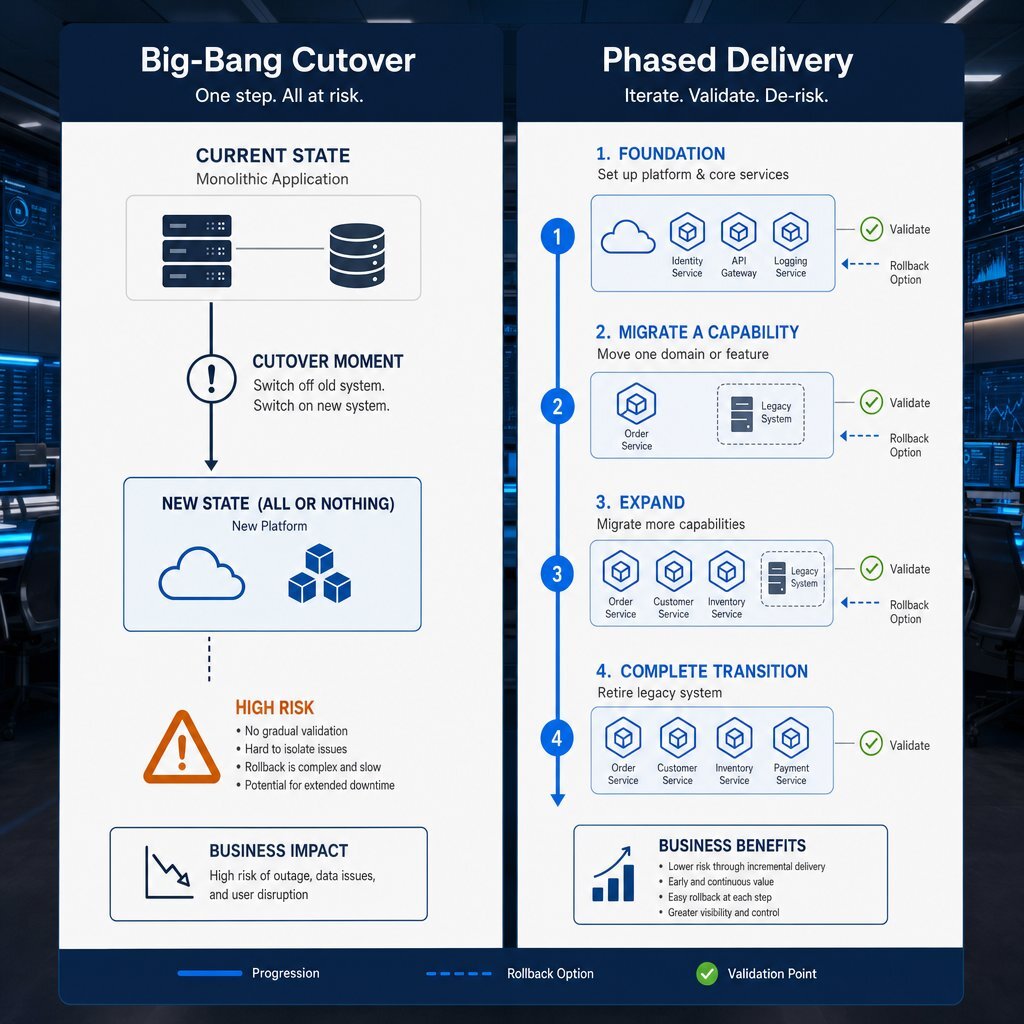
Big‑bang cutovers. Replacing an entire system in one go is the highest‑risk option. Ford’s 2021-2025 vehicle software program is one example of a plan undone by integration complexity and cost. Phased delivery is safer: new components go live gradually while the old system runs, each step is validated, and rollback is always possible.
Underestimating data migration. Code is usually easier to convert than data. Legacy databases often contain inconsistent records, duplicates, undocumented schemas, and embedded business rules. This phase causes more budget overruns than any other part of modernization and is often the least planned.
Picking AI logos over modernization depth. Building new AI products isn’t the same as modernizing a 15‑year‑old production system with no documentation. Those are different skills. The right partner has both AI capability and deep modernization experience.
No knowledge‑transfer plan. If a project ends at code delivery, your team is left guessing. You need documentation, training, and a structured handover, or you risk staying dependent on the vendor and ending up back where you started when they leave.
How to Evaluate an AI Agency for Legacy Modernization
Vendor evaluations often focus on tech stacks, headcount, and AI badges. This doesn’t tell you whether a firm can modernize a live production system without breaking it. These checks get you closer to the truth.
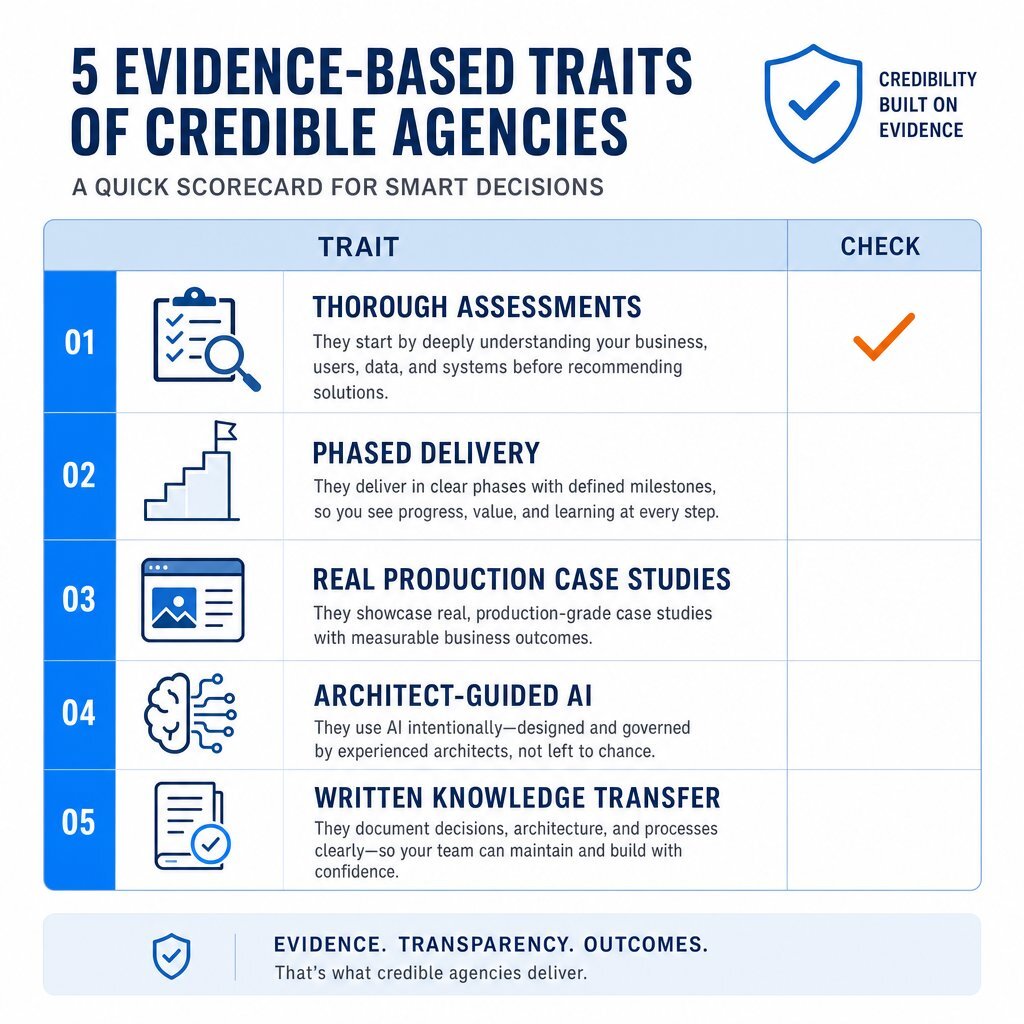
They assess before they propose. A credible agency won’t quote a timeline or price before they understand your estate. Discovery comes first: codebase analysis, dependency mapping, data‑quality review, security exposure, and technical‑debt scoring. If a vendor shows up to the first meeting with a full proposal, it rests on assumptions.
They use phased delivery by default. Ask how they move from the old system to the new one. You should hear a phased plan: new components go live while the legacy system continues to run, each step is validated, and a rollback path exists at every phase. If the default answer is a single cutover, they should have a very specific reason why that is safe for your case.
They have production case studies. Ask for an example of a legacy system they modernized while it was in production. Also, be curious about what broke, how they handled it, and what the rollback looked like. Teams with real modernization experience give concrete, detailed answers.
Their AI tooling is guided by architects. AI can speed up discovery, code conversion, and testing. However, it can’t decide where to draw domain boundaries, how to handle shared data, or what to rebuild.
Knowledge transfer is written into the contract. Modernization isn’t finished until your team can run and maintain the system. Before you sign, make sure documentation, training, and handover are defined in the contract, with clear outputs and dates. Verbal promises at the end of a project mean little once the delivery team has moved on.
Final Thoughts
Legacy software gradually slows everything down: maintenance costs climb, AI initiatives stall, and developers spend their weeks keeping old systems alive instead of building anything new. By the time the problem is impossible to ignore, the backlog of deferred decisions is expensive to unwind.
The agencies on this list have the experience to unwind it. They differ in scale, tooling, and industry focus:
Baytech Consulting – Mid‑market; fixed‑cost, AI‑first delivery with direct senior oversight.
Cognizant – Large enterprises with major mainframe estates and proprietary AI platforms.
Infosys – Big COBOL/mainframe environments in regulated industries needing AI‑accelerated delivery.
Grid Dynamics – Fortune 1000 firms wanting outcome‑based pricing and an AI‑native model.
Centric Consulting – Mid‑market buyers seeking a purpose‑built agentic framework and US delivery.
Trigent Software – Mid‑market enterprises and ISVs needing 30+ years of legacy experience.
Hexaware – Mainframe‑heavy BFSI clients that prefer automation‑first modernization.
ScienceSoft – Regulated industries with compliance‑heavy, multi‑stack legacy estates.
Keyhole Software – Long programs that require stable, senior US‑based engineering teams.
EffectiveSoft – Orgs that want long‑term, incremental AI‑assisted migration instead of a big‑bang cutover.
What does not change from one vendor to another is the core requirement: a partner that assesses before it builds, migrates in phases, and has done this on production systems under real business constraints.
Not sure where your legacy system stands? Book a free assessment with Baytech's team.
FAQs
How do AI agencies use the “strangler fig” pattern for legacy modernization?
The strangler fig pattern is an incremental migration strategy where a monolithic legacy system is replaced piece by piece. Instead of a risky overnight “big‑bang” cutover, AI tools analyze the codebase and help identify discrete business domains. Agencies then extract and rewrite those domains as modern microservices. Each new service runs alongside the old system, taking over specific requests, while the rest of the legacy application continues to operate. Over time, more traffic flows through the new services, and the legacy system is gradually switched off, without a single high‑risk cutover or extended downtime.
How do development teams prevent AI from hallucinating or changing core business logic?
To stop generative AI from inventing or dropping critical rules, experienced agencies use characterization testing (also called legacy behavior benchmarking). Before changing any code, they capture the exact inputs and outputs of the current system. When AI generates the modern implementation, the same inputs are run through both versions. If the outputs don’t match, the change is rejected. In parallel, AI agents operate inside strict guardrails: agreed‑upon architecture guidelines, coding standards, and allow‑listed libraries. This keeps the output consistent, reviewable, and aligned with the original business logic.
Can generative AI completely automate a legacy software migration?
No. AI can speed up a migration, but full automation without human oversight is a recipe for moving old technical debt into a new language. AI is very good at volume work: mapping dependencies, spotting dead code, generating documentation, and writing boilerplate. Human architects and engineers still make the key calls: where to redraw domain boundaries, what to retire, how to shape the new architecture, and which AI‑generated changes are acceptable. The best results come from AI handling the heavy lifting and people handling the judgment.
Is it secure to use LLMs and AI agents on proprietary enterprise codebases?
Enterprise‑grade agencies don’t paste sensitive code into public chatbots. Instead, they use private, enterprise‑secured LLM instances hosted in compliant cloud environments such as Azure or AWS. In these isolated setups, your codebase is only used for your project and is walled off from training the provider’s base models. Access controls, logging, and data‑handling policies are designed to meet the same standards as the rest of your regulated workloads.
What is the difference between AI‑assisted replatforming and AI‑driven refactoring?
Replatforming (“lift and shape”) moves an application to a modern environment, usually the cloud, with minimal change to the core code. AI helps by automating configuration, containerization, and deployment, enabling the legacy app to run reliably on new infrastructure.
Refactoring goes deeper. It rewrites and restructures the code to fully leverage cloud‑native capabilities, such as auto‑scaling and microservices. Here, AI accelerates translation from legacy languages (e.g., COBOL or VB6) to modern ones (e.g., Java, C#, or Python) and helps break monolithic logic into smaller, API‑driven components.
About Baytech
At Baytech Consulting, we specialize in guiding businesses through this process, helping you build scalable, efficient, and high-performing software that evolves with your needs. Our MVP first approach helps our clients minimize upfront costs and maximize ROI. Ready to take the next step in your software development journey? Contact us today to learn how we can help you achieve your goals with a phased development approach.
About the Author

Bryan Reynolds is an accomplished technology executive with more than 25 years of experience leading innovation in the software industry. As the CEO and founder of Baytech Consulting, he has built a reputation for delivering custom software solutions that help businesses streamline operations, enhance customer experiences, and drive growth.
Bryan’s expertise spans custom software development, cloud infrastructure, artificial intelligence, and strategic business consulting, making him a trusted advisor and thought leader across a wide range of industries.