In this article
- The Autonomous Dispatcher: How AI Agents Solve the Combinatorial Nightmare of Field Service Scheduling
- The Limitations of Conventional Scheduling Architecture
- Decoding the Mechanics of Autonomous AI Agents
- The Eradication of "Windshield Time" and the Reclamation of Profit
- The 2025 AI Landscape: Market Penetration and Benchmarked ROI
- The Infrastructure of Sovereign AI: Building the Tech Stack
- The Economics and Timelines of Custom AI Software
- Navigating the Pitfalls of AI Implementation and Change Management
- Conclusion: The Strategic Imperative for B2B Executives
- About Baytech
- About the Author
The Autonomous Dispatcher: How AI Agents Solve the Combinatorial Nightmare of Field Service Scheduling
The modern B2B enterprise is defined by its capacity to execute complex operations with flawless precision and predictable efficiency. For organizations across telecommunications, healthcare technology, high-tech manufacturing, real estate, and utilities, the field service team operates as the physical manifestation of the brand. Yet, despite massive capital expenditures on enterprise resource planning (ERP) and customer relationship management (CRM) systems, the actual orchestration of these mobile workforces remains overwhelmingly chaotic. Forward-thinking executives—visionary Chief Technology Officers, strategic Chief Financial Officers, and driven Heads of Sales—are increasingly realizing that while a simple automated web link is perfectly sufficient for booking a virtual sales meeting, it is catastrophically inadequate for dispatching a fleet of specialized technicians across a highly congested metropolitan grid.
How can AI agents handle complex scheduling that simple links can't? This question sits at the nexus of modern logistics and operational strategy. The logistical challenge of field service management is not merely a matter of locating open slots on a digital calendar. It is a highly dynamic, ever-shifting puzzle involving real-time traffic patterns, disparate technician skill sets, fluctuating inventory pipelines, and strict client service-level agreements (SLAs). When these variables inevitably collide, traditional rule-based scheduling systems break down, resulting in inflated operational costs, exhausted technicians, and profoundly dissatisfied customers.
Enter the era of AI-driven scheduling agents. Artificial intelligence is fundamentally rewriting the foundational rules of logistics and field service management. By moving from automated rule-followers to autonomous, context-aware problem-solvers, AI agents are capable of evaluating millions of routing permutations in real time to optimize a fleet's calendar. If you are still at the experimentation stage with AI, a structured readiness plan like the one outlined in this CTO enterprise AI checklist can help you move from pilots to production with confidence.
This exhaustive research report explores how AI agents navigate complex scheduling constraints, the profound financial implications of reducing "windshield time," the modern technology stack required to build these sovereign systems, the economic realities of custom software development, and the implementation strategies for B2B enterprises seeking a definitive competitive advantage.
The Limitations of Conventional Scheduling Architecture
To comprehend the transformative power of AI agents, it is first necessary to diagnose the systematic failure of traditional booking tools and manual dispatch methodologies. Generic scheduling applications—the ubiquitous booking links utilized for sales calls, internal meetings, and basic calendar synchronization—are built on a one-dimensional premise: binary availability.
They operate on fixed, immutable rules, cross-referencing a requested time against a static calendar interface.
The Illusion of the Calendar View
In field operations, treating scheduling as a simple calendar function is a strategic error that compromises the entire service delivery lifecycle. The entry point of appointment booking dictates the operational reality of the entire day, setting the stage for either seamless execution or cascading delays. To a human dispatcher or a rudimentary scheduling tool, a schedule looks like a manageable, two-dimensional grid of times and dates. To a mathematical optimization engine, however, it represents a combinatorial explosion of exponential proportions.
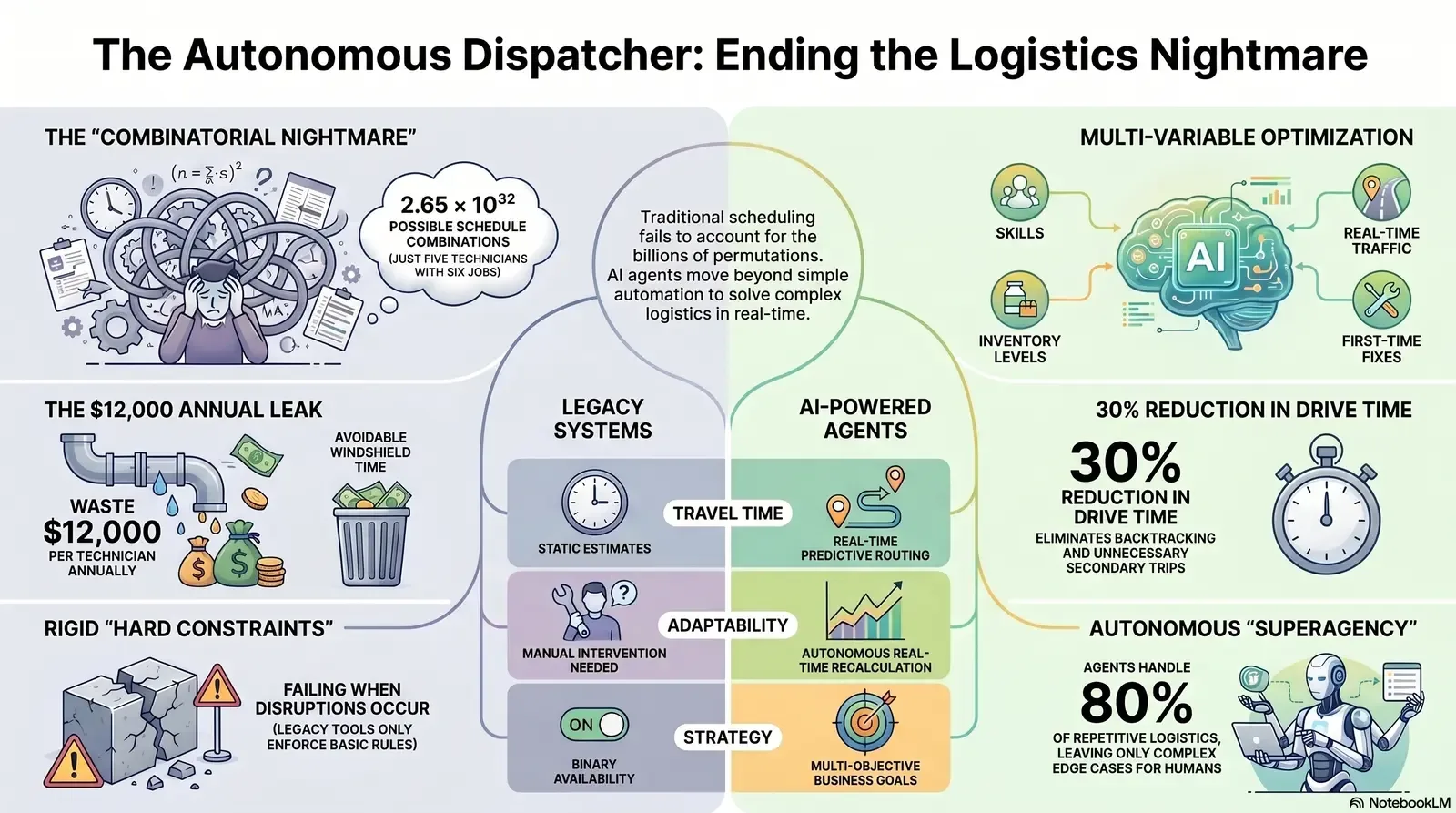
The scale of this mathematical complexity is staggering. Consider a relatively small, localized field service operation involving just five technicians, each assigned six specific jobs for the day. The number of possible ways to arrange those specific jobs is not in the hundreds or thousands; it mathematically equates to 2.65 x 10^32 possible combinations.
This mathematical reality makes finding the single most efficient route—the "Golden Schedule"—virtually impossible for a human being, a team of dispatchers, or simple rules-based software to achieve efficiently at scale. Even a minor alteration to this schedule requires the recalculation of billions of potential permutations to maintain optimization.
Hard Constraints vs. Soft Constraints
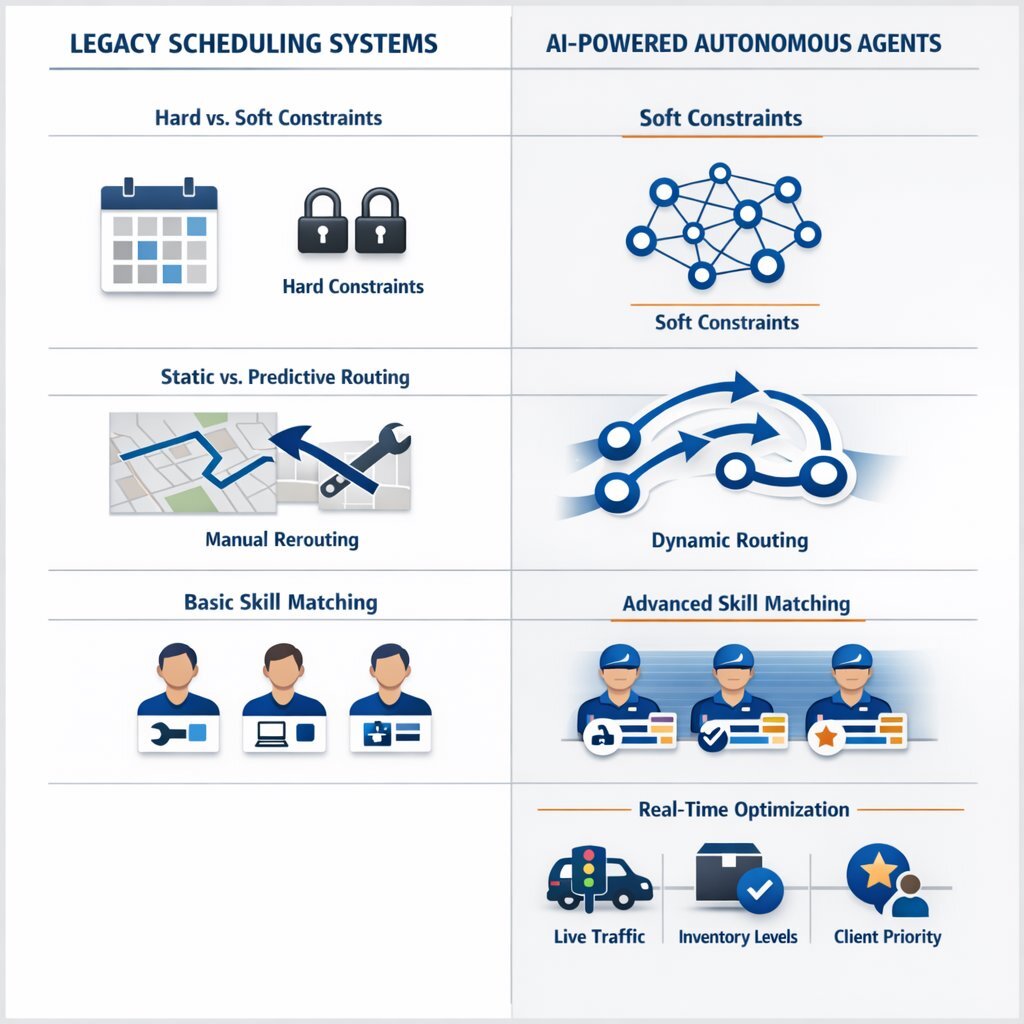
When a conventional system attempts to process these routing combinations, it relies almost exclusively on static "Hard Constraints" (Work Rules). For example, a legacy system might dictate that a specific commercial HVAC repair job requires a technician with a Level 3 certification. If that specific technician calls in sick or is delayed by traffic, the service appointment fails entirely because the rigid software cannot autonomously explore alternative routing options, nor can it elevate a Level 2 technician who happens to possess a localized compliance waiver for that specific property. These rigid boundaries ensure basic compliance but inherently limit the organization's capacity to maximize its workforce utilization rate.
Furthermore, conventional systems are completely blind to "Soft Constraints" (Work Objectives). Soft constraints are the heuristic, overarching business-driven goals that guide an organization toward ideal outcomes, rather than just "possible" ones. These include strategic objectives such as minimizing overall fleet fuel costs, prioritizing high-value enterprise SLA clients over routine residential maintenance, or ensuring an equitable distribution of labor hours among the workforce to prevent burnout. Simple booking links lack the multidimensional analytical processing power required to balance basic operational feasibility with these nuanced, strategic business objectives. If you want a deeper comparison of static tools versus modern AI copilots in customer-facing apps, this guide to the SaaS AI copilot revolution covers the shift from simple widgets to true systems of action.
| Feature Category | Simple Booking Links / Legacy Systems | AI-Powered Scheduling Agents |
|---|---|---|
| Core Architecture | Fixed-rule logic; searches for binary calendar availability. | Predictive algorithms; evaluates millions of permutations simultaneously. |
| Constraint Management | Enforces rigid Hard Constraints only; unable to negotiate alternatives. | Balances Hard Constraints with heuristic Soft Constraints (business objectives). |
| Skill Set Matching | Basic category tagging (e.g., "Plumber" vs. "Electrician"). | Granular, proficiency-based routing analyzing historical success rates. |
| Travel Time Calculation | Static, point-to-point estimates based on standard speed limits. | Real-time predictive routing factoring in live traffic, weather, and vehicle type. |
| Adaptability | Manual intervention required for any schedule disruption. | Autonomous, real-time recalculation and dynamic rerouting. |
The Human and Financial Toll of Manual Dispatch
Relying on manual dispatchers to juggle these exponentially complex variables leads to profound operational inefficiencies. Even the most highly experienced, dedicated human dispatchers can typically only optimize a schedule across three or four variables simultaneously (e.g., technician location, general skill level, and customer priority). The result is a scheduling approach that is, at best, merely adequate, but never truly optimal.
When real-world chaos inevitably strikes—such as emergency infrastructure calls, last-minute client cancellations, or complex jobs running hours past their estimated duration—the manual dispatch board devolves into a constantly shifting puzzle. This generates immense administrative burden, skyrocketing dispatcher burnout, and compromised service quality. The financial ramifications are severe: comprehensive research from the Aberdeen Group indicates that companies relying on manual dispatch waste an average of $12,000 per technician, per year, in avoidable, non-productive drive time alone.
Decoding the Mechanics of Autonomous AI Agents
Artificial intelligence fundamentally alters the field service paradigm by introducing autonomous, context-aware agency into the scheduling environment. AI scheduling algorithms do not merely digitize human workflows; they utilize advanced machine learning and predictive analytics to make highly intelligent, multivariate decisions. Unlike basic calendar tools, these systems continuously learn from historical performance patterns, adapt to environmental changes in real-time, and optimize for multiple competing business objectives simultaneously. This shift mirrors what leading DevOps and engineering teams are doing with metrics and automation, as outlined in this article on developer productivity metrics.
Continuous Multi-Variable Optimization
AI agents operate on a fundamentally different technological plane than rule-based scheduling software. When a complex appointment request enters the system, the AI does not simply scan a database for a blank space on a calendar. Instead, it executes an instantaneous, highly complex algorithmic evaluation across hundreds of variables:
- Granular Skill-Based Routing and Certification Matching: The AI instantly audits the specific technical requirements for the job and cross-references them against the active workforce's certifications, tenure, specialized experience levels, and historical first-time fix rates with that exact piece of equipment. This precision prevents the incredibly common and costly error of dispatching a highly paid, senior engineering expert to a routine preventative maintenance call, thereby preserving top-tier talent for critical, high-revenue escalations.
- Predictive Job Duration Analytics: Traditional systems allocate a flat, generic window (e.g., a standard two-hour block) for a category of repair. AI agents, conversely, analyze deep historical job duration data specific to the exact equipment model, the architectural complexity of the property type, and even the individual technician's historical efficiency patterns throughout different times of the day. This allows the calendar to be packed with surgical precision, eliminating dead space between appointments.
- Real-Time Logistics and Predictive Inventory Awareness: An optimized schedule is useless if the technician arrives without the required components. The AI agent integrates seamlessly with supply chain and warehouse inventory databases to ensure the selected technician actually possesses the necessary parts on their specific truck before the dispatch is finalized, virtually eliminating secondary supply runs. Furthermore, predictive algorithms can forecast inventory usage to prevent delays before they occur.
- Client Priority and Dynamic SLA Enforcement: The algorithm continuously weighs the contractual urgency of the ticket. A critical server outage at a Tier-1 enterprise client will cause the AI agent to autonomously and dynamically reroute technicians, bumping lower-priority residential maintenance tasks to a later window. The agent can then automatically notify the affected lower-priority customers of the delay using natural language processing, minimizing friction.
The Agentforce Era: From Automated to Autonomous
The defining characteristic of modern AI integration in logistics is the rapid transition from automated task execution to fully autonomous decision-making. Industry forecasts from leading analysts, including Gartner, predict that by 2027, AI agents will augment or fully automate 50% of complex business decisions in these operational environments.
This evolution is frequently described as moving into the "Agentforce" era, representing a leap beyond the simple automated scheduling of the past decade. For example, when a critical priority task enters the queue, an advanced AI agent does not require a human dispatcher to manually approve the workflow override. It is empowered with superagency to automatically assign the task to the nearest, most qualified technician who has not yet been dispatched, factoring in their current trajectory, live traffic conditions, and the cascading impact on the rest of the day's schedule.
Furthermore, AI agents possess conversational capabilities. Utilizing sophisticated natural language processing (NLP), conversational AI schedulers can manage complex email or SMS negotiations with a client to secure a suitable time slot. Instead of forcing a high-value B2B client to navigate a rigid self-service booking portal, the AI agent handles the back-and-forth naturally, understanding context, constraints, and preferences just as a human concierge would.
The operational outcomes of this intelligent, autonomous routing are transformative. Companies deploying AI-powered scheduling and dispatching report an average 30% reduction in aggregate drive time, a 25% increase in daily job completions, and the near-total elimination of manual double-booking errors.
The Eradication of "Windshield Time" and the Reclamation of Profit
In the logistics, utilities, and field service sectors, the most corrosive, silent threat to enterprise profitability is "windshield time." This industry term refers to the non-productive hours technicians, engineers, and crews spend sitting in their vehicles, traveling to, from, and between various job sites.
The Compounding Costs of Unproductive Travel
In field operations, every mile and every minute matters. Excessive windshield time is not merely an inconvenience; it is a massive financial drain that impacts multiple facets of the business:
- Lost Billable Capacity and Revenue: When jobs take longer to complete due to inefficient routing, geographic spread, or the need for repeat visits to fetch missing parts, technicians can fit fewer jobs into their daily schedule. This measurable decrease in billable hours compounds rapidly across a large fleet, devastating the organization's revenue capacity and overall workforce utilization rate.
- Asset Degradation and Fuel Expenditure: Unoptimized routes lead to thousands, or millions, of unnecessary miles driven annually. This accelerates vehicle wear and tear, drastically increases fleet maintenance costs, and balloons fuel expenditures, which are highly susceptible to market volatility.
- Safety Risks and Employer Liability: Road travel is statistically one of the most hazardous components of any field service role. Data from international workplace safety authorities highlights this severe risk. According to SafeWork Australia, a staggering 42% of all worker fatalities in 2022 were vehicle-related. Extended windshield time directly correlates with driver fatigue, drastically increasing the risk of catastrophic accidents, loss of life, and subsequent corporate liability.
A significant portion of this windshield time is generated not by the primary travel from the depot to the client, but by secondary, unscheduled trips. When a technician arrives at a site and discovers they lack the proper diagnostic tools or specialized parts for utility infrastructure, they are forced to drive to regional warehouses, suppliers, or meet other technicians for roadside supply transfers.
Dynamic AI Route Optimization in Action
AI route optimization systems provide the definitive antidote to the windshield time epidemic. Unlike consumer GPS applications that merely calculate the shortest physical path between Point A and Point B based on speed limits, enterprise AI logistics platforms ingest massive streams of live data to generate highly dynamic, context-aware routing decisions.
These sophisticated systems analyze live traffic feeds, hyper-local weather conditions, and urban congestion patterns to accurately predict bottlenecks before they materialize, actively rerouting technicians away from delays. Furthermore, they account for complex commercial vehicle routing restrictions, toll costs, and strict driver hours-of-service compliance regulations.
The true power of the AI agent is revealed during periods of severe disruption. If a major incident occurs—such as a highway closure, a sudden severe weather event, or a localized supply chain breakdown—the AI agent instantly recalculates the entire fleet's trajectory. It identifies alternative routes, prioritizes the fastest paths for emergency services, and automatically updates estimated arrival times for clients via SMS or email, maintaining transparency even during a crisis.
This level of intelligent, predictive routing results in an average 10% to 20% reduction in fleet fuel and labor costs, and significantly boosts on-time arrival rates, preventing costly SLA penalties. When combined with predictive inventory management—ensuring the technician has the required part before they ever turn the ignition—unnecessary secondary travel is virtually eliminated, maximizing organic growth capacity. For organizations exploring broader AI automation across back-office and operations, this guide to AI automation that actually works shows how to extend these gains beyond the field.
The 2025 AI Landscape: Market Penetration and Benchmarked ROI
The integration of artificial intelligence into field service and logistics is no longer a theoretical exercise relegated to innovation labs; it is an active, rapidly expanding operational baseline. Comprehensive market research and benchmark data from 2025 provide a crystal-clear picture of how aggressively these technologies are being adopted by B2B enterprises, and the substantial financial returns they are generating.
Widespread Experimentation vs. Scaled Enterprise Deployment
According to the authoritative McKinsey Global Survey on the State of AI in 2025, a commanding 88% of organizations now report the regular use of AI in at least one business function, up significantly from 78% the previous year. Within this broader adoption, there is massive executive curiosity surrounding agentic AI specifically, with 62% of survey respondents stating their organizations are actively experimenting with AI agents to handle complex workflows.
However, a distinct divide remains between siloed experimentation and true, scaled enterprise deployment. Nearly two-thirds of organizations remain trapped in the experimentation or piloting phase, struggling to scale their AI initiatives seamlessly across the broader enterprise architecture. Only about one-third of respondents report having successfully begun to scale their AI programs. Those that do manage to scale—termed AI "high performers," representing roughly 6% of the market—are reaping outsized rewards. These leaders are utilizing AI not just for marginal, incremental efficiency gains, but for transformative business change, and are three times more likely to be scaling the use of AI agents across most functions.
Measurable Improvements in Field Operations
In the specific domain of field service operations, early adopters and high performers are seeing exceptional, verifiable returns on their AI investments. The 2025 State of Field Service Report, published by Geotab, reveals that a staggering 93% of field service companies have already started to at least "partially" implement AI into their daily operations. The operational metrics resulting from this adoption are highly favorable:
| Operational Performance Metric | Percentage of AI Adopters Reporting Improvement | Direct Business Impact |
|---|---|---|
| Asset Uptime & Service Cost Reduction | 88% | Faster response times and predictive maintenance capabilities prevent catastrophic, costly equipment failures. |
| First-Time Fix Rates | 75% | Technicians arrive consistently equipped with the correct tools, parts, and AI-guided historical repair schematics. |
| Inventory Management Transformation | 62% | AI is fully expected to transform predictive parts ordering and stocking within the next 12 months. |
Furthermore, research from Boston Consulting Group (BCG) corroborates these findings, reporting that companies employing advanced AI in field service operations are witnessing 10% to 15% absolute productivity gains and a 10% improvement in overall service effectiveness.
From a consumer and client perspective, the market is overwhelmingly ready for this technological shift. Data from Salesforce indicates that 67% of consumers are deeply frustrated when service issues cannot be resolved instantly, and 54% state they fundamentally do not care how they interact with a company—whether human or AI—as long as their problem is fixed rapidly and efficiently. In fact, nearly 40% of consumers are already perfectly comfortable having an autonomous AI agent schedule their complex appointments.
The Workforce Impact Paradox
While the operational benefits are clear, the integration of AI agents introduces complex workforce dynamics. Executives must navigate differing expectations regarding AI's impact on employment. According to McKinsey, 32% of respondents expect a decrease in their organization's total number of employees due to AI efficiencies, while 43% expect no change, and 13% actually expect an increase in headcount to manage new capabilities. However, rather than simply cutting jobs, the reality in logistics is a massive shift in talent requirements. Most organizations report actively hiring for new AI-related roles, with highly skilled software engineers and data engineers being the most aggressively demanded talent profiles in the market.
The Infrastructure of Sovereign AI: Building the Tech Stack
Achieving these transformative metrics requires significantly more than simply purchasing an off-the-shelf software license or subscribing to a generic SaaS platform. For mid-market and enterprise B2B organizations characterized by highly complex, proprietary workflows and strict security requirements, generic tools often lack the inherent flexibility required to align with deep operational realities. As a result, strategic leaders are increasingly turning toward custom software development to architect tailored AI routing and scheduling systems. Many follow an incremental AI sidecar pattern, adding AI around existing systems instead of ripping and replacing from day one.
The Cloud-Native Foundation: Kubernetes and Postgres
Building autonomous AI agents requires a profoundly robust, scalable, and secure backend infrastructure. Elite software engineering teams rely heavily on cloud-native architectures, microservices, and containerization to deploy these complex systems reliably.
Kubernetes has firmly established itself as the default runtime environment not just for standard applications, but specifically for advanced AI workloads and data platforms. With over 80% of enterprise organizations currently running Kubernetes in production environments, it provides the essential orchestration necessary to manage the distributed microservices that power autonomous AI agents. Kubernetes ensures that the AI scheduling containers can scale dynamically based on real-time computational demand—spinning up massive processing power during peak morning dispatch routing hours when thousands of permutations must be solved instantly, and scaling down efficiently overnight to conserve resources.
Supporting this agile compute layer is the foundational database infrastructure. Robust relational databases, notably PostgreSQL, are absolutely critical for managing the vast troves of structured data required for intelligent scheduling: granular technician profiles, real-time geo-coordinates, exhaustive client histories, and complex inventory logs. The integration of advanced systems like CloudNativePG within Kubernetes environments allows these databases to operate as highly strategic control points for AI. This architecture handles the immense read/write loads required by agents evaluating millions of routing permutations, ensuring zero latency in decision-making.
Data Sovereignty and the Custom Development Advantage
A paramount consideration for the B2B executive in 2025 is data sovereignty. As AI adoption accelerates exponentially, organizations face intense regulatory and competitive pressure to maintain strict, unyielding control over exactly where their proprietary data resides and how it is processed. This is particularly critical for enterprises operating in highly regulated industries such as healthcare, finance, or government contracting.
This imperative makes the strategic choice of a custom software development partner a critical business decision. Utilizing a specialized firm like Baytech Consulting provides a distinct structural advantage. Baytech Consulting focuses on enterprise business applications that optimize complex workflows and handle massive amounts of data. Crucially, they differentiate themselves through a commitment to enterprise-grade quality, utilizing an entirely US-based, onshore team of salaried engineers. By refusing to rely on offshore resources, they mitigate the severe security, communication, and data sovereignty risks often associated with outsourced development, maximizing quality control while delivering precise, highly transparent project execution.
By leveraging custom solutions built on secure, cutting-edge tech stacks—including Azure DevOps On-Prem, VS Code/VS 2022, SQL Server, Harvester HCI, Rancher, and OVHCloud servers—organizations can seamlessly integrate powerful AI agents while strictly adhering to regional compliance mandates, ensuring the absolute protection of proprietary client data and operational intellectual property. This "Tailored Tech Advantage" allows businesses to craft software that acts as the backbone of their operational process, rather than forcing their operations to conform to the rigid limitations of an off-the-shelf product. To understand how Baytech approaches cloud, hosting, and infrastructure in general, see their overview of enterprise hosting solutions.
The Economics and Timelines of Custom AI Software
The strategic decision to commission and build a custom AI field service solution involves a significant capital commitment and requires rigorous strategic planning. Executives evaluating these initiatives must navigate the concrete realities of software pricing, complex development timelines, and the profound impact of project management methodologies on ultimate success.
The Financial Investment Landscape
The financial capital required for custom AI logistics software varies dramatically based on the inherent complexity of the required neural networks, the volume of legacy data integration necessary, and the overall scale of the enterprise deployment.
In the 2025 market landscape, pricing benchmarks indicate that developing a basic proof-of-concept or a highly focused, simple AI application typically ranges between 20,000 and 80,000. However, for a comprehensive, enterprise-grade AI field management system—featuring autonomous conversational scheduling, predictive maintenance alerts, real-time dynamic route optimization, and deep CRM/ERP integrations—organizations should anticipate a strategic investment ranging from 150,000 to well over 500,000. The talent required to build these systems is highly specialized, with AI development team expenses representing 40% to 60% of total project costs.
While this represents a substantial initial capital expenditure, the return on investment (ROI) profile is highly compelling. Enterprises typically expect to see a 30% to 40% reduction in core operational costs and a 25% verifiable increase in workforce productivity within just 18 to 24 months of full implementation, rapidly amortizing the initial development costs and generating pure long-term margin expansion.
Realistic Development Timelines
The timeline for deploying custom AI software is dictated primarily by the project's scope and the experience of the development team. A Minimum Viable Product (MVP)—designed to rapidly test core scheduling algorithms and validate basic assumptions—can often be successfully delivered in 3 to 4 months. However, architecting a full-scale, deeply integrated AI platform designed to entirely replace legacy systems generally requires 6 to 9 months, extending to 12 months or longer for highly complex, multi-national enterprise deployments.
One of the primary causes of catastrophic timeline blowouts and budget overruns in enterprise software development is the continued reliance on the antiquated "Waterfall" methodology. In this rigid approach, exhaustively detailed plans are locked in months before a single line of code is written, often resulting in a product that is strategically obsolete by the time it finally launches.
The Strategic Imperative of Rapid Agile Deployment
To combat project delays, budget overruns, and scope creep, elite custom software engineering firms employ sophisticated Agile methodologies. Agile development fundamentally eschews massive, monolithic, high-risk launches in favor of iterative, incremental progress achieved through highly collaborative, cross-functional sprints. If your organization is still running large projects in a linear way, Baytech’s Agile methodology service outlines how to make that shift safely.
Firms equipped with a proven methodology—such as Baytech Consulting's Rapid Agile Deployment model—break down the daunting complexity of a massive AI build into manageable, highly predictable bi-weekly or monthly deliverables. This structured approach creates profound project transparency; stakeholders can actively interact with working software early and often, rather than waiting a year for a final reveal.
More importantly, the Agile framework actively embraces and harnesses changing market requirements for competitive advantage. If a logistics company realizes midway through the development cycle that macroeconomic factors require the AI to weigh electric vehicle (EV) charging station proximity more heavily than standard fuel routes, the Agile engineering team can pivot instantly. This flexibility ensures that the final software product precisely matches the current, dynamic realities of the market, transforming a potentially high-risk capital project into a controlled, strategic, and ultimately successful operational initiative.
Navigating the Pitfalls of AI Implementation and Change Management
Despite the overwhelmingly compelling ROI and the sophisticated technology available, the road to seamless AI integration is fraught with operational hazards. Organizations that treat artificial intelligence as a magical, plug-and-play panacea—rather than a highly complex, strategic tool requiring rigorous management—frequently experience implementation failure. Avoiding these common pitfalls is absolutely essential for a successful, profitable rollout.
The Unforgiving Data Quality Imperative
An autonomous AI scheduling agent is fundamentally and irrevocably bound by the quality of the data it ingests. Inaccurate, siloed, duplicated, or outdated information will inevitably lead to deeply flawed algorithmic predictions, causing widespread operational chaos rather than efficiency.
If the CRM system lists an incorrect or outdated commercial service address, or the warehouse inventory system inaccurately reflects the availability of a critical replacement part, the AI will confidently and rapidly dispatch a technician to fail. The speed of AI means that it can make bad decisions thousands of times faster than a human. Therefore, before launching any AI initiative, organizations must execute a rigorous, comprehensive data cleansing process. They must ensure data accuracy, ensure seamless accessibility across disparate legacy systems, and establish strict, ongoing data governance protocols to maintain integrity. For a deeper dive into this foundation, see Baytech’s guide on data readiness for enterprise AI.
The Danger of Over-Automation and the Loss of the Human Element
A common, yet highly destructive executive mistake is the overwhelming desire to automate 100% of the scheduling and dispatch process immediately upon deployment. Not every anomaly, edge case, or client interaction can—or should—be handled exclusively by a machine. Total, unmitigated reliance on AI can erode the critical thinking, flexibility, and problem-solving capabilities of the human staff overseeing the operation.
AI systems are entirely unparalleled in their processing speed, mathematical logic, and ability to handle combinatorial scale. However, they fundamentally lack human intuition, empathy, and cultural sensitivity—traits that are absolutely required when managing high-stress client escalations, negotiating complex B2B relationships, or navigating nuanced physical environments.
The most successful and profitable enterprise deployments adhere to a symbiotic, balanced approach, often utilizing the 80/20 rule: organizations automate the 80% of repetitive, high-volume logistical routing and standard appointment setting, while elevating highly trained human dispatchers to manage the complex 20% of edge cases, VIP relationship management, and strategic oversight. In this model, AI should be viewed as a powerful exoskeleton that enhances human capability and grants "superagency," rather than a guillotine designed to blindly replace the human workforce.
Ignoring Geographic Realities and Travel Buffers
When configuring the initial constraints and parameters for an AI scheduler, companies often make the critical mistake of creating hyper-aggressive, theoretical schedules that fail to account for the messy realities of the physical world. Failing to program adequate, realistic buffers for load-in times, security clearances at commercial sites, parking difficulties in dense urban centers, or localized rush-hour traffic patterns results in a cascade of chronically late technicians and dangerously compressed service windows.
A robust, mature AI implementation must be programmed to factor in geographic nuances and the physical limitations of the workforce. There is a vast difference in travel time predictability between a dense urban high-rise route and a sprawling, rural utility route. The AI must ingest real-time traffic conditions, historical weather impacts, and vehicle-specific routing restrictions to generate schedules that are mathematically optimal, yet humanly achievable and safe. In highly regulated environments, combining these controls with an AI code approval framework helps ensure both safety and compliance as you roll out new automation.
Conclusion: The Strategic Imperative for B2B Executives
The optimization of logistics and field service management has permanently transcended the capabilities of manual dispatchers, whiteboards, and basic calendar links. The sheer combinatorial nightmare of simultaneously managing technician skill sets, real-time traffic data, precise inventory levels, and tiered client priority requires the immense computational power and autonomous decision-making capabilities of AI agents.
For the visionary CTO, the transition to AI scheduling is no longer an experimental luxury; it is an architectural necessity, requiring secure, Kubernetes-orchestrated, cloud-native deployments that guarantee data sovereignty and operational resilience. For the Strategic CFO, the financial mandate is undeniably clear: minimizing unproductive windshield time and maximizing first-time fix rates directly unlocks millions of dollars in previously lost billable capacity and protects the bottom line from fuel volatility.
By aggressively embracing a Rapid Agile Deployment model and partnering with high-quality, onshore engineering teams, B2B organizations can successfully navigate the profound complexities of custom AI integration while completely avoiding the pitfalls of rigid, legacy software. The technology has officially moved beyond the pilot phase. The organizations that possess the foresight to build, customize, and deploy these autonomous AI agents today will unequivocally define the competitive standards of service delivery, operational efficiency, and customer satisfaction for the next decade. If you are evaluating potential partners for this journey, Baytech’s overview of top California software development companies can help you benchmark quality and fit.
Frequently Asked Questions
How can AI optimize my field team's schedule? AI optimizes field schedules by moving far beyond simple binary calendar availability to perform continuous, multidimensional analysis. It instantly evaluates millions of potential routing permutations, assigning jobs based on a complex web of real-time factors. This includes technician proximity, live traffic conditions, the specific inventory currently on the truck, and predictive analytics regarding the exact estimated duration of a specific repair. This results in highly efficient, tightly packed daily schedules that eliminate gaps, reduce double-bookings, and maximize workforce utilization.
Can automation consider travel time and skills? Yes, and it does so with extreme precision. Unlike basic booking links that only check for a free time slot, advanced AI scheduling agents treat predictive travel time and granular technician skill sets as core operational constraints. The algorithm ensures that a junior technician is never sent to a complex, senior-level repair, preserving high-tier talent. Furthermore, it dynamically recalculates travel times using live traffic feeds, weather data, and vehicle restrictions to ensure the assigned technician can actually arrive within the promised SLA window.
How do we reduce "windshield time" with AI? AI drastically reduces windshield time—the highly unproductive, costly hours spent driving—by dynamically optimizing routes to prevent backtracking and eliminating unnecessary secondary trips. By integrating deeply with inventory data, the AI ensures a technician is only dispatched to a site if they already possess the necessary parts, preventing mid-day supply runs. Furthermore, by prioritizing dense, geographically clustered routing based on real-time data, AI converts hours previously wasted in transit into active, highly profitable billable service time.
Further Reading
- https://dialzara.com/blog/ai-scheduling-vs-traditional-methods-pros-and-cons
- https://www.zinier.com/blog/how-ai-agents-work-field-service
- https://www.fieldproxy.ai/blog/14-common-field-service-scheduling-mistakes-and-how-to-avoid-them-d1-40
About Baytech
At Baytech Consulting, we specialize in guiding businesses through this process, helping you build scalable, efficient, and high-performing software that evolves with your needs. Our MVP first approach helps our clients minimize upfront costs and maximize ROI. Ready to take the next step in your software development journey? Contact us today to learn how we can help you achieve your goals with a phased development approach.
About the Author

Bryan Reynolds is an accomplished technology executive with more than 25 years of experience leading innovation in the software industry. As the CEO and founder of Baytech Consulting, he has built a reputation for delivering custom software solutions that help businesses streamline operations, enhance customer experiences, and drive growth.
Bryan’s expertise spans custom software development, cloud infrastructure, artificial intelligence, and strategic business consulting, making him a trusted advisor and thought leader across a wide range of industries.