Inside Claude Opus 5.5 and the Rise of Agent Swarms
September 25, 2026 / Bryan Reynolds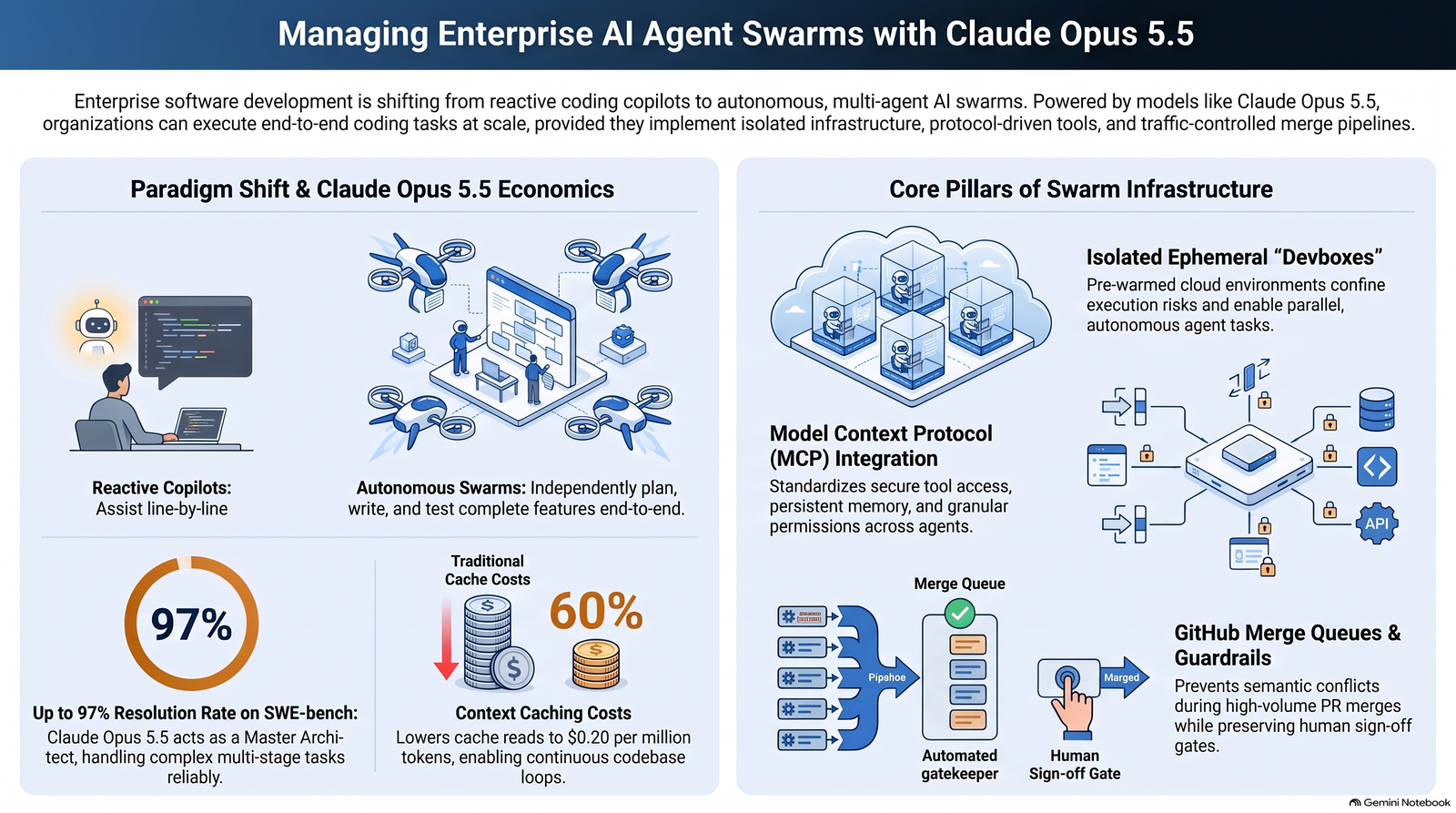
Claude Opus 5.5: What Business Owners Need to Know About Managing GitHub Enterprise AI Agent Swarms
The software engineering landscape experienced a tectonic shift in late 2026. Code generation evolved from interactive autocomplete features into fully autonomous, multi-agent swarms capable of executing end-to-end tasks, upgrading dependencies, and refactoring legacy systems without human intervention during the execution phase. At the forefront of this shift is the deployment of autonomous worker fleets—often modeled after Stripe’s highly publicized internal "Minions"—powered by frontier models like Anthropic's Claude Opus 5.5.
For executives, visionary Chief Technology Officers (CTOs), strategic Chief Financial Officers (CFOs), driven Heads of Sales, and innovative Marketing Directors, the conversation has permanently moved past whether artificial intelligence can write code. The pressing questions now revolve around enterprise infrastructure, governance, and economics. How do organizations coordinate multiple AI agents working on the same codebase simultaneously? What guardrails are necessary when granting autonomous machine workers commit access to enterprise repositories? And critically, how does an agentic swarm fundamentally differ from a traditional developer copilot?
This comprehensive analysis explores the infrastructure required to orchestrate these agents securely within a GitHub Enterprise environment, the economic and technical impact of Claude Opus 5.5, the psychological toll of "code review fatigue," and the strategic methodologies required to integrate an autonomous machine workforce safely.
The Paradigm Shift: Traditional Copilots vs. Agentic Swarms
To understand the operational impact of AI swarms, enterprise leaders must first distinguish between a copilot and an agentic swarm. The distinction dictates the necessary infrastructure, the associated costs, and the ultimate return on investment.
A traditional developer copilot operates reactively. It sits within an Integrated Development Environment (IDE), offering line-by-line autocomplete suggestions or answering chat queries based on the immediate context of an open file. It relies entirely on human direction, operating in a linear, synchronous request-response loop. The human engineer is the orchestrator, the planner, and the executor.
An agentic swarm, conversely, is proactive, autonomous, and distributed. A prime example is the internal AI system deployed by Stripe, dubbed "Minions," which merges over 1,300 pull requests (PRs) every week containing zero human-written code. These agents operate on a "fire-and-forget" model. An engineer tags an agent in a Slack thread detailing a bug report, system trace, or feature request. The agent independently ingests the context, plans the architectural change, provisions an isolated cloud environment, writes the logic, runs the enterprise testing suite, and submits a production-ready PR for human review.
The ultimate constraint on software development velocity is no longer human typing speed or cognitive capacity; it is how effectively an engineering organization can orchestrate, secure, and review the output of an autonomous, parallelized machine workforce.
Claude Opus 5.5: The Cognitive Engine for Enterprise Swarms
Released in September 2026, Claude Opus 5.5 was purpose-built to serve as the cognitive orchestrator for long-running, multi-agent workloads. For business leaders assessing the viability of AI swarms, Opus 5.5 fundamentally alters the economic and technical calculus of autonomous engineering.
Performance, Benchmarks, and Agentic Capability
Claude Opus 5.5 ranks at the absolute frontier of AI reasoning and autonomous software engineering. Evaluating the capability of AI agents has historically been challenging, as models easily memorize standard test sets. However, the industry standard has consolidated around SWE-bench Verified, a rigorous evaluation testing whether an AI agent can resolve real-world GitHub issues by downloading a repository, locating the bug, writing the patch, and passing the repository's native test suite.
On SWE-bench Verified, Claude Opus 5.5 achieves a 79.5% resolve rate out of the box, and up to 97.00% when orchestrated through specialized bash-only environments like Vals.ai. This level of capability allows the model to act as a "Master Principal Architect," orchestrating complex Task Directed Acyclic Graphs (DAGs) and coordinating faster, smaller sub-agents.
Furthermore, evaluation frameworks have evolved to measure true end-to-end autonomy. Frameworks like SWE-Cycle test agents not just on code implementation, but on environment reconstruction and verification test generation within a bare repository. Opus 5.5 excels in these full-cycle tasks due to its advanced resilience, capable of planning and executing multi-stage engineering milestones across hundreds of commits without losing contextual awareness.
The Economic Breakthrough: Cache Reads and Always-On Reasoning
Scaling an agent swarm historically resulted in exponential token costs. Because agents continuously loop, plan, and verify their work against the entire context of a massive repository, they consume vast amounts of data with every iterative step.
Opus 5.5 introduces a 40% reduction in typical workload costs compared to its predecessor, Opus 5, bringing standard API prices down to $4 per million input tokens and $20 per million output tokens. However, the most critical economic metric for agent swarms is the cost of context caching. Opus 5.5 reduces cache read costs by 60% to $0.20 per million tokens. When an agent repeatedly references a 100,000-line codebase during a debugging loop, this cache reduction makes continuous autonomous execution financially viable for enterprise deployments.
Additionally, Opus 5.5 enforces "always-on" reasoning. While previous models allowed developers to disable reasoning algorithms to save tokens, Opus 5.5 defaults to a medium reasoning effort on every request. Counterintuitively, this reduces overall operational costs because the model requires significantly fewer iterative steps, retries, and API calls to complete a task. By solving problems correctly on the first or second attempt, the total volume of token consumption drops.
Table 1: Model Pricing and Performance Comparison for Swarm Deployment
The following table illustrates how Claude Opus 5.5 compares to other frontier models in the context of enterprise agent orchestration, highlighting the cost efficiencies that make large-scale swarms economically feasible.
| Model / AI Engine | SWE-bench Verified Score | Input Cost (per 1M Tokens) | Output Cost (per 1M Tokens) | Cache Read (per 1M Tokens) | Optimal Role in a Multi-Agent Swarm |
|---|---|---|---|---|---|
| Claude Opus 5.5 | 79.5% - 97.0% | $4.00 | $20.00 | $0.20 | Master Orchestrator / Complex Logic Planning |
| Claude Fable 5.1 | 74.8% | $1.20 | $6.00 | $0.12 | High-Speed Subagent / Isolated Coding Tasks |
| GPT-6 Astra | 82.0% | $6.00 | $24.00 | $0.30 | Autonomous Chief Architect / Code Review |
| Gemini 3.8 Flash | 78.0% | $0.07 | $0.30 | N/A | Log Analysis / Rapid File Searching |
| Grok 4.20 | 58.5% | $2.00 | $8.00 | N/A | Frontier Systems Specialist |
Data aggregated from September 2026 pricing and independent benchmark reports.
The Real Economics of the Swarm
Understanding the per-token cost of a model is only one half of the economic equation. Strategic CFOs and technology leaders must evaluate the total cost of ownership (TCO) for a continuously operating machine workforce, much like they would when assessing hidden costs in a major modernization initiative.
In real-world applications, running a live multi-agent operation is highly cost-effective when architected correctly. For example, a documented deployment of an AI agent swarm at Black Matter VC in June 2026 cost a total of $1,462.37 for the month. This swarm performed the combined daily duties of a data analyst and a research assistant, continuously monitoring feeds, filtering signals, clustering data, and generating synthesis reports.
The cost breakdown reveals a fundamental principle of agent economics: token cost tracks the size and complexity of the job, not the frequency of execution.
High-Frequency, Low-Complexity Tasks: Agents that run constantly to filter logs, monitor systems, or triage incoming bug reports are delegated to smaller models (like GPT-5.4 mini or Gemini 3.8 Flash). These operations cost mere cents per day, despite firing hundreds of times.
Low-Frequency, High-Complexity Tasks: The expensive operations are the reasoning-heavy, end-to-end synthesis tasks. These are reserved for flagship models like Claude Opus 5.5. A single complex task might consume thousands of tokens, but it is executed only when the smaller agents have prepared and validated the necessary data.
By productizing this efficiency, independent developers and enterprise teams are replacing expensive per-seat software subscriptions with highly optimized, open-source or API-driven agent workspaces, creating massive profit arbitrage.
Table 2: AI Swarm Economics - Token Cost Breakdown
This table breaks down the economic distribution of a production swarm, demonstrating how intelligent routing controls monthly expenditures.
| Task Complexity | Execution Frequency | Assigned Model Tier | Estimated Cost Profile | Economic Impact |
|---|---|---|---|---|
| Routine Filtering & Triage | High (Continuous) | Micro Models (e.g., GPT-5.4 mini, Gemini Flash) | ~0.15 Input / 0.60 Output per 1M tokens | Minimal impact. High volume operations cost pennies per day. |
| Curation & Drafting | Medium (Hourly) | Mid-Weight Models (e.g., Claude Fable 5.1) | ~1.20 Input / 6.00 Output per 1M tokens | Moderate impact. Balances speed with competent coding capability. |
| Deep Reasoning & Orchestration | Low (On-Demand) | Frontier Models (e.g., Claude Opus 5.5) | ~4.00 Input / 20.00 Output per 1M tokens | Primary cost driver. Reserved for tasks requiring high accuracy and complex DAG execution. |
Architecting the Swarm: Ephemeral Infrastructure and "Blueprints"
Unleashing a highly capable model like Claude Opus 5.5 directly into a massive enterprise repository without architectural constraints is a recipe for catastrophic failure. Purely agentic systems, where a Large Language Model (LLM) is given a task and trusted to decide every subsequent action, are inherently probabilistic. They are creative but prone to omission. An unrestricted agent might hallucinate architectures, skip critical unit tests to conserve tokens, or create destructive merge conflicts when operating in parallel with other agents.
In a codebase that processes billions of transactions or manages sensitive healthcare data, "probably correct" is fundamentally insufficient. Top-tier engineering teams manage this risk by treating agents not as freelance developers, but as factory workers operating within strict, deterministic industrial pipelines, often combining strong DevOps practices with modern AI orchestration.
1. Ephemeral Environments: The "Devbox" Strategy
The foundational secret to secure multi-agent scaling is isolation. When organizations attempt to run agents on local laptops, heavily restricted bespoke sandboxes, or shared staging servers, they encounter severe bottlenecks. Autonomous swarms require a predictable, parallelizable, and entirely disposable cloud computing environment.
Stripe achieved its massive scale of 1,300 PRs per week by utilizing "devboxes." A devbox is an isolated AWS EC2 instance that is perfectly identical to the environments used by human engineers. To ensure agents do not waste time or tokens configuring environments, these instances are proactively provisioned and "pre-warmed." This means gigantic Git repositories are pre-cloned, type-checking caches are warmed, and necessary services are running before the agent is even assigned a task. The devbox is ready in under 10 seconds.
In DevOps terminology, these devboxes are treated as "cattle, not pets"—they are standardized, ephemeral, and easily replaced. Because these environments are isolated from the internet and possess no access to production databases, the agent operates with full autonomy. It does not need to pause to ask a human for permission. If the agent executes a destructive command or completely breaks the environment, the blast radius is entirely confined to a single disposable virtual machine that is destroyed upon task completion. This architecture allows engineering teams to spin up dozens of agents concurrently without risk of cross-contamination.
2. "Blueprints": Taming Agentic Chaos
To maximize system reliability and eliminate token waste, organizations must structurally separate creative reasoning from strict enterprise formatting. This is achieved through the orchestration of "Blueprints."
A blueprint is effectively a state machine defined in code that seamlessly weaves together open-ended AI agentic loops with hard-coded, deterministic execution nodes.
Agentic Nodes: The LLM is given wide latitude to read documentation, plan logic, explore the codebase, and generate code. This is where the model exercises its probabilistic creativity.
Deterministic Nodes: Once the code is written, the agentic process halts. The system hands the output over to a deterministic, hard-coded script that runs enterprise linters, formatters, and security checks.
Organizations do not need to burn expensive AI compute to format code or execute a basic security scan. By confining the AI to specific generation tasks and using deterministic nodes to verify the output, the system creates explicit, auditable, and recoverable checkpoints. Because each instance checks its own outputs independently, failures are explicit. If a deterministic test fails, the error log is fed back to the agentic node for a controlled correction loop. This creates a feedback loop that relies on the system catching errors, rather than requiring the AI to be perfectly correct on its first attempt.
The Orchestration Layer: Model Context Protocol (MCP)
An AI agent is only as effective as the enterprise context it can access. To build a truly autonomous worker, that worker needs the ability to read internal documentation, check Jira tickets, query build statuses, and navigate corporate wikis. To securely bridge the gap between frontier models and proprietary enterprise systems, the industry has standardized around the Model Context Protocol (MCP).
MCP is an open standard and architectural specification that provides a universal interface for AI agents to connect to external tools, documentation, and data sources. Before MCP, connecting an AI agent to a business application required brittle, custom point-to-point integrations for every tool. MCP replaces this by defining how multiple AI models can assume specialized roles, share contextual information, access persistent memory, and coordinate via a shared task plan.
The Centralized "Toolshed" and Deterministic Prefetching
Rather than building custom API handlers for every LLM, organizations stand up centralized MCP servers. For instance, an enterprise might house 500 internal tools (Salesforce integrations, secure build statuses, codebase indexes) within a centralized MCP "Toolshed."
However, a critical optimization must be applied: the system cannot expose all 500 tools to the agent simultaneously. Providing an LLM with hundreds of tools wastes valuable tokens as the model attempts to determine which function to invoke, increasing latency and the probability of hallucination.
Instead, the orchestration layer performs deterministic prefetching. When an agent is instantiated via a Slack prompt, the orchestrator scans the prompt for keywords, locates the relevant documentation, and surgically curates a subset of approximately 10 to 15 highly relevant tools. This prefetching occurs before the agent activates, ensuring it begins work already armed with exactly what it needs, keeping the LLM footprint highly efficient.
Multi-Agent Coordination and State Management
In a multi-agent system, specialized agents distribute work to create an agentic workflow that cycles through perception, reasoning, action, and communication. MCP facilitates this by maintaining persistent context across agent interactions.
When multiple agents run in parallel, they face critical coordination challenges, such as "Turn Awareness" (agents not knowing if it is their turn to act, leading to race conditions) and "Context Drift" (parallel agents developing inconsistent understandings of the codebase). MCP servers resolve this by providing shared memory, where agents can store and retrieve context, decisions, and findings. It enforces resource locking to prevent concurrent access to files, ensuring that multiple agents do not attempt the same task simultaneously or overwrite each other's changes.
By standardizing tool invocation through MCP, organizations ensure that capability discovery is scalable, while maintaining strict, protocol-level Role-Based Access Control (RBAC). An agent may have the cryptographic permissions to read from a staging database, but be explicitly blocked at the MCP gateway from executing write commands in production.
Traffic Control: Managing GitHub Enterprise Merge Queues
When a swarm of agents is deployed, the sheer volume of code generated can easily overwhelm standard Continuous Integration and Continuous Deployment (CI/CD) pipelines. A team of ten human developers might open 15 pull requests in a day; a fully operational agent swarm can easily open 150.
If multiple agents are working on the same repository simultaneously, they risk creating a pipeline pile-up. Two agents might open PRs that pass all independent CI checks in isolation. However, if both are merged sequentially without re-testing, they can introduce a semantic collision or logical conflict that breaks the main branch.
The Necessity of Merge Queues
To solve this concurrency problem, organizations running GitHub Enterprise Cloud must utilize native Merge Queues (or Merge Trains for those on GitLab Premium).
A merge queue acts as a highly regulated traffic controller. Instead of merging a PR as soon as it passes its isolated tests, the merge queue creates temporary branches to validate the pull request changes. Crucially, the merge queue tests the PR not just against the base branch from the moment it was opened, but against the combined state of all changes currently ahead of it in the queue. Only once these combined checks pass is the code merged. When dozens of autonomous work streams touch the same monorepo, a merge queue transitions from a convenience feature to an absolute quality control necessity.
GitHub API Rate Limiting
Furthermore, managing GitHub API rate limits becomes a critical operational requirement for enterprise swarms. GitHub enforces primary rate limits to maintain platform stability. For GitHub Apps installed on a GitHub Enterprise Cloud organization, the limit is strictly capped at 15,000 requests per hour. Secondary rate limits can also be triggered by excessive requests to a single endpoint or high CPU time consumption.
An unsupervised swarm, featuring hundreds of sub-agents constantly polling for status updates or iterating through files, can rapidly exhaust this limit, effectively freezing CI/CD operations for the entire enterprise.
To mitigate this, organizations must implement robust client-side rate limiting strategies. This involves enforcing quotas on the client side, setting up alerting mechanisms when API usage nears limits, and implementing retry mechanisms with exponential backoff. Exponential backoff reduces the likelihood of overwhelming the API by gradually increasing the wait time between retries. Finally, priority queuing systems must be established to ensure that critical, human-driven operations are processed ahead of background agent activity.
Table 3: GitHub vs. GitLab for Enterprise Agent Swarms
Choosing the right platform depends heavily on an organization's tolerance for managing infrastructure versus relying on SaaS ecosystems. The following table compares the primary enterprise options for hosting agent swarms.
| Platform Option | Primary Agentic Advantage | Main Limitation | Ideal Enterprise Fit |
|---|---|---|---|
| GitHub Enterprise Cloud | Massive ecosystem, native GitHub Apps, centralized organization controls, and built-in Merge Queues. | Higher seat pricing and strictly bound to a SaaS model. | High-throughput agent teams prioritizing ecosystem access without managing their own forge. |
| GitHub Team | Low entry price, required reviews, and CODEOWNERS enforcement. | Lacks native merge queues for private repositories. | Small to medium teams with moderate agent concurrency. |
| GitLab Premium (SaaS) | Integrated CI/CD, required approvals, and native Merge Trains. | Smaller ready-made agent ecosystem compared to GitHub. | Teams requiring strong integrated governance and CI/CD without operational burden. |
| GitLab Premium (Self-Managed) | Full control over code, network, and platform; merge trains; owned runner policy. | Requires operating a critical service, managing backups, and upgrading instances. | Organizations with strict data-location requirements and mature DevOps maturity. |
Security, Compliance, and Enterprise Guardrails
Autonomous agents take real actions on real systems. In enterprise environments moving billions of dollars or handling sensitive customer data, traditional security paradigms are insufficient. Deploying swarms requires a fundamental shift from trust-based security to architecture-enforced security, similar to the shift companies face when they reclaim control from vendor-forced migrations.
Organizations leveraging these tools must implement defense-in-depth strategies anchored by strict compliance frameworks such as SOC 2 Type II, ISO 27001, and GDPR. Securing an agent is fundamentally different from securing a chatbot. An agent queries databases, calls third-party APIs, and executes code; therefore, security cannot be an afterthought.
Sandboxed Tool Execution: Tools and generated code must be executed in isolated, network-restricted sandboxes with strict resource limits. If an agent hallucinates a malicious command, or if it ingests a compromised open-source dependency, the isolated execution environment ensures the threat cannot traverse into the wider enterprise network.
Scoped Identity and Revocable Permissions: Agents must operate under distinct, attributable service identities. Using technologies like OAuth and SAML, agents are granted least-privilege, just-in-time access. Permissions must be explicitly scoped to specific tools, time-boxed for the duration of the task, and instantly revocable with a single click.
Immutable Audit Trails: Every action, tool call, memory retrieval, and reasoning step taken by the swarm must be logged and streamed to Security Information and Event Management (SIEM) systems. If an anomaly occurs, security teams require sub-second observability and full traceability to reconstruct the agent's exact decision tree.
Human-in-the-Loop (HITL) Checkpoints: While agents can plan, code, and test autonomously, irreversible actions must trigger an approval gate. High-stakes decisions—such as merging a critical pull request to the main branch, modifying compliance documentation, or altering production databases—must pause the agent's execution until a human engineer signs off. GitHub's CODEOWNERS files are highly effective here, ensuring agents cannot approve or merge their own work.
The Human Toll: Code Review Fatigue and Cognitive Debt
The most significant bottleneck in deploying AI agent swarms is not computing power, token budgets, or API rate limits; it is human endurance. The aggressive adoption of agentic workflows has triggered a crisis in developer experience, manifesting in two severe, compounding organizational risks: Code Review Fatigue and Cognitive Debt.
The Biology of Code Review Fatigue
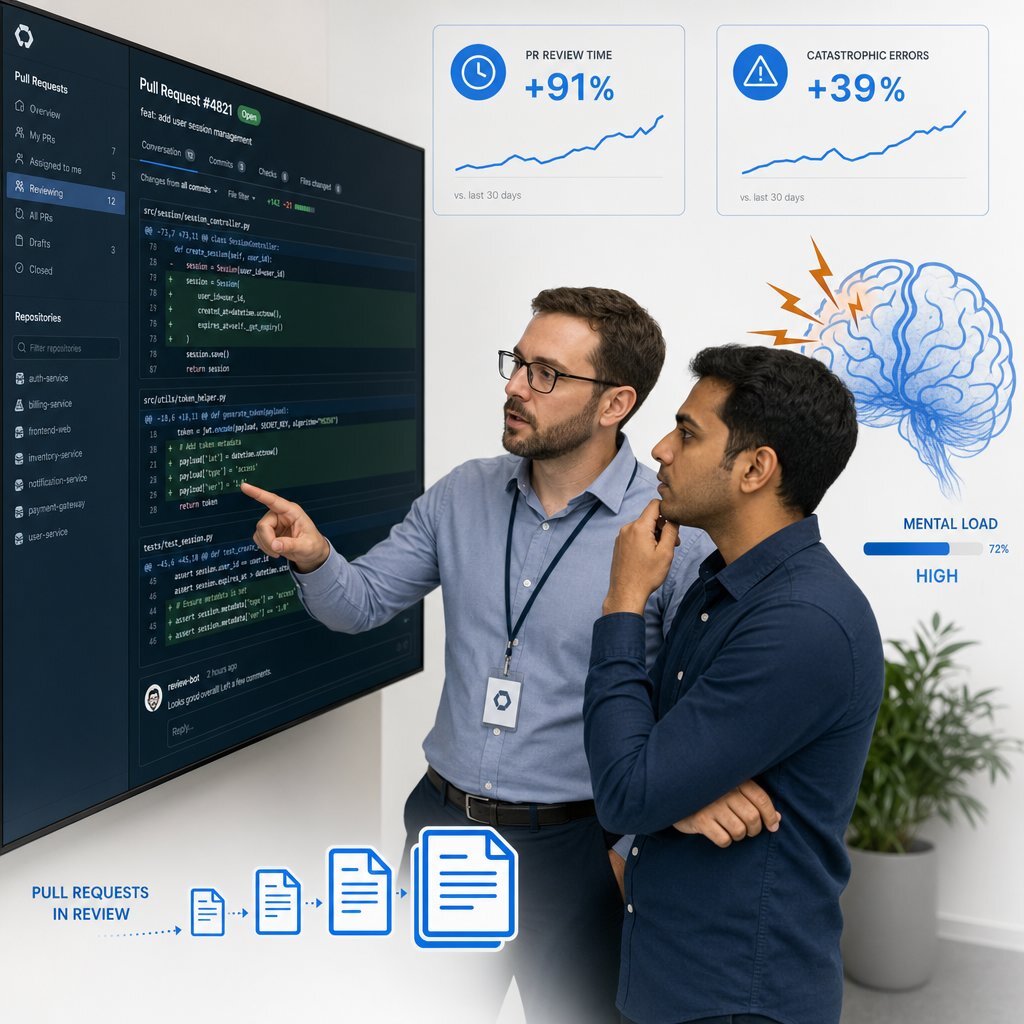
When swarms are capable of producing thousands of pull requests a week, the volume of code awaiting human review skyrockets. Industry data from Q1 2026 indicates that AI-generated code has increased PR volume by 98% per developer, subsequently driving an unprecedented 91% increase in PR review time per engineer.
Reviewing AI-generated code is fundamentally different from reviewing human-authored code. Human code contains predictable error signatures and heuristics: clean syntax generally implies safe code, and a small diff implies low risk. AI-generated code shatters these heuristics. The syntax is always immaculate, the descriptions are highly detailed, but deep architectural flaws may be hidden within perfectly formatted logic.
Hunting for these subtle, non-deterministic bugs across thousands of lines of machine-generated diffs requires intense, sustained cognitive control. Neuroscientific studies reveal that this high-stakes auditing causes glutamate to accumulate in the prefrontal cortex. To protect itself from metabolic overload, the brain actively inflates the perceived cost of mental effort, forcing the individual to seek cognitive shortcuts.
This biological phenomenon, termed "AI Brain Fry" or the "AI Reviewer's Hangover," leads directly to severe decision fatigue. Exhausted developers, confronted with their fifteenth AI-generated PR of the afternoon, take the path of least resistance: they rubber-stamp the approval, assuming the agent "probably got it right." As a result of this fatigue, studies show a 33% increase in decision fatigue and a staggering 39% jump in major catastrophic errors, as reviewers begin approving code based on "vibes" rather than rigorous analysis.
The Erosion of Expertise: Cognitive Debt
Beyond immediate physical burnout, reliance on AI swarms introduces a creeping, long-term strategic vulnerability: Cognitive Debt.
Cognitive debt occurs when an engineering team can successfully ship code and deploy features, but can no longer reliably explain why the system is architected the way it is. Traditional software development involves "productive struggle"—the specific, uncomfortable process of working through a hard problem, weighing trade-offs, and experiencing failure. This struggle is the exact mechanism that builds an engineer's internal mental model of the software system.
When an AI agent instantly generates a solution and bypasses this struggle, the human ownership loop is broken before the first line is written. Because the developer did not retrieve the solution from their own memory or wrestle with the architecture, the memory trace weakens. Over time, the engineering team loses the foundational intuition required to debug complex, cross-system failures during a critical outage. The vocabulary remains, and the code remains syntactically perfect, but institutional knowledge and true craftsmanship hollow out—much like what happens when teams over-rely on rigid off-the-shelf tools instead of building workflow-aware custom systems.
Strategic Mitigation Protocols
To counteract fatigue and cognitive debt, engineering leadership must fundamentally restructure how human capital interacts with machine output:
Triage Before Review: Organizations must formally separate PRs into a triage phase (assessing blast radius, scope, and risk) and a review phase (line-by-line analysis). Triage heuristics must be recalibrated, acknowledging that AI code requires higher scrutiny for foundational, core logic.
Limit Work in Progress (WIP): Strict limits must be placed on how many PRs an agent swarm can queue for a single human reviewer in a given day to prevent context-switching overload and metabolic exhaustion.
Automated Risk Assessments: Utilize secondary, read-only AI agents to pre-evaluate the risk profile of a PR, highlighting critical architectural changes to focus the human reviewer's limited attention specifically where it matters most.
Mandate Architectural Planning: To combat cognitive debt, engineers must be required to write detailed system design documentation and explicitly declare intent before delegating execution to the swarm, forcing them to maintain ownership of the architecture.
Table 4: Managing the Human Impact of AI Swarms
| Organizational Risk | Mechanism of Failure | Strategic Mitigation Protocol |
|---|---|---|
| Code Review Fatigue | Glutamate buildup in the prefrontal cortex leads to rubber-stamping AI-generated PRs due to metabolic overload. | Enforce WIP limits; implement strict "Triage before Review" phases to manage cognitive load. |
| Cognitive Debt | Loss of "productive struggle" degrades developers' mental models, making systems impossible to debug during outages. | Mandate human architectural planning and design documentation prior to agent execution. |
| The Trust Paradox | High usage of AI tools but low trust in outputs (only 24% strongly trust AI), leading to high stress. | Deploy automated risk assessment agents to flag high-impact logic changes for focused human review. |
Operationalizing Agent Swarms: The Baytech Consulting Approach
Successfully deploying multi-agent swarms requires more than provisioning API keys; it demands rigorous enterprise architecture and bespoke workflow design. Firms specializing in custom software development and application management, such as Baytech Consulting, observe that off-the-shelf AI deployments frequently fail due to a lack of systemic integration and improper infrastructure alignment.
Leveraging a "Tailored Tech Advantage," modern software consultancies recognize that AI swarms must be intricately woven into an organization's existing fabric. For enterprises operating within complex environments, deploying ephemeral devboxes requires deep architectural expertise. Whether utilizing Azure DevOps On-Prem, orchestrating environments via Kubernetes and Docker on a .NET stack, or managing instances on Harvester HCI and Rancher, the underlying infrastructure must support seamless, automated provisioning.
Furthermore, "Rapid Agile Deployment" methodologies align perfectly with the blueprint architecture required to tame AI swarms. By defining clear success metrics, isolating workflows, and utilizing robust databases like Postgres and SQL Server for persistent agent memory, highly skilled engineering teams can build reliable, observable agentic pipelines. This is where mature Agile methodology and AI-first delivery practices reinforce each other.
A critical differentiator in maintaining quality control over an autonomous machine workforce is avoiding fragmented, offshore development. By utilizing dedicated, onshore software architects, consultancies ensure the stringent communication and oversight necessary to prevent the accumulation of cognitive debt, keeping projects on time while delivering enterprise-grade quality. In this paradigm, the human engineer's role transitions from a line-by-line coder to an architectural systems planner, and the technology stack is meticulously designed to support that strategic oversight—often through long-term service contracts and ongoing support rather than one-off builds.
Conclusion
The transition from interactive AI copilots to autonomous agent swarms represents a fundamental re-architecture of how enterprise software is built, tested, and maintained. With models like Claude Opus 5.5 driving the cognitive heavy lifting at significantly reduced costs, the economics of continuous, multi-agent execution are now firmly in favor of widespread adoption.
However, the organizations that will dominate this new era are not those that simply unleash the highest volume of agents. Success belongs to the enterprises that treat AI not as a magic black box, but as a highly regulated industrial process. By isolating execution within ephemeral devboxes, constraining creativity through deterministic blueprints, centralizing tool access via the Model Context Protocol, and strictly managing GitHub merge queues, technical leaders can scale their output exponentially without compromising system stability.
Equally critical is the management of the human workforce. Executives must proactively combat code review fatigue and cognitive debt by restructuring productivity metrics, recalibrating review processes, and prioritizing deep architectural understanding over mere lines of code generated. In the age of AI swarms, human expertise remains the ultimate guardrail.
Frequently Asked Questions (FAQ)
How do you coordinate multiple AI agents working on the same codebase simultaneously? Coordination requires strict infrastructural and protocol-level boundaries. First, agents must never operate on local developer machines or shared staging branches. Each agent must be instantiated in an isolated, ephemeral cloud environment (a "devbox") with its own clone of the repository, preventing immediate file conflicts. Second, traffic control must be enforced at the platform level using GitHub Merge Queues (or GitLab Merge Trains). These queues test the combined state of multiple agent PRs before they are allowed to merge into the main branch, preventing semantic conflicts that occur when two perfectly valid PRs break the system when combined. Finally, communication and tool access are managed through the Model Context Protocol (MCP), ensuring all agents utilize a centralized, version-controlled set of tools and memory states.
What guardrails are necessary when giving AI agents commit access to your enterprise repositories? Commit access for autonomous agents necessitates architecture-enforced security, aligning with SOC 2 Type II standards. Essential guardrails include:
Sandboxed Execution: Agents must execute code and scripts in strictly isolated, network-restricted containers with egress allow-lists to prevent malicious actions or compromised dependencies from reaching the wider network.
Scoped Identity and RBAC: Agents must operate under dedicated service accounts with least-privilege, dynamically assigned permissions that are cryptographically verified at the MCP gateway.
Human-in-the-Loop (HITL) Checkpoints: Agents should never possess the permission to approve their own pull requests. All PRs generated by the swarm must pass deterministic CI/CD checks and mandate human review (e.g., via GitHub CODEOWNERS files) before a merge to a critical branch is executed.
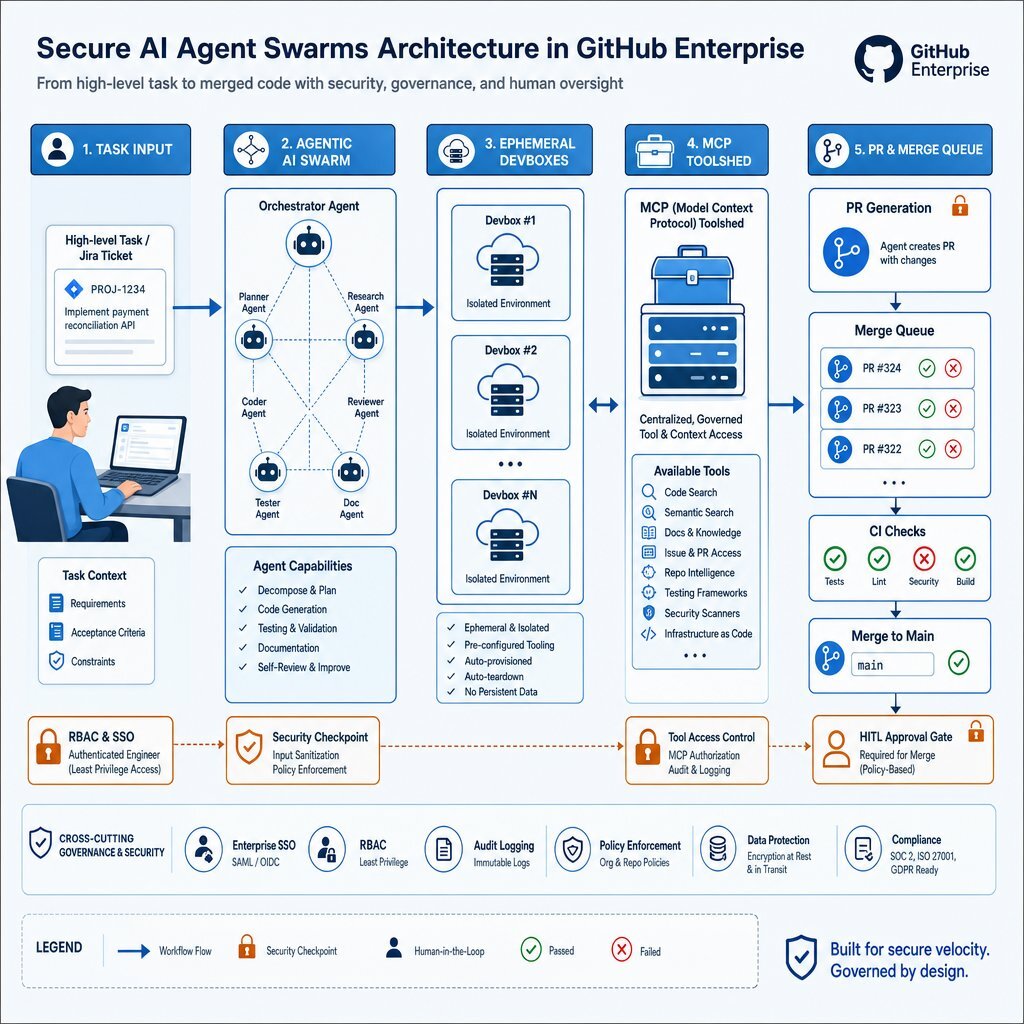
How does an agentic swarm differ from a traditional developer copilot? A traditional copilot is reactive and localized; it operates within the developer's IDE, suggesting code completions or answering questions based on explicit human prompts. It is highly dependent on continuous human steering. An agentic swarm is proactive, autonomous, and operates end-to-end. Upon receiving a high-level task (e.g., a Jira ticket), an agentic swarm will independently provision a cloud environment, read documentation, plan a multi-file architecture change, write the code, execute tests, debug its own errors via iterative loops, and submit a finalized pull request for review, requiring zero human intervention during the actual execution phase.
- Building Secure AI Agents: Identity, Authorization, and Guardrails
- The True Cost of Code Review Fatigue and Cognitive Debt in AI Workflows
- Understanding the Model Context Protocol (MCP) for Enterprise Integration
About Baytech
At Baytech Consulting, we specialize in guiding businesses through this process, helping you build scalable, efficient, and high-performing software that evolves with your needs. Our MVP first approach helps our clients minimize upfront costs and maximize ROI. Ready to take the next step in your software development journey? Contact us today to learn how we can help you achieve your goals with a phased development approach.
About the Author

Bryan Reynolds is an accomplished technology executive with more than 25 years of experience leading innovation in the software industry. As the CEO and founder of Baytech Consulting, he has built a reputation for delivering custom software solutions that help businesses streamline operations, enhance customer experiences, and drive growth.
Bryan’s expertise spans custom software development, cloud infrastructure, artificial intelligence, and strategic business consulting, making him a trusted advisor and thought leader across a wide range of industries.