Your AI Traffic Is Hiding in 'Direct' — Reclaim It
August 21, 2026 / Bryan Reynolds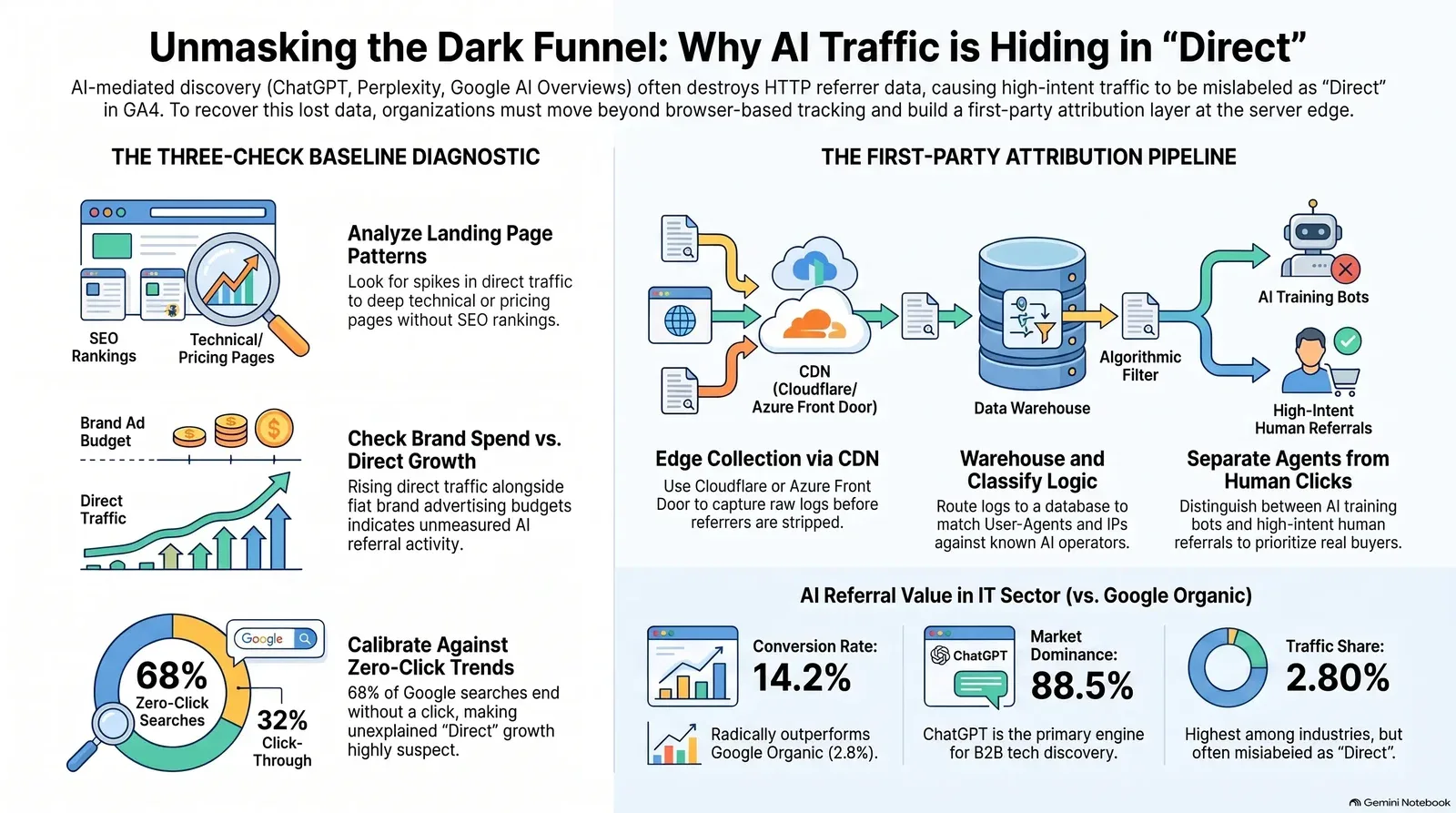
Your Direct traffic is climbing, and nobody on the revenue team can explain why. You might credit a successful brand campaign or blame a broken tracking pixel. Both are usually wrong.
The digital landscape has experienced a structural shift. AI-mediated discovery breaks a foundational technical assumption of web analytics: that a click carries a referrer. When visitors click a link inside ChatGPT, Perplexity, Gemini, or a Google AI Overview, the referrer data is frequently destroyed before it reaches your analytics stack. Consequently, platforms like Google Analytics 4 (GA4) file the visit under the ambiguous "Direct" bucket.
Marketing leaders are making budget decisions based on channel reports that quietly misattribute a real and growing source of high-intent pipeline. Resolving this blind spot is not a marketing problem; it is a data engineering requirement. Teams capturing real numbers are ignoring their standard dashboards and building custom, first-party data layers at the server or CDN edge.
The Anatomy of a Disappearing Referrer
To understand why AI referrals vanish into Direct traffic, you have to look at what happens to the HTTP Referer header when a user clicks a link inside an AI interface.
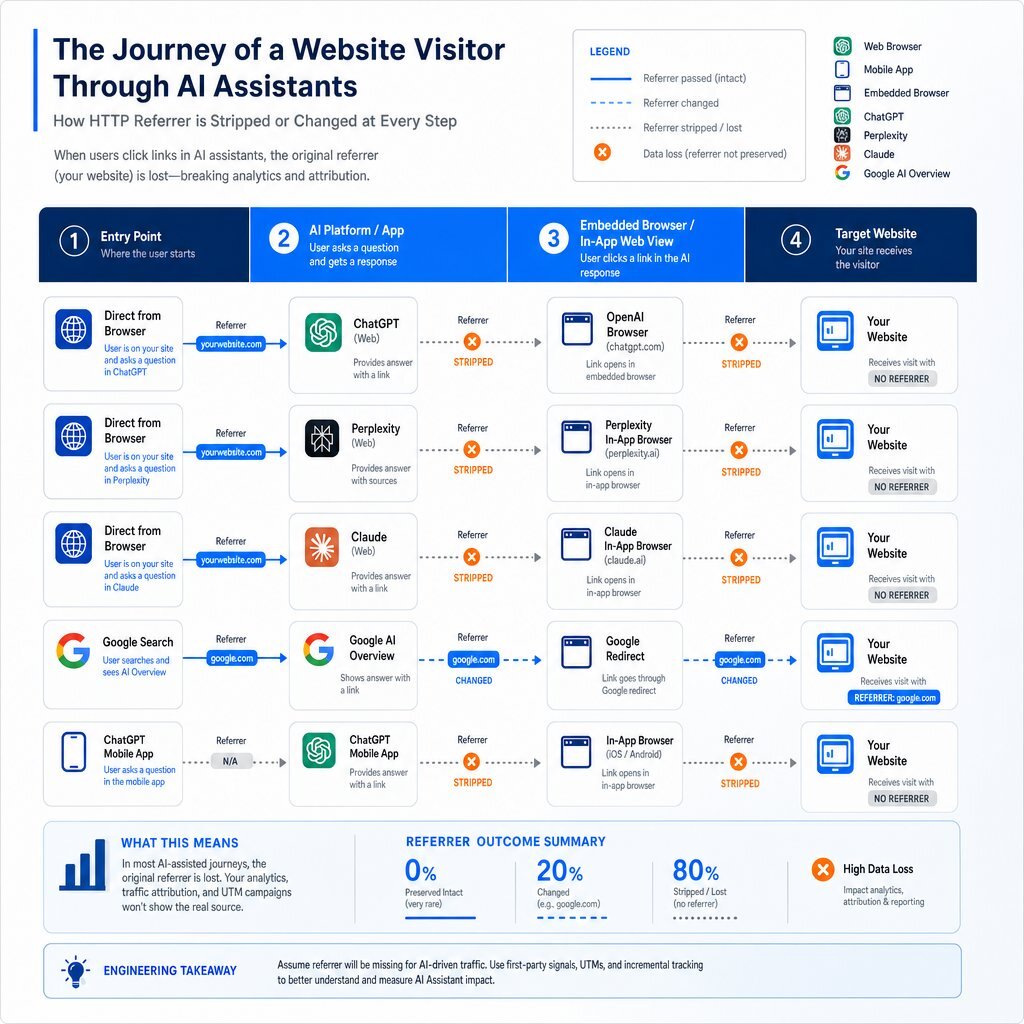
When a visitor clicks a citation in a standard desktop web browser, the session typically passes an intact referrer. However, AI usage heavily features mobile applications and embedded browsers, which disrupt this data handoff. When a user taps a link within the ChatGPT iOS or Android application, the app delegates the link to the mobile device’s native system browser. During this transition, the referrer header rarely survives. Furthermore, OpenAI’s proprietary web browser, ChatGPT Atlas, actively blocks or strips referrer headers on outbound clicks by default, causing sessions to appear as Direct or (not set).
Other platforms present similar technical hurdles. Anthropic's Claude often serves citation links with a rel="noreferrer" tag, ensuring the click registers as Direct. Perplexity's Comet browser handles outbound links differently across devices, creating inconsistencies in tracking.
Google AI Overviews and Google’s AI Mode present an entirely different attribution challenge. While these surfaces do not strip the referrer, they pass the exact same string as a standard Google organic search: google.com/search. Analytics tools receive no technical signal within the HTTP header to differentiate a click originating from a traditional ten-blue-links page versus a generative AI summary box. If a user transitions from an HTTPS environment to an HTTP page, or simply copies a URL from an AI answer and pastes it into a new tab, the referrer is also destroyed.
Sizing the Problem Honestly: B2B Benchmarks vs. Retail Hype
A critical misstep in evaluating AI traffic is borrowing benchmarks from the retail and travel sectors. Headline-grabbing statistics often highlight massive consumer adoption, such as retail AI traffic surging nearly 700% during holiday shopping seasons. Applying these figures to B2B software and industrial services will grossly inflate expectations and misguide strategy.
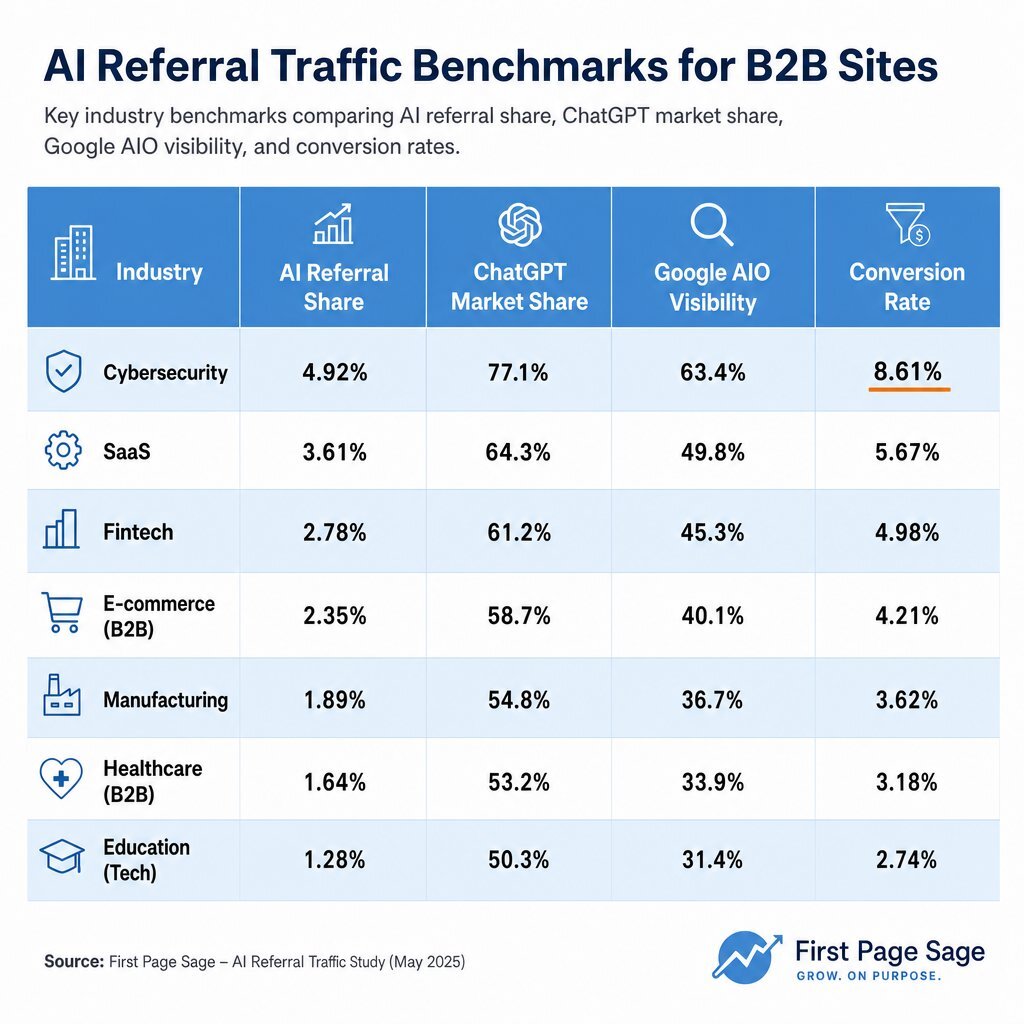
Sector-level data provides a more grounded reality for B2B enterprises. According to the 2026 Conductor AEO/GEO Benchmarks report, AI referral traffic accounts for 2.80% of total website traffic within the Information Technology industry. This is notably higher than the 1.08% global cross-industry average, but still a fractional share of total sessions. IT queries are typically complex and require deep evaluation, prompting users to click through generative AI answers more frequently than they do for simple consumer queries.
While the raw volume of AI referral traffic remains in the single digits, the business case is anchored in conversion metrics. Visitors arriving from AI engines are highly qualified, having already completed comparative research and synthesis before ever reaching a vendor's website.
| Metric | Information Technology Benchmark | Context |
|---|---|---|
| Total AI Referral Share | 2.80% of total traffic | Highest among 10 analyzed industries. |
| Month-over-Month Growth | 0.30% (July to Sept 2025) | Growth is steady but marginal, not exponential. |
| ChatGPT Market Share | 88.5% of AI traffic | The dominant engine for B2B tech discovery. |
| Google AIO Visibility | 11.4% of IT queries | Varies by sub-sector; Hardware sees 19.4% AIO triggers. |
| Average Conversion Rate | 14.2% | Radically outperforms Google Organic (2.8%). |
The Three-Check Baseline Diagnostic
Before writing a single line of code to build an attribution layer, establish a baseline to determine how much of your Direct traffic bucket is actually AI-sourced.
The fastest diagnostic a team can run involves landing page pattern analysis. Cross-reference pages experiencing a recent spike in Direct sessions against their organic search rankings. If a highly specific technical documentation page, a pricing page, or a deep blog post is receiving a sudden influx of Direct traffic—yet holds no top-tier traditional SEO ranking and has not been featured in recent email campaigns—it is highly probable that the page is being cited as a source within an AI engine.
Next, compare the growth in Direct traffic against offline brand awareness spend. If Direct traffic is climbing steadily month-over-month while brand advertising budgets remain flat, the anomaly strongly suggests the presence of unmeasured dark funnel activity. This is also where your broader analytics and discovery process needs to be honest about what your current tools can and cannot see.
Finally, calibrate against macro search trends. According to a 2026 SparkToro and Similarweb study, 68.01% of U.S. Google searches now end without a click. Only 276 out of every 1,000 searches reach the open web, down from 374 in 2024. As traditional search yields fewer clicks, any unexplained resilience or growth in Direct traffic is highly suspect.
What GA4 Channel Groups Can (and Structurally Cannot) Do
Marketing teams routinely wait for updates to standard analytics platforms to resolve this measurement gap. However, default analytics configurations are structurally incapable of recovering stripped referrers.
In May 2026, Google Analytics 4 launched a native "AI Assistant" default channel grouping designed to automatically categorize known AI referrers. While helpful, the update has severe constraints. It is not retroactive, meaning historical data remains buried in Direct or Referral categories. Furthermore, the native update initially failed to recognize critical B2B engines like Claude and Perplexity, and it inherently cannot isolate Google AI Overview clicks from standard organic traffic.
Analysts can manually build custom regex channel groups in GA4 to explicitly bucket domains like chatgpt.com, chat.openai.com, perplexity.ai, and claude.ai. This is a recommended best practice, but it is critical to understand its limitations and align it with your broader enterprise application architecture so analytics changes don’t break critical reporting elsewhere.
| Attribution Method | What It Successfully Captures | What It Structurally Misses |
|---|---|---|
| GA4 Default AI Assistant | Basic desktop web referrals from recognized engines (ChatGPT, Gemini). | Historical data, Perplexity, Claude, mobile app clicks, AI Overviews. |
| GA4 Custom Regex Group | All desktop web referrals from manually defined AI domains. | Stripped referrers, app deep-links, AI crawler activity, direct copy-paste behavior. |
| Server-Side / CDN Logs | Every HTTP request, stripped referrers (via IP/Agent matching), API fetches, crawlers. | Requires data engineering to parse and visualize; not native to marketing dashboards. |
Custom channel groupings are entirely dependent on the presence of an intact HTTP referrer. If a mobile AI application strips the referrer upon opening a link, the session lands in Direct. Because there is no data left in the browser layer to classify, regex rules cannot recover the visit.
Architecting the First-Party Measurement Layer
To accurately measure the full scope of AI engagement, you must bypass the browser layer and capture data at the infrastructure level. Content Delivery Networks (CDNs)—such as Cloudflare, Fastly, or Azure Front Door—see every single request made to a domain before JavaScript executes or analytics tags fire.
Building a first-party attribution layer involves routing these edge logs into a centralized data warehouse where they can be queried, classified, and joined with CRM records. The work is similar in spirit to any thoughtful phased modernization roadmap: start small, prove value, then expand.
The architecture flows sequentially:
- Edge Collection: Configure the CDN to stream raw access logs. On platforms like Cloudflare, this is accomplished via Logpush; on Azure Front Door, diagnostic settings route WAF and access logs.
- Warehousing: Land the raw logs into a structured, scalable database. Baytech Consulting frequently implements these pipelines using robust relational databases like PostgreSQL and SQL Server, ensuring high-volume log ingestion remains stable and performant.
- Key Fields to Capture: The pipeline must isolate specific metadata fields to enable classification. Crucial fields include
EdgeStartTimestamp,ClientRequestUserAgent,ClientIP,ClientRequestPath, andClientRequestReferer. - Classification Logic: SQL queries are applied within the warehouse to match User-Agent strings and verify IP addresses against known AI operator ranges. This step is critical; without IP verification, spoofed bots and malicious credential scanners claiming to be
ChatGPT-Userwill pollute your data.
Once the data is cleaned and classified, it can be joined back to CRM records based on IP enrichment, revealing which target accounts are researching your solutions through LLMs. Treat this like any other DevOps-style data pipeline: build for reliability first, then add more sophisticated logic over time.
Separating Crawler Activity from Human Referrals
Analyzing raw logs requires distinguishing between a machine reading a website and a human clicking a link. Treating all AI traffic as a single bucket obscures the business value. Server logs reveal four distinct classes of AI requests:
- Training Crawls: Bots like
GPTBotorClaudeBotscrape the web in massive, concentrated batch sweeps to build future LLM training corpuses. This indicates future visibility but provides no immediate traffic. - Search Index Crawls: Bots like
OAI-SearchBotorPerplexityBotindex content specifically for live retrieval-augmented generation (RAG) search engines. This is a hard prerequisite for earning citations. - Direct Agent Fetches: This represents highly qualified, live buyer intent. When a user asks an AI assistant a question, agents like
ChatGPT-Userwill fetch a website's content in real-time to formulate the answer. This happens before any human clicks a link. - Human Referrals: The final step, where a human user reads the AI-generated answer, clicks the citation, and lands on the website to convert.
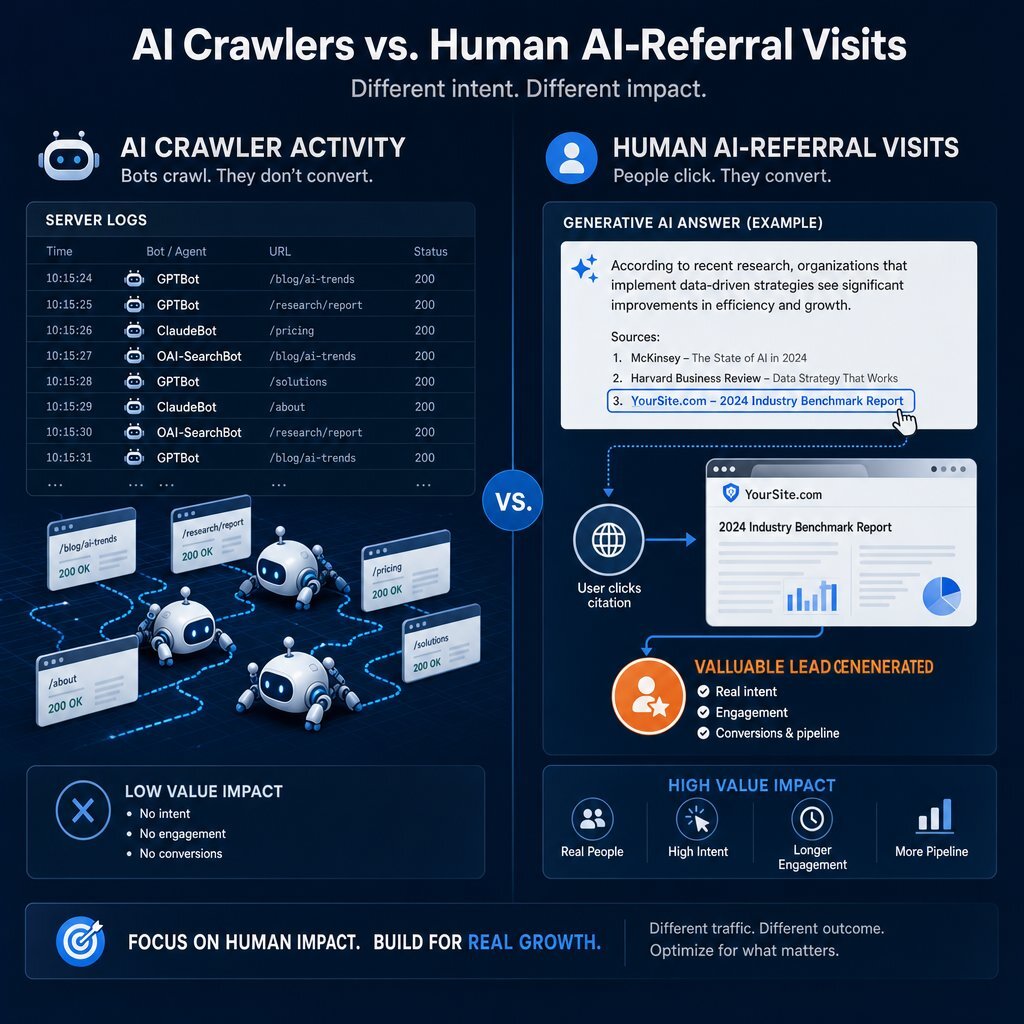
Client-side analytics tools like GA4 only see the final step—and only if the referrer survives. CDN logs capture all four stages. The Direct Agent Fetch is arguably the most valuable metric; it allows organizations to monitor exactly when an AI system evaluates their pricing pages or technical documentation on behalf of an anonymous buyer.
Lighting Up the Dark Funnel
The necessity of this engineering build becomes clear when mapped against modern B2B buying behavior. According to the 6sense 2025 B2B Buyer Experience Report, 94% of B2B buyers now use LLMs during their purchasing process.
Buyers now complete 61% of their evaluation journey independently in the "dark funnel" before ever making first contact with a vendor. This marks a massive acceleration in independent research. Buyers are utilizing AI to compare features, synthesize pricing models, and evaluate technical specifications weeks before they fill out a demo request. Furthermore, 95% of the time, B2B buyers purchase from a vendor that was already on their shortlist from Day 1 of the buying journey.
By joining CDN log data with CRM records, organizations can intercept this dark funnel activity. If server logs indicate that a Perplexity-User agent is repeatedly fetching a specific product's integration documentation, the organization knows a live buying committee is evaluating that product. Revenue models can be updated to appropriately attribute pipeline generated by these early-stage AI interactions and to align investments with the self-service buying behavior your customers already prefer.
Build vs. Buy: When an In-House Data Layer Makes Sense
When addressing AI visibility, decision-makers face a choice between licensing a dedicated Answer Engine Optimization (AEO) platform or building a custom data layer.
Procuring an enterprise GEO or AEO SaaS platform is highly effective for monitoring market visibility. These tools parse millions of queries to determine share of voice and citation rates across competitors. However, they do not track your internal pipeline attribution or solve the Direct traffic anomaly in your analytics.
Building a first-party log analysis layer solves the attribution problem. For enterprise IT and software firms, this is a modest, one-time engineering capital expenditure with low ongoing cloud storage fees. A custom data layer deployed on Azure or AWS remains entirely under the organization's control. It sidesteps perpetual SaaS licensing costs while yielding raw, unsampled data that integrates directly into existing business intelligence tools. This same mindset—owning the core data layer instead of renting it—also underpins strategies like managing AI-generated technical debt and modernizing legacy platforms without losing observability.
The Path Forward
The era of relying solely on browser-based tracking pixels is ending. General search queries are resulting in fewer website visits, and AI engines are increasingly keeping users within their own walled gardens.
Marketing teams cannot solve this by tweaking GA4 settings. Organizations that deploy custom engineering to capture edge data will secure a precise, durable view of their pipeline. They will know exactly which accounts are researching them via AI, while competitors continue to blindly celebrate unexplained surges in Direct traffic. For teams ready to reclaim visibility over their data, partnering with custom application development experts like Baytech Consulting provides the architectural rigor needed to turn raw edge logs into actionable revenue intelligence. If your existing analytics implementation or digital analytics project is already off the rails, this is often the right moment to step back and redesign the data layer properly.
Frequently Asked Questions
Why can't we just use UTM parameters to track AI referral traffic? While adding UTM parameters to outbound links is effective when an organization controls the link placement, it is impossible to enforce when AI engines dynamically generate citations in real-time. Because LLMs scrape plain URLs and rarely append custom tracking parameters automatically, UTMs will only capture a fraction of total AI traffic, leaving the majority of organic citations vulnerable to referrer stripping. Instead, focus on a solid measurement foundation, similar to how you’d approach modernization and hidden cost discovery in other parts of your stack.
Supporting Links
- In 2026, Less than One Third of Google Searches Still Send a Click
- Conductor Unveils 2026 AEO / GEO Benchmarks Report: How AI Shapes Brand Visibility in a Zero-Click World
How to detect AI agent activity in your CDN logs
About Baytech
At Baytech Consulting, we specialize in guiding businesses through this process, helping you build scalable, efficient, and high-performing software that evolves with your needs. Our MVP first approach helps our clients minimize upfront costs and maximize ROI. Ready to take the next step in your software development journey? Contact us today to learn how we can help you achieve your goals with a phased development approach.
About the Author

Bryan Reynolds is an accomplished technology executive with more than 25 years of experience leading innovation in the software industry. As the CEO and founder of Baytech Consulting, he has built a reputation for delivering custom software solutions that help businesses streamline operations, enhance customer experiences, and drive growth.
Bryan’s expertise spans custom software development, cloud infrastructure, artificial intelligence, and strategic business consulting, making him a trusted advisor and thought leader across a wide range of industries.