
Mastering Software Scoping: Essential Steps for Successful Projects
November 07, 2025 / Bryan ReynoldsThe Executive's Guide to Software Scoping: How to Protect Your Budget and Guarantee Project ROI
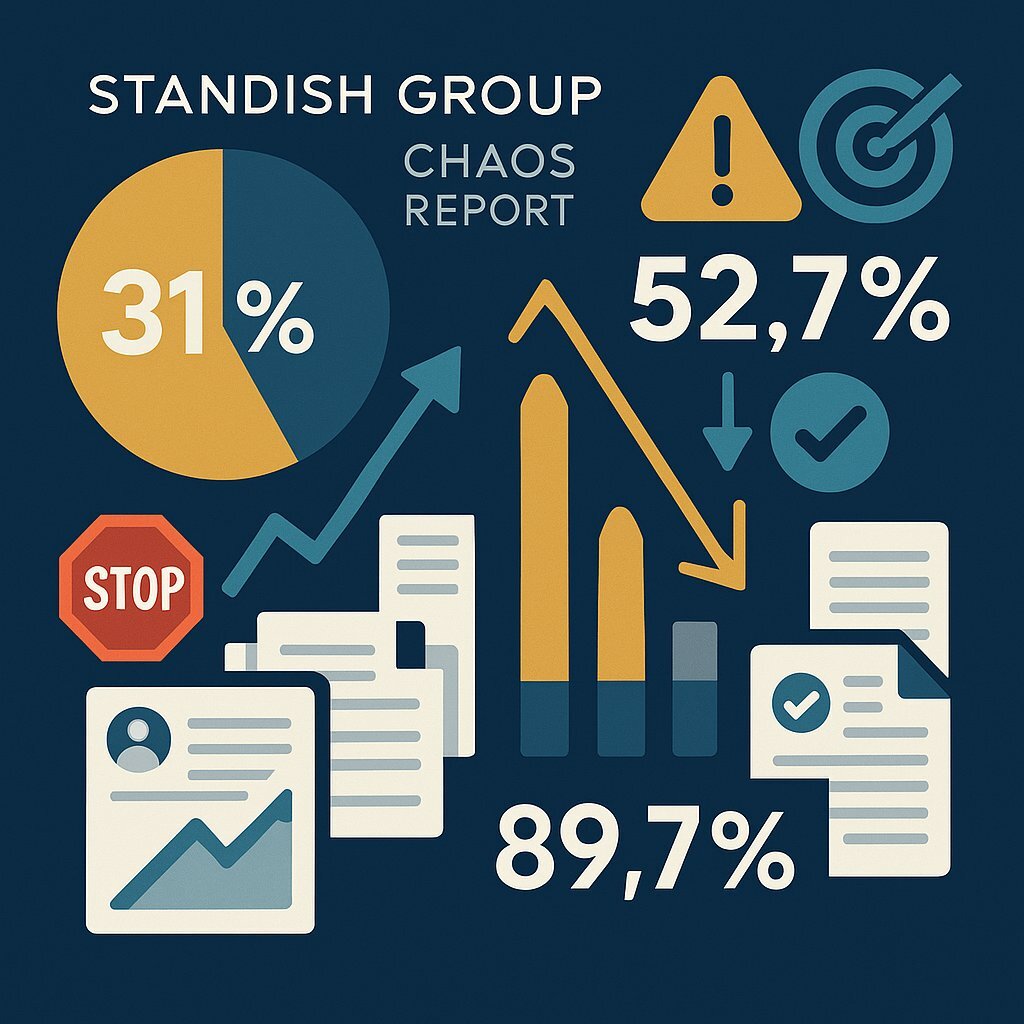
A custom software project is one of the biggest investments an enterprise can make. It promises innovation, efficiency, and a competitive edge. But the landscape is littered with projects that fail to deliver. Whether launching a new software development project or modernizing legacy systems, the stakes are high and disciplined scoping is key. The Standish Group's CHAOS report reveals a sobering truth: 31.1% of software projects are canceled before completion and 52.7% will cost 189% of their original estimates. This is not a technology problem; it's a business problem and it's almost always rooted in a failure of a single, fundamental discipline: software scoping.
For executives—CTOs, CFOs, and CEOs—a software initiative is a bet on future growth. Without a rigorous, disciplined scoping process, that investment is exposed to unacceptable risk. Software scoping is not a technical checklist to be delegated and forgotten. It's the single most critical strategic exercise to de-risk a technology investment—the blueprint that aligns business goals with technical execution and financial reality. A key output of this process is the project statement which defines the project scope, deliverables, and stakeholder responsibilities so everyone is on the same page from the start.
At Baytech Consulting, we have worked with hundreds of executives on complex software initiatives. Our experience shows, unequivocally, that the success or failure of a project is determined long before the first line of code is written. It's determined in the scoping phase, where clarifying the project's goals and project expectations is critical to ensure all stakeholders are aligned and risks are minimized. This guide distills those lessons and answers the questions we get from leaders like you who need to know every technology dollar delivers a measurable return.
What is "Software Scoping"? (And Why Is It More Than Just a Feature List?)
At its core, software scoping is the process of understanding a business need, defining the precise goals and boundaries of a software project, and detailing all the work required to meet those goals. The process to define scope involves clearly outlining project objectives and establishing the boundaries and expectations for the project. Project scope is the entire work, deliverables, goals, and constraints that must be managed to meet client needs and avoid scope creep. It clearly defines what will be done and, just as importantly, what will not be done. This process forces critical conversations that expose misalignments long before they become costly problems. The primary causes of project failure are often non-technical, stemming from communication breakdowns such as "Lack of User Input," "Incomplete Requirements," and "Lack of Executive Support." A proper scoping process mitigates these risks by requiring collaboration between all key stakeholders—from end-users to the C-suite—to forge a shared, unambiguous understanding of the project's purpose and parameters.
A key output of this process is the project scope statement, a formal document that defines the scope, deliverables, and boundaries of the project. The project plan is another important output, outlining the schedule, processes, and resources needed for successful execution.
Why is scope important in software development? Clearly defining the scope ensures project success, timely delivery, and team alignment while preventing misunderstandings and costly overruns. Proper scope management is essential to meet project objectives and desired outcomes.
The Key Distinction: Product Scope vs. Project Scope
A common point of confusion for executives is the two distinct components of scope:
- Product Scope: This defines the features and functions of the final product—the "what." For example, the product scope for a new customer relationship management tool might be "a CRM with A/B testing, funnel analysis, and feedback collection features."
- Project Scope: This defines all the work required to deliver that product—the "how." This includes the planning, design, development, testing, and deployment tasks needed to build the CRM. The software development scope outlines the overall boundaries, deliverables, and objectives for the software project so everyone understands what will be delivered. Many projects fail when leaders focus on the exciting product features and ignore the disciplined work of the project scope. A successful outcome requires mastering both. Having a clear project scope and a well-defined scope is essential to reduce risks, align expectations and ensure project success.
The Output: The Scope Statement
The foundational document produced during this process is the Scope Statement or Statement of Work (SOW) . This is not just another piece of paperwork; it is a formal, written agreement and a legally binding document that reduces uncertainty and ensures all stakeholders share a common vision by clearly outlining responsibilities and expectations. The scope statement should include a detailed description of the work to be performed so everyone is clear and aligned. It provides a definitive roadmap that covers all key components—objectives, deliverables, timelines, roles and responsibilities—necessary for project alignment and success, and any team member can reference it throughout the project's lifecycle, serving as the artifact of the consensus built during the scoping process.
As an Executive, Why Should I Invest Time and Resources in Scoping?
Investing executive time and resources in the scoping phase is not a cost; it's an investment in certainty and success. Identifying the necessary resources early in the process ensures the organization is prepared to execute project tasks effectively and prevents scope creep. The consequences of poor scoping are well documented and financially devastating.
Collaboration and alignment during scoping are critical, and involving relevant stakeholders at this stage ensures that key individuals and groups provide input and approval, reducing the risk of misalignment later.
Clarity in the scoping phase is key; clearly defining the project's objectives provides direction and guides the project to successful completion.
The Cost of Failure
The statistics of software projects are stark. Beyond the Standish Group's findings, Gartner predicts that over 70% of Enterprise Resource Planning (ERP) initiatives will not meet their original business goals. Poor scope definition is consistently identified as a primary cause of these failures. The financial impact is huge; research shows that organizations lose an estimated $97 million for every $1 billion invested due to poor project performance, much of which is directly related to poor scope management. Poor scoping often results in project delays and missed deadlines, further compounding the cost and risk of failure. This is a huge destruction of corporate capital that can be avoided.
The Strategic Benefits of Rigorous Scoping
On the other hand, a well-executed scoping process delivers strategic benefits:
- Budgetary Control & Predictability: A clear scope is the foundation of an accurate budget and schedule. It's the primary defense against the 189% cost overruns that plague troubled projects, making financial forecasting reliable—a top priority for any CFO.
- Proactive Risk Management: The scoping process is the earliest opportunity to identify potential risks—technical, resource-based or market-related—and develop concrete mitigation plans. This shifts the project's posture from reactive crisis management to proactive risk governance. If you're interested in ways to handle these escalating risks, our article "Third-Party & Supply Chain Risk: A New C-Suite Imperative" covers proactive strategies in detail.
- Stakeholder Alignment & Expectation Management: A signed-off scope statement is a contract of expectations. It ensures the client, the development team, and executive sponsors all agree on what "done" looks like, which is critical for stakeholder satisfaction and project acceptance. The project team plays a key role in maintaining this alignment and managing scope creep by ensuring all stakeholders understand and adhere to the defined deliverables.
- A Basis for Measuring ROI: Without a scope, success is unmeasurable. The objectives and deliverables in the scope statement become the key performance indicators (KPIs) against which the project's return on investment (ROI) will be measured. Defining tangible outcomes as part of the scope is essential to ensure results are specific, measurable, and aligned to business goals. To learn how leading organizations use KPIs and ROI frameworks for technology investments, see our post on CFO-driven technology ROI.
Ultimately, the scoping process is a strategic filter. A key challenge for technology leaders is "overcommitment"—taking on more projects than available resources can realistically handle. By forcing the definition of not just goals but also explicit "exclusions" or "anti-goals," the scoping process helps the organization ruthlessly prioritize. Every feature must be justified against a core business objective, naturally weeding out "nice-to-have" features and unfocused projects. This ensures the final approved scope is the highest impact use of development resources, directly aligning to the CFO's requirement to fund only high-ROI initiatives.
A clear scope is essential to deliver the project successfully.
What Does a Solid Scoping Process Look Like?
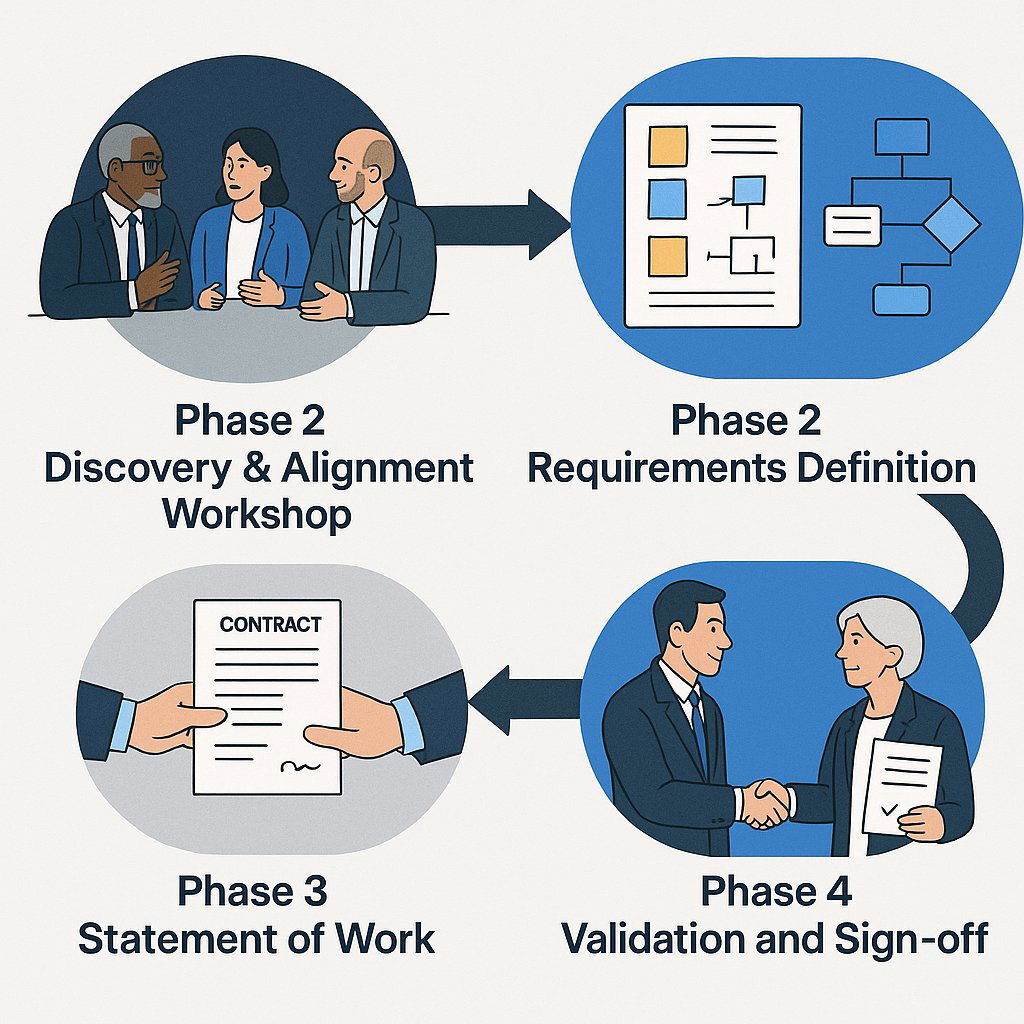
A solid scoping process is a collaborative journey, not a back office task. At Baytech Consulting, a software development company, we approach scoping as a four-phase engagement to build a fortress of clarity around your project, from the start. Early in the process, we need to identify constraints such as resources, personnel, and schedule limitations to prevent scope-related issues. As part of these phases, we also develop an implementation plan that outlines the methods and strategies for executing your project and communicate with stakeholders.
Phase 1: The Discovery & Alignment Workshop (The 'Why')
The process starts not by asking "what should we build?" but by asking why are we building it? This phase involves structured workshops and interviews with all key stakeholders—executives, end-users, subject matter experts, and team members—to uncover the business problem and objectives. The output is a clear problem statement, defined business goals, clearly articulated project goals, and a set of agreed-upon success metrics (KPIs) that will be used to measure the project's value. For example, a few examples of problem statements or goals defined in this phase might be: improving customer satisfaction, reducing operational costs, or increasing user engagement.
Phase 2: Requirements Definition (The 'What')
With the "why" established, the focus shifts to translating those high-level business goals into detailed requirements. This involves eliciting and documenting two types of requirements:
- Functional Requirements: What the system must do (e.g., "The system shall allow users to register with an email address").
- Non-Functional Requirements: How the system must be (e.g., performance benchmarks, security protocols, scalability needs).
The software developer plays a key role in understanding these requirements and translating them into actionable technical tasks to ensure the project meets expectations.
The output of this phase is a prioritized list of features, user stories, and technical constraints, often forming the basis of a Software Requirements Specification (SRS) document. Each deliverable is clearly defined and tracked as a key milestone to monitor progress throughout the project.
Phase 3: The Statement of Work (SOW) (The 'How')
This phase combines all the findings into the final project blueprint: the Statement of Work (SOW). This is a detailed process that formalizes the agreement into a document. A comprehensive SOW is the executive's ultimate tool, outlining all the key components required for project success. The SOW should also define project acceptance criteria—essential conditions and performance standards that must be met for project approval. The SOW is often supported by a detailed project plan that elaborates on goals, schedules, and processes for scope management.
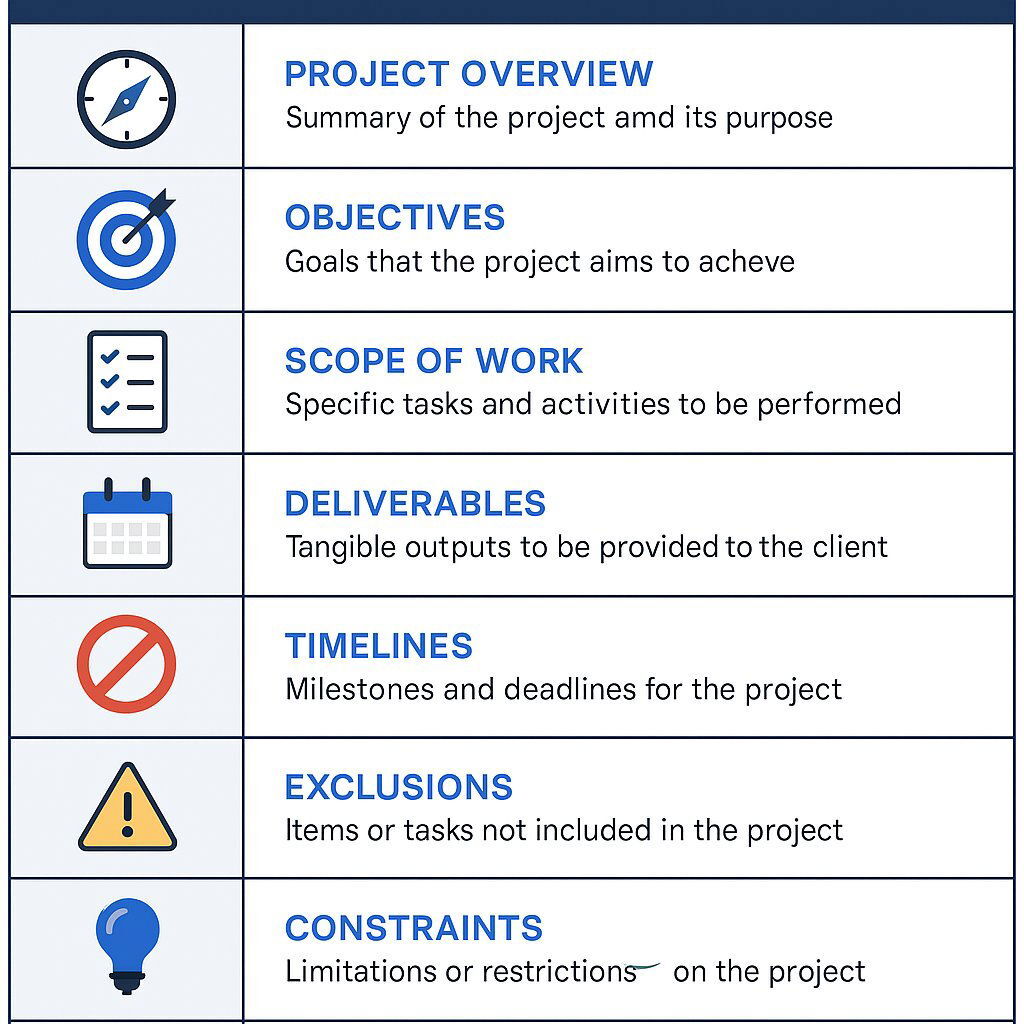
Table 1: The Statement of Work (SOW)
| Component | Description | Why It Matters for Executives |
|---|---|---|
| Project Overview | A high-level summary of the project's purpose and business context. | Aligns the project with strategic company goals from the outset. |
| Objectives | Specific, measurable, achievable, relevant, and time-bound (SMART) goals. | Defines what "success" looks like in quantifiable terms. |
| Scope of Work | A detailed breakdown of all tasks, activities, and phases. | Provides clarity on the exact work being performed. |
| Deliverables | A list of all tangible outputs (e.g., software modules, reports, documentation). | Creates a clear checklist of what will be received for the investment. |
| Timeline & Milestones | Key dates, deadlines, and project phases. | Enables tracking of progress and holds all parties accountable to the schedule. |
| Exclusions | An explicit list of what is NOT included in the project. | Prevents misunderstandings and is a primary defense against scope creep. |
| Constraints | Known limitations (e.g., budget, technology, regulations). | Sets realistic expectations and flags potential risks upfront. |
| Assumptions | Factors assumed to be true for the project to succeed (e.g., availability of client data). | Makes hidden dependencies visible and auditable. |
| Acceptance Criteria (Project Acceptance Criteria) | The conditions under which deliverables will be formally accepted, including quality, timeline, and minimum requirements for project acceptance. | Defines the "finish line" and prevents disputes over project completion. |
| Roles & Responsibilities | Who is responsible for what (client-side and vendor-side). | Ensures clear accountability and prevents tasks from being dropped. |
Phase 4: Validation and Sign-off
The final phase is to get universal agreement and commitment. The draft SOW is sent out for review and feedback in an iterative process. Once all stakeholders are aligned, the document is formally signed off by key decision makers and becomes the single source of truth for the project. Upon signature, the SOW becomes a legally binding document that outlines project scope, responsibilities, and expectations—ensuring accountability and legal clarity.
How Do We Prevent "Scope Creep" from Killing Our Project and Budget?
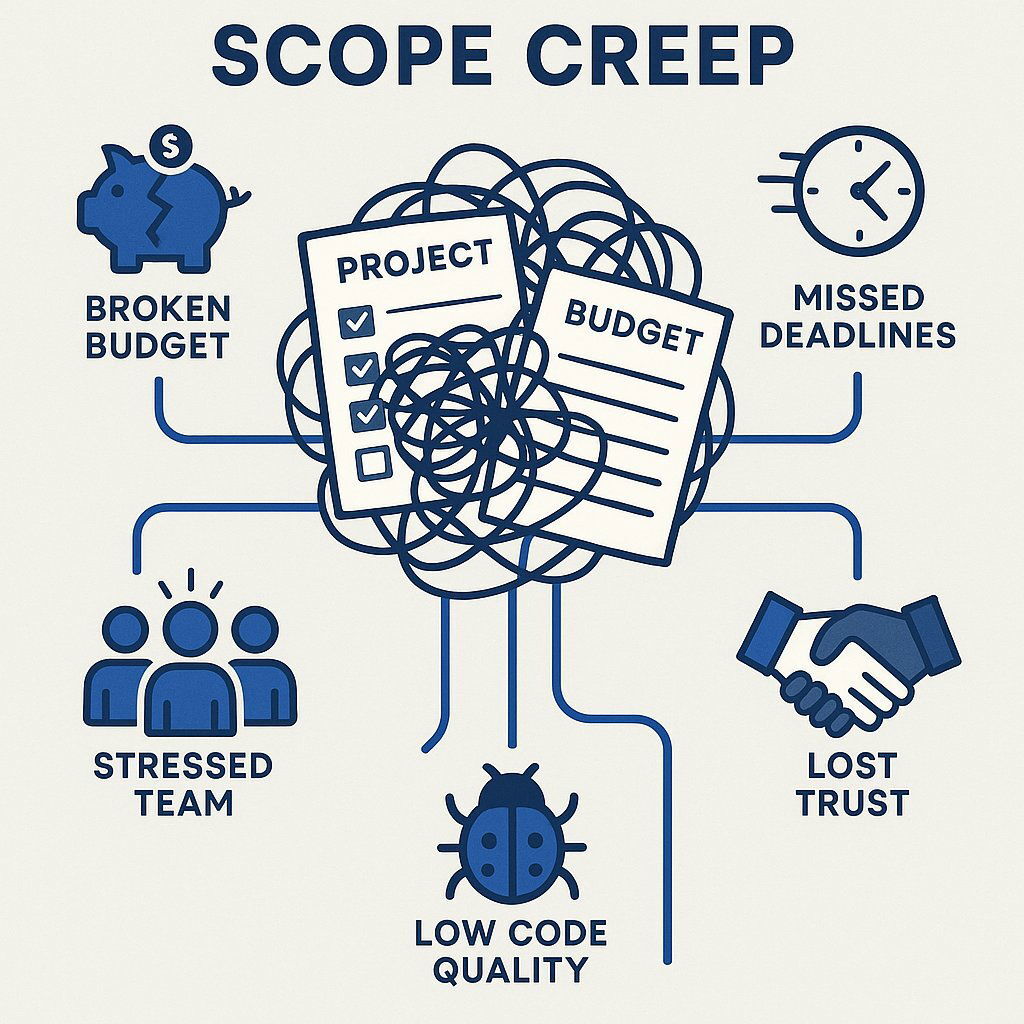
Scope creep—the uncontrolled expansion of a project's scope beyond the original agreement without corresponding adjustments to time, budget, or resources—is the silent killer of ROI. It often starts with small requests for "additional" work that accumulate into project-destroying problems.
Proper scope management is key to ensuring projects run smoothly and are completed successfully. Complex projects are more vulnerable to scope creep, so it's even more important to define and control the project's scope from the start.
The Devastating Consequences of Unchecked Scope Creep
The consequences of allowing scope to grow without formal control are severe and far-reaching:
- Budget Overruns: A 10% increase in scope can lead to a 30% or more increase in costs due to compounding effects on development, testing, and management.
- Missed Deadlines: More work means more delays, disrupting the broader business and postponing the realization of the project's value. These delays can significantly impact the overall project timeline, making it hard to meet the established milestones and deadlines.
- Team Burnout: The human cost is huge. Teams are forced to work longer hours under more stress, which degrades morale, reduces work quality, and increases employee turnover.
- Reduced Quality: To meet impossible deadlines, teams are forced to cut corners on testing and quality assurance, resulting in a buggy, unreliable final product that requires long term maintenance. Explore how to structure rapid development without sacrificing quality in our Enterprise Guide to Rapid Prototyping & MVPs.
- Eroded ROI: Projects with significant scope creep can see their projected ROI reduced by 50% or more, turning a strategic investment into a financial liability.
The ripple effect of a single uncontrolled change can be catastrophic as shown below.
Table 2: Scope Creep Impact Analysis
| Impact Area | Direct Consequence of Scope Creep | Financial & Strategic Implication for the Business |
|---|---|---|
| Budget | Increased labor hours, potential need for new software/tools. | Unplanned budget overruns, reduced project profitability, potential for project cancellation. |
| Timeline | Original milestones become unachievable; task dependencies are broken. | Delayed product launch, missed market opportunities, loss of competitive advantage. |
| Team Morale | Increased workload, stress from constant changes, burnout. | Decreased productivity, higher employee turnover, increased recruitment costs. |
| Product Quality | Rushed testing, cut corners on documentation, bypassed QA procedures. | Buggy final product, poor user experience, reputational damage, increased long-term maintenance costs. |
| Stakeholder Trust | Project deviates from original plan, promises are broken. | Erosion of trust between business and IT, damaged client relationships, difficulty securing funding for future projects. |
Baytech Consulting's Proactive Defense Strategy
Preventing scope creep requires discipline, not just good intentions. A robust defense strategy includes:
- A Rock-Solid SOW: The first and best line of defense is the clarity of the initial agreement, especially the "Exclusions" section, which leaves no room for ambiguity.
- A Formal Change Control Process: This is non-negotiable. Any requested change must be documented in a formal change request. This request is then evaluated for its impact on the "project triangle" (scope, time, and cost) and must be formally approved by designated stakeholders before any work begins.
- Empowering the Project Manager: The project manager must be empowered to have frank conversations with stakeholders, including saying "no" or "not now". Their role is to explain the trade-offs of any requested change, framing it as a business decision with clear consequences, not just a technical one.
- Transparent Communication of Impact: The project triangle is a powerful visual aid. If the scope side of the triangle is lengthened, either the time or cost side (or both) must also be lengthened to keep the project in balance. There is no other option. This reality must be communicated clearly and consistently. For additional insight on balancing timelines and technical quality, see our analysis of DevOps for faster software releases.
The project team is responsible for maintaining scope discipline and ensuring any changes are communicated to all stakeholders, to prevent unauthorized additions to project deliverables.
Agile vs. Waterfall: How Does Our Methodology Choice Impact Scoping?
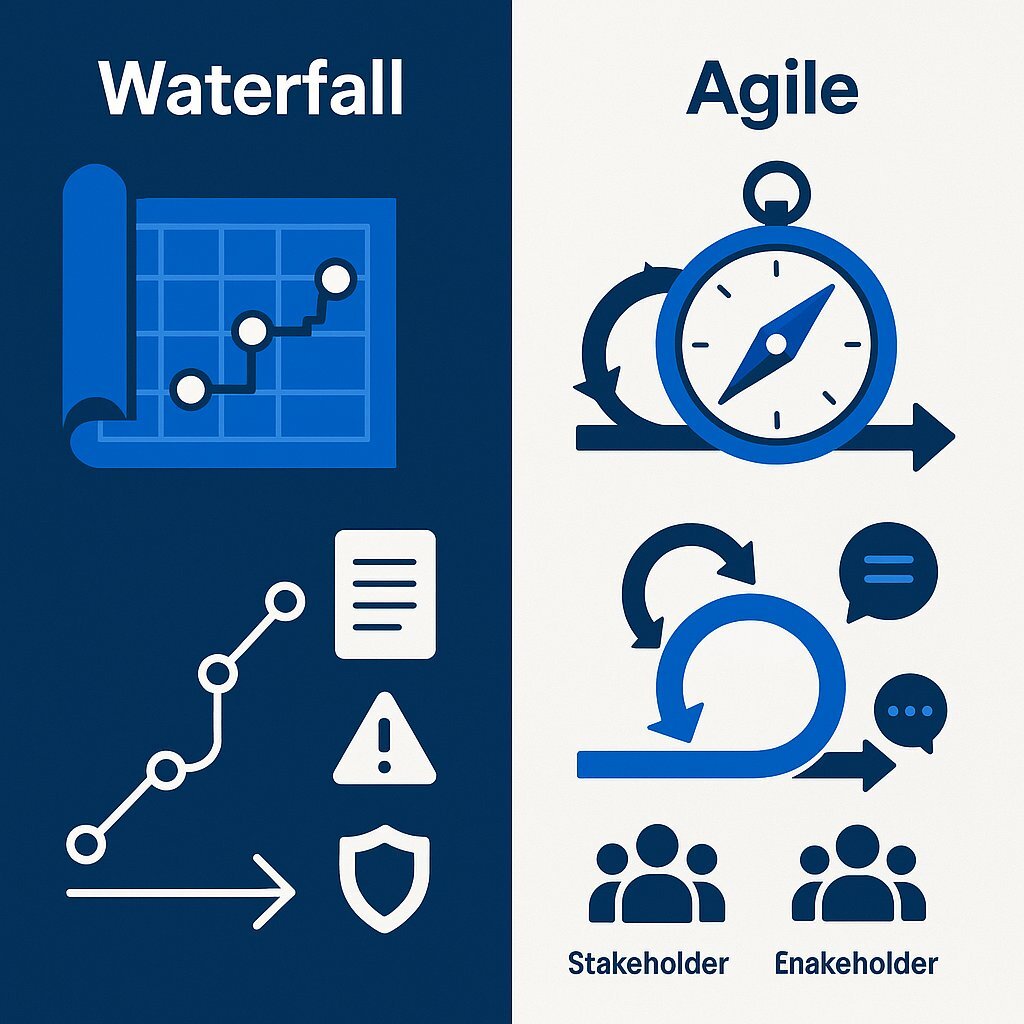
The choice of development methodology is a strategic one that fundamentally changes how scope is defined, managed, and controlled. Different methodologies directly impact how the software development scope is outlined, documented, and adjusted throughout the project, and the deliverables and stakeholder expectations. It's not about one being inherently "better," but about choosing the approach that's right for the project's context and goals.
The Waterfall Approach: The Blueprint
Waterfall is a linear, sequential model where each project phase must be completed before the next one begins. In this approach, the scope is fixed and is exhaustively defined upfront in a comprehensive SOW and SRS document. A clear project statement is also crucial in Waterfall, as it outlines the project scope, deliverables, and stakeholder responsibilities from the start. The plan is paramount, and deviation is difficult and costly. This is best suited for projects with stable, well-understood requirements where changes are unlikely, such as building a bridge or developing software for strict regulatory compliance.
The Agile Approach: The Compass
Agile is an iterative and incremental approach focused on flexibility, collaboration, and responding to change. Work is broken down into short, time-boxed cycles called "sprints" (typically one to four weeks long). In Agile, the high-level vision is defined but the detailed scope is expected to evolve. Time and cost are fixed (for each sprint), and the scope is the variable that is continuously negotiated and prioritized to fit within those constraints. This is ideal for complex, innovative projects where requirements are uncertain or expected to change, or where speed-to-market with a Minimum Viable Product (MVP) is a strategic priority. The project team plays a central role in Agile, ensuring clear communication among stakeholders and managing scope changes collaboratively.
Table 3: Scoping in Agile vs. Waterfall - An Executive's Comparison
| Aspect | Waterfall (The Blueprint) | Agile (The Compass) |
|---|---|---|
| Scope Definition | Fixed and defined in detail upfront. "Responding to change" is difficult. | Flexible and evolves over time. "Responding to change" is a core principle. |
| Primary Constraints | Scope is fixed. Time and cost are estimated based on that scope. | Time and cost are fixed (in sprints). Scope is the variable that fits within those constraints. |
| Documentation | Comprehensive and detailed from the start (SOW, SRS). | Focus on "working software over comprehensive documentation." Documentation is lean and just-in-time. |
| Stakeholder Involvement | Heavy involvement at the beginning (requirements) and end (acceptance). | Continuous collaboration and feedback throughout the entire project. |
| Risk Management | Aims to identify all risks upfront during the planning phase. | Mitigates risk through short, iterative cycles, allowing for rapid course correction. |
| Ideal Project Type | Predictable, low-complexity projects with stable requirements. | Complex, innovative projects where requirements are uncertain or likely to change. |
The most important decision is choosing the right approach for your specific goal. A partner like Baytech Consulting can help analyze a project's certainty, complexity, and strategic urgency to select the methodology—or even a hybrid approach that combines the discipline of Waterfall with the flexibility of Agile—to maximize your chances of success.
Project Scope Management Tools: The Executive's Technology Stack for Scoping Success
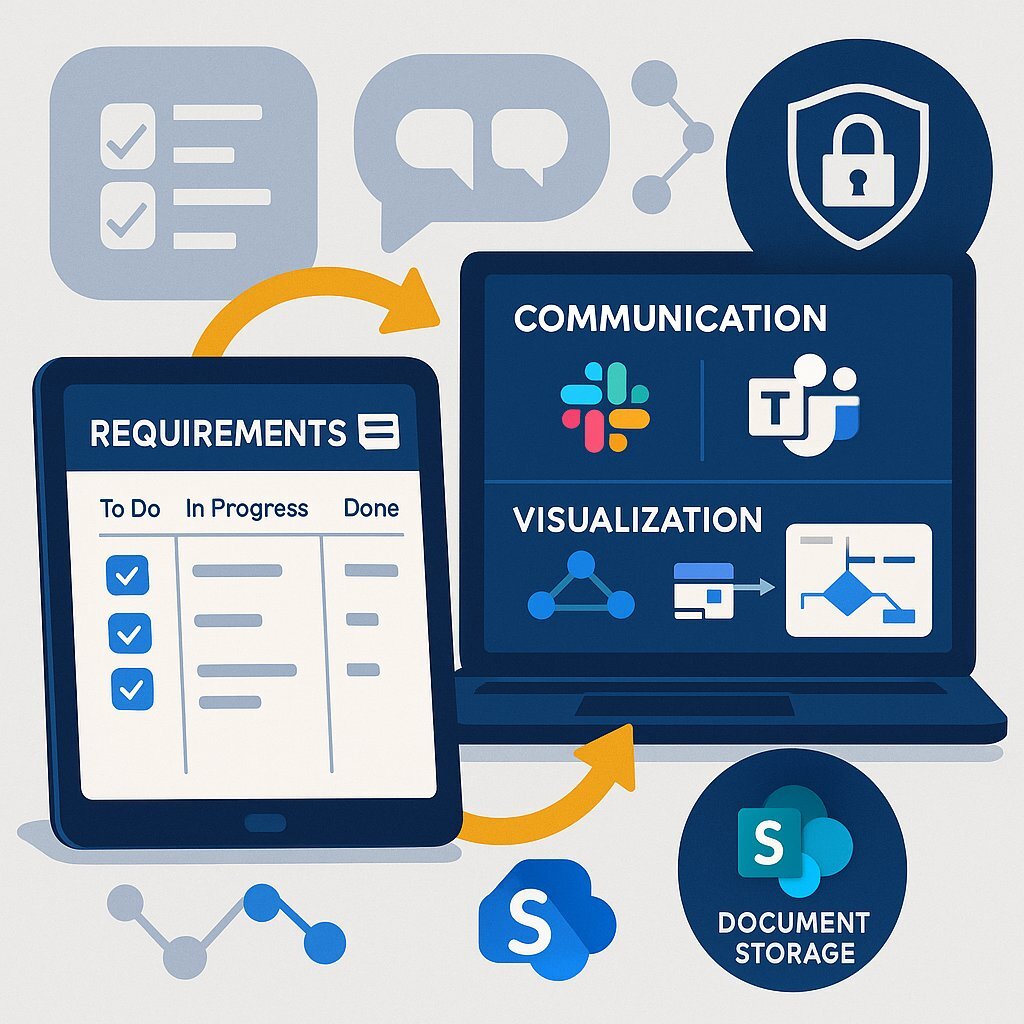
In today's fast-paced business environment, having the right project scope management tools is critical to the success of any software development project. For executives overseeing complex development projects, these tools are not just operational tools—they are strategic assets that provide visibility, control, and confidence throughout the project lifecycle.
Modern project scope management tools enable organizations to define, document, and control the project's scope with precision. They help project managers and stakeholders capture detailed requirements, track project deliverables, and manage changes efficiently, all while keeping the entire team aligned with the project's objectives and timeline. By centralizing information and automating key processes, these tools reduce the risk of miscommunication, prevent scope creep, and ensure the development project stays on track and within budget.
Categories of Project Scope Management Tools:
- Requirements Management Platforms: Tools like Jira, Azure DevOps, and IBM Engineering Requirements Management allow teams to capture, prioritize, and trace project requirements from inception to delivery. This ensures every feature and function aligns with the project's scope and business goals. Discover how Azure DevOps lifecycle security can boost project outcomes.
- Collaboration and Communication Suites: Platforms such as Confluence, Slack, and Microsoft Teams facilitate real-time communication and documentation, making it easy for project stakeholders to provide valuable input, review project scope statements, and stay on the same page throughout the software development process.
Work Breakdown Structure (WBS) and Visualization Tools: Solutions like Lucidchart, Miro, and Smartsheet help project managers break down the scope of work into individual tasks and visualize dependencies, key milestones, and project phases. This clarity is critical for project planning and resource allocation. - Change Control and Issue Tracking Systems: Integrated change management tools within platforms like Jira or ServiceNow ensure any changes to the project's scope are formally documented, evaluated, and approved, preventing scope creep and managing expectations.
- Document Management and Version Control: Tools like SharePoint and Google Workspace provide a secure, central repository for all project documentation, including the statement of work (SOW), project scope statements, and acceptance criteria. This ensures the entire team has access to the latest, legally binding documents at all times.
By investing in a robust technology stack for project scope management, executives can empower their project managers and development teams to deliver software development projects with greater predictability and success. The right tools not only streamline the project development process but also provide the transparency and accountability to protect your budget and guarantee project ROI. For organizations committed to excellence in software development, a well-chosen suite of project scope management tools is a non-negotiable foundation for project success.
The CFO's Corner: How Does Proper Scoping Directly Translate to Financial ROI?
From a financial perspective, the entire discussion of software scoping can be reframed through the lens of cost management, risk mitigation, and return on investment. Clearly defining tangible outcomes—such as specific project objectives and measurable deliverables—is essential for accurately assessing financial success and ensuring alignment across teams. The modern CFO's role has evolved beyond being a cost-cutter to being a strategic partner in funding growth and transformation, making the financial integrity of technology projects a top priority.
The High Cost of Ambiguity
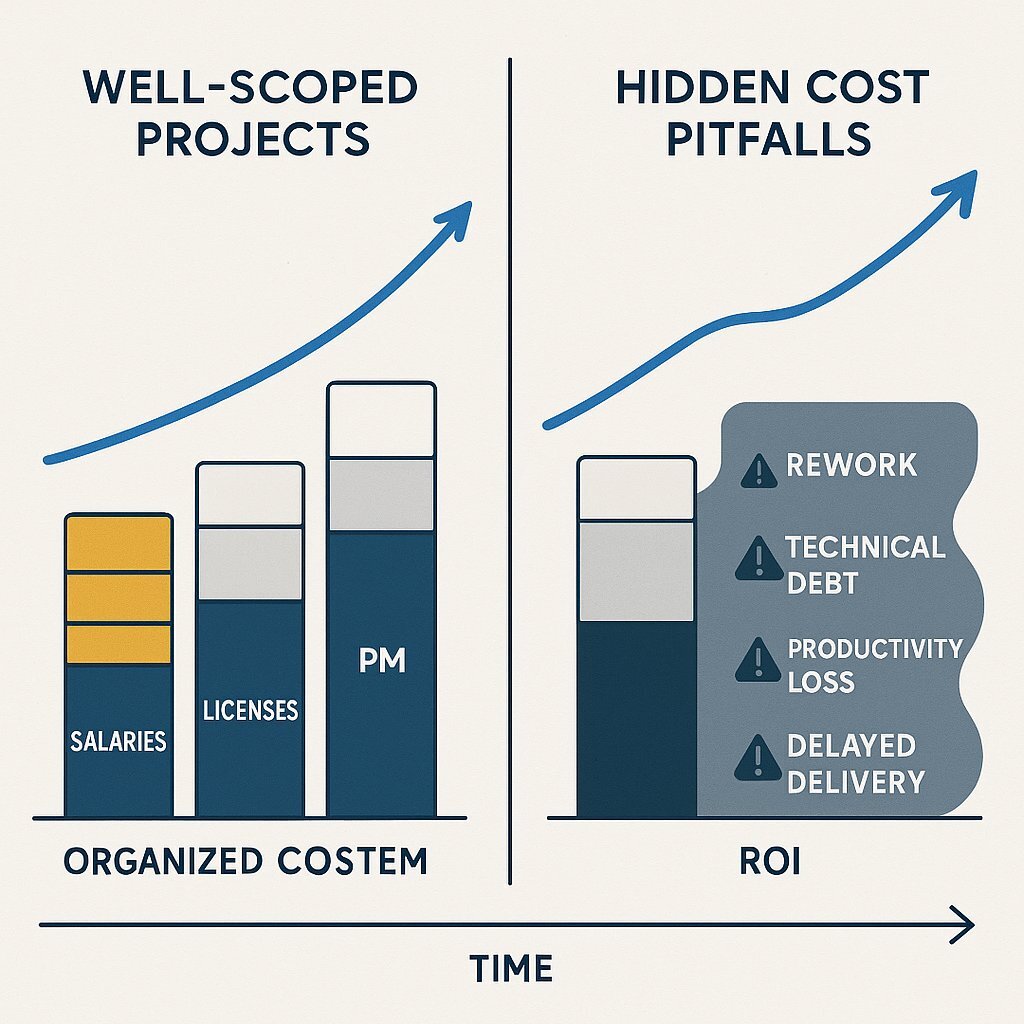
Ambiguity in a project's scope is a direct driver of unplanned costs. Poorly defined requirements are a leading cause of rework which can consume a staggering 25-40% of all project spending. To avoid ambiguity and extra costs, it is essential to include a detailed description of the work involved in the scope of work (SOW). Furthermore, poor scoping introduces a host of hidden costs that are rarely tracked on an initial budget but have a massive downstream financial impact. Explore our breakdown of software maintenance cost drivers for long-term budgeting and support insights.
Table 4: The Financial Case for Scoping (Visible vs. Hidden Costs)
| Cost Category | Visible Costs (On the Initial Budget) | Hidden Costs (The Price of Poor Scoping) |
|---|---|---|
| Development | Developer salaries/contractor fees. | Rework & Refactoring: Wasted engineering hours fixing features built on wrong assumptions. |
| Infrastructure | Server costs, hosting fees, software licenses. | Technical Debt: The "interest payment" on poor architectural choices, slowing all future development (15-25% increased maintenance costs). |
| Project Management | PM salaries, project management software. | Productivity Loss: Constant context-switching and clarification meetings that drain team efficiency. |
| Timeline | Estimated project duration. | Opportunity Cost: Delayed market entry allows competitors to gain ground; delayed efficiency gains mean cost savings are not realized. |
| Maintenance | Budget for ongoing support (typically 15-20% of initial cost). | Inflated Maintenance: A poorly scoped, buggy product requires significantly more resources to keep running. |
Scoping as an Investment in High ROI
Investing in a thorough, professional scoping process provides significant financial leverage. A well-executed custom software project has massive potential returns; a Forrester Research report found that companies can achieve an average ROI of 200% to over 400% within a few years. Rigorous scoping is the mechanism that unlocks this potential.
A clear scope allows development teams to build the right thing, the first time. This compresses the development cycle and accelerates the time-to-value, meaning the business starts realizing benefits—whether increased revenue or operational savings—much sooner. Most importantly, the scoping process ensures that the technology investment is directly and demonstrably tied to a strategic business objective, a key criterion for CFOs when approving funding. At Baytech Consulting, we don't just build software; we build solutions that are designed from day one to deliver a measurable financial return. Thorough scoping is essential for the project's success, as it defines goals, deliverables, and responsibilities that guide the team towards both successful execution and strong financial outcomes.
Conclusion: Scoping Isn't an Obstacle; It's Your Blueprint for Success
Software scoping is the most powerful tool an executive has to transform a high-risk technology expenditure into a predictable, high-return strategic investment. It's the disciplined process of turning an idea into a plan. It forces clarity, forges alignment, and builds the foundation upon which successful projects are built. A project without a scope is a risk to shareholder value. A project with a well-defined scope is a business plan ready to be executed.
Your next software project will be defined by your vision and your process. Ready to build your next project on a foundation of certainty? Contact the experts at Baytech Consulting to schedule your discovery workshop.
References
About Baytech
At Baytech Consulting, we specialize in guiding businesses through this process, helping you build scalable, efficient, and high-performing software that evolves with your needs. Our MVP first approach helps our clients minimize upfront costs and maximize ROI. Ready to take the next step in your software development journey? Contact us today to learn how we can help you achieve your goals with a phased development approach.
About the Author

Bryan Reynolds is an accomplished technology executive with more than 25 years of experience leading innovation in the software industry. As the CEO and founder of Baytech Consulting, he has built a reputation for delivering custom software solutions that help businesses streamline operations, enhance customer experiences, and drive growth.
Bryan’s expertise spans custom software development, cloud infrastructure, artificial intelligence, and strategic business consulting, making him a trusted advisor and thought leader across a wide range of industries.